The 99347 CPT code reports an evaluation and management (E/M) visit for an established patient in their home or residence. It’s the lowest level in the established home visit series. A visit qualifies with straightforward medical decision making (MDM) or at least 20 minutes of total practitioner time on the date of service.
Medicare’s 2026 national rate for 99347 is $46.09. Since January 1, 2026, Medicare also pays the G2211 add-on with it. Several pages that rank for this code still list the old 15-minute time, so check the date on any source before you rebuild a template around it.
99347 CPT Code at a Glance (2026)
| Item | 2026 detail |
|---|---|
| Code family | Home or residence services, established patient (99347 to 99350) |
| Level selection | Straightforward MDM, or at least 20 minutes of total time on the date of service |
| Patient type | Established: seen by you or a same-specialty practitioner in your group within three years |
| Settings and POS | Home (12), assisted living (13), group home (14), custodial care facility (33), residential substance abuse facility (55) |
| 2026 Medicare national rate | $46.09 (standard conversion factor); $46.32 for Qualifying APM Participants |
| RVUs | 0.90 work, 0.44 practice expense, 0.04 malpractice, 1.38 total |
| G2211 add-on | Payable with 99347 for dates of service on or after January 1, 2026 |
| Telehealth | On the CY 2026 Medicare Telehealth Services List |
| CMS status and global | Active (status A), global period XXX |
What Is the 99347 CPT Code?
CPT code 99347 covers an in-person E/M visit for an established patient where that patient lives. The official 99347 CPT code description calls for a medically appropriate history or exam plus straightforward MDM. If you pick the level by time instead, the visit needs 20 minutes or more of total time on the encounter date.
Picture the home version of a quick office follow-up. A practitioner travels to the patient, handles one minor issue or confirms a stable plan, and documents it. House call practices, home-based primary care groups, and clinicians who round in assisted living facilities bill this code week after week.
What Changed for Home Visit Codes in 2023
The AMA rebuilt this family on January 1, 2023. According to the AMA’s E/M code changes, it deleted the domiciliary and rest home codes 99334 to 99340, merged that work into 99341 to 99350, and dropped new patient code 99343. History and exam no longer set the level. MDM or total time does, the same way office visits work.
Before 2023, 99347 listed a problem-focused history and exam with about 15 minutes of typical face-to-face time. If a superbill, EHR template, or payer edit still shows that wording, update it. A 17-minute visit documented under the old logic won’t support 99347 by time today.
How to Qualify a Visit for CPT Code 99347
You can support the 99347 CPT code one of two ways: straightforward MDM or 20 minutes of total time. Pick the pathway your note supports better. You don’t need both, though documenting both gives you a fallback if an auditor questions one of them.
Straightforward MDM and the Two of Three Rule
MDM has three elements: problems addressed, data reviewed, and risk of the management plan. The AMA 2023 E/M guidelines require two of the three to meet or exceed a level. Compare straightforward with low, the level that moves a visit to 99348:
| MDM element | Straightforward (99347) | Low (99348) |
|---|---|---|
| Problems | One self-limited or minor problem | One stable chronic illness, one acute uncomplicated illness or injury, or two or more minor problems |
| Data | Minimal or none | Two items, such as reviewing an external note and a test result, or using an independent historian |
| Risk | Minimal risk from further testing or treatment | Low risk from further testing or treatment |
Using Total Time to Reach 20 Minutes
Total time counts the work the billing practitioner does on the date of service, face to face or not. CMS lists these activities in its E/M booklet:
- Preparing to see the patient, such as reviewing tests
- Obtaining or reviewing separately obtained history
- Performing a medically appropriate exam
- Counseling the patient, family, or caregiver
- Documenting in the health record
Travel doesn’t count. The AMA guidelines rule out travel time for home visit levels, and CMS also excludes time spent on services you report on their own claim line. Clinical staff time stays out as well. Write the exact minutes, for example “22 minutes total, including chart review and documentation.” Auditors push back on “over 20 minutes.”
Three Home Visit Scenarios and the Code Each Supports
Scenario one. A caregiver calls about a mild rash on an 84-year-old patient’s forearm. The nurse practitioner visits, examines it, and recommends an over-the-counter cream. That’s one minor problem with no data reviewed. Two of three elements sit at straightforward, so 99347 fits.
Scenario two. A physician checks a patient with stable hypertension (I10) and changes nothing. The problem element reaches low, but data and risk stay at straightforward. With only one element at low, the visit still lands on 99347.
Scenario three. Same patient, but the physician adjusts the lisinopril dose. The AMA classifies prescription drug management as moderate risk. Problems now meet low and risk exceeds it, so the visit supports 99348. At 2026 national Medicare rates, missing that step costs $32.74 per visit ($78.83 minus $46.09).
99347 vs 99348, 99349, and 99350
The CPT code for a home visit with an established patient depends on the level, and 99347 sits at the bottom of four. The levels differ by MDM, minimum time, and what Medicare pays for each one.
| Code | MDM level | Minimum total time | 2026 national Medicare rate |
|---|---|---|---|
| 99347 | Straightforward | 20 minutes | $46.09 |
| 99348 | Low | 30 minutes | $78.83 |
| 99349 | Moderate | 40 minutes | $132.27 |
| 99350 | High | 60 minutes | $193.06 |
Each time is a minimum, not a range. A 29-minute visit stays at 99347 by time unless MDM supports 99348. New patients use 99341, 99342, 99344, or 99345, and the moderate level is covered in our CPT 99349 billing guide.
Prolonged service codes don’t attach to 99347. Medicare’s G0318 starts at 110 minutes, and only on 99350. Other payers may accept CPT 99417 for prolonged services, which Medicare doesn’t pay, but it also applies only above the top level.
Where You Can Bill 99347: Settings and Place of Service Codes
CMS lists five residence settings for this code family in MLN006764 (CMS E/M booklet). The place of service (POS) code on the claim has to match where the patient lives.
| POS | Setting | Typical example |
|---|---|---|
| 12 | Home | Private residence, or temporary lodging such as a hotel or campground |
| 13 | Assisted living facility | Resident in an assisted living apartment |
| 14 | Group home | Group home not licensed as an intermediate care facility for individuals with intellectual disabilities |
| 33 | Custodial care facility | Residential setting providing room, board, and personal care |
| 55 | Residential substance abuse treatment facility | Live-in treatment setting |
Nursing facility and skilled nursing patients don’t qualify. The AAFP home visit coding update points those visits to 99304 to 99310. If you’re unsure how a facility is licensed, check its definition in the CMS Place of Service code set.
Physical Presence and the Inpatient Overlap
Noridian’s home visit guidance says the physician must be physically present in the beneficiary’s home to bill these codes. Medicare’s recovery auditors run an automated review, RAC topic 0011, that flags home visit codes billed during a hospital inpatient stay. Confirm admission dates before you submit for patients with recent hospital trips.
Medical Necessity Rules That Decide Whether 99347 Gets Paid
Medicare won’t pay the 99347 CPT code for a house call that happened for convenience. Noridian’s guidance sets these rules for every home visit note:
- Document medical necessity for each visit, or the MAC treats it as a social visit
- Keep visit frequency in line with office care for the same problem, except in rare cases
- Show the service couldn’t be provided by a visiting nurse under the home health benefit
- Name the active problem, since an inactive or chronic condition alone doesn’t establish necessity
Homebound status isn’t required for 99347. That test belongs to the Medicare home health benefit, which agencies bill with a separate set of home health CPT codes. Your note still needs a medical reason the patient was seen at home instead of in the office.
Diagnosis Codes That Support a Home Visit
List the condition you treated first. Then add status codes that explain why the patient couldn’t come in, when they apply:
- Z74.09, other reduced mobility
- Z99.3, dependence on wheelchair
- Z91.81, history of falling
Back each code with one sentence in the note. “Patient uses a wheelchair and needs a two-person assist to get into a car” gives a reviewer the reason in seconds.
Who Can Bill 99347
Physicians, nurse practitioners, and physician assistants can bill 99347 under their own NPI when state scope of practice allows E/M services. The patient has to be established, meaning you or another practitioner of the same specialty in your group saw them within the past three years.
Enroll each NP or PA with every payer before their first solo home visit through provider credentialing and enrollment, or those claims will deny.
If home visit levels keep sending claims back for rework, our medical billing services team codes and submits E/M claims like these every day. We can look at your recent home visit denials and tell you where they started.
2026 Medicare Payment for CPT Code 99347
National Rate and RVUs
Medicare’s 2026 national payment for 99347 is $46.09 for most clinicians. The CMS RVU26D relative value file (October 2026 release) lists 0.90 work RVUs, 0.44 practice expense RVUs, and 0.04 malpractice RVUs, for 1.38 total. Multiply 1.38 by the 2026 conversion factor of $33.4009 and you get $46.09.
Clinicians who are Qualifying APM Participants (QPs) get a separate $33.5675 conversion factor, which works out to $46.32.
The file shows the same 1.38 total in the facility and nonfacility columns, so assisted living and private home visits pay the same base amount. Medicare pays 80% of the allowed amount after the Part B deductible, and the patient owes the 20% coinsurance.
What 99347 Pays in Your Locality
Medicare adjusts each RVU by your locality’s geographic practice cost index (GPCI). We applied the 2026 GPCI file to 99347’s RVUs:
| Medicare locality | 2026 99347 amount |
|---|---|
| Alaska (statutory 1.5 work GPCI floor) | $61.48 |
| Manhattan, NY | $51.18 |
| Los Angeles, CA | $49.57 |
| Chicago, IL | $48.11 |
| Rest of Texas | $45.21 |
| Alabama | $43.68 |
| Arkansas (lowest) | $43.37 |
We calculated these from CMS files, so they can differ by a few cents from the CMS Physician Fee Schedule search tool because of rounding. Use the lookup tool for the exact amount in your area.
Adding G2211 to a 99347 Visit
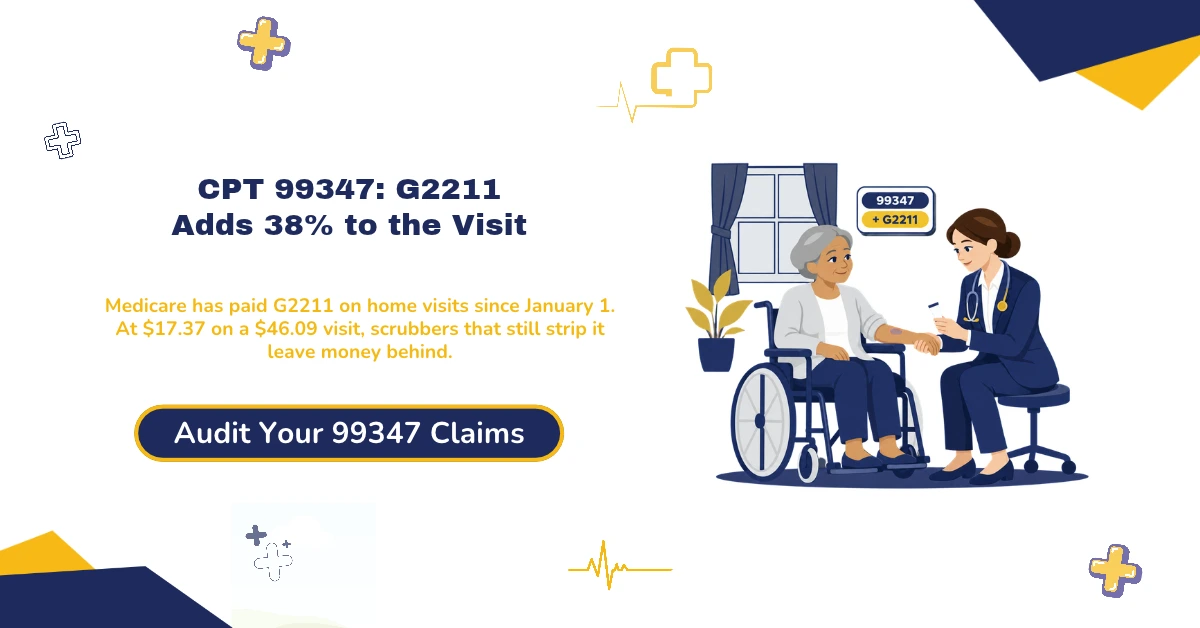
For dates of service on or after January 1, 2026, the CMS CY 2026 final rule summary (MM14315) adds G2211 to the home or residence family, 99347 included. The add-on carries 0.52 nonfacility RVUs, or $17.37 at the national rate. On a 99347 visit, that raises the national payment from $46.09 to $63.46, about 38% more.
G2211 fits when you serve as the patient’s continuing focal point for care, or you manage a single serious or complex condition over time. A one-time visit for a patient you won’t follow doesn’t qualify.
CMS doesn’t pay G2211 when the base E/M carries modifier 25, unless the other same-day service is an annual wellness visit, vaccine administration, or a Part B preventive service. Your MAC can tell you whether that exception carries over to home visits, since CMS wrote it for office visits. Pairing rules for annual wellness visit billing follow the same logic.
Some claim scrubbers still drop G2211 from home visit lines because the add-on used to pair only with office visits. Pull a recent batch of remits and look for it. If it’s missing, our revenue cycle management team can trace where it falls off.
Can You Bill 99347 for a Video Visit?
Yes, under Medicare’s telehealth rules. 99347 appears on the CY 2026 Medicare Telehealth Services List. The CMS telehealth FAQ (February 2026) confirms that through December 31, 2027, beneficiaries can receive telehealth anywhere in the United States, including at home. Report POS 10 when the patient is at home.
A video claim is a telehealth service, and POS 12 billing still requires you in the room. Commercial payers set their own telehealth policies, so check each contract before you bill 99347 by video. Some also want a telehealth modifier, which our modifier 95 guide explains.
99347 CPT Code Documentation Checklist
Run insurance eligibility verification before the visit. Then confirm the note shows:
- Where the visit happened, matching the POS code on the claim
- Established status, with the last visit inside three years
- The chief complaint and the reason the patient was seen at home
- A medically appropriate history or exam for that problem
- Straightforward MDM reasoning, or the exact total minutes and what filled them
- The plan, including follow-up, orders, or caregiver instructions
- The signature and credentials of the practitioner who was present
Sample 99347 Note
Home visit, POS 12. Established patient, last seen June 2026.
CC: Caregiver reports a red, itchy patch on the left forearm for two days.
Reason for home visit: Patient uses a wheelchair (Z99.3) and needs a two-person assist for transport.
Exam: 3 cm erythematous patch, no drainage, no warmth, no spread.
Assessment: Contact dermatitis (L30.9), likely from a new laundry soap.
Plan: Stop the soap. OTC hydrocortisone 1% twice daily for seven days. Caregiver to call if it spreads.
MDM: Straightforward. One minor problem, no data reviewed, low risk.
Total time on date of service: 21 minutes.
Common 99347 Denials and How to Fix Them
Each denial below ties to a specific, fixable error. The claim adjustment reason codes (CARCs) come from the X12 CARC code list.
| Denial | Likely cause | Fix |
|---|---|---|
| CARC 5 or 58 (place of service) | POS 11 or POS 12 billed for an assisted living resident | Match POS to the residence (13 for assisted living) and send a corrected claim |
| CARC 50 (medical necessity) | Note doesn’t say why the visit happened at home | Add the reason the patient couldn’t travel, then appeal with records |
| CARC 16 (missing information) | Missing time statement, rendering NPI, or other claim data | Complete the field and resubmit |
| New patient billed as established | No same-specialty visit in the past three years | Rebill with 99341, 99342, 99344, or 99345 |
| Inpatient overlap (RAC 0011) | Home visit dated during a hospital admission | Verify admission dates and void the line if the patient was inpatient |
| G2211 missing or denied | Scrubber strips it, or modifier 25 sits on the base code | Add G2211 when criteria are met and review modifier 25 use |
Read the remittance advice remark code (RARC) next to each CARC. It tells you whether the payer wants a corrected claim or a reconsideration. If home visit denials pile up close to their appeal deadlines, our denial management services team sorts them by root cause so the same error stops repeating.
99347 CPT Code FAQs
What are the billing guidelines for CPT 99347?
Bill 99347 for an established patient you see in person at their residence. Support it with straightforward MDM or 20 or more minutes of total time, use the POS code that matches the residence, and document why the visit happened at home. Add G2211 when you’re the patient’s ongoing focal point for care.
What is CPT code 99347?
CPT code 99347 is the lowest level of established patient home or residence E/M visit. It requires a medically appropriate history or exam and straightforward MDM, or 20 minutes of total time on the date of service. It belongs to the 99347 to 99350 series.
Does a video visit qualify for CPT code 99347?
Medicare lists 99347 as a telehealth service for 2026, and patients can receive telehealth at home through December 31, 2027. Bill it with POS 10 as a telehealth claim. An in-person home visit billed with POS 12 requires the practitioner to be physically present. Commercial payers set their own telehealth rules.
What is the CPT code range for established patient home visits?
Established patient home or residence visits use 99347 to 99350. 99347 is straightforward MDM or 20 minutes, 99348 is low MDM or 30 minutes, 99349 is moderate MDM or 40 minutes, and 99350 is high MDM or 60 minutes. New patients use 99341, 99342, 99344, and 99345.
How much does Medicare pay for 99347 in 2026?
The 2026 national Medicare rate for 99347 is $46.09, based on 1.38 total RVUs and a $33.4009 conversion factor. Qualifying APM participants receive $46.32. Your amount depends on your locality, ranging from about $43.37 in Arkansas to $51.18 in Manhattan, with Alaska higher because of its GPCI floor.
Was CPT 99347 deleted or changed in 2026?
No. CMS lists 99347 as active (status A) in its October 2026 relative value file. The last structural change came in 2023, when the AMA set the 20-minute threshold and moved level selection to MDM or time. Medicare’s main 2026 change is paying G2211 with it.
Does a patient need to be homebound for 99347?
No. Homebound status applies to the Medicare home health benefit, not to physician home visits. The note still has to show a medical reason for seeing the patient at home instead of the office, and the problem has to be active.
Getting 99347 Claims Paid on the First Submission
At $46.09, a 99347 claim leaves little room for rework. Get the POS code, established status, medical necessity statement, and G2211 right on the first pass, and you keep that margin. Pull your last 30 home visit claims and tally which of those four caused each denial.
ClaimMax RCM handles home visit billing for practices that run house calls and assisted living rounds. If you’d like another set of eyes on those claims, talk to our billing team.