
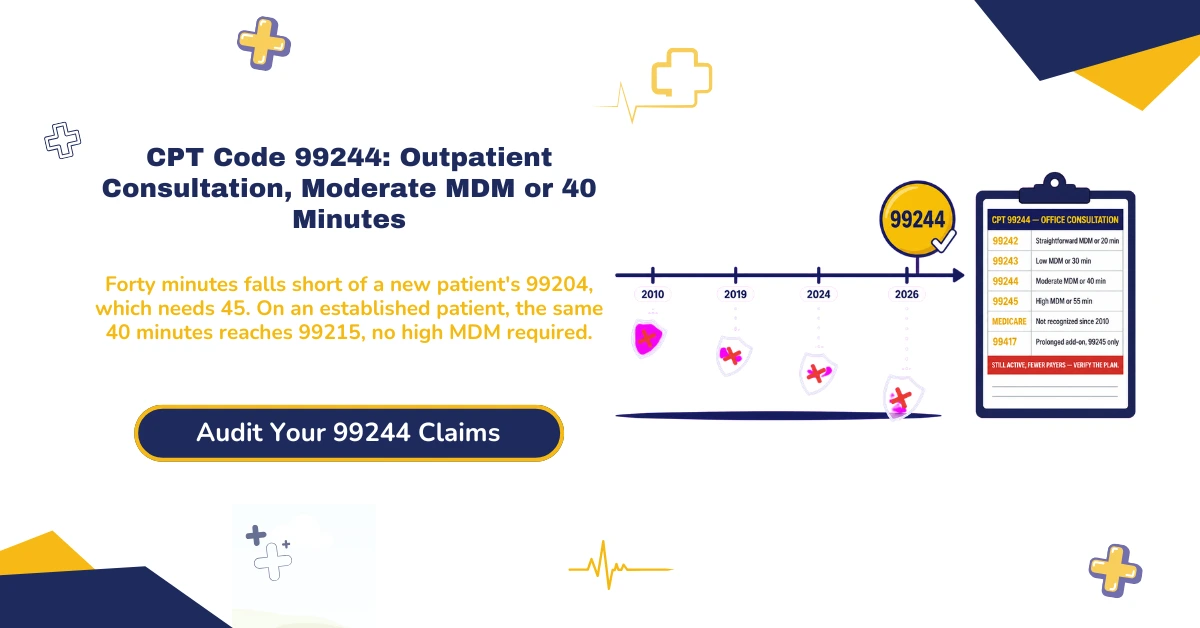
The 99244 CPT code reports an office or other outpatient consultation for a new or established patient. It requires a medically appropriate history and/or examination and moderate medical decision making, or at least 40 minutes of total time on the date of the encounter. Medicare Part B does not recognize 99244 for payment.
Active and payable are two separate questions. The AMA still lists 99244 in the CPT code set, so your coder can select it. Whether you collect on it depends on the patient’s exact plan, and that list of plans has been shrinking since 2019.
| Field | Answer |
|---|---|
| Service | Office or other outpatient consultation |
| Patient status | New or established |
| MDM level | Moderate |
| Time | 40 minutes minimum, when time selects the level |
| Consultation request | Required |
| Written report back | Required |
| Settings covered | Office, other outpatient site, home or residence, emergency department |
| Medicare Part B | Not recognized for payment |
| Other payers | Verify the exact plan and product |
Two pathways exist and you pick one. Moderate MDM supports the code by itself. So does 40 minutes of qualifying time. The AAFP E/M reference lists both thresholds for this code.
When an encounter qualifies as a 99244 consultation
A consultation starts when another physician, qualified healthcare professional, or appropriate source asks for an opinion on a specific problem. Until that request exists, no consultation code applies, however complex the visit turns out to be. Qualification and code level are separate decisions, and this one comes first.
The request has to come from an appropriate source
CPT names the sources it means. Another physician or QHP qualifies. So does a non-clinical social worker, an educator, a lawyer, or an insurance company. A patient who books the appointment herself doesn’t, and neither does a family member calling on her behalf.
Referral and consultation are different transactions. Dr. Ruiz asking your surgeon whether a patient needs an operation is a consultation. Handing that patient over for the surgeon to manage is a transfer of care, and CPT reports transfer of care with the office or outpatient visit codes instead.
The record has to show what you were asked
A note that says “referred to cardiology” tells a reviewer nothing. One that says “consultation requested by Dr. Ruiz for evaluation of persistent syncope after an inconclusive initial workup” names the requester and the clinical question in a single line.
Two authorities are at work here, and most articles blur them. Current CPT states the written report requirement outright. Documenting the request and the reason comes from payer policy and compliance expectation, not from the CPT guideline text. Both belong in the chart. Only one traces to the codebook.
The consultant has to report back in writing
CPT requires the consultant’s opinion and any services ordered or performed to go back to the requesting source by written report. Your consultant can also start treatment at the same visit. That used to disqualify a consultation under older rules, and it doesn’t anymore.
Follow-up visits use a different code
Once your consultant sees that patient again on her own initiative, the consultation’s over. CPT sends those follow-ups to the established patient office codes 99212 through 99215, or to home and residence codes 99347 through 99350. Billing a second 99244 for the same problem reliably draws a denial.
Four questions settle whether you have a consultation at all. UTMB consultation guidance works through the same test.
- Who requested the opinion, by name
- What specific problem you were asked to evaluate
- Where the request appears in the record
- Where the report back appears in the record
Current 99244 CPT code requirements in 2026
Reviewed for 2026. Moderate MDM or 40 minutes selects the level. Document moderate MDM and you don’t need a time statement at all. Log 43 qualifying minutes and you don’t need an MDM analysis. Both routes stand on their own, and mixing them on one claim weakens the record.
History and examination stay clinically necessary
Both remain part of good care. Neither one sets the code level anymore. The old scoring structure that counted HPI elements and organ systems doesn’t decide which consultation code you report, and templates built on it still push claims to the wrong level.
What changed, and what stayed
| Outdated statement | Current rule |
|---|---|
| A comprehensive history is required to reach 99244 | History must be medically appropriate |
| A comprehensive examination determines the level | Examination does not set the level |
| All three old components must meet the level | Select through MDM or time |
| Counseling has to exceed 50% of the visit | Time is total qualifying time on the encounter date |
| 40 minutes is the typical time | 40 minutes is the minimum when time selects the level |
| The family has five active office consult levels | The active range is 99242 to 99245 |
| 99242 to 99245 cover office visits only | They also cover home, residence, and emergency department consultations |
That last row catches people. CPT states that 99242 through 99245 report consultations provided in the office or other outpatient site, including the home or residence, or the emergency department. Inpatient, observation, and nursing facility consultations move to 99252 through 99255 instead.
CPT 99241 and 99251 were deleted effective January 1, 2023, because their MDM level duplicated 99242 and 99252. The AMA E/M guidelines carry the current descriptors and the two-pathway rule.
Old templates downcode more claims than weak clinical work does. A note built for 1997 scoring captures plenty of history and almost none of the MDM detail a reviewer wants. Fixing the template is half the job. The claim edits and payer rules behind it need the same update, which is what our medical billing services check before submission.
How moderate MDM supports the 99244 CPT code
Moderate MDM requires two of three elements at the moderate level. Those elements are the problems addressed, the data reviewed and analyzed, and the risk of patient management. One moderate element won’t carry the code, and a diagnosis list on its own establishes none of them.
Moderate problems addressed
CPT gives five illustrations at this level, and any one of them satisfies the problems element. Listing a condition isn’t the same as addressing it, though. Your note has to show the consultant evaluated or treated that problem at the encounter.
- One or more chronic illnesses with exacerbation, progression, or treatment side effects
- Two or more stable chronic illnesses that get actively addressed
- One undiagnosed new problem with uncertain prognosis
- One acute illness with systemic symptoms
- One acute complicated injury
Moderate data reviewed and analyzed
Three categories exist and you need to satisfy one. Category 1 asks for any combination of three items drawn from prior external notes per unique source, results per unique test, unique tests ordered, and assessment requiring an independent historian. That count of three is the detail most summaries drop.
Category 2 is independent interpretation of a test another provider performed, when you don’t report it separately. Under Category 3, you discuss management or test interpretation with an external physician, QHP, or appropriate source. Ordering a test and reviewing its result count once between them, not twice.
Moderate risk of patient management
CPT lists four examples of moderate risk, and the qualifiers inside them decide the level. Elective major surgery without identified risk factors sits at moderate. Add identified patient or procedure risk factors and it moves to high. Orthopedic and surgical practices lose the most money on this distinction.
- Prescription drug management
- Decision regarding minor surgery with identified patient or procedure risk factors
- Decision regarding elective major surgery without identified risk factors
- Diagnosis or treatment significantly limited by social determinants of health
A medication sitting on the med list proves nothing about prescription drug management. Your note needs to show a decision: started, stopped, titrated, or continued after review. Reviewers read the plan, and an unexplained refill reads as documentation, not management.
Three documentation patterns that work
Two combinations come up most often. A chronic illness worsens and your consultant changes prescription treatment, which pairs problems with risk. Or your consultant evaluates an undiagnosed condition and independently interprets a study that nobody reports separately, pairing problems with data.
Both illustrations are hypothetical. Your own record still has to carry whatever you report, and a reviewer reads the note, not the scenario.
The AMA E/M revisions FAQ covers the problems, data, and risk definitions in full.
| When the clinical work supports moderate MDM and the claim still downcodes, the gap is usually between the note and the claim, not in the care. ClaimMax RCM reviews that handoff before the pattern spreads across a quarter of encounters. Our billing runs at 3.49% of payer collections with verification of benefits and prior authorization included, and the revenue cycle audit that starts the conversation is free.Get a free billing analysis |
How the 40-minute rule works for the 99244 CPT code
Time selects the level at 40 minutes, met or exceeded, counting total physician or QHP time on the date of the encounter. That figure is a floor, not a typical duration. Face-to-face and qualifying non-face-to-face work both count toward it.
Time you can count
- Preparing to see the patient, including review of tests
- Obtaining or reviewing a separately obtained history
- Performing the medically appropriate examination and evaluation
- Counseling and educating the patient, family, or caregiver
- Ordering medications, tests, or procedures
- Independently interpreting results and communicating them, when not separately reported
- Documenting in the record and coordinating care, when not separately reported
Time you can’t count
CPT excludes three things outright: work performed as a separately reported service, travel, and teaching that isn’t specific to this patient. Clinical staff time falls outside the count by definition, because the total measures physician and QHP time. Work on another date belongs to that date.
Documenting total time
A usable time statement names the number and the work behind it. “I spent 43 minutes on the date of the encounter reviewing outside records, evaluating the patient, discussing management options, coordinating care, and completing documentation” gives a reviewer something to verify. A bare “43 minutes” gives them nothing.
The old rule that counseling had to exceed half the visit no longer applies to this family. Total qualifying time is the measure now, whatever the mix of activities inside it. AMA time documentation guidance addresses what physicians record when time drives the level.
99242, 99243, 99244 and 99245 compared
Four active levels sit in the office and outpatient consultation family. Each pairs one MDM level with one minimum time, and you satisfy either column on its own.
| Code | MDM level | Minimum time by the time pathway | What separates it |
|---|---|---|---|
| 99242 | Straightforward | 20 minutes | Lowest active consultation level |
| 99243 | Low | 30 minutes | Lower MDM and time than 99244 |
| 99244 | Moderate | 40 minutes | Moderate consultation level |
| 99245 | High | 55 minutes | Highest outpatient consultation level |
99244 is the moderate level. Calling it “moderate to high” is a common error that pushes documentation toward a standard the code never asked for. Our guides to CPT 99242 and CPT 99243 cover the two levels below it.
Low MDM or 30 minutes may support 99243. High MDM or 55 minutes may support 99245. Specialty alone never justifies a higher level, and the documented work has to carry whatever you report. ACDIS consultation guidance lists the same four pairings.
One asymmetry matters for long visits. Prolonged services code 99417 attaches to 99245 at 70 minutes and above, and no prolonged add-on exists for 99244. A 60-minute consultation that supports moderate MDM stays at 99244 with no add-on available.
99244 vs 99204: consultation or new patient office visit?
Both codes can involve moderate MDM, and they describe different services. 99244 is a requested consultation for a new or established patient starting at 40 minutes. 99204 is a standard new patient office visit running 45 to 59 minutes.
| Factor | 99244 | 99204 |
|---|---|---|
| Service type | Requested consultation | New patient office or outpatient visit |
| Patient status | New or established | New patient only |
| Request from another source | Required | Not a code-family requirement |
| Written report back | Required | Not a code-family requirement |
| MDM | Moderate | Moderate |
| Time | 40 minutes minimum | 45 to 59 minutes |
| Medicare Part B | Not recognized | Payable when requirements are met |
Moderate MDM creates no automatic crosswalk
Moderate MDM may support 99204 for a qualifying new patient. Before you make that swap, confirm patient status, place of service, MDM, time, and the payer’s policy independently. Each one can fail on its own.
The 40-minute replacement trap
99244 starts at 40 minutes. 99204 starts at 45. A consultation documented at exactly 40 minutes doesn’t support CPT 99204 requirements by time, because it falls inside the CPT 99203 time rules range of 30 to 44 minutes. Moderate MDM may still support 99204 on its own, and the time pathway won’t get you there.
The AMA CPT 99204 page confirms the 45 to 59 minute range. Payer recognition is the next decision, because a clinically valid consultation still denies when the plan doesn’t reimburse the family.
Which payers recognize the 99244 CPT code in 2026?
Payer recognition is a third test, separate from whether the encounter qualified and whether the documentation supported the level. Original Medicare Part B doesn’t recognize outpatient consultation codes. Medicare Advantage, Medicaid, and commercial policies vary by plan, product, state, network, and contract.
Original Medicare and workers’ compensation
Medicare stopped recognizing 99241 through 99245 and 99251 through 99255 for services furnished on or after January 1, 2010. The Department of Labor’s Office of Workers’ Compensation Programs stopped accepting the same ranges effective March 1, 2010, which surprises orthopedic practices with heavy work-injury volume.
Medicare Advantage varies by plan
Treat each Medicare Advantage contract as its own payer. Independence Blue Cross stopped recognizing consultation codes for its Medicare Advantage HMO and PPO members effective August 1, 2018, per its Medicare Advantage consultation FAQ. That’s one carrier’s policy, not a national rule.
Commercial policies differ by licensee and product
A payer’s brand name settles nothing. UnitedHealthcare aligned with CMS and stopped reimbursing 99242 through 99245 and 99252 through 99255 for dates of service on or after October 1, 2019, regardless of fee schedule or payment methodology. BCBSTX ended reimbursement for the same outpatient range effective November 18, 2024.
Blue plans operate as separate licensees with separate effective dates. Independence Blue Cross dropped consultation codes for commercial members on April 15, 2020, per its commercial consultation FAQ, four years before the Texas plan did.
Five checks before the claim goes out
- Identify the exact payer, plan, and product
- Confirm consultation-code recognition for that date of service
- Check whether the policy applies to your network contract
- Identify the alternative E/M family if consults aren’t accepted
- Record the source, effective date, and verification reference
Save the portal screenshot, the policy PDF, or the call reference number in the billing record. Eligibility establishes coverage, and it settles nothing about consultation-code policy. Our insurance eligibility verification team pulls the plan detail 48 to 72 hours ahead so the coding review has something to work from.
Why Medicare Part B doesn’t pay the 99244 CPT code
Medicare’s payment system doesn’t recognize CPT 99242 through 99245. The clinical work still happened, and the claim has to describe it through an eligible E/M family instead. CMS instructs providers who furnish services using CPT consultation codes to report the correct E/M visit code.
An ABN doesn’t fix a coding problem
An Advance Beneficiary Notice covers items expected to be denied as not reasonable and necessary. It isn’t a tool for shifting liability created by selecting a code Medicare never pays. Correct the code to the eligible E/M service your record supports, and bill the beneficiary only under Medicare’s own notice rules.
Medicare telehealth consultation G-codes are inpatient and ED only
CMS recognizes G0406 through G0408 for follow-up inpatient telehealth consultations and G0425 through G0427 for emergency department or initial inpatient telehealth consultations. None of them substitutes for an office consultation. For office and outpatient telehealth visits, CMS directs you to the standard office visit codes.
G2211 attaches to a base code, never to 99244
G2211 rides on eligible Medicare office and outpatient E/M codes 99202 through 99205 and 99211 through 99215, when the longitudinal care requirements are met. You can’t append it to 99244. CMS posted its current G2211 guidance on July 7, 2026.
Medicare and commercial consultation claims need two different workflows, and most practices run one. Keeping payer-specific coding, submission, remittance review, and follow-up inside a single connected process is what our revenue cycle management services handle, so the front desk isn’t asked to remember every plan exception. CMS states the non-recognition rule in its E/M services guidance.
What to bill when a payer won’t accept the 99244 CPT code
No universal one-to-one replacement exists for 99244. A payer’s rejection means recoding the service from the documentation, and swapping consultation level four for office level four is the error that produces the next denial.
Work the decision in four steps
- Confirm whether the payer recognized consultation codes on that date of service
- Identify the setting, since office, home, residence, and ED all use the office or outpatient families
- Determine new or established status under the three-year, same-specialty, same-group rule
- Recalculate the level from documented MDM or documented qualifying time
Patient status trips more claims than the level does. A patient your group’s cardiologist saw 26 months ago is established for your cardiologist today, even if this consultant has never met her. Phone calls and portal messages don’t reset that clock.
New patient alternatives
| What the record shows | Possible code | Watch for |
|---|---|---|
| Moderate MDM | 99204 may be supported | Patient has to qualify as new |
| Exactly 40 minutes | 99203 may be supported by time | 99204 begins at 45 minutes |
| 45 to 59 minutes | 99204 may be supported by time | Exclude non-countable time |
| High MDM | Consider the supported new patient level | Specialist status never justifies an upcode |
Established patient alternatives
| What the record shows | Possible code | Watch for |
|---|---|---|
| Moderate MDM | 99214 may be supported | Verify established status |
| 30 to 39 minutes | 99214 may be supported by time | Document total qualifying time |
| 40 to 54 minutes | 99215 may be supported by time | High MDM is not required on the time pathway |
| High MDM | 99215 may be supported | Documentation has to show high MDM |
That third row surprises coders. Our CPT 99215 time rules guide works through the established patient time pathway, where 40 minutes reaches 99215 without any high MDM analysis at all.
The families differ on patient status, minimum time, service definition, and payer recognition. Official payer guidance says the same thing the payer-policy section above shows: reselect the appropriate E/M code for the setting and the complexity, and drop the idea of a fixed crosswalk.
| A consultation denial rarely gets fixed by swapping one number for another. Patient status, MDM, time, setting, and payer rule all have to agree before the corrected claim goes out. ClaimMax RCM is built for practices that want affordable, expert billing without giving up collections, and orthopedics, cardiology, and surgical specialties make up a large share of the consultation volume we work.Get a free billing analysis |
Documentation and modifiers for a clean 99244 claim
A defensible consultation claim shows who asked, what they asked, what your consultant concluded, and how that conclusion traveled back. Add either the moderate MDM elements or the qualifying time, and the record supports the code.
What the note has to carry
- The requesting source, identified by name
- The specific reason for the consultation
- Relevant history and examination
- The consultant’s assessment and recommendations
- The written communication back, with date and method
- Either the moderate MDM elements or the total qualifying time
What the claim has to match
Line-level data comes first: the CPT code, the diagnosis codes, the modifier, and the place of service. Provider and payer fields come next, covering the rendering provider, the referring provider where required, patient status, and any payer-specific claim instruction. One payer’s referring-provider requirement isn’t a universal rule.
Modifier 25 needs separate work, not a separate line
Modifier 25 applies when your consultant performs a significant, separately identifiable E/M service on the same date as another procedure. The documentation has to show work beyond the usual work of that procedure. Appending it to clear an edit is how practices land in a modifier audit, and the CMS NCCI guidance supports that standard.
Modifier 57 marks the decision, not the discussion
Modifier 57 identifies the E/M visit where your consultant made the initial decision for major surgery. Discussing surgery doesn’t qualify. The CMS global surgery booklet notes it may not be payable for procedures carrying 0-day or 10-day global periods.
Modifier 32 has an actual rule
CPT states that when a consultation is mandated, by a third-party payer for example, you should also report modifier 32. That’s narrower than it sounds. A consultation your referring physician requested on clinical grounds isn’t mandated, and modifier 32 doesn’t belong on it.
Common 99244 CPT code denials and how to correct them
Denials on this code cluster into a handful of causes, and the route out differs by cause. Correct a claim when the data was wrong. Appeal when the payer applied its own policy incorrectly.
| Denial pattern | What to verify | Route |
|---|---|---|
| Payer doesn’t recognize consultation codes | The effective policy for that date of service | Recalculate the E/M code and submit a corrected claim |
| Request or report missing | The original record, without adding to it after the fact | Determine whether another E/M code was supported |
| Moderate MDM unsupported | The record against the two-of-three framework | Report the level the documentation carries |
| Fewer than 40 minutes documented | Whether MDM supports the code independently | Drop the time pathway and code from MDM |
| Wrong patient status on the replacement | Three-year, same-group, same-specialty rules | Correct the claim |
| Unsupported modifier | Whether the separate circumstance exists | Remove or correct the modifier |
Correct, or appeal
A corrected claim fits a wrong code, wrong patient status, wrong modifier, wrong place of service, or a payer-directed replacement. An appeal fits a misapplied policy, overlooked documentation already submitted, an improper downcode, or an allowed amount that conflicts with your contract. Filing limits and corrected-claim indicators vary by payer.
For Original Medicare, CMS handles minor errors and omissions through reopening, while a dissatisfied party seeks redetermination to challenge an initial determination. Our denial management services work each denial by root cause instead of resubmitting it unchanged.
Where underpayments hide
Posting is where a silent downcode becomes visible. Compare the billed code against the allowed code, the contracted amount, and the paid amount on every remittance. Our payment posting services flag those line-level gaps, and unresolved balances move to accounts receivable services with the deadline recorded.
| Medicare E/M improper payment data, 2024 reporting periodCMS reports a 10.3% improper payment rate across all E/M codes, with a projected improper payment amount of $3.9 billion. Incorrect coding accounted for 49.1% of those improper payments, insufficient documentation 34.1%, no documentation 13.1%, and other errors 3.7%. These figures cover all E/M codes, not 99244 alone. |
What changed for the 99244 CPT code in 2026
99244 stays active in the AMA code set for 2026, and Medicare didn’t restore payment for outpatient consultation codes. The changes worth tracking sit in payment mechanics and payer policy, with the descriptor untouched.
Two Medicare conversion factors for the first time
CMS finalized separate CY 2026 conversion factors: $33.5675 for qualifying APM participants and $33.4009 for everyone else, up from $32.3465. A 2.5% efficiency adjustment also landed on work RVUs for non-time-based services. E/M visits are time-based and exempt, so the replacement codes you bill instead of 99244 kept their value while procedures billed alongside them didn’t.
Updated CMS guidance
CMS refreshed its E/M services booklet in May 2026 and posted updated G2211 guidance on July 7, 2026. Neither one changed the consultation policy. Both restate that you report the correct E/M visit code when Medicare doesn’t recognize the CPT consultation family.
State Medicaid programs keep moving
New Hampshire Medicaid discontinued 99242 through 99245 and 99252 through 99255 for dates of service beginning January 1, 2026, and notified providers on January 9, 2026. Claims carrying those codes for affected dates deny. That’s a New Hampshire rule, and no national Medicaid rule exists.
| ClaimMax RCM service pricing, not CPT 99244 reimbursementFull-service medical billing runs at 3.49% of payer collections, with verification of benefits and prior authorization included at no extra charge. Credentialing is $120 per insurance application. Every engagement opens with a free revenue cycle audit. These are ClaimMax service fees, and they don’t represent any payer’s allowed amount for CPT 99244. |
Practices that lose consultation revenue often lose it twice: once at the claim, once at enrollment when a provider bills before the payer finishes loading him. Our full-service medical billing and credentialing services run against one payer list, so those failures stop compounding.
| Consultation claims need the payer rule, the patient status, the documentation, and the submitted code to agree. ClaimMax RCM reviews that whole chain before it turns into recurring denials and aging AR, and the review costs nothing.Get a free billing analysis |
99244 CPT code billing checklist and FAQs
Before you submit
- Confirm an appropriate source requested the opinion
- Document the specific reason for the consultation
- Record the written report back to that source
- Support moderate MDM or at least 40 qualifying minutes
- Verify that the exact plan recognizes consultation codes
- Reselect the E/M code from setting, status, MDM, and time if it doesn’t
- Check claim data, modifiers, and filing rules before release
Is CPT 99244 still valid in 2026?
Yes. 99244 remains an active code in the AMA CPT code set for 2026. Active status and payment are separate questions. Original Medicare Part B doesn’t recognize outpatient consultation codes, and several commercial payers have dropped them, so verify the patient’s exact plan and product before you submit.
Does Medicare pay CPT 99244?
No. Original Medicare Part B stopped recognizing outpatient consultation codes for services furnished on or after January 1, 2010. Bill the eligible E/M code that matches the setting, the patient status, and either the documented MDM or the documented time. No single automatic replacement code exists.
What code should be used instead of 99244?
There’s no direct universal crosswalk. For a qualifying new patient, moderate MDM may support 99204, while exactly 40 minutes may support 99203 by time. On the established side, moderate MDM may support 99214, and 40 to 54 minutes may support 99215 by time. Recalculate from the record.
Can 99244 be reported for an established patient?
Yes, when the payer recognizes consultation codes. The descriptor covers new and established patients alike, so patient status never disqualifies the code by itself. You still have to meet the consultation conditions and the moderate MDM or 40-minute threshold, and payer verification still applies.
Does 99244 require a referral and a written report?
It requires a consultation request, which isn’t the same as a referral. An appropriate source asks your consultant for an opinion on a specific problem, the reason gets documented, and CPT requires the findings and recommendations to go back to that source in writing. A patient-initiated visit doesn’t qualify.
Which commercial payers accept 99244?
No reliable national list exists based on carrier name. UnitedHealthcare stopped reimbursing the family in 2019, and individual Blue plans dropped it on their own dates between 2020 and 2024. Verify the exact product, contract, state, and network, then keep the effective date and source in the billing record.
Where this lands
Four decisions govern the 99244 CPT code: whether the encounter was a consultation, whether the record supports the level, whether the plan recognizes the family, and what code the claim carries. ClaimMax RCM connects those across eligibility, coding, submission, posting, denials, and AR. The goal is submitting the code your documentation and payer policy support.