
You have a visit to code. High complexity. You’re not sure if it’s 99215 or 99214. You don’t have time for a lecture.
Here’s your answer: if it’s 40 to 54 minutes OR high MDM, it’s 99215. If you’re managing a chronic condition that’s worsening, threatening function, or requiring drug therapy with intensive monitoring, it’s almost certainly 99215.
Not sure yet? Work through the decision tool below. Grab the documentation template. Done in five minutes. If the visit is genuinely complex and you want someone to handle it, our coding support team handles same-day submissions across all specialties.
99215 CPT Code in 30 Seconds
You need just enough context to confirm you’re coding the right code. Here it is.
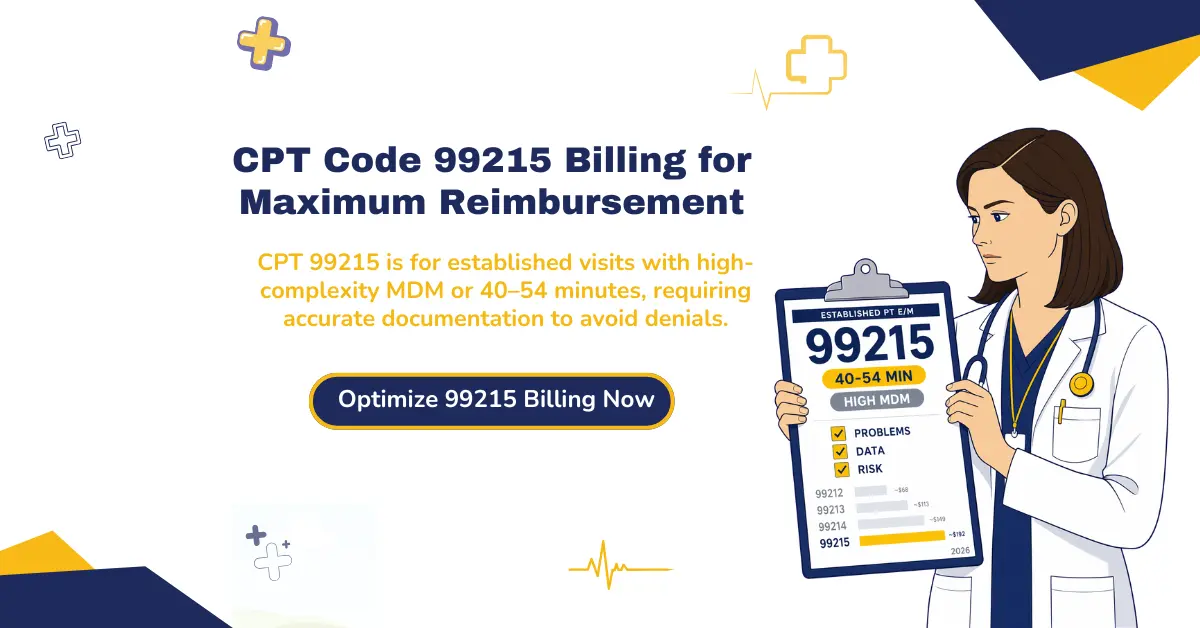
99215 CPT code = established patient office or outpatient visit requiring high complexity MDM OR 40 to 54 minutes of total time on the date of encounter.
| Element | Detail |
|---|---|
| Code | 99215 |
| Patient Type | Established (seen within past 3 years) |
| MDM Level | High complexity |
| Time Range | 40 to 54 minutes total time |
| Setting | Office or other outpatient |
| 2026 Medicare Rate (non-facility) | ~$192.38 |
| New Patient Equivalent | 99205 (60 to 74 minutes) |
| Code Selection | Use EITHER total time OR MDM. Not both required. |
That’s the code. If your visit fits either threshold, bill 99215. If it goes beyond 54 minutes, check whether 99417 or G2212 applies for prolonged services. Let’s figure out which pathway your visit uses.
Is This Visit 99215? Decide in 60 Seconds
Work through these steps in order. Stop when you have your code.
Step 1: Confirm the Patient Is Established
Has this patient been seen by any provider of the same specialty in this group within the past three years? If no, use new patient codes 99202 to 99205. If yes, keep going.
Step 2: Use Time OR MDM
| Pathway | 99212 | 99213 | 99214 | 99215 |
|---|---|---|---|---|
| Time (total minutes) | 10 to 19 min | 20 to 29 min | 30 to 39 min | 40 to 54 min |
| MDM Level | Straightforward | Low | Moderate | High |
| Problems | 1 minor/stable | 1 stable chronic OR 1 acute simple | 1 chronic worsening OR new uncertain problem | 1+ chronic severe exacerbation OR threat to life/function |
Pick one pathway per visit. If time says 99215 and MDM says 99214, bill 99215. Choose the pathway your documentation actually supports.
High MDM in Plain Terms
High MDM means at least two of three elements reach the high level. The problem element hits high when a chronic condition is severely exacerbating, when there’s a new condition threatening life or bodily function, or when a chronic illness has progressed despite treatment. The risk element hits high when the treatment decision involves drug therapy requiring intensive monitoring, a decision about hospitalization, or emergency surgery consideration.
The data element hits high when you’re reviewing records from three or more unique external sources, independently interpreting a test another provider performed, or discussing management with an external physician.
CLAIMMAX RULE: You only need 2 of 3 elements at the high level. Not all three. That’s the single most misunderstood fact about 99215, and it causes more undercoding than any other misconception.
Find Your Visit, Get Your Code
Find the scenario that matches your visit. The code and the documentation template are right there.
Scenario A: Severe Chronic Disease Exacerbation
The visit: established patient whose chronic condition has significantly worsened despite current treatment. A1c at 10.8% despite maximum oral therapy, INR supratherapeutic, CHF with ejection fraction declining, or similar deterioration.
The code: 99215. MDM: high (chronic illness with severe exacerbation). Usually 40 to 50 minutes.
Copy-paste documentation:
ASSESSMENT/PLAN:
1. [CONDITION] – severe exacerbation / progression despite current regimen
– Evidence of severity: [lab values, symptoms, exam findings – be specific]
– Current therapy failing: [what changed and why]
– New treatment: [drug/dose/monitoring protocol]
– Risk: HIGH – [intensive monitoring required / hospitalization considered]
– Follow-up: [timeframe]
TIME: Total time on date of service: [XX] minutes
Activities: chart review, examination, counseling, care coordination, documentation
Scenario B: Acute Illness Threatening Life or Bodily Function
The visit: new-onset condition posing a genuine threat to life or function. New seizure disorder with brain lesion concern, acute decompensated heart failure, TIA with evolving deficits, severe RA flare with drug toxicity.
The code: 99215. MDM: high (acute condition posing threat to bodily function). Usually 44 to 54 minutes given workup coordination.
Copy-paste documentation:
ASSESSMENT/PLAN:
1. [ACUTE CONDITION] – new presentation posing threat to [life / bodily function]
– Clinical findings: [specific exam and test results]
– Threat basis: [why this condition poses high-level risk]
– Management: [urgent referrals, new medications, monitoring plan]
– Risk: HIGH – [decision regarding [hospitalization / urgent workup]]
– Education provided: [driving restrictions, safety precautions, return precautions]
– Follow-up: [specific timeframe and trigger conditions]
TIME: Total time on date of service: [XX] minutes
Scenario C: Drug Therapy Requiring Intensive Monitoring
The visit: initiating or managing treatment with a high-risk drug. Starting warfarin, insulin, methotrexate, lithium, biologic therapy, immunosuppressives, or any agent requiring laboratory monitoring for toxicity.
The code: 99215. MDM: high (drug therapy requiring intensive monitoring is the high-risk element). Time: usually 40 to 48 minutes.
Copy-paste documentation:
ASSESSMENT/PLAN:
1. [CONDITION] – managed with high-risk drug therapy
– Current therapy: [medication, dose]
– Monitoring required: [specific labs/intervals – e.g., INR weekly, LFTs monthly]
– [Initiation / Dose change / Toxicity concern]: [details]
– Risk: HIGH – drug therapy requiring intensive monitoring for [toxicity / adverse effects]
– Patient counseled on [monitoring protocol, side effects, when to call]
– Follow-up: [timeframe tied to monitoring interval]
TIME: Total time on date of service: [XX] minutes
Scenario D: High-Complexity Multi-System Visit by Time
The visit: established patient with multiple interacting chronic conditions. The MDM might technically sit at moderate, but total time reaches 40 to 54 minutes because of the complexity of coordination and counseling.
The code: 99215 by time. Time: 40 to 54 minutes documented with specific activities. This is the cleanest pathway when MDM elements are borderline.
Copy-paste documentation:
TOTAL TIME: [XX] minutes (must be between 40 and 54)
TIME BREAKDOWN (list activities performed):
– Chart review including external records: [X] min
– Examination: [X] min
– Counseling / patient education: [X] min
– Care coordination with [specialist/team]: [X] min
– Medication reconciliation / ordering: [X] min
– Documentation: [X] min
CHIEF COMPLAINT: [reason for visit]
ASSESSMENT/PLAN:
1. [Diagnosis] – [status]
– [Plan]
– [Follow-up]
Scenario E: This Might Be 99214 Instead
Check this before you submit. These are the situations where 99215 is the wrong code.
Stay at 99214 if all of the following apply:
- The chronic condition has only mild exacerbation, not severe progression
- The new problem has uncertain prognosis but doesn’t threaten life or bodily function
- Prescription drug management is present but doesn’t require intensive monitoring for toxicity
- Total visit time was 30 to 39 minutes
- No decision about hospitalization was made or considered
If two of the three MDM elements only reach moderate, or time falls between 30 and 39 minutes, bill 99214. That’s still the correct code.
99215 Documentation Templates: Ready to Use
Three templates. Pick the one that fits your code selection method. Fill in the brackets. Done.
Template 1: Time-Based 99215
TOTAL TIME: [XX] minutes (must be between 40 and 54)
TIME BREAKDOWN (list your activities):
– Chart review / external records: [X] min
– Examination: [X] min
– Counseling / patient education: [X] min
– Care coordination with [specialist/team]: [X] min
– Medication management / ordering: [X] min
– Documentation: [X] min
CHIEF COMPLAINT: [Patient’s reason for visit]
ASSESSMENT/PLAN:
1. [Diagnosis] – [severe exacerbation / threatening bodily function]
– [Treatment plan with specifics]
– Risk: [High – specify why]
– Follow-up: [timeframe]
Template 2: MDM-Based 99215
CHIEF COMPLAINT: [Patient’s reason for visit]
PROBLEMS ADDRESSED (with severity):
1. [Condition] – [severe exacerbation / threat to life / bodily function]
– Evidence: [specific lab values, exam findings, symptoms]
DATA REVIEWED (be specific):
– External records from [source 1], [source 2], [source 3]
– [Lab/imaging/test] reviewed: [specific result]
– Discussed management with [external specialist] re: [clinical question]
ASSESSMENT/PLAN:
1. [Diagnosis] – [status]
– Plan: [Treatment including monitoring requirements]
– Risk: HIGH – [drug therapy requiring intensive monitoring /
decision regarding hospitalization / emergency surgery considered]
– Follow-up: [timeframe]
MDM COMPLEXITY: HIGH
Elements met: [Problem: HIGH] [Data: HIGH] [Risk: HIGH] (2 of 3 required)
Template 3: Complete 99215 Note
CHIEF COMPLAINT: [Reason for visit]
HPI: [Brief relevant history – 2 to 3 sentences showing clinical progression]
EXAM: [Medically appropriate findings relevant to the complexity]
DATA REVIEWED: [Specify: which external records, which labs, which imaging,
which specialist communications]
ASSESSMENT/PLAN:
1. [Diagnosis] – [severe exacerbation / threat to life or bodily function]
– Plan: [Specific management with high-risk treatment or hospitalization]
– Risk: HIGH – [reason]
– Follow-up: [timeframe]
TOTAL TIME: [XX] minutes
Activities: [chart review, external record review, exam, counseling,
care coordination, documentation]
CODE JUSTIFICATION: 99215 – High MDM / 40 to 54 minutes
99214 or 99215? Quick Comparison Card
Use this when you’re at the boundary between the two. The severity of the problem is the deciding factor in most cases.
| Factor | 99214 | 99215 |
|---|---|---|
| MDM Level | Moderate | High |
| Time Range | 30 to 39 minutes | 40 to 54 minutes |
| Problem Complexity | 1 chronic with mild exacerbation OR new problem with uncertain prognosis | 1+ chronic with SEVERE exacerbation OR threat to life/bodily function |
| Risk Level | Moderate (prescription drug management) | High (intensive monitoring, hospitalization decision, emergency surgery) |
| Data Reviewed | Moderate (limited sources) | Extensive (3+ external sources, independent interpretation, external physician discussion) |
| 2026 Medicare Rate (non-facility) | ~$148.90 | ~$192.38 |
| Revenue Difference Per Visit | Baseline | +$43.48 |
The fastest decision rule: ask whether the condition is severely exacerbating or threatening bodily function. If yes, 99215. If it’s just worsening mildly or you’re managing an undiagnosed problem with uncertain prognosis, 99214. That split covers the majority of decisions at this boundary.
A practice billing 99214 when the documentation supports 99215 loses $43.48 per visit. At 8 qualifying visits per week, that’s over $18,000 in annual Medicare revenue alone. Our denial management services team runs E/M pattern reviews to identify exactly where that revenue is going.
When the Visit Exceeds 54 Minutes: Prolonged Services Quick Reference
If the visit goes beyond 54 minutes, a prolonged services add-on code applies. The code depends entirely on the payer. Using the wrong one gets an automatic denial, not a downcode.
| Payer | Prolonged Code | First Add-On Threshold | Time Increment |
|---|---|---|---|
| Medicare (traditional) | G2212 | 69 minutes | 15-minute increments beyond 54 min |
| Medicare Advantage | Verify with plan | Varies | Verify with plan |
| UnitedHealthcare | 99417 | 55 minutes | 15-minute increments beyond 40 min |
| Aetna | 99417 | 55 minutes | 15-minute increments beyond 40 min |
| Cigna | 99417 | 55 minutes | 15-minute increments beyond 40 min |
| BCBS (most plans) | 99417 | 55 minutes | Verify for Medicare Advantage plans |
The critical gap: AMA’s 99417 starts at 55 minutes (15 minutes past the 40-minute base minimum). Medicare’s G2212 starts at 69 minutes (15 minutes past the 54-minute maximum). A 60-minute visit qualifies for 99417 with commercial payers but earns no prolonged add-on with Medicare. That gap is where billing errors happen.
99215 Modifiers: When You Need Them
Three modifiers come up regularly with 99215. Here’s when each one applies.
| Situation | Modifier | Example |
|---|---|---|
| E/M and procedure on the same date | 25 | 99215-25 and 20610 (corticosteroid injection) |
| Telehealth visit (audio-video) | 95 | 99215-95 |
| Telehealth (some commercial payers) | GT | 99215-GT |
Modifier 25: Copy-Paste Justification Language
Add this language to the note when billing 99215 alongside a same-day procedure:
The E/M service provided today was significant and separately identifiable from
[procedure name]. The evaluation addressed [condition], which required independent
medical decision-making beyond the pre- and post-procedure work of [procedure].
Modifier 25 rule: Only use this when the E/M genuinely addresses separate clinical problems or additional complexity beyond the procedure indication. If you can’t write that justification sentence clearly, the modifier doesn’t belong on the claim.
2026 Reimbursement: What You’ll Get Paid
The numbers, without the math lesson.
| Payer Type | 2026 CPT 99215 Rate |
|---|---|
| Medicare (non-facility, office) | ~$192.38 |
| Medicare (facility, hospital outpatient) | ~$125.58 |
| NP/PA billing independently (Medicare) | ~$163.52 (85% of physician rate) |
| Work RVU (wRVU) | 2.80 |
| Total RVU (non-facility) | ~5.76 |
| UnitedHealthcare (typical range) | $210 to $285 |
| BCBS (typical range) | $220 to $300 |
| Aetna (typical range) | $205 to $270 |
| Medicaid (national range) | $102 to $125 (varies significantly by state) |
Rates vary by locality. Use the CMS Physician Fee Schedule Look-Up Tool to verify your exact rate. Commercial rates depend on your payer contract. If your commercial rate for 99215 falls below 130% of Medicare, your contracts may need renegotiation.
2026 E/M Exemption Worth Knowing
CMS introduced a 2.5% efficiency adjustment cut to most procedural codes in 2026. E/M codes including 99215 are exempt from that cut. Your payment posting service review should not reflect any efficiency adjustment reduction on 99215 claims. If it does, that’s an underpayment error worth recovering.
5 Mistakes That Get 99215 Denied or Downcoded
Most 99215 problems trace back to five documentation gaps. Each takes under two minutes to fix before submission.
| Mistake | Fix | Time to Fix |
|---|---|---|
| Vague time documentation: ‘spent extended time’ | Add exact minutes plus list of specific activities performed | 1 minute |
| Asserting ‘high risk’ without explanation | Add: ‘High risk: [drug requiring intensive monitoring / hospitalization decision]’ | 30 seconds |
| ‘Reviewed labs’ with no specifics | Name the exact tests and values: ‘Reviewed BMP: creatinine 2.1 (baseline 1.4)’ | 1 minute |
| Calling a worsening condition ‘stable’ | Use ‘severe exacerbation’ or ‘progression despite treatment’ when appropriate | 30 seconds |
| HPI says mild symptoms but plan says high complexity | Make HPI severity match the plan complexity throughout the note | 2 minutes |
Pre-Submission Checklist
Run through these five checks before every 99215 claim goes out. All five answers should be yes.
- Is the patient established: seen by the same specialty group within the past 3 years?
- Is the problem clearly described as severely exacerbating, threatening function, or requiring high-risk treatment?
- If MDM-based: are 2 of 3 elements (problem, data, risk) at the high level with specific clinical detail?
- If time-based: is total time stated as 40 to 54 minutes with a list of activities?
- Do all sections of the note (HPI, exam, assessment, plan) tell the same clinical story?
Five checks. Three minutes. Those gaps cause the majority of preventable 99215 denials.
99215 by Specialty: Quick Reference
The requirements for 99215 are identical across every specialty. What varies is the clinical context that triggers the high complexity elements.
Cardiology
Typical 99215 visits:
- Acute decompensated heart failure with medication titration or hospitalization decision
- Initiation of anticoagulation (warfarin, DOAC) requiring intensive INR or monitoring protocol
- Post-MI management with multiple medication adjustments and specialist coordination
- New arrhythmia with hemodynamic instability requiring electrophysiology referral
Upgrade to 99215 from 99214 when:
- EF drops significantly between visits and you’re adjusting or escalating therapy
- You’re independently interpreting an echocardiogram, stress test, or Holter
- Hospitalization is actively discussed, even if the patient declines
Neurology
Typical 99215 visits:
- New-onset seizure with imaging showing suspected structural lesion
- Stroke or TIA with evolving neurological deficits requiring urgent coordination
- Initiation of anti-epileptic drug with therapeutic drug level monitoring
- Progressive neurodegenerative condition requiring complex treatment changes
High-risk MDM trigger in neurology:
- Initiating levetiracetam, valproate, or carbamazepine always qualifies as intensive monitoring
- Any decision about emergency hospitalization or neurosurgery referral
Rheumatology and Internal Medicine
Typical 99215 visits:
- Severe RA flare with drug toxicity concern (methotrexate hepatotoxicity, biologic infection risk)
- Lupus with organ involvement requiring immunosuppressive management
- Initiating biologics (adalimumab, infliximab, tocilizumab) with TB screening and infection monitoring
- Multi-system follow-up with CKD, CHF, and diabetes all requiring active management changes
High-risk MDM trigger:
- Any biologic initiation or dose change qualifies as intensive monitoring
- Methotrexate with LFT abnormalities is both a problem and a risk element
Telehealth
Billable: yes, for audio-video encounters.
Modifier required: Modifier 95 (or GT for some commercial payers).
POS codes: POS 10 when patient is at home (earns the higher non-facility rate of $192.38), POS 02 for other locations.
Documentation to add: “Services provided via real-time interactive audio/video technology. Patient consented to telehealth encounter.”
Clinical bar: identical to in-person. High MDM or 40 to 54 minutes still required. Telehealth doesn’t lower the threshold.
ClaimMax’s telehealth medical billing services team handles 99215 telehealth claims across all payers, including POS code verification and modifier application on every submission.
When to Stop and Get Help
This guide covers the straightforward 99215 decisions. Some situations don’t have a quick answer.
Escalate if any of these apply:
- You’re spending more than 5 minutes deciding whether it’s 99214 or 99215
- The same 99215 documentation keeps coming back denied or downcoded
- A payer is consistently downcoding to 99214 despite what looks like solid documentation
- You’re unsure whether the visit qualifies as 99215 or warrants prolonged services
- You need to code 30 or more high-complexity visits and don’t have bandwidth
These aren’t coding questions. They’re workflow problems. Getting help is faster than guessing on every claim.
ClaimMax RCM provides same-day coding support for practices billing high-complexity E/M codes. We don’t explain the rules; we code the visit. Contact our team to stop guessing on complex 99215 claims.
Quick Answers: 99215 CPT Code Coding
How do I know if it’s 99214 or 99215?
Ask whether the problem is severely exacerbating or threatening bodily function. If yes, 99215. If the problem is only mildly worsening or newly uncertain, 99214. As a time backup: 30 to 39 minutes is 99214, 40 to 54 minutes is 99215. The severity distinction is what separates these two codes in practice.
What’s the fastest way to document 99215?
Use time-based documentation. Write ‘Total time: 46 minutes’ and list your activities: external record review, examination, counseling, care coordination, documentation. Takes under 90 seconds. That’s all that’s required when using the time pathway for a 40 to 54 minute visit.
Can I bill 99215 for telehealth?
Yes. Add Modifier 95. Document that services were provided via real-time interactive audio and video technology. The MDM and time thresholds are identical to in-person visits. Use POS 10 when the patient is at home to ensure the claim processes at the $192.38 non-facility rate rather than the lower facility rate.
When do I add Modifier 25 with 99215?
When billing 99215 and a procedure on the same date. The E/M must address separate clinical problems or additional complexity beyond the procedure indication. Your note needs one sentence explaining that distinctly. If you can’t write that sentence, don’t bill both. Without Modifier 25 in that scenario, the claim generates a CO-97 bundling denial.
What is the 2026 Medicare rate for 99215?
The 2026 Medicare national average for CPT 99215 is approximately $192.38 in the non-facility office setting and approximately $125.58 in the facility setting. NPs and PAs billing independently receive approximately $163.52 (85% of the physician rate). Verify your exact rate with the CMS Physician Fee Schedule Look-Up Tool at cms.gov.
Can I bill 99215 if only 2 of 3 MDM elements are at the high level?
Yes. The MDM framework for 99215 requires 2 of 3 elements at the high level: problem complexity, data reviewed, and risk. You don’t need all three. A visit with high-level problem severity and a high-risk treatment decision fully supports 99215 even if data reviewed only reaches moderate. Two of three is all that’s required.
What gets 99215 downcoded to 99214 most often?
Vague risk documentation. Writing ‘high risk’ without explaining why. Auditors and payers won’t accept the assertion alone. Connect the risk to a specific treatment decision: ‘High risk: initiating warfarin requiring intensive INR monitoring’ or ‘High risk: decision regarding hospitalization for decompensated CHF.’ The specificity is what protects the code.
Is there a frequency limit for billing 99215?
No absolute limit exists. Each visit must independently support the code through its own documentation. Billing 99215 for the same patient repeatedly without documented clinical changes between visits triggers payer scrutiny. Payers expect case-mix variation. If your E/M distribution is mostly 99215 across all patients, that pattern draws review regardless of how well each individual note is documented.
Code It. Document It. Bill It. Done.
99215 coding doesn’t have to take more than five minutes per visit. Confirm the severity or the time, grab the template, fill in the brackets, submit.
The two errors that cost practices the most: undercoding 99215-level visits as 99214 because the documentation seems borderline, and documenting ‘high complexity’ without the specific clinical evidence that makes it auditable. Both are fixed the same way: a clear, specific note before the claim leaves the practice.
If you’re consistently at the 99214/99215 boundary and not sure whether your documentation is holding up, that’s a pattern worth reviewing, not a question to answer one claim at a time.
When 99215 coding decisions slow you down, ClaimMax RCM speeds them up. We handle medical billing, denial management, AR follow-up, credentialing services, telehealth billing, prior authorization, and payment posting for practices across all specialties.
Last Updated: 2026
Reviewed by: Coding Efficiency Specialist, ClaimMax RCM. Reflects 2026 Medicare PFS Final Rule. Templates verified against AMA CPT 2026 guidelines.