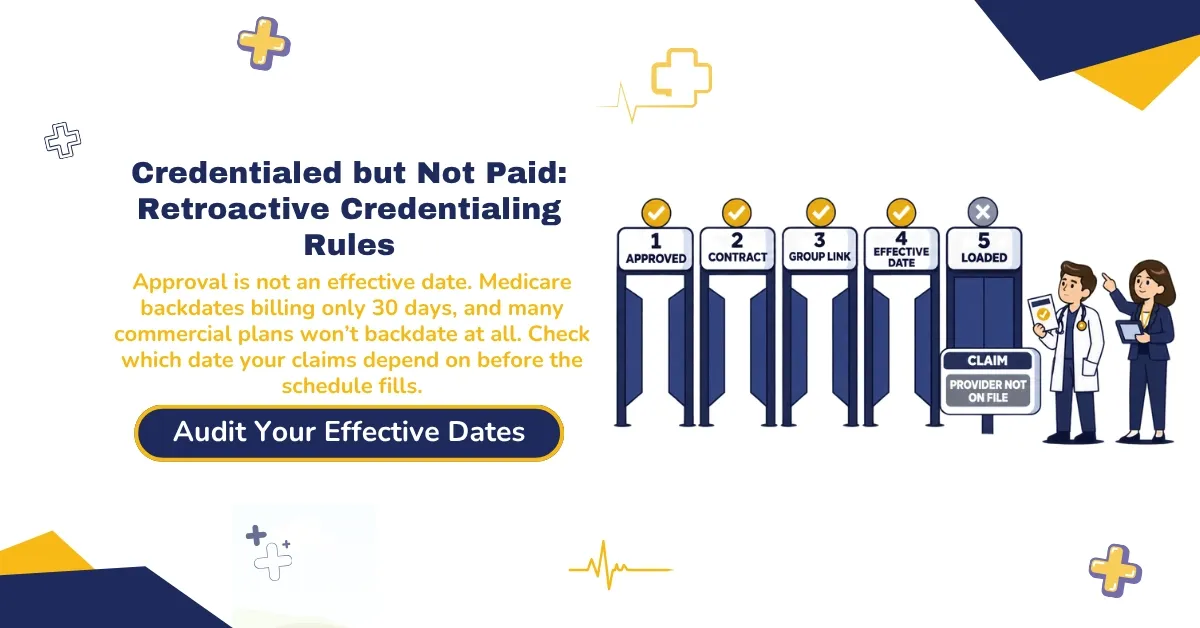
A provider can clear credentialing and still not get paid. Credentialing confirms qualifications, but payment depends on three things lining up with the date of service: the payer enrollment record, the link to the billing group, and the effective date. If any one is missing or wrong, claims stall, deny, or process out of network.
Retroactive credentialing can rescue some of those claims, but the window is narrow. Medicare allows up to 30 days of retrospective billing in qualifying cases, and many commercial plans won’t backdate at all.
You’ve seen the pattern. The welcome letter arrives, your new physician’s schedule fills up, and the first batch of claims comes back marked “provider not on file.” Your coders did their job. The payer’s claims system can’t find the provider yet, and every visit since day one sits in a holding pattern.
Most of the fix comes down to tracking each payer’s credentialing effective date with the same care you give AR, and knowing which rules let you bill backward.
Key Takeaways for Practice Managers
- Credentialing approval, contract execution, enrollment, the effective date, and the system load are five separate events, and any one of them can stop payment.
- Medicare sets the effective date as the later of the application filing date or the first date of service at the location, under 42 CFR 424.520(d).
- Medicare retrospective billing reaches back up to 30 days, or 90 days after a Presidentially declared disaster, and only when the provider meets the conditions.
- Retroactive credentialing with commercial plans depends on the contract and state law, and many plans pay only from the effective date forward.
- UnitedHealthcare tells providers to allow up to 60 days for a signed contract to load into its systems.
- Medicare pays nothing for services furnished while billing privileges are deactivated, and the CY 2027 final rule widens retroactive revocations.
Why Credentialed Providers Still Go Unpaid: Five Payment Gates
A provider becomes billable with a payer only after five separate gates close, and credentialing approval is the first of them. Practices get burned when someone treats one approval email as all five. Each gate has its own owner, its own date, and its own proof you’ll want on file.
What Is the Difference Between Credentialing and Payer Enrollment?
Credentialing verifies that a provider is qualified: license, education, training, work history, and sanctions. Payer enrollment registers that provider with a specific insurer, tied to a billing entity, tax ID, and location, so claims can pay. A provider can clear the first and still fail the second.
Treat credentialing as step zero of revenue cycle management. It happens before registration, coding, or a single claim, so a mistake here surfaces weeks later as a denial that looks like a billing problem.
The Five Payment Gates Every New Provider Must Clear
Payers run these steps in different orders, and some steps overlap. Track each gate on its own for every payer, because a single “approved” status hides which gate is still open. Use the table as your billing readiness check before the front desk books that payer’s members.
| Gate | What it confirms | Who controls it | Proof to keep on file |
|---|---|---|---|
| 1. Credentialing approval | The provider meets the payer’s standards | Payer credentialing committee | Approval letter or email with its date |
| 2. Contract execution | Participation terms and rates apply | Payer contracting and your authorized signer | Countersigned agreement |
| 3. Enrollment and group linkage | The provider is tied to your group NPI, TIN, and locations (for Medicare, through reassignment) | Payer enrollment team or the Medicare Administrative Contractor | Enrollment confirmation and PECOS reassignment record |
| 4. Effective date | The first date of service the payer will pay | The payer contract, or Medicare regulation | Written effective date |
| 5. Claims-system load and payment setup | The provider is active where claims are processed, and ERA and EFT are routed | Payer operations | Clean test claim or claim-status check under the provider |
The order varies. Commercial plans often credential first and contract second, while Medicare runs everything through PECOS enrollment and reassignment. Either way, gate four decides which visits pay, and gate five decides when you can send them without a rejection.
Why “Approved” Doesn’t Mean Claims Will Pay
An NPI doesn’t activate billing with anyone. It identifies the provider, and the payer’s enrollment record is what lets a claim pay. That gap explains a complaint we hear from practice managers every month: credentialing approved but claims denied, sometimes for a full month of visits.
Don’t count on retroactive credentialing to cover that month until a payer confirms it in writing. A verbal “you’re all set” from a provider relations rep won’t hold up when you appeal six months later, and you won’t find that rep again.
If you’ve got providers stuck between approval and their first paid claim, our credentialing and contracting services team tracks all five gates for each payer, so claims don’t go out before the payer can pay them.
The Four Dates That Decide Whether a Claim Gets Paid
Four dates control payment: the date the payer received a complete application, the credentialing approval date, the effective date, and the date the provider is loaded in the claims system. The effective date decides which dates of service pay. Once the load date passes, you can submit without a rejection.
Credentialing Approval vs. Effective Date: Why They’re Different
Approval is a decision. The effective date is a payment start date, and the two can sit weeks apart. Your credentialing effective date lives in the contract or the payer’s provider record, and it controls every claim you send for that provider.
Cigna, for example, emails approved providers their effective date. Other payers put it in a welcome packet or show it only in a portal. Whatever the source, get the provider enrollment effective date in writing and file it in the folder your billing team works from.
A documented credentialing effective date also anchors your appeal. Payers reprocess denials when their own record shows coverage for the date of service, and most won’t move that date without a documented reason.
A Worked Example: Where the Unpaid Weeks Come From
Take a hypothetical commercial plan scenario with 2027 dates. The provider starts seeing patients before the payer finishes its work, which is the setup we see most often.
| Event | Date |
|---|---|
| Payer receives a complete application | December 7, 2026 |
| Provider starts seeing patients | February 1, 2027 |
| Credentialing approval | February 9, 2027 |
| Effective date | March 1, 2027 |
| Provider loaded in the claims system | March 12, 2027 |
Claims for February 1 to 28 fall before the effective date. Expect denials, with CO-B7 as the usual code, or out-of-network processing, unless the payer grants retroactive credentialing or a state law requires payment for the credentialing period.
March 1 to 11 are payable dates, but the provider isn’t loaded yet, so hold those claims until a claim-status check comes back clean. From March 12 on, bill as usual. The filing deadline on every held claim keeps running from the date of service, and the payer won’t pause it for you.
Common Enrollment and Effective-Date Errors That Delay Claims
Most enrollment errors are small mismatches between what your practice bills and what the payer has on file. The usual suspects are a missing group link, a missing location, data that doesn’t match across systems, a lapsed CAQH profile, and a provider the payer approved but never loaded.
Billing Provider vs. Rendering Provider: The Group Link Problem
On a professional claim, the rendering provider’s individual NPI goes in Box 24J, and the group’s NPI goes in Box 33a. The payer has to see that individual linked to that group and tax ID. If the link is missing, the claim denies even when both NPIs are valid.
New hires trip this up all the time. A physician credentialed under a previous employer isn’t linked to your TIN by default, and many practices don’t learn that the billing provider vs. rendering provider relationship needs its own approval until claims bounce. Experienced group practice billing teams verify this link before the first visit.
Wrong or Missing Practice Location
Payers often enroll providers by location. A new satellite office or a telehealth service location needs its own update before the first visit there, or those claims deny while visits at the main office pay fine. For Medicare, physicians and practitioners must report a practice location change within 30 days.
Mismatched Data Across NPPES, PECOS, CAQH, and the Payer
The provider’s legal name, address, suite number, taxonomy, NPI, and TIN need to match across NPPES, PECOS, the CAQH profile, the W-9, and the payer’s file. A suite number that appears in one system and not another can stall a payer load for weeks.
Commercial payers often check taxonomy against the claim, so a specialty change that never reached the payer’s file can trigger denials. Watch for the N290 remark code, which flags a missing, incomplete, or invalid rendering provider primary identifier.
How Often Does CAQH Require Provider Attestation?
Providers must reattest their CAQH profiles every 120 days. A lapsed CAQH attestation can keep plans from relying on the profile, which stalls initial credentialing and recredentialing alike.
CAQH rebranded as DataSpring, powered by CAQH, in 2026. The DataSpring clinician page confirms the CAQH Provider Data Portal kept its name, logins, and profiles.
Set CAQH reattestation reminders at day 90, and put each provider’s CAQH attestation date on the same calendar as license renewals. Our notes on BCBS MI attestation deadlines show how one plan handles lapses.
Approved but Not Loaded in the Payer’s Claims System
UnitedHealthcare network onboarding guidance tells providers to allow up to 60 days for a signed contract to load into its systems after credentialing approval. Until the contract loads, claims may deny or pay at the out-of-network level.
Cigna’s timeline runs shorter. Its Cigna credentialing process page says approved provider information reaches its directories and claim systems within about 10 business days.
On a denial report, the gap shows up as a provider not loaded in payer system records, often paired with a “provider not on file” message. Run an eligibility or claim-status check under the new provider first, then release a small test batch before you send the full queue.
Approved and Loaded, but No Money Arriving
Some practices clear every gate and still see empty deposits. Claims process, but the ERA never arrives or the EFT routes to an old account. For Medicare, EFT runs through the CMS-588 form. Confirm ERA and EFT setup with each payer before you call a new provider’s onboarding finished.
Medicare Effective Dates and Retroactive Credentialing Rules
Medicare sets its dates by regulation instead of contract. That makes the rules predictable, and it also makes them unforgiving. Miss a filing date and the lost days stay lost, because Medicare’s backward window is short and comes with conditions.
How Medicare Sets the Effective Date of Billing Privileges
Under 42 CFR 424.520(d), the Medicare enrollment effective date for physicians and other practitioners is the later of two dates: the date the Medicare Administrative Contractor (MAC) received an application it later approved, or the date the provider first furnished services at the new practice location.
Take a hypothetical physician who starts at a new location on March 1, 2027. The MAC receives a complete application on May 15, 2027. That makes May 15, 2027 the effective date, because it’s the later of the two dates.
The 30-Day Medicare Retroactive Billing Window
Medicare retroactive billing reaches back up to 30 days before the effective date when circumstances kept the provider from enrolling earlier. The provider must meet every program requirement, including state licensure, and must have furnished the services at the enrolled location. 42 CFR 424.521 stretches the window to 90 days only after a Presidentially declared disaster.
Back to the example: billing can reach back to April 15, 2027. Visits from March 1 to April 14 can’t go to Medicare at all. Medicare doesn’t offer open-ended retroactive credentialing, so filing the day an offer is signed protects real money.
Group Reassignment Has Its Own Effective Date
A physician’s individual enrollment doesn’t let your group bill for that physician. The group needs a reassignment of benefits, filed in PECOS or on the CMS-855I. CMS folded the old CMS-855R into the CMS-855I and returned old-version forms after November 1, 2023, per its CMS-855I consolidation bulletin.
A 2026 appeal shows how unforgiving this gets. In DAB decision CR7004, a practice’s credentialing employee terminated the wrong physician’s reassignment because two employees shared a name. The physician refiled on May 22, 2026.
The judge upheld May 22, 2026 as the effective date, with retrospective billing back to April 22, 2026, and declined to grant equitable relief for the practice’s own error. That mix-up between two names cost the group close to four months of Medicare billing.
Six Months Without Claims Can Deactivate Billing Privileges
Under 42 CFR 424.540, CMS may deactivate a provider who submits no Medicare claims for six consecutive calendar months. The reactivation takes effect on the date the MAC receives the reactivation submission it later approves, and Medicare pays nothing for services furnished while the provider’s Medicare billing privileges were deactivated.
Don’t expect a backward window here. DAB decision CR6490 cites the Program Integrity Manual provision that gives a reactivation no 30-day retrospective billing period. Medicare grants no retroactive credentialing on a reactivation, so every visit in the gap stays unpaid.
How Often Does Medicare Require Revalidation?
Medicare revalidation is due every five years for most providers and every three years for DMEPOS suppliers, and CMS can request an off-cycle revalidation. CMS posts due dates seven months ahead, and MACs send notices about three to four months before the deadline.
Don’t wait for the letter. CMS revalidation guidance puts the tracking burden on the provider, grants no extensions, and warns that a missed date can mean a payment hold or deactivation.
PECOS Deletes Stalled Applications
PECOS doesn’t hold incomplete work forever. Under the PECOS inactivity deletion policy, new or edited applications disappear after 120 days of inactivity, and applications opened for corrections disappear if nobody submits them within 20 days. Returned applications get rejected if corrections don’t arrive within 30 days.
Rejected applications get deleted if nobody reopens them within 60 days. That’s why a rejection hurts: only the application Medicare approves sets your filing date, so a rejection can push the effective date weeks later.
Want a second set of eyes on revalidation dates and reassignments? We handle Medicare revalidation tracking for every provider and flag what’s due before a deactivation letter shows up.
Commercial Payers: Retroactive Credentialing and State Retro-Pay Laws
Commercial plans set effective dates through contracts and provider manuals. Many pay only from the effective date forward. Some grant an earlier date when you ask in writing, and a few states require payment for the credentialing period when the provider meets specific conditions.
Do Commercial Payers Allow Retroactive Credentialing?
Some do and many don’t, and the answer sits in your contract and the payer’s provider manual. A retroactive approval date means little on its own. Only the credentialing effective date controls which dates of service the payer will pay.
Before the provider sees that plan’s members, ask in writing whether the payer will honor dates of service back to the day it received a complete application. File the answer with the enrollment record. Commercial payer retro credentialing requests go nowhere without that paper trail.
States That Require Payment During Credentialing
A few states force the issue for fully insured plans. Self-funded employer plans under ERISA fall outside state insurance law in most cases, so check the plan type on the member’s card before you rely on a state rule.
| State | What the law does | Who it covers | Source |
|---|---|---|---|
| Iowa | Payers must pay clean claims for the credentialing period once the provider is credentialed. Providers hold those claims during credentialing, and the payer’s timely filing clock starts after credentialing ends. | Physicians, ARNPs, and PAs. The rule excludes Medicaid, Medicare, TRICARE, and other federal programs. | Iowa Administrative Code 191-70.10 |
| Texas | Plans pay a qualifying physician as a participating provider during credentialing. If the plan later denies credentialing, it may recover the in-network and out-of-network difference from the physician or group, and the patient doesn’t owe it. | Physicians joining an established group with a current plan contract (Insurance Code chapter 1452, subchapter C) | Texas Medical Association guidance |
Tennessee, South Dakota, and Louisiana have their own versions, so check your state insurance code before you count on one. A state law is the closest thing commercial billing has to guaranteed retroactive credentialing, and it only protects claims from plans that state regulates.
Loaded, but Paid at the Wrong Rate
Getting loaded doesn’t guarantee the right fee schedule. Once the effective date passes, compare the first 10 paid lines against the contracted rate. If the allowed amounts match last year’s schedule, your new rates never loaded, and you need a pricing correction before more claims close short.
Medicaid and Managed Care Plans: Two Enrollments, Two Dates
A Medicaid managed care plan can’t stand in for state Medicaid enrollment. The state enrolls the provider, the plan credentials the provider, and each one sets its own date. A claim can fail on either one, and the plan’s welcome letter won’t tell you which.
Why State Enrollment Comes Before the Plan’s Approval
Under 42 CFR 438.602(b), states must screen, enroll, and revalidate the network providers of Medicaid managed care plans. A plan can sign a network agreement while state enrollment is pending, but only for up to 120 days. After that, the plan must end the agreement if the state hasn’t enrolled the provider.
Track the state’s provider enrollment effective date and the plan’s date as two separate fields. California shows how layered this gets, and our guide to Medi-Cal provider enrollment walks through the state and plan steps.
Ordering and Referring Providers Must Be Enrolled Too
Federal rules at 42 CFR 455.410(b) require state Medicaid agencies to enroll ordering and referring physicians and other professionals. A lab, imaging, or DME claim can deny for an ordering or referring provider not enrolled with the state, even when the billing entity’s enrollment is current. Check the ordering provider’s status before you rework the claim.
Denial Codes That Point to an Enrollment Problem
Enrollment problems show up on the remittance as a short list of codes. Read the reason code and the remark code together. They tell you whether the problem is the date, the network, the provider type, or the identifier, and which team owns the fix.
| Code | Official meaning (paraphrased) | Usual enrollment cause | First fix | Owner |
|---|---|---|---|---|
| CO-B7 | Provider not certified or eligible to be paid for this service on this date of service | Date of service before the effective date or after a termination | Compare the date of service with the effective and termination dates | Credentialing |
| CO-242 | Services not provided by network or primary care providers | Provider not active in the member’s network, or not linked to the group | Confirm the network, group link, and effective date | Credentialing |
| CO-170 | Payment denied when performed or billed by this type of provider | Provider type or specialty not allowed for the service | Check the taxonomy and specialty on file | Credentialing and billing |
| CO-185 | Rendering provider not eligible to perform the service billed | Rendering provider not enrolled or not eligible | Verify the rendering provider’s enrollment | Credentialing |
| N290 (remark code, often with CO-16) | Missing, incomplete, or invalid rendering provider primary identifier | Wrong or unlinked rendering NPI | Correct the NPI in Box 24J or the payer record | Billing |
The code wording above follows the X12 claim adjustment codes list. Each of these denials carries the CO group, which means contractual obligation, so in most cases the practice can’t move the amount to the patient.
CO-B7 Denial Code: Not Eligible on the Date of Service
The CO-B7 denial code means the payer didn’t consider the provider certified or eligible to be paid for that service on that date. For Medicare, First Coast B7 guidance points to the usual cause: a date of service before the effective date or after a termination date. Check the dates in PECOS before you resubmit anything.
Claims denied for a provider not credentialed on the date of service often carry B7. Resubmitting them won’t help until the payer’s dates change.
CO-242 Denial Code: Not a Network Provider for This Member
The CO-242 denial code says a network or primary care provider didn’t furnish the services for this member. A provider can be credentialed with the payer and still not be active in that member’s PPO, HMO, or EPO product, or at that location. Our front-end failures guide breaks down more CO-242 network denials and how to catch them early.
CO-170, CO-185, and N290: Provider Type and Identifier Problems
These three codes point at different problems. The CO-170 denial code flags the type of provider, the CO-185 denial code flags the rendering provider’s eligibility for the service, and the N290 remark code flags a missing or invalid rendering provider identifier.
If the claim came back as a 277CA rejection instead of a denial, read the entity codes: 82 is the rendering provider and 85 is the billing provider. Our guide to rendering and billing entity codes shows how to fix each one.
Seeing B7 or 242 pile up on one provider? Our denial management services team traces each code back to the enrollment record first, so appeals don’t bounce off the same gap twice.
Rule Out the Patient’s Coverage First
Before you treat a denial as an enrollment problem, confirm the patient had coverage on that date. CO-26 means expenses incurred before coverage started, and CO-27 means expenses incurred after coverage ended. Both codes point at the patient’s plan.
Marketplace grace periods add a wrinkle. Enrollees receiving the premium tax credit get a three-month grace period in most cases, and coverage can end back to the first unpaid month, according to HealthCare.gov grace period rules. Claims from that window can sit pended or deny. Front-end insurance eligibility verification catches the lapse before the visit.
Hold or Submit? Protecting Timely Filing While Credentialing Is Pending
Filing deadlines run from the date of service in most contracts, and an approval doesn’t pause them. Original Medicare allows 12 months from the date of service, with limited exceptions. Commercial deadlines come from each contract. Iowa’s rule is an exception, because the payer’s clock starts only after credentialing ends.
Use this table for holding claims during credentialing, payer by payer:
| Situation | What to do |
|---|---|
| The effective date covers the date of service, and the provider is loaded | Submit as usual |
| The effective date covers the date of service, but the provider isn’t loaded yet | Hold the claims and release a test batch once the load is confirmed |
| The date of service falls before the credentialing effective date | Ask about retroactive credentialing in writing and track each claim’s filing deadline |
| The payer tells you to hold claims, or a state rule requires it, as in Iowa | Hold, and log each claim’s date of service and deadline |
| The filing deadline is close and the effective date still isn’t confirmed | Follow the payer’s written instruction and keep proof of timely submission |
Log every held claim with its date of service and deadline. For Medicaid, some states extend filing when enrollment delays weren’t the provider’s fault, and our guide to Medicaid timely filing exceptions covers those rules. Claims already near the limit belong with a team that handles aged AR recovery every day.
Can You Bill Under Another Provider While Credentialing Is Pending?
In general, no. Billing a new provider’s services under another provider’s NPI misstates who did the work unless a payer’s written policy allows it. Practices that handle billing while credentialing is pending this way risk overpayment demands and compliance trouble that outlasts the denial.
Medicare’s incident-to rules carry strict conditions, including a course of treatment the billing practitioner started and direct supervision, and CMS didn’t design them as a credentialing workaround. Locum tenens billing with modifier Q6 covers a substitute filling in for an absent physician, for up to 60 continuous days in most cases, and doesn’t fit a new hire waiting on enrollment.
How to Recover Claims Denied for Enrollment Errors
Recovery runs in three steps: sort rejections from denials, fix the payer’s enrollment record, then pick the right path for each claim. Skip the second step and the payer denies the same claims again.
Step 1: Is It a Rejection or a Denial?
A rejection never reached adjudication, so you fix the data and resubmit. Denials went through adjudication and need reprocessing, reconsideration, or an appeal. Mixing them up wastes weeks, and our breakdown of rejection versus denial shows where each one appears in your clearinghouse reports.
Step 2: Fix the Enrollment Record Before Touching the Claim
Appealing before the payer corrects its record gets you the same denial back. Confirm the credentialing effective date, the group link, and the location on the payer’s side, and get a reference number for the call. Move to the claims only after the payer confirms its record is right.
Step 3: Corrected Claim, Reprocessing, or Enrollment Appeal
Match the path to the problem:
- Corrected claim (frequency code 7): use it when the data on your claim was wrong.
- Reprocessing or reconsideration: use it when the payer’s record was wrong and the effective date covers the date of service.
- Medicare enrollment reconsideration: use it to dispute the effective date itself, by the deadline in the enrollment determination notice. Claim appeals run separately, and a redetermination request is due within 120 days of the initial determination.
- Retroactive credentialing request: for commercial plans, cite the date the payer received a complete application and any state law that applies.
Sending a reconsideration where a corrected claim belongs tends to earn a second denial. Teams that handle enrollment denial appeals every day sort the path before they write a single letter.
Evidence to Send, by Payer Type
The proof that moves a payer differs by program. Attach the documents that show the provider enrollment effective date covered the visit, and for commercial plans, the paper trail behind any retroactive credentialing request.
| Payer type | Evidence that moves the claim |
|---|---|
| Medicare | Enrollment approval letter showing the effective date and retrospective billing date, the PECOS reassignment record, and MAC correspondence |
| Medicaid | State enrollment approval with its effective date, the plan’s welcome letter, and the state enrollment confirmation number |
| Commercial | Approval or welcome letter with the effective date, countersigned contract, group-add or roster confirmation, CAQH attestation history, W-9, and proof of the date the payer received the application |
What Changes in 2027 for Provider Enrollment
CMS acted twice on provider enrollment in November 2026. One rule is final and takes effect in January 2027. The other is a proposal that could change reporting deadlines and Medicare Advantage billing later.
Final: Wider Retroactive Revocations Under the CY 2027 Rule
CMS published the CY 2027 final rule, CMS-1844-F, on November 9, 2026. Its enrollment provisions apply to every Medicare provider type, not only home health agencies, and they take effect in January 2027.
The rule widens the grounds on which CMS can make a revocation effective back to the date noncompliance began. In practice, a change you report late could turn claims Medicare already paid into overpayments. Late location or ownership reports now carry far more risk than a delayed payment.
Proposed: The CRUSH Rule (CMS-6098-P)
CMS proposed the CRUSH rule on November 16, 2026, and it isn’t final. The CMS CRUSH fact sheet lists two proposals that matter for enrollment: reporting every enrollment change within 30 days, replacing today’s split between 30 and 90 days, and requiring approved Original Medicare enrollment for providers who bill Medicare Advantage plans.
If CMS finalizes the Medicare Advantage piece, it would start with the plan year beginning two years after the final rule. Comments run for 60 days after the proposal appears in the Federal Register.
What to Do Now
- Treat 30 days as your internal deadline for reporting every enrollment change.
- Reconcile PECOS against your provider roster every quarter.
- List the providers who bill Medicare Advantage plans without Original Medicare enrollment.
Payment-Readiness Checklist Before the First Claim
This checklist works whether your own staff runs enrollment or you use provider enrollment services. Run the first list before the provider’s first scheduled visit and the second before the first claim leaves.
Before the first scheduled visit
- Effective date confirmed in writing for each payer
- Group link and practice location confirmed
- CAQH profile attested, with each payer authorized to view it
- Medicare reassignment approved in PECOS
- State Medicaid enrollment and plan credentialing both confirmed
- Written answer saved on any retroactive credentialing request
Before releasing the first claim
- Confirm the provider shows as active on a claim-status or eligibility check.
- Match the Box 24J and Box 33a NPIs to the payer record.
- Route ERA and EFT to the correct account.
- Check that a test batch paid at the contracted rate.
- Log the filing deadline for every held claim.
| Task | Owner |
|---|---|
| Applications, CAQH, PECOS, and effective dates | Credentialing |
| Claim setup, hold queue, test batch, and denials | Billing |
| Scheduling only against confirmed payers | Front desk |
Repeat these checks every quarter for established providers, and a credentialing gaps audit will catch lapses before denials do. If keeping this checklist current across every payer isn’t realistic in-house, our payer enrollment services team works it provider by provider.
Frequently Asked Questions
What are three common errors that can delay a credentialing application?
Three errors show up again and again:
- Data that doesn’t match across NPPES, CAQH, PECOS, and the W-9.
- A lapsed CAQH attestation, or a payer the provider never authorized to view the profile.
- Unanswered requests from the payer or MAC. PECOS rejects an application returned for corrections if the fixes don’t arrive within 30 days.
What are three common errors that can delay claims processing?
On the enrollment side, these three cause the longest delays:
- Billing dates of service that fall before the payer’s effective date.
- Sending claims with a missing group link or the wrong billing or rendering NPI.
- Submitting before the payer loads the provider, or before ERA and EFT are set up.
What happens if a provider is not credentialed?
Claims for that provider deny, often with CO-B7, or process out of network under CO-242, depending on the payer and the plan. Those denials carry the CO group code, so in most cases the practice can’t shift the balance to the patient. Billing the visits under another provider’s NPI creates a bigger problem than the denial.
Can providers see patients before payer credentialing is done?
Yes. A licensed provider can see patients, but payment depends on each payer’s effective date. Medicare allows up to 30 days of retrospective billing in qualifying cases, commercial plans vary by contract, and a few states require payment for the credentialing period. Without written confirmation of retroactive credentialing, book that payer’s members with a provider who’s already active.
How often does a provider need to be credentialed?
Commercial payers recredential every three years in most cases, in line with NCQA’s 36-month standard, and UnitedHealthcare follows that cycle. CAQH reattestation comes due every 120 days. Medicare revalidation runs every five years for most providers and every three years for DMEPOS suppliers, and state Medicaid agencies must revalidate providers at least every five years.
Can denied claims be resubmitted after credentialing is approved?
Yes, for dates of service the payer’s credentialing effective date covers. Approval alone doesn’t make earlier visits payable. For dates before the effective date, your route is a written retroactive credentialing request or a state law that requires payment, and the original filing deadlines keep running while you wait.
Is CO-52 still a valid denial code?
No. X12 stopped CARC 52 on February 1, 2006, so a CO-52 denial code on a current remittance points to an outdated payer code mapping. Payers now use codes such as 185, for a rendering provider who isn’t eligible to perform the service, or 170, when the payer won’t pay that type of provider.
Who is responsible for medical billing errors?
For enrollment errors, the responsibility splits. Your practice owns its provider data, whether your staff handles it in-house or you use outsourced credentialing and enrollment services. The payer owns its own load and adjudication mistakes, and a reprocessing request fixes those when you can show the payer’s record was wrong.
When Enrollment Gaps Keep Costing You Claims
Most of these losses trace back to one missing date or one unlinked record, and you can fix both. ClaimMax RCM runs credentialing and billing services under one team, so the same people check the effective date, the group link, and the first claim.
If your providers are approved but still not getting paid, our payer enrollment services team will start with the providers whose claims are stuck right now.