How do you check your BCBS MI enrollment status?
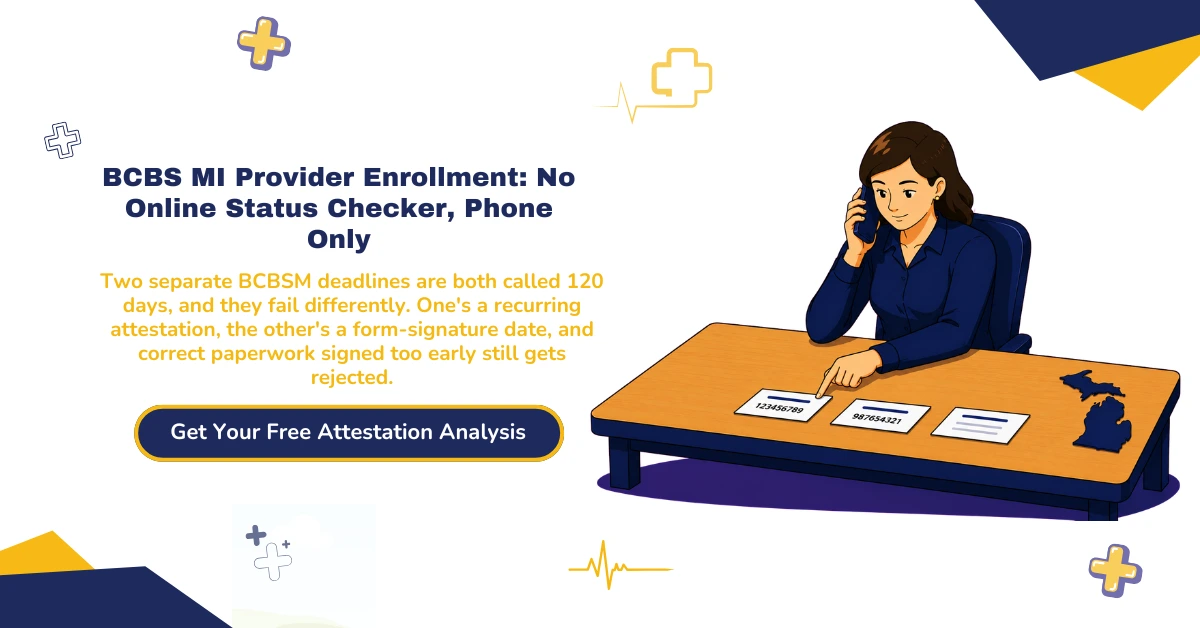
BCBS MI provider enrollment has no online status checker. The BCBSM provider enrollment phone number, 1-800-822-2761, is the only route, and BCBSM asks you to allow 30 days before calling. Have the NPI, group tax ID or last four of the SSN, and primary address ready.
Other Blues plans handle this in a browser. Blue Cross and Blue Shield of New Mexico runs a Credentialing Status Checker that takes an NPI or license number. Texas publishes its own checkers. Michigan publishes a BCBSM credentialing phone number instead.
If you’ve searched for a Michigan status portal and come up empty, that’s your answer. BCBSM hasn’t built one, and more searching won’t surface it.
Wait 30 days before you dial
BCBSM asks providers to allow 30 days for processing before requesting a status update on BCBSM provider enrollment. Call on day 12 and the representative has nothing new to tell you. Your call adds volume to the queue you’re waiting on.
Three items the representative needs
Bring all three or the call fails. BCBSM lists these BCBSM status inquiry requirements for each provider named on the enrollment form, and the BCBSM provider enrollment phone number gets you nowhere without them:
- The NPI
- The group tax ID number, or the last four digits of each provider’s Social Security number
- The provider’s primary address and phone number
Missing one of the three and the representative can’t open the record that carries your Blue Cross Blue Shield of Michigan provider number. A rep will turn away a caller who has an NPI but no tax ID.
The decision arrives by mail
BCBSM sends the outcome by mail. Letters arrive at each stage of enrollment and credentialing, and each one carries your network status. You can bill only for networks where the letter lists you as Active.
A stale address on file breaks the mechanism. Your decision letter goes to an office you left two years ago, the file sits in approved status, and your biller keeps holding claims. That second call to the BCBSM credentialing phone number is the one you could have avoided.
What keeps your BCBSM enrollment active after approval?
Four separate deadlines keep BCBS MI provider enrollment active. You attest to directory data every 90 days even when nothing changes. Practitioners attest to additional data every 120 days. Recredentialing forms need a signature dated within 120 days of the request. Full recredentialing runs every three years.
| Deadline | Interval | What it covers |
|---|---|---|
| Directory data attestation | Every 90 days | Provider directory information, even when nothing changed |
| Additional data attestation | Every 120 days | Data elements beyond the directory, including credentialing and licensing, for practitioners |
| Recredentialing form dating | Within 120 days of the request | The signature date on required recredentialing forms |
| Recredentialing | Every three years | The full recredentialing cycle |
Two deadlines say 120 days and they aren’t the same rule
Practitioners hit the 120-day attestation on a recurring cadence. The other 120 is a dating requirement: a required recredentialing form must carry a signature dated within 120 days of BCBSM’s request.
Sign that form four months before you mail it and BCBSM rejects it on the date alone. Correct contents won’t save it. One number covers two rules with two different failure modes.
Two portals, split by provider type
Practitioners attest through the CAQH Provider Data Portal, with support on 1-888-599-1771. Organizational providers attest through Availity Essentials, with support on 1-800-281-4548. BCN provider enrollment follows the same requirements, since Blue Cross and BCN share the process.
Keep the profile current between cycles and attestation takes minutes. Practices that let CAQH profile management slide spend the window chasing expired malpractice certificates.
Federal law sets the 90-day clock
Federal law drives the 90-day rule. The federal provider directory requirement at 42 U.S.C. 300gg-115 obligates plans and issuers to verify and update provider directory information not less than once every 90 days, for plan years beginning on or after January 1, 2022.
BCBSM carries that obligation, so BCBSM pushes the work down to you. Your attestation is how the plan meets its own federal deadline. BCBSM publishes the consequence under BCBSM attestation requirements.
The cost of a missed attestation
BCBS Michigan provider enrollment carries two stated consequences for a missed attestation. BCBSM removes you from the provider directory, which drops you out of the search results patients use to find BCBSM network providers. A lapse may also affect the plan’s ability to process your claims.
EFT sits downstream of all this. Your BCBS Michigan EFT enrollment can be perfect and your bank details current, and none of that helps if BCBSM can’t process the claim. The deposit stops upstream of the payment rail.
Submit changes the day they happen
BCBSM tells BCBSM network providers to make changes when they occur instead of waiting for the next attestation date. Attestation confirms what’s already on file. A new address goes in the day your lease starts.
Four clocks run at once, and in most practices four different people own them. ClaimMax tracks attestation and recredentialing dates across your active payer roster, and the free analysis surfaces up to three specific gaps in your own billing data.
What changed for out-of-state physicians enrolling in Michigan?
Michigan rejoined the Interstate Medical Licensure Compact through Public Act 6 of 2026, effective March 26, 2026, four years after repealing the prior provision. Under the Compact, qualifications already primary source verified by your state of principal license don’t get verified again for expedited Michigan licensure.
History matters here. Public Act 38 of 2022 repealed Michigan’s prior Compact provision at the same section, and Michigan sat outside the Compact until Governor Whitmer signed House Bill 5455 on March 26, 2026.
The expedited license pathway
A physician using the Compact files an application for an expedited license with the member board of the state chosen as the state of principal license. That board evaluates eligibility and issues a letter of qualification to the Interstate Commission.
The provision that matters for credentialing sits in Section 5 of the Compact text, enacted at Michigan Compiled Laws 333.16189. Static qualifications, including verification of medical education, graduate medical education, and results of any medical or licensing examination, aren’t subject to additional primary source verification where the state of principal license already verified them.
The Compact stops at licensure
The Compact governs state licensure, and it stops there. BCBSM still runs its own credentialing with its own primary source verification through CAQH, and BCN provider enrollment doesn’t change either.
Payer credentialing and contracting support stays on its own timeline regardless of how you got licensed. The Compact changes one thing: how fast you reach the Michigan license that BCBSM enrollment requires.
Run both tracks at once. A physician relocating from out of state can submit the BCBS MI provider enrollment form 30 days before their start date, and Compact licensure moves faster than standard licensure. Starting both on the same day compresses the total timeline.
Compact eligibility includes a certification gate. You need a specialty certification or a time-unlimited specialty certificate recognized by the American Board of Medical Specialties or the American Osteopathic Association’s Bureau of Osteopathic Specialists. A physician without one falls back to standard Michigan licensure.
Questions Michigan providers ask that the standard guides skip
My BCBSM application was rejected and the letter didn’t say why. Is that allowed?
Not for a Blue Care Network application. MCL 500.3531 sits in the health maintenance organization chapter of Michigan’s Insurance Code, and it requires an HMO that rejects an applicant to state the reasons in writing, citing one or more of its standards.
BCN is a Michigan HMO, so the statute reaches BCN and doesn’t reach BCBSM’s non-HMO commercial products. BCBSM’s own enrollment page says your decision letter states why, so call 1-800-822-2761 if yours didn’t.
Can I submit my BCBSM enrollment form before I finish residency?
Yes. New graduates can submit an enrollment form to BCBSM up to 60 days before finishing training. Pair that with the CAQH deadline: BCBSM requires attestation within 14 days of submitting the enrollment form.
A form sent 60 days early puts your CAQH clock at day 46 before training ends. Blue Cross Blue Shield of Michigan provider enrollment moves on both deadlines at once.
Is BCBSM’s payer ID the same as my provider number?
No. The Blue Cross Blue Shield of Michigan payer ID routes an electronic claim to BCBSM, and your Blue Cross Blue Shield of Michigan provider number identifies you inside BCBSM’s system and arrives with your enrollment decision.
Confirm your Blue Cross Blue Shield of Michigan payer ID with your clearinghouse, since the value differs between clearinghouses. Neither identifier sets your rate; that sits in the BCBSM fee schedule attached to your contract.
Does BCBSM have an online tool to check enrollment status?
No. BCBSM runs no online enrollment or credentialing status checker. Status comes by phone on 1-800-822-2761, after you allow 30 days for processing, with the NPI and the group tax ID or last four digits of the Social Security number ready.
Other Blues plans publish status checkers you can use in a browser. Michigan doesn’t, and searching for the Michigan version wastes the afternoon.