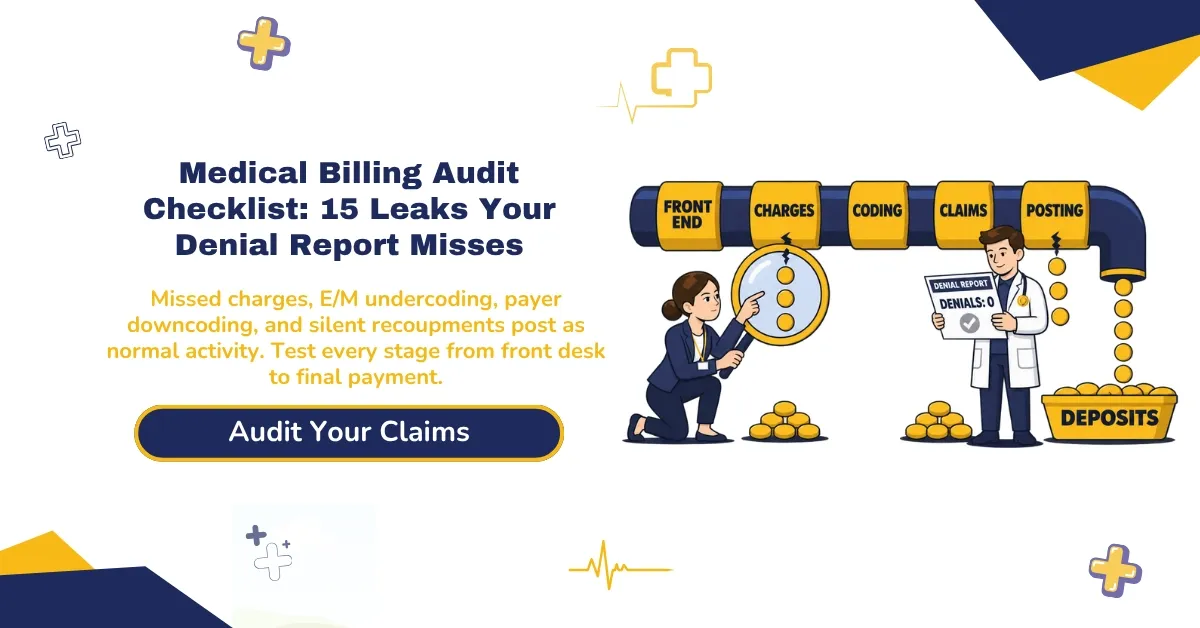
Your schedule was full last quarter. Deposits stayed flat, and the denial report shows nothing big enough to explain the gap. You close that gap with a medical billing audit checklist: you follow each claim from the front desk to the final payment and mark where the money slipped out.
Some leaks produce denials, and your team sees them. Others never trigger one. Missed charges, E/M undercoding, payer downcoding, and silent recoupments all post as normal activity, so they stay off the reports most owners read each month.
Below you’ll find the 15 leaks we check first, grouped by stage. Each one comes with a definition, the remittance code or report that exposes it, a quick test, and the person who owns the fix. It’s the same medical billing audit the ClaimMax RCM team runs for practices.
What Does a Medical Billing Audit Checklist Cover?
A medical billing audit checklist is a structured review that follows each claim from eligibility to final payment to find revenue a practice earned but didn’t collect. It covers 15 leaks across five stages: front-end, charge capture and documentation, coding, claims, and payment posting and A/R.
A coding review looks at one of those stages. A full audit tests all five, then repeats on a schedule, because leaks return whenever staff, payers, or code sets change. The table below maps every leak to its stage, its warning signal, and the person who should own it.
Why Practice Owners Miss These Revenue Leaks
Most practice owners judge billing by two numbers: the denial rate and the bank deposit. Plenty of leaders agree with you. In a January 6, 2026 MGMA Stat poll of 288 medical group leaders, 48% named denials and appeals as their biggest revenue cycle leak.
Several leaks never reach the denial report at all. A payer can pay a 99214 at the 99213 rate, and your remittance shows an adjustment instead of a denial. Missed charges, undercoding, underpayments against contract, recoupments, and secondary claims that never went out behave the same way.
You’ll also see vendor estimates claiming practices lose a set share of revenue to leakage. Treat those numbers with caution. None of the primary sources we checked, including CMS, MGMA, and HFMA, publishes a figure for revenue leakage in healthcare at the practice level, so your own claim data is the baseline worth trusting.
Signs you need a medical billing audit soon:
- Collections stay flat while visit volume grows
- The same denial code shows up month after month
- Your share of A/R over 90 days keeps climbing
- Nobody compares payments against contracted rates
- Coding hasn’t had an outside review in the past 12 months
Common medical billing errors explain part of that list. Several leaks on it start in the handoffs between the front desk, coders, billers, and payment posters, though. Our revenue cycle management services begin with a full audit for that reason, testing each handoff from scheduling to a zero balance.
The 15 Revenue Leaks at a Glance
Run this medical billing audit checklist against your last 90 days of claims and mark each row pass or fail. Start with the rows marked “No” in the denial column. Those leaks never surface on a denial report, so nobody on your team has had a reason to look for them.
The signal column lists a claim adjustment reason code (CARC) where one applies. A CARC is the standard code a payer puts on a remittance to explain why it paid a claim or line at a different amount than you billed. You can check any code on the X12 claim adjustment code list.
| # | Leak | Stage | Shows as a denial? | Signal to look for | Owner | Pass/Fail |
|---|---|---|---|---|---|---|
| 1 | Insurance verification and COB failures | Front-end | Yes | CARC 27, 22, 31 | Front desk lead | ☐ |
| 2 | Missing or expired prior authorizations | Front-end | Yes | CARC 197 | Authorization coordinator | ☐ |
| 3 | Credentialing and enrollment gaps | Front-end | Yes | CARC B7 | Credentialing coordinator | ☐ |
| 4 | Unbilled encounters and missed charges | Charge capture | No | Completed visits with no charge | Practice manager | ☐ |
| 5 | Charge lag and late superbills | Charge capture | Only later, as CARC 29 | Charge lag days | Billing manager | ☐ |
| 6 | Documentation that doesn’t support the claim | Documentation | Later, as records requests or recoupments | CARC 50, 252, 16 | Compliance lead | ☐ |
| 7 | E/M undercoding out of audit fear | Coding | No | E/M level distribution | Coding lead | ☐ |
| 8 | Modifier and NCCI bundling errors | Coding | Yes | CARC 4, 97, 151 | Coder | ☐ |
| 9 | Outdated CPT and ICD-10 codes | Coding | Yes | CARC 181, 146 | Coding lead and EHR administrator | ☐ |
| 10 | Clearinghouse rejections nobody works | Claims | No, a rejection isn’t a denial | Rejected 999 and 277CA reports | Billing specialist | ☐ |
| 11 | Denials written off without appeal | Claims | Yes, then dropped | Denials with no appeal date | Denial specialist | ☐ |
| 12 | Timely filing write-offs | Claims | Yes, too late to fix | CARC 29 | Billing manager | ☐ |
| 13 | Underpayments and automatic payer downcoding | Payment posting | No | CARC 45 variance, CARC 150 | Payment poster | ☐ |
| 14 | Recoupments and credit balances on your ERAs | Payment posting | No | PLB codes WO and FB on the 835, credit balance report | Payment poster and compliance lead | ☐ |
| 15 | Aged A/R and secondary claims that never went out | A/R | No | Primary paid, no secondary claim on file | A/R specialist | ☐ |
| Need someone to run these 15 checks on your claims?Send us 90 days of claims and remittances. Our team works through this checklist leak by leak and sends back a written report with the claims and dollars behind every finding.Book a free billing audit → |
Front-End and Eligibility Leaks
Front-end leaks start before a claim exists, at scheduling, check-in, and enrollment. In that same January poll, MGMA’s respondents ranked front-end issues second, at 23%. Fix these first in your medical billing audit checklist, since every later stage carries the same error forward.
Leak 1: Insurance Verification and COB Failures
Insurance verification and coordination of benefits (COB) failures happen when staff don’t confirm active coverage at scheduling and again at check-in, or enter secondary coverage in the wrong order. The claim then goes to an inactive plan or to the wrong payer.
Your billers rework these denials one claim at a time, so nobody sees the pattern. Picture a patient who switched employer plans on the first of the month. The front desk bills the card on file, and three weeks later the denial lands in someone’s queue.
- Shows as a denial: Yes
- Signal: CARC 27 (coverage terminated), 22 (another payer may be primary), 31 (patient not identified as insured)
- Report to pull: denials carrying those three codes over the last 90 days
- Quick test: pick 20 visits from last week and confirm a saved eligibility response for each date of service
- Owner: front desk lead
Check eligibility at scheduling and again at check-in, and ask about other coverage at every visit. For Medicare patients, complete the Medicare Secondary Payer questionnaire. If your front desk can’t keep up, insurance eligibility verification is one of the easiest pieces of the cycle to hand off.
Leak 2: Missing or Expired Prior Authorizations
Missing or expired prior authorizations occur when a service needed payer approval that’s absent, out of date, or mismatched to the billed CPT code, units, or dates of service. The payer denies the claim even though the care was appropriate.
Prior authorization denials don’t always come from a skipped request. Sometimes your staff got the approval and the number never made it onto the claim. Other times a patient used up the approved visits halfway through therapy, and nobody tracked the count.
Rules changed on January 1, 2026. Under the CMS prior authorization final rule (CMS-0057-F), Medicare Advantage, Medicaid, and CHIP plans must decide expedited requests within 72 hours and standard requests within seven calendar days, and they must give a specific reason for a denial. Commercial employer plans fall outside the rule.
- Shows as a denial: Yes
- Signal: CARC 197 (precertification or authorization absent)
- Report to pull: last month’s claims for services that needed authorization
- Quick test: on 10 claims, match the authorization number, CPT code, units, and dates to the approval
- Owner: authorization coordinator
Log the date and time of every request, and escalate any that pass the payer’s deadline. Check the approval again whenever a scheduled procedure changes. Our guide on eligibility vs prior authorization explains where each check belongs in your intake workflow.
Leak 3: Credentialing and Enrollment Gaps
Credentialing and enrollment gaps occur when the rendering provider isn’t enrolled and active with the payer on the date of service, or when the location or taxonomy on file doesn’t match. The payer denies the claim or pays it at out-of-network rates.
A new physician starts seeing patients before the payer’s effective date, and the practice holds those claims until enrollment clears. Nobody sets an alarm on the hold. Weeks later, someone opens the queue and finds claims sitting past the filing limit.
- Shows as a denial: Yes
- Signal: CARC B7 (provider not eligible to be paid for this service on this date)
- Report to pull: a grid of each provider against your top 10 payers, with effective dates
- Quick test: compare each provider’s first date of service with each payer’s effective date
- Owner: credentialing coordinator
Start enrollment before a new provider’s first clinic day, track revalidation dates on a shared calendar, and write a filing deadline next to every held claim. If you add providers each year, our credentialing and contracting services keep enrollment dates and claim holds on one calendar.
Charge Capture and Documentation Leaks
The first two leaks in this stage never produce a claim, so they can’t produce a denial. The third produces a claim that pays now and fails later, once a reviewer reads the chart. Give this part of your medical billing audit checklist extra time.
Leak 4: Unbilled Encounters and Missed Charges
Unbilled encounters and missed charges occur when a provider performs and documents a service, but no charge ever reaches a claim. The visit happened and the note exists, yet the practice never bills for it.
Nothing denies, so nothing alerts you. Open or unsigned notes never release to billing, and in-office extras slip through. A common example: the note documents an injection, the drug supply code never drops, and you collect for the administration while losing the drug.
- Shows as a denial: No
- Signal: completed appointments with no charge attached
- Report to pull: open or unsigned encounters, plus completed visits matched against posted charges
- Quick test: compare yesterday’s completed visits with yesterday’s charges
- Owner: practice manager and providers
Run a charge capture audit every day by matching the schedule to posted charges. Clear open encounters each Friday before providers leave, and confirm that injections, supplies, and in-office procedures map to charge codes in your EHR.
Leak 5: Charge Lag and Late Superbills
Charge lag is the number of days between the date of service and charge entry. Late superbills and slow note signing stretch that gap, which delays cash and pushes each claim closer to the payer’s filing limit.
Because the claim does go out, nobody flags the delay. You feel it only when a payer with a short filing window denies a claim as late. HFMA tracks this measure as Total Charge Lag Days in its MAP Keys, alongside clean claims and A/R.
- Shows as a denial: only later, as CARC 29
- Signal: charge lag days by provider
- Report to pull: date of service against charge entry date for every claim
- Quick test: find each provider’s median lag and list every claim past your internal limit
- Owner: billing manager
Write down an internal charge entry deadline, then report every exception against it each week. Our medical billing services team enters charges from your EHR, so the lag doesn’t depend on who’s out sick that week.
Leak 6: Documentation That Doesn’t Support the Claim
Documentation that doesn’t support the claim means the note can’t prove the service, the level billed, or the medical necessity. The payer pays now, then denies or recoups the money after a reviewer reads the record.
CMS measures this every year. Its CMS FY 2025 improper payment data put the Medicare fee-for-service improper payment rate at 6.55%, or $28.83 billion. CMS reports that most of those improper payments involved insufficient documentation, and it notes that this kind of error doesn’t by itself point to fraud or abuse.
The CMS fact sheet on CMS documentation requirements (MLN909160) lists common errors that reviewers find: incomplete progress notes, records with no provider signature, and no order or intent to order when Medicare policy requires one. The damage arrives months after payment, as a records request or a takeback (see Leak 14).
- Shows as a denial: later, as a records request or recoupment
- Signal: additional documentation requests, plus CARC 50, 252, or 16 with a remark code
- Report to pull: every records request from the last 12 months
- Quick test: check 10 charts per provider for a signature, an order where required, and support for the level billed
- Owner: compliance lead
Build EHR template prompts that won’t let a note close without these elements, and coach providers one chart at a time. Audit the same providers again in 60 days to confirm the habit stuck.
Coding and Compliance Leaks
Coding leaks run in both directions. Undercoding costs you money on every visit. Overcoding pays now, and payers take it back later. A medical coding audit covers this slice of the review, and the three leaks below work as a short medical coding audit checklist inside your larger medical billing audit checklist.
Leak 7: E/M Undercoding Out of Audit Fear
E/M undercoding happens when a provider bills a lower evaluation and management level than the medical decision making or total time supports, in most cases to avoid drawing a payer’s attention.
An undercoded claim pays without a fuss, so no report flags it. MGMA’s commentary on its January poll pointed to undercoding, with E/M services at the top of the list, as a big part of the coding leak practices report.
Medicare’s 2026 national non-facility rate is $95.19 for 99213 and $135.61 for 99214, a gap of $40.42 per visit before geographic adjustment. If one provider codes five supportable 99214 visits a day as 99213, four days a week for 48 weeks, that’s about $38,800 a year in Medicare allowed amounts.
You can confirm both rates, and your local version of them, in the CMS fee schedule lookup. Our breakdown of 99214 Medicare reimbursement walks through the RVUs behind the 2026 numbers.
- Shows as a denial: No
- Signal: each provider’s E/M level distribution
- Report to pull: E/M levels by provider for the last 90 days
- Quick test: rescore 10 of each provider’s 99213 notes against the current AMA E/M guidelines
- Owner: coding lead
Review charts with each provider, one note at a time, and point to the places where the documentation already supports the higher level. Include overcoded notes in the same session so the education stays balanced and defensible.
Leak 8: Modifier and NCCI Bundling Errors
Modifier and NCCI bundling errors occur when a modifier is missing, wrong, or added out of habit, or when a coder bills two codes on their own lines that the National Correct Coding Initiative (NCCI) bundles together. The line then denies or pays less.
Modifier 25 ends up on every same-day E/M and procedure because a template adds it. Modifier 59 goes on claims where an X modifier (XE, XS, XP, or XU) fits better, if the payer accepts them. Imaging groups lose money when the 26 or TC split is missing.
CMS updates the CMS NCCI edits files for procedure-to-procedure (PTP) pairs and medically unlikely edits (MUEs) every quarter. A claim scrubber your team set up last year is already out of date.
- Shows as a denial: Yes
- Signal: CARC 4 (code inconsistent with the modifier), 97 (included in another service), 151 (units or frequency not supported)
- Report to pull: denials carrying those three codes
- Quick test: pull 10 claims with modifier 25 or 59 and confirm each note supports a separate service
- Owner: coder
Load the current quarter’s edits into your scrubber and write a modifier policy for each specialty you bill. Our guide to modifier 59 rules covers the cases where an X modifier is the better choice.
Leak 9: Outdated CPT and ICD-10 Codes
Outdated CPT and ICD-10 codes are deleted or invalid codes still sitting in EHR favorites, superbills, or the charge master. The payer denies the line on the code alone, no matter how good the documentation is.
Two updates matter right now. According to the CMS FY 2027 ICD-10 files, the new code set applies to encounters from October 1, 2026 through September 30, 2027. The AMA released the AMA CPT 2027 code set on September 9, 2026, with 299 new, 74 revised, and 80 deleted codes, effective January 1, 2027.
The global maternity care codes are among the 2027 deletions. The AMA states that deleted codes are invalid for dates of service on or after January 1, 2027, and that claim systems and clearinghouses should reject them.
- Shows as a denial: Yes
- Signal: CARC 181 (procedure code invalid on the date of service) and 146 (diagnosis invalid for the date of service)
- Report to pull: denials carrying these codes since October 1, 2026
- Quick test: export your superbill and EHR favorites and compare them with the 2027 deleted code list
- Owner: coding lead and EHR administrator
Schedule a code set review before each January, April, July, and October update, and remove deleted codes from favorites the same week. Keep a dated copy of each change so you can show a payer when you made it.
| Not sure your E/M levels match your notes?Our coders rescore a sample of each provider’s notes against current AMA E/M guidelines, then test modifiers and code sets against this quarter’s edits. You get the findings in writing, with the claims behind each one.Get a free revenue cycle audit → |
Claims and Clearinghouse Leaks
A rejection means the payer never accepted the claim. A denial means the payer processed it and refused to pay. Your team works the two in different systems, and rejections fall into the gap between them. This stage of the medical billing audit checklist covers both.
Leak 10: Clearinghouse Rejections Nobody Works
Clearinghouse rejections happen when the clearinghouse or the payer’s front end bounces a claim before adjudication. The payer never records it, no denial exists, and the filing clock keeps running.
Rejections live in the clearinghouse portal instead of on the denial report in your practice management system. Staff open them, plan to fix them later, and the claims sit there until someone runs into the filing deadline.
- Shows as a denial: No
- Signal: rejected 999 and 277CA acknowledgments from the clearinghouse
- Report to pull: the clearinghouse rejection report for the last 30 days, sorted by age
- Quick test: list every rejection older than your written limit and check whether a corrected claim went through
- Owner: billing specialist
Work rejections every business day and fix the cause where it started, which in most cases means registration data or a scrubber edit. Our clearinghouse rejections guide lists the common rejection codes and what each one means.
Leak 11: Denials Written Off Without Appeal
Denials written off without appeal are denials your team could have contested but adjusted off the account instead. The balance disappears from A/R, and the revenue goes with it.
A write-off closes the account, so the denial looks resolved on every report. If nobody reviews adjustments by user and reason code, these write-offs stay invisible to you and to your billing manager.
- Shows as a denial: Yes, then the team drops it
- Signal: denials with no appeal date, and write-offs without supervisor approval
- Report to pull: your denial log matched to your appeal log, plus an adjustment report by user and reason
- Quick test: take 20 denials written off last quarter and mark which were appealable and still inside the payer’s deadline
- Owner: denial specialist
Require supervisor approval for write-offs above a dollar amount you set, and store each payer’s appeal deadline in your system. Our denial management services team tracks those deadlines payer by payer, so appeals reach the payer before the window closes.
Leak 12: Timely Filing Write-Offs
Timely filing write-offs happen when a claim reaches the payer after its filing deadline. The payer denies it for good, and even perfect coding can’t rescue it at that point.
Medicare sets its limit in federal regulation. Under 42 CFR 424.44, you must file a Medicare claim no later than one calendar year after the date of service, with a few narrow exceptions. Commercial and Medicaid limits come from your contracts and state rules, and many of them run shorter.
Claims parked in credentialing holds, authorization holds, or unworked rejections age without anyone watching the calendar. Leaks 3, 5, and 10 feed this one.
- Shows as a denial: Yes, too late to fix
- Signal: CARC 29 (the time limit for filing has expired)
- Report to pull: unbilled, held, and rejected claims with the days left before each payer’s limit
- Quick test: sort open claims by days left and flag anything inside your alert window
- Owner: billing manager
Load each payer’s filing limit into your practice management system and set an alert that fires 30 days before the deadline. Medicaid limits change from state to state, and our guide to Medicaid timely filing rules lists them.
Payment Posting and A/R Leaks
A claim marked “paid” isn’t always paid in full. This stage of your medical billing audit checklist tests revenue integrity after adjudication: whether each payment matches your contract, whether a payer took money back, and whether your team billed every balance to the right payer.
Leak 13: Underpayments and Automatic Payer Downcoding
Underpayments and automatic payer downcoding occur when a payer pays less than your contracted rate for the billed code, or reprices a higher E/M level to a lower one. Your remittance shows an adjustment, and no denial ever appears.
Payer downcoding became a live issue in 2025. Cigna’s policy R49, effective October 1, 2025, let Cigna lower 99204 and 99205, 99214 and 99215, and 99244 and 99245 by one level when its claim criteria didn’t support the billed level.
Maryland pushed back. In March 2026, the Maryland Insurance Administration fined Cigna $80,000 and ordered it to stop automatic downcoding. Its Maryland Bulletin 26-9, dated April 7, 2026, states that downcoding isn’t permitted under § 15-1005 of the state Insurance Article. Rules differ by state, so check with your own insurance regulator.
- Shows as a denial: No
- Signal: CARC 45 adjustments larger than your contract allows, and CARC 150 (the payer says the information doesn’t support this level of service)
- Report to pull: ERA line detail comparing the billed code, paid code, and allowed amount with your contract rate
- Quick test: compare 50 paid claims for your top codes with one major payer against its contract
- Owner: payment poster
Load contract rates into your practice management system so posters see the variance at posting. Appeal with the contract in hand, and where state law bans downcoding, file a complaint. Our payment posting services flag underpayments line by line against your payer contracts.
Leak 14: Recoupments and Credit Balances on Your ERAs
Recoupments happen when a payer takes money back for an older claim out of a current payment. Credit balances are overpayments your practice is holding and may owe back. Both leave your books showing cash you don’t have.
Takebacks are climbing. Kodiak Solutions benchmarking data shows payer takebacks rose to 1.57% at the start of 2026, up from 1.38% a year earlier, even as initial denial rates fell.
On the 835, these takebacks appear as provider-level adjustments, and the X12 provider adjustment codes define WO as “Overpayment recovery amount” and FB as a balance carried forward that isn’t tied to one claim.
Credit balances carry a compliance clock. Under 42 CFR 401.305, you must report and return an identified Medicare overpayment within 60 days. A timely, good-faith investigation can pause that deadline for up to 180 days, and the rule reaches back six years.
Payment posters post the net check amount and move on. Nobody traces the deduction back to the original claim, and the credit balance report sits unopened until an auditor asks for it.
- Shows as a denial: No
- Signal: PLB codes WO and FB on the 835, plus your credit balance report
- Report to pull: every provider-level adjustment from the last 90 days, and credit balances by age
- Quick test: trace 10 recoupments to the original claim and decide whether each one was valid
- Owner: payment poster and compliance lead
Keep a recoupment log, dispute takebacks that don’t hold up, and refund valid credit balances inside the 60-day window. Write down the date you identified each one, since that date starts the clock.
Leak 15: Aged A/R and Secondary Claims That Never Went Out
Aged A/R and unsent secondary claims are balances that sit past 90 days with no owner, or primary payments where nobody billed the secondary payer. Sometimes your statement goes to the patient for money the secondary plan owed.
Total A/R can look steady while the old buckets grow underneath it. HFMA tracks this with its MAP Key AR-1, aged A/R as a percentage of billed A/R, so you can see the old money apart from the new.
- Shows as a denial: No
- Signal: A/R over 90 days by payer, and primary payments with a balance but no secondary claim
- Report to pull: aging by payer and bucket, plus primary-paid claims with no secondary claim on file
- Quick test: for your 20 oldest balances, name the owner, the last touch, the next action, and the deadline
- Owner: A/R specialist
Build a work queue for each aging bucket and set a written threshold for A/R over 90 days by payer. Add an automatic check that every primary payment with a remaining balance has a secondary claim attached.
| Paid claims still leaking money?We compare your remits with your payer contracts, trace each takeback to its original claim, and sort every balance past 90 days by owner and next action.Start with a free A/R aging audit → |
Which KPIs Show a Leak Before It Grows?
KPIs tell you where to look, and the checklist tells you why the number moved. Track these eight with fixed formulas so a change in the number reflects a change in your billing rather than in how someone ran the report.
No regulator sets targets for these measures. The HFMA MAP Keys define several of them, and the targets in the last column are industry convention. Trend each KPI against your own baseline before you compare yourself with anyone else.
| KPI | How it’s defined | What a leak looks like | Flags leaks | Common target (industry convention) |
|---|---|---|---|---|
| Clean claim rate | HFMA CL-1: claims passing edits with no manual intervention, divided by claims accepted into the claims tool | Rate falls, or swings from payer to payer | 1, 8, 9, 10 | 95% or higher |
| Initial denial rate | Denied claims divided by claims submitted, by payer and CARC | The same CARC repeats | 1, 2, 3, 8, 11 | Under 5% |
| Charge lag days | HFMA PB-4: Total Charge Lag Days | Lag grows for one provider | 4, 5 | Your own baseline |
| Net days in A/R | HFMA FM-1: net A/R divided by average daily net patient service revenue | Rising trend | 15 | Your own baseline |
| Aged A/R share | HFMA AR-1: aged A/R as a percentage of billed A/R | Old buckets grow while total A/R looks flat | 12, 15 | Your own baseline |
| Net collection rate | Payments divided by charges minus contractual adjustments | Drops while visit volume holds | 13, 14 | 95% or higher |
| Underpayment variance | Lines paid below contract divided by paid lines | Persistent variance with one payer | 13 | Your own baseline |
| Appeal overturn rate | Overturned denials divided by appealed denials | Low appeal volume, beyond a low overturn rate | 11 | Your own baseline |
If your clean claim rate slips, our clean claim rate formula guide shows how to calculate it the same way every month, so a drop points to billing and not to the math.
How to Run a Medical Billing Audit Without Stopping Billing
Run the medical billing audit checklist in two passes: reports first, then charts. Reports tell you where to point the chart review, and that order is the fastest way to learn how to audit medical billing without pulling staff off the claims they’re working today.
Pick a Sample That Finds Patterns
Sample by risk: your top codes by volume and dollars, your top payers, and every provider. A fixed sample of 10 to 20 encounters per provider, kept the same each cycle, gives you results you can compare. Include paid claims too, because underpayments only show up on claims that paid.
Set a Cadence Your Team Can Keep
None of these intervals comes from a regulation. They split the medical billing audit checklist into a rhythm that catches fast leaks within a month and slow leaks within a year:
- Monthly: rejections, denials, posting variances, and recoupments
- Quarterly: one rotating deep review, such as a coding sample, a contract variance check, or a charge capture audit
- Yearly: a full RCM audit across all 15 leaks
- After a trigger: a new EHR or practice management system, a new provider, a payer contract change, or the October 1 and January 1 code updates
Decide Who Audits: Internal or External
Your own team knows the workflow but can miss its own blind spots. An outside medical billing audit adds independence and payer experience. OIG’s OIG compliance program guidance lists risk assessment, auditing, and monitoring as one of the seven elements of a compliance program.
If an outside reviewer will see patient records, sign a Business Associate Agreement first, and ask for auditors who hold AAPC credentials such as CPC or CPMA. Our revenue cycle audit services follow that setup, with a written report at the end.
What Changed in 2026 and What’s Coming in 2027
Update your medical billing audit checklist on the dates below. Each change touches at least one leak above, and a missed update shows up later as healthcare revenue leakage. Treat each date as a trigger for a short medical billing compliance audit.
- January 1, 2026: CMS-0057-F decision timeframes started for Medicare Advantage, Medicaid, and CHIP plans (Leak 2).
- January 1, 2026: The CMS 2026 fee schedule rule set two conversion factors, $33.57 for qualifying APM participants and $33.40 for everyone else, plus a 2.5% downward efficiency adjustment for services that aren’t time-based. E/M, care management, behavioral health, and Medicare telehealth list services are exempt (Leaks 7 and 13).
- March and April 2026: Maryland fined Cigna and issued Bulletin 26-9 against automatic downcoding (Leak 13).
- October 1, 2026: The FY 2027 ICD-10-CM code set took effect for encounters through September 30, 2027 (Leak 9).
- January 1, 2027: CPT 2027 takes effect, deleted global maternity codes become invalid, and most CMS-0057-F API requirements begin (Leaks 2 and 9).
- Before January 1, 2027: Check the CY 2027 Physician Fee Schedule final rule on CMS.gov and load the new rates before your first 2027 posting (Leak 13).
What to Do After the Audit
Sort every finding into one of four groups: confirmed loss, recoverable before a deadline, contractual (not a leak at all), and compliance risk. Handle compliance items first, because the 60-day overpayment clock may already be running. Then chase recoverable dollars nearest their deadlines, and fix processes last.
A simple medical billing audit template keeps the follow-through honest. Turn your medical billing audit checklist into a worksheet with these columns, and give every row a name and a date:
| Column | What to record |
|---|---|
| Leak # | The leak number from the table above |
| Finding | What you found, in one sentence |
| Claims affected | How many claims in the sample showed it |
| Dollars observed | The amount you saw denied, underpaid, or unbilled |
| Root cause | The step where the error started |
| Owner | One named person |
| Due date | When the fix goes live |
| Re-audit date | When you test the same sample again |
| Status | Open, in progress, or closed |
Audit the same sample again in 30 to 60 days. If the numbers didn’t move, your fix treated a symptom, and you need to go one step further upstream. Report the dollars you saw denied or underpaid, and skip forecasts of what you’ll recover.
Medical Billing Audit Checklist FAQs
What does a medical billing audit include?
It reviews every stage of a claim: eligibility, charge capture, documentation, coding, claim submission, payment posting, and A/R. A thorough review also checks compliance items such as signatures, overpayment refunds, and payer contract terms. The 15 leaks in the table above cover each of those areas.
How often should you audit medical billing?
Review fast-moving items such as rejections, denials, and posting variances every month. Rotate a deeper review each quarter, run a full audit once a year, and add a review after any trigger, such as a new EHR, a new provider, or a code set update.
What’s the difference between a billing audit and a medical coding audit?
A coding audit checks whether the codes on a claim match the documentation. A billing audit covers the whole claim life cycle, from eligibility to the final payment, and includes the coding audit as one part. Most practices need both, run on different schedules.
How long does an RCM audit take?
It depends on your claim volume, the scope, and how fast you can export reports. A review built on reports, such as denials, aging, and remits, moves faster than one that requires pulling and reading charts. Start with the report side, then decide which charts to pull.
Can an internal audit trigger a payer audit?
No. Running an internal audit doesn’t notify any payer. If your audit identifies a Medicare overpayment, though, the 60-day clock to report and return it starts at identification. OIG treats regular auditing and monitoring as a core part of an effective compliance program.
What should you do if the audit finds an overpayment?
Report and return it within 60 days of identification under 42 CFR 401.305. A timely, good-faith investigation into related claims can pause that deadline for up to 180 days. If you find a pattern across many claims, talk with healthcare counsel before you refund.
Where does most revenue leakage in healthcare start?
In MGMA’s January 2026 poll, practice leaders named denials and appeals (48%) and front-end issues (23%) as their biggest leaks. The leaks that never appear as denials, such as missed charges, underpayments, and recoupments, start in charge capture and payment posting, where few standard reports look.
Where to Start This Week
You don’t need the full medical billing audit checklist to find your first leak this week. Three reports will show you where to look, and none of them takes more than an afternoon:
- Pull a CARC report for the last 90 days and sort it by count.
- Match yesterday’s completed visits against yesterday’s charges.
- Compare 50 paid claims for your top codes with one payer’s contract.
Before you close each report, write down an owner and a deadline for every finding. If you’d rather have a second set of eyes, our medical billing audit services run the full medical billing audit across all 15 leaks.
| Find your first leak without pulling staff off claimsOur team reviews a sample of your claims against all 15 leaks and sends back a written report, claim by claim, with an owner and a fix for each finding.Request your free revenue cycle analysis → |