The main vision therapy CPT codes are 92065 and 92066. CPT 92065 is orthoptic training performed by a physician or other qualified health care professional. Its counterpart, CPT 92066, is orthoptic training performed by trained staff under that professional’s supervision. You bill one or the other for a session, and CPT bars reporting both on the same date.
Three other code families sit around them. CPT 92060 covers the sensorimotor exam that documents the eye deviation before therapy starts. Some payers accept physical medicine codes such as 97110 and 97530, billed under an occupational therapy plan of care with modifier GO. Digital amblyopia programs use Category III codes.
Payment depends on more than the code. Most commercial payers cover office-based therapy for convergence insufficiency and little else, and many plans exclude it outright. Session caps run out fast. Below you’ll find 2026 Medicare rates, payer rules, documentation checklists, denial fixes, and the 2027 changes to budget for.
Vision Therapy CPT Codes at a Glance: The 2026 Code Set
The 2026 vision therapy CPT codes center on 92065 and 92066 for orthoptic training. Practices add 92060 for sensorimotor testing, 97xxx physical medicine codes under an occupational therapy plan of care, and Category III codes for digital amblyopia programs. The AMA maintains CPT, and each payer decides which of these vision procedure codes it pays.
Vision Therapy Coding Cheat Sheet
Use this optometry billing and coding cheat sheet as a quick reference for the optometry CPT codes tied to therapy. Descriptions are paraphrased, since the AMA owns the full CPT text. Dollar amounts live in the 2026 payment section, so each rate has one home on this page.
| Code | Short description | Who performs it | Billing unit | Key restriction |
|---|---|---|---|---|
| 92065 | Orthoptic training by a physician or QHP | OD, MD, or DO in person | Per session, untimed | Not with 92066, 0687T, or 0688T same day |
| 92066 | Orthoptic training under supervision | Vision therapist, COVT, orthoptist, or technician | Per session, untimed | Not with 92065, 0687T, or 0688T same day |
| 92060 | Sensorimotor exam with interpretation and report | OD or MD | Per exam, both eyes | Separate procedure; check NCCI edits |
| 97110 | Therapeutic exercise | OD, where state scope allows | Each 15 minutes | Modifier GO and plan of care |
| 97112 | Neuromuscular reeducation | OD, where state scope allows | Each 15 minutes | Modifier GO and plan of care |
| 97530 | Therapeutic activities | OD, where state scope allows | Each 15 minutes | Modifier GO and plan of care |
| 97533 | Sensory integrative techniques | OD, where state scope allows | Each 15 minutes | Modifier GO and plan of care |
| 97129, 97130 | Cognitive function interventions | OD, where state scope allows | First 15 minutes; each added 15 minutes | Modifier GO and plan of care |
| 0687T | Online amblyopia program: device, setup, first session | Physician or QHP | Once at start | Category III; not with 92065 or 92066 |
| 0688T | Online amblyopia program: monthly data review and report | Physician or QHP | Per calendar month | Category III; not with 92065 or 92066 |
| 0704T | Eye-tracking amblyopia device: supply, setup, education | Physician or QHP | Once at start | Category III; coverage varies |
| 0705T | Eye-tracking surveillance center support | Technical service | Each 30 days, 18 or more training hours | Category III; coverage varies |
| 0706T | Eye-tracking interpretation and report | Physician or QHP | Per calendar month | Category III; coverage varies |
| 92499 | Unlisted ophthalmological service | OD or MD | Per service | Use only when no code fits |
A common denial on these vision codes starts with a pairing error that a claim scrubber could have caught. Billing 92065 beside 0687T, or sending a 97530 line without GO, brings the claim back on the remittance weeks later. Our medical billing services check code pairs and modifiers before a claim leaves the practice.
Optometrists can bill past 92065 because the AOA places other therapy services under the occupational therapy model of physical medicine and rehabilitation. AOA’s reimbursement guide lays out that model, including modifier GO and the plan of care, in its January 2024 update.
Deleted Codes You Shouldn’t Bill
Four code groups still show up on vision therapy superbills years after the AMA retired them. A deleted code on a 2026 date of service comes back as a CO-181 denial, meaning the code was invalid on that date. Swap each one for its current replacement:
- 97532 (cognitive skills): deleted in 2018; use 97129 and 97130
- 96111 (developmental testing): deleted in 2019; use 96112 and 96113
- 97001 to 97004 (PT and OT evaluations): deleted in 2017; use 97161 to 97168
- 99201 (new patient office visit): deleted in 2021; use 99202 to 99205
Several online guides still list 97532 and 97001 as active. If your EHR picklist or fee schedule came from one of them, clean it out before the January claims go out.
CPT 92065 vs 92066: Who Ran the Session Decides the Code
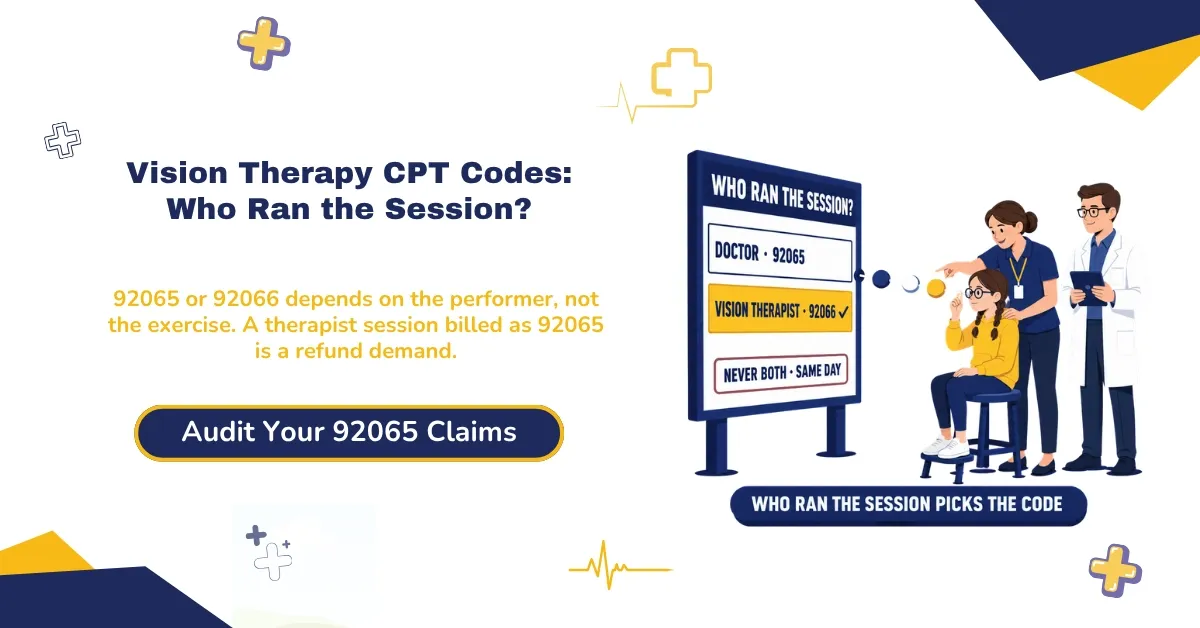
The person who delivered the session decides the code. If the optometrist or ophthalmologist ran it, you bill 92065. A vision therapist or other trained staff member running it under supervision means 92066. Orthoptic training has carried two codes split by performer since January 1, 2023.
| Code | Performer | Same-day restriction |
|---|---|---|
| 92065 | Physician or other QHP, in person | Not with 92066, 0687T, or 0688T |
| 92066 | Staff under physician or QHP supervision | Not with 92065, 0687T, or 0688T |
What Is CPT Code 92065?
CPT code 92065 is orthoptic training performed by a physician or other qualified health care professional. The doctor trains the patient in person through binocular vision exercises during the visit. It’s the vision therapy CPT code most practices billed for each session before 2023, and old charge templates still default to it.
The descriptor changed twice in two years. In 2022, CPT trimmed it from “Orthoptic and/or pleoptic training, with continuing medical direction and evaluation” to “Orthoptic training.” In 2023, the AMA revised 92065 again and added 92066. BCBS Mississippi’s policy history records both changes, which helps when a payer’s table still shows the old wording.
The 92065 CPT code isn’t timed, so you report one unit per session regardless of length. Per the AOA’s reimbursement guide, doctors should still record face-to-face time on the note. Auditors use those minutes to judge whether the doctor delivered the training or a technician did.
92066 CPT Code Description and Who Can Bill It
The 92066 CPT code description is orthoptic training under the supervision of a physician or other qualified health care professional. Per AOA coding guidance on orthoptic training, sessions run by paraoptometrics, vision therapists, certified optometric vision therapists (COVTs), and other non-licensed staff can only be submitted with 92066.
Orthoptists land under 92066 too. The AAO notes they aren’t licensed practitioners, so they can’t report 92065 in their own right. Staff-delivered services raise the same supervision questions covered in our CPT 99211 rules for staff visits, and the chart has to name who did the work.
Some software guides describe 92065 as an evaluation code and 92066 as a follow-up visit. Neither is right. Both codes describe the same training service, and the only difference is the person delivering it. Evaluation work belongs to the exam codes and 92060.
Can 92065 and 92066 Be Billed on the Same Day?
No. CPT parenthetical notes bar reporting 92065 with 92066, 0687T, or 0688T on the same date, and 92066 carries the mirror restriction. If the doctor opened the session and a therapist finished it, bill the one code that matches the person who delivered most of the training, and note the reason in the chart.
The Revenue Gap Between the Two Codes
Staffing drives revenue per session. Per the AOA, when 92066 launched in 2023, 92065 paid about $40.33 per session at the national average, while 92066 carried 0.77 RVUs, or about $25.46. Those are 2023 figures, and the 2026 rates sit in the payment section below.
That gap tempts practices to keep billing therapist sessions as 92065, and a payer audit that compares notes to codes turns it into a refund demand. If your therapists run most sessions and claims still go out as 92065, our team that handles billing for independent practices can flag the mismatch before a payer does.
Testing and Exam Codes Billed Before Therapy Starts
Before therapy starts, you bill the workup: an eye exam (92002 to 92014) or office E/M visit (99202 to 99215), the sensorimotor exam (92060), and sometimes developmental testing. These codes sit outside the vision therapy CPT codes, but they produce the diagnosis and baseline numbers payers check before they approve sessions.
Eye Exam Codes vs E/M Codes for the Workup
Use 92002 or 92004 for new patients and 92012 or 92014 for established ones. Office E/M runs 99202 to 99215, since the AMA deleted 99201 in 2021. Pick the family that fits your documentation, and bill one exam code per visit for the same problem.
Refraction (92015) is a separate service Medicare doesn’t cover, so keep it off the therapy claim and collect it under your financial policy. Plan type matters more. A routine vision plan won’t pay for therapy, so benefit verification has to confirm the medical plan before the first visit.
Plenty of optometry billing errors on therapy cases start at check-in, when the claim defaults to the vision plan on file. In optometry billing, the plan decision comes before the code decision, and the front desk makes it.
92060 CPT Code Description and Billing Rules
The 92060 CPT code description is a sensorimotor examination with multiple measurements of ocular deviation, with interpretation and report, listed as a separate procedure. Payers expect measurements in more than one field of gaze, a documented sensory test such as Worth 4 dot or Maddox rod, and a written interpretation.
CPT 92060 covers both eyes, so you don’t append RT or LT. It carries an XXX global, and the “separate procedure” label lets NCCI bundle it into a larger service on the same day. The AAO’s EyeNet reports that NCCI bundles 99211 into 92060.
CPT sets no frequency cap on the 92060 CPT code. Payers judge medical necessity, which in practice means the initial workup plus documented re-evaluations when the plan of care changes. Check the MUE file for the per-day unit limit instead of trusting a number from a forum thread.
Developmental and Neurobehavioral Testing (96110, 96112, 96113, 96116, 96121)
These codes support visual perceptual workups. Billing them depends on state scope of practice and on the payer, so confirm both before you add them to a therapy evaluation:
- 96110: developmental screening with a standardized instrument
- 96112: developmental test administration, first hour
- 96113: developmental test administration, each added 30 minutes
- 96116: neurobehavioral status exam, first hour
- 96121: neurobehavioral status exam, each added hour
In 2023, the AAO reported no CCI edit between 92066 and 92060. Edits change each quarter, so confirm the pair in the current CMS NCCI edit files before you bill both on one date, and document the exam and the training as separate services.
When 97110, 97112, 97530, and 97533 Fit Vision Therapy
Some payers prefer physical medicine codes over the core vision therapy CPT codes for parts of a program. You bill them under an occupational therapy model: modifier GO on each line, a signed plan of care, and timed 15-minute units. State scope of practice and the payer’s policy decide if an optometrist can bill them at all.
Which 97xxx Code Matches Which Vision Problem
The AOA maps each physical medicine code to a type of vision work. Optometry billing and coding teams new to these codes can use the table below when they build the plan of care, then tie each session note to the code chosen for that work.
| Code | What it describes | Typical vision therapy use |
|---|---|---|
| 97110 | Therapeutic exercise for strength, endurance, range of motion, and flexibility | Convergence and accommodative exercises |
| 97112 | Neuromuscular reeducation of movement, balance, coordination, and proprioception | Eccentric fixation and fixation training |
| 97530 | Dynamic therapeutic activities to improve function | Oculomotor and saccadic work tied to daily tasks |
| 97533 | Sensory integrative techniques | Sensory processing work |
| 97129, 97130 | Cognitive function interventions | Attention and visual processing work after brain injury |
CPT 97530 is a therapeutic activities code for direct, one-on-one dynamic activities that improve functional performance, billed in 15-minute units. In vision therapy, it fits oculomotor and saccadic training tied to reading, sports, or other daily tasks the patient struggles with.
The OT Model Rules: GO, Plan of Care, KX
Under the OT model, each 97xxx line carries modifier GO, and a signed plan of care lists diagnoses, measurable long-term goals, and the type, amount, frequency, and duration of treatment. Medicare treats optometrists as physicians for services their state license allows, which is the legal basis for an OD billing these codes.
Unit math follows Medicare’s 8-minute rule: add the total timed minutes for the day, then convert to units. A 38-minute session split between 97110 and 97530 bills three units. Our guide to occupational therapy CPT codes walks through the same timing rules for OT practices.
Once a patient’s outpatient OT spending passes the 2026 KX threshold of $2,480, each line needs modifier KX to attest that medical necessity is documented. The threshold counts OT from any provider that year, so check the running total at intake. CMS therapy threshold guidance explains how the amount accrues.
Can a Vision Therapist Bill 97xxx Incident To the Doctor?
No, not under Medicare unless the therapist meets occupational therapist qualifications. Section 230.5 of the Medicare Benefit Policy Manual, Chapter 15 requires staff furnishing therapy incident to a physician to meet therapist standards, except licensure. The AOA adds that delegating these codes to vision therapists isn’t covered by Medicare and many other payers.
That rule catches practices billing vision therapy with a staff model built for 92066. A vision therapist can run the session, but the claim then belongs under 92066. Moving the same session to 97530 to collect the higher timed rate is the kind of shift auditors look for.
Can 97110 and 97530 Be Billed Together?
Yes, with separate timed minutes for each, unless the current quarter’s NCCI procedure-to-procedure file lists an edit for the pair. If an edit exists with modifier indicator 1, distinct time blocks plus modifier 59 or XU can apply. As of October 2026, we couldn’t verify a published NCCI edit between these two codes.
Commercial payers can run their own edits, so check the payer’s policy before you assume the pair pays. Our breakdown of modifier 59 and X modifiers covers indicator rules and the documentation each modifier needs before you append it.
Payer policy can override all of this. Premera’s policy treats neuro-visual rehabilitation after brain injury as investigational, even when billed with 97110 or 97530, and it sends outpatient physical medicine requests for vision therapy to care management review before approval.
Tracking each patient’s running OT total against the KX threshold is weekly work, and it slips when the front desk gets busy. Our revenue cycle management team watches those counters across payers so a session doesn’t go out without the modifier it needs.
Digital Amblyopia Codes: 0687T, 0688T, and 0704T to 0706T
Five Category III codes cover digital amblyopia treatment. 0687T and 0688T report online programs, and 0704T to 0706T report remote treatment with an eye-tracking device. As of October 2026, many payers treat them as unproven, and CPT bars billing 0687T or 0688T on the same day as 92065 or 92066.
What Each Code Covers
| Code | What it reports | Billing period |
|---|---|---|
| 0687T | Online digital program: device supply, educational setup, and first session | Once, at the start |
| 0688T | Online program: physician or QHP review of performance data, with report | Per calendar month |
| 0704T | Eye-tracking device: supply, setup, and patient education | Once, at the start |
| 0705T | Surveillance center technical support and data analysis, with at least 18 training hours | Each 30 days |
| 0706T | Physician or QHP interpretation and report | Per calendar month |
UnitedHealthcare’s 2026 vision therapy policy lists all five codes with these descriptors. The same-day bar with 92065 and 92066 is documented for 0687T and 0688T. We couldn’t confirm it for 0704T to 0706T, so check the CPT book first.
Do Payers Cover Digital Amblyopia Therapy?
As of October 2026, coverage splits by payer. UnitedHealthcare treats remote and digital amblyopia therapy as unproven. Anthem’s dichoptic therapy guideline allows it for defined amblyopia types after patching or atropine. Aetna covers the eye-tracking system after six months of failed conservative treatment and treats online software as experimental.
Verify benefits in writing before anyone dispenses a device. A home headset that ships before the payer answers leaves the practice holding the cost, and a non-covered denial on a Category III code is hard to overturn on appeal.
Will These Codes Survive 2027?
Maybe not. Category III codes are temporary, and the AMA archives codes that aren’t converted to Category I within five years. The AAO’s coding fact sheet lists 0687T and 0688T as set to sunset in 2027. If the AMA archives them, no dedicated vision therapy CPT code replaces them, and you’d report the service with an unlisted code.
For eye services, that unlisted code is 92499, and UnitedHealthcare already lists it in the same policy. Unlisted claims need a cover letter, a comparison code for pricing, and notes. Check the AMA Category III code file after each release, and read up on how Category III codes work before you rely on one.
Confirming plan exclusions before a device ships costs less than appealing a non-covered denial. Our eligibility and benefits verification team checks therapy exclusions, visit caps, and authorization rules before the first session is booked.
Vision Therapy ICD-10 Codes Payers Accept (and the Ones They Deny)
The diagnosis you link to the vision therapy CPT codes decides coverage more often than the procedure code does. ICD-10-CM H51.11, convergence insufficiency, is the one most commercial payers accept. Amblyopia codes support some digital treatment, while strabismus, dyslexia, and brain injury codes sit on Aetna’s not-covered list.
Convergence Insufficiency ICD-10: H51.11
ICD-10-CM H51.11 is convergence insufficiency, and it’s a valid, billable code for FY2027 dates of service. The code carries no laterality. Because it’s the diagnosis behind most covered vision therapy, the exam has to prove it with measured findings instead of symptoms alone.
BCBS Mississippi publishes the clearest objective standard we’ve found for this diagnosis. Its policy looks for these findings before it approves office-based therapy:
- Near exodeviation at least 4 prism diopters greater than at distance
- Positive fusional vergence under 15 prism diopters
- Near point of convergence break beyond 6 cm
- A stereoacuity criterion set at 500 seconds of arc
Practices often record the Convergence Insufficiency Symptom Survey (CISS) score too. It’s a common symptom measure for convergence insufficiency and it strengthens an appeal, though we haven’t seen a payer policy require it.
Covered vs Denied Diagnoses Under Aetna’s Policy
Aetna Clinical Policy Bulletin 0489 gives the clearest covered and not-covered split of any major payer. Use it as a reference point, then check your own payer’s list, since other plans draw the line in different places and update on their own schedules.
| Diagnosis | ICD-10-CM codes | Aetna status (CPB 0489, reviewed July 2025) |
|---|---|---|
| Convergence insufficiency and excess | H51.11 to H51.12 | Covered if criteria met |
| Other binocular movement disorders | H51.8 | Covered if criteria met |
| Unspecified amblyopia | H53.001 to H53.009 | Covered if criteria met |
| Amblyopia suspect | H53.041 to H53.049 | Covered if criteria met |
| Deprivation, refractive, and strabismic amblyopia | H53.011 to H53.039 | Covered only for eye-tracking digital systems |
| Esotropia and exotropia | H50.00 to H50.18 | Not covered |
| Intermittent heterotropia | H50.311 to H50.34 | Not covered |
| Diplopia | H53.2 | Not covered |
| Nystagmus | H55 range | Not covered |
| Intracranial injury, including concussion | S06 range | Not covered |
| Dyslexia and alexia | R48.0 | Not covered |
Laterality Decides Whether the Code Survives Edits
Amblyopia codes need a sixth character for laterality: H53.001 for the right eye, H53.002 for the left, H53.003 for both, and H53.009 for unspecified. An unspecified-eye code invites edits and medical review. Code the eye the exam documented, and update the code if the plan of care changes.
FY2027 ICD-10-CM applies to dates of service from October 1, 2026, through September 30, 2027. Eyefinity’s review found no changes affecting eye care codes. Confirm against the official addenda before you assume your diagnosis picklist is clean for the new fiscal year.
2026 Medicare Payment for Vision Therapy CPT Codes
The 2026 national non-facility Medicare amounts are about $38.41 for 92065, $26.39 for 92066, and $64.13 for 92060. Each figure equals the code’s total RVUs times the $33.4009 conversion factor for clinicians who aren’t qualifying APM participants. Your payment shifts with locality, setting, and contract.
2026 Rate Table
Rates below use national, unadjusted RVUs. The 2027 column is illustrative only: it applies the proposed $32.8409 conversion factor and assumes no RVU changes, which the final rule could alter. Amounts for 97xxx are per 15-minute unit.
| Code | Non-facility total RVU | 2026 national, non-QP | 2027 illustrative (proposed CF) |
|---|---|---|---|
| 92065 | 1.15 | $38.41 | $37.77 |
| 92066 | 0.79 | $26.39 | $25.94 |
| 92060 | 1.92 | $64.13 | $63.05 |
| 97110 | 0.87 | $29.06 | $28.57 |
| 97112 | 0.98 | $32.73 | $32.18 |
| 97530 | 1.05 | $35.07 | $34.48 |
Figures reflect CMS national amounts as of October 2026. Confirm current values for your locality in the CMS Physician Fee Schedule Look-Up Tool before you load them into a fee schedule, and record the date you pulled them.
92065 CPT Code Reimbursement vs 92066: The Staffing Math
At 2026 national rates, the 92065 CPT code pays $12.02 more per session than 92066. Picture a practice running 20 therapist-led sessions a week for 50 weeks and billing them as 92065. That’s about $12,020 a year in overpayments a payer can recoup, plus the audit that comes with it.
Billing those sessions as 92066 gives up the higher rate and keeps the money you collect. Some practices restructure so the doctor delivers part of the program in person, with face-to-face time documented, and bill 92065 for those visits alone.
Why Your Payment Won’t Match the National Figure
National amounts are a starting point. Medicare adjusts each code by geographic practice cost indices (GPCIs) for your locality, pays less in a facility setting, and applies sequestration. In a facility, 92065 drops to 0.82 RVUs, or $27.39 at the national rate. Commercial contracts pay a percentage of Medicare or a flat rate.
Post each payment against the contracted rate for that code, and flag anything short. Our payment posting with underpayment checks catches a 92065 paid at the 92066 rate before the same shortfall repeats for months.
Does Insurance Cover Vision Therapy? 2026 Payer Rules
Most commercial payers cover office-based vision therapy only for symptomatic convergence insufficiency, often with a 12-session cap. Many plans exclude vision therapy outright. Medicare pays 92065 when it’s reasonable and necessary, with no national coverage determination. As of October 2026, most payers treat digital amblyopia therapy as unproven.
Coverage for vision therapy CPT codes turns on two separate checks. Eligibility confirms the plan is active and the benefit exists, and prior authorization confirms the payer agreed to the sessions. Our post on eligibility vs prior authorization breaks down how the two differ at the front desk.
| Payer | Covered indication | Session limit | Prerequisite | Digital codes |
|---|---|---|---|---|
| Medicare | Reasonable and necessary; no NCD | MAC rules apply | ABN when coverage is doubtful | No MAC LCDs for 0687T or 0688T |
| Aetna | Convergence insufficiency and listed binocular and amblyopia codes | 12 visits, then medical review | No plan exclusion | Eye-tracking covered after 6 months of failed treatment; online software experimental |
| UnitedHealthcare | Convergence insufficiency | Set by plan | Plan benefit in force | Unproven |
| BCBS Mississippi | Symptomatic convergence insufficiency | Up to 12 sessions | 12 weeks of failed home therapy | Check the policy |
| BCBS Michigan | Set by plan policy | Set by plan | Set by plan | 0687T and 0688T noncovered |
| Anthem | Set by plan policy | Set by plan | Patching or atropine first, for digital therapy | Allowed in defined cases |
| Medicaid | State-specific; EPSDT for members under 21 | State-specific | Prior authorization in many states | State-specific |
Medicare
Yes. Medicare pays 92065 when the training is reasonable and necessary, and no national coverage determination exists for orthoptic training, so your MAC’s rules govern. Use an ABN when you expect a medical necessity denial: modifier GA with a signed ABN, GZ without one. For services the statute excludes, such as refraction, append GY.
Medicare Advantage plans write their own rules. UnitedHealthcare’s Medicare Advantage list treats 0687T and 0688T as not reasonable and necessary, so request a pre-service organization determination before you start a digital program for an MA member.
Aetna
Yes, for convergence insufficiency and a short list of binocular and amblyopia diagnoses, on plans without a vision therapy exclusion. Per Aetna CPB 0489 (reviewed July 28, 2025), Aetna covers up to 12 orthoptic visits. Anything beyond 12 goes to medical review, and the member should move to a home program.
Aetna covers eye-tracking systems for amblyopia after six months of failed conservative treatment and treats online digital software as experimental. One detail trips up coders: Aetna’s code table still shows the pre-2022 92065 descriptor. Payer tables lag the CPT book, so code from the current CPT edition.
UnitedHealthcare
Yes for convergence insufficiency, and little else. UnitedHealthcare’s 2026 policy treats vision therapy for convergence insufficiency as proven and medically necessary. It treats remote, online, and digital amblyopia therapy as unproven, and it states that listing a code in the policy doesn’t imply coverage.
Is Vision Therapy Covered by Blue Cross Blue Shield?
It depends on the plan, because each BCBS licensee writes its own medical policy. BCBS Mississippi’s orthoptic training policy supports up to 12 sessions after at least 12 weeks of failed home therapy. Blue Cross Blue Shield of Michigan lists 0687T and 0688T as noncovered, and Anthem allows dichoptic digital therapy in defined cases.
Premera’s vision therapy policy sends outpatient physical medicine requests for vision therapy to care management review. Read the policy for the member’s specific plan, and save a dated copy with the authorization so you can quote it word for word on appeal.
Medicaid
Medicaid coverage is state-specific. For members under 21, the federal EPSDT benefit requires states to cover medically necessary services that correct or ameliorate a condition, even when the state plan limits vision therapy. Many state plans also require vision therapy prior authorization, so check the provider manual before session one.
Vision Therapy Documentation Requirements That Survive Review
Payers want three things in writing: objective baseline measurements that prove the diagnosis, a plan of care with measurable goals and a session count, and a note for each session that shows who did the work and what changed. Good optometry billing and coding starts with that paper trail, and appeals depend on it.
What the Evaluation Must Show
Record these findings at baseline and again at each re-evaluation, using the same tests both times so the payer can compare the numbers line by line:
- Near point of convergence, break and recovery
- Positive and negative fusional vergence at near
- Phoria at near and at distance
- Accommodative amplitude and facility
- Stereoacuity
- Symptom score, such as the CISS
- Prior home therapy, with dates and outcomes
That last line matters for BCBS Mississippi, which requires 12 weeks of failed home therapy before it approves office sessions. Other payers ask for the same history on appeal, so record it at intake even when the plan doesn’t require it.
Plan of Care Checklist
- Diagnoses with ICD-10-CM codes and laterality
- Measurable long-term goals with target values
- Treatment type and session frequency
- Duration and total sessions requested
- Signing provider and date
For 97xxx under Medicare, add certification of the plan, a progress report at least once every 10 treatment days, and recertification at least every 90 days, per Chapter 15 of the Medicare Benefit Policy Manual.
Session Note Checklist
- Date of service
- Performer’s name and credential
- Supervising doctor
- Procedures performed and the code billed
- Face-to-face minutes, plus start and stop times for 97xxx
- Patient response and home program assigned
- Progress against plan of care goals
The performer’s credential is a line auditors check early, because it separates the two orthoptic vision therapy CPT codes on review. Keep financial forms in the chart as well: an ABN for Medicare when coverage is doubtful, and a signed financial agreement for commercial plans with an exclusion.
How to Bill Vision Therapy: Step by Step
Billing vision therapy runs in eight steps: verify the plan, code the workup, match the payer’s criteria, get authorization, document each session, pick the session code, track counters, and post payments. These vision therapy billing guidelines apply whether the session goes out as 92065, 92066, or a 97xxx code.
- Check the right plan. Confirm the medical plan on file, and look for vision therapy exclusions, session limits, and prior authorization rules.
- Code the workup. Bill the exam or E/M and 92060 with full measurements, and link the diagnosis with laterality.
- Match the payer’s criteria. Document failed home therapy, the objective thresholds, and any session cap the policy sets.
- Get authorization in writing. Track submission dates. Medicare Advantage and Medicaid plans owe standard decisions within 7 calendar days and expedited ones within 72 hours under CMS-0057-F.
- Deliver and document. Record the performer, minutes, and progress on each session note.
- Pick the session code. Choose among the vision therapy CPT codes by who delivered the session: 92065, 92066, or 97xxx with GO. Check same-day restrictions and the current NCCI edits.
- Track the counters. Compare sessions used against sessions authorized, and watch the KX threshold on 97xxx lines.
- Post and follow up. Compare each payment to the fee schedule, and work denials inside the appeal window.
Steps 1, 4, and 7 slip first when the front desk is stretched. That’s the part an outside team can take off your plate, and our end-to-end medical billing covers those steps along with the billing and coding optometry practices need for therapy claims.
Why Vision Therapy Claims Get Denied and How to Fix Them
Most vision therapy denials trace back to five causes: a diagnosis the plan won’t cover, a plan exclusion, a missing authorization, a used-up visit cap, and code errors on the vision therapy CPT codes themselves, such as the wrong performer code or a missing GO modifier. The CARC on the remittance tells you which one you’re facing.
| CARC | What it means | Typical vision therapy cause | Fix |
|---|---|---|---|
| CO-50 | Not medically necessary | Thin objective data or a non-covered diagnosis | Appeal with measurements and the payer’s criteria |
| CO-204 or PR-204 | Service not covered by the plan | Vision therapy exclusion | Check benefits first; collect under a signed agreement |
| CO-197 | Authorization absent | No prior authorization on file | Get authorization before session one |
| CO-119 | Benefit maximum reached | Session cap exceeded | Track sessions; request an extension before the cap |
| CO-151 | Frequency not supported | Too many sessions per period | Show progress data or reduce frequency |
| CO-11 | Diagnosis inconsistent with procedure | Strabismus or TBI code on 92065 | Recode only if the record supports it |
| CO-4 | Modifier missing or inconsistent | No GO on a 97xxx line | Send a corrected claim |
| CO-97 or CO-236 | Bundled or incompatible pair | 92065 with 92066, or 0687T the same day | Bill the one code that matches the session |
| CO-181 | Code invalid on date of service | Deleted code such as 97532 | Rebill with the current code |
A vision therapy claim denied with CO-4 or CO-97 is a coding problem you can fix with a corrected claim. The same timed-code logic applies across therapy specialties, and our breakdown of timed therapy code denials covers the PT side in detail.
What a Medical Necessity Appeal Needs
A CO-50 appeal wins on evidence measured against the payer’s own policy. Send a one-page letter that quotes the policy criteria and shows the patient meets each one, then attach the records below so the reviewer doesn’t have to request them:
- Baseline and current measurements
- Dated home therapy attempt and outcome
- Signed plan of care
- Payer policy criteria, quoted with the policy number
- Session notes showing progress
The same CARC showing up month after month means the fix sits upstream, in intake or coding. Our denial management services trace each repeat denial to its source and correct the step that caused it.
What Changes for Vision Therapy Billing in 2027
Last updated: October 30, 2026. This section will be refreshed within 7 days of the CY 2027 PFS final rule.
As of October 2026, four changes sit on the 2027 calendar: a lower proposed Medicare conversion factor, the expected sunset of digital codes 0687T and 0688T, new payer prior authorization APIs, and no announced change to 92065 or 92066. Confirm each one against the final rules before you update fee schedules.
The Proposed 2027 Conversion Factor
CMS’s CY 2027 proposed rule proposes a conversion factor of $32.8409 for clinicians who aren’t qualifying APM participants, down 1.68% from $33.4009. Qualifying participants would get $33.1693. The drop comes from the one-year 2.5% increase for 2026 expiring. CMS expects to publish the final rule in November.
The same rule proposes paying other same-day services at 50% when an E/M visit is billed with a procedure that carries a 0, 10, or 90-day global. CPT 92065 carries an XXX global, so the proposal shouldn’t touch it. Confirm the global indicator in the Look-Up Tool once the final rule posts.
CPT 2027 and Orthoptic Training
The AMA released the CPT 2027 code set on September 9, 2026, effective January 1, 2027, with 299 new codes, 74 revisions, and 80 deletions. As of October 2026, we found no change to 92065 or 92066 in the AMA’s announcement or in payer summaries. Confirm the orthoptic vision therapy CPT codes against the 2027 codebook.
Digital Amblyopia Codes Reach Their Sunset
The AAO’s amblyopia coding fact sheet lists 0687T and 0688T as set to sunset in 2027. If the AMA archives them, payers expect the Category I unlisted code, which for eye services is 92499. The AMA now releases Category III updates in April, July, and October, so check after each one.
Prior Authorization APIs Go Live January 1, 2027
Under the CMS prior authorization final rule, Medicare Advantage, Medicaid, and CHIP payers must run FHIR-based prior authorization APIs by January 1, 2027. The 7-day standard and 72-hour expedited decision timeframes, plus specific denial reasons, have applied since January 1, 2026. Qualified health plan issuers on the federal exchanges are excluded from those timeframes.
ICD-10 and the 2027 KX Threshold
The FY2027 ICD-10-CM update took effect October 1, 2026, and the FY2027 ICD-10-CM files are posted on the CMS site. CMS will publish the 2027 KX threshold with the final PFS rule. Until then, $2,480 is the only confirmed figure, and it applies to 2026 dates of service.
Your January 2027 Prep Checklist
Work through this list in December so your January claims go out with the right rates, current codes, and updated payer rules:
- Update fee schedules for your optometry CPT codes after the final rule
- Recheck 0687T and 0688T status in the AMA Category III file
- Confirm each payer’s prior authorization API onboarding
- Re-verify payer policies, starting with Aetna CPB 0489
- Reset the KX tracker for 2027 totals
Vision Therapy Billing FAQ
What is the CPT code for vision therapy?
The main vision therapy CPT code is 92065 when a physician or other qualified health care professional performs the session, and 92066 when trained staff perform it under supervision. CPT 92060 covers the sensorimotor exam before therapy. Some payers accept 97xxx codes with modifier GO, and digital amblyopia programs use Category III codes.
What is the difference between 92065 and 92066?
The difference is the performer. CPT 92065 is orthoptic training that a physician or other qualified health care professional delivers in person. The 92066 CPT code is the same training delivered by staff under supervision. CPT split the service in 2023, and the two codes can’t be billed on the same date.
How many units of 92065 can you bill per day?
One, in most cases. CPT code 92065 is a session-based code with no time increment, so a single orthoptic training session equals one unit. The AOA notes that some carriers allow more than one session per day with documentation. Check the payer’s policy and the current MUE value before billing a second unit.
Can 92060 and 92065 be billed on the same day?
Yes, if the payer allows it. No CPT parenthetical bars the pair, but the 92060 CPT code is a separate procedure, so check the current quarter’s NCCI edits and the payer’s policy first. Document the sensorimotor exam and the training as distinct services, with measurements, interpretation, and session notes for each.
Does Medicare cover vision therapy?
Medicare pays 92065 when the training is reasonable and necessary, and no national coverage determination limits it, so your MAC’s rules apply. Refraction isn’t covered at all. Give the patient an ABN and append GA when you expect a medical necessity denial. Medicare Advantage plans set their own rules and can require prior authorization.
What ICD-10 code supports vision therapy?
ICD-10-CM H51.11, convergence insufficiency, is the diagnosis most commercial payers accept for office-based vision therapy. Back it with objective findings such as near point of convergence, fusional vergence, and near versus distance phoria. Aetna also covers some amblyopia codes, while strabismus, dyslexia, and brain injury codes sit on its not-covered list.
How much does Medicare pay for 92065 in 2026?
The 2026 national non-facility Medicare amount for the 92065 CPT code is about $38.41, based on 1.15 total RVUs and the $33.4009 conversion factor. In a facility setting, it’s about $27.39. Your actual payment changes with your locality’s GPCIs, and the proposed 2027 conversion factor would lower the national figure to about $37.77.
Why is vision therapy denied by insurance?
Vision therapy gets denied for five common reasons: a plan exclusion, a diagnosis the payer won’t cover, a missing prior authorization, a used-up session cap, and coding errors such as billing 92065 for a therapist’s session or leaving GO off a 97xxx line. The CARC on the remittance tells you which one applies.
Who can bill orthoptic training?
Optometrists, ophthalmologists, and other qualified health care professionals bill 92065 when they deliver the training themselves. Vision therapists, certified optometric vision therapists, paraoptometrics, and orthoptists can’t report 92065, so their sessions go out as 92066 under the supervising doctor. That orthoptic training CPT code rule is a common audit target.
Need Help Billing Vision Therapy?
ClaimMax RCM works with practices that bill orthoptic training and the codes around it. The revenue risk sits in three places: performer coding on 92065 and 92066, payer session caps, and the 2027 rate and code changes. Our team handles benefits checks, authorization tracking, coding review, and denial follow-up.
Want a second look at how your practice bills vision therapy CPT codes? Our outsourced revenue cycle team can review your recent therapy claims with you and point out where your optometry billing is leaving money on the table.
About the author: [Author Name], [CPC or COC], has [X] years of experience in optometry and ophthalmology billing. [LinkedIn profile URL]
Reviewed by: [Reviewer Name], [Credential]. Last reviewed: October 30, 2026.
Changelog: October 2026: updated for the CY 2027 proposed rule, CPT 2027, and FY2027 ICD-10-CM.
CPT is a registered trademark of the American Medical Association.