
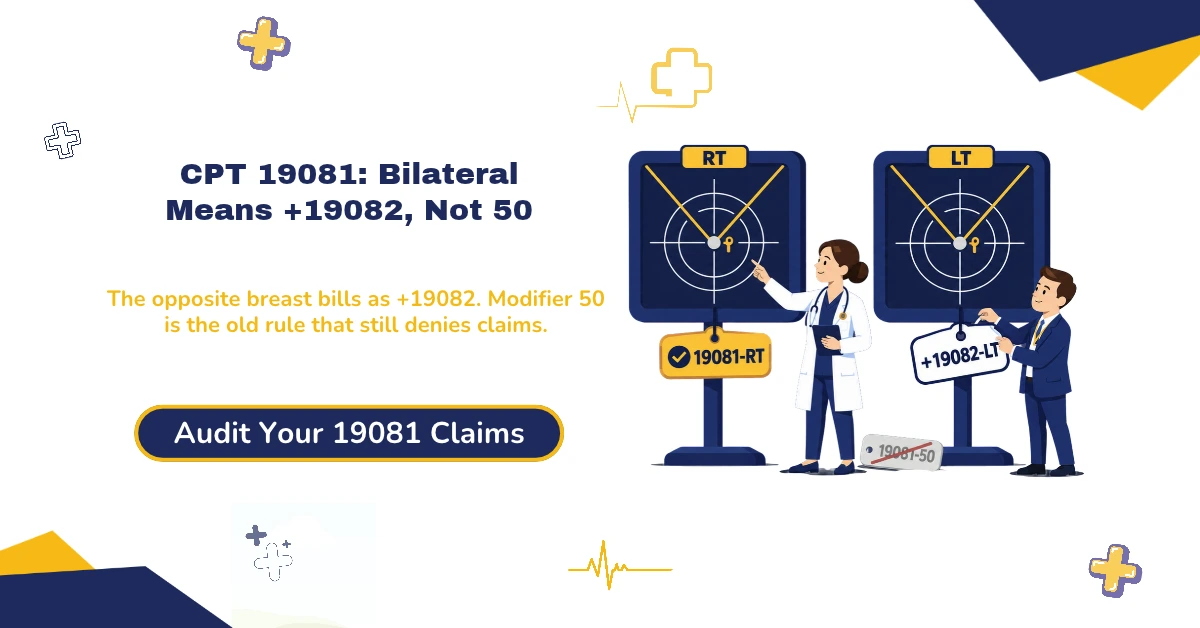
CPT code 19081 reports a percutaneous breast biopsy of the first lesion under stereotactic guidance. The code includes placement of a breast localization device, such as a clip or metallic pellet, and imaging of the biopsy specimen when the radiologist performs them.
Medicare’s 2026 national payment for 19081 is about $478.30 in the office and $138.28 in a facility at the $33.4009 non-QP conversion factor. Each additional stereotactic lesion in that session goes on add-on code +19082, and that’s true for a lesion in the opposite breast too.
You’ll get the rules that move money on a stereotactic breast biopsy CPT code claim: bundling, bilateral reporting, modifiers, tomosynthesis, 2026 payment, coverage, and denial fixes. Most 19081 CPT code denials start in the procedure note, well before anyone builds the claim.
CPT Code 19081 at a Glance: 2026 Quick Reference
Keep this table open while you build a 19081 claim. Each row is a fact a payer checks during adjudication. The sections below expand the rows that cause the most rework, so you don’t have to hunt for them.
CPT 19081 quick reference, CMS 2026 Physician Fee Schedule
| Item | 2026 Detail |
|---|---|
| Code type | Primary CPT code, Surgery section, Integumentary System, Breast |
| Short descriptor | BX BREAST 1ST LESION STRTCTC |
| Guidance | Stereotactic, including combined stereotactic and tomosynthesis guidance |
| Lesions covered | First lesion per session |
| Add-on code | +19082 for each additional stereotactic lesion, same or opposite breast |
| Included when performed | Localization device placement, specimen imaging, stereotactic guidance |
| Global period | 000 (no postoperative days) |
| PFS status | A (active, separately paid) |
| 2026 RVUs | Work 3.21; total 14.32 office, 4.14 facility |
| 2026 national rate (non-QP) | About $478.30 office, $138.28 facility at $33.4009 |
| 2026 national rate (QP) | About $480.69 office, $138.97 facility at $33.5675 |
| Modifier 50 | Not used. Report the contralateral lesion with +19082. |
| Professional and technical split | None (PC/TC indicator 0). No modifier 26 or TC. |
| Medicare coverage | NCD 220.13, Percutaneous Image-Guided Breast Biopsy |
These are national amounts before the geographic practice cost index (GPCI) adjusts them for your locality. Pull your exact locality rate from the CMS Physician Fee Schedule Look-Up, which we link in the payment section.
What CPT Code 19081 Covers
19081 covers the first lesion sampled through the skin under stereotactic guidance, plus the clip and specimen X-ray that come with most of these procedures. Coders choose it by the guidance named in the report, and the rest of the descriptor tells you what’s already paid.
The Official 19081 CPT Code Description
The AMA CPT descriptor for 19081 reads, word for word, as follows. Coders match the procedure note against this exact language before they pick a code:
“Biopsy, breast, with placement of breast localization device(s) (eg, clip, metallic pellet), when performed, and imaging of the biopsy specimen, when performed, percutaneous; first lesion, including stereotactic guidance.”
Everything before the semicolon is the parent descriptor that 19081 shares with the rest of the family, 19082 to 19086. Only the final clause, “first lesion, including stereotactic guidance,” belongs to 19081 alone. That clause is the part your coder checks against the note.
The CPT code 19081 description is copyrighted text that the AMA’s CPT Editorial Panel maintains. Quote it from a licensed source, such as the AMA CPT code set, since free lookup sites sometimes carry an outdated version.
What’s Included in 19081
Four elements come built into 19081, and your team can’t bill any of them on a separate line:
- Approach: percutaneous needle access through the skin, with no open incision
- Guidance: stereotactic imaging that locates the lesion from two X-ray angles
- Localization device: a breast localization device, such as a clip or metallic pellet, when performed
- Specimen imaging: an X-ray of the removed cores to confirm the needle hit the target, when performed
“When performed” means 19081 stays reportable even if the radiologist didn’t place a breast localization device or skipped the specimen image. Don’t hold a claim waiting on a clip the radiologist didn’t place. Bill what the note supports and move the claim forward.
Device Type Doesn’t Change the Code
Coders select 19081 by guidance modality, and the biopsy device plays no part in that choice. A spring-loaded core needle, a vacuum-assisted probe, and a rotating device all report as 19081 when the radiologist uses stereotactic guidance.
There’s no separate core needle biopsy CPT code for stereotactic cases. The CPT code for needle core biopsy of breast tissue under stereotactic guidance is 19081 as well. Think of the guidance as the address on the claim and the device as the car that got you there.
You’ll also hear the procedure called a stereotactic core needle biopsy, an X-ray-guided or mammographically guided biopsy, or a vacuum-assisted breast biopsy (VAB). Mammotome is a brand of vacuum device. None of those names creates a different code.
Where 19081 Came From
Codes 19081 to 19086 took effect January 1, 2014. They replaced device-based codes 19102 and 19103, and they absorbed stereotactic guidance code 77031, which the AMA deleted at the same time.
Some older charge sheets still list 19103 plus 77031 where the 19081 CPT code belongs. Neither old code is valid for a date of service after December 31, 2013, so those lines reject before a person ever reviews them.
What You Can’t Bill Separately With CPT Code 19081
Guidance, localization devices placed during the biopsy, and specimen imaging are already paid inside 19081. Put them on their own lines and you’ll trigger a National Correct Coding Initiative (NCCI) bundling denial. Good medical billing services catch these pairs before the payer does.
Codes Bundled Into 19081
CPT bundles the services below into 19081 when your team performs them on the same lesion in the same session.
Services bundled into CPT 19081 (same lesion, same session)
| Service | Code(s) | Status with 19081 |
|---|---|---|
| Specimen radiography | 76098 | Bundled |
| Ultrasound guidance for needle placement | 76942 | Bundled, and the wrong modality for 19081 |
| Fluoroscopic guidance | 77002 | Bundled |
| CT guidance | 77012 | Bundled |
| MR guidance | 77021 | Bundled |
| Localization device, same lesion, same session | 19281 to 19288 | Bundled |
| Fine needle aspiration, same lesion | 10004 to 10012, 10021 | Bundled |
| Tissue marker supply (clip) | A4648 | Don’t expect separate payment; check commercial contracts |
The cpt 76098 line confuses billers because specimen radiography sounds like its own imaging study. On a stereotactic biopsy, the descriptor already includes it. We see this on new imaging accounts: a 76098 line hard-coded in the charge master that denies on each claim for months before anyone traces it.
The breast biopsy with clip placement CPT code is still 19081, because the clip sits inside the descriptor. CPT limits these exclusions to the same lesion. For a separate lesion, check the pair’s modifier indicator in the current quarter’s CMS NCCI PTP edit files before you append anything.
Pathology Isn’t Bundled
The pathologist’s reading of the cores, usually surgical pathology code 88305, is a separate service that the pathology group bills under its own provider number. Some billers hear “bundled” and treat the word as everything in the room. That over-correction costs the pathologist a valid claim.
The Post-Biopsy Mammogram Depends on Guidance and MAC
No single national rule decides whether the mammogram after a 19081 biopsy pays. The answer depends on the guidance your radiologist used and on your Medicare Administrative Contractor (MAC), so a blanket “always bundled” claim from any reference deserves a second look.
Noridian, the MAC for Jurisdictions JE and JF, treats the mammogram after a tomosynthesis-guided biopsy as part of the procedure, wherever the patient has it. Legacy AMA and ACR guidance, quoted in an archived BCBSND policy, allowed separate reporting after a combined biopsy only when the patient moved to a separate mammography unit.
Check your MAC’s billing article and the payer’s policy before you bill 77065 or 77066 on the same date. The tomosynthesis section further down walks through Noridian’s rule in detail.
When Localization Codes Are Billable
Localization codes 19281 to 19288 stand on their own in two situations, and both come up on busy breast centers’ schedules:
- No biopsy that session, such as a clip or wire placed with no tissue sampling
- Placement before an open excision, such as 19101 or 19301, where the localization line may need modifier 59 or XE to clear the NCCI edit
CPT guidelines support both exceptions. Read the note before you assume the code is bundled, because a pre-surgical wire placed the morning of a lumpectomy is a separate service from the excision that follows it.
If stereotactic claims keep losing lines to bundling edits, our coders can review a sample batch and show you which edit fired and why.
Stereotactic, Ultrasound, or MRI: Choosing the Right Breast Biopsy CPT Code
The CPT code for stereotactic biopsy of breast tissue is 19081. Your coder picks the code from the guidance documented in the report, so CPT 19081 fits only when the note names stereotactic guidance for the first lesion.
Breast Biopsy Codes by Guidance Modality
Each guidance modality carries its own first-lesion code and its own add-on, and the table maps them side by side so your coder can match the note in seconds.
Breast biopsy CPT codes by guidance modality
| Guidance | First lesion | Each additional lesion |
|---|---|---|
| Stereotactic | 19081 | +19082 |
| Stereotactic and tomosynthesis combined | 19081 | +19082 |
| Ultrasound | 19083 | +19084 |
| MRI | 19085 | +19086 |
| Tomosynthesis only (Noridian JE/JF, BCBSND) | 19499 (unlisted) | 19499-59 same breast; 19499-50 opposite breast |
| No imaging guidance | 19100 (needle core) or 19101 (open incisional) | Same code again, with documentation of the separate lesion |
These are the CPT codes for breast biopsy that payer policies reference, and the BCBSND breast biopsy policy lays them out the same way. The tomosynthesis-only row comes from MAC and payer policy, so confirm it with your own contractor.
What Is the Difference Between 19081 and 19083?
19081 reports a stereotactic-guided biopsy of the first breast lesion, and 19083 reports an ultrasound-guided one. The two descriptors match word for word until the last clause, so the guidance named in the procedure note is the only thing that separates them.
Pick the wrong code and no modifier will rescue the claim. You’ll need a corrected claim with the right code. Our CPT 19083 billing guide covers the ultrasound side, including its own add-on rules.
Two Modalities in One Session
A different modality on the same date means a second primary code, and the add-on doesn’t apply across modalities. Say the radiologist samples a stereotactic lesion in the left breast and an ultrasound lesion in the right: that claim carries 19081-LT and 19083-RT.
Add-on codes apply only when the same modality samples more lesions in that session. Depending on the payer’s edits, the second primary may need modifier XS or 59 to show a separate lesion, so check the current NCCI pair before you submit.
Tomosynthesis Guided Breast Biopsy: The Quick Rule
The CPT code for tomosynthesis guided breast biopsy is 19081 when stereotactic guidance is also used, and unlisted 19499 when tomosynthesis is the only guidance, under Noridian’s billing article and BCBSND’s policy. You’ll find the claim-field rules in the tomosynthesis section below.
How to Bill +19082 and Bilateral Stereotactic Biopsies
Multi-lesion and bilateral stereotactic sessions use one CPT code 19081 line plus as many +19082 units as the note supports. Getting that count right is most of the work on these claims.
What +19082 Covers
+19082 reports each additional lesion biopsied under stereotactic guidance in the same session, in the same breast or the opposite breast. Its descriptor ends with “each additional lesion, including stereotactic guidance (List separately in addition to code for primary procedure).” Three rules keep it clean:
- Never alone: +19082 needs 19081 on the same claim
- Same modality only: an ultrasound lesion goes to 19083 or +19084
- Lesions, not passes: six cores from one lesion are still one unit of 19081
Bilateral Stereotactic Biopsies Use 19081 Plus 19082
A lesion in each breast under stereotactic guidance bills as one 19081 and one +19082, with no second 19081 line and no modifier 50.
CPT’s 2015 errata set this rule: use the add-on whether the additional lesion sits in the same breast or the contralateral breast. Before that correction, coders reported 19081-50 for bilateral cases. Older references still show it, and that’s why the error keeps coming back on new accounts.
Billing Scenarios
These five sessions cover the stereotactic claims most breast centers send, from a single lesion to a mixed-modality day:
CPT 19081 and +19082 billing scenarios
| Session | Correct claim |
|---|---|
| One lesion, right breast | 19081-RT |
| Two lesions, right breast | 19081-RT, 19082-RT |
| One lesion in each breast, both stereotactic | 19081-RT, 19082-LT |
| Three lesions, left breast | 19081-LT, 19082-LT (2 units) |
| Stereotactic left plus ultrasound right | 19081-LT, 19083-RT |
Laterality modifiers on these lines depend on the payer. The modifier section below explains when a payer expects RT and LT on each line.
Why Two Units of 19081 Reject
Two units of 19081 on one date fail the payer’s units edit before anyone reads the note. The code describes the first lesion, so one date of service supports one unit, and CMS enforces unit limits through Medically Unlikely Edits (MUEs).
The rejection tells you the count was wrong. Most teams fix the wrong thing first and swap modifiers, which won’t clear it. Rebuild the claim as 19081 plus +19082 and resubmit it as a corrected claim.
The reverse problem shows up too. A +19082 line without 19081 rejects under the CMS add-on code edits, because an add-on can’t stand without its primary on the same claim.
The Bilateral Indicator Isn’t a Reporting Instruction
The fee schedule’s bilateral surgery indicator describes how Medicare would price a modifier 50 claim. CPT’s instruction tells you how to report the service, and it sends the contralateral lesion to +19082. Follow CPT when you build the claim.
If the same units rejection comes back after three resubmissions, a charge-entry rule is the likely source. Our denial management services team traces that rule and fixes it where it starts.
Modifiers for CPT 19081: Which Ones Apply and Which Don’t
RT and LT do most of the modifier work on 19081 claims. Modifiers 50, 26, TC, and 51 don’t belong on the line at all, and 59 or XS needs a documented reason.
Does CPT 19081 Need a Modifier?
CPT code 19081 often needs only a laterality modifier, RT or LT, when the payer requires one. Modifier 50 doesn’t apply, 26 and TC don’t apply because the code doesn’t split, and 59 or XS fits only a distinct service.
Modifier Decision Table
You’ll see a long list of modifiers suggested for 19081 across coding references. The table gives each one a yes, no, or conditional answer, along with the rule behind it:
Modifier rules for CPT 19081
| Modifier | Use with 19081? | Rule |
|---|---|---|
| RT / LT | Payer-dependent | Identifies the breast. Many payers require it. |
| 59 / XS | Conditional | Distinct lesion or site only, with documentation |
| XE | Conditional | Separate encounter on the same day |
| 25 | On the E/M, not on 19081 | Significant, separately identifiable same-day E/M |
| 50 | No | Use +19082 for the contralateral lesion |
| 26 / TC | No | PC/TC indicator 0. The code doesn’t split. |
| 51 | No | Use +19082 for additional lesions. Add-on codes are exempt from modifier 51. |
Some code references list 50, 26, or TC for 19081. Those entries conflict with CPT instructions and the CMS fee schedule data, and the corrections section later in this guide lays out each one with its source.
What Does RT Mean on a 19081 Claim?
RT on a 19081 claim means the biopsied lesion was in the right breast, and LT means the left. In a bilateral session, the 19081 line carries one side and the +19082 line carries the other side.
CMS guidance in the CMS MLN modifier 59 booklet says procedures on different sides of the body take RT and LT rather than 59 or XS. Laterality is the modifier question that matters most on 19081.
Modifier 59 or XS on a Breast Biopsy
Modifier 59 or XS belongs on a breast biopsy claim only when NCCI would bundle two services that your team performed as distinct procedures. The common case is a localization device placed before an open excision, the exception covered in the bundling section.
CMS prefers the more specific X modifiers over 59 when one fits, such as XS for a separate structure or XE for a separate encounter. Our guide to modifier 59 rules covers the documentation each one needs.
Same-Day E/M and the 0-Day Global
19081 has a 000 global period, so you can bill a significant, separately identifiable E/M on the same day with modifier 25 on the E/M line. The visit where the radiologist decides to biopsy doesn’t qualify by default.
The note has to show work beyond the usual pre-procedure assessment. Our breakdown of how 0-day globals work covers the timing. CMS proposed changes to payment for E/M visits billed with modifier 25 in the CY 2027 PFS proposed rule, so confirm the final rule before you carry 2026 habits into 2027.
Tomosynthesis-Guided and Contrast-Enhanced Breast Biopsies: When 19081 Applies
19081 still applies when tomosynthesis or contrast joins stereotactic guidance. Under Noridian’s policy, the code stops applying when tomosynthesis is the only guidance, and that one detail drives a lot of misdirected appeals.
Combined Stereotactic and Tomosynthesis Guidance Uses 19081
A percutaneous breast biopsy that uses both stereotactic and tomosynthesis guidance reports as 19081 for the first lesion and +19082 for each additional lesion. Noridian’s billing article A57848 and BCBSND’s breast biopsy policy both say so.
In that combined case, the CPT code for tomosynthesis guided breast biopsy is the same stereotactic code you’d use without the 3D images. The extra imaging doesn’t earn a separate line.
Tomosynthesis-Only Guidance Goes to Unlisted 19499
If tomosynthesis is the only guidance, the procedure doesn’t fit 19081 and goes to unlisted code 19499 under the Noridian tomosynthesis billing article, which covers Jurisdictions JE and JF. Three claim rules follow:
- Narrative: describe the procedure in Loop 2400, SV101-7 on the 837P or Item 19 on paper, and in SV202-7 or UB-04 Block 80 for Part A
- Additional lesions: the same breast takes 19499 plus 19499-59, and the opposite breast takes modifier 50
- Localization: 19281 to 19288 aren’t separately payable with 19499
That opposite-breast rule is the one breast biopsy scenario where Noridian directs modifier 50. This is a Noridian MAC policy, also adopted by BCBSND, so check your own MAC before applying it outside JE and JF.
A tomo-only note billed as 19081 often comes back as a medical necessity denial, and the fix is 19499 with a narrative. Unlisted codes also fail fast when Item 19 is blank, so add it to your list of CMS-1500 field errors to scrub.
The Post-Tomosynthesis Mammogram
Noridian treats a mammogram after a tomosynthesis-guided biopsy as part of the procedure, whether or not the patient moves to another room. The rule covers 77065 and 77067, with or without G0279, and it holds even when the mammogram goes out on a separate claim. If one claim pays first, Noridian can adjust or deny the other.
Contrast-Enhanced Biopsy Coding
A contrast-enhanced biopsy under stereotactic guidance still reports as CPT code 19081, and the contrast injection (96374) and contrast material (Q9967) are separate billing questions.
19081 and 96374 share an NCCI procedure-to-procedure edit that allows a modifier. Modifier 59 or XU may fit on 96374 when the note shows the injection was a separate decision, so check the pair in the current NCCI PTP files before you append it.
Q9967 is a HCPCS Level II supply code, the kind of line where HCPCS vs CPT codes trip up new coders. In the office, Medicare pays Q9967 separately using the CMS ASP pricing files.
In the hospital outpatient setting, Q9967 payment packages into the procedure, but the facility should still report the code so the cost data stays complete. Commercial payers vary on both points, so read the contract before you set charge rules.
2026 Medicare Reimbursement for CPT Code 19081
Rates updated October 2026. We’ll add 2027 figures after CMS publishes the final rule.
2026 National Payment for 19081
Medicare’s 2026 national payment for CPT code 19081 is about $478.30 in a non-facility setting and $138.28 in a facility setting at the non-QP conversion factor of $33.4009.
CPT 19081 national Medicare payment, CMS 2026 Physician Fee Schedule
| Setting | Total RVUs | Non-QP ($33.4009) | QP ($33.5675) |
|---|---|---|---|
| Office / non-facility (POS 11) | 14.32 | $478.30 | About $480.69 |
| Facility (POS 22, POS 24) | 4.14 | $138.28 | About $138.97 |
Clinicians who aren’t qualifying participants (QPs) in an advanced alternative payment model bill at the non-QP rate. Your actual payment runs through one formula: (work RVU × work GPCI + PE RVU × PE GPCI + MP RVU × MP GPCI) × conversion factor.
Pull your locality’s figure from the CMS Physician Fee Schedule Look-Up before you load expected allowables. A national average can sit well above or below what your MAC pays in your county.
What Changed From 2025 to 2026, and Why the Facility Rate Fell
19081’s office payment rose about 1.6% in 2026, but its facility payment fell about 11.3%, because CMS cut facility practice expense and applied a 2.5% efficiency adjustment to work RVUs.
ClaimMax RCM analysis of CMS PFS relative value files, 2025 and 2026
| Component | 2025 | 2026 | Change |
|---|---|---|---|
| Work RVU | 3.29 | 3.21 | Down 2.4% (efficiency adjustment) |
| Facility PE RVU | 1.20 | 0.58 | Down about 52% |
| Total RVUs, office | 14.56 | 14.32 | Down 1.6% |
| Total RVUs, facility | 4.82 | 4.14 | Down 14.1% |
| Conversion factor (non-QP) | $32.3465 | $33.4009 | Up 3.26% |
| National office payment | $470.97 | $478.30 | Up 1.6% |
| National facility payment | $155.91 | $138.28 | Down 11.3% |
We derived the 2025 facility PE RVU of 1.20 as 4.82 total facility RVUs minus 3.29 work RVUs minus 0.33 malpractice RVUs. Each payment equals total RVUs times that year’s non-QP conversion factor, before GPCI adjustment.
CMS’s CY 2026 final rule cut the share of facility practice expense allocated on work RVUs to half the non-facility amount. The 2.5% efficiency adjustment also trimmed work RVUs on non-time-based procedures, and 19081 is one of them.
For a hospital-based radiologist, the 19081 CPT code now pays about $17.63 less per first-lesion biopsy than it did in 2025. The radiologist does the same procedure and gets a smaller check, because CMS changed the math behind the facility side.
Multiple Procedures and the Add-On
19081 falls under the standard multiple procedure payment reduction, while +19082 is an add-on code that Medicare doesn’t reduce as a second procedure.
If your radiologist bills 19081 and 19083 in one session, Medicare typically pays the higher-valued primary at 100% and the lower-valued one at 50%. Our walkthrough of the multiple procedure payment reduction shows how the ranking works.
What to Expect for 2027
CMS’s CY 2027 proposed rule would lower the non-QP conversion factor about 1.68%, to $32.8409, and the QP factor about 1.19%, to $33.1693. The final rule usually arrives around November 1.
The CY 2027 PFS proposed rule also proposes practice expense changes that reach 000-global codes like 19081. Those include indirect PE allocated on both work and clinical labor RVUs, removal of the indirect practice cost index (IPCI) over two years, and a 5% annual cap on PE changes.
Final 2027 payment for 19081 depends on the final RVUs, so we won’t publish an estimate until CMS releases them. Budget with the 2026 figures and watch for the update.
Hospital, ASC, and Commercial Payment for Stereotactic Breast Biopsy
In a hospital outpatient department or an ambulatory surgical center (ASC), the facility bills its own payment for CPT code 19081, and the radiologist bills the professional facility rate covered in the Medicare payment section above.
Hospital Outpatient and ASC Payment
Hospitals bill 19081 under the Outpatient Prospective Payment System (OPPS), where it maps to APC 5072 with status indicator J1. Under OPPS, +19082 is packaged, so the facility collects no separate payment for additional lesions.
The CY 2026 OPPS Addendum B and ASC Addendum AA list the facility rates for both settings, and you’ll find them through the CMS prospective payment systems hub. Load those numbers into your contract module rather than a vendor summary.
HCPCS C7501 (stereotactic) and C7502 (MR guidance) describe biopsy of all lesions, unilateral and bilateral, in one session. CMS built these C-codes for facility billing, so confirm your payer recognizes them. Our hospital revenue cycle management team sets those facility charge rules.
The POS 11 vs POS 22 Underpayment
A practice that owns its stereotactic unit but submits POS 22 collects the facility rate, about $340 less per first lesion in 2026, and no denial flags the error.
The claim looks healthy on every report, yet the money’s missing. Only line-level posting against expected allowables catches it. Our guide to POS 22 billing rules explains when that place of service belongs on the claim and when it doesn’t.
Commercial Payers
Commercial payment for 19081 depends on each contract and often runs above Medicare, so benchmark against your own remits and the payer’s published rates.
Health plans publish negotiated rates in machine-readable files under the CMS price transparency rules. You can compare what a payer pays other groups for the stereotactic breast biopsy CPT code against the rate in your own contract.
If nobody has compared your 19081 remits against the right setting and contract rate, that’s a 20-minute check, and the gap tends to show up fast. Our line-level payment posting team runs that comparison on each remit.
Medicare Coverage for 19081: NCD 220.13, BI-RADS, and ICD-10 Codes
What NCD 220.13 Covers
Medicare covers stereotactic or ultrasound-guided percutaneous breast biopsy under NCD 220.13 for non-palpable lesions graded BI-RADS III, IV, or V, and for palpable lesions that are hard to biopsy by palpation alone.
BI-RADS is the Breast Imaging Reporting and Data System category the radiologist assigns on the imaging report. Your MAC decides which palpable lesions count as difficult. MRI guidance falls outside the NCD, so coverage for 19085 runs through MAC policy.
CMS keeps the NCD’s ICD-10 list current through quarterly updates. A claim for CPT code 19081 has to pair with a diagnosis on that list, or the payer will deny it for medical necessity.
ICD-10 Codes That Commonly Support 19081
Most 19081 claims rest on a breast imaging finding from R92, a breast lump code from N63, or a breast cancer code from C50 or D05. The table lists the common ones.
Validated against FY2027 ICD-10-CM, effective October 1, 2026
| ICD-10-CM | Description | When it fits a 19081 claim |
|---|---|---|
| R92.0 | Mammographic microcalcification found on diagnostic imaging of breast | The classic stereotactic indication |
| R92.1 | Mammographic calcification found on diagnostic imaging of breast | Calcifications without “micro” documented |
| R92.8 | Other abnormal and inconclusive findings on diagnostic imaging of breast | Non-calcification imaging abnormality |
| R92.2 | Inconclusive mammogram | Only if the report states it |
| N63.11 to N63.15, N63.21 to N63.25 | Unspecified lump in the right or left breast, by quadrant | Lesion with a documented quadrant |
| C50.911, C50.912 (and site-specific C50 codes) | Malignant neoplasm of breast | Known cancer, re-biopsy |
| C50.A1, C50.A2 | Malignant inflammatory neoplasm of right or left breast | New in FY2026 |
| D05.11, D05.12 | Intraductal carcinoma in situ of right or left breast | DCIS follow-up |
| Z85.3 | Personal history of malignant neoplasm of breast | Secondary code, as supported |
Diagnosis laterality has to match the RT or LT modifier. If the radiologist named the quadrant, an unspecified-quadrant code is a downgrade you chose. Check each pairing against the NCD 220.13 list and your MAC’s billing article before the claim drops.
Screening Codes Don’t Support a Diagnostic Biopsy
Z12.31 reports a screening mammogram encounter and doesn’t support a 19081 claim. By the time the radiologist samples tissue, the encounter is diagnostic, so code the finding that prompted the biopsy instead of the screening that found it.
Documentation That Supports a CPT Code 19081 Claim
A 19081 note has to name stereotactic guidance, count the lesions, and record laterality, because those three facts decide the code, the add-on units, and the modifiers. The checklist below covers the rest.
CPT 19081 documentation checklist
| Element | Why the claim needs it |
|---|---|
| Guidance named as “stereotactic,” not “image-guided” | Selects 19081 over 19083, 19085, or 19499 |
| Tomosynthesis use stated, combined or alone | Decides 19081 vs 19499 |
| Lesion count and location for each lesion | Supports +19082 units |
| Laterality and quadrant | Supports RT/LT and the ICD-10 code |
| Prior imaging finding and BI-RADS category | Supports NCD 220.13 medical necessity |
| Device type and number of cores | Clinical support; doesn’t change the code |
| Clip placed or not; specimen imaged or not | Documents the “when performed” elements |
| Contrast agent given, if any | Supports 96374 and Q9967 |
Most gaps come from a macro that says “biopsy performed under image guidance.” Fix the template once with a required modality field and a lesion count field. A pre-bill stereotactic claim coding review catches the notes that slip through anyway.
Those two fields also keep your claims inside clean claim standards, so your team doesn’t work the same rejection twice in one month.
Why 19081 Claims Get Denied and How to Fix Them
Most denials on CPT code 19081 trace back to five problems: a bundled line, a units error, an add-on without its primary, a modifier mismatch, or a diagnosis that doesn’t support medical necessity.
Common CPT 19081 denial codes and fixes
| CARC / RARC | What it usually means on a 19081 claim | Fix |
|---|---|---|
| CO-97 or CO-236 | Guidance, 76098, or a localization code billed beside 19081 | Remove the bundled line and correct the claim |
| CO-151 with N362 | Two units of 19081 on one date | Rebuild as 19081 plus +19082 |
| CO-107 | +19082 sent without 19081 | Add the primary to the same claim |
| CO-4 | Modifier 50, or a missing or invalid RT/LT | Correct the modifiers per the modifier table |
| CO-11 | Diagnosis laterality or quadrant doesn’t match | Recode to the documented finding |
| CO-50 | Diagnosis outside the NCD 220.13 or MAC list, or tomo-only billed as 19081 | Correct the code, or appeal with imaging and BI-RADS documentation |
| CO-16 (missing narrative) | 19499 sent without a procedure description | Add the narrative in Item 19 or Loop 2400 and resubmit |
Remark code pairings vary by payer. Match each fix to the exact CARC and RARC on the 835 you received before you act.
Corrected Claim or Appeal?
Coding, units, and modifier errors go back as corrected claims or reopenings, while medical necessity denials go to appeal with the imaging report and the NCD or MAC citation.
Commercial payers usually take a replacement claim with frequency code 7 and the original claim number. Medicare Part B handles most denied lines through a reopening for clerical errors or a redetermination, so check your MAC’s process before you resend anything.
For Original Medicare, the Medicare appeals process gives you 120 days from receipt of the initial determination to request a redetermination. Log the denial date the day the remit posts, since that clock doesn’t pause for internal reviews.
A Denial We See Often
One pattern shows up across breast imaging accounts. A tomosynthesis-only biopsy goes out as CPT 19081, Medicare denies it as not medically necessary, and the team appeals medical necessity and loses. The right claim was 19499 with a narrative from the start.
The denial reason points you at medical necessity while the problem sits in the code. Read the guidance line in the note before you fight the denial reason, and you’ll save a full appeal cycle on claims like this one.
If the same breast biopsy denial keeps coming back across providers, you’re looking at a workflow pattern. Our breast biopsy denial recovery work traces that pattern back to the step that creates it.
What Other 19081 Guides Get Wrong
Several widely read references on CPT code 19081 repeat rules that changed years ago or never applied, and each one produces a denial or an underpayment. You’ll see these claims in a lot of places, and the table pairs each one with the correct rule.
Common 19081 misconceptions and the correct rule
| Claim you’ll see | What’s correct | Source |
|---|---|---|
| Use modifier 50 for bilateral 19081 | Report 19081 plus +19082 for the contralateral lesion | CPT guidance since the 2015 errata; BCBSND policy table |
| Modifiers 26 and TC apply to 19081 | PC/TC indicator 0; no component split | CMS 2026 RVU file |
| +19082 is only for the same breast | Same or opposite breast, same modality | CPT guidance |
| Medicare pays $470.97 / $155.91 in 2026 | Those are 2025 figures; 2026 is about $478.30 office and $138.28 facility | CMS PFS 2025 and 2026 |
| Tomosynthesis-only = 19499 is national CMS policy | It’s Noridian JE/JF policy, also used by BCBSND | Noridian article A57848 |
| A post-biopsy mammogram is always bundled | It depends on the guidance and the MAC | A57848; payer policy |
| 19081 covers ultrasound or MRI guidance | Stereotactic only, plus combined tomosynthesis | CPT descriptor |
| FNA 10022 and mammography 77051 to 77057 bundle with 19081 | Those codes no longer exist; use 10004 to 10012, 10021, and 77065 to 77067 | CPT code set |
If your coding cheat sheet predates 2015, it likely teaches at least two of these. Swap it for the current CPT book and your MAC’s articles, and retrain anyone who learned from the old version.
Related Codes You’ll See With 19081
These are the CPT codes for breast biopsy and imaging that sit next to CPT code 19081 on the same claims and in the same audits. Each row gives the one-line relationship your coder needs.
Codes related to CPT 19081
| Code | Short description | Relationship to 19081 |
|---|---|---|
| +19082 | Each additional lesion, stereotactic | Add-on to 19081 |
| 19083 / +19084 | Ultrasound-guided, first / additional lesion | Different modality; separate primary |
| 19085 / +19086 | MRI-guided, first / additional lesion | Different modality; separate primary |
| 19100 / 19101 | Needle core without imaging / open incisional | No imaging guidance |
| 19499 | Unlisted procedure, breast | Tomosynthesis-only guidance (Noridian, BCBSND) |
| 19281 / 19283 | Localization device, mammographic / stereotactic guidance | Bundled with 19081 for the same lesion |
| 76098 | Surgical specimen radiography | Bundled |
| 76942 | Ultrasound guidance for needle placement | Bundled; wrong modality for 19081 |
| 77061 to 77063 | Digital breast tomosynthesis | Don’t bill as guidance for a combined-guidance 19081 |
| 88305 | Surgical pathology | Separate service by the pathologist |
| 19301 | Partial mastectomy | Common next step; localization before excision is separately reportable |
Each breast biopsy CPT code in that table follows the same logic, with guidance picking the family and lesion count picking the units. Our page on ultrasound-guided code 19083 covers the ultrasound family in depth.
MRI-guided cases follow their own coverage path because NCD 220.13 doesn’t address them. For imaging context on 19085 and +19086, see our roundup of breast MRI codes and the related diagnostic studies.
CPT 19081 Frequently Asked Questions
What is another name for a stereotactic breast biopsy?
Stereotactic breast biopsy also goes by stereotactic core needle biopsy, X-ray-guided or mammographically guided breast biopsy, and vacuum-assisted breast biopsy (VAB). Mammotome is a device brand. Each of these uses the CPT code for stereotactic biopsy of breast tissue, 19081, when the radiologist uses stereotactic guidance.
Is CPT 19081 a surgical procedure?
Yes. CPT places 19081 in the Surgery section, under Integumentary System, Breast, with a 000 global period. The procedure is percutaneous and image-guided, but payers still process it under surgical rules, including global period and multiple procedure logic.
What is CPT code range 19081 to 19101?
The 19081 to 19101 range is the breast biopsy series. Codes 19081 to 19086 cover image-guided percutaneous biopsy by modality, 19100 covers needle core biopsy without imaging guidance, and 19101 covers open incisional biopsy. Localization codes 19281 to 19288 sit in a separate series.
How much does Medicare pay for CPT 19081 in 2026?
Medicare’s 2026 national rate for CPT code 19081 is about $478.30 in the office and $138.28 in a facility at the $33.4009 non-QP conversion factor, before locality adjustment. Use the CMS Look-Up for your county’s figure, and see the payment section above for the full breakdown.
Does CPT 19081 require prior authorization?
Original Medicare doesn’t require prior authorization for 19081. Some Medicare Advantage and commercial plans do, and their lists change by plan year. Run eligibility and prior auth checks before you schedule the patient, not after the claim denies.
What does a patient pay for a stereotactic breast biopsy?
Under Original Medicare, the biopsy counts as diagnostic, so the Part B deductible and 20% coinsurance apply. Patients can compare estimated ASC and hospital costs in the Medicare Procedure Price Lookup by searching the CPT code for stereotactic breast biopsy, 19081.
Is CPT 19081 still valid for 2027?
As of October 2026, 19081 remains an active code, and we haven’t found a 2027 deletion or revision for it. Confirm it against the CPT 2027 code set before January 1. CMS’s final rule, expected around November 1, 2026, will set 2027 payment.
Getting 19081 Paid Right the First Time
Modality, lesion count, and laterality drive almost every dollar on a CPT code 19081 claim. Get the guidance right and the code follows. Count the lesions and you’ll have the add-on units, and once the side is on record, the modifiers and diagnosis line up behind it.
If breast imaging claims are where your denials cluster, the team at ClaimMax RCM can review a sample and show you which rule is leaking revenue. Bring a month of 19081 remits and talk to our coders about what they show.
Update Log
| Date | Change |
|---|---|
| October 2026 | Published with 2026 PFS rates, FY2027 ICD-10-CM codes, and Q4 2026 NCCI references |
| November 2026 (planned) | Add CY 2027 final rule rates within seven days of release |
Sources
- AMA CPT code set overview
- CMS NCCI procedure-to-procedure edits
- BCBSND coding guidelines for breast biopsies
- CMS NCCI add-on code edits
- CMS MLN booklet: proper use of modifiers 59, XE, XP, XS, and XU
- Noridian billing and coding article A57848, tomosynthesis-guided breast biopsy
- CMS average sales price files
- CMS Physician Fee Schedule Look-Up Tool
- Federal Register: CY 2027 PFS proposed rule
- CMS prospective payment systems
- CMS health plan price transparency
- NCD 220.13, Percutaneous Image-Guided Breast Biopsy
- CMS Original Medicare appeals
- Medicare Procedure Price Lookup