
Table of Contents
- CPT Code 12002 at a Glance
- What CPT 12002 Covers
- How to Choose CPT Code 12002 Over Neighboring Repair Codes
- Adding Multiple Wound Lengths to Reach 12002
- CPT Code 12002 Global Period: 000 Days, Not 10
- Modifiers and Same-Day E/M With CPT Code 12002
- CPT Code 12002 Reimbursement in 2026
- Documentation That Holds Up on Audit
- Why 12002 Claims Get Denied or Downcoded
- 12002 Coding Scenarios From Real Clinics
- Is CPT Code 12002 Still Valid in 2026?
- Frequently Asked Questions About CPT 12002
- Getting 12002 Paid the First Time
CPT code 12002 reports a simple repair of superficial wounds totaling 2.6 cm to 7.5 cm on the scalp, neck, axillae, external genitalia, trunk, or extremities, including hands and feet. Medicare gives it a 000 (zero-day) global period, not 10 days, and the 2026 national rate is $139.28 in an office and $57.45 in a facility.
Three facts decide whether the code fits: closure complexity, anatomic site group, and total repaired length. In the 12002 denials and underpayments we work, the cause sits in one of those facts or in old 10-day global guidance. The sections below take each fact in turn, then cover the payer rules and the fix when a claim comes back.
CPT Code 12002 at a Glance
CPT 12002 is an active 2026 code with a 000 global period, 1.11 work RVUs, and a Medicare limit of one unit per date of service. The table lists the attributes payers check on the claim line.
| Attribute | Value |
|---|---|
| Code type | CPT Category I, Integumentary System, Repair (Closure) |
| Repair class | Simple (single-layer) |
| Site group | Scalp, neck, axillae, external genitalia, trunk, extremities (hands and feet included) |
| Total length band | 2.6 cm to 7.5 cm |
| Global period | 000 (Medicare). No 10-day global since January 1, 2011 |
| 2026 work RVU | 1.11 |
| 2026 Medicare national rate, office (POS 11, POS 20) | $139.28 |
| 2026 Medicare national rate, facility (POS 22, POS 23) | $57.45 |
| Medically Unlikely Edit | 1 unit per date of service (practitioner) |
| Bilateral modifier 50 | Not applicable. Lengths on both sides add into one total |
| Next code by length | 12004 (7.6 cm to 12.5 cm) |
| Status | Active in CPT 2026 |
The 12002 global period of 000 means Medicare packages the repair date and nothing after it. A medically necessary wound check on day 3 stands as its own visit. Older references still print 10 days because their authors wrote them before Medicare’s 2011 change, which the global period section explains in full.
Sources: CMS PFS Look-Up Tool, RVU26D effective October 1, 2026; CMS Q4 2026 practitioner MUE table. Rates use the non-qualifying participant conversion factor of $33.4009.
Each of those rows depends on the code descriptor, and payers read that descriptor as three separate tests. Start there before you look at modifiers or payment.
What CPT 12002 Covers
Code 12002 covers a single-layer closure of superficial wounds (epidermis, dermis, or subcutaneous tissue without significant involvement of deeper structures) when the repaired lengths in its site group total 2.6 cm to 7.5 cm. Sutures, staples, and tissue adhesive all count.
The 12002 CPT Code Description in Plain Terms
The CPT code 12002 description sets three limits: the repair must be simple, the wound must sit in one specific site group, and the total repaired length must fall between 2.6 cm and 7.5 cm. Payers adjudicate procedure code 12002 against all three limits at once.
Miss one limit and the line fails, even if the other two check out. A 5.0 cm layered closure on the forearm passes the length and site tests, but the layered work makes it intermediate. On the cheek, a 5.0 cm simple repair passes complexity and length, yet the face has its own codes.
To an auditor, simple means one layer. If the note doesn’t document a layered closure, the reviewer reads the repair as simple, no matter how long the provider spent on it. Time plays no part in repair code selection. Length, site, and depth decide the code.
Body Sites That Qualify, and the Face Exception
The site group for 12002 includes the scalp, neck, axillae, external genitalia, trunk, arms, legs, hands, and feet. A laceration repair on a finger lands here when the closure is simple, because CPT places the hands inside this group. On an index finger, a 3.0 cm simple closure bills as 12002.
Coders slip at the jump to intermediate repair. In the simple series, the hands, feet, neck, and genitalia sit with the trunk and extremities in 12001 to 12007. The intermediate codes split them apart: 12031 to 12037 cover the scalp, axillae, trunk, and extremities, while 12041 to 12047 cover the neck, hands, feet, and external genitalia.
Facial wounds belong to a different group. Repairs of the face, ears, eyelids, nose, lips, and mucous membranes go to 12011 to 12018, even when the length falls inside the 2.6 cm to 7.5 cm band. A 4.0 cm cheek repair can’t bill as 12002 under any payer.
What Counts as a Simple Repair
CPT accepts sutures, staples, or tissue adhesive as the closure, alone or combined, with or without adhesive strips. Strips by themselves don’t qualify. The CMS NCCI Policy Manual, Chapter III states that closures with adhesive strips or tape alone don’t support a separate repair code, so that work goes into the E/M.
Tissue adhesive alone counts as a repair under CPT, though Medicare wants HCPCS G0168 for that closure on physician claims. The global period section covers the Medicare adhesive rules, hospital claims included.
Three services come with the repair and don’t bill on their own:
- Local anesthesia
- Chemical cautery or electrocautery of wounds that aren’t closed
- Routine cleansing and irrigation
You can bill debridement on its own line in three situations. Gross contamination requires prolonged cleansing, you remove appreciable devitalized or contaminated tissue, or you debride without immediate primary closure. Our guide to wound care CPT codes covers those debridement codes.
Subcutaneous tissue sits inside simple repair, even though some references limit it to the epidermis and dermis. Once a wound is simple and inside this group, only length and a few neighboring codes stand between you and the right claim line.
How to Choose CPT Code 12002 Over Neighboring Repair Codes
Three facts pick the code: how complex the closure was, which anatomic group the wound sits in, and the total repaired length in centimeters. CPT 12002 applies only when the answers are simple, the 12001 to 12007 site group, and 2.6 cm to 7.5 cm.
The Three Questions That Pick the Code
Work through these in order on each chart:
- Complexity: was the closure simple, intermediate, or complex?
- Anatomic group: does the wound sit in the trunk and extremities group, the face group, or one of the intermediate splits?
- Total length: what do the repaired lengths add up to inside that bucket?
Order matters here. You can’t add lengths until you settle complexity and site group, because CPT lets you add only wounds that share both. Coders who start with the ruler tend to add a cheek wound to an arm wound and land on a code that neither wound supports.
12002 vs 12004 and 12001: Where the Length Lines Fall
The simple repair ladder for the trunk and extremities group runs in six steps:
| Code | Total length |
|---|---|
| 12001 | 2.5 cm or less |
| 12002 | 2.6 cm to 7.5 cm |
| 12004 | 7.6 cm to 12.5 cm |
| 12005 | 12.6 cm to 20.0 cm |
| 12006 | 20.1 cm to 30.0 cm |
| 12007 | Over 30.0 cm |
Is there a 12003 CPT code? No. The current code set skips from 12002 to 12004, so a total of 9.0 cm moves straight to 12004 with nothing in between.
Record length to a tenth of a centimeter. A total of 7.5 cm is 12002, and 7.6 cm is 12004. Rounding 7.5 cm up to 8 cm bills a higher code than the repair supports, and rounding 2.6 cm down to 2.5 cm gives away money you earned.
Wounds totaling 2.5 cm or less belong to 12001, the bottom rung of the ladder. Our CPT 12001 billing guide covers that code’s documentation and payment rules.
12002 vs 12032: The Line Between Simple and Intermediate
Intermediate repair adds a layered closure of one or more deeper layers of subcutaneous tissue and superficial (non-muscle) fascia, on top of the skin closure. CPT also counts a single-layer closure as intermediate when a heavily contaminated wound needed extensive cleaning or removal of particulate matter.
Code 12032 covers intermediate repairs of 2.6 cm to 7.5 cm on the scalp, axillae, trunk, and extremities, excluding hands and feet. The same layered repair on a hand is 12042. Keep the labels straight as well: 12032 is intermediate, and complex repairs run from 13100 to 13153.
On audit, the note has to say “layered” or describe the contamination and the cleaning. Without that language, payers reprice the line to 12002. We see this on ED charts a lot: the provider placed deep sutures, but the procedure note says “laceration repaired” and stops.
12002 vs 12013 and 12014: Same Length, Different Site
The facial bands are narrower. Code 12013 covers 2.6 cm to 5.0 cm, and 12014 covers 5.1 cm to 7.5 cm, so a 6.0 cm simple cheek repair bills as 12014. There’s no 12012 CPT code either. The face series runs 12011, 12013, and 12014, then continues with 12015 to 12018.
A chart with a 3.0 cm forearm wound and a 3.0 cm cheek wound produces two lines: 12002 for the arm and 12013 for the cheek. You can’t combine them into one 6.0 cm total, because the face sits in its own group with its own length bands.
If your coders rebuild these three questions from memory on each chart, site and length errors slip through, and most of them don’t show up as a denial. They show up as a lower code paid in full. Our pre-submission coding review puts a second coder on site, length, and complexity before the claim goes out.
Adding Multiple Wound Lengths to Reach 12002
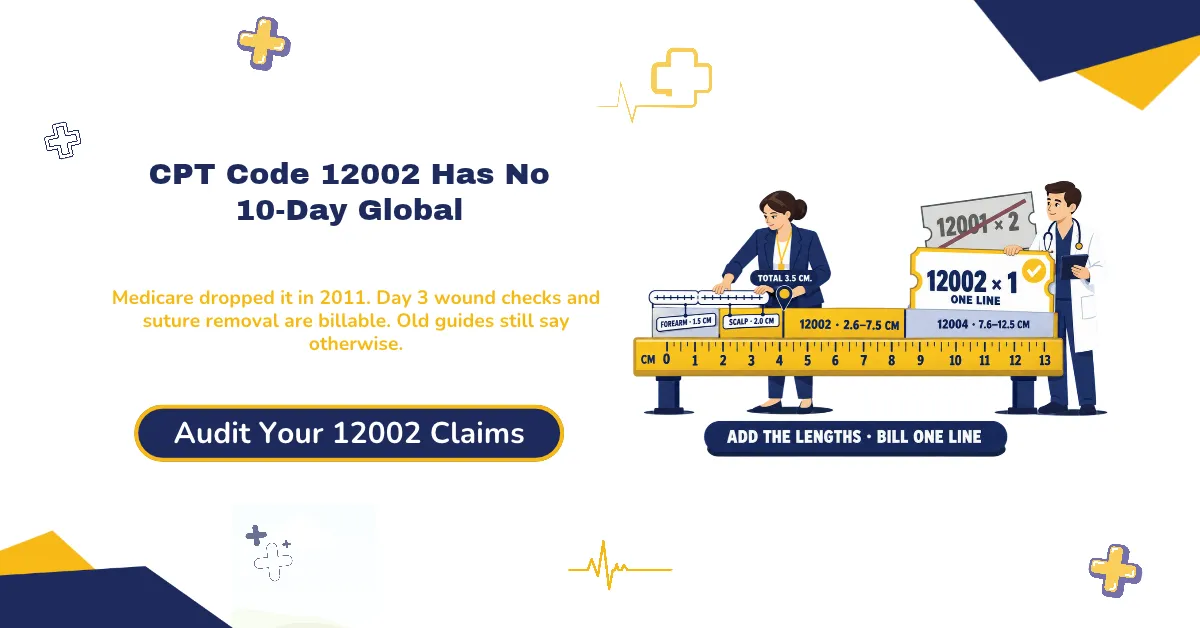
Add the lengths of each simple repair in the 12001 to 12007 site group and report one code for the total. If the sum lands between 2.6 cm and 7.5 cm, that’s one unit of 12002, no matter how many wounds made up the total.
The Additive Rule, Step by Step
CPT tells you to add repairs that share a classification and an anatomic group. Four steps keep the math clean:
- Sort the wounds by classification: simple, intermediate, or complex.
- Sort each classification by site group.
- Add the repaired lengths inside each bucket.
- Report one code per bucket.
Measure the repaired wound in centimeters, whether it’s curved, angular, or stellate, and record the full length you closed. A ruler laid between two endpoints of a curved scalp wound undercounts it, and the shortfall can drop a 12002 repair into 12001 territory.
| Wounds repaired (all simple) | Total | Report |
|---|---|---|
| Simple repair of a 3.0 cm scalp laceration | 3.0 cm | 12002 |
| 1.5 cm forearm + 2.0 cm scalp | 3.5 cm | 12002 x1 (not 12001 x2) |
| 2.0 cm hand + 1.0 cm neck + 1.5 cm thigh | 4.5 cm | 12002 |
| 3.0 cm arm + 2.0 cm cheek | Separate groups | 12002 + 12011 |
| 4.0 cm arm + 5.0 cm leg | 9.0 cm | 12004 |
The examples apply the additive rule as described in the ACEP Wound Repair FAQ.
When Lengths Can’t Be Added
Keep the lengths apart in three situations:
- Different classifications, such as a simple scalp repair and an intermediate forearm repair
- Different site groups, such as an extremity wound and a facial wound
- Different code families, such as a repair and an adjacent tissue transfer
In multiple laceration repair, the error we see most is one claim line per wound. Three simple 1.0 cm repairs on the arm and leg total 3.0 cm, so they bill as one line of 12002 instead of three lines of 12001.
Why 12002 Can’t Go on a Claim Twice
The Medicare practitioner MUE for 12002 is 1 unit per date of service. A second 12002 line denies, because CPT wants the combined length on one line. If the wounds total 7.5 cm or less, that line stays 12002, and anything above 7.5 cm moves to 12004 or higher.
NCCI Chapter III warns against reporting services on multiple claim lines with modifiers to get around an MUE. A claim with 12002 on one line and 12002-59 on the next tells the payer the coder skipped the addition. Reviewers look for that pattern, and a provider who repeats it can end up on targeted review.
Sequencing Mixed Repairs on One Claim
List the more complex repair first. CPT tells you to append modifier 59 to the less complicated repair when you report more than one classification, and Medicare prefers XS when the repairs sit on separate structures.
Say a patient needs a 3.5 cm intermediate forearm repair plus simple repairs totaling 3.5 cm on the scalp and leg. The claim reads 12032 first, then 12002-XS. For the documentation behind each choice, see our breakdown of modifier 59 and the X modifiers.
Commercial payers split between 59 and XS, so check the contract or the payer’s modifier policy before you pick one for CPT 12002. The secondary line also takes a payment reduction, and the 2026 reimbursement section shows that math.
Getting the length right gets 12002 paid once. The days after the repair raise a separate question, and outdated 10-day guidance still costs practices money there.
CPT Code 12002 Global Period: 000 Days, Not 10
CPT 12002 has a 000 (zero-day) global period under the Medicare Physician Fee Schedule. Medicare removed the 10-day global from simple repairs 12001 to 12018 on January 1, 2011, which is why older references still show 10 days.
The ACEP Surgical Package FAQ documents that change for emergency physicians. Intermediate and complex repairs, 12032 included, still carry a 10-day global, so the zero-day rule stops at the simple series.
What a 000 Global Means on the Claim
Medicare packages the day of the repair and nothing more. The decision to repair, the local anesthesia, and routine work before and after the closure on that date all sit inside the 12002 payment. A separate, significant E/M on the same date still needs modifier 25, which the modifier section covers.
The 12002 global period ends on the repair date. From the next day on, Medicare doesn’t treat related visits as global care, so a medically necessary wound check on day 3 bills as its own visit. Medical necessity still applies, and a visit with nothing to evaluate won’t support an E/M level.
Suture Removal and Follow-Up Visits, Payer by Payer
ACEP confirms that Medicare doesn’t bundle suture removal into 12001 to 12018. Commercial payers that follow the CPT surgical package may treat routine follow-up as included, so your answer depends on who’s paying and what the contract says.
| Payer type | Suture removal after 12002 | How to report |
|---|---|---|
| Medicare | Not bundled (ACEP) | Medically necessary E/M; in the office, add +15853 (sutures or staples) or +15854 (sutures and staples) |
| Commercial payer following the CPT surgical package | May treat routine follow-up as included | Check the contract before billing |
| Patient returns to a different provider | Separate service | E/M, plus the add-on code if in the office |
CPT added +15853 and +15854 on January 1, 2023. Both are add-on codes valued for practice expense only, so you report them with an E/M and not on their own. They don’t need modifier 25. Medicare values them for the office setting, which keeps them off facility claims.
A Medicare suture removal visit can leave the patient with a copay, and plenty of patients don’t expect a bill for a quick check. ACEP raises the same point. Many practices handle it with a written billing policy that staff hand the patient on the day of the repair.
Tissue Adhesive and G0168
Under CPT, tissue adhesive alone counts as a repair. A 4.0 cm forearm wound closed with Dermabond alone codes to 12002 for payers that follow CPT.
Medicare draws a different line on physician claims. NCCI Chapter III directs you to report a closure with adhesive alone using HCPCS G0168. If the provider uses adhesive along with sutures or staples, the repair code includes the adhesive, and G0168 stays off the claim.
Hospital outpatient claims follow a third path. OPPS doesn’t recognize G0168, so the facility reports the repair CPT code for a closure with tissue adhesive alone. Since Medicare packages only the repair day, the real billing risk sits on that date, in how the E/M and other procedures share the claim.
Modifiers and Same-Day E/M With CPT Code 12002
CPT 12002 billed alone needs no modifier. With other services on the claim, modifier 25 goes on the separate E/M, and 59 or XS goes on the less complicated repair, which is often 12002 itself.
Modifier 25 Goes on the E/M, Never on 12002
NCCI Chapter III sets the rule. The decision to perform a minor procedure is part of the procedure payment, so an E/M that only gets the provider to “this needs sutures” isn’t billable. A significant, separately identifiable E/M is payable with modifier 25.
Two points trip coders up. The E/M and the repair can share a diagnosis, and new patient status alone doesn’t justify an E/M on the same day. Noridian, a Medicare contractor, publishes an example on its modifier 25 page: a layered scalp closure after a car accident, 12032, billed with 99213-25 because the physician also checked for neurologic injury.
Before you append 25, strike each line of the note tied to the repair and read what’s left. That remainder has to support the E/M level on its own. Our walkthrough on documenting a separate 99213 shows what a remainder that holds up looks like.
Which Modifiers Apply to 12002 and Which Don’t
Each 12002 modifier question comes down to which line carries it:
| Modifier | Use with 12002? | Rule |
|---|---|---|
| 25 | On the E/M only | Separate, significant E/M on the same day |
| 59 or XS | On the secondary repair | Different classification or separate structure; Medicare prefers XS |
| 51 | Depends on the payer | Medicare applies the multiple procedure reduction on its own |
| RT, LT, FA to F9, TA to T9 | Optional | Some payers want them for site clarity |
| 50 | No | Repair codes add lengths from both sides into one total |
| 24, 58, 78, 79 | Seldom relevant | Global period modifiers; 12002 creates no postoperative days, though 79 can apply when the repair falls inside another surgery’s global |
Modifier lists that attach a long run of surgical modifiers to 12002 mix in rules written for 10-day and 90-day codes. On a zero-day repair, most of those modifiers have nothing to attach to.
NCCI Bundles That Absorb 12002
NCCI Chapter III folds a simple repair into several other services. Check this table before you reach for a modifier:
| Billed with | Result | NCCI Ch. III basis |
|---|---|---|
| Benign or malignant lesion excision | Simple repair is integral, so not separately reportable | E.6 |
| Closure of a surgical incision (000, 010, and 090 global procedures) | Repair codes can’t be reported | L.9 |
| Adjacent tissue transfer, same wound (14000 to 14350) | Repair is included | H.1 |
| Coincidental Z-plasty or W-plasty on a traumatic wound | Report the repair code, not tissue transfer | H.5 |
| Incision and drainage, same site, same encounter | I&D isn’t separately reportable | D |
| Local anesthetic injection (11900) | Misuse of the code | G |
| Debridement needed to complete the repair, or cultures taken during closure | Included | E.7, H.6 |
The I&D row trips up urgent care coders most. A provider who drains a hematoma from a laceration and then closes it reports the repair alone. Our page on incision and drainage bundling rules covers how I&D bundles with other procedures. Modifier placement decides whether 12002 pays; POS and line order decide how much.
CPT Code 12002 Reimbursement in 2026
CPT code 12002 pays a 2026 Medicare national rate of $139.28 in an office or urgent care and $57.45 in a hospital setting, using the non-qualifying participant conversion factor. Your local rate moves with the geographic adjustment for your Medicare locality.
The RVU Math Behind the 2026 Rate
The 12002 CPT code carries the same work and malpractice RVUs in both settings. Practice expense drives the gap, because the practice pays for the room, the staff, and the supplies when the repair happens in the office.
| Component | Non-facility | Facility |
|---|---|---|
| Work RVU | 1.11 | 1.11 |
| Practice expense RVU | 2.82 | 0.37 |
| Malpractice RVU | 0.24 | 0.24 |
| Total RVU | 4.17 | 1.72 |
| Times $33.4009 (non-qualifying participant) | $139.28 | $57.45 |
| Times $33.5675 (qualifying APM participant) | $139.98 | $57.74 |
CMS cut work RVUs for services that aren’t time-based by a 2.5% efficiency adjustment in 2026, and 12002 falls in that group, as the CMS CY 2026 PFS final rule fact sheet explains. The rates above come from the CMS PFS Look-Up Tool, using RVU26D effective October 1, 2026.
Office vs Facility: Why POS Moves the Rate
Medicare pays the non-facility rate at POS 11 (office) and POS 20 (urgent care facility). The facility rate applies at POS 19 and POS 22 (outpatient hospital) and at POS 23 (emergency room), as defined in the CMS Place of Service codes page.
A wrong POS on an office claim produces a silent underpayment with no denial attached. On 12002, the gap is $81.83 per line. Our notes on POS 11 non-facility rates show where those POS defaults go wrong in practice management systems.
On the facility side, the hospital bills 12002 on its own UB-04 under OPPS. An ED laceration produces two claims with 12002 on them: the physician’s professional claim at the facility rate and the hospital’s facility claim.
When 12002 Is the Second Procedure
Medicare ranks same-day procedures by fee schedule value. The procedure with the highest value pays at 100%, and each additional procedure pays at 50%. As the secondary repair, 12002 pays $69.64 non-facility or $28.73 facility. A same-day E/M sits outside this reduction, so a 99213-25 line still pays in full.
Medicare’s system ranks the lines itself, but some commercial payers apply the cut in line order. That’s one more reason to list the more complex repair first. If a remittance shows the 50% cut on the more valuable repair, check your line order first. With the order right, ask the payer to reprocess the claim.
Commercial Contracts
Commercial 12002 reimbursement depends on how your contract defines its Medicare reference. Many agreements pay a percentage of Medicare, and the contract language sets which Medicare: QP or non-QP conversion factor, current year or a fixed base year. Each of those choices changes the allowable on each 12002 line.
Pull your contracted allowable for 12002 from a recent remittance and compare it with your locality’s Medicare rate. If the math doesn’t match the contract percentage, the payer may have loaded the wrong fee schedule year.
A POS default set wrong or a 50% cut taken on the wrong repair won’t show up as a denial. It shows up as a smaller deposit that slips past reconciliation. If you’d like a second set of eyes on those lines, our free claims audit compares what payers paid you against what your contracts say.
Documentation That Holds Up on Audit
A CPT code 12002 claim holds up when the note records each wound’s location and repaired length in centimeters, states single-layer closure, and shows the closure method. Length is the element we find missing most often.
| Element | Note must show | Why the payer cares |
|---|---|---|
| Length | Each wound measured in cm after repair | A line with no length can be repriced to 12001 |
| Site | Specific location and laterality | Drives the site group and the ICD-10 code |
| Complexity | “Single-layer” or “simple closure” | Separates 12002 from 12032 |
| Method | Sutures, staples, adhesive, or a combination | Determines G0168 eligibility under Medicare |
| Cleansing | Routine vs extensive | Heavy contamination supports intermediate repair |
| Exploration | Foreign body, tendon, neurovascular status | Supports medical necessity |
| Separate E/M | Distinct history, exam, and medical decision making | Supports modifier 25 |
A note line that covers each element reads like this:
Simple single-layer repair, 3.2 cm laceration, right volar forearm, 4-0 nylon interrupted sutures, wound irrigated, no foreign body, distal neurovascular intact.
Compare that with a line we see on a lot of charts: “lac repaired x3.” A coder reading it has no lengths, no sites, and no closure type, so the claim can’t support anything above the lowest code. Pair the repair with an injury code that matches the site and side:
| ICD-10-CM code | Description |
|---|---|
| S01.01XA | Laceration without foreign body of scalp, initial encounter |
| S51.811A | Laceration without foreign body of right forearm, initial encounter |
| S61.411A | Laceration without foreign body of right hand, initial encounter |
| S61.211A | Laceration without foreign body of left index finger without damage to nail, initial encounter |
| S81.811A | Laceration without foreign body of right lower leg, initial encounter |
All five codes validate in the FY2027 ICD-10-CM set, effective October 1, 2026.
For the suture removal visit, the ICD-10-CM guideline default is the original injury code with 7th character D for a subsequent encounter, such as S51.811D. Z48.02, encounter for removal of sutures, is a valid code, but check Coding Clinic before you build it into a laceration template.
Get any element on that list wrong and the remittance tells you which one, in the form of a specific reason code.
Why 12002 Claims Get Denied or Downcoded
Most CPT code 12002 denials trace to five causes: a missing modifier 25, a duplicate unit, a site and diagnosis mismatch, an NCCI bundle, and missing wound length. Each cause leaves a recognizable reason code on the remittance.
| Code | Meaning | Usual 12002 cause | Fix |
|---|---|---|---|
| CO-97 | Included in another service | E/M billed without modifier 25, or a repair bundled into an excision | Corrected claim, or accept the bundle |
| CO-4 | Modifier inconsistent with procedure | Modifier 25 on the 12002 line, or 59/XS missing on the secondary repair | Corrected claim |
| CO-151 | Units exceed what the payer allows (MUE) | 12002 billed twice instead of totaling the lengths | Recode as one total length |
| CO-11 | Diagnosis inconsistent with procedure | A cheek or forehead laceration code (S01.41- or S01.81-) paired with 12002 | Recode to 12011 to 12018, or fix the site |
| CO-236 | NCCI pair not compatible | Repair billed with tissue transfer or I&D at the same site | Check the PTP edit before any modifier |
| CO-16 or CARC 150 | Missing information, or level not supported | No length documented, so the payer repriced to 12001 | Amend the note, then resubmit |
CARC meanings follow the standard code definitions, and payers apply them in different ways. Remark codes on MUE denials vary by MAC, for example N362 or MA01.
Corrected Claim or Appeal
Send a corrected claim when the error is yours: the modifier, units, site, or POS. File an appeal when the note already supports the billed length or complexity, and attach the note. Work these within a few weeks, since small repair lines sit at the bottom of the queue and age out first.
If the same reason code keeps coming back across several providers, the shared note template is the likely cause. Our denial management team traces repeat codes back to the template field behind them. For repair lines already aging, our AR follow-up staff work them before the filing window closes.
12002 Coding Scenarios From Real Clinics
Billing leads teach repair coding one chart at a time. The four cases below follow that format, with the encounter, the code, and the reason, the way you’d walk a new coder through them.
Urgent Care Forearm Laceration (POS 20)
A cook comes in with a 4.0 cm laceration on the right forearm from a kitchen knife. The provider irrigates it and closes it in a single layer with sutures.
- Code: 12002 with S51.811A
- Reason: The visit covered the decision to repair and nothing else, and that decision sits inside 12002, so there’s no E/M. The claim pays the non-facility rate for POS 20.
ED Scalp Laceration After a Fall (POS 23)
A patient falls, hits her head, and reports a brief loss of consciousness. The ED physician completes a full neurologic workup, then performs a simple repair of a 3.0 cm scalp laceration.
- Code: ED E/M with modifier 25, plus 12002 and S01.01XA, with the head injury diagnosis the workup supports on the E/M
- Reason: The neurologic workup stands on its own once you strike the repair lines, so the E/M earns modifier 25. The professional claim pays the facility rate. For leveling the visit itself, see our guide to level 3 ED visit coding.
Pediatric Multiple Laceration Repair
A child needs simple repairs of a 2.0 cm chin laceration, a 1.5 cm knee laceration, and a 2.5 cm forearm laceration.
- Code: 12011 for the chin, and 12002 once for the knee and forearm at 4.0 cm
- Reason: The chin sits in the face group, so it can’t join the extremity total. List the line with the higher fee schedule value first, since that line pays at 100%.
Medicare Suture Removal on Day 9
A Medicare patient returns to the office that placed the sutures. On day 9, the provider checks the wound for infection and removes the sutures.
- Code: A medically necessary E/M plus +15853, with S51.811D or the matching injury code carrying 7th character D
- Reason: The 000 global ended on the repair date, so the visit is billable. Under your written policy, tell the patient about the copay before the visit.
Is CPT Code 12002 Still Valid in 2026?
Yes. Code 12002 is an active Category I code for 2026, with no change to its length band or site group.
The AMA’s CPT 2026 code set release reported 418 changes: 288 new codes, 84 deletions, and 46 revisions. Code 12002 wasn’t among the deletions, and the dates below mark the changes that shaped how it bills today.
| Date | Change |
|---|---|
| January 1, 2011 | Medicare removed the 10-day global from 12001 to 12018 |
| January 1, 2023 | +15853 and +15854 added for office suture removal |
| January 1, 2026 | Two conversion factors, plus a 2.5% efficiency adjustment to work RVUs |
| October 1, 2026 | RVU26D, the Q4 2026 MUE tables, and the FY2027 ICD-10-CM set took effect |
Frequently Asked Questions About CPT 12002
What is the 12002 CPT code used for?
Code 12002 reports a single-layer repair of superficial wounds totaling 2.6 cm to 7.5 cm on the scalp, neck, axillae, external genitalia, trunk, arms, legs, hands, or feet. Facial wounds use 12011 to 12018 instead.
A layered closure moves the repair to the intermediate codes, such as 12032 or 12042. Measure the repaired length in centimeters, and add lengths only when the wounds share a site group and a classification.
Does CPT 12002 have a global period?
CPT 12002 has a 000 (zero-day) global period under Medicare, so Medicare packages only the repair date. The 10-day global for 12001 to 12018 ended on January 1, 2011.
Older references still list 10 days because their authors wrote them before that change. After the repair date, you can bill medically necessary follow-up visits, and in the office, +15853 or +15854 covers suture removal on top of the E/M.
Does 12002 need a modifier?
CPT 12002 needs no modifier when it’s the only service on the claim. Modifier 25 goes on a separate same-day E/M and stays off the 12002 line.
If you also report an intermediate or complex repair, 12002 becomes the less complicated procedure and takes modifier 59 or XS, with Medicare preferring XS. RT, LT, and digit modifiers stay optional unless a payer asks for them.
What is the 12002 reimbursement rate in 2026?
CPT 12002 pays a 2026 Medicare national rate of $139.28 in the office and $57.45 in a facility, using the $33.4009 conversion factor. Qualifying APM participants receive $139.98 and $57.74.
Your rate shifts with your locality’s geographic adjustment, and a secondary 12002 line drops to 50% of the full amount. Commercial plans pay what your contract sets, which is often a percentage of the Medicare rate.
Is there a 12003 CPT code?
The simple repair series moves from CPT 12002 straight to 12004, so the code set has no 12003. Any total above 7.5 cm goes to 12004, the next rung up.
The ladder runs 12001 (2.5 cm or less), 12002 (2.6 cm to 7.5 cm), 12004 (7.6 cm to 12.5 cm), and then 12005 to 12007 for longer totals. Over in the face series, 12012 is missing too, so 12011 jumps to 12013.
Can you add laceration lengths to reach 12002?
Yes, CPT 12002 applies to the combined length of simple repairs that share a classification and a site group. A 1.5 cm forearm wound and a 2.0 cm scalp wound total 3.5 cm and bill as one unit of 12002.
You can’t add a facial wound to an extremity total, and an intermediate repair can’t join a simple one. Bill each group or classification on its own line, listing the more complex repair first.
Can you bill an E/M with CPT code 12002 on the same day?
A same-day E/M can bill with 12002 only when it’s significant and separately identifiable, with modifier 25 on the E/M line. The decision to repair the wound sits inside the procedure payment.
Both services can share a diagnosis. Even so, the E/M needs its own documented work, such as a neurologic exam after a head injury, and new patient status alone doesn’t qualify.
Does Dermabond count as a 12002 repair?
CPT 12002 includes closures with tissue adhesive, because CPT treats adhesive alone as a repair. Commercial payers that follow CPT pay the adhesive closure as 12002.
Medicare treats physician claims another way: adhesive alone goes to HCPCS G0168, and adhesive used with sutures or staples stays inside the repair code. Hospital outpatient claims under OPPS don’t recognize G0168, so facilities report the repair code.
Getting 12002 Paid the First Time
Three habits keep CPT code 12002 lines clean. Total the lengths by site group and classification before you pick the code. Treat the global as 000, so follow-up and suture removal visits stay billable under Medicare. Keep modifier 25 on the E/M and 59 or XS on the secondary repair.
If you’d rather have those checks built into the workflow, our outsourced medical billing team reviews each repair line for length, site, and modifiers before it goes out. You can also start with a free coding audit of your recent laceration claims to see where the money went. Either way, ClaimMax RCM codes against the 2026 NCCI manual and the current RVU file.
CPT codes and descriptors are copyright the American Medical Association.
Publishing Notes: Link Attributes (not part of the article body)
Internal links (blue, bold above) are dofollow with absolute URLs. External links carry rel=”nofollow noopener” and target=”_blank”. Word files can’t store rel attributes, so apply them in the CMS when you paste the article.