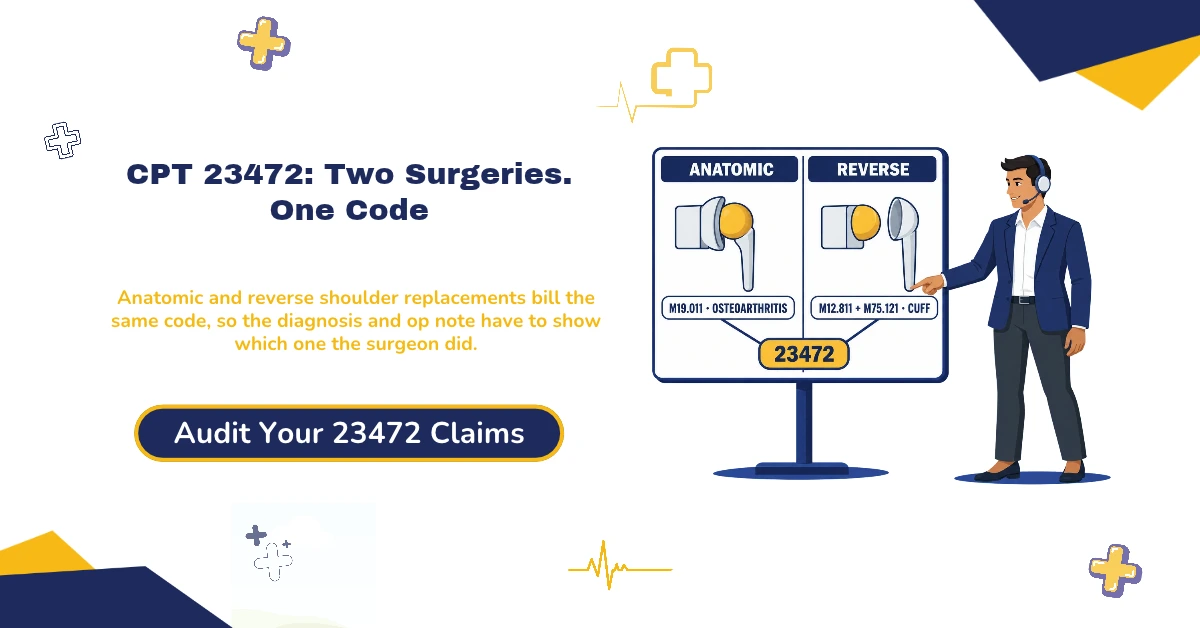
CPT code 23472 reports a total shoulder arthroplasty, where the surgeon replaces both the glenoid and the proximal humerus with prosthetic components in one session. The same code covers anatomic and reverse total shoulder arthroplasty. In 2026, Medicare’s national physician payment is $1,300.30 (38.93 total RVUs), and the code carries a 90-day global period.
One code for two different surgeries is where most of the trouble starts. Payers can’t read the implant design from the CPT code, so they check the diagnosis and the operative note against their own policy. A reverse shoulder billed with a primary osteoarthritis diagnosis and no cuff findings is the claim that ends up in review.
This guide is for coders and billers who work orthopedic surgery claims, whether they bill for the surgeon or for the facility. Payment figures come from the CY 2026 Medicare Physician Fee Schedule. Commercial rules vary, so check your contracts before you apply a payer rule from one plan to another.
CPT code 23472 at a glance (2026)
CPT 23472 is an active Category I code in 2026, with no change to its descriptor this year. Medicare pays the surgeon about $1,300 nationally, allows one unit per date of service, and pays for an assistant at surgery. Hospitals bill it under a C-APC, and ASCs have been able to bill Medicare for it since 2024.
| Item | 2026 detail |
|---|---|
| Official descriptor | Arthroplasty, glenohumeral joint; total shoulder (glenoid and proximal humeral replacement (eg, total shoulder)) |
| Designs covered | Anatomic total shoulder and reverse total shoulder arthroplasty |
| Facility RVUs | Work 21.58, practice expense 12.99, malpractice 4.36, total 38.93 |
| Medicare national payment | $1,300.30 at the $33.4009 conversion factor; about $1,306.78 for qualifying APM participants at $33.5675 |
| Global period | 090 |
| Laterality | RT or LT on every claim |
| Bilateral surgery indicator | 1: modifier 50 applies, paid at 150% |
| Assistant at surgery indicator | 2: payable with modifier 80, 82, or AS |
| Co-surgery and team surgery | Co-surgeon indicator 1 (documentation required); team surgery indicator 0 (not paid) |
| MUE | 1 per date of service |
| Hospital outpatient (OPPS) | Status indicator J1, C-APC 5116 |
| ASC | Payment indicator J8 (device-intensive), covered since January 1, 2024 |
| Inpatient only list | Removed January 1, 2021 |
Your local payment moves with the geographic practice cost index (GPCI), so treat the national figure as a starting point. The CMS Physician Fee Schedule Look-Up Tool returns the rate for your MAC locality.
What CPT code 23472 covers
CPT 23472 covers replacement of both sides of the glenohumeral joint: a humeral component (stemmed or stemless) with a head or cup, plus a glenoid component or a reverse baseplate. Exposure, bone preparation, trialing, cementing when used, and closure all sit inside the code. Report it once per shoulder per session.
What “total” means on a 23472 claim
Both joint surfaces have to be replaced. If the surgeon replaces the humeral head and leaves the native glenoid alone, the case is a hemiarthroplasty and the code is 23470, even when the dictation says shoulder replacement. Fracture cases slip most often. An op note that says “humeral head replaced, glenoid inspected and preserved” is a 23470 claim.
Coders who look up the total shoulder replacement CPT code land on 23472, and that’s correct for most cases. Still, the word “replacement” in a dictation doesn’t decide the code. Read the implant log. A glenoid component, or a baseplate with a glenosphere, on that list means 23472.
Is CPT 23472 a surgical code?
Yes. It’s a Category I code in the musculoskeletal section of CPT, and Medicare gives it a 90-day global period. The surgeon bills it on the CMS-1500 (837P). Hospitals report it on the UB-04 (837I), and an ASC bills Medicare on the 837P under its own facility rate.
Anesthesia goes on its own claim under 01638, the anesthesia code for total shoulder replacement, with base and time units. Our guide to anesthesia CPT code billing explains how those units add up. The anesthesia claim should carry the same diagnosis and laterality as the surgeon’s claim, since payers compare the two.
Is CPT 23472 the CPT code for reverse total shoulder arthroplasty?
Yes. CPT has no separate code for a primary reverse total shoulder arthroplasty, so a primary reverse case reports with 23472, the same code as an anatomic total shoulder. The ACGME case log guidelines map reverse TSA to 23472, and Aetna’s shoulder arthroplasty policy does the same. Revisions use 23473 or 23474.
Coders sometimes go looking for a separate reverse TSA CPT code. There isn’t one, and no modifier flags the reverse design on the claim. The difference shows up in the diagnosis code and the implant record, and the payer checks both during medical necessity review.
How payers tell anatomic from reverse when the code is the same
They look at the indication. Aetna’s policy sets different criteria for each design. An anatomic total shoulder needs a working rotator cuff, and Aetna considers total shoulder arthroplasty for osteoarthritis with an irreparable cuff tear experimental and investigational.
A reverse shoulder has its own list. Aetna wants an intact, functioning deltoid, at least 90 degrees of passive elevation, enough bone stock to hold the components, and no Charcot (neuropathic) joint. The surgeon’s exam note has to record those findings, because the claim itself can’t.
So the diagnosis and the op note have to tell the same story as the implant. A reverse claim with M19.011 alone and no cuff findings in the dictation looks like the wrong surgery for the diagnosis. Orthopedic groups hit this wall across many procedures, as we cover in orthopedic prior authorization challenges.
Right and left reverse shoulder claims
Report CPT code 23472 with RT or LT, as in 23472-RT. The sixth character of the diagnosis code has to match: 1 for right, 2 for left. A 23472-LT claim paired with M12.811 (right shoulder) is a laterality mismatch, and most payer edits reject it before anyone reads the claim.
CPT 23472 vs 23470, 23473, and 23474: choosing the right shoulder arthroplasty code
Pick the code by which components the surgeon replaced and whether a total shoulder was already in place. 23470 replaces the humeral side only. 23472 replaces both sides. 23473 revises one component of an existing total shoulder, and 23474 revises both. In 2026, about $464 separates the lowest and highest Medicare rates in this family.
| Code | What it describes | 2026 total RVUs (facility) | 2026 Medicare national payment |
|---|---|---|---|
| 23470 | Hemiarthroplasty: humeral replacement only | 32.57 | $1,087.87 |
| 23472 | Total shoulder arthroplasty, anatomic or reverse | 38.93 | $1,300.30 |
| 23473 | Revision of total shoulder, humeral or glenoid component | 43.12 | $1,440.25 |
| 23474 | Revision of total shoulder, humeral and glenoid components | 46.47 | $1,552.14 |
Work RVUs climb in the same order: 17.44 for 23470, 21.58 for 23472, 24.38 for 23473, and 26.53 for 23474. Payment figures use the 2026 non-APM conversion factor of $33.4009.
What is CPT 23474?
CPT 23474 reports revision of a total shoulder arthroplasty when the surgeon revises both the humeral and glenoid components, including allograft when performed. The AMA created 23473 and 23474 for CPT 2013. A failed reverse with a loose baseplate and a loose stem, both replaced, is a 23474 case.
So the revision reverse total shoulder arthroplasty CPT code is 23473 or 23474, and the choice depends on how many components the surgeon changes. The revision codes apply to anatomic and reverse implants alike.
When is CPT 23473 the right code?
Use 23473 when the surgeon revises one component, either the humeral or the glenoid side, and leaves the other in place. A loose or worn glenoid component on an otherwise stable anatomic total shoulder is a typical case. The op note should say which component the surgeon removed and replaced and that the other one was well fixed and retained.
What separates 23472 from 23473 is history. 23472 is a primary procedure. 23473 is a return to the OR to fix one part of a total shoulder the patient already has.
Where coders slip: removal codes and conversions
Removal codes come first. The NCCI Policy Manual, Chapter IV says 23470 and 23472 include removal of the native joint or a failed prosthesis and its replacement. It also says 23333, 23334, and 23335 shall not be reported separately with 23470 or 23472 for removal of a prior failed prosthetic joint.
Conversions come second. Because the manual describes 23472 as including removal of a failed prosthesis, many coders report a hemiarthroplasty-to-total conversion with 23472. Commercial payers don’t all agree, so flag conversions for coder review and check the payer’s policy first. Knee claims follow the same removal logic, which our CPT 27447 total knee guide walks through.
If your coders keep debating hemi versus total on fracture cases, or revisions keep coming back short-paid, a second look at the op note before submission costs far less than an appeal. Our surgical claim coding review checks the implant log against the code before the claim leaves your office.
ICD-10 codes that support CPT code 23472
The diagnosis has to explain why the shoulder needed both surfaces replaced. Anatomic cases usually pair with primary, post-traumatic, or secondary osteoarthritis (M19.01-, M19.11-, M19.21-) or with osteonecrosis of the humerus (M87.02-). Reverse cases usually pair with a cuff arthropathy coded as M12.81- plus the cuff tear code, or with a proximal humerus fracture (S42.2-).
| ICD-10-CM code | Description | Typical design |
|---|---|---|
| M19.011 / M19.012 | Primary osteoarthritis, right / left shoulder | Anatomic |
| M19.111 / M19.112 | Post-traumatic osteoarthritis, right / left shoulder | Anatomic or reverse |
| M19.211 / M19.212 | Secondary osteoarthritis, right / left shoulder | Anatomic or reverse |
| M87.021 / M87.022 | Idiopathic aseptic necrosis of right / left humerus | Anatomic or reverse |
| M12.811 / M12.812 | Other specific arthropathies, not elsewhere classified, right / left shoulder | Reverse |
| M75.121 / M75.122 | Complete rotator cuff tear or rupture, not specified as traumatic, right / left shoulder | Reverse (secondary code) |
| S42.201A / S42.202A | Unspecified fracture of upper end of right / left humerus, initial encounter, closed | Reverse or hemiarthroplasty |
| Z96.611 / Z96.612 | Presence of right / left artificial shoulder joint | Status code after surgery, not an indication |
All of these codes are valid in the FY2027 ICD-10-CM set, which took effect October 1, 2026. The CMS ICD-10 code files carry any mid-year updates.
Shoulder arthroplasty ICD-10 codes for anatomic cases
Primary osteoarthritis carries most anatomic total shoulders. Payers want the radiology report to back it up, and Aetna asks for at least two radiographic findings, such as joint space narrowing and osteophytes. Post-traumatic osteoarthritis (M19.11-) fits a patient with an old fracture. Secondary osteoarthritis (M19.21-) fits arthritis caused by another documented condition.
Reverse TSA ICD-10 coding and the cuff tear arthropathy gap
ICD-10-CM has no code named “cuff tear arthropathy.” Aetna’s policy maps it to M12.81-, and coders usually add the cuff tear code (M75.121 or M75.122) so the claim shows both the arthropathy and the deficient cuff. For a massive irreparable tear without arthritis, the cuff tear code leads, and the record needs pseudoparalysis findings and 12 weeks of supervised therapy.
Older patients with a proximal humerus fracture often go straight to a reverse. Code the fracture with the initial-encounter seventh character A, and use the most specific fracture code the imaging supports. S42.201A and S42.202A are the unspecified fallbacks.
Mapping mistakes that trigger denials
| Mistake | Why it fails | Fix |
|---|---|---|
| M12.511 coded as shoulder osteoarthritis | M12.511 is traumatic arthropathy, right shoulder | Use M19.011 for primary osteoarthritis or M19.111 for post-traumatic osteoarthritis |
| Reverse TSA billed with M19.011 alone | The diagnosis doesn’t explain a deficient cuff | Add M12.81- and the cuff tear code the record supports |
| Laterality mismatch | The sixth character doesn’t match RT or LT | Match 1 to right and 2 to left on every line |
A claim scrubber catches most of these once someone writes the edit. When one slips through, the denial usually comes back as medical necessity or a diagnosis inconsistent with the procedure, and diagnosis mismatch denial recovery starts with a corrected claim.
Modifiers for CPT code 23472
Every 23472 claim needs RT or LT. Past laterality, the right modifier depends on timing and on who else operated. Use 58, 78, or 79 for procedures during the global period, 24 or 57 for E/M visits, 80, 82, or AS for assistants, 62 for co-surgeons, and 22 when the work is substantially greater than typical.
| Modifier | When it applies on a 23472 claim |
|---|---|
| RT / LT | Every claim, to identify the operated shoulder |
| 50 | Same-session bilateral replacement (bilateral indicator 1, paid at 150%) |
| 22 | Substantially greater work than typical, documented with time and cause |
| 58 | Staged or planned procedure during the global period, including a planned second shoulder |
| 78 | Unplanned return to the OR for a related complication, such as dislocation or infection |
| 79 | Unrelated procedure during the global period |
| 24 | Unrelated E/M visit during the global period |
| 57 | E/M visit on the day before or day of surgery that resulted in the decision to operate |
| 80 / 82 | Assistant surgeon; 82 when no qualified resident is available in a teaching hospital |
| AS | PA, NP, or clinical nurse specialist acting as assistant at surgery |
| 62 | Co-surgeons, each performing a distinct part of the procedure |
| 54 / 55 | Surgical care only or postoperative care only, when care transfers between providers |
| 59 / XS | Separate site or structure for a code that has an NCCI edit with 23472 and a modifier indicator of 1 |
The CMS Global Surgery Booklet counts a 90-day global as 92 days: the day before surgery, the day of surgery, and the 90 days after. Routine follow-up visits in that window aren’t billable. For when 59 or an X-modifier holds up, see our guide to modifier 59 and X-modifiers.
When modifier 22 holds up on a shoulder replacement
Payers want a cause and a number. Modifier 22 fits cases like severe glenoid bone loss that needs extensive reconstruction, or a patient whose body habitus added a documented hour of exposure. The op note should state the extra time and compare it with the surgeon’s typical 23472.
Expect a records request. Most payers review modifier 22 claims by hand, so send the op note with the claim when the payer accepts attachments.
Bilateral and staged shoulder replacements
Most surgeons stage bilateral shoulders weeks or months apart. If the second side falls inside the first side’s 90-day global and the surgeon planned it, append 58 with the correct side, which starts a new global period.
A same-day bilateral case goes on one line with modifier 50 and one unit, and Medicare pays 150% of the fee schedule amount. Billing two units or two separate lines tends to trip the MUE of 1 for Medicare. Commercial payers vary, and some want two lines with RT and LT instead.
Modifier errors on shoulder cases tend to hide in small underpayments, like a 79 billed where the payer expected a 78, or a missed 58 on the second shoulder. If your aging report keeps turning those up, our full revenue cycle management team tracks global periods for each surgeon so the claim carries the right modifier before it goes out.
Can CPT code 23472 and 23430 be billed together?
It depends on the payer. CPT Assistant (July 2024) says biceps tenodesis (23430) is separately reportable with 23472. NCCI pairs the two codes in its Medicare edits, and Aetna’s policy calls biceps tenodesis integral to shoulder arthroplasty and doesn’t reimburse it separately. Check the payer’s rules before you add 23430 to the claim.
23430 billing decision by payer type
| Payer | 23430 with 23472 | What to do |
|---|---|---|
| Medicare | NCCI edit pairs the two codes | Check the modifier indicator in the current quarter’s PTP file before you add a modifier |
| Aetna | Tenodesis is integral to the arthroplasty and not reimbursed separately | Don’t bill 23430; document the tenodesis in the op note anyway |
| Commercial payers that follow CPT Assistant | Often separately payable | Bill 23430 with a supporting biceps diagnosis, such as M75.21 or M75.22 |
The modifier indicator on an NCCI edit decides what’s possible. An indicator of 0 means no modifier can bypass the edit. With an indicator of 1, 59 or XS can bypass it when the record supports a separate procedure. Look up the pair in the NCCI procedure-to-procedure edit files; the Q4 2026 files took effect October 1, 2026.
The CPT Assistant July 2024 article is the citation commercial payers usually want to see in a 23430 appeal. Payer-by-payer rules like this one are where payer-specific claim scrubbing pays for itself.
Is biceps tenodesis included in total shoulder arthroplasty?
For Medicare and Aetna claims, it works out that way, since neither pays it separately. CPT’s own guidance treats it as separately reportable. Tenotomy is a different procedure: cutting the biceps tendon without reattaching it doesn’t support 23430. Before 23430 goes on any claim, the op note has to describe the tendon fixed to bone and the fixation method.
Does CPT 23472 include rotator cuff repair?
The NCCI Policy Manual doesn’t address open rotator cuff repair with shoulder arthroplasty, so the PTP edit table decides. Before you bill 23410, 23412, or 23420 with 23472, look up each pair in the current quarter’s file and check the modifier indicator. Coders generally treat subscapularis release and repair during the approach as part of the arthroplasty.
CPT code for reverse total shoulder arthroplasty with biceps tenodesis
Report 23472 with RT or LT for the reverse. Add 23430 only when the payer allows it and the op note documents a true tenodesis with a coded, supported biceps diagnosis. For Medicare, the NCCI edit governs the pair. Aetna doesn’t pay the tenodesis at all.
CPT code 23472 reimbursement in 2026
Medicare’s 2026 national rate for the surgeon is $1,300.30, or about $1,306.78 for qualifying APM participants. The facility gets paid separately: under an MS-DRG for inpatients, under C-APC 5116 in a hospital outpatient department, and under the ASC payment system with indicator J8. Local rates vary with the GPCI.
Surgeon payment for 23472
The physician rate rests on 38.93 total RVUs: 21.58 work, 12.99 practice expense, and 4.36 malpractice. Medicare multiplies each piece by your locality’s GPCI and then by the conversion factor, which is $33.4009 for 2026, or $33.5675 for qualifying APM participants.
Commercial contracts usually pay a percentage of Medicare or a fixed fee schedule, and that percentage is negotiable when the contract renews. If your shoulder rates haven’t moved in years, payer contract rate negotiation is worth a look before the next renewal date.
Facility payment by setting
| Setting | Payment system | How the 23472 case is paid |
|---|---|---|
| Hospital inpatient | IPPS | Typically MS-DRG 483, though some cases group to MS-DRG 515 to 517 |
| Hospital outpatient | OPPS | Status indicator J1, C-APC 5116 |
| ASC | ASC payment system | Payment indicator J8 (device-intensive) |
Hospital outpatient claims for 23472 should report HCPCS C1776 (joint device, implantable) for the implant, since CMS expects device codes on device-intensive procedures. ASC rates are in the CMS ASC payment rate addenda. Revision code 23474 maps to a different C-APC, 5115.
What patients pay
For an inpatient stay, Original Medicare patients owe the 2026 Part A deductible of $1,736 for the hospital, plus Part B cost sharing on the surgeon’s claim. In hospital outpatient and ASC settings, the $283 Part B deductible and 20% coinsurance apply to the surgeon and facility claims. Medicare’s Procedure Price Lookup compares national averages for the two outpatient settings.
Medicare Advantage and commercial plans set their own cost sharing. Run benefit verification before surgery before the date gets booked, so the patient hears their share from your office and not from a bill.
What 2027 looks like for 23472
The CY 2027 proposed rule sets conversion factors of $33.17 for qualifying APM participants and $32.84 for others, down from $33.57 and $33.40. At 38.93 RVUs, the non-APM rate for CPT code 23472 would fall to about $1,278.46. The CMS CY 2027 PFS proposed rule fact sheet has the details, and CMS usually publishes the final rule in early November.
Surgeon and facility claims for the same shoulder go out on different forms under different payment systems, and a mismatch between them draws attention in review. ClaimMax RCM handles hospital and facility claim billing alongside the surgeon side, so the codes and diagnoses agree across both claims.
Is CPT 23472 inpatient only? Setting of care in 2026
No. CMS removed 23472 from the Medicare inpatient only list on January 1, 2021, and it stayed off when CMS added most of that year’s removals back for 2022. In 2026, Medicare pays for 23472 as an inpatient admission, a hospital outpatient procedure, or an ASC case, depending on the patient’s condition and the surgeon’s judgment.
Is CPT code 23472 inpatient or outpatient?
It can be either. Palmetto GBA’s Jurisdiction J guidance says total shoulder arthroplasty “may be performed safely and efficiently as an outpatient in properly selected patients,” and that admissions follow the two-midnight rule. In practice, the surgeon has to document why the patient needs a stay spanning two midnights before the hospital bills it as inpatient.
Medicare added 23472 to the ASC covered procedures list in 2024. MedPAC’s March 2026 report counted 11,047 Medicare ASC cases that first year.
The inpatient only list phase-out and 23472
The CY 2026 OPPS final rule starts a three-year phase-out of the inpatient only list, removing 285 musculoskeletal procedures in 2026, according to AAHKS’s summary of the final rule. 23472 was already off the list, so the change doesn’t move it. With more joint procedures eligible for outpatient care, the admission note matters more when a patient stays.
Place of service codes for 23472 claims
| POS | Setting | 23472 use |
|---|---|---|
| 21 | Inpatient hospital | Admitted patients who meet the two-midnight expectation |
| 22 | On-campus outpatient hospital | Outpatient cases in an on-campus hospital department |
| 19 | Off-campus outpatient hospital | Outpatient cases in an off-campus provider-based department |
| 24 | Ambulatory surgical center | ASC cases, paid under indicator J8 |
The surgeon’s POS has to match where the facility billed the case. Our guide to POS 22 billing rules covers on-campus cases. Off-campus departments follow the off-campus POS 19 claims rules instead.
Prior authorization and medical necessity for CPT code 23472
Original Medicare doesn’t currently require prior authorization for CPT code 23472, but many Medicare Advantage and commercial plans do. Payers look for the same facts: months of pain and lost function, a documented trial of conservative care, imaging that shows joint damage, and for a reverse, a working deltoid. A gap in any of them usually ends in a denial.
What Medicare and Aetna check before approving 23472
Palmetto GBA’s Jurisdiction J guidance lists the Medicare side. The patient needs at least 12 weeks of pain or disability and 12 weeks of failed conservative therapy. Pain and function should be scored on a validated scale, such as VAS, DASH, SPADI, or ASES, at baseline and after treatment, using the same scale both times.
The record has to address each criterion. Palmetto also expects the performing surgeon to be credentialed and privileged at the facility. For a massive irreparable cuff tear, the chart needs pseudoparalysis and 12 weeks of supervised physical therapy.
| Aetna requirement | What the chart needs |
|---|---|
| 6 months of pain and functional loss | Dated notes showing onset and progression |
| 12 weeks of non-surgical treatment within the past year | At least half of it as in-person physical therapy, confirmed by PT notes or claims history |
| 2 or more radiographic findings | A radiology report that names the findings |
| Reverse only: intact deltoid, at least 90 degrees of passive elevation, adequate bone stock, no Charcot joint | Exam findings and imaging in the surgeon’s note |
| No shoulder steroid injection within 12 weeks of surgery | Injection dates in the record |
Aetna confirms therapy with PT notes or claims history, so a surgeon’s line saying “failed PT” won’t carry the request alone. Running these checks at scheduling through an eligibility and prior authorization workflow catches missing notes while there’s still time to get them.
The 12-week steroid injection rule
Aetna lists a corticosteroid injection within 12 weeks of surgery as an absolute contraindication. It’s easy to miss when the injection happened at another office. Check the injection history before the surgery date gets set. Our guide to shoulder injection billing under 20610 shows how those injections get coded, which helps when you search claims history for one.
Therapy records cause the other common gap. If the PT notes sit with an outside clinic, request them before you submit, and watch for the problems we describe in physical therapy documentation gaps.
Does Medicare cover shoulder replacement surgery?
Yes, when it’s medically necessary. Part A covers the inpatient hospital stay, and Part B covers the surgeon plus outpatient and ASC facility claims. Original Medicare doesn’t currently require prior authorization for 23472, but that doesn’t protect the payment. MACs and auditors can review the record after payment and recoup the money if it doesn’t support medical necessity.
Medicare Advantage prior authorization timelines in 2026
Under CMS-0057-F, Medicare Advantage plans and state Medicaid and CHIP programs have to decide expedited prior authorization requests within 72 hours and standard requests within 7 calendar days, starting January 1, 2026. Submit the request at least two weeks before the surgery date to leave room for a peer-to-peer. The CMS-0057-F fact sheet lists the full requirements.
Why CPT 23472 claims get denied
Most CPT code 23472 denials trace back to the chart. The common reason codes are medical necessity (CO-50), missing authorization (CO-197), a diagnosis that doesn’t support the procedure (CO-11), modifier problems (CO-4), bundling (CO-97), and missing information (CO-16). Each one has its own fix, and a few get resolved with a corrected claim before any appeal.
| CARC | What it means | Typical 23472 cause | Fix |
|---|---|---|---|
| CO-50 | Not medically necessary | Conservative care, scores, or imaging findings missing | Appeal with PT notes, scores, and the radiology report |
| CO-197 | Authorization absent | Medicare Advantage or commercial auth not obtained or expired | Retro-authorization if the payer allows it, then appeal |
| CO-11 | Diagnosis inconsistent with procedure | Osteoarthritis code alone on a reverse case, or a laterality mismatch | Corrected claim with the right diagnosis |
| CO-4 | Modifier missing or inconsistent | No RT or LT, or modifier 50 billed on two lines | Corrected claim |
| CO-97 | Included in another service | 23430, or 23333 to 23335 billed with 23472 | Check the NCCI indicator; appeal only when a modifier applies and the record supports it |
| CO-16 | Missing information | Missing device code, NPI, or attachment | Resubmit with the missing data |
How one weak op note can sink the whole episode
A shoulder replacement produces several claims: surgeon, assistant, anesthesia, and facility, and many payers review them together. If the surgeon’s note can’t support medical necessity, the payer can deny or recoup the facility claim too, and the assistant and anesthesia claims can follow. A privileging gap at a new ASC carries the same risk.
What goes in a 23472 appeal packet
- The operative note with the implant log or sticker sheet
- Dated clinic notes showing how long the pain and functional loss lasted
- Physical therapy notes, or claims history showing the therapy visits
- Validated pain and function scores at baseline and after treatment
- The radiology report with the specific findings
- A short letter from the surgeon tying the findings to the payer’s policy criteria
For Medicare, file the redetermination within 120 days of receiving the initial determination. Commercial appeal windows vary by contract, so check the payer agreement before the deadline gets close.
A single 23472 denial can hold up payment on every claim from the same case. If your team doesn’t have time to build packets like this for each CO-50, our denial management and appeals team works them from the first denial to the final decision.
23472 CPT code documentation checklist
A clean CPT code 23472 claim starts weeks before surgery. The chart needs a dated history of pain and failed treatment, imaging that names the damage, and an operative note that spells out the implant design and every component placed. Use the first list before scheduling and the second before coding.
Before surgery
- Dated onset of pain and functional loss, with the duration stated
- Conservative treatment history with dates, including in-person PT
- Baseline and follow-up scores on the same validated scale
- A radiology report naming at least two findings
- Injection history covering the 12 weeks before the planned date
- Authorization number and approved dates for Medicare Advantage or commercial plans
In the operative note
- State the design, anatomic or reverse
- List each component placed, with manufacturer and catalog numbers from the implant log
- Describe the condition of the rotator cuff and the deltoid
- Document any tenodesis with its fixation method, kept apart from any tenotomy
- Record removal of any prior hardware or prosthesis
- Note extra time and its cause when the case qualifies for modifier 22
CPT code 23472 FAQs
What is CPT code 23472?
CPT 23472 is the procedure code for total shoulder arthroplasty, where the surgeon replaces both the glenoid and the proximal humerus. It applies to anatomic and reverse designs alike. Medicare assigns it a 90-day global period, and the 2026 national physician payment is $1,300.30, based on 38.93 total RVUs.
Is CPT code 23472 surgery?
Yes. It’s a Category I surgical code in the musculoskeletal section of CPT, with a 90-day global period. Surgeons report it on the professional claim, while hospitals and ASCs report it on their facility claims. Anesthesia for the case is billed separately under 01638, and routine postoperative visits inside the global period aren’t billed.
What is the CPT code for total shoulder arthroplasty?
The code is 23472, for both anatomic and reverse total shoulder replacement. If the surgeon replaces only the humeral side, the code is 23470. For a patient who already has a total shoulder and needs a revision, the code is 23473 for one component or 23474 for both.
What is the difference between CPT 23472 and 23474?
CPT 23472 is a primary total shoulder arthroplasty, while 23474 is a revision of an existing total shoulder in which the surgeon revises both the humeral and glenoid components, including allograft when performed. In 2026, 23474 carries 46.47 total RVUs and a Medicare national payment of $1,552.14, against 38.93 RVUs and $1,300.30 for 23472.
What does CPT code 23473 represent?
CPT 23473 reports revision of a total shoulder arthroplasty when the surgeon revises one component, either humeral or glenoid, including allograft when performed. It applies to anatomic and reverse implants. The 2026 Medicare national payment is $1,440.25 at 43.12 total RVUs. A revision that replaces both components moves up to 23474.
When should CPT 23470 be used instead of 23472?
Use 23470 when the surgeon replaces only the humeral head and leaves the native glenoid in place. That’s a hemiarthroplasty, often done for proximal humerus fractures or for osteonecrosis with a healthy glenoid. If the op note lists a glenoid component or a reverse baseplate, the correct code is 23472.
Does CPT 23472 require a modifier?
Yes. Every 23472 claim needs RT or LT to identify the shoulder. Other modifiers depend on the case: 50 for a same-day bilateral procedure, 58 for a planned second shoulder inside the global period, 78 for a related return to the OR, 80, 82, or AS for an assistant, and 22 for documented extra work.
Is CPT 23472 inpatient only?
No. CMS removed 23472 from the Medicare inpatient only list in 2021, and Medicare has paid for it in ASCs since 2024. Hospitals can bill it as an outpatient procedure under C-APC 5116. Inpatient admission still applies when the surgeon expects a medically necessary stay spanning two midnights and documents why.
Was CPT 23472 deleted or changed in 2026?
No. CPT 23472 is active in 2026 with the same descriptor, and Medicare pays it under the 2026 Physician Fee Schedule at 38.93 total RVUs. The CY 2027 proposed rule lowers the conversion factor, which would trim payment in 2027 if CMS finalizes it. Check the final rule, expected in early November, before you update 2027 fee schedules.
How much does Medicare pay for CPT 23472 in 2026?
The 2026 national physician payment is $1,300.30, based on 38.93 total RVUs and a $33.4009 conversion factor. Qualifying APM participants get about $1,306.78. Your local rate depends on your locality’s GPCI, and Medicare pays the facility claim separately under the DRG, APC, or ASC rate for the setting.
Getting CPT code 23472 paid the first time
Most 23472 problems start long before the claim. The implant design drives the diagnosis code, the diagnosis drives the authorization, and the authorization depends on therapy notes and imaging that someone has to collect weeks ahead. Once those pieces sit in the chart, the coding is the easy part.
ClaimMax RCM’s team handles orthopedic surgery billing for surgeon groups and the facilities they operate in, from authorization through appeal. We code the surgeon and facility claims against the same op note, so the two don’t contradict each other.
If you’d like to see where your shoulder claims lose money, ClaimMax RCM can run a free revenue cycle analysis on your recent 23472 denials and payments.
Sources
- CMS Physician Fee Schedule Look-Up Tool
- ACGME Case Log Guidelines, Adult Reconstructive Orthopaedic Surgery
- Aetna Clinical Policy Bulletin 0837
- CMS ICD-10 code files
- CMS Global Surgery Booklet, MLN907166
- CPT Assistant, July 2024
- Medicare NCCI procedure-to-procedure edits
- NCCI Policy Manual 2026, Chapter IV
- Medicare Procedure Price Lookup for 23472
- CMS CY 2027 Physician Fee Schedule proposed rule fact sheet
- CMS ASC payment rate addenda
- MedPAC March 2026 Report to the Congress, Chapter 11
- AAHKS summary of the 2026 Medicare OPPS and ASC final rules
- CMS Interoperability and Prior Authorization Final Rule (CMS-0057-F) fact sheet
- Palmetto GBA Jurisdiction J shoulder arthroplasty guidance