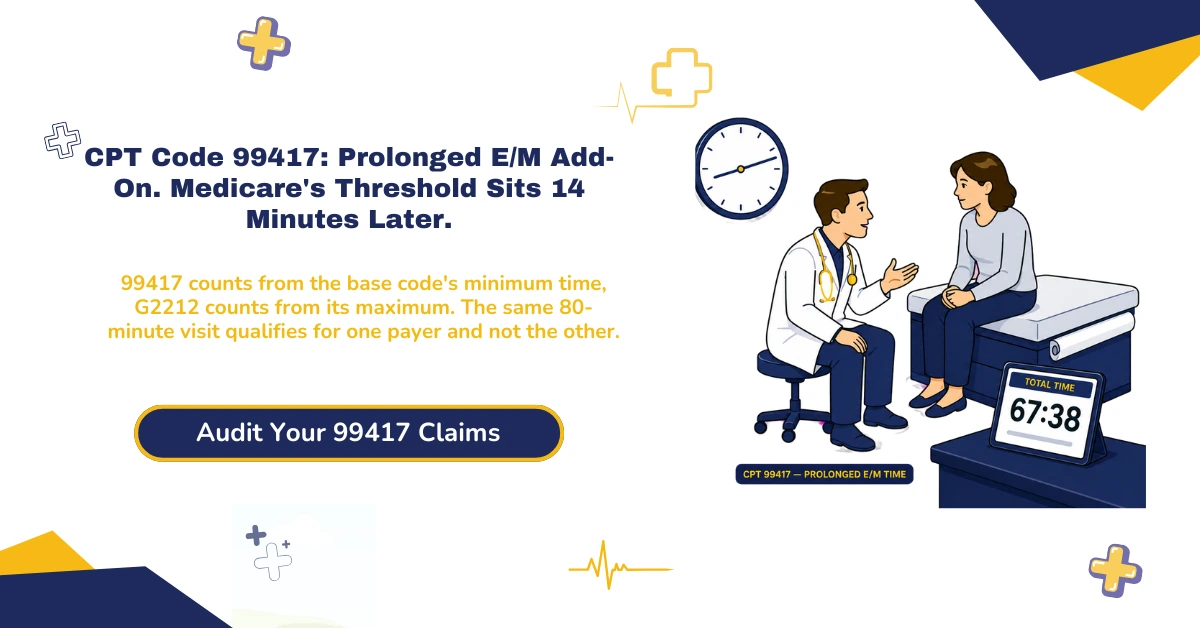
CPT code 99417 reports each complete additional 15 minutes of prolonged outpatient evaluation and management (E/M) time, after the practice selects an eligible primary service using total time. The first unit starts at 75 minutes with 99205 and 55 minutes with 99215 for payers that follow CPT rules. Medicare uses G2212 instead.
Two separate rule sets govern this code, and they don’t line up. Medicare’s first prolonged unit opens 14 minutes later than the CPT threshold on both base codes.
What CPT 99417 is used for
CPT 99417 pays for qualifying physician or qualified healthcare professional (QHP) time that runs past an eligible outpatient E/M service on the same date. It covers face-to-face care and related work away from the patient, counted together. The physician or QHP must select the primary service using total time.
What the add-on code captures
A complete 99417 CPT code description covers two things: the work the code pays for, and what has to be true of the primary service underneath it. Both have to hold. AMA splits prolonged services CPT codes by setting, and 99417 handles the outpatient side.
AMA deleted 99354 and 99355 effective January 1, 2023, and pointed coders to 99417 for prolonged work on the date of an outpatient visit, a home or residence visit, or a cognitive assessment. Practices still carrying 99354 in a charge master are billing a deleted code.
What 99417 does not replace
99417 is an add-on code, so it never travels alone on a claim. It doesn’t substitute for the primary E/M code, and it doesn’t cover minutes the physician spent on a service billed under its own code.
A long wait in the lobby isn’t billable time either.
When CPT code 99417 can be billed
CPT code 99417 can be billed when four conditions hold: the claim carries an eligible primary code, someone selected that primary code using total time, the reporting physician or QHP reached a full extra 15 minutes, and none of those minutes belong to a separately reported service.
Four conditions have to be met
- The claim carries a primary code from the eligible list.
- Someone selected that primary code using total time.
- The reporting physician or QHP reached a complete additional 15 minutes.
- No part of that time belongs to another reported service.
Condition two catches more claims than the other three combined. A provider who picks 99215 on medical decision making, with no total time in the note, leaves the 99417 CPT code with nothing under it. Partial units won’t rescue the claim, because CPT doesn’t allow rounding up.
Codes that block 99417 on the same date
CPT blocks 99417 on the same date of service as 90833, 90836, 90838, 99358, 99359, 99415, and 99416. The psychotherapy add-ons cause the most trouble in practice. A payer edit will reject a behavioral health claim carrying 99215, 90838, and one of the prolonged service codes on a single date.
Medical necessity still has to support the visit
Reaching a time threshold doesn’t prove the visit needed that time. A 58-minute established patient visit can support 99215 plus one unit under CPT rules. The note still has to show what filled those minutes. A copied line reading “extended counseling performed” won’t hold up when a payer pulls the record.
Run the payer check before submission. Waiting for the first denial costs a corrected claim and another 30 days. ClaimMax’s medical billing services connect the coding review, the claim build, the payer rule, and the follow-up in one workflow.
Which primary codes pair with 99417 in 2026
99205 and 99215 are the common pairings, and CPT recognizes eight more. The current list adds an office consultation code, two home or residence codes, the cognitive assessment code, and four synchronous telemedicine codes. A payer may work from a shorter list, so CPT eligibility doesn’t settle coverage.
Office, consultation, home, cognitive, and telemedicine codes
Table 1. CPT pairings for 99417 and the total time at which the first unit begins. Source: AMA CPT.
| Primary code | Service | First 99417 unit at | Notes |
|---|---|---|---|
| 99205 | New patient office or outpatient | 75 minutes | Core pairing |
| 99215 | Established patient office or outpatient | 55 minutes | Core pairing |
| 99245 | Office or outpatient consultation | 70 minutes | Medicare does not recognize the base code |
| 99345 | New patient home or residence | 90 minutes | Payer dependent |
| 99350 | Established patient home or residence | 75 minutes | Payer dependent |
| 99483 | Cognitive assessment and care plan | 75 minutes | No required base threshold |
| 98003 | New patient synchronous audio-video | 75 minutes | Verify payer recognition |
| 98007 | Established patient synchronous audio-video | 55 minutes | Verify payer recognition |
| 98011 | New patient synchronous audio-only | 75 minutes | Verify payer recognition |
| 98015 | Established patient synchronous audio-only | 55 minutes | Verify payer recognition |
99483 runs on a different mechanism. It carries no required base time threshold, so CPT ties the add-on to the typical time of the service and opens the first unit at 75 minutes.
The CPT code 99245 pairing starts at 70 minutes, since 99245 needs 55 minutes at the base level. Traditional Medicare doesn’t recognize 99245 for Part B payment at all.
Payer recognition can narrow the CPT list
| 2026 payer warningCPT pairing doesn’t create payer coverage. In the CY 2026 Physician Fee Schedule final rule, CMS declined to add telemedicine E/M codes 98000 to 98015 to the Medicare telehealth services list, and those codes carry a fee schedule status indicator of I, meaning not valid for Medicare. Confirm the policy first. |
State programs publish their own instructions. NC Medicaid allowed 99417 with 99245, 99345, and 99350 in an August 2023 bulletin, and Nevada Medicaid added 99483 to that same set in February 2024. Neither bulletin tells you what your state program does today.
CPT 99417 time chart for non-Medicare payers
For payers that follow CPT rules, the first unit of 99417 opens at 75 total minutes with 99205 and 55 total minutes with 99215. Each unit after that needs another complete 15 minutes. A partial interval isn’t reportable.
99205 CPT code and 99417 time thresholds
Table 2. The 99417 time chart for new patients. Applies to payers following CPT rules, not to Medicare. Source: AMA CPT E/M guidelines.
| Total physician or QHP time | Report |
|---|---|
| 60 to 74 minutes | 99205 alone |
| 75 to 89 minutes | 99205 plus 99417 x 1 |
| 90 to 104 minutes | 99205 plus 99417 x 2 |
| 105 to 119 minutes | 99205 plus 99417 x 3 |
| 120 to 134 minutes | 99205 plus 99417 x 4 |
99215 CPT code and 99417 time thresholds
Table 3. The 99417 time chart for established patients. Applies to payers following CPT rules, not to Medicare. Source: AMA CPT E/M guidelines.
| Total physician or QHP time | Report |
|---|---|
| 40 to 54 minutes | 99215 alone |
| 55 to 69 minutes | 99215 plus 99417 x 1 |
| 70 to 84 minutes | 99215 plus 99417 x 2 |
| 85 to 99 minutes | 99215 plus 99417 x 3 |
| 100 to 114 minutes | 99215 plus 99417 x 4 |
An established patient visit totals 54 minutes. Report 99215 alone, since the first prolonged unit hasn’t been reached. Add one minute and the answer changes: at 55 minutes, that same visit supports 99215 plus one unit, assuming the payer follows CPT rules and the note supports total time.
A new patient visit totals 104 minutes. Report 99205 plus two units. The third unit doesn’t open until 105 minutes, so those four extra minutes past 100 earn nothing. Both charts assume the provider selected the base code by time.
For the thresholds sitting under each base code, see the ClaimMax guides to 99205 time requirements and CPT code 99215.
Never round up a partial unit
CPT sets a hard floor: don’t report the code for any time increment under 15 minutes. A visit at 68 minutes on a 99215 base has 13 qualifying minutes past the first unit, and 13 minutes buys nothing. Auditors watch for rounded-up units, because they cluster.
How many units of CPT 99417 you can bill
Report one unit for each complete 15 minutes of qualifying time past the minimum time of the eligible primary service. CPT sets no universal four-unit cap. Payers apply their own frequency limits through maximum-units edits, so the ceiling on any claim comes from the payer.
Calculate only complete 15-minute units
| 99417 units = qualifying minutes past the primary code minimum, divided by 15, rounded down. |
The formula earns its keep on the pairings that never get their own chart. Take 99350, where the base threshold sits at 60 minutes. A 94-minute visit gives you 34 qualifying minutes past 60, which divides into two complete units with four minutes left over that nobody can bill.
Four units is not a universal CPT maximum
Don’t run this formula for Medicare. G2212 counts from the maximum time of the base code, and that single change shifts every number in the calculation.
CPT 99417 vs. G2212: which code should you bill
CPT 99417 and HCPCS code G2212 both report prolonged office or outpatient E/M time, and they aren’t interchangeable. Payers following CPT use 99417. Medicare uses G2212, which opens its first unit 14 minutes later on both base codes. Medicare treats 99417 as invalid on its fee schedule.
Use 99417 for non-Medicare payers that follow CPT
Table 4. G2212 vs 99417, side by side.
| Rule | CPT 99417 | HCPCS G2212 |
|---|---|---|
| Payer pathway | Non-Medicare payer following CPT | Medicare |
| 99205 first prolonged unit | 75 total minutes | 89 total minutes |
| 99215 first prolonged unit | 55 total minutes | 69 total minutes |
| Counts from | Minimum time of the base code | Maximum time of the base code |
| Unit length | Complete 15 minutes | Complete 15 minutes |
| Eligible base codes | 10 codes across office, consultation, home, cognitive, and telemedicine | 99205, 99215, and 99483 |
| Partial unit allowed | No | No |
Searches for a G2212 CPT code description run into a naming problem. G2212 isn’t a CPT code. CMS built it as a HCPCS Level II code after disagreeing with how CPT set the 99417 threshold, so anyone searching for CPT G2212 wants a Medicare code.
Use G2212 for Medicare office visits
Table 5. The G2212 time table for Medicare prolonged office and outpatient E/M visits. Source: CMS MLN006764, May 2026. The 75 to 88 and 55 to 68 rows are added by ClaimMax; CMS Table 3 lists only the rows where G2212 applies.
| Total time on the date of service | Report |
|---|---|
| 99205, 60 to 74 minutes | 99205 alone |
| 99205, 75 to 88 minutes | 99205 alone, no prolonged unit |
| 99205, 89 to 103 minutes | 99205 plus G2212 x 1 |
| 99205, 104 to 118 minutes | 99205 plus G2212 x 2 |
| 99215, 40 to 54 minutes | 99215 alone |
| 99215, 55 to 68 minutes | 99215 alone, no prolonged unit |
| 99215, 69 to 83 minutes | 99215 plus G2212 x 1 |
| 99215, 84 to 98 minutes | 99215 plus G2212 x 2 |
| 99215, 99 minutes or more | Add one G2212 for each additional complete 15 minutes |
Those two added rows cover the window where the pathways disagree. An 80-minute new patient visit supports 99205 plus a prolonged unit for a commercial payer following CPT. The same visit for a Medicare patient supports 99205 alone, because Medicare wants 89 minutes.
Medicare also allows G2212 with 99483, and that pairing runs on its own numbers: a 100-minute threshold, with countable time running from 3 days before the visit through 7 days after.
| Do not publish this claim“G2212 is obsolete, and Medicare now accepts 99417 universally.” That claim is wrong. CMS’s May 2026 E/M Services booklet still directs Medicare practitioners to use G2212 for prolonged office and outpatient E/M visits selected by time. Confirm the patient’s payer before choosing the code. |
Medicare Advantage plans don’t all process the code the same way. Check the plan’s current reimbursement policy and its claim edits before assuming it mirrors fee-for-service Medicare.
When a practice serves Medicare, Medicaid, Medicare Advantage, and commercial patients, one universal rule can’t carry the code decision. ClaimMax’s revenue cycle management services connect payer verification, coding, submission, and denial follow-up under one accountable workflow.
If your team still settles G2212 vs 99417 claim by claim, a payer-specific coding review catches the mismatch before submission.
What time counts toward CPT 99417
Count qualifying time the physician or QHP personally spent on the date of the encounter. Both face-to-face care and related work away from the patient count toward the total, as long as nobody reports that activity separately under its own code.
Countable physician or QHP activities
Table 6. Activities AMA counts toward total E/M time. Source: AMA CPT E/M guidelines.
| Countable activity | What it looks like in the clinic |
|---|---|
| Preparing to see the patient | Reading the outside imaging report before you walk in |
| Obtaining or reviewing separately obtained history | Working through the referring physician’s intake notes |
| Performing the examination or evaluation | The medically appropriate assessment |
| Counseling and educating the patient or caregiver | Walking a family through treatment options and risks |
| Ordering medications, tests, or procedures | Placing the lab order and the imaging order |
| Referring and communicating with other professionals | A call to the treating cardiologist |
| Independently interpreting results when not separately reported | Reading a study yourself when nobody bills the interpretation |
| Coordinating care when not separately reported | Arranging home health before the patient leaves |
| Documenting clinical information in the health record | Finishing the encounter note that evening |
All time has to land on the same date of service
A physician spends 34 minutes with the patient, 12 minutes on outside records, and 9 minutes finishing the plan that evening. All of it lands on the same calendar date, and none of it belongs to another billed service. Total time is 55 minutes.
Reaching 55 minutes doesn’t guarantee payment. The base code, the payer pathway, the note, and the medical necessity all still have to hold up under review.
What time can’t be counted toward 99417
Leave out time spent on a service reported separately, travel, and teaching that isn’t specific to this patient. Those are the three exclusions CPT names. Clinical staff minutes and work done on another date drop out too, because CPT defines total time as the reporting professional’s own time on the encounter date.
Exclude separately reported services
Table 7. Time to leave out of the prolonged services calculation.
| Time to leave out | Why it is excluded | Source of the rule |
|---|---|---|
| Minutes on a separately billed procedure | Another code already pays for that work | CPT E/M guidelines |
| Travel | Travel is not qualifying E/M work | CPT E/M guidelines |
| General teaching | It is not management of this specific patient | CPT E/M guidelines |
| Clinical staff minutes | Total time is the physician or QHP’s own time | CPT definition of total time |
| Work performed on another date | Total time runs by the encounter date | CPT definition of total time |
| Resident time without the teaching physician present | The teaching physician counts personally performed time, plus time present while the resident performs those activities | CMS teaching physician rules |
Don’t count staff time, travel, or other-day work
CPT sums time when two professionals share a visit, and only distinct time counts. Two clinicians in the same discussion still yield one set of claimable minutes. CMS blocks split or shared billing for office visits altogether, because incident-to payment is available in that setting.
A physician documents 65 total minutes, and 12 of those went to a separately billed procedure. Strip the 12 out. Qualifying E/M time comes to 53 minutes, which leaves a 99215 claim without a prolonged unit under either pathway.
Once the minutes are right, the note becomes the problem. A correct total still needs documentation that explains the work and supports the primary service.
What documentation supports a CPT code 99417 claim
A defensible CPT code 99417 claim needs five things in the note: a statement that the provider selected the base code by time, the total minutes as a specific number, a description of what filled those minutes, confirmation that separately reported services sit outside the total, and clinical content explaining why the visit ran long.
State the code selection method
A note that never says how the provider picked the base code leaves the add-on unsupported. One line handles it. Write that total time drove the selection, then give the number.
Reviewers check the method before they check the minutes. A note that argues high medical decision making and says nothing about time gives the prolonged unit no foundation.
Write a time statement that survives review
| Total time on the date of the encounter: 62 minutes. Activities: review of outside cardiology records, examination, counseling on treatment options, care coordination with the referring physician, and documentation. Time excludes the separately billed procedure. |
That last sentence closes the most common audit question before anyone asks it. A bare “spent 62 minutes” gives a reviewer nothing to verify, and it reads the same on every chart in the practice.
Avoid the patterns that draw review
Rounded totals sitting on the threshold attract attention, and so does the word “approximately.” Templated time language repeated across patients reads as auto-populated text, and reviewers treat it that way.
Which modifiers apply to CPT 99417
99417 carries no modifier on most claims. Modifier 51 never applies, because add-on codes are exempt from the multiple procedure reduction. Modifier 25 belongs on the base E/M code when a procedure runs on the same date, and it does not belong on the prolonged line. Telehealth modifiers follow the payer.
Table 8. Modifier handling on a claim that carries 99417.
| Modifier | Where it goes | When it applies |
|---|---|---|
| 51 | Nowhere on this claim | Add-on codes are exempt from multiple procedure reduction |
| 25 | On the base E/M code | A significant, separately identifiable E/M runs alongside a same-date procedure |
| 95 | On the base E/M code | Synchronous audio-video visit, when the payer wants it |
| 93 | On the base E/M code | Audio-only visit, when the payer recognizes the modifier |
| FS | On the base E/M code | Split or shared visit in a facility setting; CMS blocks split or shared billing for office visits |
No modifier converts a wrong-payer code into a payable one. A Medicare claim carrying 99417 with modifier 95 attached comes back the same way it would without one.
Can you bill 99417 with a telehealth visit
CPT allows 99417 with four synchronous telemedicine base codes: 98003 and 98011 for new patients, 98007 and 98015 for established patients. Medicare runs a separate route, because CMS assigns 98000 through 98015 a status indicator of I and keeps Medicare telehealth on the office visit codes.
The CPT telemedicine pathway
Table 9. Telemedicine base codes that accept 99417. Source: AMA CPT.
| Base code | Modality and patient type | Base time threshold | First 99417 unit at |
|---|---|---|---|
| 98003 | Audio-video, new patient | 60 minutes | 75 minutes |
| 98007 | Audio-video, established patient | 40 minutes | 55 minutes |
| 98011 | Audio-only, new patient | 60 minutes | 75 minutes |
| 98015 | Audio-only, established patient | 40 minutes | 55 minutes |
The audio-only codes carry a second requirement. CPT wants more than 10 minutes of medical discussion before the base code applies at all. That requirement sits underneath the time threshold, and it does not replace it.
The Medicare telehealth pathway
Medicare practitioners bill 99202 through 99215 with the telehealth place of service and the payer’s modifier, then add G2212 once total time clears 89 minutes on 99205 or 69 minutes on 99215. The 98000 series stays off Medicare claims.
Commercial and Medicaid adoption of the telemedicine family varies by plan. Confirm that a payer recognizes the base code before you decide whether the prolonged unit belongs on the claim.
Three worked claim examples
The same encounter produces a different claim depending on who pays. These three examples run the arithmetic from documented minutes to submitted units, first for a commercial payer following CPT rules and then for traditional Medicare.
A 62-minute established patient visit, commercial payer
The provider selects 99215 by time. 62 minutes clears the 55-minute threshold by 7 minutes, so one unit of 99417 goes on the claim. The second unit stays closed until 70 minutes.
An 80-minute new patient visit, Medicare
The provider selects 99205 by time. Medicare wants 89 minutes before G2212 applies, so this claim carries 99205 alone. Those 6 minutes past 74 earn nothing under the Medicare pathway, and 99417 is not an option for this patient.
A commercial payer following CPT would pay 99205 plus one unit of 99417 on the same 80 minutes. Same note, same minutes, two different claims.
A 100-minute established patient visit, Medicare
This claim carries 99215 plus G2212 x 3. Medicare opens the first unit at 69 minutes, the second at 84, and the third at 99. At 100 documented minutes the third unit qualifies, with one minute left over that nobody bills.
CPT 99417 reimbursement and RVU
No Medicare payment exists for CPT 99417. CMS assigns the code a fee schedule status indicator of I, meaning not valid for Medicare purposes, so a Medicare claim carrying 99417 comes back rejected and never reaches pricing. Commercial payment runs on your contract, and Medicare pays the prolonged office visit through G2212.
What a published 99417 RVU tells you
Fee schedule sites publish a 99417 RVU and build a national Medicare rate from it. The arithmetic runs fine. Medicare still refuses to price the code, so the resulting dollar figure describes a payment that nobody collects.
Treat that number as a benchmark for contract conversations. Ask what each commercial contract pays per 15-minute unit, then compare the answers across your payer mix.
How 99417 CPT code reimbursement gets set
Commercial payers set 99417 payment by contract. Some pay a flat amount per unit, some tie the rate to a percentage of the Medicare physician fee schedule, and some cap units per date of service through a maximum-units edit. Pull the fee schedule attached to each contract.
What Medicare pays for G2212
Medicare prices G2212 through the physician fee schedule. Payment equals total relative value units, adjusted by your locality’s geographic practice cost index, multiplied by the conversion factor. CMS finalized two conversion factors for 2026 in the CY 2026 final rule: $33.4009 for non-qualifying clinicians and $33.5675 for qualifying APM participants.
Run your own locality through the CMS Physician Fee Schedule Look-Up Tool. A national average hides the geographic adjustment your claims run on. Then check what posts against what you expected, because a paid claim is not always a claim paid in full. ClaimMax’s payment posting services flag the variance while the dispute window is still open.
Why 99417 claims get denied and how to fix them
99417 denials cluster in five places: the base code sits outside the eligible list, the provider selected the base code by medical decision making, the documented minutes fall short of the threshold, the claim went to Medicare, or the units exceed what the payer allows on one date.
Table 10. Common 99417 denial triggers and the corresponding fix.
| What the payer saw | Likely reason | What fixes it |
|---|---|---|
| Add-on billed without a qualifying primary service | The base code is not on the eligible list, or it did not pay | Confirm the base code, then resubmit the pair together |
| Prolonged unit denied on a paid base code | The note selected the base code by medical decision making | No fix on this claim; correct the documentation pattern going forward |
| Units above the allowed frequency | The payer applies a maximum-units edit | Recheck the unit math, then send records if the minutes support it |
| 99417 denied by Medicare | Medicare treats 99417 as invalid | Resubmit with G2212 when total time clears the Medicare threshold |
| Service bundled into another payment | 99358, 99359, 99415, 99416, or a psychotherapy add-on shares the date | Review the same-date exclusions before resubmitting |
Correct the claim or appeal it
Corrected claims fix your own errors. Wrong code for the payer, wrong unit count, a missing base code, or claim data that contradicts the note all route to a corrected claim. Calling that an appeal sends the file into the wrong queue on the wrong timeline.
Appeals defend a claim that was right when it left the building. File one when the note supports the units, the payer follows CPT rules, and the denial arrived anyway. Build the packet once with the note, the time statement, and the payer’s own policy language.
Repeated prolonged service denials point to a pattern in the documentation or the payer setup, not to one bad claim. ClaimMax’s denial management services sort each denial into correction, records, or appeal, and the accounts receivable team works the balance before the filing window closes.
99417 compared with the other prolonged service codes
Prolonged service reporting splits by setting and by payer. 99417 covers outpatient work under CPT rules and 99418 covers inpatient and observation. Medicare replaces both with its own G codes: G2212 for office and cognitive assessment, G0316 for inpatient and observation, G0317 for nursing facility, and G0318 for home or residence.
Table 11. Prolonged service codes by setting and payer pathway.
| Code | Setting | Payer pathway |
|---|---|---|
| 99417 | Office, consultation, home or residence, cognitive assessment, telemedicine | Payers following CPT |
| 99418 | Inpatient and observation | Payers following CPT |
| G2212 | Office or outpatient, plus cognitive assessment | Medicare |
| G0316 | Inpatient and observation | Medicare |
| G0317 | Nursing facility | Medicare |
| G0318 | Home or residence | Medicare |
99358 and 99359 belong to a different category. They report prolonged work on a date other than the face-to-face encounter, and CPT blocks them on the same date as 99417. Reaching for them to capture same-day overflow time produces a denial.
99415 and 99416 report prolonged clinical staff time under physician supervision. Those codes describe a different resource, and CPT blocks them on the same date as 99417 as well.
Frequently asked questions about CPT code 99417
Can 99417 be billed alone?
No. 99417 is an add-on code, so a qualifying primary service has to appear on the same claim for the same date. A claim carrying the prolonged unit without an eligible base code gets denied for a missing qualifying service, and no modifier corrects it.
Does Medicare accept 99417?
No. CMS assigns 99417 a fee schedule status indicator of I, meaning not valid for Medicare purposes. Medicare practitioners report prolonged office and outpatient time with G2212 instead, starting at 89 total minutes on 99205 and 69 total minutes on 99215.
How many units of 99417 can be billed on one date?
CPT sets no universal cap. Report one unit for each complete 15 minutes of qualifying time past the minimum time of the base code, rounding down. Individual payers apply their own frequency limits through maximum-units edits, so the practical ceiling comes from the contract.
Can 99417 be reported when the base code was selected by medical decision making?
No. CPT ties the add-on to time-based selection of the primary service. A note that supports high medical decision making and records no total time leaves nothing for the prolonged unit to attach to, and the correction belongs in the documentation, since no claim edit reaches it.
Does documentation time count toward 99417?
Yes, when the physician or QHP performs it on the date of the encounter and nobody reports it separately. Finishing the encounter note that evening counts. So does reviewing outside records before the visit and coordinating care afterward, as long as all of it lands on the same calendar date.
What is the difference between 99417 and G2212?
Both report prolonged office and outpatient E/M time in 15-minute units. 99417 counts from the minimum time of the base code and applies to payers following CPT. G2212 counts from the maximum time and applies to Medicare, which puts its first unit 14 minutes later on both 99205 and 99215.
How ClaimMax handles prolonged service billing
Prolonged service claims break in four places: the payer pathway, the base code selection method, the unit math, and the same-date exclusions. ClaimMax RCM checks all four before submission, while a correction still costs minutes instead of another 30 days.
Verification starts with the exact plan on the card, not the payer name. The team confirms which prolonged service code that product recognizes, checks the documented minutes against the applicable threshold, and reviews the claim for codes that share the date and block the add-on.
ClaimMax RCM pricing
| Service | Price | Included |
|---|---|---|
| Full medical billing | 3.49% of payer collections | Verification of benefits and prior authorization at no additional charge |
| Credentialing | $120 per insurance application | Payer credentialing workflow |
Percentage pricing means ClaimMax gets paid when the practice gets paid. Verification of benefits confirms what a plan says about coverage, and it never guarantees payment. The same holds for a submitted prior authorization.
If your team decides between 99417 and G2212 one claim at a time, ClaimMax can review the payer rules, the documentation pattern, and the denied-claim history with your billing staff. Start with ClaimMax RCM and a free revenue cycle analysis.