The 99245 CPT code is the highest-level office or other outpatient consultation for a new or established patient. Code selection requires high medical decision making, or at least 55 minutes of total physician or qualified health professional time on the date of the encounter. Traditional Medicare does not recognize outpatient consultation codes for Part B payment.
CPT code 99245 comes down to five facts. Four of them live in the note. The fifth lives in the payer’s policy.
| Item | Requirement |
|---|---|
| Setting | Office or other outpatient |
| Patient status | New or established |
| MDM level | High |
| Time, when used for code selection | 55 minutes, met or exceeded |
| Traditional Medicare | Does not recognize 99245 for Part B payment |
CPT rules decide whether the code can be reported. The patient’s plan decides whether the claim gets paid. Both have to line up. When they don’t, a clean note still ends in a denial.
Pull the plan’s consultation policy before the visit. Checking after the remittance posts means a corrected claim and a longer wait for the money.
What Is the 99245 CPT Code?
CPT code 99245 is the highest-level office or other outpatient consultation for a new or established patient. The encounter must support high medical decision making, or at least 55 minutes of total time when time drives the selection. History and examination must be medically appropriate, but neither element sets the level.
A complete 99245 CPT code description covers two things: where the service happens and how the level gets picked. Most summaries don’t get past the first.
99245 Is the Highest Office Consultation Level
CPT 99245 sits at the top of the office and other outpatient consultation family. The current family runs from 99242 to 99245. AMA deleted 99241 effective January 1, 2023. Older lists of outpatient consult CPT codes show five levels instead of four.
Patient status doesn’t narrow the field. A cardiologist can report 99245 for a patient seen two years ago, provided the consultation requirements are met.
History and Examination Do Not Determine the Level
History and examination don’t select the level. Both belong in the note, and both have to be medically appropriate for the presenting problem. Neither gets scored against a component grid the way the pre-2021 rules worked.
Any CPT code 99245 definition that still requires a comprehensive history and physical examination is quoting a retired framework. Level selection runs on MDM or total time under current AMA E/M guidance.
99245 Is Not an Inpatient Consultation Code
99245 covers outpatient work only. Inpatient and observation consultations use 99252 to 99255, a separate range with its own time thresholds. An admitted patient needs the inpatient range instead. Reporting the outpatient consultation code produces a denial that a corrected claim has to fix.
Place of service still needs its own check. An outpatient consultation CPT code can be performed in a hospital outpatient department or a physician office, and the plan’s setting rules apply either way.
When Does an Encounter Qualify as a Consultation?
An encounter qualifies as a consultation when an appropriate source requests a provider’s opinion about a defined clinical issue and the consultant returns findings and recommendations to that requester in writing. A patient’s self-referral, with no documented request, does not meet the consultation requirement.
Level comes later. Nothing in the 99245 CPT code selection rules matters until the encounter clears that gate.
An Appropriate Source Must Request the Opinion
A physician or other qualified health professional has to request the opinion before consultation CPT codes apply. The request needs to name a specific clinical question. Identify the requester in the record.
Patient and family requests don’t count. Someone booking a cardiology visit on a neighbor’s recommendation hasn’t created a consultation, however complex the encounter turns out.
Document the Request, Reason, and Report
Three elements have to appear in the record before a CPT code for consultation holds up. UTMB’s faculty coding team calls them the three R’s in its consultation guidance.
| Requirement | What the record must show | Failure risk |
|---|---|---|
| Request | Requester’s name and the opinion asked for | Encounter may not qualify |
| Reason | The specific clinical question | Medical necessity unclear |
| Report | Findings returned to the requester | Consultation loop incomplete |
Those three have to survive the handoff from scheduling to submission. Reliable medical billing services confirm the request, clinical question, code level, and payer rule before the claim goes out.
Consultation, Referral, and Transfer of Care Are Not Identical
A consultation asks for an opinion. A referral sends the patient out for evaluation or treatment. Transfer of care hands ongoing management to someone else.
Consultants can start treatment and still report consult CPT codes, provided the request and report are documented. CPT removed its old transfer-of-care language, so applying it now costs legitimate claims.
New and Established Patients Can Both Qualify
Consultation codes don’t split into new and established families. A specialist who saw the patient 18 months ago can still report an office consultation CPT code, provided the requirements are met.
Patient status starts mattering later. Anyone searching for a new patient consult CPT code usually assumes consultations work like 99202 to 99215. Status only turns decisive when a plan rejects consultations.
Two encounters, same cardiologist.
A primary care physician asks the cardiologist to evaluate unexplained syncope and recommend the next step. The cardiologist names the requester, documents the question, and sends recommendations back. That’s the pattern behind searches for a CPT code for consultation with specialist.
Now the patient books that same cardiologist directly for ongoing management. No request exists in the chart. The visit may be necessary and well documented, and it still isn’t a consultation.
How Does High MDM Support CPT 99245?
CPT 99245 requires high medical decision making in at least two of the three MDM elements: problems addressed, data reviewed and analyzed, and risk of patient management. Two elements at the high level are enough. The third can sit lower without changing the selection.
High MDM Requires Two of Three Elements
Two of three costs revenue in both directions. Some coders downcode encounters that already reached the threshold for 99245. Others assume all three elements must be high, which the AMA E/M revisions FAQs don’t require.
| MDM element | High-level signal | Documentation focus |
|---|---|---|
| Problems addressed | Severe or life-threatening condition | What the provider actively managed |
| Data reviewed and analyzed | Extensive qualifying data activity | What was reviewed, interpreted, or discussed |
| Risk of patient management | High-risk management decision | What was decided, and why |
Problems Addressed at the High Level
The problem has to be severe, not just present. Severe exacerbation or progression of a chronic illness qualifies. So do severe side effects of treatment, and any illness threatening life or bodily function.
Diagnosis count proves nothing. A note listing 11 conditions where the provider addressed two of them earns credit for two. The rest were carried forward, not managed.
Extensive Data Review Requires More Than Record Volume
Data credit follows category rules, not page count. Records reviewed, tests ordered, independent interpretation, and discussion with an external physician each sit in defined categories with their own counting requirements.
One activity counts once. Interpreting an outside echo and then discussing that same echo with the ordering cardiologist doesn’t produce two data credits. A pasted list of reviewed records invites an auditor to check.
High Risk Must Reflect the Management Decision
Risk lives in the decision, not the diagnosis. Drug therapy requiring intensive monitoring for toxicity qualifies. So does a decision about emergency major surgery, hospitalization, or escalation to hospital-level care.
Not every prescription clears that bar. Starting a statin and starting a drug that needs serial liver enzyme checks sit in different places, and the note has to show which one happened.
Note Length Does Not Equal MDM Level
A six-page note can support moderate MDM. A one-page note can support high MDM when the problems, the data work, and the management risk are all visible in it.
Volume isn’t the variable. Reviewers auditing CPT code 99245 look for what was addressed, what was analyzed, and what was decided. Pages of templated history answer none of that.
An oncologist evaluates severe treatment toxicity, independently reviews the imaging, discusses management with the treating specialist, and decides whether the patient needs admission. Problems look high. Risk looks high. Data may reach high if the interpretation and the discussion each satisfy their own category rules.
With two elements at the high level and the consultation requirements documented, the 99245 CPT code may be supported through MDM. May, not automatically.
Complex care and a defensible note aren’t the same thing. When the encounter clearly ran high but the record shows only one high element, ClaimMax’s medical coding support catches it before the claim goes out.
How Does the 55-Minute Time Rule Work for CPT 99245?
CPT 99245 requires at least 55 minutes of total physician or qualified health professional time on the date of the encounter when time drives the code selection. The full threshold must be met. Time spent by clinical staff, time on separately reported services, and work performed on another date do not count toward it.
In time based medical billing, the minutes on the claim have to represent qualifying work the reporting professional performed. Whose minutes, and which date, decide more denials than the total ever does.
Fifty-Five Minutes Is the Minimum
The threshold is a floor, not an average. Pre-2021 descriptors published typical times, and anyone trained on that language still reads the number as a target to land near. Current guidance treats it as a minimum to meet or exceed, and the AAFP E/M time table shows where each level starts.
Rounding doesn’t happen here. A documented 53 minutes supports 99244 by time, not the 99245 CPT code. High MDM may still carry the higher level. Time alone won’t.
What Time May Count
Qualifying work counts whether or not the patient is in the room. Preparing for the visit, reviewing records and results, taking the history, performing the examination, counseling the patient or caregiver, ordering tests and medications, coordinating care, and writing the note all qualify on the encounter date.
Each activity still has to belong to the E/M service being reported. Work that supports a separately billed procedure belongs to that procedure, not to the 55 minutes.
What Time Should Not Be Counted
Staff minutes never count, no matter how much work the staff did. A medical assistant who spends 12 minutes rooming the patient and collecting vitals contributes nothing here. Travel doesn’t count either, and neither does teaching that isn’t specific to managing this patient.
Shared time counts once. When two professionals sit in on the same discussion, both can’t claim those minutes.
| Counts toward total time | Does not count |
|---|---|
| Same-date record and test review | Work performed on another date |
| Patient evaluation and examination | Clinical staff time |
| Counseling and care coordination | Separately reported procedures |
| Same-date documentation | Minutes claimed twice by two professionals |
The Note Must State Total Time Clearly
One sentence protects the whole claim: “Code selected by total time. I personally spent 58 minutes on the date of the encounter performing qualifying evaluation and management activities.”
Never write “approximately 55 minutes.” The hedge weakens the attestation, and a figure sitting exactly on the threshold is the first pattern a reviewer pulls.
When Can 99417 Be Added to CPT 99245?
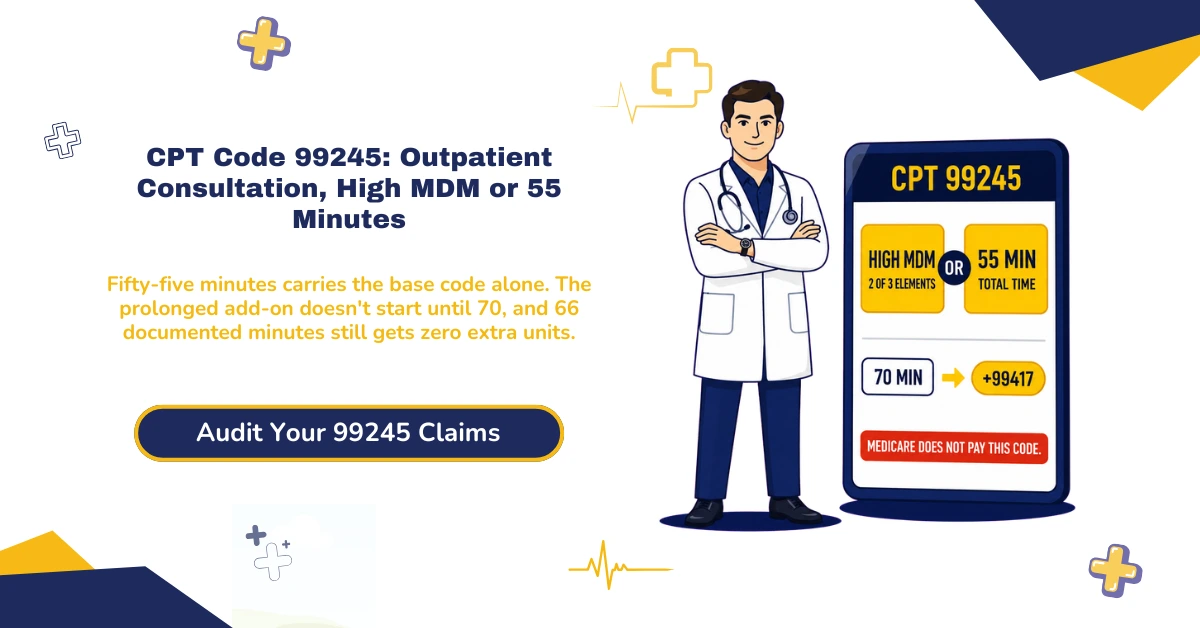
CPT 99417 can be reported with CPT 99245 when the visit level was selected by total time and the encounter reaches 70 minutes on the date of service. At 69 minutes, the claim carries 99245 alone. CPT permits the pairing, and the patient’s plan decides whether it pays.
The First Unit Begins at 70 Minutes
The arithmetic is 55 plus 15. Fifty-five minutes satisfies the base code. One full prolonged increment adds another 15, which puts the first unit of 99417 at 70 total minutes on the encounter date. AAFP’s E/M time reference lists the office consultation prolonged threshold as 70 minutes or longer.
Partial increments don’t get reported. Adding 11 minutes past the base gives you 66 documented minutes and no add-on unit.
Use 99417 Only When the Visit Is Selected by Time
An MDM-selected encounter can’t carry 99417. When the note supports high MDM and never records total time, the add-on has no foundation under it. Document the minutes, or leave the unit off the claim.
Medicare sits outside this entirely. CMS lists consultations as not applicable in its prolonged services table, because traditional Medicare doesn’t recognize 99245 in the first place. G2212 is Medicare’s outpatient prolonged code, and it attaches to 99205 and 99215, never to a consultation.
Total Time Sets the Number of Units
| Total time on the encounter date | Report |
|---|---|
| 55 to 69 minutes | 99245 only |
| 70 to 84 minutes | 99245 plus one unit of 99417 |
| 85 to 99 minutes | 99245 plus two units of 99417 |
| 100 minutes or more | 99245 plus three units of 99417, adding one unit for each additional 15 minutes |
State programs publish their own instructions. NC Medicaid’s 99417 guidance confirms the pairing for that program, which tells you nothing about the plan in front of you. Confirm the plan recognizes both the 99245 CPT code and 99417 before the claim goes out.
What Documentation Must Support a 99245 Claim?
A defensible 99245 claim needs five elements in the medical record: the requesting source, the specific clinical question, a medically appropriate history and examination, visible support for high MDM or total time, and the written report returned to the requester. A sixth check sits outside the record, in the payer’s policy.
Identify the Requester and Clinical Question
Name the requester and name the question. “Patient referred for evaluation” tells a reviewer nothing about who asked or what they needed to know.
Compare that to this: “Dr. Smith requested a cardiology opinion regarding recurrent syncope and whether further rhythm monitoring is needed.” One sentence, and the source, the question, and the decision are all on the page. Date the request, or link the order directly to the encounter.
Use a Medically Appropriate History and Examination
Nothing in the CPT code 99245 description requires a comprehensive history and physical examination. Extent follows medical need, and that’s the entire rule.
Padding the exam backfires. Adding systems nobody asked about makes the note longer without making the level stronger, since neither element gets scored for level selection anymore.
Show Why the Encounter Supports High MDM
Clinical reasoning has to be visible, not inferable. The note should name the problems addressed, the data reviewed and analyzed, and the management risk, then show the decision that came out of them.
Reviewers auditing a 99245 CPT code claim read for the “why.” A diagnosis list and an order set describe activity. The sentence explaining why admission was considered and ruled out is what carries high MDM.
Record Defensible Total Time
Say what you left out. When a procedure was reported separately on the same date, the note should state that its time was excluded from the total. That one line closes the most common time-based audit question before it gets asked.
Prolonged units need their own math. If the claim carries 99417, the documented minutes have to reach the unit threshold on their own.
Complete the Written Report Loop
The loop closes when the requester actually receives the findings. Document the recommendations, name the recipient, and record the date and the method of communication.
Method stays flexible unless the payer specifies one. A routed EHR note works, so does a faxed letter or a portal message. An undocumented phone call doesn’t.
Use a Prebill Documentation Checklist
Seven checks before the claim goes out:
- Consultation request identified by requesting provider name
- Clinical reason documented as a specific question
- Medically appropriate history and examination recorded
- High MDM or total time pathway supported in the note
- Total encounter time stated when time drives selection
- Written report sent back to the requesting provider
- Payer acceptance of consultation codes confirmed before submission
Number seven is the one practices skip. Revenue cycle management services connect the request, the note, the code level, and the payer rule before the claim leaves the building.
The note can be airtight and the claim can still fail on a payer rule. When that’s the gap, ClaimMax can review the note, the payer’s consultation policy, the code level, and the claim setup before submission.
When Is CPT 99245 Supported or Unsupported?
Level 99245 holds when three things line up: the encounter qualifies as a consultation, the note supports high MDM or 55 minutes, and the payer recognizes consultation codes. Miss any one, and the claim needs a different path. Five scenarios show where each one breaks.
Supported Through High MDM
A pulmonologist gets a request to evaluate a patient whose interstitial lung disease has progressed on current therapy. The consultant addresses a severe condition, independently interprets outside imaging, and decides against admission after weighing it. Recommendations go back to the requesting provider that afternoon.
Two elements sit at the high level. The plan recognizes consultation codes. The high MDM pathway may support this claim.
Supported Through Time
Same request pattern, different basis. The note records 58 minutes of qualifying work on the encounter date, lists what filled those minutes, and states that time drove the selection. The report goes back. The plan accepts the code.
Fifty-eight minutes clears the base threshold and falls short of 70. No prolonged unit belongs on this claim.
Unsupported Because the Encounter Is a Self-Referral
The patient calls the specialty office directly and books. No requesting provider appears anywhere in the chart. The visit runs long, the condition is serious, and the documentation is excellent.
None of that creates a consultation. Without a request and report, the encounter is an office visit, and the 99202 to 99215 range applies.
Unsupported Because the Note Does Not Show High MDM or 55 Minutes
The request is legitimate. The clinical question is documented, the report goes back, and the consultation requirements are satisfied in full. Then the note shows moderate MDM and 43 documented minutes.
Consultation coding still applies. The consultation level doesn’t. Moderate MDM and 43 minutes point to 99244, not 99245.
Clinically Supported but Not Payable by the Payer
Everything checks out clinically. Request, question, high MDM, report back, all documented. The plan stopped reimbursing consultation codes two years ago.
The record supports the service. The claim needs a payer-recognized E/M code instead.
| Scenario | Consultation qualified? | Level 99245 supported? | Payment check needed? |
|---|---|---|---|
| High MDM with request and report | Yes | Potentially | Yes |
| 58 minutes with request and report | Yes | Potentially | Yes |
| Patient self-referral | No | No | Yes |
| Moderate MDM and 43 minutes | Yes | No | Yes |
| Payer rejects consult codes | Clinically, yes | Clinically, yes | Alternative billing path required |
Documentation gets you two of the three answers. The third sits in the payer’s policy, and that’s where the next section starts.
Is CPT 99245 Still Valid in 2026?
Yes. The 99245 CPT code remains an active office or other outpatient consultation code in 2026. Providers may report the code when the consultation requirements and either high MDM or 55 minutes are documented. Active status and payer recognition are separate questions, and traditional Medicare does not reimburse consultation codes.
Active Does Not Mean Payable
AMA maintains CPT code 99245 in the current code set. Two separate authorities answer two separate questions here. CPT rules decide whether the service can be reported. The plan’s reimbursement policy decides whether the submitted code gets paid.
A code denied under a reimbursement policy hasn’t been deleted. That plan simply stopped covering the service, and another plan may still pay it.
The Code Remains Reportable for Recognizing Payers
Four conditions have to hold: the encounter qualifies as a consultation, the note supports high MDM or total time, the request and report are documented, and the plan recognizes consultation codes.
Three out of four isn’t enough. A flawless record submitted to a plan that dropped consultation codes still comes back unpaid.
Do Not Call 99245 a Medicare Code
Active in CPT and payable by Medicare are different statuses. Any 99245 CPT code description implying Medicare coverage describes a rule that ended in 2010. A complete 99245 code description covers both halves: the CPT meaning, and whether the plan in front of you recognizes it.
| Question | Direct answer |
|---|---|
| Is 99245 deleted? | No |
| Is 99245 active in CPT 2026? | Yes |
| Does active mean every payer pays it? | No |
| Does traditional Medicare pay it? | No |
| Can a commercial payer recognize it? | Yes, when its policy and contract allow it |
Does Medicare or Commercial Insurance Pay CPT 99245?
Traditional Medicare does not recognize CPT 99245 for Part B payment. Commercial rules vary by payer and by product. Some plans stopped reimbursing consultation codes years ago and require a standard office or outpatient E/M code instead. Verify the patient’s exact payer, product, contract, and date-of-service policy before submission.
Traditional Medicare Does Not Pay 99245
Medicare stopped recognizing consultation codes on January 1, 2010, and the position hasn’t moved since. The CMS E/M Services booklet states plainly that Medicare doesn’t recognize outpatient consult CPT codes 99242 to 99245 for Part B payment purposes.
No Medicare rate exists for 99245. Any page publishing a Medicare reimbursement amount for the 99245 CPT code is quoting a number with nothing behind it. Report the payable E/M code matching the setting, the patient’s status, and the MDM or time the record supports.
Medicare Does Not Use a Universal One-to-One Crosswalk
CMS never built a crosswalk, and said so in the 2010 Physician Fee Schedule: physicians would use the office and hospital visit codes directly, so no translation table was needed.
The 99245 CPT code doesn’t automatically become 99205, and 99215 isn’t an automatic answer either. Replacement depends on patient status, location, the MDM or time documented, and the payer’s own instructions. Consultation level doesn’t carry across.
Medicare Advantage Requires Plan-Level Verification
Medicare Advantage plans set their own timelines. Independence Blue Cross aligned its Medicare Advantage HMO and PPO position on August 1, 2018, roughly 20 months before the same rule reached its commercial members.
Payer name alone tells you nothing. Payer and plan verification should confirm the member’s exact product before anyone applies a consultation-code rule, and Medicare Advantage entries belong in their own row of the matrix.
Commercial Insurers Do Not Follow One Rule
| Payer or program | Published position | Operational action |
|---|---|---|
| Traditional Medicare | Does not recognize 99242 to 99245 for Part B payment, since January 1, 2010 | Report the appropriate nonconsult E/M code |
| UnitedHealthcare Commercial | Does not reimburse 99242 to 99245, including with telehealth modifiers, since October 1, 2019 | Report the E/M code describing the visit |
| BCBSTX | Stopped reimbursing outpatient and inpatient consultations effective November 18, 2024 | Use the E/M code for the location and complexity |
| Independence Blue Cross | Stopped recognizing consultation codes effective April 15, 2020 | Resubmit with the appropriate E/M code |
Policy sources: UnitedHealthcare consultation policy | BCBSTX consultation policy | Independence consultation FAQ
Never trust an undated list of payers that accept consultation CPT codes. Without the product name, the state, the effective date, the policy URL, and the date someone last checked, that list ages into misinformation. Payer contract review matters too, since the published policy and the executed contract can both shape how the service must be reported.
Build a Payer Acceptance Matrix Before Billing
| Field | Example entry |
|---|---|
| Payer | BCBSTX |
| Product | Commercial PPO |
| Consult codes recognized? | No |
| Applicable codes | 99242 to 99245 |
| Effective date | November 18, 2024 |
| Alternative required | Appropriate office or outpatient E/M code |
| Last verified | July 31, 2026 |
If your team checks the CPT code for consultation policy one claim at a time, ClaimMax can help build a payer-specific rule matrix before those claims reach adjudication.
CPT 99245 vs. 99244, 99205, and 99215
Four codes get confused with the 99245 CPT code, and three of them share high MDM. Only two of the four require a consultation request and a written report back.
| Code | Service type | Patient status | MDM | Time threshold | Request and report |
|---|---|---|---|---|---|
| 99244 | Office or outpatient consultation | New or established | Moderate | 40 minutes | Required |
| 99245 | Office or outpatient consultation | New or established | High | 55 minutes | Required |
| 99205 | Office or outpatient visit | New patient | High | 60 minutes | Not required |
| 99215 | Office or outpatient visit | Established patient | High | 40 minutes | Not required |
Each time figure is a minimum to meet or exceed. Older references show 99205 at 60 to 74 minutes and 99215 at 40 to 54; CPT replaced those ranges with threshold language, and CMS keeps them only inside its prolonged-services arithmetic.
The lower levels in the consultation family follow the same structure: 99242 at straightforward MDM or 20 minutes, and 99243 at low MDM or 30 minutes.
99245 vs. 99244
Both codes sit in the same family, and both need the request and the report. Level is the only split. CPT code 99244 takes moderate MDM or 40 minutes, and 99245 takes high MDM or 55.
Note length decides nothing. A short note showing two high MDM elements supports the higher level; a long one documenting moderate complexity thoroughly does not.
99245 vs. 99205
Consultation status separates these two, not complexity. CPT code 99205 is a new-patient office visit with no request or report requirement, and the patient must be new under the three-year rule.
Time thresholds don’t line up either. A 57-minute encounter clears 99245 and falls five minutes short of 99205. Converting that claim because a payer rejected consultation codes hands the payer a level the record can’t support.
99245 vs. 99215
Patient status restricts 99215 to established patients. CPT 99245 covers new and established alike, which is exactly why the conversion looks easy when a plan drops consultation codes.
Established status alone doesn’t select CPT code 99215. The record still has to support high MDM or 40 minutes, and the consultation request that justified the original code does nothing for the replacement.
Select the Alternative From the Actual Encounter
- Does the payer recognize consultation codes for this product?
- Did the encounter qualify as a consultation?
- Is the patient new or established under the alternative E/M family?
- Which MDM level or time threshold does the record support?
- Does the place of service match the code selected?
Run them in order. Jumping to step four is how a 99245 encounter becomes a 99215 claim that gets downcoded a second time.
What Place of Service, Telehealth, and Modifier Rules Apply to 99245?
Report the place where the service actually happened, not the place the code number implies. CPT 99245 covers office and other outpatient settings, which include a physician office, a hospital outpatient department, and other outpatient locations. Telehealth and modifier rules sit with the payer, and no modifier converts a noncovered consultation code into a payable one.
The Code Category Does Not Automatically Determine One POS
Office or other outpatient covers more ground than POS 11. A consultation performed in a hospital outpatient department belongs in that setting on the claim, and defaulting to POS 11 because the code lives in the outpatient family creates a mismatch a payer can spot.
Setting also decides the code family. An admitted inpatient needs 99252 to 99255, not 99245, and an office encounter never takes an inpatient consultation code.
Telehealth Payment Depends on the Payer
Remote delivery doesn’t change Medicare’s position. Traditional Medicare doesn’t recognize the outpatient consultation family for Part B payment, and the encounter happening over video changes nothing about that.
UnitedHealthcare makes the same point in writing. Its commercial policy excludes 99242 to 99245 from reimbursement including when reported with telehealth modifiers. Confirm whether the plan wants POS 02, POS 10, modifier 95, or something else, and confirm it recognizes the code at all before worrying about the format.
Modifier 32 Is for a Mandated Consultation
Modifier 32 belongs on third-party-mandated consultations. Think of an evaluation required by a workers’ compensation carrier or a court, not one a treating physician requested.
Ordinary physician-requested consultations don’t take it. The record has to show who mandated the service and why, and the payer’s own rules still govern payment.
Modifier 25 Requires a Separately Identifiable E/M Service
Modifier 25 applies when a significant, separately identifiable E/M service happens on the same date as a procedure. The evaluation must go beyond the work already built into that procedure.
Same-day proximity isn’t the test. Document both services independently, then check NCCI and payer edits before the claim goes out.
Modifiers 51 and 59 Do Not Select the Consultation Level
Neither modifier touches E/M level selection. Modifier 51 handles multiple procedures. Modifier 59 addresses distinct procedural services and bundling edits.
Neither one rescues a rejected consultation code. When a plan doesn’t recognize 99242 to 99245, the fix is a different code, not a different modifier.
| Do not assume: that CPT 99245 always uses POS 11, that modifier 95 makes a noncovered consultation payable, or that modifier 25 automatically permits same-date procedure billing. |
Common CPT 99245 Denials and How to Fix Them
CPT 99245 claims are commonly denied for five reasons: the payer doesn’t recognize consultation codes, the request or written report is missing, the record doesn’t support high MDM or 55 minutes, the place of service is wrong, or the claim carries a modifier or prolonged-service error. The correct fix depends on the root cause, not on the denial code.
Match the Denial Trigger to the Right Action
| Denial trigger | What it usually means | Correct action |
|---|---|---|
| Payer doesn’t recognize consult codes | Code is nonpayable under policy | Correct to the appropriate E/M code when supported |
| Consultation request missing | Encounter may not qualify as a consultation | Review the original records and code the service truthfully |
| Written report missing | Consultation loop is incomplete | Check whether the communication was documented elsewhere |
| High MDM unsupported | Level billed exceeds the documentation | Correct to the supported level |
| Fewer than 55 minutes | Time pathway not met | Use MDM if supported, or select the supported code |
| 99417 denied | Prolonged threshold or payer rule not met | Recheck total time and the plan’s policy |
| Patient status wrong on replacement code | New or established family chosen incorrectly | Correct the alternative E/M code |
| POS or telehealth mismatch | Claim format doesn’t match the encounter | Correct the claim data |
| Same-date procedure edit | E/M not shown as separately identifiable | Review documentation and modifier rules |
| Payer downcoded despite support | Adjudication conflicts with the record or contract | Consider reconsideration or appeal |
Root cause decides everything downstream. Denial management services should sort each 99245 denial into correction, supporting records, reconsideration, or formal appeal before the filing window closes.
When to Submit a Corrected Claim
Corrected claims fix your own errors. Wrong CPT code, wrong patient status, wrong POS, a missing or invalid modifier, claim data that doesn’t match the note, or a plan that requires a nonconsult E/M code all route here.
Corrected claims aren’t appeals, and calling them appeals sends the file into the wrong queue with the wrong timeline.
When to Appeal
Appeals defend a claim that was right the first time. File one when the original code followed the plan’s policy, the documentation supports both the consultation and the level, the payer downcoded a supported service, a submitted record was overlooked, or payment came in below the contracted rate.
Build the packet once, completely: claim and patient identifiers, the denial reason, the applicable policy language, the clinical note, the consultation request, the written report, the MDM or time support, and the resolution you’re asking for.
Not sure which path a denied consultation claim belongs in? ClaimMax can trace the denial back to the payer rule, the code selected, and the original documentation before anyone touches the claim.
| Corrected claim | Appeal |
|---|---|
| Submitted information was wrong | Original submission was supportable |
| Change the code, modifier, POS, or patient status | Defend the code, the payment, or the policy application |
| Follow the payer’s corrected-claim process | Follow the payer’s appeal process |
| Don’t argue that an admitted error was correct | Don’t change a correct claim just to get paid |
Do Not Manufacture Missing Documentation
Never backdate a consultation request. Never add minutes nobody recorded or performed. Never reconstruct high MDM after the fact to prop up a billed level.
Addenda are allowed and useful, provided they’re truthful, dated, attributable to the author, and compliant with your documentation policy. When the original record doesn’t support 99245, correct the claim and move on.
CMS reported that established office visits ranked third among service types with the highest improper payments in its FY2025 Medicare fee-for-service data, with 65% of those improper payments traced to incorrect coding. Those figures cover E/M services broadly, not the 99245 CPT code specifically.
Separate Denials From Underpayments
A denial refuses payment. An underpayment pays the claim below the contracted rate, which is why it slips past teams watching only the denial queue.
Different problems, different routes. Denials go to correction or appeal. Underpayments go to contract comparison and payment dispute, and underpayment identification at the posting stage is what surfaces them. Anything unresolved needs medical AR follow-up before the aging bucket closes the window on both.
How ClaimMax Manages CPT 99245 Billing
We’re ClaimMax RCM, a full-service revenue cycle management company supporting healthcare providers from payer verification through final payment. Consultation claims break in four places: the payer rule, the consultation qualification, the level selection, and the claim format. Our workflow checks all four before submission.
ClaimMax Checks the Payer Before the Code Is Submitted
Verification starts with the exact plan, not the payer name on the card. The team confirms whether that product recognizes consultation codes, records the policy effective date, and checks contract terms that override the published policy.
When the plan doesn’t accept them, the alternate E/M family gets identified before the encounter, not after the denial. The 99245 CPT code and its replacement rarely carry the same time threshold.
ClaimMax Reviews the Consultation and Code Level
Every consultation claim gets read against the record. The team confirms the request, the clinical reason, and the written report, then reviews whether high MDM or documented time supports the level billed.
Prolonged-service eligibility, modifiers, and place of service get checked in the same pass. Catching a POS mismatch before submission costs minutes. Catching it after adjudication costs a corrected claim and another 30 days.
ClaimMax Routes Every Claim Through the Correct Path
- Payer and product verification
- Consultation qualification
- MDM or time review
- Claim scrubbing against payer rules
- Submission and adjudication tracking
- Payment or denial review
- Correction, appeal, or AR follow-up
Step seven is where most billing operations lose money. A denied consultation claim needs someone to decide whether it’s a correction or an appeal, and that decision has a deadline attached to it.
ClaimMax Pricing
| ClaimMax service | Price | Included |
|---|---|---|
| Full medical billing | 3.49% of payer collections | Verification of benefits and prior authorization at no additional charge |
| Credentialing | $120 per insurance | Payer credentialing workflow |
ClaimMax charges 3.49% of payer collections for full medical billing, with verification of benefits and prior authorization included at no additional charge. Credentialing costs $120 per insurance.
Percentage pricing means we get paid when the practice gets paid. Verification of benefits confirms what a plan says about coverage; it doesn’t guarantee the plan will pay, and neither does a submitted prior authorization guarantee approval.
Want to see where consultation claims are breaking in your workflow? ClaimMax can review the payer rules, documentation path, and denied-claim history with your team.
Button: Review My Consultation Claims
Frequently Asked Questions About CPT 99245
Is CPT 99245 still valid?
Yes. CPT 99245 remains active in the 2026 code set as the highest-level office or other outpatient consultation. Report it when the consultation requirements are documented and the encounter supports high MDM or at least 55 minutes of total time. Active status is a CPT question. Whether the claim gets paid is a separate question answered by the patient’s plan, and traditional Medicare answers it no.
Does Medicare cover CPT 99245?
Traditional Medicare does not recognize CPT 99245 for Part B payment and hasn’t since January 1, 2010. Report the payable E/M code matching the setting, the patient’s status, and the MDM or time the record supports. Neither 99205 nor 99215 is an automatic substitute. CMS never published a crosswalk, so the replacement comes from the encounter itself.
What is the difference between 99244 and 99245?
Level, and only level. CPT 99244 requires moderate MDM or 40 minutes of total time. CPT 99245 requires high MDM or 55 minutes. Both are office or outpatient consultation codes, both apply to new or established patients, and both need the request from an appropriate source and the written report back. Note length has nothing to do with which one applies.
Is 99245 for a new or established patient?
Either one. Consultation codes don’t split into new-patient and established-patient families the way office visits do, so a specialist who saw the patient two years ago can still report 99245 when the consultation requirements are met. Patient status becomes decisive only when a plan rejects consultation codes and the claim converts to a standard E/M code.
What is the time requirement for 99245?
At least 55 minutes of total physician or qualified health professional time on the date of the encounter, when time drives the code selection. The threshold is a floor to meet or exceed, not a typical time. Staff minutes don’t count, and neither does work performed on another date. A documented 53 minutes supports 99244 by time, not 99245.
Can 99417 be billed with 99245?
Yes, when the visit level was selected by total time and the encounter reaches 70 minutes. The math is 55 minutes for the base code plus one full 15-minute increment. Partial increments aren’t reported. An MDM-selected encounter can’t carry 99417 at all. Medicare sits outside this entirely, since it doesn’t recognize 99245 in the first place.
What code replaces 99245 for Medicare?
No universal replacement exists. Select the office or outpatient E/M code that matches the actual encounter: determine whether the patient is new or established under the three-year rule, then match the MDM level or time threshold the documentation supports. A 57-minute consultation clears 55 minutes but falls short of the 60 required for 99205.
Can CPT 99245 be billed through telehealth?
Commercial rules vary by plan and product. Traditional Medicare doesn’t recognize the code for office consultation payment whether the visit happens in person or remotely, and UnitedHealthcare excludes consultation codes even when reported with telehealth modifiers. Confirm the plan’s telehealth policy, POS requirement, and modifier rules, and confirm it recognizes consultation codes before formatting anything.
Does a referral automatically qualify as a consultation?
No. A referral sends the patient out for evaluation or treatment. A consultation asks for an opinion on a specific clinical question. The record must show the request from an appropriate source, name the question, and document the findings going back to the requester. Without that loop, the encounter is an office visit regardless of its complexity.
Can a procedure and 99245 be billed on the same date?
Possibly. The E/M work has to be significant and separately identifiable from the procedure’s usual preprocedure and postprocedure work, and both services need independent documentation. Modifier 25 signals that separation. Same-day proximity alone doesn’t justify it, and NCCI edits plus the plan’s own rules determine whether the pairing survives adjudication.
A 99245 denial can start at the consultation request, the code level, the payer rule, the claim format, or the appeal decision. ClaimMax reviews the entire path so your team can correct the real issue instead of resubmitting the same claim and waiting for another denial.