CPT 99253 reports an inpatient or observation consultation for a new or established patient. The service needs a medically appropriate history and/or examination. You pick the level using low medical decision making, or using at least 45 minutes of total time on the date of the encounter. A valid code doesn’t mean your payer reimburses it.
The 99253 CPT code sits in the four-level consultation family that runs from 99252 through 99255. It covers admitted patients and observation patients under one descriptor, so the patient doesn’t have to be a formal inpatient for the code to apply. Payer recognition is a separate check that happens before submission.
CPT 99253 Code Snapshot
| Field | Answer |
|---|---|
| Service | Inpatient or observation consultation |
| Patient | New or established |
| MDM level | Low medical decision making |
| Time | 45 minutes minimum when time drives selection |
| Original Medicare | Not recognized for Part B payment |
| Commercial plans | Policy and contract dependent |
| Prolonged services | Add-on 99418 starts at 95 minutes |
Five Things to Know Before You Submit
- The 99253 CPT code description covers inpatient and observation consultations in one code.
- Low MDM or 45 minutes selects the level. You need one path, not both.
- Original Medicare doesn’t recognize the CPT consultation codes for Part B payment.
- Commercial recognition varies by plan, product, state, and contract.
- The consultation request and the report back have to appear in the record.
Verify the 99253 CPT code descriptor against the current CPT code set each January. AAFP publishes a free table listing the MDM level and minimum time for every active E/M code. See the AAFP E/M time and MDM table.
CPT 99253 gets confused with 99053, 99153, and 99453 in EHR search fields, and none of those three touches consultations. Check the digits before the claim leaves.
This guide comes from the billing team at ClaimMax RCM, who work hospital consultation claims across orthopedics, cardiology, hospital medicine, and surgical specialties every week.
When Should You Use CPT 99253?
Report CPT 99253 when another physician or appropriate source asks for your opinion on an admitted or observation patient, you evaluate that patient yourself, you send your findings back, and the record supports low MDM or 45 qualifying minutes. Your payer also has to recognize consultation codes for the date of service.
Confirm the Care Setting First
The 99253 CPT code belongs to the inpatient or observation consultation family. It doesn’t apply to office or outpatient consultations, which use 99242 through 99245. It doesn’t apply to emergency department encounters, and it doesn’t apply to routine follow-up hospital visits later in the same stay.
Observation status counts. The 99253 CPT code description has covered admitted patients and observation patients under one descriptor since the 2023 restructure. A cardiologist evaluating an observation patient can still report an inpatient consultation CPT code when the rest of the requirements hold.
Confirm Somebody Requested the Consultation
A consultation starts with a request from another physician or an appropriate source. The requesting clinician keeps managing the patient and wants your recommendations. Write the request into the chart, along with the clinical question you were asked to answer.
Comanagement isn’t a consultation. Neither is a follow-up visit, and neither is a patient or family member asking for a second opinion. When you take over management of the problem going forward, the encounter has moved past consultation coding.
Don’t treat every transfer of care as an automatic disqualifier, though. The AMA deleted the old “transfer of care” definition from the consultation guidelines effective January 1, 2023, so the determination now rests on what your documentation shows and what your payer’s policy says.
Confirm the Payer Recognizes Consultation Codes
CPT eligibility and payer payment policy are two separate checks. Your note can satisfy every CPT requirement and still produce a non-covered denial because the plan stopped recognizing 99252 through 99255 years ago.
Run four tests before anyone picks the code:
- Confirm inpatient or observation status on the date of service.
- Confirm a documented request from a physician or appropriate source.
- Confirm low MDM, or 45 qualifying minutes.
- Confirm the patient’s specific health plan recognizes CPT code 99253.
Practices juggling different consultation rules across Medicare and commercial plans need medical billing services that validate payer policy before the claim goes out, not after the remittance arrives.
One Consultation Per Consultant, Per Admission
CPT allows one consultation per consultant per hospital admission. Every encounter you have with that patient after the first one goes on a subsequent hospital care code from 99231 through 99233. Reporting a second consultation later in the same stay reads as a duplicate to the payer.
What Does Low MDM Mean for the 99253 CPT Code?
The 99253 MDM level is low, which means at least two of the three MDM elements reach the low level. Those three elements are the number and complexity of problems addressed, the amount and complexity of data reviewed and analyzed, and the risk of complications or morbidity from patient management. Coders shorten them to problems, data, and risk.
Two of three. That rule decides more 99253 claims than any other. One element sitting at moderate doesn’t lift the whole encounter to moderate.
The AMA kept the three MDM sub-components intact through the 2021 and 2023 revisions while rewriting the elements used for code selection. Current E/M levels come from MDM or total time, and a medically appropriate history and exam no longer set the level on their own. See the AMA E/M coding guidance.
Problems Addressed Means Problems You Managed
A diagnosis sitting in the chart isn’t a problem addressed. The record has to show you evaluated or managed the condition during this encounter. Problem lists copied forward from the admission note don’t count toward your MDM level, and auditors look for that pattern.
At the low level you’re typically working with one stable chronic illness, an acute uncomplicated illness or injury, or a small number of self-limited problems. Say what you assessed and what you decided about it.
Data Reviewed and Analyzed Has to Be Specific
The data element covers work you performed on information: reviewing outside records, ordering or reviewing unique tests, or using an independent historian when the patient can’t give a reliable history. Name the records and the tests in the note.
“Labs reviewed” tells a reviewer nothing. Which labs, and what did you conclude? Don’t assume every lab review lands at the low data level either, because the data element gets scored under specific counting rules in the current MDM table.
Risk Comes From Your Management Decision
Risk means the risk attached to what you decided to do, not the seriousness of the diagnosis. A frail patient with a worrying-sounding condition can still generate a low-risk encounter when your recommendation is conservative management and a follow-up.
Low-risk management looks like over-the-counter medication recommendations, conservative treatment, a referral, or watchful waiting. Once you’re starting a drug with monitoring requirements or weighing hospitalization decisions, you’ve moved above low.
What Qualifies and What Doesn’t
A qualifying example of 99253 low MDM: an orthopedic surgeon is asked to evaluate an observation patient’s stable knee effusion, reviews the admission labs and an outside radiology report, recommends conservative management with outpatient follow-up, and documents all of it. Problems, data, and risk each support low, so low MDM holds.
A non-qualifying example: the consultant lists eight chronic conditions in the assessment, reviews nothing specific, and writes “will follow.” A long problem list without documented evaluation or management doesn’t establish the 99253 MDM level.
| MDM Element | What the Record Should Show | Common Audit Gap |
|---|---|---|
| Problems | Conditions you evaluated or managed at this encounter | Diagnoses copied forward with no assessment |
| Data | Named tests, records, or sources and what you concluded | “Labs reviewed” with no detail |
| Risk | The management decision and the risk it carries | Diagnosis severity used as a substitute for risk |
Medical necessity still governs everything above. Documentation can support a level that the patient’s clinical picture doesn’t justify, and payers audit for that gap.
How Much Time Is Required for CPT 99253?
The 99253 time requirement is 45 minutes when you select the 99253 CPT code by time. That number is a floor, not a range, and you have to meet or exceed it. When your note supports low MDM instead, you never have to reach 45 minutes at all. The two paths are alternatives.
The 99253 time requirement bites only on the time path. A consultant documenting 44 minutes and low MDM still has a clean 99253 on the MDM path. A consultant who documents 44 minutes and straightforward MDM has a 99252. Pick the path the record supports, then check the number against that path.
Total Time Is Broader Than Face-to-Face Time
Total time covers your qualifying work on the date of the encounter, whether or not the patient is in front of you. Clinical staff time never counts toward your total, and neither does work you performed on a different calendar date.
Countable activities include:
- Preparing to see the patient and reviewing records
- Obtaining or reviewing history
- Performing a medically appropriate examination
- Counseling the patient or family
- Ordering medications, tests, or procedures
- Communicating with the treating team about your recommendations
- Documenting the encounter in the record
What You Can’t Count Toward CPT 99253
Four categories stay out of your total time. Clinical staff and resident time belongs to them, not to the billing physician. Time already counted toward a separately reported service can’t be counted twice. Work performed on a different date doesn’t roll forward. Estimated time the physician didn’t write down creates audit exposure.
Don’t invent a start-and-stop-time requirement either. Some payers ask for it and most don’t, so check your policies rather than rebuilding your templates around a rule that may not apply to your plans.
Write the Time Statement So a Reviewer Can Score It
One workable format: “I spent 47 minutes on the date of the encounter reviewing records, evaluating the patient, discussing recommendations with the care team, and documenting this consultation.”
That gives a reviewer a number and the activities behind it. Identical time statements pasted across a whole service line draw attention during an audit.
When the encounter runs past 95 minutes, add-on code 99418 reports the prolonged consultation work. Below that threshold, 99254 begins at 60 minutes when moderate MDM or the time supports it.
What Documentation Supports the 99253 CPT Code?
The 99253 CPT code description says nothing about paperwork, so the 99253 documentation requirements come down to four proofs: somebody requested your opinion, you evaluated the patient, you sent your findings back, and the record supports 99253 low MDM or 45 qualifying minutes. Miss one and the encounter becomes a hospital care service.
Name Who Asked and Why
The note should identify the requesting physician or appropriate source by name, state the clinical reason for the request, and capture the specific question you were asked to answer. In a shared inpatient record, that request can live in an order, a progress note, or a standalone consultation request.
No payer mandates one sentence format. Reviewers look for a request that existed before you saw the patient, written by someone other than you where possible.
Document Your Own Evaluation
History and examination still matter clinically, and the descriptor still requires them to be medically appropriate. They stopped driving the level in 2023, which trips up teams still working from old audit tools that score history and exam elements.
Your assessment has to be yours. A note that restates the admitting physician’s impression without independent clinical reasoning gives a reviewer nothing to score.
Support the Path You Chose
On the MDM path, the record needs problems addressed, data reviewed and analyzed, and management risk. On the time path, it needs total qualifying time, the general work performed, and the date of service. You don’t have to satisfy both paths at the qualifying level.
Show That You Reported Back
The consultant’s opinion and recommendations have to reach the requesting clinician. A separate written letter isn’t required by most payers. Routing your consultation note to the requester inside a shared electronic record works for most payers, as long as the routing leaves a trace somebody can audit later.
The Seven-Item Consultation Documentation Checklist
- Requesting clinician or appropriate source, identified by name
- Clinical reason for the consultation
- Patient status and setting on the date of service
- Medically appropriate history and/or examination
- Your assessment and recommendations
- Low MDM or qualifying total time
- Evidence that your findings went back to the requester
Item seven fails more audits than the other six combined. The consultant does the work, answers the question, and no note records that the answer reached the requesting physician. Build the routing step into your inpatient consult billing codes workflow rather than leaving it to memory.
How Does 99253 Compare With 99252, 99254, and 99255?
All four consultation levels share the same descriptor language and split on MDM and minimum time. The 99253 CPT code sits at the low level, one step above 99252. Your note decides which row applies, and clinical acuity by itself never moves you up a level.
| CPT Code | MDM Level | Minimum Time | Main Selection Risk |
|---|---|---|---|
| 99252 | Straightforward | 35 minutes | Billing 99253 when the record stays straightforward |
| 99253 | Low | 45 minutes | Confusing low MDM with moderate MDM |
| 99254 | Moderate | 60 minutes | Using diagnosis severity in place of moderate MDM |
| 99255 | High | 80 minutes | Reporting high complexity without two high-level elements |
CPT 99251 no longer exists. The AMA deleted it effective January 1, 2023 to align the family with four MDM levels, which makes 99252 the lowest active inpatient consult CPT code. A claim carrying 99251 for a 2026 date of service rejects on submission.
Both directions cost money. Reporting 99254 on a low-MDM note invites a downcode, while holding a moderate encounter at 99253 gives away reimbursement you earned. Score the note, then pick the row.
Our full breakdown of all four levels, including the complete Medicare crosswalk for each one, lives in the inpatient consultation CPT code guide.
Does Medicare Pay CPT 99253 in 2026?
Original Medicare doesn’t recognize CPT 99253 or the other CPT consultation codes for Part B payment, and hasn’t since January 1, 2010. You report the E/M code that describes the service you performed and that your documentation supports. No universal one-to-one replacement code exists for every 99253 encounter.
Under the Medicare Physician Fee Schedule, CPT code 99253 carries procedure status indicator I, which CMS defines as not valid for Medicare purposes because Medicare uses another code for reporting and payment.
Three Medicare Paths, Not One
Most crosswalk charts show a single arrow from 99253 to 99221. Patient status changes the answer, and observation patients follow a different rule that costs practices real money when the biller doesn’t check it.
| Patient Status | Your Role | Report Instead |
|---|---|---|
| Inpatient | Consultant, first qualifying E/M this stay | 99221 to 99223 |
| Inpatient | Consultant, record won’t support 99221 | 99231 to 99233 |
| Observation | Ordering or treating physician | 99221 to 99223 |
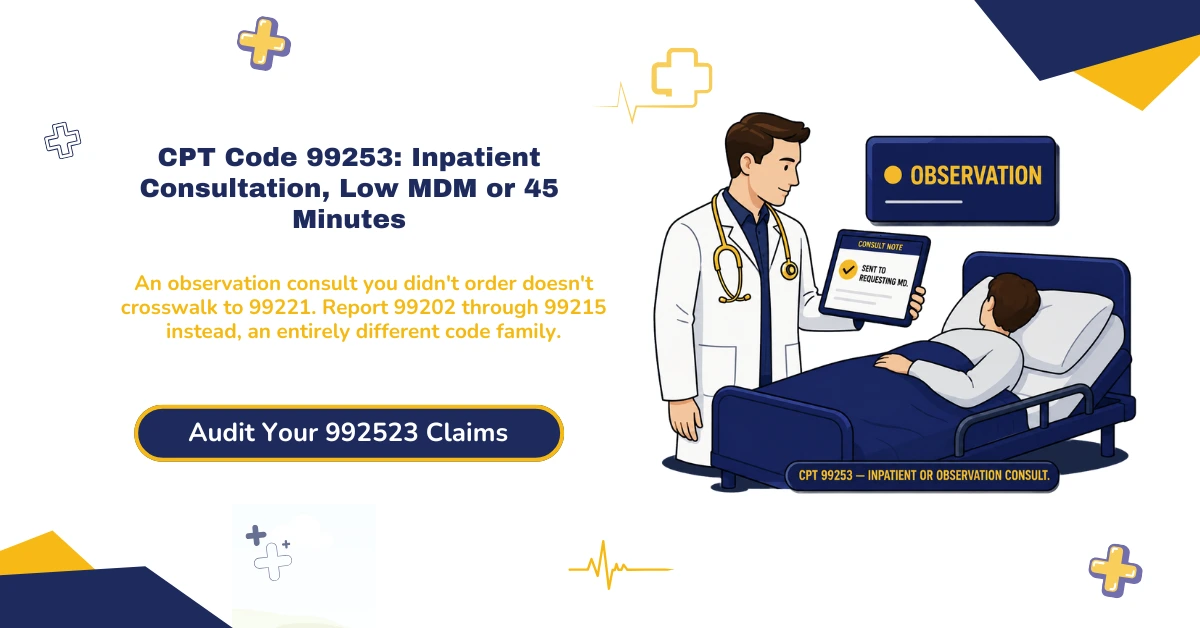
| Observation | Any other consultant | 99202 to 99215 |
| Any setting | Consultation furnished by telehealth | G0425 to G0427 |
Chapter 12 of the CMS Medicare Claims Processing Manual is direct about observation. Only the practitioner who ordered observation services bills the hospital care codes. Every other physician furnishing a consultation while the patient sits in observation status bills the appropriate outpatient service codes.
That single rule catches orthopedic and surgical consultants constantly, because a hip fracture or a knee injury lands in observation more often than in a formal admission. Read the manual at CMS Medicare Claims Processing Manual.
99221 Is the Closer Match, Not 99223
Coders reach for 99223 because both codes sit at the top of their search results. CPT 99223 needs high MDM or 75 minutes, which a low-MDM consult won’t support. CPT 99221 accepts straightforward or low MDM with a 40-minute threshold, so a documented 99253 maps there far more cleanly.
Run the arithmetic before you substitute. A 99253 clears 45 minutes and 99221 needs 40, so the time path usually holds. When the record won’t support even 99221, CMS instructs you to report a subsequent care code from 99231 through 99233 rather than forcing the initial code. Our CPT 99231 documentation guide covers that threshold.
Medicare Does Pay Some Consultations
The blanket statement most billing teams repeat has an exception worth money. Medicare pays HCPCS G0425 through G0427 for initial inpatient and emergency department telehealth consultations, and G0406 through G0408 for follow-up inpatient telehealth consultations. Both families remain on the CMS list of telehealth services for calendar year 2026.
Modifier AI Belongs to One Physician
Modifier AI identifies the principal physician of record, meaning the admitting or attending physician who oversees the patient’s care during the stay. That physician appends AI to the initial hospital care code. Consultants report the same code range without it, and that absence is what tells the payer the claim covers specialty care.
Modifier AI carries no payment weight and never makes a consultation code payable. Watch the characters, too. Billers type A1 with the numeral more often than you’d expect, and the claim rejects on an invalid modifier before a human reads it.
The Medicare Decision Tree
- Is the payer Original Medicare, or a plan following CMS methodology?
- Is the patient inpatient or observation on the date of service?
- For observation, did you order the observation services, or are you the consultant?
- Is this your first qualifying E/M during this stay?
- Does the record support the initial code’s MDM or time threshold?
- Are you the principal physician of record? If yes, append AI.
Switching between consultation codes and hospital care codes by payer, by patient status, and by your role on the case turns one missed rule into a denied claim. ClaimMax RCM builds those checks into revenue cycle management services so the billing path gets verified before submission. The revenue cycle audit that shows you where consultation claims are leaking costs nothing.
REVIEW MY CONSULTATION BILLING
Which Commercial Payers Accept the 99253 CPT Code?
Some commercial health plans reimburse CPT 99253, and others require you to report the hospital E/M code that describes the service instead. The correct path depends on the payer, the product, the state, your contract, and the date of service. Treating “commercial insurance” as one policy produces write-offs.
Four separate concepts sit behind every consultation claim: whether the code is valid under CPT, whether the payer recognizes it, whether the patient’s benefits cover the service, and what your contract says the allowed amount is. A valid code still gets rejected under a payer’s reimbursement policy.
Brand Name Tells You Nothing
Blue Cross plans vary by state, by product, and by local licensee, so “Blue Cross pays consultation codes” isn’t a usable rule. Your billing team verifies the exact plan, not the logo on the card.
Check the specific health plan name, the product type, state-specific policy, your network contract, the effective date of the policy, the patient’s setting, and whether the payer follows CMS consultation methodology.
UnitedHealthcare as a Worked Example
UnitedHealthcare’s Consultation Services Policy for Commercial and Individual Exchange plans, policy number 2025R0129A, doesn’t reimburse consultation codes 99242 through 99245 or 99252 through 99255. That applies to all UnitedHealthcare Commercial benefit plans and all Individual Exchange benefit plans on CMS-1500 claims.
The policy took effect on June 1, 2019 for providers paid on CMS relative value units from 2010 forward, percent-of-charge contracts, and non-network providers. Everyone else moved to the same rule on October 1, 2019. UnitedHealthcare still reimburses the telehealth consultation G codes when the claim identifies the requesting source.
Read it directly at the UnitedHealthcare Consultation Services Policy, and don’t extend that rule to UnitedHealthcare products the policy doesn’t name.
Build a Consultation Code Payer Matrix
Your team can’t hold 40 payer policies in memory. Write them down in a table your billing team can query in seconds, and the 99253 CPT code description stops being a debate every time a consult hits the queue.
| Matrix Field | What You Record |
|---|---|
| Payer and plan | Full legal plan name, not the brand |
| Product | Commercial, exchange, Medicare Advantage, or Medicaid |
| Consultation codes accepted | Yes, no, or conditional |
| Applicable codes | 99252 to 99255, or the alternative family |
| Effective date | Date the policy took effect |
| Requesting provider data | Whether claim fields 17 and 17b are required |
| POS rules | Accepted place of service codes |
| Source | Direct link to the payer’s own policy |
| Last verified | Month, day, year |
| Owner | The person responsible for updating this row |
Re-verify a row when a payer announces a policy update, when a new contract starts, when a denial pattern shifts, when you open a location, or when a physician joins the group. Calendar-driven reviews miss those triggers.
How Should CPT 99253 Be Submitted on a Professional Claim?
Physician and QHP services go out on a professional claim, which means the electronic 837P transaction, or the CMS-1500 paper form where paper submission is still permitted. The 99253 place of service has to match where the patient received the service.
Professional Claim, Not Institutional
Hospital employment doesn’t turn your professional service into an institutional claim. Don’t reach for the UB-04 because the physician’s paycheck comes from the hospital. CMS describes the CMS-1500 as the claim form used by non-institutional providers and suppliers, and the electronic 837P is its transaction equivalent.
Paper is the exception under the Administrative Simplification Compliance Act, not a default. Most practices submit electronically and file paper only under a waiver. See CMS professional claim guidance.
Match Place of Service to the Actual Site of Service
| POS Code | Setting |
|---|---|
| 21 | Inpatient hospital |
| 22 | On Campus-Outpatient Hospital |
| 19 | Off Campus-Outpatient Hospital |
“Observation always uses POS 22” is the shortcut that generates place of service denials. Observation is outpatient status, and the correct code depends on whether that outpatient department sits on the hospital’s main campus or off it. Verify the campus, then pick 22 or 19. The full list lives in the CMS Place of Service Code Set.
Identify the Requesting Source When the Payer Asks
Some payers require the requesting physician or appropriate source on the claim itself, using the name in field 17, the NPI in field 17b, or the electronic equivalent. UnitedHealthcare denies its telehealth consultation codes outright when the claim doesn’t identify the requesting entity.
Field 17 and 17b aren’t universal requirements for every 99253 claim. Record which of your payers demand them in the matrix and let the scrubber enforce it.
A Modifier Can’t Rescue a Nonpayable Code
The 99253 vs 99223 question shows up on claims too. Modifier AI belongs on the initial hospital care code reported by the principal physician of record, and never on CPT 99253. A telehealth modifier won’t force a plan to recognize consultation codes either.
Watch the Same-Date Sequencing Trap
You consult on a patient in the emergency department. Another clinician admits that patient hours later. You see the patient again the same calendar date. CPT says that second encounter is subsequent care, reported with 99231 through 99233, even though it’s your first inpatient contact.
Build a claim edit for any consultant who touches a patient twice on one date.
The Prebill Checklist
- Confirm the payer recognizes consultation codes on this date of service.
- Confirm inpatient or observation status and your role on the case.
- Validate low MDM or 45 qualifying minutes in the note.
- Match the diagnosis to the clinical reason for the consultation.
- Select the place of service for the actual site of service.
- Add requesting source data where the payer requires it.
- Run duplicate, bundling, and payer-specific edits.
How Does CPT 99253 Reimbursement Work?
There is no single national CPT 99253 reimbursement rate. Original Medicare doesn’t recognize the code for Part B payment, and commercial 99253 reimbursement depends on your contracted fee schedule, network status, place of service, patient benefits, and claim accuracy.
Why You Won’t Find a Medicare Rate for CPT 99253
Consultation codes carry MPFS status indicator I. CMS defines that indicator as not valid for Medicare purposes, since Medicare uses another code for reporting and payment. Any published “Medicare rate for 99253” you find on an aggregator site is inferred, not official. CMS explains every indicator on its status indicators reference.
Four numbers to keep off your fee schedule: a national Medicare payment amount for 99253, an unqualified RVU-based payment promise, a rate lifted from a pricing aggregator, and any figure ignoring locality or contract terms.
Commercial Payment Starts With Your Contract
The allowed amount comes from your contracted fee schedule, your network participation, the payer’s code recognition, the place of service, bundling logic, modifier treatment, and the patient’s benefit design. Some commercial contracts use Medicare-based methodologies and others don’t, so don’t assume a percentage of the Medicare rate.
| Payment Field | What Your Team Reviews |
|---|---|
| Billed charge | The amount your practice submitted |
| Expected allowed amount | The contracted or policy-based allowance |
| Payer payment | The amount the insurer paid |
| Patient responsibility | Deductible, copay, or coinsurance |
| Contractual adjustment | The approved write-off |
| Variance | The difference that needs review |
| Denial or remark code | The explanation that needs action |
Post a remittance without comparing it to the expected allowance and the underpayment becomes permanent. Good payment posting services reconcile every ERA and EOB line against the contract and flag the variance the same day.
Why Is CPT 99253 Denied, and What Should Your Billing Team Do?
The most common 99253 denial reasons include payer nonrecognition of consultation codes, unsupported low MDM or time, missing consultation documentation, an incorrect place of service, duplicate billing, and claim data errors. The right response depends on which one you’re looking at. Some claims need a corrected claim, and others need an appeal.
The Payer Doesn’t Recognize the Consultation Family
Pull the payer’s policy and check the effective date against your date of service. Confirm the patient’s exact product. Then decide whether the documented service supports a different hospital E/M code, and submit a corrected claim only when that replacement code describes what you performed.
Appealing this denial with documentation wastes 30 to 60 days. The payer isn’t disputing your note. It stopped covering the code family, and that argument goes nowhere.
The Record Doesn’t Establish a Consultation
Six gaps produce this denial: no identifiable requesting source, no clinical reason, no independent assessment, no recommendations, no evidence the findings went back, or a note reading like routine follow-up. Re-check the 99253 documentation requirements above.
MDM or Time Doesn’t Support the Level
Low MDM needs two of the three elements at the low level. Time-based billing needs 45 qualifying minutes on the date of the encounter. Clinical severity alone never sets the level, and a longer note isn’t evidence of greater complexity. Time already billed under a separately reported service can’t be counted again.
Claim Data Triggered It
Wrong place of service, missing requesting provider information, an invalid NPI, a duplicate claim, a same-specialty group edit, a diagnosis mismatch, a bundling edit, a previously processed E/M code for the same date, or the wrong payer product on file. Pull your own CARC and RARC codes from the remittance rather than trusting a published list.
Corrected Claim, Appeal, or Follow-Up
| Denial Cause | First Action | Evidence Needed | Prevention |
|---|---|---|---|
| Payer rejects the consultation family | Review the policy and re-level the service | Payer policy and the original note | Payer matrix |
| Wrong claim field | Submit a corrected claim | Correct demographic or provider data | Prebill edits |
| Unsupported code level | Re-score MDM or time | The original signed record | Coding audit |
| Documentation overlooked | Appeal when the record already supports it | Note, request, report, and policy | Documentation checklist |
| Duplicate or bundling edit | Compare related claims for the stay | Claim history and remittance | Duplicate edit |
| Underpayment | Contract review and payer follow-up | Contract plus the ERA or EOB | Posting variance report |
Every appeal rests on documentation that existed at the time of service. Send the original signed record. Adding clinical facts after a denial turns a billing problem into a compliance problem.
Claims sitting unresolved past the first follow-up need structured medical AR follow up with payer-specific escalation and timely filing deadlines tracked by bucket. An unworked consultation denial turns into a write-off six months later.
When the same consultation denial keeps coming back, fixing one claim won’t fix the workflow. ClaimMax reviews the payer rule, the code selection, the documentation, and the follow-up path together through denial management services, and that review sits inside the 3.49% billing rate with verification of benefits and prior authorization included at no additional cost.
REVIEW MY DENIED CONSULTATION CLAIMS
What Do Real CPT 99253 Billing Scenarios Look Like?
Scenario 1: Commercial Payer Accepts Consultation Codes
A hospitalist asks an orthopedic surgeon to evaluate an observation patient’s knee effusion. The surgeon documents the request, examines the patient, reviews an outside imaging report, recommends conservative management, and routes the note back. Total time reaches 48 minutes and the record supports low MDM either way.
Correct billing path: verify the plan reimburses 99252 through 99255, confirm the campus for the place of service, and submit CPT 99253. Meeting the requirements isn’t a payment guarantee, but it’s the only claim that survives review.
Scenario 2: The Record Supports 99253 and the Payer Doesn’t
Same clinical picture, UnitedHealthcare Commercial plan. Policy 2025R0129A doesn’t reimburse the consultation family. Your billing team re-levels the documented service against the hospital E/M codes and reports one only when the note supports it.
Correct billing path: no modifier, no resubmission of 99253, and no appeal arguing clinical appropriateness. The code family changed, and the claim has to change with it.
Scenario 3: Original Medicare, Observation Patient
An orthopedic consultant evaluates a Medicare patient placed in observation after a fall. The hospitalist ordered the observation services. The consultant performs the first qualifying E/M of the stay and documents low complexity.
Correct billing path: skip the consultation code, and skip 99221 through 99223 as well. Because the patient sits in observation and the consultant didn’t order those services, this claim goes out on an office or other outpatient code from 99202 through 99215. Modifier AI stays with the ordering physician.
Scenario 4: The Service Supports 99254 Instead
The consultant addresses two problems requiring moderate management, reviews multiple unique tests, and starts a medication with monitoring. Or total qualifying time reaches 60 minutes.
Correct billing path: the 99253 vs 99254 call goes to 99254 where the payer accepts the family. Diagnosis severity alone doesn’t establish moderate MDM, so two of the three elements still have to reach moderate before the level holds.
When One Denial Points to a Workflow Problem
Repeated consultation issues trace back to disconnected steps: payer verification, documentation, coding review, claim edits, payment posting, denial routing, and AR follow-up sitting in separate queues. Outsourcing isn’t right for every practice.
ClaimMax RCM Pricing
Affordable billing and expert coding shouldn’t be a tradeoff, especially for orthopedic and surgical groups where a single misrouted consult costs more than a month of billing fees.
| ClaimMax RCM Service | Pricing |
|---|---|
| Full service medical billing | 3.49% of collections from payers |
| Verification of benefits | Included at no additional cost |
| Prior authorization | Included at no additional cost |
| Revenue cycle audit | Free, no obligation |
| Credentialing | $120 per insurance |
ClaimMax RCM charges 3.49% of collections from payers for full service medical billing. Verification of benefits and prior authorization are included at no additional cost. Credentialing costs $120 per insurance through credentialing and contracting services, and the revenue cycle audit is free.
The 99253 CPT code rewards teams that check the payer before the claim leaves. That check is what the 3.49% buys you.
Frequently Asked Questions About the 99253 CPT Code
Is CPT 99253 Still a Valid Code in 2026?
Yes. CPT code 99253 remains active in the 2026 CPT code set and reports an inpatient or observation consultation for a new or established patient. Code validity and payer recognition are separate questions. Original Medicare stopped recognizing the CPT consultation codes for Part B payment on January 1, 2010, and several commercial plans followed.
How Much Time Is Required for CPT 99253?
45 minutes, when total time on the date of the encounter drives your code selection. The 99253 time requirement is a floor you meet or exceed, not a range. Low MDM is the alternative path, and it carries no minute threshold. Count your own qualifying time as the physician or QHP, on the encounter date.
Does Medicare Accept 99253?
Original Medicare doesn’t recognize the CPT consultation codes for Part B payment. Report the E/M code matching the service and setting: 99221 through 99223 or 99231 through 99233 for inpatients, and 99202 through 99215 for observation patients when you didn’t order the observation services. Medicare Advantage plans set their own rules.
Can You Bill 99253 to Medicare?
Don’t submit the 99253 CPT code to Original Medicare. Select the hospital or outpatient E/M family matching the patient’s status and your role, then confirm the note supports that code’s own MDM or time threshold. Use modifier AI only as the principal physician of record. Correct a denied claim rather than appealing a coverage decision.
Can CPT 99253 Be Used for an Observation Patient?
Yes. The consultation family covers inpatient and observation services under one descriptor, so observation status doesn’t disqualify the code with payers that recognize it. Two conditions apply. The record has to support low MDM or 45 qualifying minutes, and the 99253 place of service has to match the actual site of service.
What Is the Difference Between CPT 99253 and 99254?
The 99253 vs 99254 decision splits on one level. CPT code 99253 requires low MDM or 45 minutes, and CPT 99254 requires moderate MDM or 60 minutes. Either code can be reached through MDM or through time. Diagnosis severity doesn’t establish moderate MDM, so two of the three elements have to reach moderate first.
What Is the Difference Between 99253 and 99223?
The 99253 vs 99223 comparison crosses two code families. CPT 99253 is a consultation code, payable where the plan recognizes consultations. CPT 99223 reports initial hospital inpatient or observation care at high MDM or 75 minutes. Neither substitutes for the other on its own. For a low-MDM consult under Medicare, 99221 is the closer match.
What Should a Practice Do When CPT 99253 Is Denied?
Read the denial and the payer’s policy first. The common 99253 denial reasons sort into four buckets: nonrecognition of the code family, documentation gaps, an unsupported code level, or claim data errors. Submit a corrected claim for fixable submission errors, and appeal when the original signed record supports what you billed.
How Much Does ClaimMax RCM Charge for Medical Billing?
ClaimMax RCM charges 3.49% of collections from payers for full service medical billing. Verification of benefits and prior authorization are included at no additional cost, and the revenue cycle audit is free. Credentialing costs $120 per insurance. Final pricing should be confirmed against your provider count, payer mix, specialty, and service scope before onboarding.
Check the Payer Before the Claim Leaves
The correct code depends on more than the note. Your team connects the clinical service, the MDM or time path, the patient’s status, the payer’s policy, and the claim fields before anything gets released. When those steps live in separate queues, valid services turn into denials that trace back to a rule your team never checked.
Consultation claims that keep getting corrected after submission point to a problem earlier in the workflow. ClaimMax RCM reviews the payer rules, the coding checks, the claim edits, and the denial patterns together, and full service medical billing runs at 3.49% of payer collections with verification of benefits, prior authorization, and the revenue cycle audit included at no additional cost.