
A consultant sees your patient in the hospital, writes a solid note, and the claim comes back non-covered. Nothing was wrong with the documentation. The code itself wasn’t payable to that payer.
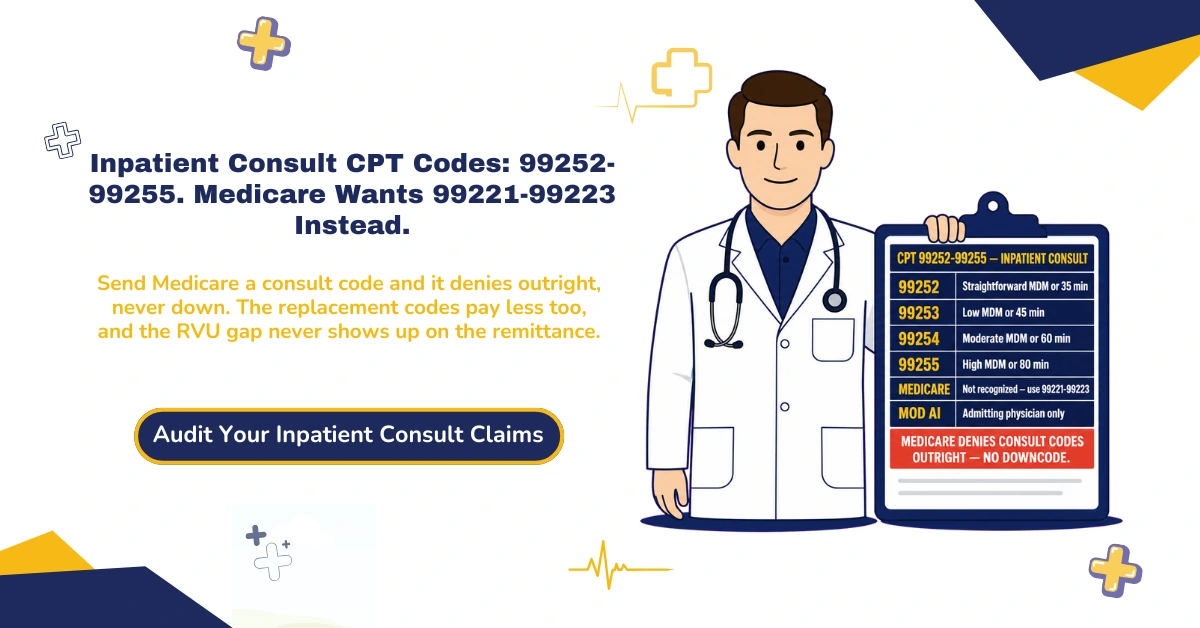
Picking a CPT code for inpatient consult services splits into two workflows, and the payer decides which one applies. Commercial plans that recognize consultations want 99252 through 99255. Medicare wants an initial hospital care code. Send Medicare a consultation code and the claim denies outright; it doesn’t come back downcoded.
This guide covers the active range, how to pick a level, what to bill when a payer won’t accept a consult, the documentation that has to sit in the chart, and the denials that follow when any of it slips.
| Quick answer. The CPT codes for an inpatient consultation are 99252, 99253, 99254, and 99255. Level selection depends on medical decision making or total time on the date of the encounter. Medicare has not recognized these codes since January 1, 2010 and requires initial hospital care codes 99221 to 99223 instead. |
Quick answers to 14 inpatient consult coding questions
What is the CPT code for inpatient consults?
99252 through 99255. Four levels, selected by medical decision making or total time, covering both inpatient and observation status.
Is CPT 99254 a consult code?
Yes. CPT 99254 is the level 4 inpatient or observation consultation, requiring moderate medical decision making or 60 total minutes on the date of the encounter.
Is 99253 an inpatient consultation code?
Yes. CPT 99253 sits one level below 99254 and needs low medical decision making, or 45 total minutes on the date of the encounter.
Is 99252 the lowest inpatient consultation code?
Yes. The AMA deleted CPT 99251 effective January 1, 2023, which makes 99252 the lowest active level in the range.
Is CPT 99251 still valid in 2026?
No. CPT 99251 was deleted on January 1, 2023. A claim carrying it for a 2026 date of service rejects on submission.
Does Medicare pay for inpatient consultation codes?
No. Medicare stopped recognizing consultation codes for Part B payment on January 1, 2010, and that policy still stands in 2026.
What is the replacement code for 99255?
CPT 99223, initial hospital inpatient or observation care with high medical decision making or 75 minutes. Check 99223 against its own criteria before you bill it.
Is 99223 inpatient or outpatient?
Inpatient. CPT 99223 reports initial hospital inpatient or observation care for a patient who has been formally admitted or placed in observation.
Does CPT 99223 need a modifier?
Sometimes. The admitting physician appends modifier AI to identify the principal physician of record. A consultant billing 99223 leaves it off.
Can a consultation be billed more than once per admission?
No. CPT allows one consultation per consultant per admission. Every encounter after that goes on a subsequent hospital care code.
Is 99233 an inpatient consultation code?
No. CPT 99233 reports subsequent hospital inpatient or observation care, the follow-up visits after the first encounter of the stay.
Can 99252 to 99255 be used for observation patients?
Yes. The post-2023 descriptors cover inpatient and observation consultations under the same four codes.
Is CPT 99231 inpatient or outpatient?
Inpatient. CPT 99231 reports the lowest level of subsequent hospital inpatient or observation care, supported by straightforward or low medical decision making or 25 minutes.
How do I bill a hospital consult for a Medicare patient?
Report initial hospital care code 99221, 99222, or 99223 based on the medical decision making or time your note supports. Leave modifier AI off unless you admitted the patient.
Inpatient consult CPT codes 99252 to 99255 at a glance
The active code range for 2026
Every CPT code for inpatient consult work in 2026 sits in this four-code range. The inpatient consultation CPT codes below cover both admitted and observation patients.
Inpatient consultation comparison table, 2026
| CPT code | Level | Medical decision making | Total time on the date of the encounter |
|---|---|---|---|
| 99252 | 2 | Straightforward | 35 minutes |
| 99253 | 3 | Low | 45 minutes |
| 99254 | 4 | Moderate | 60 minutes |
| 99255 | 5 | High | 80 minutes |
CPT 99252 is the level 2 inpatient or observation consultation, requiring straightforward medical decision making (MDM) or 35 total minutes on the date of the encounter.
CPT 99253 is the level 3 inpatient or observation consultation, requiring low medical decision making or 45 total minutes on the date of the encounter.
CPT 99254 is the level 4 inpatient or observation consultation, requiring moderate medical decision making or 60 total minutes on the date of the encounter.
CPT 99255 is the level 5 inpatient or observation consultation, requiring high medical decision making or 80 total minutes on the date of the encounter. The AMA maintains the full range at the AAPC inpatient consultation code reference.
Time thresholds have to be met or exceeded
The threshold is a floor, and the note has to clear it. A consultant who documents 79 minutes has a 99254, no matter how close 80 looks on paper. Auditors read the number in the note, and a reviewer who finds 79 minutes against a 99255 will take the level down.
Coders working from an EHR template hit this most often when the template rounds or when the physician writes a range instead of a figure. Ask for one number.
The AMA left 99252 through 99255 alone in the 2026 code set. The descriptors that apply this year are the same ones that took effect in 2023, and the AMA evaluation and management descriptors carry the current language.
Why you’ve seen 40 and 55 minutes attached to these codes
Coders still work from tables built before 2023, and those tables show 40 minutes next to 99252 and 55 minutes next to 99253. Those figures were correct once. They stopped being correct on January 1, 2023, and a coder working from one of those tables will bill the wrong level.
The pre-2023 thresholds and what replaced them
Deleted versus current time thresholds
| CPT code | Pre-2023 typical time (deleted) | Current 2026 threshold |
|---|---|---|
| 99251 | 20 minutes | Code deleted |
| 99252 | 40 minutes | 35 minutes |
| 99253 | 55 minutes | 45 minutes |
| 99254 | 80 minutes | 60 minutes |
| 99255 | 110 minutes | 80 minutes |
The current 2026 time threshold for CPT 99252 is 35 minutes, not 40 minutes. The current 2026 time threshold for CPT 99253 is 45 minutes, not 55 minutes. The IDSA evaluation and management reference guide carries the current figures in a table updated in October 2025.
Where 40 and 55 minutes belong now
Both numbers are still live in 2026. They moved to a different code family. Forty minutes is the threshold for CPT 99221 and 55 minutes is the threshold for CPT 99222, and both of those report initial hospital inpatient or observation care.
Seeing 40 minutes printed next to a consultation code tells you the table predates the restructure. That’s a useful check when someone hands you a cheat sheet with no date on it.
The cost of using the old numbers runs one direction. A coder who believes 99253 needs moderate medical decision making will hold a moderate encounter at 99253 when the note supports 99254. That’s a downcode on the level most consultants report.
What changed in the 2023 restructure
Before 2023, these codes required three key components: history, examination, and medical decision making. The AMA replaced that structure on January 1, 2023. Since then, the level comes from medical decision making or total time, and history and examination no longer drive it.
The exam still has to be medically appropriate and documented. It doesn’t set the level anymore.
What counts as a consultation: request, render, report
A CPT code for inpatient consult billing only holds when three elements are documented.
Three elements make a service a consultation. Miss one and the encounter isn’t a consult, no matter how complex the case was or how long the physician spent on it. Billing teams call these the three Rs.
Consultation documentation requirements
| Element | Requirement | What the record has to show |
|---|---|---|
| Request | Another physician or qualified health professional asks for an opinion | Requesting provider name, specialty, clinical question, and date |
| Render | The consultant personally evaluates the patient | History, examination, and findings relevant to the question asked |
| Report | Findings go back to the requester | A written report documented in the medical record |
The request has to be in the chart
In a shared inpatient record, the requesting physician can document the request as an order, as part of a plan inside a progress note, or as a standalone consultation request. Any of those work. A verbal request that nobody wrote down does not.
Most legitimate consultations fall apart here on audit. The consultant did the work and answered the question, and the requesting physician never put the ask in writing.
The consultant renders an opinion
The consultant has to see the patient and form a clinical opinion on the specific problem. Ordering diagnostic or therapeutic services while working out that opinion doesn’t cost you the consultation. CPT allows it.
The report goes back to the requester
In a shared electronic record, routing the consultation note to the requesting physician satisfies this. Make sure the routing shows up in the chart, because a reviewer can’t audit an EHR action that left no trace.
Who can request a consultation
A physician or qualified health professional. A patient asking for a specialist opinion doesn’t create a consultation under CPT, and neither does a family member or a third-party payer. Those encounters get a standard evaluation and management code for the setting.
Practices lose money on this one without noticing, because a patient-requested second opinion looks identical to a consult in the chart until someone checks who asked.
When any of the three elements is missing, report the encounter as initial or subsequent hospital care. That’s the correct code for what happened.
| Documentation gaps in the request or the report back are the most common reason a legitimate consultation gets billed down. ClaimMax RCM reviews the note against the payer’s rules before the claim goes out, and the coding review comes inside the 3.49% billing rate along with free verification of benefits and prior authorization. |
Does Medicare pay for inpatient consultation codes in 2026?
Medicare has not recognized CPT consultation codes for Part B payment since January 1, 2010. Submitting 99252 through 99255 to Medicare produces a non-covered denial no matter how well the consultant documented the encounter.
CMS removed both consultation families from Part B payment through Transmittal 1875, Change Request 6740. The AMA kept the codes in the CPT book because plenty of commercial payers still recognize them.
CMS restated the policy in May 2026
The May 2026 revision of the CMS Evaluation and Management Services booklet repeats the instruction: a physician providing a service described by a CPT consultation code should report the correct evaluation and management visit code instead.
Most coding references still cite the 2010 transmittal for this. The May 2026 booklet says the same thing in a document CMS updated three months ago, which is the version to quote when a physician pushes back.
Appeals won’t recover this denial
Appealing the documentation won’t recover a consultation code submitted to Medicare. Medicare doesn’t cover the code, so supporting detail in the note changes nothing.
The only path is a corrected claim carrying the right evaluation and management code. Practices that route these into an appeals queue burn 30 to 60 days before someone notices the appeal can’t work.
Medicare Advantage and Medicaid
Under Medicare, the CPT code for inpatient consult work comes from the initial hospital care range, and the same logic carries into the plans that follow Medicare.
Medicare Advantage plans usually follow the same policy, though individual plans set their own rules and some diverge. Medicaid splits by state, with some programs mirroring Medicare and others paying consultations.
Check both at the payer level. A billing team that treats every government plan as one policy will send consultation codes to plans that pay them and initial care codes to plans that don’t.
| A consultation code sent to a payer that doesn’t cover it never shows up in your denial reports as a coding error. It lands as a coverage denial and gets written off. ClaimMax RCM’s denial management team works these by root cause and rebills with the code the payer covers. The free revenue cycle audit will tell you how many you’re sitting on. |
The payer decision matrix: which code set applies
Two things decide the CPT code for inpatient consult billing: whether the payer recognizes consultations, and how complex the encounter was. Work both before anyone picks a number.
Payer and complexity decision matrix
| Complexity of the encounter | Payer recognizes consultations | Medicare and payers following Medicare |
|---|---|---|
| Straightforward MDM or 35 minutes | 99252 | 99221, or 99231 to 99233 (see the floor rule below) |
| Low MDM or 45 minutes | 99253 | 99221 |
| Moderate MDM or 60 minutes | 99254 | 99222 |
| High MDM or 80 minutes | 99255 | 99223 |
This matrix points to the right code family. It doesn’t authorize a one-for-one swap. When a payer won’t take a consultation code, check the replacement against its own medical decision making and time criteria before you bill it.
Payer recognition varies by carrier and by region, so a rule that holds for a commercial plan in one state can fail for the same carrier in another. The Centene inpatient consultation payment policy is one example of a 2026 commercial policy published on the payer’s own site. Build the check into your payer grid and review it once a year.
The 2026 Medicare crosswalk: what to bill instead of 99252 to 99255
When a payer rejects the CPT code for inpatient consult services, these four substitutes apply. The 99255 replacement code gets asked about most, so it leads.
Replacement code for 99255
Report CPT 99223, initial hospital inpatient or observation care with high medical decision making or 75 minutes. Confirm the note supports high complexity on its own before you submit, since 99223 carries its own criteria.
Replacement code for 99254
CPT 99222 is the substitute, initial hospital inpatient or observation care with moderate medical decision making or 55 minutes. A 99254 encounter documented at 60 minutes clears 99222 on time, though the moderate MDM standard still has to hold up.
Replacement code for 99253
Use CPT 99221, initial hospital inpatient or observation care with straightforward or low medical decision making or 40 minutes. Low complexity maps cleanly here.
Replacement code for 99252
CPT 99221 is the usual answer, and it fails more often than coders expect. A 99252 needs 35 minutes; 99221 needs 40. The next section covers what to do when the note lands in that gap.
Initial hospital care reference
| CPT code | Service | Medical decision making | Total time |
|---|---|---|---|
| 99221 | Initial hospital inpatient or observation care | Straightforward or low | 40 minutes |
| 99222 | Initial hospital inpatient or observation care | Moderate | 55 minutes |
| 99223 | Initial hospital inpatient or observation care | High | 75 minutes |
More than one physician can report an initial hospital care code for the same patient during the same admission, as long as each one performed an initial evaluation. That rule is what makes the substitution work at all. Without it, a consultant seeing a patient the hospitalist already admitted would have nothing to bill.
The 99221 floor rule: when the replacement code doesn’t fit either
Every crosswalk you’ll find online assumes the replacement code always works. It doesn’t, and the gap sits at the bottom of the range.
Run the arithmetic. CPT 99252 needs straightforward medical decision making or 35 minutes. CPT 99221 needs straightforward or low medical decision making or 40 minutes. A consultant who documents 36 minutes and straightforward complexity has a clean 99252 and falls five minutes short of 99221.
The positional crosswalk says bill 99221. The note won’t support it.
This is the one place where a CPT code for inpatient consult claim has no clean substitute in the initial care range.
What CMS says to do instead
When the documentation doesn’t support the lowest level of initial hospital care, CMS instructs the physician to report a subsequent hospital care code from the 99231 to 99233 range.
In practice: if the note won’t hold 99221, don’t force it. Report 99231, 99232, or 99233 based on what the encounter documents. CMS has told its contractors not to find fault when a physician reports subsequent care in these circumstances and the record backs it up.
Subsequent care thresholds
CPT 99231 needs straightforward or low medical decision making or 25 minutes. Moderate complexity or 35 minutes moves the visit to 99232, and high complexity or 50 minutes reaches 99233.
Notice that 99231 sits at 25 minutes, well under the 35 a level 2 consultation requires. A short consult that misses 99221 still clears 99231 with room to spare.
Stop crosswalking by row position
Re-level the encounter against the replacement code’s own criteria every time. Row-position mapping works for three of the four consultation levels and breaks on the fourth, which is exactly the kind of error that survives an internal audit because it looks correct on a chart.
Modifier AI: who uses it and who leaves it off
Modifier AI identifies the principal physician of record, meaning the admitting or attending physician who oversees the patient’s care during the admission. CMS created it in 2010 so that multiple physicians could report initial hospital care for the same patient without the claims looking like duplicates. Noridian’s modifier AI guidance sets out the current rules.
The four rules that govern it
The admitting physician appends modifier AI to the initial hospital care code, 99221 through 99223, or to the initial nursing facility code, 99304 through 99306. It goes on the initial visit alone, and subsequent days don’t carry it.
Every other physician who performs an initial evaluation reports the same code range with no modifier. That absence is the signal. It tells the payer this claim covers specialty care, not the admission.
Modifier AI carries no payment weight. As the First Coast modifier AI fact sheet puts it, the modifier is informational, so a claim doesn’t pay more or less because someone appended it.
When the consultant leaves modifier AI off
A consultant substituting an initial hospital care code for a consultation Medicare won’t cover reports it without modifier AI. The hospitalist who admitted the patient owns that modifier.
One more thing worth checking in your claim edits: the modifier is AI, the letters A and I. Billers type A1 with the numeral more often than you’d guess, and the claim rejects on an invalid modifier before a human ever reads it.
| Orthopedic groups run into this constantly, since a hip fracture consult and the admission often land on the same day from two different practices. ClaimMax RCM builds payer-specific modifier rules into claim scrubbing, so the edit catches the problem before submission instead of after the remittance. Hospital revenue cycle support covers the whole workflow. |
Selecting the level: medical decision making or total time
Since January 1, 2023, the level comes from one of two paths: medical decision making or total time on the date of the encounter. History and examination still have to be medically appropriate and documented in the chart, and neither one sets the level.
The two-of-three MDM rule
The level on a CPT code for inpatient consult claim rests on this rule more than any other.
Medical decision making has three components: the number and complexity of problems addressed, the amount and complexity of data reviewed and analyzed, and the risk of complications or morbidity from patient management.
At least two of the three components have to reach the level being billed. A single component at a higher level doesn’t raise the overall MDM.
Take an encounter with moderate problems, moderate data, and low risk. Two components clear moderate, so the MDM is moderate and 99254 holds. Flip it so only the data reaches moderate, and the encounter drops to 99253.
What counts toward total time
Time on the date of the encounter includes reviewing prior records, including records the consultant pulled from other facilities. Add obtaining history, performing the examination, counseling the patient or family, ordering tests, documenting the encounter, interpreting results, and coordinating care with the treating team.
That last one surprises physicians. A 20-minute phone call with the hospitalist about the recommendation counts, as long as it happened on the encounter date and the note says so.
What doesn’t count
Time a nurse, resident, or mid-level spent doesn’t roll into the billing provider’s total. Work performed on a different calendar date doesn’t count either, which catches consultants who review the chart the night before and see the patient the next morning.
Administrative work unrelated to the clinical encounter stays out. Pulling the record for a billing question isn’t patient care.
When time drives the selection, the note has to carry the actual number of minutes. A statement about complexity won’t substitute for it, and a reviewer who can’t find a figure will downcode to whatever the MDM supports.
99251 and 99241: deleted codes that still get billed
CPT 99241 and CPT 99251 were deleted from the CPT code set effective January 1, 2023. A claim carrying either code for a 2026 date of service rejects on submission, and no appeal fixes it.
Both were the lowest level in their consultation ranges, and physicians rarely used either one. The AMA removed them in the same restructure that moved consultation coding onto medical decision making or time.
What replaced 99251 and 99241
CPT 99252 took over as the lowest inpatient or observation consultation level. On the outpatient side, CPT 99242 replaced 99241 as the entry point for office consultations.
Why these still show up on claims
Old fee schedules and EHR favorites lists keep deleted codes alive long after the AMA retires them. A physician who built a favorites list in 2019 will keep selecting 99251 until someone rebuilds it.
The CPT 2026 code set carried 418 editorial changes, including 288 new codes, 84 deletions, and 46 revisions. Evaluation and management work concentrated on remote physiologic monitoring, so consultation descriptors came through untouched. That doesn’t help a practice still submitting a code deleted three years ago.
Run a report on deleted codes in your charge master every January. It takes an afternoon and it catches this class of rejection before the first claim goes out. Our HCPCS and CPT code guide covers how discontinued codes behave on submission.
Consultation or transfer of care: the distinction that changes the claim
A consultation is a request for an opinion, and the requesting physician keeps primary management of the patient. A transfer of care happens when the consultant takes over management of the problem going forward.
The billing splits along that line. A consultant who renders an opinion while the requester keeps managing the patient supports a consultation code, where the payer takes them. Once the consultant assumes management, the encounter becomes an initial hospital care code from 99221 through 99223.
Read the plan, not the header
Nothing changes a CPT code for inpatient consult claim faster than a consultant quietly taking over the problem.
The note usually gives it away in the assessment and plan. A consultant who writes recommendations for the primary team wrote a consultation. A consultant who writes orders and says they’ll follow daily took over the problem.
Physicians blur this without meaning to. A cardiologist asked for an opinion on new atrial fibrillation who then starts anticoagulation and plans to manage it through discharge has moved past a consultation, whatever the note is titled.
Why this got harder, not easier
CPT’s published guidance around transfer of care has thinned over the last few code cycles. The distinction still governs the claim, and payers still audit against it, so the determination now rests on what the documentation shows and what the payer’s policy says.
Practices that had a codified rule to point to now have to build their own internal standard. Write it down and apply it the same way across every consultant in the group.
One consultation per admission and the same-day rules
CPT allows one consultation per consultant per hospital admission. Every encounter that consultant has with the patient after the first one goes on a subsequent hospital care code.
Reporting a second consultation code for a follow-up visit later in the same stay is a billing error, and it’s one payers flag in audits because the pattern shows up cleanly in claims data.
Can two specialists bill a consultation for the same patient?
Yes, when the payer recognizes consultation codes and each consultant received an independent request that meets the documentation elements. A cardiology consult and a nephrology consult on the same admission are two separate services.
Under Medicare’s framework the same logic holds with different codes. Each physician who performs an initial evaluation reports an initial hospital care code, and the absence of modifier AI marks each one as specialty care.
Where same-specialty billing breaks
Two physicians in the same specialty and the same group generally can’t both report an initial service for one patient during one admission. The payer treats the second claim as a duplicate.
This catches large groups more than small ones. When a partner covers a weekend and sees the patient for the first time, that visit reads as an initial service to the physician and as a duplicate to the payer. Bill it as subsequent care.
The same-date sequencing trap
A consultant sees the patient in the emergency department. Another clinician admits the patient to inpatient or observation status a few hours later. The same consultant sees the patient again that afternoon, on the same calendar date.
Most coders reach for an initial hospital care code on that second encounter. CPT says otherwise.
What CPT instructs
| When the first inpatient or observation encounter follows a consultation service earlier the same date, the consultant doesn’t report an initial hospital care code from 99221 through 99223, and doesn’t report a consultation code from 99252 through 99255, for that inpatient encounter. The consultant reports a subsequent hospital inpatient or observation care code from 99231 through 99233. |
The same principle covers a consultation performed in anticipation of an admission by a different clinician, where the consultant then sees the patient once the admission goes through.
Why this catches good billing teams
The word initial does the damage. A coder looks at the claim, sees the patient’s first inpatient encounter with that consultant, and picks from the initial range. The sequence matters more than the status change, and nothing in the chart flags it.
Emergency department consults followed by admission are the common version. Build a check into your workflow for any consultant who touches a patient twice on one date, because the second service almost never codes the way it looks.
Follow-up visits after the consultation
Once a consultant reports the inpatient or observation consultation, every later encounter with that patient during the same admission goes on a subsequent hospital care code: 99231, 99232, or 99233.
The level works the same way it did on the consultation, driven by medical decision making or time. Subsequent care thresholds sit lower than the consultation thresholds across the board, which is why a short follow-up still supports a billable code. Our CPT 99233 documentation guide covers the high-complexity end.
One exception matters. A consultant who takes over management of the patient’s primary problem has moved into a transfer of care, and the transfer rules covered earlier take over from here.
On the last day of the stay, only the attending or principal physician of record reports hospital discharge day management. A consultant still managing a concurrent problem reports a subsequent hospital care code for that final visit, even though it’s the patient’s discharge date.
Telehealth inpatient consultations: the codes Medicare does pay
Medicare doesn’t recognize CPT consultation codes. It does recognize a separate set of HCPCS telehealth consultation codes, and it pays them.
That surprises most billing teams, because the general rule gets repeated so often that the exception disappears.
Initial inpatient and emergency department telehealth consults
HCPCS G0425, G0426, and G0427 report telehealth consultations in the emergency department or the initial inpatient setting, and CMS lists them as payable telehealth services. The three levels run at roughly 30, 50, and 70 or more minutes of communication with the patient by telehealth.
Follow-up inpatient telehealth consults
HCPCS G0406, G0407, and G0408 report follow-up inpatient telehealth consultations at limited, intermediate, and complex levels. CMS MLN Matters MM6130 carries the descriptors.
Setting restrictions that make or break the claim
The telehealth route is the one path where a CPT code for inpatient consult service reaches Medicare payment under a consultation descriptor.
These are inpatient services, so they don’t fit a service furnished to a patient at home. CMS guidance confirms Medicare pays them in a facility setting.
Professional telehealth claims carry place of service 02 for telehealth delivered somewhere other than the patient’s home, or place of service 10 for telehealth in the home. The place of service and the code have to agree, and a mismatch draws an edit before adjudication. Our place of service 22 guide walks through how POS drives code family selection.
One caution on this whole section. Medicare telehealth coverage has run on a series of legislative extensions, and the terms have shifted more than once. Confirm current coverage, the active descriptors, and the place of service guidance against CMS before you build these into a workflow.
What the crosswalk costs: RVUs and 2026 reimbursement
Consultation codes carry higher relative value units than the initial hospital care codes that replace them. When a payer won’t take a consultation, the practice bills a lower-valued code for identical physician work, and nothing on the remittance advice shows the difference.
Two conversion factors for 2026
CMS finalized separate conversion factors for calendar year 2026, the first time the fee schedule has run on two. Clinicians who qualify as Advanced Alternative Payment Model participants use $33.57. Everyone else uses $33.40. Both rose from the 2025 factor of $32.35, by 3.77% and 3.26%.
CMS also applied a negative 2.5% efficiency adjustment to work RVUs for services that aren’t time-based, and exempted time-based codes, codes on the telehealth list, and new codes for 2026. Evaluation and management services are time-based, so consultations and hospital care codes escape that reduction.
How to size the gap for your own group
Every CPT code for inpatient consult claim that crosswalks to initial hospital care gives up value, and the arithmetic is worth running once.
Pull the work RVU for 99255 and for 99223 from the CMS Physician Fee Schedule Look-Up Tool, then subtract. Multiply the difference by the number of high-complexity consults your group reports each month for payers that don’t recognize consultation codes. That annual figure is what the crosswalk costs you.
Two things to keep straight while you run it. Work RVU drives physician compensation, and it isn’t what Medicare pays. Payment comes from total RVU with the geographic practice cost index applied, then multiplied by the conversion factor for that clinician’s participation status.
Consultation codes also carry a Medicare status indicator worth checking before anyone builds a fee schedule around them, since the indicator tells you how the contractor will handle the code on submission.
| The gap between what a consultation is worth and what the substitute pays doesn’t appear on any remittance. It shows up as a compensation shortfall at year end, after the encounters are closed. ClaimMax RCM tracks consultation recognition payer by payer so the right code goes out the first time, and full-service medical billing runs at 3.49% of collections with verification of benefits and prior authorization included. |
Denial prevention: the seven root causes
Inpatient consultation denial prevention table
| Root cause | What the denial looks like | Prevention |
|---|---|---|
| Consultation code sent to a payer that doesn’t cover it | Coverage denial, not a downcode | Flag consultation codes by payer at claim scrubbing |
| Consultation request never documented | Service doesn’t qualify as a consultation | Confirm requesting provider, specialty, and clinical question before billing |
| No report communicated back to the requester | Compliance exposure on audit | Add the communication note to the record before closing the encounter |
| MDM documented below the level billed | Downcode to a lower level | Document all three MDM components, never by implication |
| Time missing when time drives the level | Reduction or takeback on audit | Record the actual minutes and the activities behind them |
| Transfer of care billed as a consultation | Billing error with recoupment exposure | Read the plan; if the consultant assumed management, bill initial hospital care |
| Second consultation reported in one admission | Duplicate denial and an audit flag | Move every encounter after the first onto subsequent hospital care |
Denials on a CPT code for inpatient consult claim trace back to one of seven causes.
Six of these seven happen before submission, which means a claim edit catches them. The seventh, the coverage denial, only gets recovered if someone works it instead of writing it off.
Reading the denial codes
Payers assign different adjustment reason codes to the same underlying problem, so pull yours from your own remittance data instead of a published list. Match each consultation denial to the root cause above, then check the code your payers use for that category and build the mapping into your denial workflow.
The categories hold steady even when the codes differ. A coverage denial behaves one way, a documentation denial another, and a duplicate a third. Our accounts receivable recovery team works all three separately.
The denial nobody codes for
A consultant who isn’t enrolled with the payer gets denied no matter how clean the coding is. Hospital-based specialists move between groups and pick up new hospital privileges faster than credentialing keeps up. The claims then fail on enrollment, and the coding has nothing to do with it.
Check enrollment status for every consultant against every payer before the first claim goes out on a new hire.
| ClaimMax RCM handles both halves of this. Provider credentialing and payer enrollment run at $120 per insurance, and the billing side works consultation denials down to root cause and rebills them. If your orthopedic or hospitalist group is writing off inpatient consult denials, the free revenue cycle audit will show you how much is sitting there. |
Setting rules: inpatient, observation, emergency department, and office
Inpatient and observation
The AMA deleted the separate observation code ranges effective January 1, 2023 and folded observation into the hospital inpatient and observation families. CPT 99252 through 99255 cover consultations in both statuses, and no separate observation consultation code exists.
Emergency department
For a Medicare patient, a consultation performed in the emergency department goes on an emergency department visit code, 99281 through 99285, chosen by level of service. The consultation range doesn’t apply there. Our CPT 99285 billing guide covers the top of that range.
Office and outpatient
Consultations in an office or outpatient setting use 99242 through 99245 where the payer recognizes them. Where the payer doesn’t, they fall to the new or established patient office visit codes, 99202 through 99215.
The compliance line on setting
CMS has identified billing office or other outpatient evaluation and management codes for an admitted patient as incorrect coding. Setting and patient status decide the code family, and clinical acuity doesn’t override them.
Practices trip this when a specialist sees an admitted patient and the front desk books it like a clinic visit. The scheduling system picks the office code, nobody catches it, and the claim goes out wrong.
Frequently asked questions about the CPT code for inpatient consult range
What is the difference between 99223 and 99255?
CPT 99223 compared with CPT 99255
| Comparison point | CPT 99223 | CPT 99255 |
|---|---|---|
| Service | Initial hospital inpatient or observation care | Inpatient or observation consultation |
| Medical decision making | High | High |
| Total time | 75 minutes | 80 minutes |
| Medicare | Payable | Not recognized since January 1, 2010 |
| Documented request required | No | Yes |
Both report a high-complexity first encounter with a hospitalized patient. CPT 99223 bills to any payer, and CPT 99255 bills only to payers that recognize consultation codes.
How do I choose between 99253 and 99254?
CPT 99253 needs low medical decision making or 45 minutes. CPT 99254 needs moderate medical decision making or 60 minutes. At least two of the three MDM components have to reach moderate before 99254 holds.
Can a consultation code be billed for an established patient?
Yes. Consultation codes don’t split into new and established patient categories, so a consultant who has seen the patient before can still report a consultation when the request, the evaluation, and the report back are all documented.
Can a consultation and an admission be billed on the same day?
Not by the same physician for the same patient. A consultant who sees the patient before admission and again after it reports subsequent hospital care for the second encounter.
What documentation is required to bill CPT 99254?
The request, the evaluation, and the report back to the requester, plus either explicit moderate MDM documentation or a documented total time of 60 minutes or more on the encounter date.
What is the CPT code for an inpatient consultation with a specialist?
CPT 99252 through 99255, the same range every specialty uses. The consultant’s specialty doesn’t change the code.
Are there separate codes for psychiatric or rehabilitation inpatient consults?
No. Psychiatry, rehabilitation, and every other specialty report from 99252 through 99255. What changes by specialty is the typical MDM profile and the payer’s coverage policy.
What is the CPT code for an emergency department consult?
For a Medicare patient, 99281 through 99285. Commercial payers that recognize consultations may accept the consultation range for an emergency department encounter, so check the policy.
Do commercial payers still reimburse 99252 to 99255?
Many do. Coverage varies by carrier and by region, and a payer that covers consultations in one state may not in another. Verify per payer and re-check annually.
What happens if the patient requests the consultation?
It doesn’t meet the CPT definition of a consultation. Report a standard evaluation and management code for the setting, since a patient or family request doesn’t come from an appropriate source.