The 99281 CPT code is the level 1 emergency department (ED) visit. It’s the lowest of five ED levels. The American Medical Association (AMA) describes it as an “Emergency department visit for the evaluation and management of a patient that may not require the presence of a physician or other qualified health care professional.”
In practice, 99281 covers minimal services in a hospital ED, such as uncomplicated suture removal, where clinical staff do the hands-on work under supervision. The American College of Emergency Physicians (ACEP) says few ED patients fit this level. That makes it a rare code on physician claims, and urgent care operators sometimes reach for it by mistake.
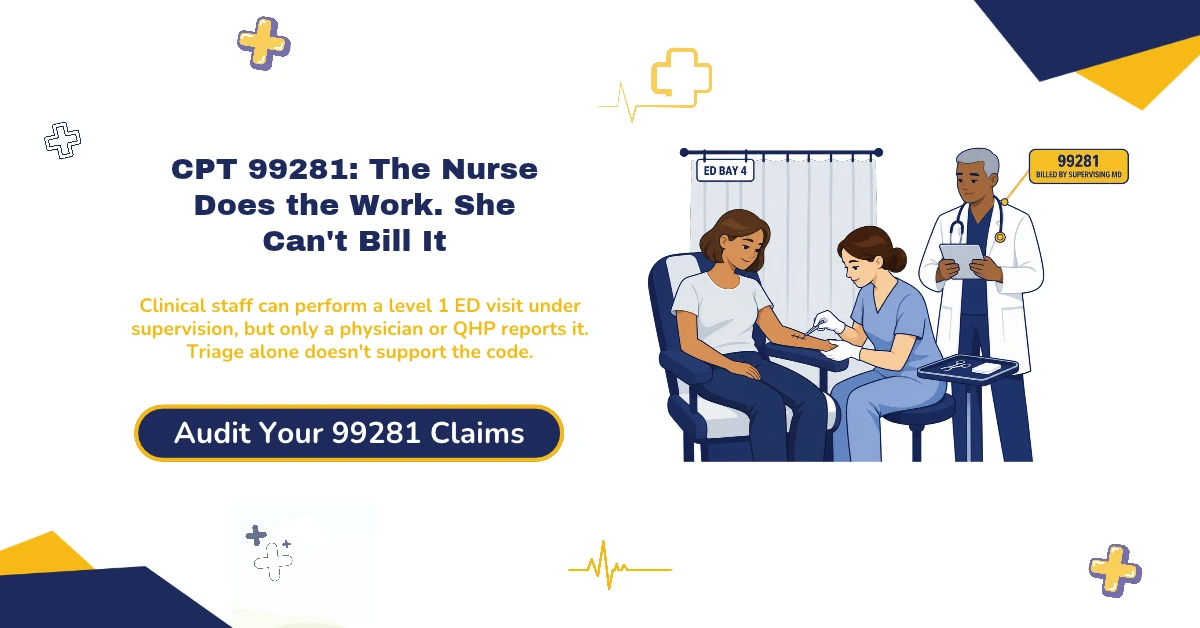
Billers at ED groups and hospitals get two rules wrong more than any others. Only a physician or qualified health care professional (QHP) reports 99281, even when a nurse does the work. Triage alone doesn’t support the code. Payers edit for both, and if your charge rules get either one wrong, you’ll repeat the error on every low-acuity ED claim.
99281 CPT Code at a Glance
Before a 99281 claim leaves your system, check it against each row below. The source behind every rule sits in parentheses beside it.
| What to check | 99281 rule (source) |
|---|---|
| Code level | Level 1 of five ED E/M levels (AMA) |
| Medical decision making (MDM) | Doesn’t apply (AMA, AAFP) |
| Time | Not used to pick any ED level (AMA) |
| Who does the face-to-face work | Clinical staff may, under supervision (AMA) |
| Who reports the code | A physician or QHP only (AMA) |
| Supervision | Direct supervision; the physician doesn’t need to be at the bedside (Medicare contractor guidance) |
| Patient status | New or established; ED codes make no distinction (AMA) |
| Setting | A hospital-based ED available 24 hours a day (AMA); place of service 23 on the professional claim |
| Typical visits | Uncomplicated suture removal, dressing changes, packing removal (ACEP) |
| 2026 Medicare national payment, professional | $11.02 (CMS) |
| 2026 Medicare national payment, facility | $86.15, APC 5021, Type A ED (CMS OPPS, via ACEP) |
| Global period | XXX, the standard for E/M codes (CMS) |
| Modifiers | None routinely; modifier 25 only for a significant, separately identifiable E/M with a same-day procedure (CPT) |
What Does CPT Code 99281 Mean?
CPT code 99281 means a level 1 ED visit for a problem that may not need a physician or QHP in the room. It’s the only ED level without a medical decision making (MDM) level. Time plays no part in choosing it.
The Official CPT Code 99281 Description
The 99281 CPT code description turns on one phrase: a patient “that may not require the presence of a physician or other qualified health care professional.” In the AMA’s 2023 E/M guidelines, that patient’s issue counts as a minimal problem. A clinician doesn’t have to be present, yet the service still runs under a physician’s or QHP’s supervision.
CPT defines a QHP as someone qualified by education, training, licensure, and facility privileging who works within their scope of practice and “independently reports that professional service.” Nurse practitioners and physician assistants meet that definition in most cases. An ED nurse counts as clinical staff, and clinical staff don’t report services on their own.
Why 99281 Has No MDM Level and Time Doesn’t Count
MDM measures three things: the problems addressed, the data reviewed, and the risk of patient management. For 99281, the AMA sets that grid aside: “The concept of the level of MDM does not apply to 99211, 99281.” The AAFP’s E/M level table says the same. Straightforward MDM belongs to 99282, one level up.
Any payer table or AI answer that pins straightforward MDM on 99281 is describing the wrong code. Time doesn’t help either. The AMA says time “is not a descriptive component for the emergency department levels,” because ED physicians work at variable intensity across several patients at once. That’s the whole CPT code 99281 definition: a descriptor plus a supervision requirement.
What Changed for 99281 on January 1, 2023
Before 2023, 99281 required three key components: a problem-focused history, a problem-focused exam, and straightforward MDM. On January 1, 2023, CPT replaced them with today’s descriptor, and all five ED codes stopped using history and exam to set the level. A template that still asks for a “problem-focused” exam follows a retired standard.
Some payer policies we reviewed in 2026 still label 99281 “straightforward.” Follow each payer’s written policy on that payer’s claims, and code to CPT everywhere else.
What Is an ED Level, and Where Does 99281 Fit?
An ED level is one of five CPT codes, 99281 to 99285, that describe how much evaluation and management an emergency department visit needed. Level 1 has no MDM level. Levels 2 to 5 climb from straightforward to high MDM, and a group reports one ED level per patient encounter.
| Level | CPT code | MDM required | Typical problem (CPT terms) | 2026 Medicare national, professional |
|---|---|---|---|---|
| 1 | 99281 | Doesn’t apply | Minimal problem; may not need a physician or QHP present | $11.02 |
| 2 | 99282 | Straightforward | One self-limited or minor problem | $40.42 |
| 3 | 99283 | Low | For example, one acute, uncomplicated illness or injury | $69.47 |
| 4 | 99284 | Moderate | For example, an acute illness with systemic symptoms, or an undiagnosed new problem with uncertain prognosis | $118.24 |
| 5 | 99285 | High | For example, an illness or injury that poses a threat to life or bodily function | $171.35 |
Payments equal total RVUs (0.33, 1.21, 2.08, 3.54, and 5.13) times the $33.4009 CY 2026 conversion factor, before geographic adjustment.
Across emergency room levels 1 to 5, the leveling rule changes at level 2. From 99282 up, the chart needs two of the three MDM elements at or above the level’s threshold. A patient who asks what “level 4” means on an ER bill is looking at a 99284 visit with moderate MDM.
The CPT code for an emergency room visit is one of these five, chosen by the MDM the chart supports. Our CPT 99283 guide covers the low-MDM level in depth. High-MDM visits, and the denials they draw, get their own walkthrough in the 99285 billing guide.
Two neighbors sit outside the five levels. CPT 99288 covers a physician’s direction of emergency medical services crews by two-way radio or phone. Critical care, 99291 and 99292, runs on time instead of MDM and starts at 30 minutes of critical care.
Which Encounters Qualify for a Level 1 ED Visit?
The 99281 CPT code fits a narrow set of visits: a registered ED patient who needs a minimal service that clinical staff can perform under supervision. ACEP’s coding committee calls it “improbable that many patients that present to the emergency department clinically fit into this category.” Most who fit are back for wound care.
Encounters That Fit 99281
ACEP’s ED coding FAQ expects level 1 patients to come back for one of these:
- Uncomplicated suture removal from a well-healed wound
- A simple dressing change
- Packing removal from a wound or the nose, with nothing else needed
ACEP rates the risk of removing sutures or packing from a well-healed wound as minimal, since complications are rare. Picture a patient back on day 10. Another facility placed her sutures, and your nurse removes them after checking the wound. She reviews home care, and her note names the supervising physician. That visit supports 99281.
What Pushes a Visit Above Level 1
According to ACEP, two common add-ons take a visit past level 1. A tetanus shot is one. ACEP treats the decision to give it as a moderate-risk treatment choice, the same tier as prescription drug management. Injectable lidocaine is the other, since it needs a prescription.
Repacking a wound or starting an antibiotic moves past minimal risk too. So does any test the physician orders, because level 1 has no room for data review. If a physician or QHP personally evaluates a self-limited or minor problem and documents straightforward MDM, the visit is 99282.
Some example lists put medication refills at level 1. Managing a prescription is a moderate-risk decision under the MDM table, so a refill visit doesn’t belong there.
ICD-10-CM Codes That Commonly Pair With 99281
Diagnosis coding for a level 1 visit stays in the Z48 aftercare family in most cases. All three codes below are valid for HIPAA transactions in the FY2027 code set, effective October 1, 2026.
| ICD-10-CM | Description | Typical 99281 visit |
|---|---|---|
| Z48.02 | Encounter for removal of sutures | Suture removal |
| Z48.00 | Encounter for change or removal of nonsurgical wound dressing | Dressing change after an injury |
| Z48.01 | Encounter for change or removal of surgical wound dressing | Dressing change after surgery |
If the nurse finds infection or a reopened wound, code the complication instead. A physician now has to evaluate it, so the level rises in most cases.
Who Performs 99281, and Who Can Report It?
An ED nurse or other clinical staff member can perform the hands-on part of a 99281 visit, but only a physician or QHP reports the code. The AMA values 99281 as the supervising physician’s work, because the hospital employs the nurse and covers her time in its own facility charge.
Clinical Staff Can Perform the Face-to-Face Work
The AMA’s guideline is direct: “For 99211 and 99281, the face-to-face services may be performed by clinical staff.” CPT’s clinical staff member works under supervision, can perform or assist with a service, and “does not individually report that professional service.” Think of the nurse removing sutures under a standing protocol while the attending sees other patients.
Only a Physician or QHP Reports the Code
AMA’s CPT webinar FAQ settles the billing question: “Only physicians or other QHPs are able to report the service.” According to the same answer, the work RVUs pay for supervision, and 99281 has no direct practice expense inputs because the staff belong to the facility.
On the professional side, the 99281 CPT code goes out on the CMS-1500 under the supervising physician’s or QHP’s NPI. Medicare’s incident-to rules don’t apply to hospital services, so the nurse’s time can’t move onto the physician’s claim. Some guides and AI answers say nurses bill 99281 on their own. The AMA says only a physician or QHP reports it.
What Supervision Looks Like in the ED
Wellpoint Federal, the Medicare Administrative Contractor formerly called National Government Services, says 99281 “requires direct supervision of a physician or NPP but does not require personal supervision at the bedside.” The supervising clinician can stay with other patients. Name that person in the note, though, because the claim goes out under that NPI.
Specialists use the same code family. Under the Medicare Claims Processing Manual, any physician who sees a registered ED patient may use the ED codes. A specialist called down for a Medicare patient reports 99281 to 99285. Medicare stopped paying consultation codes in 2010.
That’s the practical answer to the ER consult CPT code question. Our guide to ED consults for Medicare covers the inpatient consult codes too.
Can You Bill 99281 for Triage or a Patient Who Leaves Without Being Seen?
Not on the professional claim. Triage alone isn’t an evaluation and management service, so when a nurse triages a patient who then leaves without being seen (LWBS), the chart doesn’t support the 99281 CPT code. The hospital’s facility claim follows separate CMS rules, and a few state Medicaid programs set their own triage policy.
The Professional Claim
The AMA addressed this at its CPT symposium. An AMA E/M expert said, “Triage is not an evaluation and management service, and so you cannot report this service.” She added that 99281 “does require evaluation and management,” even without a physician present. You can read the full exchange in the AMA’s E/M expert Q&A, published January 14, 2025.
For billers, the rule fits on a sticky note. A triage note with vitals and a chief complaint, followed by an LWBS disposition, gets no professional E/M charge.
The Facility Claim and State Medicaid Exceptions
Hospitals follow a different trail. In the 2011 OPPS rule, CMS let hospitals bill a visit code for triage-only patients under their own coding guidelines. A 2012 CMS FAQ then required hospitals to furnish outpatient visits incident to a physician’s service and under an order. ACEP reads that to exclude care a nurse gives under a standing order alone.
Diagnostic tests don’t have to meet the incident-to rule. If the hospital ran a test before the patient walked out, it can still bill that test on the facility claim.
State Medicaid programs can go the other way. Iowa Medicaid’s Informational Letter 2504-MC-FFS replaced 99211 with 99281 for ER triage services, effective February 1, 2024. Under Iowa Medicaid’s ED E/M guide, updated March 2026, one ED level pays per encounter, and modifier 25 doesn’t create a second payment for triage.
Rules differ by state, so check the Medicaid billing rules for every state you bill. Then set your hospital revenue cycle management charge rules so a triage-only encounter never posts 99281 by default, while a Medicaid program that pays for it still gets the code.
If your charge capture drops a 99281 on every triage, you need a rule fix, and coders can’t patch it one claim at a time. We build payer-specific triage rules into our medical billing for ED groups, so a level 1 charge posts only where the payer recognizes it.
99281 vs 99282 vs 99211: How to Choose the Right Code
99281 is an ED visit for a minimal problem that may not need a physician present. 99282 is an ED visit where a physician or QHP documents a medically appropriate history or exam and straightforward MDM. 99211 is the office version of 99281, for established patients. The 99281 CPT code applies only inside a hospital ED.
99281 vs 99282: Who Makes the Medical Decision
The 99282 CPT code description requires “a medically appropriate history and/or examination and straightforward medical decision making.” That one clause puts a physician or QHP at the center of a level 2 visit. Level 1 doesn’t require one in the room.
| Feature | 99281 | 99282 | 99211 |
|---|---|---|---|
| Setting | Hospital ED, POS 23 | Hospital ED, POS 23 | Office or other outpatient site, such as POS 11 |
| Patient status | New or established | New or established | Established only |
| MDM | Doesn’t apply | Straightforward | Doesn’t apply |
| Physician or QHP presence | May not be required | Required: history or exam plus MDM | May not be required |
| Who reports it | Physician or QHP | Physician or QHP | Physician or QHP |
| Typical encounter | Nurse removes sutures under supervision | Physician evaluates one self-limited or minor problem | Nurse visit for an established office patient |
Report CPT code 99282 if a physician or QHP personally evaluates a self-limited or minor problem and the note supports straightforward MDM. A minimal service that clinical staff provide under supervision stays at 99281. ACEP expects few ED patients to fit level 1, so a physician group’s 99281 volume should stay small.
Undercoding here costs money on both claims. In 2026, Medicare pays a national $40.42 for CPT 99282 on the professional claim, $29.40 more than 99281. The hospital’s APC 5022 pays $156.87 against $86.15 for APC 5021. Billing 99281 after a physician documents straightforward MDM leaves both differences on the table.
99281 vs 99211: Same Idea, Different Setting
The AMA treats these two codes as a pair. MDM doesn’t apply to either, and clinical staff may perform the face-to-face service for both. 99211 covers an office or other outpatient visit for an established patient, while 99281 covers an ED visit for any patient, new or established.
That’s why an urgent care center or hospital-based clinic reports 99211 for an established patient’s nurse visit, never 99281. Our 99211 billing guide covers the office-side supervision and co-billing rules.
Why Urgent Care and Office Visits Can’t Use 99281
Freestanding urgent care centers and physician offices can’t report the 99281 CPT code. CPT reserves 99281 to 99285 for a hospital emergency department, defined as an organized hospital-based facility for unscheduled episodic care that’s available 24 hours a day. Urgent care and office visits use office or other outpatient codes 99202 to 99215.
Place of Service Decides the Code Family
Payers read the place of service (POS) code on the professional claim to see where the visit happened, and the E/M code family has to match it. CMS defines POS 23 as “A portion of a hospital where emergency diagnosis and treatment of illness or injury is provided.”
| POS | CMS name | Visit codes on the professional claim |
|---|---|---|
| 23 | Emergency Room, Hospital | 99281 to 99285 |
| 20 | Urgent Care Facility | 99202 to 99215 |
| 11 | Office | 99202 to 99215 |
| 22 | On Campus-Outpatient Hospital | 99202 to 99215 (the hospital’s facility claim uses G0463) |
The CPT code for urgent care is an office or other outpatient visit, 99202 to 99215, billed with POS 20 and leveled by MDM or total time. Inside the ED, the CPT code for an ER visit is one of 99281 to 99285 with POS 23.
Some commercial contracts add a twist. A payer may pay a CPT code for an urgent care visit plus HCPCS S9088, an add-on for services in an urgent care center, or swap the visit for S9083, a global urgent care fee. Other payers treat both S codes as informational only. Neither is CPT, and neither is an ED code.
Hospital clinics on the main campus bill office codes with POS 22, and our POS 22 billing rules cover that setting. Registration matters as well. Under Medicare’s Claims Processing Manual (Chapter 12, section 30.6.11.C), a physician who meets an unregistered patient in the ED bills office or outpatient codes.
The 2026 OIG Audit of ED Codes Billed Outside the ED
The HHS Office of Inspector General (OIG) tested this rule in OIG report A-07-23-05139, issued March 9, 2026. Auditors reviewed Medicare claims from 2021 and 2022 that carried ED visit codes with a non-ED place of service or revenue center.
Medicare improperly paid physicians $922,524 for 9,749 services. Hospitals received $14.2 million in potentially improper payments. CMS agreed to recover the $922,524 but didn’t concur with the other four recommendations, which included system edits.
In other words, a POS mismatch can still pay today and come back in a later review. Check POS 23 against ED registration on every 99281 to 99285 line before the claim goes out.
99281 CPT Code Reimbursement and Cost in 2026
In 2026, Medicare pays a national $11.02 for the 99281 CPT code on the professional claim and $86.15 on the hospital’s facility claim under APC 5021, before geographic adjustment. The physician group and the hospital bill separately, so Medicare makes two payments for one level 1 ED visit, and the patient owes coinsurance on each.
Professional vs Facility Payment
CMS gives CPT code 99281 0.25 work RVUs and 0.33 total RVUs in the 2026 Medicare fee schedule. Multiply 0.33 by the $33.4009 conversion factor and you get $11.02, or $11.08 for qualifying APM participants at $33.5675. The amount stays small because the code has no direct practice expense inputs.
| Code | Total RVUs | 2026 Medicare national, professional | OPPS APC | 2026 Medicare national, facility |
|---|---|---|---|---|
| 99281 | 0.33 | $11.02 | 5021 | $86.15 |
| 99282 | 1.21 | $40.42 | 5022 | $156.87 |
| 99283 | 2.08 | $69.47 | 5023 | $278.89 |
| 99284 | 3.54 | $118.24 | 5024 | $426.30 |
| 99285 | 5.13 | $171.35 | 5025 | $608.43 |
Hospitals send their half on a UB-04 (837I) with an ED revenue code beside the CPT code. The rev code for emergency room services is 045X, and 0450 is the general classification line. If you searched for CPT code 0450, you were looking for that revenue code, which the National Uniform Billing Committee (NUBC) maintains outside CPT.
A hospital ED that isn’t open 24 hours a day, seven days a week counts as Type B and reports G0380 instead of 99281. Each hospital sets its facility level from internal guidelines, which CMS requires to match hospital resources to levels consistently, per ACEP’s APC payment FAQ.
The facility level and the physician’s level can differ for the same visit, so your hospital facility billing team should check both before the claims go out. All the figures above are national rates; local amounts move with the geographic practice cost index and the hospital wage index.
What a Medicare Patient Pays
At 2026 national rates, Medicare allows $97.17 for a level 1 ED visit ($11.02 plus $86.15), and a patient who has met the deductible owes about $19.43. That splits into about $2.20 of coinsurance on the professional claim and about $17.23 on the facility claim, 20% of each.
The 2026 Part B deductible is $283. Until a patient meets it, they pay the Medicare-approved amount themselves. Medicare Advantage, commercial, and Medicaid patients pay under their own plan’s ED cost-sharing.
What Changed in the 2026 Fee Schedule
CMS set the 2026 conversion factor at $33.4009 for most clinicians, up 3.26%, and $33.5675 for qualifying APM participants, up 3.77%, per the 2026 fee schedule fact sheet. Both include a one-year 2.5% increase set by statute. Hospital OPPS rates rose 2.6%.
A separate 2.5% efficiency cut hit the work RVUs of non-time-based services. CMS left E/M services out of it, so 99281 kept its 0.25 work RVU.
Plan for a dip next year. CMS’s July 14, 2026 proposed rule would lower the conversion factors to $32.84 (down 1.68%) and $33.17 (down 1.19%) as the one-year increase expires. If RVUs hold, 99281 would pay about $10.84 in 2027. CMS publishes the final rule in early November in most years.
If your ED remittances don’t line up with these 2026 rates, our revenue cycle management services team can trace each short payment to the payer and the contract line behind it.
Same-Day Billing Rules: Suture Removal, Modifier 25, and Drug Administration
Payers deny or bundle a same-day 99281 CPT code because of the codes billed beside it. Check the suture removal add-ons and the surgical global period first. Then look for drug administration lines on the physician claim, which CMS’s National Correct Coding Initiative (NCCI) won’t pair with an ED visit.
Suture Removal Codes 15853 and 15854 Stay Off the ED Claim
CPT added 15853 (removal of sutures or staples not requiring anesthesia) and 15854 (removal of sutures and staples not requiring anesthesia) on January 1, 2023, as add-on codes reported with an E/M visit. ACEP’s surgical package FAQ calls them “not applicable for reporting services that occur within a hospital or emergency department setting.”
In the ED, the visit code carries the suture removal on its own. Bill 99281 when clinical staff remove the sutures under supervision, and leave the add-on codes off the claim.
How Global Periods Decide Whether the Visit Is Billable
Medicare dropped the 10-day global for simple repairs 12001 to 12018 on January 1, 2011, so our simple repair code 12001 guide lists a 0-day global. For Medicare, a later suture removal visit after a simple repair sits outside the repair’s payment, and you can bill it.
Intermediate repairs (12031 to 12057) and complex repairs (13100 to 13160) carry a 10-day global. If your group removes those sutures inside the 10 days, that’s post-op care. Report 99024 if the payer tracks post-op visits; it pays nothing.
Commercial payers that follow the CPT surgical package fold typical follow-up care into the repair, so check each payer’s global days before you bill the return visit. ACEP also notes that some groups skip billing the follow-up to spare patients a copay, which is a group policy choice.
Does 99281 Need Modifier 25?
In most cases, no. Modifier 25 marks a significant, separately identifiable E/M service on the same day as a procedure by the same physician or QHP. A level 1 visit that consists of the procedure itself, like a dressing change, has nothing separate to mark.
If a physician evaluates a separate problem and also performs a minor procedure, MDM sets the E/M level at 99282 or higher, and that line takes modifier 25. Our guide to modifier 25 on ED visits walks through that pairing.
Drug administration follows its own rule. Under the 2026 NCCI policy manual, Chapter XI, a physician can’t report 99281 to 99285 with drug administration codes such as 96360 to 96379. The one exception is drug administration at a separate encounter in a non-facility setting that day, with modifier 25 on the E/M code.
Hospitals paid under OPPS work differently. They may report drug administration with 99281 to 99285 and add modifier 25 to the visit code when it’s significant and separately identifiable. An intramuscular injection (96372) given in the ED belongs on the hospital’s claim, and the physician’s claim leaves it off.
Documentation Checklist for a 99281 Claim
The 99281 CPT code needs no MDM, so a level 1 note has to prove something else: the patient was a registered ED patient, and the problem stayed minimal. Check these seven items before the claim goes out.
- ED registration and arrival time, which support POS 23. Timestamps serve the audit trail; time doesn’t set the level.
- Reason for the visit in plain terms, such as “suture removal, simple repair 7 days ago.”
- Staff actions and findings: sutures or staples removed and counted, wound appearance, and any sign of infection.
- Names and credentials of the staff member who did the work and the supervising physician or QHP who reports it. The reporting clinician’s NPI goes on the claim as rendering.
- Proof that nothing raised the level: no prescription, no tetanus or lidocaine, no tests. If any of those happened, MDM sets the level.
- Discharge instructions and disposition.
- An ICD-10-CM code that matches the visit, such as Z48.02 (encounter for removal of sutures).
On the hospital side, the facility level has to follow the hospital’s own internal guidelines. Keep the facility criteria worksheet with the record so an auditor can see how your coders chose the level.
Sample 99281 note: “Arrived 14:10, registered in ED. Here for suture removal, right forearm laceration repaired 7 days ago (simple repair, 4 sutures). RN removed 4 sutures; wound edges well approximated, no redness or drainage. Wound care instructions given. Supervising physician: [name]. Discharged 14:25. Dx: Z48.02.”
Common 99281 Denials and How to Fix Them
Payers deny the 99281 CPT code for a short list of reasons, and most of those denials come back to the place of service or a bundled same-day service. The table pairs each claim adjustment reason code (CARC) with its likely cause and the fix.
| CARC | Payer’s reason (paraphrased) | Likely cause on a 99281 claim | Fix |
|---|---|---|---|
| CO-5 | Code doesn’t match the place of service | 99281 billed with POS 11, 20, or 22 | Confirm ED registration and correct POS to 23, or recode to 99202 to 99215 |
| CO-58 | Service rendered in an inappropriate or invalid place of service | Payer doesn’t recognize the site as an ED | Appeal with the ED registration record, or recode to an office or outpatient visit |
| CO-97 | Payment included in another service already adjudicated | Visit falls inside a 10-day global or bundles with a same-day procedure | Check global days; add modifier 25 only for a separate, significant E/M; otherwise report 99024 or write it off |
| CO-236 | Code pair not allowed on the same day under NCCI | Drug administration (96360 to 96379) on the physician claim with 99281 | Remove the drug administration line from the professional claim; the hospital reports it |
| CO-185 | Rendering provider not eligible to perform the service | A nurse or other clinical staff member listed as rendering | Rebill under the supervising physician’s or QHP’s NPI |
| CO-16 | Claim lacks information or has a billing error | Missing rendering NPI, POS, or diagnosis | Add the missing field and send a corrected claim |
Track denials by CARC every month. A run of CO-5 denials points to a POS mapping error in your practice management system, and coders can’t fix that one claim at a time. Our guide to CMS-1500 claim errors shows where POS sits on the form, in item 24B.
Sorting by CARC also shows you which fixes belong upstream. Denial teams, ours included, start every review that way, and our denial management services team works each denial back to its root cause before the rebill goes out.
How ClaimMax RCM Handles ED Visit Billing
ClaimMax RCM runs emergency department billing for physician groups and hospitals. Our AAPC-certified coders level each visit from the 99281 CPT code to 99285 under the AMA’s 2023 rules. Before a claim goes out, the team checks POS 23 against registration, scrubs NCCI pairs, tests modifier 25 against the global period, and confirms the rendering NPI.
For pricing, ClaimMax RCM’s emergency department billing services cost 3.49% of collections, with insurance eligibility verification and prior authorization included. If a new ED physician, NP, or PA joins your group, credentialing and payer enrollment costs $120 per insurance.
If you’re comparing third-party medical billing companies, ask any vendor that quotes emergency room medical billing to walk you through four things. Get specifics on POS mapping, facility and professional claim splits, NCCI drug administration edits, and denial tracking by CARC. Our page on billing for ED physician groups shows how ClaimMax tracks denials and payments per provider.
A stack of CO-5 or CO-97 denials on your ED claims points to a fixable rule. Send us a sample through a free revenue cycle audit, and we’ll check it against the rules on this page.
CPT 99281 FAQs
What Is CPT 99281?
99281 is the level 1 emergency department visit, for a patient whose problem may not need a physician or QHP present. Clinical staff can perform the service under supervision, but only a physician or QHP reports it. MDM and time don’t apply. In 2026, Medicare pays a national $11.02 on the professional claim and $86.15 on the facility claim.
Can a Nurse Bill CPT 99281?
No. A nurse can do the face-to-face work under supervision, but the AMA says only a physician or other QHP reports the service. Nurse practitioners and physician assistants count as QHPs, so they can report 99281 under their own NPI where state scope and payer enrollment allow. Medicare pays their services at 85% of the physician fee schedule amount.
What Is the Difference Between 99281 and 99285?
99281 is the lowest ED level, for a minimal problem with no MDM requirement. 99285 is the highest and needs high MDM, such as an illness or injury that poses a threat to life or bodily function. At 2026 Medicare national rates, 99281 pays $11.02 professional and $86.15 facility, and 99285 pays $171.35 and $608.43.
Is 99281 for New or Established Patients?
Both. CPT makes no new or established distinction for ED codes 99281 to 99285, so any patient registered in the ED can qualify when the visit fits level 1. Its office counterpart, 99211, works differently and applies only to established patients seen in an office or other outpatient setting.
What Is CPT Code 99288?
CPT code 99288 covers a physician’s or QHP’s direction of emergency medical systems (EMS) advanced life support, where the clinician directs ambulance or rescue crews by two-way voice communication. Medicare lists 99288 as a status B (bundled) code, so it doesn’t pay separately under the physician fee schedule. Commercial payers set their own policy for it.
Is the 99281 CPT Code Still Valid in 2026?
Yes. 99281 is an active CPT code, and CMS prices it on the 2026 Medicare Physician Fee Schedule at 0.33 total RVUs. Its current descriptor took effect January 1, 2023, when the AMA replaced the old history, exam, and MDM requirements with today’s wording about physician presence.
Sources
- AMA: 2023 CPT E/M Descriptors and Guidelines
- AMA: CPT E/M Webinar FAQ
- AMA: E/M Experts Offer CPT Advice for Physician Private Practices (January 14, 2025)
- AAFP: Time and Medical Decision Making Levels for E/M CPT Codes
- ACEP: 2023 ED E/M Guidelines FAQ
- ACEP: APC (Ambulatory Payment Classifications) FAQ
- ACEP: Surgical Package FAQ
- CMS: Medicare Claims Processing Manual, Chapter 12
- CMS: Place of Service Code Set
- CMS: CY 2026 Medicare Physician Fee Schedule Final Rule Fact Sheet
- CMS: CY 2027 Medicare Physician Fee Schedule Proposed Rule Fact Sheet (July 14, 2026)
- CMS: 2026 Medicare Parts A & B Premiums and Deductibles
- CMS: Physician Fee Schedule Look-Up Tool
- CMS: Medicare NCCI Policy Manual 2026, Chapter XI
- HHS OIG: Report A-07-23-05139 (March 9, 2026)
- Iowa HHS: Emergency Department E/M Services Overview (updated March 2026)
- Wellpoint Federal: Evaluation and Management FAQs
- X12: Claim Adjustment Reason Codes (CARC) code list