Last Updated: April 2026 | 13 min read
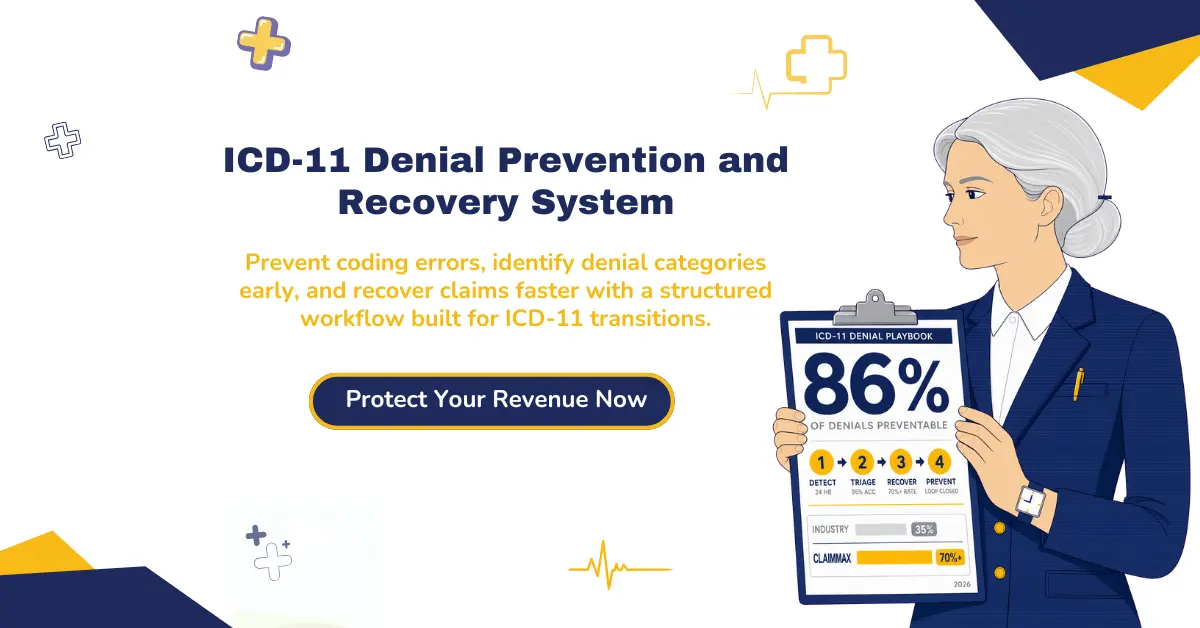
86% of medical claim denials are preventable, according to research published by Premier Healthcare. Yet ICD-11 denial management remains one of the least-prepared disciplines in most practice billing operations. US healthcare practices still absorbed approximately $262 billion in initial claim denials in a single year, according to Change Healthcare’s analysis of three billion adjudicated claims. Those two numbers tell the whole story. The problem isn’t that denials can’t be prevented. It’s that prevention breaks down before the dollars make it back.
During a coding system transition, the gap between preventable denials and recovered denials widens. New failure modes emerge faster than denial-management workflows can adapt. ICD-11 will introduce nine specific denial categories that don’t exist under ICD-10, each requiring its own recovery protocol. Practices that apply ICD-10 denial logic to ICD-11 denials won’t recover them.
This is the operational playbook for preventing, identifying, categorizing, and recovering ICD-11 claim denials before, during, and after the transition. It’s not a tutorial on ICD-11. It’s a recovery system.
The playbook is built on two proprietary tools. The 9-Category ICD-11 Denial Taxonomy classifies every denial type the transition will produce. The 4-Stage Recovery Workflow operationalizes detection, triage, recovery, and prevention as a continuous feedback loop. ClaimMax RCM developed both from real denial pattern analysis across coding system transitions.
By the end of this guide, you’ll know which nine denial categories to expect, how to recover each one, and what to put in place before the transition to keep your recovery rate above 70%.
What’s Inside This Playbook
Here’s what we’ll cover, in the order a claims analyst works through them.
- Why ICD-11 Will Multiply Denial Rates Before It Reduces Them
- The 9-Category ICD-11 Denial Taxonomy
- Inside the Most Expensive Denial Type: Cluster Construction Errors
- How Payer Adjudication Logic Will Process ICD-11 Claims Differently
- The 4-Stage ICD-11 Denial Recovery Workflow
- Underpayment Detection: The Hidden Loss During the Transition
- Appeal Letter Templates and the HIPAA Appeal Process
- Building Your Pre-Transition Denial Baseline
- How ClaimMax RCM Recovers Denied and Underpaid Claims
- The Cost of Inaction: Quantifying Your ICD-11 Denial Exposure
- Frequently Asked Questions About ICD-11 Claim Denials and Recovery
- The Denial Wave Is Coming: Build Your Recovery System Now
Why ICD-11 Will Multiply Denial Rates Before It Reduces Them
Healthcare practices should expect ICD-11 claim denials to spike before improving during the transition. That’s not pessimism. It’s the pattern from every major coding system change on record, and understanding it is the foundation of any realistic prevention plan.
The Pre-Transition Denial Baseline
Healthcare practices in the US currently operate at denial rates between 5% and 10%, according to MGMA and HFMA benchmark data. Of those denials, 86% are theoretically preventable, per Premier Healthcare research. Of the preventable denials, the average recovery rate across the industry sits near 35%, according to multiple Change Healthcare reports.
That means most practices are already leaving about 65 cents of every preventable denied dollar on the table before ICD-11 arrives. The transition doesn’t create a new problem. It amplifies one that already exists.
The Transition-Period Denial Rate Multiplier
During the ICD-9 to ICD-10 transition, practices that weren’t adequately prepared experienced denial rate increases of 60% to 80% in the first 60 to 90 days post-cutover. Most moderated by Month 6 and stabilized below pre-transition baseline by Month 12. But the cumulative revenue impact during that spike was substantial and in many cases unrecovered.
ICD-11 introduces ICD-11 claim denials that have no ICD-10 analog. The ICD-9 to ICD-10 change was challenging because of volume. The new system is challenging because of entirely new failure modes. The comparison matters because the same preparation discipline applies, but the denial management response must be built for categories that don’t yet exist in your billing system’s lookup tables.
ICD-11 Specific Denial Drivers Without ICD-10 Analogs
ICD-11’s post-coordination structure introduces three new failure modes. Cluster construction errors occur when stem codes and extension codes are combined in ways that violate ICD-11 syntax rules. Extension code omissions occur when a required modifier is missing from the cluster entirely. Stem-extension mismatch errors occur when the extension codes are valid but don’t belong to the submitted stem code’s allowed set.
These aren’t “new versions of old denials.” They’re categorically different. Applying ICD-10 ICD-11 denial management workflows to these new failure modes produces the wrong recovery path every time. The practices that will protect their revenue are the ones that build a denial taxonomy for these new categories before the first ICD-11 claim is submitted.
The 9-Category ICD-11 Denial Taxonomy: Every Failure Mode the Transition Will Produce
ClaimMax RCM’s 9-Category ICD-11 Denial Taxonomy is the operational classification system for every denial type the coding system change will produce. The taxonomy is not academic. It’s the categorization that determines which recovery protocol applies to a given denial. Every ICD-11 claim denial fits into exactly one of these nine categories, and effective ICD-11 denial management begins with knowing which category you’re working with.
Category 1: Cluster Construction Error
A claim is denied because the submitted ICD-11 code cluster violates ICD-11 syntax rules. Extension codes are attached to the wrong stem, placed in invalid combinations, or outside the allowed set for that stem. Recovery starting point: re-construct the cluster against the WHO ICD-11 Coding Tool, validate the syntax, and resubmit. These are highly recoverable because the underlying clinical decision was correct.
Category 2: Stem Code Misselection
The denial traces to a clinically adjacent but not exact stem code being chosen. The coder selected a related diagnostic category instead of the precise root condition code. Recovery starting point: review the clinical documentation for stem code precision, select the correct stem, and resubmit within the appeal window.
Category 3: Extension Code Omission
The claim is denied because a required modifier was not included. Severity, laterality, anatomical location, or etiology extension codes were left off the cluster entirely. This is the most common ICD-10-to-ICD-11 muscle memory failure, where coders apply single-code logic to a cluster requirement. Recovery starting point: identify the missing extension code, add it to the cluster, and resubmit.
Category 4: Documentation Insufficiency
The clinical documentation doesn’t support the extension codes attached to the cluster. The coder coded ahead of what the chart can substantiate. Recovery starting point: if the documentation can be amended and the clinical picture supports it, amend and resubmit. If the documentation can’t support the coding, revise the cluster to match what the chart actually documents.
Category 5: Crosswalk Mismatch
During the transition period, bidirectional ICD-10/ICD-11 mapping is in use. Stale or non-payer-specific crosswalk tables produce a code the payer’s adjudication engine doesn’t recognize. Recovery starting point: re-code natively in the payer’s expected code system, resubmit as a corrected claim, and document the crosswalk failure for your trend analysis.
Category 6: Specialty Chapter Misclassification
The denial traces to a code drawn from a restructured ICD-11 chapter that the practice’s coding staff hasn’t trained on yet. Mental and behavioral disorders, sleep-wake disorders, and sexual health conditions are the highest-risk chapters because they’ve been substantially reorganized. Recovery starting point: route the case to a coder with training on the specific chapter, recode, and resubmit.
Category 7: Severity or Laterality Modifier Error
The cluster is structurally valid but the severity or laterality extension is incorrect. The coder applied a default modifier value instead of reading the chart. Recovery starting point: pull the chart, confirm the correct modifier value, correct the cluster, and resubmit. These are fast recoveries because the fix is a single extension code change.
Category 8: Payer-Specific Configuration Mismatch
The cluster is correct by ICD-11 syntax, but the payer’s adjudication system isn’t configured to accept it yet. The denial reflects payer readiness lag, not a coding error. Recovery starting point: escalate to the payer’s provider relations department, document the configuration gap, refile using the payer’s approved interim coding pathway, and track the configuration status for future submissions.
Category 9: Underpayment Coding
This is a paid claim, not a denied one. But the reimbursement is below the contracted rate because the submitted cluster didn’t reflect the full clinical picture. The payer paid what was asked for, but less was asked for than the documentation supports. Recovery starting point: chart re-review for additional supportable extension codes, file a corrected claim with the more specific cluster, and follow up on the payment differential.
Every ICD-11 claim denial fits into exactly one of these nine categories, and effective ICD-11 denial management begins with knowing which category you’re working with. The taxonomy is the foundation of the 4-Stage Recovery Workflow, where each category routes to a specific recovery protocol. Contact ClaimMax RCM to map your current denial backlog against this taxonomy before the transition arrives.
Inside the Most Expensive ICD-11 Denial Type: Cluster Construction Errors Explained
A cluster construction error is an ICD-11 claim denial that results from invalid syntax in the submitted code cluster. The stem code and extension codes may be individually correct, but they were combined or ordered in a way that violates ICD-11 post-coordination rules. Cluster construction errors are the most common ICD-11 denial category and the most recoverable, because the underlying clinical decision was correct and only the syntax needs correction before resubmission.
Cluster construction errors are projected to be the most frequent ICD-11 claim denial category because they’re the failure mode most native to post-coordination. The logic of combining stem and extension codes in valid sequences is a new learned skill, not an extension of ICD-10 coding knowledge. Here are three real scenarios that show how these errors occur and exactly how to recover from them.
Example 1: Diabetic Foot Ulcer Cluster Hierarchical Error
Clinical scenario: A patient with Type 2 diabetes presents with a diabetic foot ulcer, lateral right foot, moderate severity.
Intended cluster: Stem code for Type 2 diabetes mellitus, extension code for peripheral angiopathy (complication type), extension code for right lateral foot (anatomical location), extension code for moderate severity.
Submitted cluster error: The anatomical location extension code was attached at the hierarchical level of the diabetes stem code rather than at the peripheral angiopathy extension code level. The payer’s adjudication engine rejected the cluster as syntactically invalid.
Recovery: Re-attach the anatomical extension at the correct hierarchical position within the cluster. Validate against the WHO ICD-11 Coding Tool before resubmission. This correction takes under 15 minutes and the claim recovers fully.
Example 2: Respiratory Infection Relationship Extension Omission
Clinical scenario: A patient presents with acute respiratory infection with comorbid hypertension documented as a complicating factor.
Intended cluster: Stem code for the respiratory infection plus stem code for hypertension, linked through a relationship extension indicating the comorbid relationship.
Submitted cluster error: The relationship extension was omitted entirely, producing two unlinked stem codes. The payer’s adjudication engine treated them as conflicting diagnoses on the same claim and denied for clinical implausibility.
Recovery: Add the correct relationship extension code linking the two stem codes, document the comorbid relationship in the chart review note, and resubmit. The denial becomes a corrected claim, not an appeal.
Example 3: Depression Cluster Ordering Rule Violation
Clinical scenario: A patient presents with major depressive disorder, recurrent episode, severe, with psychotic features.
Intended cluster: Stem code for major depressive disorder plus four extension codes: recurrence specifier, severity specifier, psychotic features qualifier, and episode type specifier.
Submitted cluster error: The severity extension was placed before the recurrence extension in violation of ICD-11 ordering rules for mood disorder clusters.
Recovery: Reorder the extension codes according to ICD-11 syntax: recurrence first, severity second, psychotic features third, episode type fourth. Validate the reordered cluster. Resubmit.
Why Cluster Construction Errors Are Highly Recoverable
According to AHIMA, cluster construction errors sit at 80% to 90% recoverability within the standard payer appeal window because the underlying clinical decision was correct. No documentation amendment is needed. No provider query is required. The error is syntax, not substance. A coder with post-coordination training and access to the WHO ICD-11 Coding Tool can correct and resubmit most cluster construction errors within one business day of detection.
That recovery rate depends entirely on detecting the denial quickly and routing it to the right specialist. The 4-Stage Recovery Workflow Stage 1 Detection is specifically designed to catch these denials within 24 hours, before appeal windows close and before the denial backlog compounds. Speak with ClaimMax RCM’s claims integrity team about building cluster construction error detection into your pre-submission workflow.
How Payer Adjudication Logic Will Process ICD-11 Claims Differently
Every ICD-11 claim denial originates in the payer’s adjudication engine, not in the practice’s billing system. Understanding what the adjudication engine evaluates is the foundation of preventing denials and recovering them when they occur. ICD-11 claim denials originate in three payer adjudication layers, and identifying the layer where a denial originated by reading the 835 ERA reason code is the first analytical step of every recovery protocol.
Layer 1: Syntactic Validation and the Rejection vs Denial Distinction
The adjudication engine first validates the ICD-11 cluster against ICD-11 syntax rules. Clusters that fail syntactic validation reject before any clinical adjudication. These rejections appear as 277CA front-end rejections rather than 835 ERA denials.
This distinction matters operationally. A rejection and a denial require completely different response paths. Rejections must be corrected and resubmitted. Denials must be appealed. Practices that don’t distinguish rejections from denials in their reporting will misclassify these failures and miss recovery opportunities. Most billing systems don’t surface this distinction automatically. You have to build the 277CA parsing into your Stage 1 Detection workflow separately.
Layer 2: Clinical Plausibility and ICD-11’s Specificity Effect
Clusters that pass syntactic validation are then evaluated against the payer’s clinical plausibility rules. Stem codes that don’t match the documented procedure codes (CPT, HCPCS) trigger clinical-plausibility denials.
ICD-11’s higher specificity will surface clinical-plausibility issues that ICD-10’s lower specificity masked. A vague ICD-10 code for a broadly described condition may have passed clinical plausibility because the payer’s rules were written for that level of specificity. An ICD-11 cluster with a precise stem and detailed extensions may trigger a plausibility review because the new level of specificity is more specific than the payer’s existing coverage rules expect. These Layer 2 denials are the most time-consuming to appeal. Our prior authorization specialists handle the coverage-dispute layer when clinical plausibility denials become authorization-based disputes.
Layer 3: Coverage and Medical Necessity Under Restructured Chapters
Clusters that pass clinical plausibility are evaluated for coverage and medical necessity against the payer’s policy. ICD-11’s restructured chapters create new coverage decision points because payer policies are written against ICD-10 chapter structures and must be remapped.
The mental and behavioral disorders chapter restructuring is the highest-risk area for Layer 3 denials. New conditions like prolonged grief disorder and gaming disorder have no ICD-10 equivalent, meaning payer coverage policies don’t yet address them. A technically correct ICD-11 cluster for a newly classified condition may generate a coverage denial simply because the payer hasn’t updated its medical necessity criteria. CMS technical references on 837/835 transactions define the transaction-level standards your billing team needs to navigate these three adjudication layers accurately.
Every denial belongs to one of these three layers. Identifying the layer from the 835 ERA reason code is the first step of Stage 2 Triage in the 4-Stage Recovery Workflow, which routes each denial to the correct recovery specialist based on where it originated.
The 4-Stage ICD-11 Denial Recovery Workflow: From Detection to Prevention
ClaimMax RCM’s 4-Stage ICD-11 Denial Recovery Workflow is a closed-loop operational system. It detects denials early, triages them to the correct recovery protocol, executes the recovery, and feeds learnings back into prevention. The workflow operationalizes the 9-Category Denial Taxonomy from Section 2. These two tools work as one system: the taxonomy classifies, the workflow acts.
Stage 1: Detection (24-Hour Denial Capture, 4-Hour Rejection Capture)
Stage 1 catches denials and rejections at the earliest possible touchpoint. Every 835 ERA is parsed within 24 hours of receipt. Every 277CA front-end rejection is parsed within four hours. Every paid claim is screened for underpayment patterns against the contracted reimbursement rate. The detection stage produces the daily denial register.
The Stage 1 success metric is detection latency: the gap between when a denial occurs and when it enters the recovery workflow. Detection latency above seven days is the single biggest predictor of unrecovered denials industry-wide. Missed appeal windows, compounding backlogs, and staff attention diverted to older cases are all consequences of slow detection. Build the 24-hour parsing into your billing operations before the first ICD-11 claim is submitted, not after the first denied batch arrives.
Stage 2: Triage (95% Accuracy Target Against the 9-Category Taxonomy)
ICD-11 denial management at Stage 2 categorizes every detected denial against the 9-Category Denial Taxonomy and routes it to the correct recovery specialist. Cluster construction errors route to the syntax-recovery specialist. Documentation insufficiency denials route to the provider-query specialist. Payer-specific configuration mismatches route to the payer-relations specialist.
The Stage 2 success metric is triage accuracy: the percentage of denials correctly categorized on first triage. ClaimMax targets 95% triage accuracy. Misclassified denials waste recovery hours on the wrong protocol and reduce the overall recovery rate for the entire denial batch. A cluster construction error sent to the documentation team wastes a day before anyone realizes the error is syntactic, not clinical.
Stage 3: Recovery (70%+ Recovery Rate Target vs 35% Industry Baseline)
Stage 3 executes the recovery protocol for each categorized denial. For cluster construction errors, the protocol is cluster correction and resubmission within the payer appeal window. For documentation insufficiency, the protocol is provider documentation amendment followed by resubmission. For payer-specific configuration mismatches, the protocol includes escalation to payer provider relations and documentation of the configuration gap for trend analysis.
The Stage 3 success metric is recovery rate: the percentage of denied dollars actually recovered. ClaimMax’s denial management services target a recovery rate above 70% for ICD-11 denial recovery in the transition period, compared to the industry baseline of 35% reported by Change Healthcare. Doubling the industry baseline recovery rate requires both triage accuracy (you can’t execute the right protocol on the wrong category) and detection speed (you can’t appeal outside the window).
Stage 4: Prevention (Closing the Loop on Denial Rate Trend)
Stage 4 closes the loop. Recovery patterns from Stage 3 aggregate into trend reports that feed back into pre-submission controls: cluster validation at the clearinghouse layer, documentation prompts in the EHR templates, coder retraining on specific failure modes, and payer-specific submission rules added to the routing configuration.
The Stage 4 success metric is the denial rate trend. The workflow is succeeding when the denial rate trends downward across consecutive months as preventions take effect. Practices that treat denial recovery as a downstream cleanup function will absorb the same denials repeatedly. Practices that treat Stage 4 as a continuous prevention program convert recovery data into clean claim rates.
The 9-Category Denial Taxonomy and the 4-Stage Recovery Workflow operate as a single system. The taxonomy classifies. The workflow acts. Together, they convert ICD-11 denial risk from an unmanaged exposure into a controlled, measured operational discipline. Contact ClaimMax RCM to discuss operationalizing this workflow for your practice. Our revenue cycle management team integrates both tools into your existing billing operations.
Underpayment Detection: The Hidden Loss During the ICD-11 Transition
Most ICD-11 claim denials are visible. Underpayments aren’t. An underpayment is invisible until the practice compares the actual reimbursement against the contracted rate. ICD-11 underpayments are paid claims reimbursed at 10% to 25% below the contracted rate because the submitted cluster was underspecified. Detection requires programmatic comparison of every paid claim against the contracted fee schedule, with the chart-supportability decision determining whether the underpayment can be recovered through a corrected claim.
During the coding system cutover period, underpayments will increase because cluster construction issues that don’t trigger outright denials can still produce reimbursement below the contracted rate. Underspecified clusters pay at face value. If the cluster doesn’t reflect the full clinical severity or complexity, the payer adjudicates at the level of specificity submitted.
How ICD-11 Underspecification Produces Underpayments
A syntactically valid cluster that omits severity or comorbidity extension codes often pays at a lower DRG, RVU, or fee-schedule level than the documented clinical encounter warrants. The payer’s adjudication engine treats the underspecified cluster at face value. The result is a paid claim approximately 10% to 25% below the contracted rate for what the chart actually documents. No denial is generated. No denial code appears in the 835 ERA. The revenue loss is silent.
Detecting Underpayments Through Contract-vs-Payment Variance
Every paid claim must be programmatically compared against the practice’s contracted fee schedule for the payer. Any payment more than a defined tolerance below the contracted rate is flagged as a candidate underpayment. That candidate flag enters the same Stage 1 Detection register as denials, then routes through Stage 2 Triage with the underpayment-specific protocol from the 9-Category Taxonomy (Category 9: Underpayment Coding). Accurate payment posting against current contracted fee schedules is the technical foundation that makes underpayment detection possible. Practices that post payments without comparing to the contracted rate can’t see the variance that flags the underpayment.
The Chart-Supportability Decision in Underpayment Recovery
Not every payment variance is a recoverable underpayment. The chart-supportability decision determines whether additional extension codes are clinically supportable. If the chart documents higher severity or additional comorbidities than what was coded, a corrected claim adds those extensions and captures the additional reimbursement. If the chart doesn’t support additional specification, the underpayment is documented for provider documentation training but not recovered. Filing a corrected claim that isn’t supported by documentation creates compliance risk. The AR follow-up team owns the variance tracking side. The coding review team owns the chart-supportability decision.
ClaimMax internal analysis indicates approximately 20% to 30% of recoverable revenue exists in underpayments that practices don’t detect because they aren’t measuring against contracted fee schedules. For practices focused exclusively on denials, this recovery opportunity is entirely invisible. The combined denial-plus-underpayment recovery rate is the most accurate measure of total revenue protection during the transition.
Appeal Letter Templates and the HIPAA Appeal Process for ICD-11 Denials
An effective ICD-11 appeal letter requires three components: explicit citation of the 835 ERA reason code the payer issued, a category-specific argument built from the 9-Category Denial Taxonomy, and a documentation attachment set tailored to the denial category. The appeal must be filed within the HIPAA-defined appeal window of typically 60 to 90 days from the denial date, depending on payer and plan type. A generic appeal template won’t win these overturns. Category-specific appeals do.
The Three Components of an Effective ICD-11 Appeal Letter
Component 1: The Citation Match
The appeal letter must explicitly cite the 835 ERA reason code the payer issued and address that specific reason code directly. If the denial cited CO-16 (claim/service lacks information), the appeal must demonstrate either that the information was included in the original submission or that it’s now provided in the corrected submission. Payer reviewers are reading for responsiveness to the specific denial code, not a general defense of the claim. AHIMA recommends category-specific appeal documentation as the standard of practice for coding-related denials.
Component 2: The Category-Specific Argument
The appeal argument is built from the denial’s category in the 9-Category Taxonomy. A cluster construction error appeal argues syntax correction, includes the corrected cluster, and attaches WHO ICD-11 Coding Tool validation output confirming the corrected cluster’s syntactic validity. A documentation insufficiency appeal argues amended clinical documentation and attaches the amended note with the specific supporting language highlighted. The category determines the argument structure. Using a cluster-error argument for a documentation-insufficiency denial fails because the argument doesn’t address the actual denial basis.
Component 3: The Documentation Attachment Set
Each denial category has a specific attachment set. Cluster construction error appeals attach the corrected 837 claim and the WHO ICD-11 Coding Tool validation output. Documentation insufficiency appeals attach the amended clinical note. Crosswalk mismatch appeals attach the original ICD-11 coding with the crosswalk failure log showing where the mismatch occurred.
The ICD-11 Appeal Process and the HIPAA 60-to-90 Day Window
The ICD-11 appeal process under HIPAA requires payers to follow timelines and procedures under 45 CFR 164. First-level appeal windows typically run 60 to 90 days from the denial date, depending on payer and plan type. Second-level appeals follow if the first level is upheld. External review is the final level for medically necessary services denied on coverage grounds. Medicare and Medicaid carry specific federal timelines that differ from commercial payer timelines. Your provider contract defines the applicable window for commercial payers.
Why Appeal-Window Tracking Is a Stage 3 Workflow Control
The 4-Stage Recovery Workflow Stage 3 (Recovery) includes appeal-window tracking as a controlled function. Every denial in the recovery queue carries a deadline. Denials approaching the deadline are escalated regardless of where they sit in the recovery workflow. A missed appeal window converts a recoverable denial into a permanent revenue loss. There’s no workaround once the window closes. Appeal-window tracking isn’t a calendar reminder. It’s a triage control that overrides all other prioritization when deadlines approach. Contact ClaimMax RCM to discuss how we build appeal-window tracking into your denial recovery operations.
Building Your Pre-Transition Denial Baseline: The Measurement Foundation of Prevention
ICD-11 claim denial prevention starts with denial measurement. According to AHIMA, the industry average time to identify a new denial pattern during coding transitions exceeds 45 days. A practice that doesn’t know its current denial rate, its current denial categories, or its current recovery rate can’t detect a transition-period spike, can’t identify which denial categories are spiking, and can’t calibrate recovery interventions. Three pre-transition baselines must be established 90 days before any ICD-11 cutover because without them a practice can’t distinguish new denial patterns from pre-existing operational issues.
Pre-transition baseline establishment requires 90 days of clean data. Practices that wait until the transition is imminent can’t establish a usable baseline because their data will be contaminated by transition-period anomalies. The window is now, not later.
Baseline 1: Overall Denial Rate (90-Day Rolling Window)
The percentage of submitted claims that result in any denial or rejection, calculated over a rolling 90-day window and tracked as a single number. Industry benchmarks place the typical baseline between 5% and 10%. Your practice’s specific baseline is more useful than the industry number because it accounts for your payer mix, your specialty, and your existing denial management discipline.
This number becomes your transition monitoring alarm. Any deviation above your baseline that corresponds with ICD-11 claim submissions triggers a category-level investigation. Without the baseline, the spike is invisible until it’s already three months deep.
Baseline 2: Denial Category Distribution by Dollars
The breakdown of denied dollars across denial categories under your current ICD-10 billing. Common pre-transition categories include eligibility issues, prior authorization gaps, coding errors, and medical necessity denials. This distribution is the comparison set that makes ICD-11-specific denial categories detectable as new patterns rather than noise within existing patterns.
When cluster construction errors start appearing after transition, you’ll only recognize them as a new trend if you know they weren’t present before. That recognition requires a documented baseline distribution from the 9-Category Taxonomy perspective. Credentialing services updates often surface coverage gaps that show up as pre-existing eligibility denials in this baseline. Resolving those before the transition reduces the baseline noise and improves the ICD-11 pattern detection accuracy.
Baseline 3: Recovery Rate Against the 35% Industry Benchmark
The percentage of denied dollars actually recovered through appeals, corrections, and resubmissions. Industry baseline sits near 35% according to Change Healthcare data. A practice operating below 35% has lower-than-baseline recovery discipline that must be addressed before the transition compounds it. A practice operating above 50% has stronger-than-baseline discipline that should be documented and preserved through the transition period.
Knowing your recovery rate baseline tells you how much work the Stage 3 Recovery workflow has to do and where the process gaps are before new ICD-11 denial categories add to the load.
How ClaimMax RCM Recovers Denied and Underpaid ICD-11 Claims
ClaimMax RCM is a claims integrity specialist. Our operating model is built around recovering denied and underpaid claims across coding system transitions. The 9-Category ICD-11 Denial Taxonomy and the 4-Stage Recovery Workflow aren’t templates we apply generically. They’re the operational methodology we’ve developed from real denial pattern analysis, and they run as the underlying system for every engagement we take.
Here’s how the service model works.
Service Track 1: ICD-11 Denial Recovery Service
We recover denied and underpaid ICD-11 claims on behalf of your practice. Our ICD-11 denial management commercial structure is built on alignment: we earn when you recover. During the ICD-11 transition, our claims integrity team runs Stage 1 Detection across your 835 ERA and 277CA streams, triages every denial through the 9-Category Taxonomy, executes the category-specific recovery protocol, and tracks every appeal window until the claim resolves. The medical billing service team handles claim resubmissions, and the denial management team owns the appeal pathway.
Service Track 2: ICD-11 Denial Audit
A fixed-scope assessment of your current denial profile, mapped against the 9-Category Denial Taxonomy. We identify recoverable denials in your existing 90-day denial backlog, quantify the recovery opportunity, and deliver a written report with a prioritized recovery action list. For practices that want to evaluate the methodology before committing to an ongoing engagement, the audit is the diagnostic entry point. Delivery is 14 business days from kickoff. Contact ClaimMax RCM to request your audit.
Service Track 3: Full-Service Medical Billing with Integrated Denial Recovery
For practices that want to delegate billing operations entirely with denial recovery integrated as an always-on function, our medical billing service includes pre-submission cluster validation, integrated underpayment detection against your contracted fee schedules, and the 4-Stage Recovery Workflow running as the permanent denial defense across every payer. Our telehealth medical billing clients receive the same integrated denial recovery, with the additional layer of coverage-adjudication monitoring for behavioral health claims under the restructured ICD-11 chapter.
Most practices begin with the audit to map the recoverable backlog, then engage Track 1 for ongoing denial recovery. Track 3 is available for practices that want to remove billing operations from their internal workload entirely. Contact ClaimMax RCM to discuss which track fits your current denial volume and transition timeline.
The Cost of Inaction: Quantifying Your ICD-11 Denial Exposure
The cost of unmanaged ICD-11 denial risk is the cumulative dollar value of denials that aren’t detected, categorized, recovered, or prevented from recurring. Each unmanaged denial is a permanent revenue loss that compounds across the transition period. For a $5 million practice, the exposure is specific and calculable across three components.
Component 1: Direct Denial Loss in the Transition Year
ICD-11 claim denials add to a practice already billing $5 million annually with a 7% denial rate, creating $350,000 in denied claims. At the 35% industry recovery rate, it recovers $122,500 and permanently loses $227,500 in any given year. During an unprepared ICD-11 transition with denial rates spiking to 11% to 13%, denied claim volume nearly doubles. Even at the same 35% recovery rate, permanent loss climbs to $350,000 to $450,000 in the transition year alone.
That’s a $125,000 to $225,000 increase in permanent denial loss from a single year of under-preparation. The denial management services engagement is built to prevent precisely this exposure through Stage 4 Prevention controls.
Component 2: Undetected Underpayment Loss
ClaimMax internal analysis indicates approximately 20% to 30% of recoverable revenue exists in underpayments that practices don’t detect because they aren’t comparing paid amounts to contracted fee schedules. For the same $5 million practice, undetected underpayments may represent $40,000 to $80,000 in annually recoverable revenue that’s treated as collected when it’s actually paid below contract.
Underpayments don’t show up as denials. They don’t trigger alerts. They sit in AR follow-up queues as closed accounts until someone runs the contract-vs-payment variance analysis. Without that analysis, the underpayment is invisible and permanent.
Component 3: Recovery-Discipline Erosion as Compounding Cost
Practices that absorb a transition-period denial spike without an effective recovery workflow develop a recovery-discipline erosion. Backlogged appeals miss windows. Denial categorization becomes inconsistent. Recovery rates drop further below industry baseline. This erosion can persist for 12 to 24 months post-transition, compounding the direct losses long after the initial spike resolves.
For a $5 million practice, the cumulative ICD-11 denial exposure across an unmanaged transition can exceed $500,000 to $700,000 across direct denial loss, undetected underpayments, and recovery-discipline erosion. Strong ICD-11 denial management through the 9-Category Denial Taxonomy and the 4-Stage Recovery Workflow before the transition is the operational investment that prevents this exposure from materializing. MGMA benchmark data shows practices that formalize denial recovery workflows recover 15% to 20% more denied revenue than those without documented workflows. Consult with our revenue cycle management team to model your specific exposure based on your current denial rate and payer mix.
Frequently Asked Questions About ICD-11 Claim Denials and Recovery
Here are direct answers to the denial prevention and recovery questions billing teams ask most often about ICD-11 claim denials and the coding system change.
What ICD-11 claim denial rate should I expect during the transition?
Practices that didn’t prepare for the ICD-9 to ICD-10 transition saw denial rates increase 60% to 80% in the first 60 to 90 days post-cutover. ICD-11 introduces denial categories without ICD-10 analogs, so unprepared practices should expect comparable or higher spikes. Practices that establish a denial baseline, build the 9-Category Denial Taxonomy, and implement pre-submission cluster validation typically limit the spike to 10% to 20%.
How do I appeal an ICD-11 claim denial?
An effective ICD-11 appeal letter has three components: explicit citation of the 835 ERA reason code the payer issued, a category-specific argument built from the 9-Category Denial Taxonomy, and a documentation attachment set tailored to the denial category. The ICD-11 appeal process requires filing within the HIPAA-defined window of typically 60 to 90 days from the denial date, depending on the payer and plan type.
What are the most common ICD-11 denial reasons?
ICD-11 claim denials fall into nine categories: cluster construction error, stem code misselection, extension code omission, documentation insufficiency, crosswalk mismatch, specialty chapter misclassification, severity or laterality modifier error, payer-specific configuration mismatch, and underpayment coding. Cluster construction errors are projected to be the most common because they’re the failure mode most native to ICD-11 post-coordination logic.
Can ICD-11 claim denials be prevented?
Yes. Premier Healthcare research finds 86% of medical claim denials are theoretically preventable. Prevention requires three pre-transition controls: a denial baseline measurement covering overall rate, category distribution, and recovery rate; pre-submission cluster validation against the WHO ICD-11 Coding Tool; and a denial taxonomy that catches new failure modes before they become claim losses. Unprevented denials become recovery work, with an industry baseline recovery rate near 35% according to Change Healthcare. Contact ClaimMax RCM to begin building your prevention program.
What is a cluster construction error in ICD-11?
A cluster construction error is an ICD-11 claim denial that results from invalid syntax in the submitted code cluster. The stem code and extension codes were correct individually but were combined or ordered in a way that violates ICD-11 post-coordination rules. Cluster construction errors are the most common ICD-11 denial category and the most recoverable, because the underlying clinical decision was correct and only the syntax requires correction before resubmission.
How do I detect ICD-11 underpayments?
ICD-11 underpayments are paid claims reimbursed at 10% to 25% below the contracted rate because the submitted cluster was underspecified. Detection requires programmatic comparison of every paid claim against the practice’s contracted fee schedule. Any payment more than a defined tolerance below the contracted rate is flagged as a candidate underpayment, then chart-reviewed to determine whether additional supportable extension codes can be added in a corrected claim.
What is the difference between an ICD-11 claim denial and a rejection?
A rejection occurs at the front-end of the payer’s adjudication system and appears as a 277CA response when an ICD-11 cluster fails syntactic validation before any clinical adjudication. A denial occurs after clinical or coverage adjudication and appears in the 835 ERA. Rejections must be corrected and resubmitted. Denials must be appealed. Treating rejections as denials wastes recovery effort on the wrong pathway and misses the resubmission window.
How long do I have to appeal an ICD-11 denial?
Appeal timelines vary by payer and plan type. HIPAA-covered first-level appeals typically allow 60 to 90 days from the denial date, with second-level and external review levels following if the first level is upheld. Medicare and Medicaid carry specific federal timelines. Commercial payer timelines are defined in your provider contract. Missed appeal windows convert recoverable denials into permanent revenue loss, which is why appeal-window tracking is a Stage 3 Recovery controlled function in the 4-Stage Workflow.
The ICD-11 Denial Wave Is Coming: Build Your Recovery System Before It Arrives
ICD-11 denial management and ICD-11 claim denials aren’t future problems. It’s a measurement and control discipline that must be built before the transition, not during it.
86% of medical claim denials are preventable, per Premier Healthcare. But during an ICD-11 coding system transition, that preventability collapses unless the practice has a denial taxonomy designed for the new failure modes and a recovery workflow that catches denials within 24 hours. The window for building that system before the wave hits is narrowing.
ClaimMax RCM’s 9-Category ICD-11 Denial Taxonomy classifies every ICD-11 claim denial type the transition will produce. The 4-Stage Recovery Workflow operationalizes detection, triage, recovery, and prevention as a closed loop targeting recovery rates above 70%, which is twice the 35% industry baseline. Both tools work together as one denial protection system.
Our commercial structure aligns with your outcome. We earn when you recover. That alignment is the operational model that makes professional ICD-11 denial protection accessible without fixed retainers or upfront commitments.
Healthcare practices ready to build their ICD-11 denial recovery system can request the ICD-11 Denial Audit from ClaimMax RCM today. Our claims integrity team will deliver your audit findings within 14 business days, including your prioritized recoverable denial backlog and a recovery-rate forecast against the 70% target.