
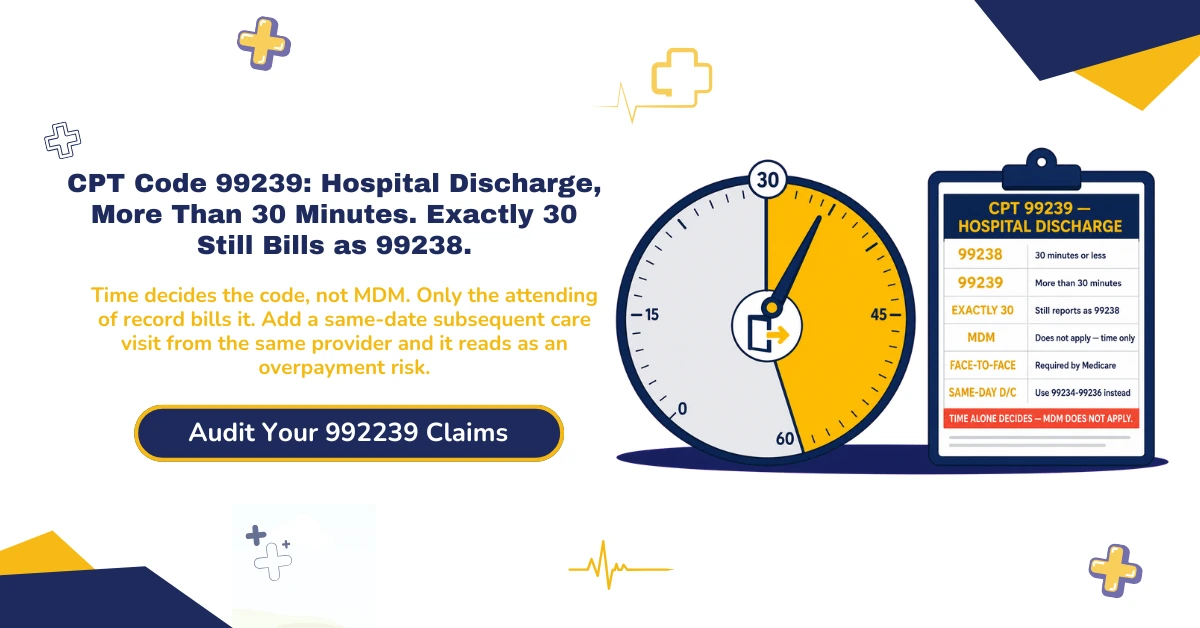
CPT 99239 reports hospital inpatient or observation discharge-day management when the responsible physician or qualified healthcare professional spends more than 30 minutes on qualifying discharge work on the date of the encounter. CPT 99238 covers the same service at 30 minutes or less. Time decides the code, not medical decision making.
Billing teams search this topic for a few practical reasons. A missing time statement can leave a supported claim looking unsupported. Same-day admission and discharge can move the encounter into a different code family. The reporting provider matters too, and a same-date visit from that provider can turn a clean discharge claim into an overpayment risk.
This guide from ClaimMax RCM walks hospitalists, attending physicians, and hospital billing teams through current CPT and Medicare rules for 99239: what counts toward the time threshold, who can report it, how same-day stays change code selection, what the documentation needs to show, and how reimbursement gets calculated for 2026.
Key Takeaways for CPT 99239
- CPT 99239 applies when qualifying discharge-management time exceeds 30 minutes on the encounter date.
- CPT 99238 applies when that same time is 30 minutes or less.
- Code selection runs on total time, not the medical decision making level.
- Qualifying time may be cumulative and doesn’t have to run continuously.
- Medicare requires a face-to-face discharge encounter as part of the service.
- Same-day admission and discharge often points to a different code family altogether.
What Is CPT 99239?
Official CPT 99239 Definition
CPT 99239 covers discharge-day management for a hospital inpatient or observation patient, performed by the physician or qualified healthcare professional responsible for that discharge. The descriptor sets the threshold at more than 30 minutes of total qualifying time on the encounter date, and that time doesn’t have to run in one continuous block.
AMA CPT guidance describes hospital inpatient and observation discharge-day management as a total-time service: 99238 for 30 minutes or less, 99239 for anything beyond it, counted across the whole encounter date rather than one uninterrupted sitting. (AMA CPT E/M guidelines)
Does CPT 99239 Apply to Inpatient and Observation Care?
Yes. CPT 99239 covers both hospital inpatient and hospital observation discharge-day management under the current code family. Observation is technically an outpatient status, but the discharge codes don’t separate observation from inpatient the way some older resources still describe.
Don’t treat 99239 as an office or outpatient E/M code. It belongs to the hospital inpatient and observation care family, and the setting still has to match what’s documented in the record and reflected on the professional claim.
What’s Current for CPT 99239 in 2026?
The code stays active and unchanged at the descriptor level for 2026. The separate hospital observation code family, 99217 through 99220, was retired back in 2023 and folded into the combined hospital inpatient and observation structure. Discharge management wasn’t part of that consolidation.
Nothing new in 2026 converts 99239 into a code selected by medical decision making. AMA’s 2023 descriptor overhaul documents the deletion of the standalone observation codes alongside the revision, not removal, of the surrounding hospital E/M family. (AMA 2023 E/M changes)
CPT 99238 vs 99239: What Is the Difference?
The difference between CPT 99238 and CPT 99239 is the total qualifying discharge-management time on the encounter date. Report 99238 when the service runs 30 minutes or less. Report 99239 when total time exceeds 30 minutes. Neither code gets chosen by medical decision making complexity.
| Requirement | CPT 99238 | CPT 99239 |
|---|---|---|
| Service type | Inpatient or observation discharge management | Inpatient or observation discharge management |
| Time | 30 minutes or less | More than 30 minutes |
| Exactly 30 minutes | Report 99238 | Do not report 99239 |
| Code selected by MDM? | No | No |
| Total time may be cumulative? | Yes | Yes |
| Medicare face-to-face requirement | Required | Required |
What if the Service Takes Exactly 30 Minutes?
Thirty minutes on the nose supports 99238, not 99239. The higher-time code only starts once qualifying work exceeds that mark; 31 minutes is the practical floor. Don’t round an unsupported 29 or 30-minute encounter up to clear the threshold. Document the actual total and let the code follow it.
Does MDM Determine 99238 or 99239?
No. Medical decision making doesn’t decide between these two discharge codes. The service still has to be medically necessary, and the record still has to support the discharge work performed and the time claimed, but the level itself comes down to the clock.
What Time Counts Toward CPT 99239?
Time for CPT 99239 includes qualifying discharge-management work performed by the responsible physician or qualified healthcare professional on the encounter date. The total can include the final exam, discussion of the hospital stay, continuing-care instructions, and preparing discharge records, prescriptions, and referrals. Time may be cumulative and doesn’t need to run continuously.
Activities That May Count Toward Discharge Time
| Qualifying activity | Documentation focus |
|---|---|
| Final examination | Findings and discharge readiness |
| Discussion of hospital stay | Clinical course and outcome |
| Continuing-care instructions | Patient, family, or caregiver instructions |
| Medication reconciliation | Changes, discontinued drugs, new prescriptions |
| Preparation of discharge records | Discharge documentation completed |
| Prescriptions and referral forms | Orders and destinations |
| Coordination of post-discharge care | Receiving provider or facility |
| Follow-up arrangements | Scheduled or recommended follow-up |
Not every discharge touches every row above. Include what happened for that specific patient, not a checklist of everything a discharge could involve.
Time That Shouldn’t Be Counted Automatically
A few categories need a second look before they go into the total. Work performed on another calendar date doesn’t count, and neither does staff time the billing practitioner didn’t personally perform.
Time already counted toward another service stays out too, along with waiting or travel time that has no qualifying patient-specific work attached to it. Treat borderline cases as payer-verification questions rather than settled exclusions, since official guidance doesn’t spell out every scenario.
Must All 31 Minutes Be Face-to-Face?
No. Medicare requires the hospital discharge-day management service to include a face-to-face encounter, but the more-than-30-minute threshold covers total qualifying discharge-management work, not bedside minutes alone.
CMS frames the Medicare service around that face-to-face requirement, while AMA defines the code itself through total discharge-management time on the encounter date, a distinction that resolves most of the confusion around this question. (CMS 2026 E/M guidance)
Is a Discharge Summary Alone Enough?
A completed discharge summary doesn’t automatically prove more than 30 minutes of qualifying work. The record needs to support the actual time and the activities behind it, not just the existence of paperwork. There’s no separate “discharge summary” code; the summary is one output of a broader discharge-management service, not the service itself.
Who Can Bill CPT 99239?
Under CPT guidance, the physician or qualified healthcare professional responsible for the patient’s discharge reports 99239. For Original Medicare, the attending physician of record, or an eligible practitioner acting on that physician’s behalf, reports the discharge-management service. Other practitioners need a code that reflects their own, separate work that day.
CPT Rule for the Responsible Discharging Provider
CPT frames eligibility around “physician or other qualified healthcare professional,” and the deciding factor is responsibility for discharge services, not physical presence in the building. A specialist who stops by on the discharge date without owning that discharge shouldn’t report this code just because the timing lines up.
Medicare Attending Physician Rule
CMS assigns the discharge-management service to the attending physician of record, or to a practitioner acting on that physician’s behalf, and it pays only one hospital discharge-day management service per patient per stay, regardless of how many providers touched the case that day. (CMS Claims Processing Manual)
What Should Consultants Report?
A consultant doesn’t bill the discharge code by seeing the patient on the discharge date alone. When a consultant manages a separate problem, the appropriate subsequent hospital care code may apply once its own requirements are met, subject to same-date edits and payer rules.
Not every consultant visit on the discharge date is separately payable. The record needs to show distinct, medically necessary work to support one.
Can an NP or PA Report the Service?
CPT permits qualified healthcare professionals to report 99239. Medicare coverage still depends on that practitioner’s eligibility, role in the case, and state scope-of-practice rules.
Whether the visit was billed independently or jointly matters too, along with the specific payer’s own policy. None of that resolves the same way for every payer, so verify it instead of assuming it. Split/shared and teaching-physician scenarios for this code get their own treatment later in this guide.
| Question | CPT guidance | Medicare rule |
|---|---|---|
| Who reports the service? | Responsible physician or QHP | Attending physician or eligible representative |
| Can consultants report it? | Not unless responsible for discharge | Usually a different, applicable code |
| How many services are payable? | One discharge service | One payable service per stay |
Can CPT 99239 Be Billed for Same-Day Admission and Discharge?
Generally, no. CPT 99239 isn’t reported when a patient is admitted and discharged on the same calendar date. For Medicare, a same-day stay under 8 hours typically supports an initial hospital inpatient or observation code instead, while a stay of 8 or more but less than 24 hours typically points to CPT 99234 through 99236.
Required Decision Table
| Medicare scenario | Code direction |
|---|---|
| Same date, less than 8 hours | Initial hospital care, 99221 to 99223 |
| Same date, 8 or more but less than 24 hours | Same-day admission and discharge, 99234 to 99236 |
| Different date, stay under 8 hours total | Initial hospital service only, under the current CMS table |
| Different date, stay 8 hours or more | Initial hospital service plus 99238 or 99239 |
| One encounter on the admission and discharge date | Initial care code may apply |
| Two or more encounters on the same date | Evaluate 99234 through 99236 |
CMS’s current evaluation and management guidance lays out this length-of-stay framework directly, including the split between stays under 8 hours and same-day stays of 8 hours or more.
Same-Day Stay of Less Than 8 Hours
Use the applicable initial hospital inpatient or observation care code when CMS requirements are met, and skip 99238 or 99239 entirely. Selecting among 99221 to 99223 still comes down to the usual initial-care requirements, not the fact that the stay happened to be brief.
ClaimMax RCM’s CPT 99221 guide covers this same-day threshold from the initial-care side, including the exact hour cutoffs. The CPT 99222 guide walks through the same rule for moderate-complexity admissions.
Same-Day Stay of 8 to Less Than 24 Hours
Evaluate 99234 through 99236 once the stay reaches 8 hours but stays under 24 on the same calendar date. The service still has to meet the same-day admission and discharge requirements on its own; it isn’t selected only because discharge work happened to run past 30 minutes. Don’t add 99239 on top of a combined same-day service.
Admission and Discharge on Different Dates
Report the applicable initial service for the admission date. Discharge management can then be reported on the actual discharge date, once CMS requirements are met, using 99238 or 99239 depending on the qualifying time documented for that later date.
Can 99222 and 99239 Be Billed on the Same Day?
No, not for admission and discharge performed on the same calendar date. Figure out whether the encounter supports an initial-care code alone or a same-day admission and discharge code from 99234 through 99236, and let that decision replace the discharge code entirely rather than adding it on top.
CPT 99239 Documentation Requirements
Documentation should clearly show that the responsible practitioner performed qualifying discharge-day management and spent more than 30 minutes on it. The record needs a stated total time and a description of the principal discharge activities. For Medicare, it should also support the face-to-face encounter and the practitioner’s responsibility for that discharge.
Required Time Statement
A specific total, like “45 minutes,” documents more clearly than a vague phrase like “more than 30 minutes.” Start and stop times can support that total, though they aren’t a universal requirement; check the applicable MAC and payer policy before assuming one way or the other. Never round unsupported time upward to clear the threshold.
Clinical and Operational Elements
The note should include, as applicable: the final patient evaluation, the patient’s condition at discharge, medication reconciliation, discharge instructions, patient or caregiver education, the follow-up plan, referrals, prescriptions, receiving-facility or home-health coordination, pending-test instructions, and total discharge-management time. Not every discharge touches every item on that list, and the note shouldn’t pretend otherwise.
Weak vs Strong Documentation
A weak note reads like this: “Patient discharged home. Instructions reviewed. More than 30 minutes.” It gives no precise total, no real description of the work, and little to defend on audit.
A stronger version reads: “Total discharge-management time was 42 minutes on the encounter date. Work included the final evaluation, medication reconciliation, patient and caregiver education, preparation of discharge instructions and prescriptions, and coordination of follow-up with the receiving primary care practice.”
Treat this as an educational model, not a template to copy word for word. Document only the work performed for that specific patient.
EHR Template Requirements
A discharge template built for this code should prompt for total time, date of service, the reporting practitioner, the face-to-face encounter, medication changes, the follow-up destination, care coordination, discharge disposition, and a same-day E/M alert that flags a possible conflict before the claim goes out.
Documentation errors tend to surface only after submission, once they’ve already become claim edits. ClaimMax RCM’s hospital revenue cycle management team reviews hospital coding, documentation, and same-date claim conflicts before preventable errors reach the payer.
Can CPT 99239 Be Billed With Other E/M Services on the Same Date?
For Medicare, a provider generally shouldn’t report another E/M code on the same date as hospital discharge-day management. CPT 99238 and 99239 already include the reporting provider’s E/M work for that patient on the discharge date. Any same-date combination needs review against current NCCI edits, provider identity, specialty, encounter circumstances, and payer policy.
The 2026 Medicare NCCI policy manual treats a discharge code as inclusive of the provider’s physician services on that date, and generally doesn’t expect another E/M code from that same provider on that date. (2026 Medicare NCCI Policy Manual)
Can 99233 and 99239 Be Reported on the Same Date?
No, not for the same provider and patient on the same discharge date. The subsequent hospital visit is already part of the discharge-management service, so the time and work shouldn’t split across two separate claims. A different provider’s medically necessary, distinct service still needs its own payer and coding analysis before it goes out.
CMS treats same-provider reporting of 99231 through 99233 alongside 99238 or 99239 as an overpayment risk once both land on the same discharge date for the same patient (CMS Claims Processing Manual). ClaimMax’s CPT 99233 guide covers that subsequent-care code in full, including this exact same-date conflict.
Can Modifier 25 Override the Edit?
Modifier 25 isn’t a universal fix for pairing another E/M service with discharge management. Don’t append it just because two visits happened at separate times of day.
Any exception needs the exact code pair, a genuine separate-service basis, supporting documentation, and current payer and NCCI policy behind it. A system edit firing on its own isn’t a reason to add the modifier.
Pre-Claim Same-Date Edit
| Pre-claim check | Required action |
|---|---|
| Same patient | Confirm both lines belong to the same encounter |
| Same provider | Compare rendering and billing practitioner data |
| Same date | Check whether both services fall on the discharge date |
| E/M pair | Run current NCCI and payer edits |
| Time | Prevent duplicated minutes across services |
| Documentation | Confirm the second service is separate and medically necessary |
| Modifier | Apply only when the exact rule supports it |
Do not automatically bill together: 99231 through 99233 with 99238 or 99239; 99221 through 99223 with 99238 or 99239 on the same date; 99234 through 99236 with a separate discharge code; or any other E/M service alongside discharge management from the same provider on the same date.
Special Billing Rules and Exceptions for CPT 99239
Special scenarios need more than a simple check against the 30-minute threshold. Global surgery, death pronouncement, nursing-facility admission, teaching-physician participation, split or shared services, and same-date procedures can all change who bills, which date applies, and whether a second service is even payable.
Hospital Discharge During a Global Surgical Period
Routine postoperative discharge care tied to the surgery is generally part of the global surgical package. Don’t report discharge management separately just because the surgeon spent more than 30 minutes on it.
An unrelated condition can create a separately reportable service when documentation clearly supports it. Modifier 24 may apply to that unrelated postoperative E/M, but only when the record backs it up.
| Question | Why it matters |
|---|---|
| Who performed the discharge? | Surgeon, hospitalist, or another practitioner |
| Why was the patient hospitalized? | Surgical recovery or a separate condition |
| Is the discharge work related to the surgery? | Related work is usually included globally |
| Was care transferred? | Responsibility needs to be documented clearly |
| Does documentation show an unrelated condition? | Required before considering separate reporting |
Can 99239 Be Used for a Death Pronouncement?
Yes. For Medicare, the physician who personally performs the death pronouncement may report the appropriate discharge-management code once the service requirements are met. The date of service is the date the pronouncement happened, not the date paperwork got finished, and documentation should support the face-to-face service, the pronouncement itself, the time, and the work performed (CMS Claims Processing Manual).
What if the Patient Physically Leaves on a Different Date?
The date of the practitioner’s discharge-management visit isn’t always the date the patient physically leaves the building. A physician might complete the face-to-face discharge service late Tuesday, with transportation moving the patient Wednesday morning. Verify the actual visit date against the documentation for Medicare purposes, rather than defaulting to whatever date shows up on the transportation record.
Hospital Discharge and Nursing-Facility Admission on the Same Date
Medicare may pay the hospital discharge code and a nursing-facility admission code on the same date once the requirements for both are separately met. That’s a different situation from reporting two hospital E/M services. Global-surgery rules can still block separate nursing-facility payment when the admission relates to postoperative care, so documentation needs to clearly separate the two services.
Teaching Physician and Resident Time
Resident-only time doesn’t automatically become the billing practitioner’s reportable time. The teaching physician’s own participation and documentation still have to meet Medicare’s teaching rules, and a routine cosignature isn’t a substitute for that involvement. (CMS teaching physician guidelines)
Split or Shared Discharge Services
CMS recognizes split or shared E/M services in qualifying facility settings, with the billing practitioner performing the substantive portion. Because discharge management runs on total time, that substantive-portion test applies to the minutes each practitioner personally contributed, verified against current payer policy rather than assumed.
The physician and the nonphysician practitioner need to be in the same group for Medicare’s split or shared rules to apply at all. (CMS split or shared guidance)
Critical Care and Discharge on the Same Date
Critical care and discharge management are both E/M services, and the same provider shouldn’t double count the same minutes toward both. The 2026 NCCI treatment of discharge management as inclusive of that provider’s services on the discharge date still applies here.
Check the exact code pair, provider, group, timing, and payer policy before reporting both. Support any separately reportable service with its own documentation.
Same-Day Obstetric Delivery and Discharge
Routine postpartum and discharge work included in maternity care shouldn’t get separated out just because it runs past 30 minutes. Confirm the applicable same-day delivery-package rules before reporting a separate discharge service, since AMA’s maternity guidance folds routine same-day postpartum care into delivery care itself.
CPT 99239 RVUs and Medicare Reimbursement in 2026
Medicare reimbursement for CPT 99239 isn’t one universal dollar figure. Payment comes from the code’s work, practice-expense, and malpractice RVUs, adjusted for the local geographic practice cost indices and multiplied by the applicable 2026 conversion factor. Commercial payment depends on each provider’s own contract, network status, specialty, and fee schedule.
CMS builds Physician Fee Schedule payment from work, practice-expense, and malpractice RVUs, adjusted geographically and multiplied by a conversion factor. (CMS 2026 PFS Final Rule)
What Does “99239 RVU” Mean?
Work RVU measures the physician’s time, skill, and intensity. Practice-expense RVU covers the overhead of delivering the service, and malpractice RVU reflects liability cost. Geographic Practice Cost Indices adjust each of those three for local cost differences, and the conversion factor turns the adjusted total into a dollar amount:
Adjusted work RVU + adjusted practice-expense RVU + adjusted malpractice RVU, multiplied by the applicable conversion factor, equals the estimated Medicare allowed amount.
2026 Conversion Factors
CMS finalized two separate conversion factors starting in 2026: $33.57 for qualifying APM participants and $33.40 for nonqualifying clinicians, the first year the fee schedule has run parallel rates by participation status. Either number is one input into the formula above, not a finished payment amount on its own.
Verify the Current RVU Before Quoting a Number
Pull 99239’s current work, practice-expense, and malpractice RVUs from the CMS Physician Fee Schedule Look-Up Tool for the applicable locality before quoting a dollar figure to a physician or finance committee. (CMS Physician Fee Schedule Look-Up Tool)
RVU values shift with annual rule changes. A number that was accurate last year can be stale by the time this guide gets read.
Medicare vs Commercial Payer Rates
Medicare’s allowed amount varies by locality, and a billed charge is never the same thing as an allowed amount. Commercial rates get negotiated contract by contract, so a national commercial average won’t reliably predict what any individual provider collects on a given 99239 claim.
Payment accuracy needs a check after adjudication, not an assumption from the billed charge. ClaimMax RCM’s payment posting team reconciles ERAs and EOBs at the line level and flags underpayments while payer dispute windows are still open.
Common CPT 99239 Denials, Audit Risks and Corrective Actions
CPT 99239 claims run into trouble when the record doesn’t support more than 30 minutes, the wrong practitioner reports the discharge, the claim pairs with another same-date E/M service, the date of service is wrong, or the encounter belonged to a same-day admission and discharge code instead.
Each failure needs its own fix. A generic appeal can’t rescue a code the documentation never supported in the first place.
| Denial or audit trigger | Root cause | Pre-claim prevention | Corrective action |
|---|---|---|---|
| Missing total time | Threshold unsupported | Require a time field in the template | Review documentation against payer policy |
| Time is 30 minutes or less | Wrong discharge level billed | Compare stated time to the threshold | Correct to the supported code, where allowed |
| 99233 and discharge code, same date | Unbundled E/M service | Same-provider, same-date edit | Void or correct the unsupported line |
| Same-day admission coded as discharge | Wrong code family selected | Length-of-stay and date logic check | Recode under the applicable CMS rules |
| Wrong reporting provider | Consultant or non-responsible provider billed | Confirm attending responsibility | Correct the provider and the claim, where supported |
| Incorrect date of service | Departure date or paperwork date used | Compare visit and discharge records | Correct to the actual supported service date |
| Global-surgery conflict | Related postoperative work billed separately | Global-period check | Review relatedness and modifier rules |
| Missing face-to-face support | Medicare requirement not documented | EHR encounter field | Submit the supporting record only when it exists |
| Payer-specific edit | Contract or policy differs from Medicare | Payer rule library | Correct or appeal against the exact policy |
Correct or Appeal, Not Both by Default
A corrected claim fits when a field was entered wrong, the wrong code went out but the record supports a different one, or the payer specifically asks for a correction. An appeal fits when the original claim accurately reflects documented work, or when the payer misapplied its own policy against documentation that supports the time and provider already on file.
Don’t appeal because the discharge felt complex or a higher payment seems fair. Appeal because the record supports what was billed.
Repeat denials across providers or payers usually point to a workflow gap rather than one bad claim. ClaimMax RCM’s denial management team combines claim recovery with root-cause correction, so the same documentation or coding failure doesn’t keep repeating into the next billing cycle.
CPT 99239 Coding Examples for Healthcare Providers
These scenarios show the rules working together rather than in isolation. None of them introduces a new policy; each one applies what the sections above already covered.
Multi-Day Inpatient Discharge Over 30 Minutes
Facts: Patient admitted Monday, discharged Wednesday. The responsible practitioner performs 42 minutes of qualifying discharge work, and the record supports the total time and the face-to-face encounter.
Code direction: Report the discharge code for more than 30 minutes.
Error to avoid: Don’t also report a subsequent hospital visit by the same provider on Wednesday.
Discharge Taking Exactly 30 Minutes
Facts: A multi-day hospital stay ends with total qualifying discharge time of exactly 30 minutes.
Code direction: Use the lower-time discharge code, not the more-than-30-minute code.
Error to avoid: Don’t round 30 minutes upward.
Six-Hour Same-Day Observation Stay
Facts: Observation starts at 9:00 a.m. and ends at 3:00 p.m. on the same calendar date, a stay under 8 hours.
Code direction: Use the applicable initial hospital inpatient or observation care code under Medicare guidance, not a separate discharge code. CMS’s current guidance distinguishes stays under 8 hours from same-day stays of 8 or more hours.
Twelve-Hour Same-Day Observation Stay
Facts: Observation starts at 7:00 a.m. and ends at 7:00 p.m., with two qualifying encounters documented across that stretch.
Code direction: Evaluate 99234 through 99236.
Error to avoid: Don’t add 99239 just because the discharge work alone ran past 30 minutes.
Consultant’s Final Visit
Facts: The hospitalist is responsible for discharge. A cardiologist evaluates a separate active problem before discharge and isn’t acting on the attending’s behalf.
Code direction: The hospitalist reports the discharge service. The consultant evaluates the appropriate code for the separate, medically necessary final-day service, subject to payer and same-date rules.
Death Pronouncement
Facts: The physician personally pronounces death, performing and documenting 35 minutes of qualifying service. Paperwork gets completed later.
Code direction: Use the pronouncement date, and apply Medicare’s discharge-management guidance from there.
Practices that want these six scenarios on one page, alongside the 99238-versus-99239 threshold and the same-day rules, can request ClaimMax RCM’s hospitalist discharge billing cheat sheet through the contact link below.
How ClaimMax RCM Supports Accurate Hospital Discharge Billing
Accurate discharge billing takes more than picking the right code. Documentation, charge capture, provider identity, date of service, same-date edits, claim submission, remittance posting, and denial follow-up all have to agree with each other. ClaimMax RCM manages those steps as one connected revenue cycle rather than treating code selection as an isolated task.
ClaimMax RCM’s CPT 99239 Workflow
- Verify the inpatient or observation setting.
- Compare the admission and discharge dates.
- Validate the length-of-stay logic.
- Confirm the responsible reporting provider.
- Review the documented time and supporting detail.
- Run NCCI and payer-specific edits.
- Reconcile payment and work any resulting denials.
ClaimMax RCM Pricing
Medical billing runs at 3.49% of payer collections. Verification of benefits and prior authorization are included at no separate charge, and every new account starts with a free revenue cycle audit before any commitment. Credentialing runs $120 per insurance, handled by the same team that already knows hospital E/M coding.
| Service | ClaimMax RCM pricing |
|---|---|
| Full-service medical billing | 3.49% of payer collections |
| Verification of benefits | Included at no separate charge |
| Prior authorization | Included at no separate charge |
| Revenue cycle audit | Free, before any commitment |
| Credentialing | $120 per insurance |
Verification of benefits and prior authorization aren’t required for 99239 itself; they’re part of ClaimMax RCM’s broader full-service revenue cycle model, alongside coding validation, claim submission, and denial follow-up for every hospital E/M code a practice bills.
That combination is what affordable, specialty-aware billing looks like at ClaimMax RCM: medical billing and full-service revenue cycle management built to help hospitalist groups, orthopedic practices, and any specialty reporting this code collect what the documentation earns from the payer.
See how ClaimMax RCM can review your hospital billing workflow, flag discharge-coding gaps, and show where unsupported claims, denials, or underpayments are affecting collections.
Request a Hospital Billing Review
Frequently Asked Questions About Hospital Discharge Coding
What is CPT 99239 used for?
CPT 99239 reports hospital inpatient or observation discharge-day management when total qualifying discharge work exceeds 30 minutes on the date of the encounter, performed by the responsible practitioner.
What is the difference between CPT 99238 and 99239?
99238 covers 30 minutes or less; 99239 covers more than 30 minutes. Time chooses the code, not MDM, and exactly 30 minutes still belongs to 99238.
Is 99239 inpatient or outpatient?
It applies to both hospital inpatient and observation discharge management. Observation is a hospital outpatient status, but the current code family covers both, and it isn’t an office outpatient code.
Does time need to be documented for 99239?
Yes. The record should support more than 30 minutes, ideally with a specific total rather than a vague phrase. Start and stop times can help; verify whether your MAC or payer expects them.
Can you bill 99222 and 99239 on the same day?
Generally not, for a same-day admission and discharge. A stay under 8 hours uses initial care under Medicare, and a stay of 8 to under 24 hours uses 99234 through 99236 when requirements are met, without adding a separate discharge code.
Can you bill 99233 and 99239 on the same date?
Not by the same provider for the same patient. The subsequent-care visit is already part of discharge management, and CMS treats the separate subsequent-care line as an overpayment risk.
Can a consultant report the discharge code?
Only the practitioner responsible for the discharge reports 99238 or 99239 under CPT. Medicare uses the attending-of-record framework, and consultants should evaluate the code that represents their own separate, medically necessary work.
Can 99239 be used when a patient dies?
Yes. Medicare permits the pronouncing physician to report the appropriate discharge-management code, using the pronouncement date, with documentation that supports the service and the qualifying time.
Is a hospital discharge follow-up code the same as 99239?
No. CPT 99239 reports hospital discharge-day management itself. Post-discharge office visits or transitional care management happen after discharge and carry their own separate requirements; they aren’t substitutes for the discharge code.
What does ClaimMax RCM charge for medical billing?
ClaimMax RCM charges 3.49% of payer collections for full-service medical billing, with verification of benefits and prior authorization included at no separate charge and a free revenue cycle audit up front. Credentialing runs $120 per insurance. Confirm final terms in the client agreement.
Final CPT 99239 Billing Checklist
- Inpatient or observation setting confirmed
- Admission and discharge dates checked against each other
- Length of stay verified
- Responsible practitioner confirmed
- Face-to-face Medicare requirement supported
- Total discharge time documented, with the activities behind it
- Time confirmed to exceed 30 minutes
- Same-date E/M conflicts cleared
- Global-surgery issues reviewed
- Correct date of service selected
- Payer policy checked
- Payment reconciled after adjudication
Correct hospital discharge billing protects revenue by matching the claim to the work performed. Document qualifying time, follow the applicable CPT and payer rules, and fix workflow failures before they turn into repeat denials.
ClaimMax RCM can review your hospital discharge billing workflow, from documentation and charge capture through payment posting and denial recovery.
Get a Hospital RCM Review