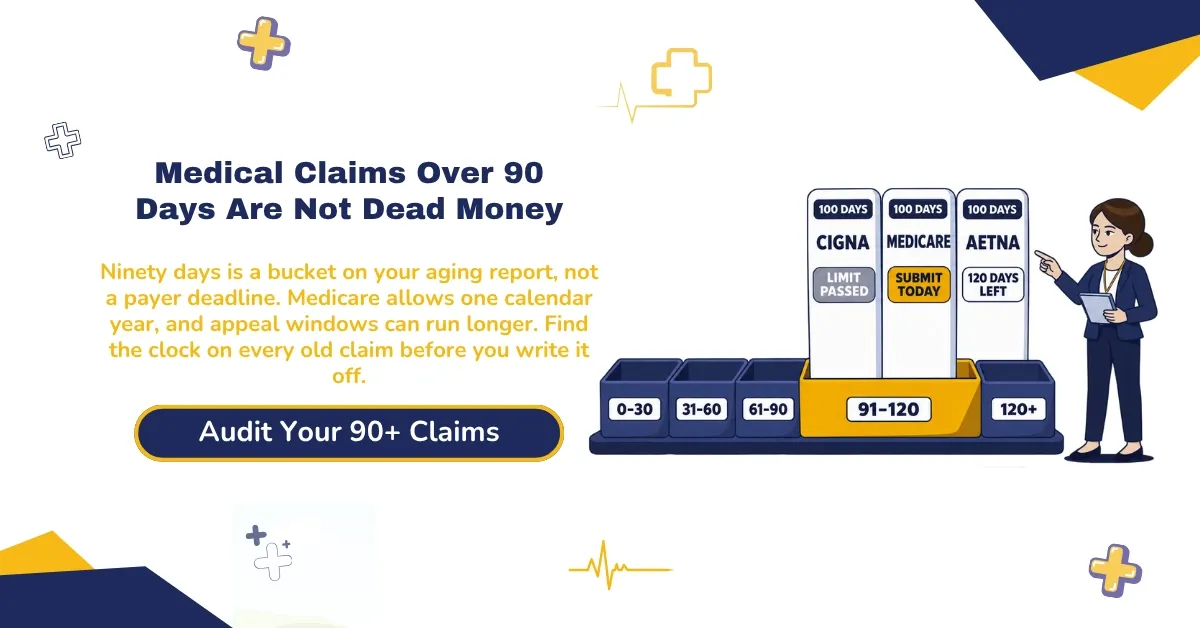
| Short answer Yes. A payer can still pay medical claims over 90 days old while its timely filing limit, appeal window, or a recognized exception remains open. Ninety days marks a bucket on your aging report; it isn’t a payer deadline. Medicare allows one calendar year from the date of service, while Cigna gives participating providers 90 days. |
Picture a Monday aging review. The 91 to 120 day column shows $60,000, and somebody on the team calls it dead money. Some of those unpaid insurance claims are lost. Others sit inside a Medicare filing window with months left, or inside a commercial appeal window nobody put on the calendar.
Each old claim answers to a specific clock. You’ll find the clock for each kind of aged claim below, along with 2026 filing rules for Medicare, Medicaid, and the large commercial payers. The last part gives your billing team a triage order to start this week.
| Key takeaways The 90-day mark is a bucket on the aging report; the payer’s deadline is a separate date.Claims a payer never received follow the filing limit, and denied claims follow the appeal or reconsideration window.Medicare allows one calendar year to file, 120 days to request a redetermination, and reopenings for clerical errors.Payer proof of receipt, such as a 277CA acknowledgment, can overturn a late filing denial.Write off a claim only after you’ve checked every deadline and exception, and record it with a reason-specific adjustment code. |
Is a Medical Claim Over 90 Days Old Still Recoverable?
What the 90-Day Bucket Measures
Often, yes. The 90-day mark tells you how long a balance has sat open, and it says nothing about whether a payer will still accept the claim. Practice management systems sort open balances into AR aging buckets of 0 to 30, 31 to 60, 61 to 90, 91 to 120, and over 120 days.
Check the aging basis before you trust the report. Some systems age from the date of service, some from the submission date, and some from the last transaction. A rebilled claim can look 20 days old when the visit happened five months ago. Our AR over 90 days formula guide shows the HFMA bucket definitions.
Why Two Claims of the Same Age Can Have Opposite Outcomes
Two claims can sit in the same bucket and face opposite outcomes. A Medicare claim at 140 days that nobody submitted still falls inside Medicare’s one calendar year timely filing limit. Cigna’s 90-day limit has already closed on a participating claim at 95 days that Cigna never received, unless you hold proof of filing or an exception applies.
At ClaimMax RCM, our billers check the controlling clock on every 90+ day claim before anyone calls a payer. That first check separates claims worth a phone call from claims that need a corrected submission, an appeal, or a documented write-off. It’s how our accounts receivable services team sorts a backlog.
Which Deadline Controls a Claim Over 90 Days Old?
The claim’s status decides the clock. Claims a payer never received follow the timely filing limit, and denied claims follow the appeal or reconsideration window. Six clocks cover most old claims you’ll find on an aging report, and each clock starts on a different date.
Table 1. Six clocks that decide whether a payer can still pay an old claim (rules checked November 20, 2026)
| Claim status | Clock that controls it | Clock starts | Rule and source | Next step |
|---|---|---|---|---|
| Never received, or rejected before processing | Original timely filing limit | Date of service | Medicare: no later than one calendar year after the date of service (42 CFR 424.44) | Submit, or correct and resubmit |
| Denied by Medicare after processing | Redetermination window | Receipt of the initial determination | 120 days from receipt; CMS presumes receipt five calendar days after the notice date (CMS redetermination guidance) | Redetermination request |
| Medicare claim with a minor error | Reopening | Date of the initial determination | CMS sends minor errors and omissions to reopening, outside the appeals process | Reopening request |
| Medicare Advantage plan denial | Plan reconsideration | Date of the plan’s decision notice | 65 calendar days (CMS Part C reconsideration page) | Read your participation agreement, then request reconsideration |
| ERISA group health plan denial | ERISA appeal | Receipt of the adverse benefit determination | At least 180 days (29 CFR 2560.503-1) | Appeal as the patient’s authorized representative |
| Out-of-network claim under the No Surprises Act | Open negotiation, then Federal IDR | Initial payment or denial notice | 30 business days to negotiate, then four business days to start IDR (CMS Federal IDR overview) | Federal IDR |
Aging and deadlines drift apart because payers process claims at different speeds. Aetna runs its 180-day reconsideration clock from the initial claim decision. A claim Aetna denied on day 20 has less time left than one denied on day 85, even though both claims sit in the same aging bucket today.
ERISA appeal rights belong to the patient. Federal rules give the claimant at least 180 days to appeal an adverse benefit determination, and they require plans to let an authorized representative act for the claimant. Get the patient’s signed authorization on file before you submit the appeal.
For Medicare Advantage, a claim reconsideration through the plan follows the 65-day window CMS describes. Contracted providers should read the participation agreement first, because the agreement can set its own dispute steps and deadlines for payment disputes.
What Can Still Be Recovered After 90 Days
Five groups of old claims can still reach payment, as long as their clock stays open. Sort your 90+ bucket into these groups before anyone picks up the phone, because each group needs a different action.
Claims the Payer Never Finished Processing
- Pending claims: a payer asked for records or opened a review, and the claim can still pay once someone answers the request.
- Claims the payer never received: you can still submit them while the payer’s timely filing limit is open.
- Clearinghouse rejections: these never reached the payer, so you have nothing to appeal. Fix the data and resubmit before the original filing deadline; our guide to clearinghouse rejections explains the codes.
Denied Claims With an Open Appeal or Correction Window
- Coding, modifier, or demographic denials: fix them with a corrected claim or a reconsideration, depending on the route your payer requires.
- Medical necessity denials: appeal with the clinical notes inside the payer’s appeal window.
- Corrected claims: UnitedHealthcare revised its corrected claim timely filing requirements in its 2026 Administrative Guide, so check the correction deadline in your agreement before you resubmit.
Paid Claims With Money Still Owed
- Underpayments: the payer paid below your contracted rate, and the gap shows up line by line on the ERA. Our guide to underpaid claims on the ERA walks through the check.
- Secondary and tertiary balances: once the primary pays or denies, bill the secondary policy if it was active on the date of service.
- Unposted payments: the money arrived, but nobody applied it to the claim. Match deposits and ERAs before you call; solid payment posting services catch these before they age.
Claims Where an Exception Extends the Clock
Medicare timely filing exceptions sit in 42 CFR 424.44(b), and the regulation lists four of them. Each one covers a delay the provider didn’t cause:
- Administrative error by CMS, a Medicare contractor, or an HHS agent
- Retroactive Medicare entitlement
- Retroactive entitlement plus a state Medicaid recoupment made six or more months after the service
- Retroactive Medicare Advantage or PACE disenrollment plus a plan recoupment made six or more months after the service
Each exception extends the deadline through the last day of the sixth calendar month after the month of the notice or recoupment. The administrative error exception doesn’t apply if you request it more than four years after the date of service.
Commercial payers write their own versions. Cigna counts coordination of benefits claims from the processing date on the primary carrier’s EOB, which can save a claim that looks like a coordination of benefits denial. Under Humana’s claim filing rules, a claim sent in error to another carrier starts its clock on the date that carrier notifies you of the error.
Retroactive Medicaid eligibility restarts the clock in several states, including Texas, which gives you 95 days from the eligibility add date within 365 days of service. Run insurance eligibility verification again before you rebill. If a payer denies a claim you sent on time, proof of timely filing can overturn the denial.
A typical 90+ bucket mixes all five groups together. Our free AR aging audit sorts yours claim by claim, so your billers spend their hours on balances that can still pay.
What Usually Cannot Be Recovered
You usually can’t recover a claim once every filing, appeal, and exception route has closed, or when nobody owed the balance in the first place. These seven situations end most recovery attempts:
- Past the filing limit with no proof: the timely filing limit passed, you hold no payer acknowledgment, and no exception applies.
- Medicare late filing denials sent to appeal: CMS says the denial “isn’t an initial determination and isn’t subject to appeal” in its CMS timely filing guidance.
- Exhausted appeals: the payer upheld the denial at every level available to you.
- Missed appeal windows: the deadline passed, and the payer won’t accept your good cause explanation.
- Correct contractual adjustments: the payer paid your contracted rate, so the leftover balance is a write-off.
- Duplicates, credits, and paid balances: reconcile these and close them instead of chasing them.
- Balances your contract bars from the patient: if your agreement holds the patient harmless for late filing denials, the balance can’t move to patient AR.
A timely filing denial usually carries the CO-29 denial code, CARC 29: “The time limit for filing has expired.” With proof of timely filing, you can often reverse it with the payer. Without that proof, treat it as final and send the pattern to our denial management services team so it stops repeating.
Timely Filing Limits by Payer for 2026 and 2027
Your timely filing limit depends on the payer, the plan type, and your contract, and the contract usually controls. Use the table below as a starting point, then confirm each number against your participation agreement before you write anything off.
Table 2. Payer filing deadlines and appeal windows for claims over 90 days old (checked November 20, 2026; we recheck when payers publish 2027 manuals)
| Payer | Filing deadline | Appeal or reconsideration window | Clock rules for old claims | Source |
|---|---|---|---|---|
| Original Medicare | One calendar year after the date of service | Redetermination: 120 days from receipt of the initial determination | Four exceptions in 42 CFR 424.44(b) | 42 CFR 424.44 |
| Medicare Advantage (Humana example) | One year from the date of service, or as the provider agreement states | 65 calendar days from the plan’s notice | Your participation agreement can change the dispute steps | Humana claims submissions page |
| Medicaid (federal ceiling) | No later than 12 months from the date of service | Set by each state | States can set shorter limits | 42 CFR 447.45 |
| Texas Medicaid (fee-for-service) | 95 days from each date of service | 120 days from the disposition date on the R&S Report | Retroactive eligibility: 95 days from the add date, within 365 days | TMHP claims filing manual |
| New York Medicaid (fee-for-service) | 90 days from the date of service | Not stated in this source | Delays outside your control: submit within 30 days of regaining control, subject to a two-year limit | 18 NYCRR 540.6 |
| Cigna | 90 days for participating providers; 180 days for out-of-network providers | Not stated on this page | Consecutive-day services count from the last date of service; COB counts from the primary EOB processing date | Cigna claim submission rules |
| Humana commercial | 90 days if no state or contract rule applies | Not stated on this page | A claim sent in error to another carrier starts when you’re notified | Humana claims submissions page |
| Aetna | Set by your contract | Reconsideration within 180 calendar days of the initial claim decision; appeal within 60 calendar days of the reconsideration decision | Clinical and utilization review decisions go to appeal | Aetna dispute and appeal process |
| UnitedHealthcare | Set by your Participation Agreement | Set by your agreement | 2026 Administrative Guide revised corrected claim filing requirements | UnitedHealthcare 2026 Administrative Guide |
| BCBS | Set by each BCBS plan and your agreement | Set by each plan | Check your local plan’s provider manual | Your local BCBS provider manual |
| TRICARE | One year from the date of service or inpatient discharge | Set by the regional contractor | Check your region’s contractor manual | TRICARE claim filing rules |
Medicare and Medicare Advantage
Original Medicare sets the clearest rule: the Medicare timely filing limit is one calendar year after the date of service. Medicare Advantage plans set filing deadlines through provider contracts. Humana, for example, requires Medicare Advantage claims within one year from the date of service or as the provider agreement states.
Medicaid Varies by State
Federal rules cap the Medicaid timely filing limit at 12 months from the date of service, and states can set shorter windows. Texas allows 95 days and New York allows 90 for fee-for-service claims. Our guide to Medicaid timely filing by state lists each state’s rule.
Medicare crossovers get their own clock. If a timely Medicare claim covers the same services, the federal rule lets Medicaid pay within six months after the agency or provider receives notice of Medicare’s decision. Keep the Medicare remittance with the Medicaid claim.
Commercial Payers and TRICARE
Cigna lists five exceptions to its filing deadlines. Keep the paperwork for whichever one applies to your claim:
- A longer filing period required by applicable law
- A provider agreement that allows more time
- Coordination of benefits, counted from the processing date on the primary carrier’s EOB
- A claim filed on time that Cigna later asked for more information on
- Extraordinary circumstances, such as a natural disaster, backed by evidence
UnitedHealthcare’s 2026 Administrative Guide revised Chapter 10, including corrected claim timely filing, effective April 1, 2026 for current providers and January 1, 2026 for new ones. Aetna runs two steps: a claim reconsideration within 180 calendar days, then an appeal within 60 calendar days of that decision.
TRICARE requires claims within one year of the date of service or inpatient discharge. Your contract outranks every published figure, so pull the agreement before you trust any chart, including ours.
How to Recover a Medicare Claim Denied as Late (CO-29 Denial Code)
Why a Medicare Late Filing Denial Can’t Be Appealed
You don’t appeal a Medicare timely filing denial. Your two options are proving the claim reached Medicare on time or showing it fits one of four exceptions. CMS states that the late filing denial isn’t an initial determination, so the denial carries no appeal rights.
We see the same mistake on legacy AR projects. A biller spots the CO-29 denial code, files a redetermination, and waits weeks for a dismissal while the exception window keeps running. Commercial payers use a different route; with Aetna, a timely filing appeal starts as a reconsideration request.
Medicare Timely Filing Exceptions and How to Request One
The Medicare timely filing limit is one calendar year after the date of service, and the four exceptions listed earlier are the only regulatory extensions. Each request needs a dated document that ties the late claim to the event:
- Administrative error: a written notice showing that a CMS, MAC, or HHS error caused the delay, plus the notice that the contractor corrected the error
- Retroactive entitlement: the beneficiary’s entitlement notice with its effective date
- State Medicaid recoupment: the state’s recoupment notice and the date of recovery
- Medicare Advantage or PACE disenrollment: the plan’s recovery notice and the disenrollment date
Send the request through your MAC’s written exception process, because forms and claim remarks differ by contractor. File it well inside the six-month extension, since the MAC needs time to research the request before your window closes.
Reopening, Redetermination, or a New Claim?
Pick the route by the problem. CMS says MACs don’t process corrections for minor errors and omissions through the appeals process; those go to reopening. Under 42 CFR 405.980 (Cornell LII), you can request a reopening within one year of the initial determination for any reason, or within four years for good cause.
Medicare also allows a reopening at any time to fix a clerical error behind an unfavorable determination, and the regulation states that third party payer error doesn’t count as clerical error. Disputed coverage decisions belong in a redetermination within 120 days of receipt. Our denial appeal support team picks the route before we file anything.
Proof of Timely Filing: What Payers Accept
Strong proof of timely filing shows the date the payer or clearinghouse received your claim. A screenshot from your own billing system shows when you sent the claim, and payers give that record far less weight. Rank your evidence from strongest to weakest:
- Payer claim acknowledgment (277CA): shows the payer accepted the claim and the date it arrived.
- Clearinghouse receipt date: one payer’s written policy, Anthem’s proof of timely filing policy for its California Medicaid plan, asks for “the clearinghouse assigned receipt date from the reconciliation reports.”
- Payer claim number or portal history: shows the original claim on file before the deadline.
- Mail records: the same Anthem policy accepts official return receipt or delivery confirmation plus a claim log listing each claim.
- Another payer’s timely EOB: helps when the patient gave you the wrong insurance and you billed that plan on time.
A 999 acknowledgment confirms only that the file passed format checks. Rejected claims never reached processing, so its rejection report proves the payer turned it away. Our guide to 999 vs. 277CA reports explains the difference, and Anthem’s policy history notes that it no longer accepts fax proof.
The same Anthem policy accepts these good cause reasons for a late claim:
- Administrative error by an official source
- Retroactive enrollment
- Wrong insurance information from the member
- Third party delays in supporting documents
- Circumstances beyond your control
- Records destroyed or damaged through no fault of yours
Pull the proof before you write the request. Without a dated acceptance, your argument against the late filing denial has nothing to stand on, and the payer will uphold the denial.
How to Triage Medical Claims Over 90 Days
Sort by deadline first, then by dollar value, then by how fixable each denial is. Your oldest claim may need nothing but a documented write-off, while a 95-day claim might expire next week if nobody acts on it.
- Confirm the aging basis. Check whether your report ages from the date of service, the submission date, or the last transaction.
- Reconcile before you call. Match ERAs, EOBs, deposits, and credits so nobody chases a claim the payer already paid.
- Find the clock and log its date. Use the deadline table above to name each claim’s clock, then record the exact filing or appeal deadline in your work queue.
- Rank by days left. Break ties by expected dollars, then by whether you already hold the document that fixes the denial.
- Batch by payer and denial reason. One call can cover a dozen claims, and stalled payers go to provider relations instead of another status check.
- Record the outcome and root cause. Use reason-specific codes and send the cause back to the front end; our medical billing audit checklist shows where these leaks start.
Same Age, Three Different Outcomes
Take three illustrative claims, all 100 days past the date of service. The rules come from the payer sources in the table above, and the claims themselves are examples:
Table 3. Illustrative example: three claims at 100 days
| Claim | Situation at 100 days | Rule that applies | Action |
|---|---|---|---|
| A | Cigna participating; never received; no 277CA on file | 90 days from the date of service | Check the COB and extraordinary circumstance exceptions; if none apply, write it off with a timely filing code |
| B | Medicare; never submitted | One calendar year from the date of service | Submit it today |
| C | Aetna; denied on day 40 for a modifier error | Reconsideration within 180 calendar days of the initial claim decision | Correct it and request reconsideration; about 120 days remain |
Three claims of the same age can need three different actions. The Medicare claim has months left, the Aetna claim has about 120 days, and the Cigna claim needs an exception check before anyone approves a write-off.
91 to 120 Days vs. Over 120 Days
In your AR over 90 days, never-received commercial claims in either bucket have often passed 90-day filing deadlines. Denials issued in the last few months can still sit inside commercial appeal windows. Medicare claims, and claims under 365-day Medicaid programs such as North Carolina’s, can still go out as originals at 200 days.
Want a deadline-sorted list like this for your own 90+ bucket? Contact our AR team and we’ll build it with you, claim by claim.
Write Off or Keep Working? Small Balances, Bad Debt, and Patient Bills
Write off a claim only when every clock has closed, the cost to work it exceeds what you’d collect, or nobody owed the balance in the first place. Put that rule in writing so two billers make the same call on the same claim.
Write Down Your Small Balance Write Off Rule
Base your small balance write off threshold on your own cost per touch. Add up staff minutes per follow-up, multiply by your loaded hourly rate, and set the line where working the claim costs more than it returns. Billers adjust below that line; a manager approves anything above it.
Give each write-off its own adjustment code: timely filing, small balance, contractual, and bad debt. Separate codes show leadership how much money the follow-up process loses each month, while one generic adjustment code hides the losses.
Bad Debt Is a Patient Balance Decision
A bad debt write off in medical billing covers patient balances you couldn’t collect after a fair statement and follow-up cycle. Payer timely filing losses belong in their own category, because they point to a billing process failure on your side of the claim.
When You Can Bill the Patient After a Payer Denial
Check the group code on the remittance before you send a statement. PR, patient responsibility, assigns the amount to the patient. CO, contractual obligation, means the provider absorbs it. Our guide to CO vs. PR group codes shows how each code reads on the ERA.
A denial for missing the payer’s timely filing limit usually comes back under CO. If your agreement holds the patient harmless, moving that balance to the patient breaks the contract, so read the agreement before anyone mails a bill.
What Changes for Aged Claims in 2027
Last verified: November 20, 2026
Three dated changes affect old claims heading into 2027: the Federal IDR Gateway, required remittance codes for surprise billing claims, and UnitedHealthcare’s corrected claim rule. Watch these dates:
- April 1, 2026: UnitedHealthcare’s 2026 Administrative Guide took effect for currently contracted providers, including revised corrected claim filing requirements in Chapter 10. Check the 2027 guide when UnitedHealthcare publishes it.
- June 11, 2026: the Federal IDR administrative fee dropped from $115 to $15 per party per dispute for disputes started on or after this date.
- November 13, 2026: Federal IDR moved from single-use web forms to the CMS IDR Gateway.
- January 1, 2027: payers must use the specified CARCs and RARCs for No Surprises Act items and services furnished on or after this date. Our guide to 2027 ERA changes covers other remittance shifts.
- January 15, 2027: single-use IDR web forms won’t be available outside the Gateway, except the Notice of IDR Initiation Resubmission form. Anyone who processes disputes, represents a party, or submits IDR forms needs a Gateway account.
- Spring 2027: CMS expects new Gateway functions, per the CMS Federal IDR implementation timeline; each one applies to open negotiation periods starting 90 calendar days after CMS posts notice.
Medicare’s one calendar year rule in 42 CFR 424.44 was current on eCFR as of October 23, 2026. Your timely filing limit won’t change on January 1 unless your payer’s 2027 manual or your contract changes it.
Should You Work Old AR In-House or Outsource It?
Keep old claims in-house if someone owns the 90+ list every week. Outsource when new claims eat all your staff time and the old AR recovery work keeps sliding to next month. Watch for these signs:
- Nobody owns the AR over 90 days list.
- The 90+ bucket grows month after month.
- A biller left and took the follow-up history with them.
- A previous billing company left claims behind; see our guide to switching billing companies.
- Appeal deadlines pass before anyone touches the denial.
Ask any vendor five questions before you sign the agreement:
- Is the fee charged only on aged balances the vendor recovers?
- Will the vendor check every claim’s deadline before calling payers?
- Will the vendor sign a HIPAA business associate agreement?
- Does write-off approval stay with your practice?
- Will you get a root cause report at the end?
Compare the numbers with our breakdown of in-house vs. outsourced billing cost. If you’d like a second pair of hands on the backlog, our aged AR recovery services work claims in deadline order and report every write-off reason back to you.
Frequently Asked Questions
Can a doctor bill you 3 years later?
Only when the balance belongs to the patient. The remittance needs to assign it with the PR group code, and your contract and state law need to allow the bill. Check both before an old balance goes out on a statement.
A provider who misses the payer’s filing deadline gets a denial under the CO group code in most cases. Under a participating agreement that holds the patient harmless, that loss stays with the provider, even three years later.
Is there a time limit for medical insurance claims?
Yes. Original Medicare allows one calendar year from the date of service. Federal rules cap Medicaid at 12 months, and states can set shorter windows: Texas allows 95 days and New York allows 90 for fee-for-service claims.
Commercial payers vary. Cigna allows 90 days for participating providers and 180 days for out-of-network providers, and UnitedHealthcare sets the timely filing limit in your Participation Agreement. Our list of state Medicaid filing limits covers each state.
How far back can you bill insurance?
You can bill insurance as far back as the payer’s filing deadline allows, counted from the date of service for most payers. Once that deadline passes, an exception or proof of an earlier submission is your only way back in.
Medicare extends its deadline through the last day of the sixth calendar month after a qualifying notice, such as retroactive entitlement. Proof that the payer received an earlier claim on time also keeps the claim alive.
How long does a provider have to bill insurance?
The answer depends on the payer and on which date starts the clock. Cigna counts services on consecutive days from the last date of service, and North Carolina Medicaid counts inpatient claims from the last date of service on the claim.
Coordination of benefits claims at Cigna run from the primary payer’s EOB processing date instead. Your contract overrides published defaults, so check the agreement before you calendar any deadline.
Can you appeal a CO-29 timely filing denial?
Commercial payers often allow it: send a reconsideration or appeal with proof the payer received the claim on time. Medicare doesn’t. CMS treats the late filing denial as outside the appeals process, so you submit proof of timely receipt or request one of the four exceptions.
Medical claims over 90 days old with no proof and no exception stay closed with every payer. Record those losses under a timely filing adjustment code so the pattern shows up in your monthly reports.
What percentage of AR over 90 days is normal?
No official national standard exists. HFMA defines how to measure aged AR, and it doesn’t set a universal target. Practices often set internal goals around 10% to 15% of total AR; treat that range as a convention.
Track your own trend on the same aging basis each month, and compare payers against each other. Our guide to AR over 90 days benchmarks shows the formula and a worked example.
The Bottom Line on Claims Over 90 Days
Medical claims over 90 days old stay recoverable while their controlling clock is open, so check the deadline before you approve the write-off. Then fix the upstream step that let the claim age: eligibility, charge entry, rejection follow-up, or denial work.
If claims keep landing in your 90+ bucket, the cause sits earlier in the cycle. Full revenue cycle management closes those gaps before the next claim ages past 90 days.
Sources and Review
Written by [Author name, credential] and reviewed by [Reviewer name, credential] of the ClaimMax RCM billing team. We checked every payer rule in this article against the sources below on November 20, 2026, and we recheck them when payers publish 2027 provider manuals.
Drafted with research assistance; our billing team verified every rule against the official sources listed here.
- 42 CFR 424.44, Medicare time limits for filing claims (eCFR)
- CMS: First Level of Appeal, Redetermination by a Medicare Contractor
- CMS: Medicare timely filing guidance (MLN)
- 42 CFR 405.980, Medicare reopenings (Cornell LII)
- CMS: Reconsideration by the Medicare Advantage (Part C) Health Plan
- 29 CFR 2560.503-1, ERISA claims procedure (eCFR)
- 42 CFR 447.45, Medicaid timely claims payment (eCFR)
- TMHP: Texas Medicaid claims filing
- 18 NYCRR 540.6, New York Medicaid billing
- Cigna: Submit claims
- Humana: Claims submissions
- Humana: Claim addresses and filing rules
- Aetna: Disputes and appeals overview
- UnitedHealthcare: 2026 Administrative Guide notice
- TRICARE: Claim filing tips
- Anthem: Proof of timely filing policy (California Medicaid)
- CMS: About Independent Dispute Resolution
- CMS: IDR Gateway
- CMS: Federal IDR Operations Implementation Timeline