Incision and drainage CPT codes run from 10040 to 10180, and the correct code depends on the lesion type, the anatomical site, and whether the drainage was simple or complicated. Most published guidance states the range as 10060 to 10180, which leaves out 10040, the one code in this family whose descriptor changed on January 1, 2026.
Six facts decide whether the claim pays.
| QUICK REFERENCEWhat the family covers: CPT 10040 to 10180 report incision and drainage of skin and subcutaneous lesions, plus puncture aspiration and drainage of postoperative wound infections.The 10060 vs 10061 split: one lesion through one incision is 10060. Multiple lesions, multiple incisions, probing, loculation breakdown, or drain placement points to 10061.No official definition exists. Neither the AMA nor CMS publishes a concrete definition of simple versus complicated in any document you can inspect.Global period: 10060 and 10061 carry a 010 indicator, a 10-day minor surgical global period. Packing removal and routine wound checks inside that window are bundled.Unit caps move quarterly. A Medically Unlikely Edit sets the per-day unit cap on 10060, and CMS refreshes that file four times a year, not once.Modifier 50 does not pay 150% on every code. The bilateral payment adjustment applies when the bilateral surgery indicator is 1, and not when it is 0, 2, or 3. |
What incision and drainage means in CPT terms
In CPT terms, incision and drainage is the surgical act of opening the skin to establish drainage of a fluid collection, and the code family is defined by what was drained and how, not by where the procedure was performed.
An incision and drainage cpt code reports one thing: the operative act of creating an opening and evacuating the collection. It doesn’t report the antibiotic you sent home with the patient. It doesn’t report the wound culture. And it doesn’t report the dressing that went on afterward.
Place of service doesn’t change the CPT code. An abscess drained in an emergency department and the same abscess drained in your office both report 10060. What changes is the payment amount, which I cover further down.
An i&d cpt code also carries a technique floor. You have to breach the skin barrier with a sharp instrument. A dressing change isn’t an I&D, no matter how much material comes off the wound bed, and billing it that way is the fastest route to a medical necessity denial.
One more boundary, because it drives more miscoding than any other. Needle aspiration alone does not qualify as an incision and drainage. That distinction has its own code, 10160, and its own section below.
Per CMS NCCI Policy Manual, Chapter III, revision date January 1, 2026, incision and drainage in the integumentary system covers cutaneous or subcutaneous drainage of cysts, pustules, infections, hematomas, abscesses, seromas, and fluid collections. That list is broader than most billers assume, and it’s why the cpt code for incision and drainage of abscess isn’t always the right answer.
The complete incision and drainage CPT code family (10040 to 10180)
The incision and drainage CPT code family spans 10040 to 10180 and divides by lesion type, with 10060 and 10061 covering cutaneous and subcutaneous abscesses, 10080 and 10081 covering pilonidal cysts, 10140 covering non-purulent collections, 10160 covering puncture aspiration, and 10180 covering postoperative wound infections.
Work the table below from left to right. Lesion type first, then the trigger, then the global period. Most claims land on cpt code 10060 or cpt code 10061, and the procedure code for incision and drainage of abscess falls out of that sequence on its own.
Which CPT code applies to each type of incision and drainage procedure?
| CPT Code | Descriptor Summary | What Triggers This Code | Global Period | 2026 Change |
|---|---|---|---|---|
| 10040 | Extraction of multiple small skin lesions such as milia, comedones, cysts, and pustules | A session of lesion extraction, not a single comedone | 010 | Descriptor revised January 1, 2026 |
| 10060 | Incision and drainage of abscess, simple or single | One purulent collection, one incision | 010 | No change |
| 10061 | Incision and drainage of abscess, complicated or multiple | Multiple lesions, probing, loculation breakdown, or drain placement | 010 | No change |
| 10080 | Incision and drainage of pilonidal cyst, simple | Drainage only, cyst and lining left in place | 010 | No change |
| 10081 | Incision and drainage of pilonidal cyst, complicated | Extensive drainage, packing, or complex management | 010 | No change |
| 10140 | Incision and drainage of hematoma, seroma, or other non-purulent fluid collection | The note names blood or serous fluid, not pus | 010 | No change |
| 10160 | Puncture aspiration of abscess, hematoma, bulla, or cyst | A needle was used and no incision was made | 010 | No change |
| 10180 | Incision and drainage, complex, of a postoperative wound infection | Infection of a prior surgical site requiring complex drainage | 010 | No change |
Source note: Global period indicators reflect the CMS global surgery assignments carried in the Physician Fee Schedule relative value file. Descriptor summaries are paraphrased. CPT codes and descriptors are copyright the American Medical Association.
Every code in this family carries a 010 global surgery indicator. All eight. That means a 10-day postoperative window attaches to an acne extraction and to a complex postoperative wound drainage alike, and the follow-up visit is bundled either way.
Three of these codes cause more trouble than the rest combined. They get their own treatment below. And because 10060 sits in the integumentary minor-procedure group, the same modifier logic that governs benign lesion destruction billing applies here too.
CPT 10040 and the 2026 descriptor change
CPT 10040 reports extraction of multiple small skin lesions, and the AMA revised the descriptor effective January 1, 2026 to replace the term acne surgery with extraction. It’s the only code revision in the entire Integumentary System section of CPT 2026.
Worked example: a dermatology visit where the provider opens and expresses eight comedones and two milia in one session. That’s 10040. A single comedone extraction isn’t.
Documentation trigger: the note has to name the lesions and the extraction technique. Update the template while you’re in there. A note that still says acne surgery invites edits that expect operative prep and sterile technique, and that’s work nobody performed.
When not to use it: cosmetic extraction. Medicare doesn’t cover it, and the patient needs an Advance Beneficiary Notice on file before the visit, not after the denial.
CPT 10080 and 10081 for pilonidal cysts
CPT 10080 and 10081 report incision and drainage of a pilonidal cyst, simple and complicated respectively, and neither code is interchangeable with 10060.
Worked example: a resident drains a pilonidal abscess in the office and packs it. The cyst wall stays. That’s cpt code 10080.
Now the correction that a page currently ranking on page 1 gets wrong. Removing the cyst with its epithelial lining isn’t incision and drainage at all. That’s excision, and it reports with 11770 through 11772. Bill 10080 for an excision and you’ve undercoded the case by a wide margin.
When to use each: 10080 when the note describes drainage and packing. 10081 when it describes extensive drainage, multiple tracts, or complex wound management.
CPT 10180 for postoperative wound infection
CPT 10180 reports complex incision and drainage of a postoperative wound infection, and per the CMS NCCI Policy Manual, Chapter III, it would never be reportable at the same patient encounter as the procedure that caused the infection.
Worked example: a patient returns nine days after an abdominal case with a purulent, dehisced incision. The surgeon opens it, drains it, and packs it. That’s 10180, and it stands on its own claim.
Documentation trigger: the note must establish the infection is at a prior surgical site and describe why the drainage was complex.
One more rule from the same chapter: if 10180 was performed to gain access to an anatomic region for another procedure, it isn’t separately reportable. Performed at a site unrelated to the other procedure, it can be.
Sources: AMA CPT 2026 code set changes | CMS NCCI Policy Manual, Chapter III (revision date 1/1/2026) (external links open in a new tab, rel=”nofollow”)
CPT 10060 vs 10061: how payers decide what counts as complicated
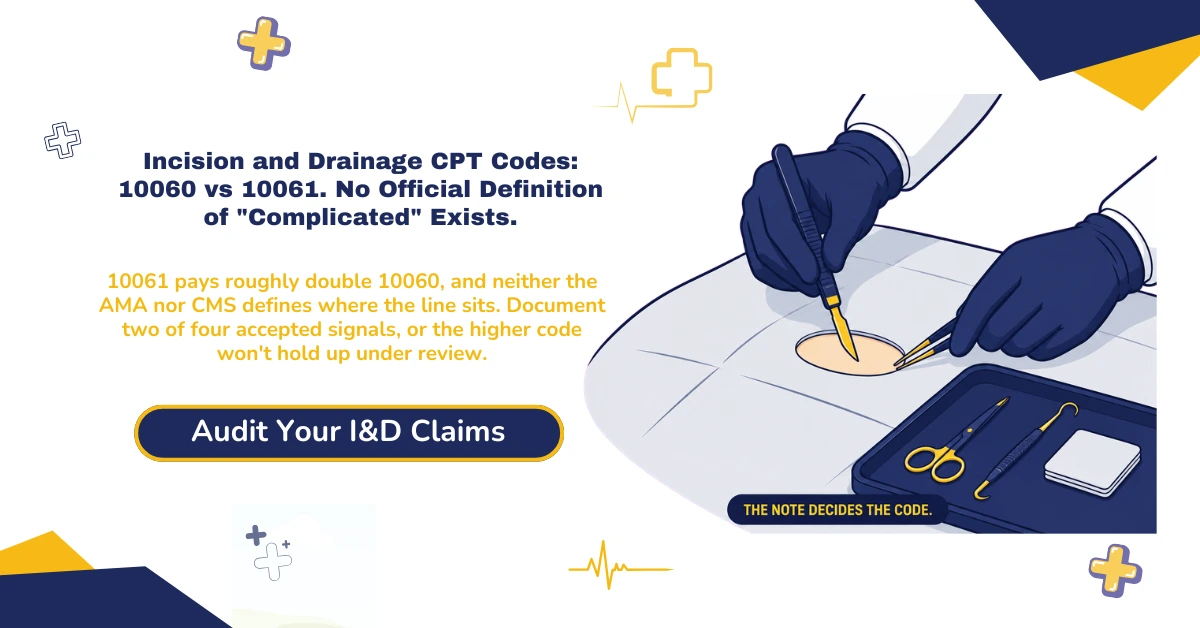
CPT 10060 reports incision and drainage of a simple or single abscess, and CPT 10061 reports the same procedure when it is complicated or involves multiple abscesses, with the technique described in the operative note deciding which applies.
The 10060 cpt code description reads simple or single. The 10061 cpt code description reads complicated or multiple. Most guidance compares the two on three axes, which isn’t enough to code from. Here are eight.
What is the difference between CPT 10060 and CPT 10061?
| Factor | CPT 10060 | CPT 10061 |
|---|---|---|
| Lesion count | Single | Multiple, or one requiring complex management |
| Incisions | One | Multiple, or one extended to reach the collection |
| Loculations | Minimal or none | Breakdown of loculations documented |
| Packing | Minimal or none | Significant packing described |
| Drain placement | Not typical | Common |
| Global period | 10 days | 10 days |
| 2026 work RVU | 1.19 | 2.39 |
| Audit exposure | Low | High when complexity isn’t documented |
Source note: Work RVUs from the CMS Physician Fee Schedule relative value file RVU26A, effective January 1, 2026. Both values reflect the 2.5% efficiency adjustment CMS finalized for non-time-based services in the CY2026 final rule.
That RVU gap is the whole reason auditors care. 10061 carries roughly double the work value of 10060, so a pattern of 10061 on notes that describe one lesion and one incision reads as upcoding whether or not anyone intended it.
Why no official definition of simple versus complicated exists
Neither the AMA nor CMS publishes a concrete definition of simple versus complicated in any publicly inspectable document, which means the distinction gets inferred from the operative narrative rather than measured against a published standard.
I went looking. Three documents came back empty, and naming them is what makes this checkable.
- CMS NCCI Policy Manual, Chapter III, revision date January 1, 2026: bundling rules for the I&D family, and no complexity definition.
- CMS Article A56766, revision effective April 1, 2026: documentation and utilization expectations for I&D of abscess, and no complexity definition.
- AMA CPT 2026 code set: one revision in the Integumentary System section, and it belongs to 10040.
So what do you code from? Accepted practice, which is a different thing from a published rule, and I want to be clear that’s what this is. Coders and payers converge on the same four signals: more than one lesion, more than one incision, probing or blunt breakdown of loculations, and placement of a drain or significant packing.
Document any two of those and 10061 holds up. Document none of them and it won’t, because there’s no published standard to appeal to.
Does packing make it 10061?
Packing alone does not make an incision and drainage complicated, but significant packing described alongside probing, loculation breakdown, or drain placement supports 10061.
The distinction billers miss: almost every I&D gets some packing. If packing by itself pushed a case to 10061, you would stop using the simple code. Payers know that. So the packing has to sit next to something else in the note.
A note that says “abscess drained, packed with iodoform gauze” is 10060. A note that says “cavity probed, multiple loculations broken down, packed with iodoform” is 10061. Same gauze. Different procedure.
The audit exposure on this code behaves the way it does on every minor procedure with a same-day E/M. If that pattern is familiar from arthrocentesis modifier rules, it’s the same trap wearing a different code number.
| If your 10061 claims keep getting downcoded and nobody can point to why, the pattern is usually in the operative note template, not in the coding. That’s fixable upstream. |
Sources: CMS Article A56766, Billing and Coding: Incision and Drainage of Abscess (external links open in a new tab, rel=”nofollow”)
Which incision and drainage CPT code applies at each anatomical site
Not every abscess bills under 10060, because CPT assigns site-specific codes to several anatomical locations, and using the general integumentary code where a site-specific code exists is a common cause of payer edits.
Find the site, then check whether CPT already gave that site its own code. If it did, the general incision and drainage cpt code is wrong, and the i&d of abscess cpt code you want sits somewhere else in the book.
Which CPT code applies to an abscess at each anatomical site?
| Anatomical Site | CPT Code | Notes |
|---|---|---|
| Skin and subcutaneous, general | 10060 or 10061 | Default when no site-specific code exists |
| Finger, subcutaneous pulp | 26010 or 26011 | 26011 for a felon or complicated drainage |
| Hand, tendon sheath | 26020 | Drainage of tendon sheath, not skin |
| Palmar bursa, single | 26025 | Single bursal space |
| Palmar bursa, multiple | 26030 | Multiple bursal spaces |
| Deep soft tissue abscess | 20000 or 20005 | Below the deep fascia, by depth |
| Perianal, superficial | 46050 | Superficial perianal abscess |
| Thrombosed external hemorrhoid | 46083 | Incision, not excision |
| Vulva or perineum | 56405 | Vulvar or perineal abscess |
| Bartholin gland | 56420 | Gland-specific, not 10060 |
| Scrotal wall | 55100 | Scrotal wall abscess |
| Mouth vestibule | 40800 | Drainage of vestibule of mouth |
| Dentoalveolar structures | 41800 | Medical claim, see the dental section |
| External ear | 69000 or 69005 | 69005 when complicated |
| Breast cyst | 19000 | Puncture aspiration of breast cyst |
| Subungual hematoma | 11740 | Evacuation, not I&D |
Source note: Codes 20000 and 20005 report drainage of deep soft tissue abscesses by depth and appear on almost no billing-company guidance for this family. Confirm depth documentation before using either one.
The cpt code for abscess incision and drainage at a perirectal, axillary, or gluteal site, and at the knee, ankle, foot, lower extremity, or upper extremity, all routes through this table. Most land on 10060 or 10061. The ones that don’t are the ones that cost you money.
Hand and finger incision and drainage codes
A finger abscess drained in the subcutaneous pulp reports CPT 26010 when simple and CPT 26011 when complicated, such as a felon, rather than the general integumentary codes.
Worked example: a patient presents with a throbbing, tense fingertip. The provider incises the pulp space, drains frank pus, and packs it. That’s 26011, and it pays more than 10060 because the digit anatomy carries more work.
Now the boundary rule, because it’s where hand claims break. A simple paronychia or a surface boil on the finger still reports 10060. The distinction is depth, not location. Drainage of the pulp space is 26010. Drainage of skin that happens to sit on a finger is not.
Documentation trigger: the note has to name the compartment. “Finger abscess drained” won’t carry 26010 through review, because it never says what was opened.
Sources: CMS Article A56766, foot and podiatry routing rules (external links open in a new tab, rel=”nofollow”)
Codes that get confused with 10060
Three codes get billed as 10060 by mistake more than any others: 10140 for non-purulent collections, 10160 for puncture aspiration, and 26010 for finger abscesses.
CPT 10140 versus 10060: purulent versus non-purulent
CPT 10140 reports incision and drainage of a hematoma, seroma, or other non-purulent fluid collection, and the fluid named in the operative note decides which code goes on the claim.
This one denies in both directions. Bill 10060 with a hematoma diagnosis and you get a medical necessity denial, because the covered diagnosis list for the abscess codes doesn’t include it. Bill 10140 for an abscess and the same thing happens in reverse.
The fix is a single line in the note. Name the fluid. Serous, sero-sanguinous, bloody, or frank pus. CMS asks for that word anyway, which I cover in the documentation section.
CPT 10160 versus 10060: aspiration is not incision
CPT 10160 reports puncture aspiration of an abscess, hematoma, bulla, or cyst performed with a needle, and needle aspiration alone does not qualify as an incision and drainage.
No blade, no 10060. That’s the whole test, and it’s the one line the 10060 cpt code description won’t give you.
Two additional rules attach to 10160, and both come from CMS rather than CPT. Per CMS Article A56766, when 10160 is the correct code for a foot paronychia, it shouldn’t be combined with 11750 or 11765 for the same condition and site.
The second rule comes from the NCCI Policy Manual, Chapter III. Reporting 10160 for administration of a local anesthetic before another procedure is a misuse of the code.
That second rule catches practices that bill an aspiration code for the numbing step. It reads as unbundling, and it’s the kind of pattern a probe review finds fast. If the aspiration-versus-incision line looks familiar from puncture aspiration versus incision, that’s because the same logic governs joint work.
CPT 10060 versus 26010, including the reimbursement gap
CPT 10060 and CPT 26010 both report abscess drainage, but 26010 is restricted to a finger and carries a higher relative value because of the digit anatomy involved.
Rate figures circulating for 10060 range from about $40 to about $122 depending on which page you land on, and most of them are undated. Some quote work RVUs as if they were total RVUs. Others carry a conversion factor from a prior year. The verifiable 2026 inputs sit below.
What are the 2026 Medicare payment inputs for CPT 10060 and CPT 26010?
| Input | Value | Source |
|---|---|---|
| 2026 work RVU, 10060 | 1.19 | CMS PFS relative value file RVU26A |
| 2026 work RVU, 10061 | 2.39 | CMS PFS relative value file RVU26A |
| 2026 conversion factor, non-QP | $33.4009 | CY2026 PFS final rule, CMS-1832-F |
| 2026 conversion factor, QP | $33.5675 | CY2026 PFS final rule, CMS-1832-F |
| Payment formula | Total RVU x GPCI adjustment x conversion factor | CMS RBRVS methodology |
| Global period, 10060 and 10061 | 010 | CMS PFS relative value file |
Source note: Total RVU combines work, practice expense, and malpractice components, and the practice expense value differs between facility and non-facility settings. CMS changed the facility practice expense methodology for CY2026, so carrying a 2025 total RVU forward produces a wrong number. Pull the current components for your locality from the CMS Physician Fee Schedule look-up tool before you publish a rate.
I’m not going to hand you a national dollar figure for these codes, and that’s deliberate. Any single number is wrong somewhere, because GPCI adjustment moves it by locality and the two conversion factors move it again by APM status. The formula above gives you the right answer for your own contract. A rounded average gives you a benchmarking error.
Sources: CMS Physician Fee Schedule look-up tool (external links open in a new tab, rel=”nofollow”)
What changed for incision and drainage billing in 2026
One descriptor revision took effect January 1, 2026 in the incision and drainage family, and neither of the abscess codes changed.
Four findings changed the incision and drainage cpt picture this year, each with the operational consequence attached.
First, CPT 10040. The AMA replaced acne surgery with extraction in the descriptor, effective January 1, 2026. Consequence: update note templates, because surgical terminology invites edits that expect operative prep documentation you never generated.
Second, a verified negative. CPT 2026 contains exactly one code revision in the Integumentary System section, and 10040 is it. Consequence: 10060, 10061, 10080, 10081, 10140, 10160, and 10180 carry the same descriptors they carried in 2025. If your fee schedule is failing on those codes, the problem is payment policy, not the code set.
Third, CMS Article A56766 moved. The revision effective April 1, 2026 changed the contractor from National Government Services to Wellpoint Federal, with no change to coverage. Consequence: the policy still governs, but the contractor name on your reference file is stale.
Fourth, NCCI edits refresh quarterly. Consequence: a code pair that cleared last quarter may not clear this one, so check the current quarterly file before you assume separate work means separate pay.
That second finding is the one worth keeping. Confirming what didn’t change takes as much work as confirming what did, and it’s the difference between a fee schedule you trust and one you hope about.
Sources: CMS NCCI Procedure-to-Procedure edits, quarterly postings (external links open in a new tab, rel=”nofollow”)
What Medicare pays for incision and drainage in 2026
Medicare pays for incision and drainage under the Physician Fee Schedule by multiplying total RVUs by the annual conversion factor, and the non-facility rate exceeds the facility rate because the practice absorbs supply and staff cost directly.
The cpt code for incision and drainage carries no special payment rule, so it moves with the fee schedule like everything else. CY2026 is the first year with two conversion factors, and that alone breaks a lot of fee schedules built from last year’s math.
What are the 2026 conversion factors and payment inputs for incision and drainage codes?
| Input | 2026 Value | What It Does to the Claim |
|---|---|---|
| Conversion factor, qualifying APM participants | $33.5675 | Applies to clinicians meeting QP thresholds in an advanced APM |
| Conversion factor, non-qualifying participants | $33.4009 | Applies to everyone else, including traditional MIPS |
| Prior year conversion factor | $32.3465 | CY2025, single factor |
| Work RVU efficiency adjustment | -2.5% | Applied to work RVUs for non-time-based services |
| Facility practice expense change | Indirect portion halved | Reduces facility PE RVUs relative to non-facility |
| Work RVU, 10060 | 1.19 | Post-adjustment value in RVU26A |
| Work RVU, 10061 | 2.39 | Post-adjustment value in RVU26A |
Source note: Source: CY2026 Medicare Physician Fee Schedule final rule (CMS-1832-F), effective January 1, 2026, and the CMS PFS relative value file RVU26A. Rates vary by GPCI locality. Pull your own locality values before benchmarking a contract.
Two clinicians in the same practice can bill the identical i&d cpt code and get paid different amounts in 2026. That’s new. If your contracted rate references the Medicare fee schedule, find out which conversion factor the contract points at.
The second table is the one almost nobody publishes, and it decides more denials than the rate does.
What are the CMS payment policy indicators for CPT 10060 and 10061?
| Indicator | What It Controls | Why It Matters on an I&D Claim |
|---|---|---|
| Global surgery indicator | Length of the postoperative package | 010 makes 10060 and 10061 minor procedures with a 10-day window |
| Multiple procedure indicator | Whether standard multiple surgery reduction applies | Drives the payment cut on the second and later procedures in a session |
| Bilateral surgery indicator | Whether modifier 50 triggers a 150% adjustment | Only an indicator of 1 pays the adjustment. 0, 2, and 3 do not |
| MUE value | Maximum units per code per patient per day | Caps how many units of one code you can bill at all |
| MUE adjudication indicator | Whether the cap can be exceeded | Determines if a modifier can ever open a second line |
| Assistant surgeon indicator | Whether an assistant is payable | Statutory restriction applies to most minor integumentary procedures |
| ASC payment indicator | Whether and how the code pays in an ASC | Changes the facility side of the claim, not the professional side |
Source note: Indicator values sit in the CMS Physician Fee Schedule relative value file and the quarterly MUE files, and CMS updates the MUE files four times a year. Look up the current value for each code before you build an edit rule around it.
Two of these rows drive entire sections below. The MUE value decides whether you can bill 10060 twice in a day. The bilateral indicator decides whether modifier 50 does anything at all.
Why place of service changes your payment
Billing the wrong place of service on an incision and drainage claim produces a silent underpayment rather than a denial, which is why it goes uncaught for months.
The mechanism is the practice expense RVU. When you bill a cpt code for incision and drainage from your own office, the practice bought the tray, the gauze, and the staff time, so CMS pays the non-facility rate. In a hospital outpatient department, the facility bills for those, so the professional claim pays the lower facility rate.
Put POS 22 on a claim for a procedure performed in your own office and Medicare pays you the facility rate. The claim doesn’t bounce. It pays. It just pays less, every time, on every line, until somebody notices. Recovering that gap is AR follow-up services work, and it starts with a POS audit rather than an appeal.
CMS also cut the indirect portion of facility practice expense RVUs for 2026, which widens the office-versus-facility gap on these codes compared with last year. A POS error that cost you a little in 2025 costs more now.
| Underpayments don’t bounce, so nobody works them. If your 10060 line has been paying at the facility rate from an office setting, that gap has been compounding quietly for as long as the POS code has been wrong. |
Why you cannot bill CPT 10060 twice on the same day
A Medically Unlikely Edit caps the units of CPT 10060 that Medicare will pay for one patient on one date of service, and no amount of documentation changes the cap on a line that exceeds it without the right adjudication indicator.
Billers get three different answers to this incision and drainage cpt question depending on which page they land on.
One site publishes a unit cap in a data table, then two scrolls later suggests splitting two abscesses onto separate lines with modifier 59. Another states flatly that multiple drainages in one encounter must be coded as a single complicated procedure. Most say nothing at all.
Start with what an MUE is. It’s a per-line unit cap CMS publishes to stop implausible billing, and every cpt code for i&d in this family carries one. The values live in a file CMS refreshes each quarter.
The MUE Adjudication Indicator decides whether the cap can be exceeded at all. Some MUEs are date-of-service edits, and no modifier opens a second line. Others are line edits where a second line with an appropriate modifier can be considered on appeal with records attached.
Now the boundary rule nobody states plainly. An MUE is not an NCCI bundling edit. NCCI governs which code pairs can go on the same claim. The MUE governs how many units of a single code you can bill at all. Modifier 59 answers the first question. It has no effect on the second.
That confusion is why billers keep applying modifier 59 to a problem modifier 59 was never built to solve.
What decides whether a second unit of an incision and drainage code can be billed?
| Element | Where It Lives | What It Means on the Claim |
|---|---|---|
| MUE value | Quarterly CMS MUE file | The maximum units payable for that code, per patient, per day |
| MUE Adjudication Indicator 1 | Same file | Line edit. A second line may be considered with an appropriate modifier |
| MUE Adjudication Indicator 2 | Same file | Date-of-service edit based on policy. Units above the cap are not payable |
| MUE Adjudication Indicator 3 | Same file | Date-of-service edit based on clinical benchmarks. Appealable with records |
| NCCI PTP edit | Quarterly PTP file | A separate question entirely. Governs code pairs, not unit counts |
Source note: CMS updates the MUE and PTP files on a quarterly cycle. Per the CMS NCCI Policy Manual, Chapter III, MUE values are set so that reporting a code across multiple lines with modifiers to bypass the edit should be uncommon, and doing it routinely signals that units of service are being coded incorrectly.
For two distinct abscesses drained in one session, the CPT structure already anticipated you. The descriptor for 10061 reads complicated or multiple. That word multiple is doing the work. Reaching for two units of 10060 is usually the wrong instinct, and 10061 on a single line is usually the right one.
When the cap gets exceeded, the remittance tells you. The line comes back with a frequency or units reason code, not a medical necessity code, and that distinction changes whether you correct the claim or appeal it.
The 10-day global period on incision and drainage claims
CPT 10060 and 10061 carry a 010 global surgery indicator, which is a 10-day minor surgical global period, and routine postoperative care at the same site during that window is bundled into the original procedure payment.
The 10060 global period runs 10 days from the date of the procedure. Per the CMS NCCI Policy Manual, Chapter III, a procedure with a global period of 000 or 010 days is a minor surgical procedure by definition, and that definition carries consequences most practices discover on a remittance.
What the global package includes
Removal of packing is included in the global surgical package, along with removal of drains, sutures, and staples, dressing changes, and local incision care.
Read that against your own workflow, because the global days for cpt 10060 cover exactly this. Every I&D gets packed. Every pack comes out at a follow-up visit two or three days later. That visit sits inside the 10 days, at the same site, related to the procedure. It’s bundled.
Practices bill it anyway, and the E/M denies as included in another service. The staff then work it as a denial, resubmit it, and it denies again, because the claim was correct the first time and the rule is the problem.
CMS also folds treatment of complications into the package when they don’t require a return to the operating room. A wound check that finds mild cellulitis and adds an oral antibiotic stays inside the global period.
Which modifier applies inside the global period
The modifier that opens a claim inside the global window depends on whether the service was related to the drainage, who performed it, and whether it required a return to the procedure room.
Which modifier applies to services inside the 10-day global period?
| Situation | Modifier | Applied To |
|---|---|---|
| E/M unrelated to the drainage during the postoperative period | 24 | The E/M code |
| Repeat drainage at the same site by the same provider | 76 | The procedure code |
| Repeat drainage at the same site by a different provider | 77 | The procedure code |
| Staged or more extensive related procedure | 58 | The procedure code |
| Related procedure requiring return to the procedure room | 78 | The procedure code |
| Unrelated procedure during the postoperative period | 79 | The procedure code |
Source note: Modifier 24 attaches to the E/M code. The remaining five attach to the procedure code. Reversing that is a common cause of modifier inconsistency denials.
Modifier 76 is the row most guidance leaves out, and inside the 10060 global period it’s the one you’ll use most. An abscess cavity that re-accumulates and needs draining again on day 4 is a repeat procedure by the same provider. That’s 76, not 24 and not 79.
Modifier 24 has its own trap: it belongs on an E/M that has nothing to do with the abscess. A patient who comes back for the wound and also gets a hypertension recheck needs the E/M to stand on its own. The documentation standard is the same one that governs CPT 99213 documentation on any other same-day pairing.
Documenting a repeat drainage inside the window
A repeat incision and drainage cpt line inside the global period is separately payable only when the note establishes what changed since the first procedure, rather than recording that a second drainage occurred.
Three elements carry it. What changed clinically since the index procedure, stated in findings rather than conclusions. Why the repeat was medically necessary instead of routine postoperative care. And the technique and findings of the second procedure, described on their own terms.
Sample language that works: “Wound re-examined on postoperative day 4. Cavity had re-accumulated approximately 6 ml of purulent material with a new area of fluctuance at the inferior margin. Cavity reopened, irrigated, and repacked.” That note earns modifier 76. “Packing changed, wound healing well” does not.
Modifiers for incision and drainage claims
CPT 10060 does not carry a modifier on its own, and the modifier that makes the claim pay usually attaches to the other service on the claim rather than to the drainage code.
That inversion generates more CO-97 denials on cpt code 10060 than any other single error. Billers reach for the procedure line because the procedure is what they’re thinking about.
Which modifier applies when incision and drainage is billed with another service?
| Paired Service | Modifier | Applied To | Note |
|---|---|---|---|
| Same-day office E/M, 99202 to 99215 | 25 | The E/M code | Must be significant and separately identifiable |
| Distinct procedure, separate site, same date | 59 or XS | The lower-valued code | XS is preferred for a separate structure |
| Multiple procedures in one session | 51 | Secondary procedures | Many payers apply the reduction on their own |
| Bilateral abscesses | 50 | The procedure code | One unit, one line, for practitioner claims |
| Repeat drainage inside the global period | 76 | The procedure code | Same provider, same site |
| Incision and drainage billed alone | None | Not applicable | No modifier is required |
Modifier 50 and what the bilateral indicator controls
The bilateral payment adjustment applies only to codes carrying a bilateral surgery indicator of 1, and appending modifier 50 to a code with an indicator of 0, 2, or 3 will not increase the allowed amount.
Guidance circulating for this code family states that modifier 50 pays 150% on 10060. That claim is conditional on an indicator value, and it gets published without the condition.
Check the indicator in the CMS Physician Fee Schedule relative value file before you build a rule around it. An indicator of 1 pays the adjustment. An indicator of 0 means the adjustment doesn’t apply, so you bill it, get paid 100%, and never see a denial, because an underpayment doesn’t generate one.
The reporting format matters separately from the payment question. Per the CMS Claims Processing Manual, practitioners and outpatient hospitals report a bilateral surgical procedure with modifier 50 and one unit on a single claim line. An ambulatory surgery center reports two lines instead, one with LT and one with RT.
Two lines from a physician office where CMS expects one is a coding error, and it denies rather than underpays.
When modifier 25 holds up on an I&D claim
Modifier 25 belongs on the E/M code and not on the incision and drainage code, and it holds only when the evaluation addressed something beyond the decision to drain.
Per the CMS NCCI Policy Manual, Chapter III, the decision to perform a minor surgical procedure is included in the payment for that procedure. The same chapter adds a detail most billers get backwards: the E/M and the minor procedure do not require different diagnoses. A shared diagnosis doesn’t disqualify the E/M. Absent separate work does.
Use the cross-out test. Strike every line in the note that relates to the drainage. What survives must support the E/M level on its own. If nothing survives, don’t bill the E/M.
Chapter III closes one more door. A new patient status alone doesn’t justify a same-day E/M with a minor procedure, so “new patient” isn’t a modifier 25 rationale.
Two failure patterns account for most of the damage. Modifier 25 placed on 10060 instead of the E/M bundles the E/M and pays you for the procedure alone. Modifier 25 on both lines gets the claim rejected outright. The same two errors drive the CO-97 bundling denial pattern on low-level E/M codes.
NCCI bundling rules that stop incision and drainage from paying separately
Per the CMS NCCI Policy Manual, Chapter III, revision date January 1, 2026, an incision and drainage performed as part of another procedure, or performed to gain access to an area for another procedure, is not separately reportable at the same patient encounter.
Four rules sit in that chapter, and they govern every cpt code for i&d in the 10040 to 10180 range. Zero billing-company pages I can find state all four.
Rule 1, access and component drainage. If you incised or drained a lesion as part of another procedure, or to reach something else, the drainage doesn’t bill separately at that encounter. An operative note that describes drainage as a step inside a larger procedure will not support a separate line, because the note itself is the evidence against it.
Rule 2, the pilonidal example CMS gives. A surgeon excising pilonidal cysts or sinuses with 11770 through 11772 may incise and drain one or more of the cysts along the way. Reporting 10080 or 10081 separately for that drainage is inappropriate. CMS wrote this example itself, which makes it the cleanest citation in the family.
Rule 3, same anatomic site, same encounter. Incision and drainage codes shall not be reported separately with excision, repair, destruction, or removal procedures performed at the same anatomic site at the same patient encounter. Different site, same day, is a different question and can be reportable.
Rule 4, CPT 10180 and the originating procedure. Drainage of a postoperative wound infection would never be reportable at the same encounter as the procedure that caused the infection. It can be separately reportable at a subsequent encounter, and it can be reportable alongside an unrelated procedure at a different anatomic site.
Which NCCI Chapter III rule blocks an incision and drainage line?
| Rule | What It Blocks | When It Can Still Be Reported |
|---|---|---|
| Access or component drainage | Drainage performed as part of, or to reach, another procedure at the same encounter | Not at that encounter. The drainage is part of the larger procedure |
| Pilonidal excision | 10080 or 10081 alongside 11770 through 11772 for the same cysts | Not at that encounter. CMS gives this as its own worked example |
| Same anatomic site | I&D reported with excision, repair, destruction, or removal at the same site, same encounter | A different anatomic site on the same date can be separately reportable |
| 10180 and the originating procedure | 10180 at the same encounter as the procedure that caused the infection | A subsequent encounter, or an unrelated anatomic site, depending on circumstances |
Source note: Source: CMS NCCI Policy Manual, Chapter III, Section D, revision date January 1, 2026. Rule statements are paraphrased.
Why a modifier does not always fix it
An NCCI edit pair denies the Column Two code unless a clinically appropriate NCCI-associated modifier applies, and some bundling restrictions can’t be overridden by any modifier.
The Correct Coding Modifier Indicator on the pair tells you which situation you’re in. An indicator of 0 means no modifier will open the pair. An indicator of 1 means a modifier may, when the clinical facts support it.
Edits change quarterly, so a pair that cleared in the last quarter may not clear in this one. Pull the current file rather than trusting a screenshot from a prior quarter. The same quarterly discipline that governs NCCI bundling decisions on endoscopy claims applies here without modification.
The documentation CMS requires for incision and drainage
CMS Article A56766 sets specific documentation expectations for any cpt code for incision and drainage of abscess, including the pre-operative size, location, and appearance of the lesion, and the approximate quantity and quality of the material drained.
That last requirement is the one incision and drainage cpt claims fail on, and it isn’t vague. CMS names the units it wants for quantity, and it names the words it wants for quality: serous, sero-sanguinous, bloody, exudative, frank pus, or malodorous. Your note needs a number and one of those words.
What does Medicare require in an incision and drainage operative note?
| Element | What to Record | Why It Matters |
|---|---|---|
| Medical necessity | The signs and symptoms that required drainage | Establishes coverage under the LCD |
| Pre-operative findings | Size, location, and appearance of the lesion | Named A56766 requirement |
| Technique | Equipment used, incision versus puncture, probing, irrigation | Drives 10060 versus 10061 versus 10160 |
| Drainage character | Approximate quantity and quality of material drained | Named A56766 requirement, and the one most often missing |
| Wound management | Packing, drain placement, wound left open | Supports the complexity claim on 10061 |
| Recurrence rationale | Why the infection persisted and what is being done | Required when the same site is drained more than once |
| Aftercare | Follow-up plan and return precautions | Most of these items sit inside the global package |
A56766 adds one more line worth knowing about. The contractor keeps the right to require photographic documentation of lesions before or after treatment from providers who show a pattern of abuse on these codes, with individual notice first.
| Most practices don’t have a documentation problem across the board. They have one missing field in one template. If your I&D notes never record how much was drained, that’s a five-minute EHR fix, not a training program, and it’s the same discipline behind every clean claim submission workflow. |
The utilization thresholds CMS publishes
CMS states in A56766 that a single drainage procedure is often curative, that it would be unusual for any individual lesion or collection to require more than two such services, and that drainage more than twice per year in the same location is uncommon.
Services exceeding that parameter get treated as not medically necessary. Claims carrying a hidradenitis suppurativa diagnosis, L73.2, are excluded from the parameter, though the record still has to explain why more definitive therapy isn’t appropriate.
A numeric threshold from CMS is rare in this family. Two per lesion, two per year per location. Build the alert into your practice management system rather than discovering it on a probe review.
When incision and drainage is not the right code at all
CMS states that billing incision and drainage codes for paronychia of the foot is not appropriate when avulsion or resection of the toenail was performed to treat the same condition.
The routing is explicit. Paronychia sufficiently treated with nail avulsion alone bills 11730. Permanent correction of a recurring ingrown toenail by nail resection or wedge excision of the nail lip bills 11750 or 11765. Neither one is an incision and drainage.
When 10060, 10061, or 10160 is correct for that presentation, A56766 says not to combine it with 11750 or 11765 for the same condition.
For podiatry claims under specialty 48, the article goes further and names the payable diagnoses. CPT 10060, 10061, and 10160 are payable for L02.611, L02.612, and L98.8 only. Claims carrying furuncle, carbuncle, or suppurative hidradenitis diagnoses on the foot are subject to review, because those conditions are uncommon there.
Anesthesia is not separately billable
Anesthesia administered by, or incident to, the physician performing the incision and drainage is included in the payment for the procedure and is not separately payable.
The NCCI Policy Manual reaches the same conclusion from the other direction. Local infiltration, regional blocks, and mild sedation aren’t separately reportable by the physician performing the procedure, and payment for a surgical procedure already covers dressings, supplies, and local anesthesia.
ICD-10 codes that pair with incision and drainage
Every incision and drainage icd 10 pairing has to match the documented condition and site, and the covered diagnosis list in CMS Article A56766 is organized by anatomic region rather than alphabetically.
Which ICD-10 codes pair with incision and drainage of an abscess?
| Condition and Site | ICD-10-CM | Pairs With |
|---|---|---|
| Cutaneous abscess of face | L02.01 | 10060 or 10061 |
| Cutaneous abscess of neck | L02.11 | 10060 or 10061 |
| Cutaneous abscess of abdominal wall | L02.211 | 10060 or 10061 |
| Cutaneous abscess of back | L02.212 | 10060 or 10061 |
| Cutaneous abscess of chest wall | L02.213 | 10060 or 10061 |
| Cutaneous abscess of groin | L02.214 | 10060 or 10061 |
| Cutaneous abscess of perineum | L02.215 | 10060 or 10061 |
| Cutaneous abscess of buttock | L02.31 | 10060 or 10061 |
| Cutaneous abscess of right or left axilla | L02.411, L02.412 | 10060 or 10061 |
| Cutaneous abscess of right or left upper limb | L02.413, L02.414 | 10060 or 10061 |
| Cutaneous abscess of right or left lower limb | L02.415, L02.416 | 10060 or 10061 |
| Cutaneous abscess of right or left hand | L02.511, L02.512 | 10060, 10061, or 26010 |
| Cutaneous abscess of right or left foot | L02.611, L02.612 | 10060, 10061, or 10160 |
| Hidradenitis suppurativa | L73.2 | 10060 or 10061, exempt from the utilization cap |
| Pilonidal cyst or sinus with abscess | L05.01, L05.02 | 10080 or 10081 |
| Abscess of the breast and nipple | N61.1 | 19000 or site-specific code |
| Postprocedural hematoma or seroma | L76.31 to L76.34 | 10140 |
| Infection following a procedure, superficial incisional | T81.41XA | 10180 |
Source note: Codes drawn from the Group 1 covered list in CMS Article A56766, revision effective April 1, 2026. Correct use of a listed code does not by itself assure coverage. The service still has to be reasonable and necessary in the individual case.
Why the unspecified code costs you
L02.91 reports a cutaneous abscess of unspecified site, and it does not appear anywhere on the Group 1 covered diagnosis list in CMS Article A56766.
I checked the whole incision and drainage icd 10 list. Face, neck, abdominal wall, back, chest wall, groin, perineum, umbilicus, flank, buttock, both axillae, both limbs, both hands, both feet, head, and other sites are all there. The unspecified code is not.
So when the operative note names the location and the coder picks L02.91 anyway, the claim carries a diagnosis the policy doesn’t cover. That denies as not medically necessary, and the appeal is embarrassing, because the correct code was sitting in the note the whole time.
The reverse error costs just as much. Forcing an abscess diagnosis onto a note describing a cyst without infection triggers denials too, because coverage is tied to a documented purulent collection. Diagnosis specificity drives payment across the wound care ICD-10 families the same way.
The ICD-9 question
ICD-9 was retired for United States claims on October 1, 2015, so an incision and drainage claim submitted today uses ICD-10-CM.
This still gets asked because guidance from 2005 continues to rank for it. If a page tells you to select an ICD-9 code for 10180, the rest of that page is 20 years old too.
Why incision and drainage claims get denied and how to fix them
Denials on the cpt code for incision and drainage of abscess cluster around five failures, and each one carries a recognizable reason code on the remittance.
What do the common denial codes on an incision and drainage claim mean?
| Reason Code | What It Means | Usual Cause on an I&D Claim | Corrective Action |
|---|---|---|---|
| CO-97 | Service is included in another payment | Modifier 25 missing from the same-day E/M, or NCCI same-site bundling | Verify modifier placement, submit a corrected claim |
| CO-4 | Modifier missing or inconsistent with the procedure | Modifier 25 placed on 10060 instead of the E/M | Correct per the modifier matrix and resubmit |
| CO-50 | Not deemed medically necessary | Diagnosis outside the covered list, or L02.91 used when the site was documented | Recode to the site-specific L02 code |
| CO-16 | Claim lacks information needed for adjudication | Drainage quantity and quality absent from the operative note | Amend documentation and resubmit |
| CO-151 | Payer deems the information does not support this many services | Unit cap exceeded, or the A56766 utilization threshold questioned | Verify units, appeal with records when the frequency is supported |
| One CO-97 on an I&D claim is a coding slip. The same CO-97 firing across four providers in the same month is a workflow problem, and no volume of individual appeals stops it from repeating next month. That pattern is what our denial management services team traces back to the template that caused it. |
The five errors behind most incision and drainage denials
Five errors account for the bulk of the denied dollars on incision and drainage cpt claims, and they show up in roughly this order of frequency.
Modifier 25 on the wrong line. The most common failure and the least visible, because the denial reads like a documentation problem when the documentation was fine.
Complexity billed without complexity documented. Cpt code 10061 on a note that describes one lesion, one incision, and a strip of gauze.
Diagnosis mismatch. The unspecified L02.91, or an abscess diagnosis on a note describing a non-infected cyst.
Missing drainage description. The A56766 quantity-and-quality requirement, absent from a template nobody has updated since the EHR went live.
Bundling. The drainage was a component of a larger procedure at the same site and went out on its own line anyway.
Corrected claim or appeal
Submit a corrected claim when the documentation supports the service and the claim was built wrong, and file an appeal when the payer applied a rule incorrectly to a claim that was built right.
Corrected-claim territory: modifier placement, diagnosis selection, unit counts, and place of service. Nothing about the encounter changes. The claim form was wrong.
Appeal territory: frequency limits applied to a case the record supports, and medical necessity denials where the note carries the coverage criteria. Attach the operative note with the quantity and quality language highlighted.
Watch the filing clock on both. These are low-dollar lines, so they sit at the bottom of every work queue and age out of the appeal window while higher-balance claims get worked first. Root-cause denial recovery exists because the aging pattern is predictable and the write-off is avoidable.
Incision and drainage versus debridement
Incision and drainage codes apply when the intent was to release and drain a fluid collection, and debridement codes apply when the intent was to excise devitalized tissue to a specific tissue depth.
Draining an abscess is not debridement, and necrotic tissue in the cavity does not convert it into one. When an abscess drains incidentally during excision of nonviable tissue, the debridement governs the coding. The note has to state the intent without ambiguity, because the two families pay differently and reviewers read for intent before they read for technique.
The depth rule, the surface-area aggregation math, and the same-wound conflict between the 97597 family and the 11042 family all live on our wound care CPT codes guide.
ADA dental codes for incision and drainage
The ADA code for incision and drainage is a CDT code rather than a CPT code, with D7510 covering intraoral drainage of a soft tissue abscess and D7520 covering extraoral drainage.
Which incise and drain dental code replaces the CPT incision and drainage codes?
| Setting | Code | Description |
|---|---|---|
| Intraoral soft tissue abscess | D7510 | Drainage through an intraoral incision |
| Intraoral, complicated or multiple spaces | D7511 | Multiple fascial spaces involved |
| Extraoral soft tissue abscess | D7520 | Drainage through an extraoral incision |
| Extraoral, complicated or multiple spaces | D7521 | Multiple fascial spaces involved |
| Vestibule of mouth, medical claim | 40800 | CPT, drainage of an abscess of the vestibule |
| Dentoalveolar structures, medical claim | 41800 | CPT, drainage from dentoalveolar structures |
Source note: CDT code descriptions are paraphrased. Current Dental Terminology is copyright the American Dental Association. Confirm current CDT descriptors against the current code set before submission.
When a dental abscess bills medical
A dental abscess drained by a physician in an office or emergency department may bill under CPT rather than CDT, and the deciding factor is the provider type and the plan being billed, not the tooth.
The boundary is clean. An ada code incision and drainage claim goes to the dental plan. A CPT claim goes to the medical plan. Send a CDT code to a medical payer, or the reverse, and you usually get a clearinghouse rejection rather than a payer denial.
That distinction matters more than it sounds. A rejection never reaches the payer, so it never generates a remittance, and it never lands in a denial queue.
Practices that bill both plans usually find out when a batch of claims has sat unpaid for ninety days with nothing to work. Sorting the plan routing is the first thing our dental billing services team fixes on a combined-plan practice.
Change log for incision and drainage CPT codes
Seven dated changes affect incision and drainage coding, and each entry below comes from a document you can open and check. An undated last-reviewed stamp is not a change record.
What has changed for incision and drainage coding?
| Date | Change |
|---|---|
| October 1, 2015 | ICD-9 retired for United States claims. All I&D claims use ICD-10-CM. |
| January 1, 2024 | Short or long descriptions revised for 10060, 10061, 10080, 10081, 10140, 10160, and 10180 in the annual CPT update, per revision R3 of CMS Article A56766. |
| October 1, 2025 | ICD-10-CM annual update. A56766 revision R5 deleted S30.1XXA, S30.1XXD, and S30.1XXS and added S30.11X, S30.12X, S30.13X, L02.217, L02.227, L03.31A, and L03.32A. |
| January 1, 2026 | CPT 10040 descriptor revised. Acne surgery replaced with extraction. The only revision in the Integumentary System section of CPT 2026. |
| January 1, 2026 | CMS NCCI Policy Manual revision effective, including Chapter III on the integumentary system. |
| January 1, 2026 | CY2026 Physician Fee Schedule effective. Two conversion factors for the first time, at $33.5675 and $33.4009, plus a 2.5% efficiency adjustment to work RVUs. |
| April 1, 2026 | CMS Article A56766 revision R6. Contractor changed from National Government Services to Wellpoint Federal, with no change to coverage. |
Source note: Dated, finalized changes only. Proposed rules are excluded until CMS finalizes them. NCCI procedure-to-procedure and MUE files update quarterly and are not itemized here.
Frequently asked questions about incision and drainage CPT codes
Thirteen questions cover the incision and drainage cpt decisions billers hit most.
What are the CPT codes for incision and drainage?
The cpt code for incision and drainage runs from 10040 to 10180. CPT 10060 and 10061 cover cutaneous and subcutaneous abscesses, simple and complicated. CPT 10080 and 10081 cover pilonidal cysts. CPT 10140 covers non-purulent collections such as hematomas and seromas. CPT 10160 covers puncture aspiration, and 10180 covers postoperative wound infections. CPT 10040 covers extraction of multiple small skin lesions. Site-specific codes exist outside this range for the finger, hand, perianal area, and several other locations.
What is the difference between CPT codes 10060 and 10061?
CPT 10060 reports a simple or single abscess drainage, and cpt code 10061 reports drainage that is complicated or involves multiple abscesses. The operative note decides which applies. Multiple lesions, multiple incisions, probing, breakdown of loculations, significant packing, or drain placement support 10061. The 2026 work RVUs are 1.19 and 2.39, so the gap is roughly double. Neither the AMA nor CMS publishes a concrete definition of simple versus complicated, which is why the note carries the whole decision.
What is the CPT code for hand incision and drainage?
A finger abscess drained in the subcutaneous pulp reports CPT 26010 when simple and CPT 26011 when complicated, such as a felon. Drainage of a hand tendon sheath reports 26020. A single palmar bursa reports 26025 and multiple palmar bursae report 26030. Depth decides the code, not location. A simple paronychia or a surface boil that happens to sit on a finger still reports 10060, because nothing below the skin was opened.
What is the difference between 10060 and 26010?
Both report abscess drainage, and 26010 is restricted to the subcutaneous pulp of a finger. CPT 26010 carries a higher relative value because digit anatomy adds work. The 2026 work RVU for 10060 is 1.19 under the CMS relative value file RVU26A. Calculate payment for either code by multiplying total RVUs by your locality adjustment and the applicable 2026 conversion factor, which is $33.4009 for non-qualifying participants and $33.5675 for qualifying APM participants.
What is the difference between 10060 and 10140?
The fluid decides it. The cpt code for incision and drainage of abscess is 10060 or 10061, and both require a purulent collection, meaning pus. CPT 10140 covers a hematoma, seroma, or other non-purulent fluid collection. Billing 10060 with a hematoma diagnosis produces a medical necessity denial, and billing 10140 for an abscess produces the same result in reverse. The operative note has to name the material drained, which CMS requires anyway under Article A56766 as part of the quantity and quality documentation.
What is the definition of CPT code 10180?
CPT 10180 reports complex incision and drainage of a postoperative wound infection. Per the CMS NCCI Policy Manual, Chapter III, revision date January 1, 2026, it would never be reportable at the same patient encounter as the procedure that caused the infection. It can be separately reportable at a subsequent encounter depending on circumstances. When performed to gain access to an anatomic region for another procedure, it is not separately reportable. At an unrelated anatomic site, it can be reported alongside the other procedure.
What is the global period for CPT 10060?
CPT 10060 carries a 010 global surgery indicator, which is a 10-day minor surgical global period. Per the CMS NCCI Policy Manual, Chapter III, a global period of 000 or 010 days defines a minor surgical procedure. Removal of packing and drains, dressing changes, local incision care, and follow-up visits related to recovery all sit inside the package. Treatment of complications that does not require a return to the operating room is included as well.
Can you bill CPT 10060 twice on the same day?
A Medically Unlikely Edit caps units of 10060 per patient per date of service, and the MUE Adjudication Indicator decides whether that cap can ever be exceeded. Check the current quarterly MUE file, because CMS updates it four times a year. For two abscesses drained in one session, the CPT structure already answers the question: the 10061 descriptor reads complicated or multiple. An MUE is not an NCCI bundling edit, so modifier 59 does not solve a unit-cap problem.
Does CPT 10060 need a modifier?
Billed alone, cpt code 10060 needs no modifier. The modifier usually attaches to the other service on the claim. Modifier 25 goes on a same-day E/M, never on the drainage code. Modifier 59 or XS goes on the lower-valued code when a distinct procedure was performed at a separate site. Modifier 76 goes on the procedure code for a repeat drainage inside the global period by the same provider. Placing modifier 25 on 10060 bundles the E/M.
Does CPT 10160 need a modifier?
CPT 10160 follows the same logic as 10060. No modifier is required when it is billed alone. Modifier 25 belongs on a same-day E/M when the evaluation was significant and separately identifiable. Per CMS Article A56766, when 10160 is used for a foot paronychia it should not be combined with 11750 or 11765 for the same condition and site. Reporting 10160 for administration of a local anesthetic before another procedure is a misuse of the code under the NCCI Policy Manual.
What type of diagnosis is covered by CPT code 10060?
CMS Article A56766 publishes a Group 1 covered diagnosis list built mainly on the L02 cutaneous abscess, furuncle, and carbuncle series, organized by anatomic site. It also carries cellulitis codes in the L03 series, pilonidal codes L05.01 and L05.02, hidradenitis suppurativa L73.2, and postprocedural hematoma and seroma codes in the L76 series. The unspecified code L02.91 does not appear anywhere on that list. For podiatry claims under specialty 48, CPT 10060, 10061, and 10160 are payable for L02.611, L02.612, and L98.8 only.
What is the ICD-9 code for an incision and drainage procedure?
There is no current ICD-9 code to report, because ICD-9 was retired for United States claims on October 1, 2015. Every incision and drainage claim submitted today carries an ICD-10-CM diagnosis. The question persists because guidance published in 2005 still ranks for it. Match the ICD-10-CM code to the documented site and condition, and use the site-specific L02 code rather than the unspecified L02.91 whenever the operative note names the location.
What is the dental code for incision and drainage?
The incise and drain dental code set is CDT rather than CPT. D7510 covers intraoral drainage of a soft tissue abscess and D7511 covers the intraoral procedure when multiple fascial spaces are involved. D7520 and D7521 cover the extraoral equivalents. CDT codes go to dental plans and CPT codes go to medical plans. When a physician drains a dental abscess in an office or emergency department, 40800 and 41800 are the CPT options for the medical claim.
Getting paid for the drainage you already perform
Three things decide payment on an incision and drainage cpt claim, and none of them happen on the claim form.
The incision and drainage cpt note has to name the site, the technique, and the character of what came out. The modifier goes on the other service, not on the drainage code. And the 10-day global window swallows the follow-up visit that nobody expects it to, which is the packing removal every one of these procedures generates.
Get those three right and the denials stop being a monthly event.
| The fix almost always starts at the operative note, not the claim form. If the same reason code keeps landing across your providers, our I&D denial recovery team maps it back to the workflow that produced it, and our outsourced medical billing team works both sides for practices in all 50 states. ClaimMax RCM is headquartered in California and serves practices nationwide. |
CPT codes, descriptors, and other data are copyright the American Medical Association. Current Dental Terminology is copyright the American Dental Association. Regulatory data reflects the CY2026 Medicare Physician Fee Schedule final rule (CMS-1832-F), the CMS NCCI Policy Manual Chapter III (revision date January 1, 2026), and CMS Article A56766 (revision effective April 1, 2026). NCCI procedure-to-procedure and MUE files update quarterly. Verify all codes, indicator values, and rates against current CMS, MAC, and payer sources before claim submission.