
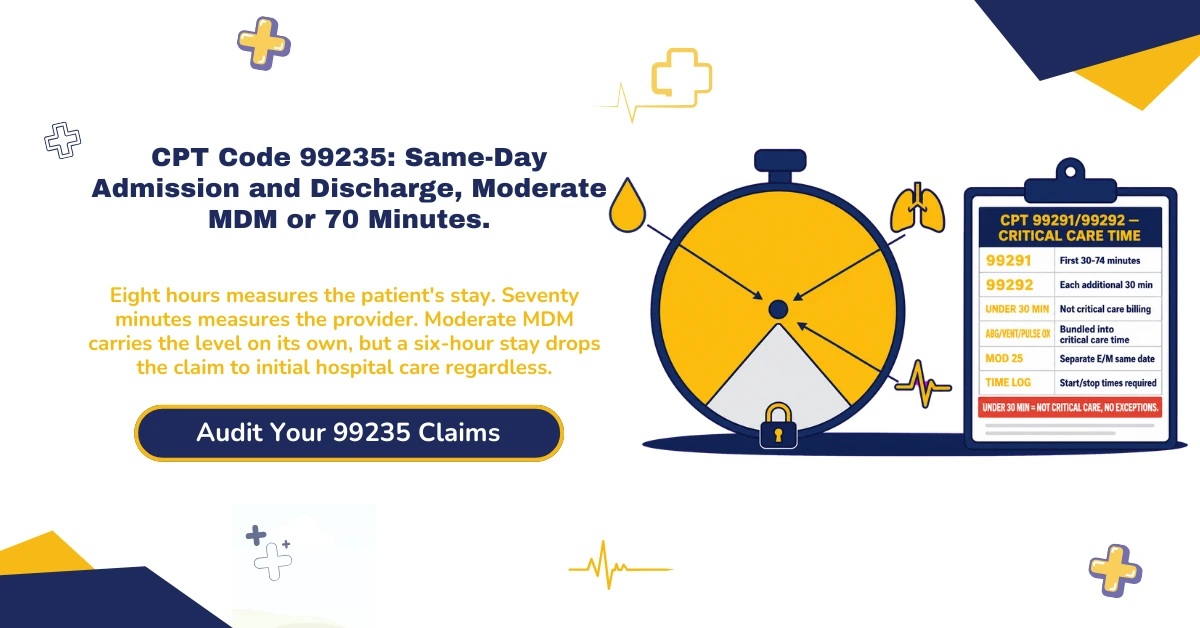
The 99235 CPT code reports hospital inpatient or observation care that includes admission and discharge on the same calendar date. It’s a same-day admission and discharge service covering both ends of the stay. Moderate medical decision making supports the level, or at least 70 minutes of qualifying provider time. The patient’s length of stay is a separate requirement.
Two clocks run at once here, and mixing them up causes most of the errors on these claims. One measures how long the patient stayed under hospital status. The other measures how long the physician or qualified healthcare professional (QHP) worked that day. They answer different billing questions.
A clinically sound encounter can still land on the wrong claim. CPT 99235 breaks down when the stay runs short of the duration requirement, when admission and discharge fall on separate calendar dates, when documented decision making sits below moderate, or when time gets claimed without support.
This guide covers what the 99235 CPT code includes, how the eight-hour rule differs from the 70-minute threshold, and how moderate MDM supports the level alone. It also covers the rest of the same-day admission and discharge family, documentation, place of service, 2026 payment, and why payers downcode CPT code 99235.
CPT 99235 Quick Facts for 2026
The table below separates the facts that get confused most often: the service category, the date requirement, the moderate MDM requirement, the provider-time threshold, the patient-duration threshold, the work included, and the codes sitting on either side.
| Field | CPT 99235 requirement |
| Service category | Hospital inpatient or observation evaluation and management (E/M) |
| Date requirement | Admission and discharge on the same calendar date |
| Included services | Initial admission work and discharge work |
| MDM level | Moderate |
| Time threshold | At least 70 minutes when selected by time |
| Patient-duration rule | Generally at least 8 hours under current short-stay guidance |
| History and exam | Medically appropriate |
| Level selection | MDM or total time |
| Lower same-day level | CPT 99234 |
| Higher same-day level | CPT 99236 |
| Under 8 hours | Evaluate the appropriate initial hospital care code |
| Different discharge date | Initial service, plus a discharge service when the stay reaches 8 hours |
HTML note: <table aria-label=”CPT 99235 quick facts for 2026″>
That structure exists because the AMA folded the standalone observation codes into the hospital inpatient and observation family in 2023. The 99235 CPT code description didn’t change in that overhaul, but the codes around it did. See the AMA E/M revisions page for the current framework.
| Do Not Confuse These RequirementsEight hours measures the patient’s stay. Seventy minutes measures qualifying physician or QHP time, and only when code selection runs on time instead of MDM. |
Anyone searching the 99235 code description usually wants those two numbers side by side, and Section 4 puts them there. First, though, it helps to be precise about what CPT 99235 actually represents inside the E/M family, because a good share of the coding errors on these claims start with a definition problem rather than a math problem.
What Is CPT Code 99235?
CPT 99235 is a professional E/M code for qualifying hospital inpatient or observation care where admission and discharge happen on the same calendar date. The professional E/M service covers evaluating the patient, managing the stay, and completing the discharge. It isn’t a discharge-only code, and it isn’t automatically an emergency department code.
What the Service Includes
The code covers one physician’s or QHP’s work across the whole encounter, not a single visit. What that work looks like depends entirely on the patient’s condition.
- Initial patient evaluation on the date of admission
- Review of relevant clinical information
- Medical decision making and orders
- Reassessment during the stay
- Discharge planning and instructions
- Final discharge work and disposition
No two of these encounters look the same. A patient placed in observation for chest-pain rule-out generates different tests, different reassessments, and a different note than a patient placed for dehydration.
What CPT 99235 Does Not Represent
Plenty of the confusion around the CPT code 99235 description comes from what people assume it covers.
- A facility room charge or any part of the hospital’s institutional claim
- An observation-unit location code
- An emergency department code used because the patient stayed several hours
- A discharge-only service
- An automatic code for chest pain, dehydration, or a medication adjustment
- A multi-day hospital service
| Current E/M Level SelectionA medically appropriate history and examination are still required. Neither one sets the level anymore. MDM or total time selects the code, so any page still scoring comprehensive history and comprehensive examination for CPT 99235 is describing a framework that ended in 2023. |
That correction matters because several pages ranking for this code still teach the old scoring model. The bigger conceptual problem, though, is the one covered next: length of stay and provider time are two separate measurements.
CPT 99235 Has Two Time Requirements
CPT 99235 involves two different measures of time. The patient’s length of stay decides whether the same-day short-stay code family applies at all. Provider time decides the service level, and only when time replaces MDM as the selection method. An eight-hour stay doesn’t prove 70 minutes of work, and 70 minutes of work doesn’t fix an ineligible stay.
The Patient’s Eight-Hour Length of Stay
This clock measures the patient. Medicare calls it the 8 to 24 Hour Rule, and it decides whether the encounter belongs to 99234 through 99236 or to a different code family entirely. The Medicare Claims Processing Manual sets out professional reporting for these hospital and observation services.
- Admission and discharge must fall on the same calendar date for 99234 through 99236
- The qualifying stay generally has to reach at least eight hours
- A stay under eight hours follows a different professional reporting pathway
- Facility timestamps and physician work time aren’t interchangeable
One qualification worth stating plainly: the eight-hour rule started as CMS policy, and CPT published similar guidance in 2024. Commercial payers can still set their own duration policies, so the contract governs before the manual does.
The Provider’s 70-Minute Total Time
This clock measures the billing practitioner. The 99235 CPT code time threshold is 70 minutes, and it must be met or exceeded before time can select the level.
- Total qualifying physician or QHP time on the date of service counts
- Face-to-face and qualifying non-face-to-face work both contribute
- Time from separately reported procedures can’t be counted again
- The note should state the total when the time pathway gets used
Anyone reading a 99235 CPT code description time reference should treat 70 minutes as a floor, not a window. There’s no upper bound built into the code, and framing it as a closed range invites undercoding on longer encounters.
Why One Clock Cannot Replace the Other
| Patient duration | Provider time |
| Measures the stay | Measures professional work |
| Determines eligibility for the short-stay code family | Determines the level when time is used |
| Generally at least 8 hours | At least 70 minutes for CPT 99235 |
| Based on admission and discharge timing | Based on qualifying work performed |
| Does not establish MDM | Does not establish a qualifying stay |
HTML note: <table aria-label=”CPT 99235 eight-hour stay versus 70-minute provider time”>
Time is only one of two pathways to this level. The other one runs entirely on documented clinical complexity, and it’s the pathway most of these encounters actually use.
How Moderate MDM Supports CPT 99235
CPT 99235 can be selected through moderate medical decision making even when nobody documents 70 minutes. The record has to support the current MDM framework across the problems addressed, the data reviewed and analyzed, and the risk of patient management. Writing “moderate MDM” in the assessment doesn’t establish the level by itself.
Two of those three elements generally have to reach moderate for the level to hold. That structure is worth knowing before looking at any single element in isolation.
Problems Addressed
These patterns may support a moderate problem level, depending on what the assessment and plan actually show.
- One or more chronic illnesses with exacerbation, progression, or treatment side effects
- Two or more stable chronic illnesses actively addressed
- An undiagnosed new problem with an uncertain prognosis
- An acute illness with systemic symptoms
- An acute complicated injury
A diagnosis sitting in the problem list isn’t automatically addressed. The provider’s assessment and plan have to show evaluation or management of it, which is the distinction auditors look for first.
Data Reviewed and Analyzed
Data counts by unique element, not by volume. Ordering the same test twice doesn’t create two unique data points, and that misunderstanding inflates plenty of notes.
- Review of external notes from another practice or facility
- Review of unique test results
- Ordering unique tests
- Use of an independent historian
- Independent interpretation when it isn’t separately reported
- Discussion of management or test interpretation with an external professional
Risk of Patient Management
Risk covers the management decisions made, including the ones considered and rejected. Prescription drug management sits at moderate risk, though it doesn’t hand over the level on its own.
- Prescription drug management
- Decision about minor surgery with identified patient or procedure risk factors
- Diagnosis or treatment significantly limited by social determinants of health
- Other documented moderate management risk
Be careful with hospitalization decisions here. Placing a patient in observation doesn’t automatically prove moderate or high risk, and treating it that way is how upcoding patterns start.
MDM Versus Time Selection
| Select through MDM when | Select through time when |
| Documented clinical complexity supports moderate MDM | At least 70 qualifying minutes are documented |
| Exact total time isn’t stated in the note | Total time is clearly stated |
| Clinical reasoning is the stronger support | Work extends well beyond the face-to-face encounter |
| Problems, data, and risk are all documented | Separately reported procedure time has been excluded |
HTML note: <table aria-label=”CPT 99235 MDM pathway versus time pathway”>
Documentation and medical necessity both have to support the level reported, which is the same standard in CMS E/M compliance guidance. Practices seeing repeated E/M downcoding usually need medical billing services that review documentation, code selection, claim edits, and payer responses as one connected process.
| The MDM Label Is Not the Evidence“Moderate MDM” is a conclusion. Problems, data, and risk are the evidence behind it. A coder or auditor has to be able to follow the provider’s reasoning from the note itself, and a copied MDM label can’t repair documentation that never showed the work. |
When moderate MDM keeps getting downcoded, the failure usually sits in the handoff from documentation to claim. ClaimMax RCM reviews that handoff before the same error reaches another payer.
Moderate makes more sense next to the levels on either side of it, which is where the comparison table belongs.
CPT 99234 vs. 99235 vs. 99236
CPT 99234, 99235, and 99236 all report admission and discharge performed on the same calendar date, separated only by level. Straightforward or low MDM and 45 minutes give you 99234. Moderate MDM and 70 minutes give you the 99235 CPT code. High MDM and 85 minutes give you 99236. Those times apply only when total time selects the code.
| Code | MDM level | Time when selected through time | Same-date service |
| CPT 99234 | Straightforward or low | 45 minutes | Admission and discharge |
| CPT 99235 | Moderate | 70 minutes | Admission and discharge |
| CPT 99236 | High | 85 minutes | Admission and discharge |
HTML note: <table aria-label=”CPT 99234 versus 99235 versus 99236 comparison”>
The AAFP E/M time table lists the same thresholds across the E/M families. Worth flagging: some search results currently describe the 99234 CPT code as moderate complexity and CPT 99235 as high. Both statements are wrong, and billing from them produces a systematic upcode.
MDM Differences
CPT 99234 applies at straightforward or low MDM. The 99236 CPT code applies at high. Moderate sits between them, and the documented problems, data, and risk decide which one fits.
Diagnosis alone never selects the code. A patient admitted with chest pain can land at any of the three levels depending on what the physician evaluated, ordered, reviewed, and managed. Hospital placement by itself doesn’t establish high risk either.
Time Differences
CPT 99234 needs 45 minutes, cpt 99235 needs 70 minutes, and cpt code 99236 needs 85 minutes. Each threshold has to be met or exceeded, not approached. A note documenting 68 minutes doesn’t support the middle level through the time pathway, though it may still support it through MDM.
How to Avoid Automatic Upcoding or Downcoding
- Confirm the same-day short-stay code family applies at all.
- Decide whether MDM or total time will select the level.
- Match the documented level to 99234, 99235, or 99236.
Step one carries more weight than most teams give it. Picking the right level inside the family means nothing if the encounter never belonged to the family in the first place.
Payment differences between the three levels tempt people to reverse the order and start from the code they want. Auditors read it the other way around, working from the documented problems, data, and risk toward whichever level those facts actually reach.
Selecting the right level only matters once the practice confirms the same-day short-stay family applies at all, which is the decision the next section walks through.
When to Use CPT Code 99235
Use CPT 99235 when a qualifying inpatient or observation patient is admitted and discharged on the same calendar date, the stay reaches the applicable duration requirement, and the physician’s or QHP’s service supports moderate MDM or at least 70 minutes. If the stay runs under eight hours, or if discharge crosses into another calendar date, a different initial-care and discharge pathway applies.
Same-Date Stay of Eight Hours or More
This is the pattern the code was built for: admission and discharge on the same calendar date, a stay reaching at least eight hours, and both services performed and documented.
MDM or time then decides which of the three levels applies. Payer-specific instructions still need verification, since a commercial plan can set duration rules that differ from Medicare’s.
Same-Date Stay of Less Than Eight Hours
Don’t default to 99234 through 99236 here. Evaluate the appropriate initial hospital care code instead, and skip the separate same-date discharge code, because the professional short-stay framework doesn’t add one.
The level for that initial service still depends on documented MDM or time. A six-hour stay doesn’t automatically mean the cpt code 99221 level; it just means the same-day admission and discharge family is off the table. ClaimMax RCM’s CPT 99221 guide covers the initial hospital care cpt code selection from that side.
Admission and Discharge on Different Dates
Once the dates split, the same-date codes stop fitting. Report the applicable initial service for the first date. Whether a discharge service belongs on the later date depends on length of stay, which is where most published matrices get it wrong.
When the stay reaches eight hours or more across two dates, discharge day management applies on the discharge date. CPT 99238 discharge services covers discharge management of 30 minutes or less. The CPT 99239 discharge services guide covers the 99239 cpt code description for discharge work running past 30 minutes.
When the stay runs under eight hours and still crosses midnight, CMS treats that continuous observation as a single service reported on the initial date. Only the initial hospital care code gets reported, and no discharge code goes with it.
Short-Stay Code Selection Matrix
| Length of stay | Discharge date | General professional reporting pathway |
| Less than 8 hours | Same calendar date | Initial hospital inpatient or observation care code only |
| 8 hours or more | Same calendar date | CPT 99234, 99235, or 99236 |
| Less than 8 hours | Different calendar date | Initial hospital inpatient or observation care code only |
| 8 hours or more | Different calendar date | Initial care plus the applicable discharge service |
HTML note: <table aria-label=”Hospital short-stay professional code selection matrix”>
Row three is the one to check against whatever your team currently uses. Plenty of published tables put a discharge code there, and both the CMS table and the CPT table say otherwise.
If admission and discharge fall on the same calendar date and the qualifying stay reaches eight hours, evaluate the 99235 CPT code alongside 99234 and 99236. A shorter stay points to initial hospital care instead. Once discharge lands on another date, evaluate the initial and discharge services separately by date.
Getting the admit and discharge same day cpt decision right is only the first step, since the claim still has to survive submission, adjudication, and posting. Consistent short-stay coding needs revenue cycle management services that connect status documentation, code selection, claim edits, payer responses, and final payment.
One question still decides the claim: where the service happened, and under what status.
Can CPT 99235 Be Used After an Emergency Department Visit?
The 99235 CPT code may apply after an emergency department evaluation when the patient gets formally placed in inpatient or observation status and every same-date admission, discharge, duration, MDM, or time requirement is met. It isn’t reported because an ED visit ran long. Patient status, physician role, documented service, and place of service all have to agree.
Observation Is a Status, Not a Room
Observation describes what the patient’s status is, not where the bed sits. A patient can stay in a regular ED bed the entire time and still be under observation status, and the professional E/M code doesn’t change because of the room number.
ACEP observation coding guidance states this directly, citing CPT 2026 for the point that a patient designated as observation status doesn’t need to be located in a hospital-designated observation area. Several competitor pages still claim a dedicated observation bed is required. That claim is wrong, and it causes real coding errors.
What matters is the order, the documented status, the service performed, and the payer’s policy.
When an ED Encounter May Lead to CPT 99235
- The patient receives an emergency department evaluation.
- An authorized order places the patient in inpatient or observation status.
- The qualifying physician or QHP performs the admission service.
- The patient remains for the applicable duration.
- The same-date discharge service gets performed and documented.
- Moderate MDM or the 70-minute threshold supports the medicare cpt code 99235 claim.
- The team evaluates whether the earlier ED service is separately reportable.
That last step has no universal answer. Provider identity, group and specialty relationships, payer policy, and whether the work was genuinely distinct all change it. Section 12 covers the CPT and Medicare split.
POS 21, POS 22, and POS 23
Place of service (POS) describes the setting on the professional claim. Getting the cpt code 99235 place of service right matters as much as getting the level right.
| POS | CMS description | Typical relevance |
| 21 | Inpatient hospital | Professional services for a patient in inpatient status |
| 22 | On-campus outpatient hospital | Observation and other on-campus outpatient services |
| 23 | Emergency room, hospital | Services provided in the hospital emergency department |
HTML note: <table aria-label=”CMS place of service codes relevant to CPT 99235″>
CMS maintains the full CMS place-of-service codes set used on every professional claim. The right place of service code for cpt 99235 follows the patient’s documented status, not the building.
Common Setting and POS Errors
- Leaving POS 23 on the claim after the professional service moved to observation reporting
- Using POS 21 because the patient stayed overnight, without an inpatient status order
- Treating observation as a physical room requirement instead of a status
- Reporting the code without a supported admission and discharge service
Observation cpt codes carry more of these conflicts than most teams expect. They tend to surface during coding denial management, where the payer response gets traced back to the original documentation and claim configuration.
Once the setting and the service family are right, the next question is who may report the code and what the record has to contain.
Who Can Bill CPT 99235?
CPT 99235 is generally reported by the physician or qualified healthcare professional responsible for the qualifying admission and discharge service. The record should show at least two face-to-face E/M encounters on the same date, usually the admission evaluation and the discharge encounter. Same-group, same-specialty, consultant, and payer-specific rules all affect who submits the claim.
ACEP observation coding guidance states that 99234 through 99236 require at least two physician or QHP face-to-face encounters with the patient on the same date of service. That requirement catches a lot of teams by surprise.
The Physician or QHP Responsible for the Stay
The reporting professional has to furnish or be responsible for both halves of the service, and the two encounters need to be distinguishable from each other in the record.
A discharge summary alone doesn’t prove two encounters happened, and neither does a copied attestation. Auditors read the underlying clinical record, where a summary written after the fact describes the stay without establishing a separate discharge evaluation.
Physicians aren’t the only eligible billers. A nurse practitioner or physician assistant may report it when Medicare, state scope-of-practice rules, and the payer allow, billing under their own rendering National Provider Identifier (NPI).
Same-Group and Same-Specialty Providers
Medicare generally treats physicians of the same specialty in the same group as one physician for per-day hospital E/M reporting, as the Medicare Claims Processing Manual sets out. Two group physicians touching the case doesn’t create two billable same-day services.
Documentation should show how the work combined and who submitted the claim. Commercial plans don’t all follow the Medicare group rule, so check payer policy before reporting separate services.
Consultants and Split or Shared Services
A consultant doesn’t get to report the 99235 CPT code just because they evaluated the patient that day. They report the E/M service matching their own role, work, and payer policy.
For Medicare split or shared facility E/M services, verify the current substantive-portion requirements first. Rendering NPI, group relationship, specialty, and documented contribution all need confirming before the claim goes out, because observation cpt codes carry the same provider-identity risk as any other hospital E/M family.
Correct provider identity still doesn’t establish the service. The record has to carry every required component.
What Documentation Is Required for CPT 99235?
Documentation for the 99235 CPT code should establish inpatient or observation status, admission and discharge on the same calendar date, the qualifying length of stay, at least two face-to-face E/M encounters, and the work supporting moderate MDM or 70 minutes. The note also needs the billing professional, the discharge work, and any excluded procedure time.
ACEP’s May 2026 guidance names the observation order, the placement and discharge times, and the two face-to-face encounters as the central documentation elements here.
Status, Admission, and Discharge Documentation
| Documentation element | What the record should establish |
| Status order | Inpatient or observation status was formally established |
| Start time | When the qualifying stay began |
| Discharge date and time | When clinical services and discharge work ended |
| Calendar date | Admission and discharge occurred on the same date |
| Patient duration | The stay met the applicable duration requirement |
| First encounter | The admission evaluation was performed |
| Second encounter | The discharge evaluation was performed |
HTML note: <table aria-label=”CPT 99235 documentation checklist”>
Waiting time deserves its own note. ACEP lists a patient awaiting a ride home among situations where observation coding generally isn’t indicated, so transportation delays after clinical care shouldn’t pad the qualifying stay.
Documentation Supporting Moderate MDM
The record has to carry the reasoning behind the label. Auditors reconstruct the level from what the note shows about problems, data, and risk.
- Problems actively evaluated or managed, with clinical status and severity
- Tests and external information reviewed, and tests ordered
- Independent historian or independent interpretation, when applicable
- Management discussions with other professionals
- Prescription or treatment decisions, and the risk attached to them
History and examination should be medically appropriate, and neither one determines the level. CMS E/M documentation guidance states that MDM or practitioner time selects the level, and that documentation volume shouldn’t drive the code.
Documentation Supporting 70 Minutes
A time-selected claim needs the total, the activities behind it, and the exclusions.
- Total qualifying physician or QHP time on the date of service
- Face-to-face and qualifying non-face-to-face activities included in that total
- Review, orders, documentation, counseling, and care coordination
- Separately reported procedure time, excluded
- Staff-only time, excluded
| Recommended Time StatementTotal qualifying time personally spent on the date of service: 74 minutes. This included record review, patient evaluation, ordering and reviewing tests, management discussions, counseling, discharge planning, and documentation. Time for separately reported procedures was excluded. Treat that as a structural model, not universal wording to paste into every chart. |
Discharge Work and Final Disposition
The discharge half needs its own documentation: final reassessment, response to treatment, the discharge decision, instructions and follow-up, medication decisions, referrals, and return precautions where clinically appropriate.
| Audit question | Yes or no |
| Is the status order documented? | |
| Are start and discharge times visible? | |
| Are two encounters distinguishable? | |
| Does MDM or time support the level? | |
| Is the discharge work documented? | |
| Is separately billed procedure time excluded? | |
| Does the billing provider match the record? |
HTML note: <table aria-label=”CPT 99235 pre-submission documentation audit questions”>
A documentation audit belongs before submission, well ahead of any payer records request. That’s where preventable downcoding is easiest to stop, and it costs nothing to run.
Requirements read cleanly on a checklist and look different inside an actual encounter, which is what the next three examples show.
CPT 99235 Documentation Examples
These examples show how CPT 99235 may be supported through moderate MDM or total time, and why a clinically appropriate encounter can still require a different code. Read each as a documentation pattern, not a coding rule attached to a diagnosis.
Example 1: Supported Through Moderate MDM
A patient is placed in observation status at 8:00 a.m. with an acute illness showing systemic symptoms, and discharged at 5:00 p.m. the same calendar date. Total time isn’t stated anywhere in the note.
The admitting physician documents the initial evaluation, orders and reviews several unique tests, reviews outside records, starts prescription treatment, reassesses at midday, and performs a separate discharge evaluation with instructions.
This scenario may support CPT 99235 through moderate MDM, because the record establishes an eligible nine-hour stay on one calendar date and the documented problems, data, and risk carry the level. The diagnosis by itself supports nothing.
Example 2: Supported Through Total Time
A patient is admitted and discharged on the same calendar date after a qualifying stay, with two distinct encounters documented. The physician records 74 minutes of total qualifying time, itemizes the activities, and states that separately reported procedure time was excluded. Clinical complexity reads closer to low, and nobody wants to argue moderate on it.
This scenario may support the code through time, because the documented total exceeds 70 minutes and the stay requirements are met. Time-based coding is the cleaner pathway whenever complexity is ambiguous.
Example 3: CPT 99235 Is Not Supported
A patient arrives at 10:00 a.m., gets placed in observation, and goes home at 4:00 p.m. the same date. One face-to-face encounter appears in the record. Discharge instructions were added to the chart afterward. The clinical picture arguably reaches moderate MDM.
Moderate MDM doesn’t repair an ineligible stay. Six hours falls under the duration requirement, so the practice should evaluate the appropriate initial hospital inpatient or observation care code instead of forcing cpt 99235 onto the claim.
| Scenario | Eligible stay | Level support | General result |
| Example 1 | Yes | Moderate MDM | CPT 99235 may be supported |
| Example 2 | Yes | 70 or more minutes | CPT 99235 may be supported |
| Example 3 | No | MDM may be moderate | Evaluate the initial care code |
HTML note: <table aria-label=”CPT 99235 supported and unsupported examples”>
A supported E/M service can still hit claim edits when another service lands on the same date, which is the next problem.
Can CPT 99235 Be Billed with Other Same-Day Services?
CPT 99235 may sometimes be reported alongside another same-day service when the E/M work is significant, separately identifiable, medically necessary, and supported by the record. The team has to review current National Correct Coding Initiative (NCCI) edits, payer policy, provider identity, and what each service already includes. Modifier 25 doesn’t get added just because two codes appear on one claim.
Separately Reported Procedures
Procedure time can’t also count toward the 70-minute E/M total. The E/M work has to go beyond the pre-service and post-service work already built into the procedure, and the record needs to show that.
A separate note isn’t universally required, though identifiable separate work is. Medical necessity has to exist independently for each service reported.
Modifier 25 and a Separately Identifiable E/M Service
- Was a separate E/M problem evaluated or managed?
- Was that work beyond the usual procedure-related service?
- Does the note clearly distinguish it?
- Do the payer and the current edit permit separate reporting?
Modifier 25 identifies supported separate work. It doesn’t create medical necessity, and it doesn’t override an incorrect code combination. CMS covers the principle in its CMS NCCI guidance library.
ED and Observation Services on the Same Date
CPT policy and Medicare policy split here, and applying the wrong one costs money in both directions.
Under CPT, the earlier site-of-service E/M may be separately reported when the service is significant and separately identifiable, with modifier 25 on the other service. Medicare takes the opposite position: services the practitioner provides in conjunction with that admission on the same date count as part of the initial hospital inpatient or observation care. ACEP’s guidance describes that distinction directly.
For Medicare patients whose physicians share a specialty and a group, generally either the ED service or the observation service gets billed. Private payers set their own rules, so no single policy applies across the board.
Current NCCI Edit Review
- Open the current CMS practitioner procedure-to-procedure (PTP) edit file.
- Search the E/M code together with the secondary service.
- Review the modifier indicator.
- Confirm the documentation supports separate reporting.
- Check payer-specific edits before submission.
CMS posted practitioner PTP revisions effective July 1, 2026, in the current CMS PTP edits files. Check the current quarter rather than any permanent list of code pairs published on a billing website.
Correct coding on the 99235 CPT code still doesn’t produce one universal payment amount.
How Much Does CPT 99235 Reimburse in 2026?
CPT 99235 has no single universal 2026 reimbursement amount. Medicare payment shifts with geographic locality, practitioner status, facility setting, relative value units (RVUs), and applicable payment adjustments. Commercial reimbursement follows the payer contract. Verify the locality-specific allowed amount instead of trusting a national estimate published on a billing site.
CMS calculates Physician Fee Schedule payment from work, practice-expense, and malpractice RVUs, adjusted by geographic practice cost indices and multiplied by a conversion factor.
Why There Is No Universal Payment Amount
- Calendar year and file release
- Medicare locality and geographic practice cost indices
- Facility payment setting
- Work, practice-expense, and malpractice RVUs
- Qualifying or nonqualifying APM participant status
- Commercial contract terms and claim-specific adjustments
One anchor is worth having. ACEP lists the 2026 RVU total for cpt 99235 at 4.28, between 99234 at 2.64 and 99236 at 5.68. That’s an input, not an allowed amount.
2026 Medicare Conversion Factors
| 2026 payment category | Final conversion factor |
| Qualifying APM participant | $33.57 |
| Nonqualifying APM participant | $33.40 |
HTML note: <table aria-label=”2026 Medicare conversion factors”>
CMS finalized two conversion factors in the 2026 Medicare Physician Fee Schedule final rule, the first year with parallel rates by Alternative Payment Model (APM) participation status. A conversion factor is one part of the formula, not the allowed amount for the 99235 CPT code.
How to Verify the Current Allowed Amount
- Open the CMS Physician Fee Schedule lookup.
- Select 2026.
- Search CPT 99235.
- Select the correct MAC locality and practitioner category.
- Review the applicable facility payment amount.
The CMS fee schedule lookup returns locality-specific values, and the CMS 2026 payment file separates the two APM files. Pull any 99235 cpt code reimbursement figure from there before quoting it to a finance committee.
Identifying Underpayments After Adjudication
A paid claim isn’t automatically a correctly paid claim. Compare the allowed amount against the contracted rate, separate contractual adjustments from payer reductions, confirm the POS, and investigate variances at the line level.
Accurate payment posting services compare each adjudicated line against the expected rate instead of treating every posted payment as resolved. A claim can clear every coding edit and still lose a few dollars a line, which nobody notices until it’s a year of volume.
ClaimMax RCM checks posted amounts against the payer response and the contract rate while dispute windows are open, and every new account starts with a free revenue cycle audit. Payment problems usually begin earlier, with documentation, status, coding, or claim configuration.
Why CPT 99235 Claims Get Denied or Downcoded
CPT code 99235 claims get vulnerable when the record doesn’t support the qualifying stay, the two same-day encounters, moderate MDM, the 70 minutes, the billing practitioner, or the place of service. Others fail because the claim duplicates a same-group service or conflicts with a payer’s own observation rules. Trace the denial to the exact upstream failure before correcting or appealing.
| Claim issue | What the payer or auditor may find | Corrective action |
| Stay under 8 hours | Same-day code family unsupported | Evaluate initial hospital care |
| Different discharge date | Same-day code used incorrectly | Report initial and discharge services by date |
| One encounter documented | Admission and discharge work not established | Confirm both encounters before billing |
| Moderate MDM unsupported | Clinical facts don’t support the level | Review problems, data, and risk |
| Missing 70-minute total | Time pathway incomplete | Correct only when actual time is documented |
| Procedure time counted twice | E/M time overstated | Remove separately reported procedure time |
| Wrong POS | Claim setting conflicts with status | Correct POS based on service and payer |
| Duplicate group E/M | More than one same-specialty service submitted | Consolidate or correct the reporting |
| Modifier 25 unsupported | Separate E/M work not established | Remove the modifier or strengthen valid documentation |
| Payer-policy conflict | Commercial rule differs from Medicare | Apply the contracted payer policy |
HTML note: <table aria-label=”CPT 99235 denial matrix”>
Stay and Calendar-Date Errors
Check admission and discharge dates before anyone selects a level. A same-date service under eight hours follows a different pathway, and a later-date discharge needs eight hours before discharge day management applies.
Don’t appeal a code the original facts never supported. That appeal loses, and it leaves a pattern behind.
Unsupported MDM or Time
Note volume doesn’t prove moderate MDM. A long note built from templates and imported labs can support a lower level than a short, specific assessment.
Time statements have to reflect actual qualifying work. Adding time after a denial to preserve the submitted level isn’t a correction, it’s a compliance problem.
Provider, POS, and Duplicate-Service Errors
Rendering provider and group relationships drive more denials here than most teams track. POS has to match the billed service, same-specialty group duplicates get denied, and mixing ED, observation, and inpatient services on one date needs a payer review first.
A Denial-Prevention Workflow
- Verify dates, status, and duration.
- Confirm provider identity and both encounters.
- Validate MDM or time.
- Review POS, modifiers, and NCCI edits.
- Compare the payer response against the original claim before correcting or appealing.
Short inpatient and outpatient billing stays an active federal oversight area in 2026. HHS OIG runs an ongoing series on HHS OIG short-stay oversight and CMS enforcement of the Two-Midnight Rule.
Keep that in proportion. The work targets facility inpatient claims, and the Two-Midnight Rule doesn’t apply to professionally coded services. None of it means every professional claim for the 99235 CPT code sits under audit. It does mean status, medical necessity, service dates, and claim configuration should stay aligned.
The same denial reason shouldn’t return month after month. ClaimMax RCM traces recurring failures from the payer response back to status, documentation, coding, claim edits, and follow-up, starting with a free revenue cycle audit, so the workflow gets fixed upstream instead of one claim at a time.
Anything still unresolved after correction or appeal belongs in a structured accounts receivable services workflow, rather than an aging report nobody works.
How ClaimMax RCM Supports CPT 99235 Billing
ClaimMax RCM connects the work surrounding the 99235 CPT code: benefit verification, prior authorization where a payer requires it, documentation review, coding, claim submission, payer follow-up, denial management, payment posting, and accounts receivable (AR) recovery. The goal is a submitted claim that matches the service actually performed and documented.
One Workflow from Coverage Review to Final Payment
| Workflow stage | ClaimMax RCM focus |
| Verification of benefits | Confirm coverage and plan details |
| Prior authorization | Verify requirements when the payer applies them |
| Documentation review | Identify missing status, time, MDM, or discharge support |
| Coding | Match the service and level to the record |
| Claim submission | Validate provider, POS, modifiers, and payer data |
| Denial management | Trace payer responses to root causes |
| Payment posting | Reconcile ERA and EOB amounts at the line level |
| AR follow-up | Pursue unresolved or underpaid balances |
HTML note: <table aria-label=”ClaimMax RCM revenue cycle workflow for hospital E/M claims”>
Verification of benefits and prior authorization aren’t requirements for this code specifically. Both sit inside the full-service model, and insurance eligibility verification runs ahead of the appointment rather than after a rejection.
ClaimMax RCM Pricing
| ClaimMax RCM service | Pricing |
| Full-service medical billing | 3.49% of payer collections |
| Verification of benefits | Included with full-service billing |
| Prior authorization | Included with full-service billing |
| Revenue cycle audit | Free, before any commitment |
| Credentialing | $120 per insurance application |
HTML note: <table aria-label=”ClaimMax medical billing and credentialing pricing”>
The 3.49% rate applies to ClaimMax RCM’s billing services and runs on payer collections. Verification of benefits and prior authorization come included, every new account opens with a free revenue cycle audit, and credentialing stays separate at $120 per insurance application.
That combination is what affordable, expert billing looks like here: pricing built to maximize claim collections from payers for hospitalist groups, emergency physicians, orthopedic practices, and any other specialty reporting this code. These figures describe ClaimMax RCM service pricing, not CPT 99235 reimbursement, and no pricing arrangement overrides payer policy or guarantees payment.
When Credentialing Is a Separate Need
A correctly coded service can still fail on enrollment. Enrollment status, effective dates, payer participation, and contract setup all affect whether a clean claim processes, and no code change fixes any of them.
Credentialing belongs in its own workflow, which is why credentialing and contracting services run at $120 per insurance application instead of folding into the billing rate. Paying for credentialing doesn’t make a service payable; it makes the provider eligible to bill it.
The short questions come up constantly in provider meetings, so they’re gathered below.
Frequently Asked Questions About CPT 99235
What is CPT code 99235?
The 99235 CPT code reports qualifying hospital inpatient or observation E/M care that includes admission and discharge on the same calendar date. Moderate MDM supports the level, or at least 70 minutes when time selects the code. The patient’s qualifying stay requirement has to be met as well.
Does CPT 99235 require 70 minutes?
No. Seventy minutes applies only when time is used to select the code. The service can also be selected through moderate MDM when the record supports the current problems, data, and risk framework. Either way, the stay still has to qualify for the same-day admission and discharge family.
How long must the patient stay for CPT 99235?
The short-stay code family generally applies once the inpatient or observation stay reaches at least eight hours and admission and discharge fall on the same calendar date. CMS calls this the 8 to 24 Hour Rule. It’s separate from the 70-minute professional-time threshold, and payer-specific rules still need verification.
How many encounters are required?
Same-day admission and discharge codes generally require at least two face-to-face E/M encounters on the date of service. One represents the admission work and the other the discharge work. A discharge summary added later doesn’t establish a second encounter by itself. ACEP states this two-encounter requirement in its current observation guidance.
Can multiple providers bill CPT 99235?
Not automatically. The billing team has to review which professional was responsible for the qualifying service, whether the providers share a specialty and group, whether split or shared rules apply, and whether any other service is separately reportable. Duplicate per-day E/M reporting from one group often gets denied.
Can CPT 99235 be used in the emergency department?
It may apply when an ED patient gets formally placed in inpatient or observation status and every admission, discharge, duration, MDM, or time requirement is met. Staying in an ED bed for several hours doesn’t support the code on its own, because observation describes a status rather than a location.
What is the difference between CPT 99234 and CPT 99235?
CPT 99234 requires straightforward or low MDM, or at least 45 minutes through the time pathway. Moderate MDM supports 99235 instead, or at least 70 minutes. Both sit in the same-date admission and discharge family and both need an eligible stay behind them.
How much does CPT 99235 reimburse in 2026?
There’s no single universal 2026 amount. Medicare payment depends on locality, RVUs, facility setting, geographic adjustments, and whether the practitioner is a qualifying APM participant. Commercial payment depends on the contract. Check the current CMS fee schedule for the applicable location and practitioner category.
What happened to CPT 99225?
The 99225 cpt code belonged to the former subsequent observation care family, and it was deleted when inpatient and observation E/M services were consolidated in 2023. Subsequent hospital inpatient or observation care now uses 99231 through 99233, depending on documented MDM or time. ACEP confirms the deletion of that observation-only family.
Does correct coding guarantee payment?
No. Correct coding is necessary and not sufficient. Payment also turns on coverage, provider enrollment, payer policy, medical necessity, authorization where it applies, timely filing, claim data, edits, and contract terms. A paid claim still deserves an underpayment review rather than an assumption that it processed correctly.
| Working With ClaimMax RCMCPT 99235 holds up when the service facts, the provider role, the documentation, the coding, and the claim configuration all agree. A weakness in any one of them turns into a rejection, a downcode, an underpayment, or a balance that ages out. ClaimMax RCM connects those steps through full-service billing at 3.49% of payer collections, with verification of benefits and prior authorization included and a free revenue cycle audit before any commitment. Credentialing is available separately at $120 per insurance application. Start with a review of the workflow producing the recurring problem, rather than the single claim that already reached AR. |
Ready to see where hospital E/M claims are losing revenue? Start with a free revenue cycle audit from ClaimMax RCM and get the gaps identified before the next claim goes out.
This guide is educational and doesn’t replace payer policy, official CPT guidance, or legal advice. Payer rules vary by contract, locality, and setting. Verify current CMS, AMA, and commercial payer requirements before submitting claims. Reviewed for coding accuracy against CPT 2026, the Medicare Claims Processing Manual, and ACEP observation coding guidance updated May 2026.