
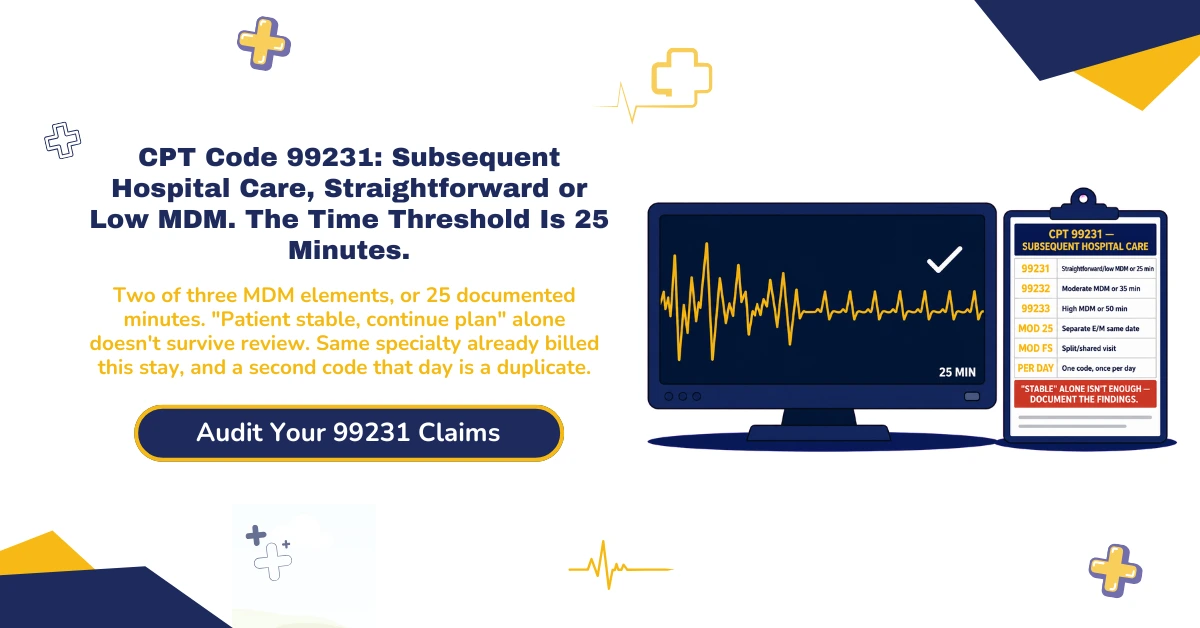
CPT code 99231 remains active in 2026. It reports subsequent hospital inpatient or observation care, the visit a physician or qualified healthcare professional bills after the first day of a hospital stay but before discharge. The code supports straightforward or low medical decision making, or at least 25 minutes of qualifying total time on the date of the encounter.
Getting the level wrong costs money in both directions. Downcode a moderate visit to 99231 and that revenue never comes back. Upcode a straightforward visit to 99232 and you’re building a pattern an auditor will eventually flag. Neither mistake happens on purpose. Both start with a documentation gap or a coder guessing instead of checking the note.
This guide covers when 99231 applies, how medical decision making and time each support it, where it splits from 99232 and 99233, what the record needs to show, and which billing rules trip up otherwise clean claims.
At ClaimMax RCM, hospital E/M reviews connect the clinical note, the code selected, the claim data, and the payer’s remittance instead of treating coding as an isolated task.
What Is CPT Code 99231?
CPT 99231 Definition
CPT code 99231 reports a subsequent hospital inpatient or observation encounter: professional E/M work performed after the stay’s initial visit and before discharge. The code supports straightforward or low medical decision making, or at least 25 minutes of qualifying time when the visit is billed by time instead.
“Subsequent” describes the relationship between the billing practitioner, their specialty and group, and the current stay, not just the calendar date. A second physician from a different specialty can still owe an initial-care code on day three of someone else’s admission. The next section covers that distinction in full.
Is CPT Code 99231 Still Active in 2026?
Yes. CPT code 99231 remains active in 2026. The confusion traces back to 2023, when the American Medical Association deleted the standalone observation codes, 99217 through 99220 and 99224 through 99226, and folded observation care into the existing hospital care families. The subsequent-care codes, 99231 through 99233, stayed exactly where they were.
Coding references confirm that the AMA merged the two categories into a single “Hospital Inpatient or Observation Care Services” family in 2023, deleting the standalone observation codes and reporting observation encounters under the same codes as inpatient visits (AMA CPT E/M guidance).
Where CPT 99231 Sits in the Hospital E/M Family
| Care Stage | Code Family |
| Initial hospital inpatient or observation care | 99221 to 99223 |
| Subsequent hospital inpatient or observation care | 99231 to 99233 |
| Same-day admission and discharge | 99234 to 99236 |
| Hospital discharge management | 99238 and 99239 |
CPT 99231 Code Snapshot
| Field | Detail |
| CPT code | 99231 |
| Visit type | Subsequent care |
| Setting | Hospital inpatient or observation |
| MDM | Straightforward or low |
| Time pathway | At least 25 minutes |
| 2026 status | Active |
| Adjacent codes | 99232 and 99233 |
When Should Providers Use CPT Code 99231?
Subsequent Care During the Same Stay
CPT 99231 applies to a qualifying encounter after the stay’s initial service and before discharge. Whether a visit counts as “initial” or “subsequent” depends on the physician, their specialty and subspecialty, their group, and whether that combination already billed a professional service during the current stay. It isn’t only about which hospital day it is.
A cardiologist who joins the case on day four still owes an initial-care code if nobody from cardiology billed earlier in that stay. Payer consultation policies add another layer worth checking before you assume the family.
Clinical Situations That May Support 99231
Three patterns show up often enough to be worth walking through:
Improving pneumonia: oxygen status trending better, morning labs reviewed, treatment plan continues, no new complication.
Cellulitis responding to treatment: erythema improving, vitals stable, current antibiotics continue, no escalation needed.
Routine pre-discharge monitoring: clinical response reviewed, discharge planning moves forward, but the patient isn’t going home that day.
A stable or improving patient doesn’t automatically mean 99231. The documented MDM or the qualifying total time decides the code, not how the patient looks on paper.
When a Different Code Family Applies
A few situations point elsewhere: an initial evaluation for that provider and stay, a same-day admission and discharge, hospital discharge management itself, critical care, or nursing facility services. Each family carries its own rules, and the billing-rules section below covers the conflicts that come up most between them.
Before you land on 99231, confirm this sequence: the setting is hospital inpatient or observation, the visit is subsequent rather than initial or discharge, and the documented MDM or time supports straightforward or low. If all three check out, 99231 is worth evaluating.
Practices billing high volumes of hospital claims need hospital revenue cycle management that checks the provider, the encounter stage, the code level, and the payer’s own rules together, before the claim goes out rather than after a denial comes back. ClaimMax’s CPT 99222 billing guide covers the initial-care side of this same decision in the same depth.
CPT 99231 MDM Requirements
CPT code 99231 requires straightforward or low medical decision making when MDM sets the level. The practitioner’s work is evaluated across three elements: problems addressed, data reviewed and analyzed, and management risk. The note has to support at least two of the three at the applicable level.
How the Two-of-Three Rule Works
Two of three qualifying elements set the level, not a checklist where every box needs a mark. Each element still has to reflect work the practitioner performed at that encounter. A problem sitting on yesterday’s list doesn’t count again today unless it was genuinely addressed.
Problems Addressed
Typical straightforward-or-low patterns include one self-limited or minor problem, one stable chronic illness, one acute uncomplicated illness or injury, or an improving problem that’s still being actively evaluated. Naming a diagnosis in the note doesn’t prove it was addressed. The assessment has to show the thinking behind it.
Data Reviewed and Analyzed
This element separates real analysis from a passing mention. Ordering a unique test counts. Reviewing an external note counts. Independently interpreting a test counts, when that test isn’t separately billed. Noting that a lab exists, without saying what it showed, doesn’t.
Risk of Patient Management
Risk comes from the management decision, not the diagnosis label. A medication change can support a moderate-risk pattern, but one moderate-risk element alone doesn’t push the whole encounter to moderate MDM if the other two elements stay at straightforward or low.
Why “Patient Stable” Isn’t Enough
| Insufficient Documentation | Stronger Documentation |
| Patient stable. Continue plan. | Pneumonia improving, oxygen saturation maintained on room air, morning labs reviewed, no adverse response, continue current therapy and reassess discharge readiness tomorrow. |
That doesn’t mean “patient stable” can never appear in a chart. It means that sentence alone may not show the assessment, the work performed, or the medical necessity a reviewer needs to see.
CPT 99231 MDM Requirements at a Glance
| MDM Element | What the Note Should Show | Common Failure |
| Problems | The condition evaluated and addressed | Diagnosis copied forward without assessment |
| Data | Specific data reviewed or analyzed | “Labs reviewed” with no context |
| Risk | The management decision and its risk | A risk label with no decision behind it |
| Overall | At least two qualifying elements | Code chosen from a single element |
Both CMS and AMA guidance build MDM around this same three-part structure. Check the full descriptor language in the AMA CPT E/M guidance before applying it to an unusual case.
CPT 99231 Time Requirements
CPT code 99231 requires at least 25 minutes of qualifying physician or QHP time on the date of the encounter when time sets the level. That total can include eligible face-to-face and non-face-to-face work the reporting practitioner personally performs.
What Counts Toward the 25 Minutes?
Qualifying work includes preparing to see the patient, reviewing tests and records, obtaining or reviewing relevant history, performing a medically appropriate exam, counseling the patient or family, ordering medications or tests, coordinating care, and documenting the encounter. Clinical staff time doesn’t count toward the physician’s total.
What Time Can’t Be Counted?
Leave out clinical staff time, work performed on a different date, travel, general teaching unrelated to that patient’s management, and time already billed under a separately reported service. Two practitioners can’t count the same minutes twice.
Does 99231 Require Start and Stop Times?
The record should document total qualifying time clearly when time sets the code. Start and stop times can help support that total, but no single format is universally required unless a specific payer’s policy calls for one. Check your MAC and payer rules before assuming either way.
Example of a Defensible Time Statement
“Total physician time on the date of service was 28 minutes, including record review, bedside evaluation, review of morning labs, care coordination, orders, and documentation.”
Treat that as an illustrative model, not a template to paste into every note. Document the actual work performed for that patient on that date.
CPT 99231 Time Requirements at a Glance
| Activity | Countable When Personally Performed? |
| Same-day record review | Yes |
| Patient examination | Yes |
| Same-day documentation | Yes |
| Care coordination | Generally yes, when not separately reported |
| Clinical staff time | No |
| Work on another date | No |
| Separately billed procedure time | No |
CMS defines E/M time as the total practitioner time on the date of service, and current guidance counts qualifying activities whether or not they involve direct patient contact (CMS E/M Services booklet).
CPT 99231 vs 99232 vs 99233
CPT codes 99231, 99232, and 99233 all report subsequent hospital inpatient or observation care. CPT 99231 supports straightforward or low MDM, or at least 25 minutes. CPT 99232 supports moderate MDM, or at least 35 minutes. CPT 99233 supports high MDM, or at least 50 minutes.
99231 vs 99232
The jump from 99231 to 99232 tracks increasing problem complexity, more extensive data analysis, and moderate management risk. A new test result reviewed on its own doesn’t automatically move the encounter to 99232. The complete documented picture has to support a genuinely moderate level, not just one more data point than yesterday.
99231 vs 99233
99233 requires high MDM or 50 minutes, tied to threats to life or bodily function, extensive data synthesis, or high-risk management decisions. Clinical deterioration pushes toward 99233. A long problem list without a change in acuity usually doesn’t. ClaimMax’s CPT 99233 guide walks through the high-complexity threshold in full.
One Patient, Three Days
Day 2, potential 99231: Pneumonia improving, oxygen stable, morning labs reviewed, treatment continues.
Day 3, potential 99232: New fever develops, additional testing ordered, antibiotic strategy reassessed, a moderate management decision documented.
Day 4, potential 99233: Respiratory status worsens, management escalates, high-risk decisions get made, extensive evaluation follows.
Treat this progression as an educational illustration. Actual code selection always depends on that day’s complete documented encounter, not on which day of the stay it happens to be.
99231 vs 99232 vs 99233 Comparison Table
| Code | MDM Level | Minimum Time | Typical Work Pattern | Common Risk |
| 99231 | Straightforward or low | 25 minutes | Routine or improving course | Generic, copied-forward note |
| 99232 | Moderate | 35 minutes | New concern or more active management | Unsupported moderate risk |
| 99233 | High | 50 minutes | Significant deterioration or high-risk management | Diagnosis used without supporting work |
CPT 99231 Documentation Requirements
Documentation for CPT code 99231 should identify the condition addressed, what changed since the prior visit, the findings that support that assessment, the data reviewed, the management decision, and the medical necessity for the visit. When time sets the level, the record should also state at least 25 minutes of qualifying total time.
CPT 99231 Documentation Checklist
- Encounter date: work matches the correct service date
- Patient status: inpatient or observation, stated clearly
- Interval change: what’s different since the last visit
- Problems addressed: conditions actively evaluated that day
- Data: tests, records, or information actually reviewed
- Assessment: the practitioner’s clinical evaluation
- Plan: the management decision made that day
- Medical necessity: why the visit was needed
- Time: total qualifying minutes, when time selects the code
- Signature: the reporting practitioner’s authentication
Example of Documentation That May Support 99231
A note that states pneumonia is improving, cites the specific data reviewed, ties the assessment to that data, and continues or adjusts treatment with a discharge-readiness note gives a reviewer something to work with. Total time only belongs in the note when time is the basis for the code, and length alone never proves compliance.
Example of Insufficient Documentation
“Patient stable. Continue current treatment.” That sentence doesn’t show what the provider evaluated, what changed, which data got reviewed, or why the visit was medically necessary. There’s no minimum word count that fixes this. Specificity fixes it.
When a Coder Should Query the Provider
A query is worth raising when the code level conflicts with the documented MDM, when time is used but no total appears, when the note describes moderate work but 99231 got selected anyway, when diagnoses are listed without evidence they were addressed, or when copied text conflicts with the patient’s current status.
Documentation Quality Comparison
| Weak Documentation | Stronger Documentation |
| Patient stable | Names the condition and what changed |
| Labs reviewed | Identifies the results and their effect on the plan |
| Continue plan | Explains the management decision |
| 25 minutes | States the specific qualifying activities behind the total |
When the note, the code, and the claim don’t tell the same story, that gap needs fixing before submission, not after a denial. ClaimMax’s medical billing services connect coding review, claim submission, payment posting, and denial follow-up under one team instead of routing hospital E/M claims through separate vendors.
Find the gap before the payer does. ClaimMax RCM reviews hospital E/M documentation patterns, coding consistency, and claim-edit risks before they turn into repeat denials.
CPT 99231 Billing Rules: Place of Service, Daily Units, Admission and Discharge
CPT 99231 is a per-day subsequent hospital care service. Medicare generally allows one subsequent-care service, per calendar day, from the same physician or from physicians of the same specialty in the same group. The code also has to match the patient’s actual status, date of service, and stage of care.
Can 99231 Be Billed More Than Once Per Day?
Generally, no, for the same physician or same-specialty physicians in the same group. The claim should carry one medically necessary subsequent-care code for that calendar day, even when the record documents more than one encounter that day. Different specialties and different groups are a separate analysis; don’t assume the same rule applies across every provider on the case.
What Place of Service Applies to CPT 99231?
| Patient Status | Typical Professional Claim POS |
| Hospital inpatient | POS 21 |
| On-campus hospital outpatient or observation | POS 22 |
| Off-campus hospital outpatient | POS 19, when applicable |
The physical room a patient sits in doesn’t decide their status. The claim should reflect the formally designated inpatient or outpatient status, matched to the payer’s POS instructions.
Can 99231 Be Reported on the Admission Date?
Usually not. Initial hospital inpatient or observation care typically belongs to 99221 through 99223. A subsequent code shouldn’t replace an appropriate initial-care service just because the visit ran short. Provider, specialty, group, and payer rules all still apply.
Can 99231 Be Reported on the Discharge Date?
The same provider generally shouldn’t report 99231 alongside hospital discharge-day management on the same date. CMS treats same-provider reporting of the subsequent-care codes alongside 99238 or 99239 on the discharge date as an overpayment risk once both land on one claim. ClaimMax’s CPT 99239 discharge guide covers that same-date conflict directly.
Confirm the current CMS Place of Service code set before submitting a claim with an unfamiliar POS.
Does CPT 99231 Need a Modifier?
CPT 99231 doesn’t routinely require a modifier. A modifier gets added only when the encounter meets that modifier’s specific definition and the payer recognizes it. Common hospital scenarios may involve modifier 25, 24, AI, or FS, but none of them belong on a claim automatically.
When Modifier 25 May Apply
Modifier 25 fits when a significant, separately identifiable E/M service happens on the same date as another qualifying procedure, and the documentation shows work beyond the usual pre- and post-service care for that procedure. Two specialists seeing the patient, or extra time spent, don’t by themselves justify the modifier. The note has to show the separate work.
When Modifier 24 May Apply
Modifier 24 may identify an E/M service unrelated to a recent surgery, during that surgery’s postoperative period. The record needs to make the “unrelated” part clear. A second diagnosis on its own isn’t enough, and global-surgery rules still apply on top of it.
Modifier AI for the Principal Physician
Medicare requires modifier AI on the initial hospital E/M service billed by the principal physician of record, not on every subsequent visit that follows. Commercial payer requirements can differ, so confirm the specific policy before assuming AI carries forward.
Split or Shared Subsequent Hospital Visits
This applies to qualifying Medicare facility E/M services jointly performed by a physician and an NPP from the same group, where the billing practitioner performs the substantive portion. Under current CMS policy, the substantive portion means either more than half of the total time or the substantive part of the medical decision making. Both practitioners need to be identified in the record, and the billing practitioner has to sign and date it. Medicare identifies this reporting with modifier FS.
CPT 99231 and Telehealth in 2026
CMS permanently removed telehealth frequency limitations for subsequent inpatient visits, effective January 1, 2026. Before this change, subsequent hospital telehealth visits were capped at roughly once every three days. CMS made this change permanent by removing the frequency limitations for subsequent inpatient visits, subsequent nursing facility visits, and critical care consultations, first waived during the COVID-19 public health emergency and now built into the CY 2026 Physician Fee Schedule rule (CMS 2026 PFS final rule).
That change affects how often a subsequent hospital telehealth visit can be billed. It doesn’t override the per-diem rule, technology requirements, or a payer’s own telehealth coverage policy.
Can Prolonged Services Be Added to 99231?
No. Medicare’s prolonged-services add-on, G0316, pairs with the highest-level code in the hospital care family it’s billed alongside. For subsequent hospital care, that’s 99233, once the practitioner’s total time clears the corrected 65-minute threshold, not 99231. Non-Medicare payer treatment of CPT 99418 needs its own verification.
CPT Code 99231 Reimbursement and RVUs in 2026
CPT code 99231 doesn’t have one universal reimbursement figure. Medicare payment depends on the code’s work, practice-expense, and malpractice RVUs, the applicable conversion factor, geographic adjustments, facility pricing, and the practitioner’s qualifying APM participant status. Commercial payment depends on each practice’s individual contract.
How Medicare Calculates 99231 Payment
The simplified formula: adjusted work RVU, plus adjusted practice-expense RVU, plus adjusted malpractice RVU, multiplied by the applicable conversion factor. Facility and non-facility amounts aren’t interchangeable, locality affects the total, and a billed charge is never the same figure as the allowed amount.
2026 Medicare Conversion Factors
| 2026 Participant Status | CMS Conversion Factor |
| Qualifying APM participant | $33.57 |
| Nonqualifying APM participant | $33.40 |
For 2026, CMS finalized two separate conversion factors for the first time under MACRA, reflecting a 3.77% increase for qualifying APM participants and a 3.26% increase for everyone else, driven by the statutory APM update plus a temporary payment increase enacted in the One Big Beautiful Bill Act (CMS 2026 PFS final rule). Neither figure is the payment for 99231 by itself. Each one is a single input in the formula above, and both are worth double-checking against the current fee schedule before you quote them to a physician or a finance committee, since conversion factors and RVU files get revised.
How to Verify the Current 99231 Allowed Amount
Pull the current locality-specific rate directly, rather than relying on a remembered figure or a number from an older article. Select the correct year, enter 99231, choose the MAC and locality, confirm facility pricing, and confirm qualifying APM status. Then compare that figure against the actual remittance.
Reimbursement Terms Reference
| Financial Term | Meaning |
| Charge | The amount billed by the provider |
| Allowed amount | The maximum amount recognized under the payer’s policy or contract |
| Payment | The amount received after adjustments and patient responsibility |
| Work RVU | The relative value tied to physician work |
| Conversion factor | The dollar multiplier used in the PFS formula |
| GPCI | The geographic adjustment applied to RVU components |
Verify current rates through the CMS Physician Fee Schedule lookup tool before quoting a dollar figure.
Common CPT 99231 Denials and How to Prevent Them
Common CPT code 99231 denials trace back to unsupported MDM or time, incorrect patient status, duplicate daily units, admission or discharge-date conflicts, wrong provider sequencing, modifier errors, or missing medical necessity. The strongest prevention strategy checks the note and the claim together before submission, not after a rejection arrives.
Where E/M Claims Run Into Trouble
Medicare’s Comprehensive Error Rate Testing program reported a 6.55% improper payment rate for fiscal year 2025, representing $28.83 billion across the Medicare fee-for-service program (CMS CERT program). That figure covers the entire fee-for-service program, not 99231 specifically, but E/M services have consistently ranked among the code types CERT reviewers flag most often, and insufficient documentation remains the leading driver behind those errors.
Top 99231 Denial Reasons
| Claim Failure | What Creates It | Pre-Bill Control |
| Unsupported MDM | Note doesn’t establish two qualifying elements | MDM validation before submission |
| Missing time | Time pathway selected with no total documented | Time-field edit |
| Duplicate daily unit | Same provider or same-specialty group bills twice | Provider-date-specialty edit |
| Wrong POS | Inpatient and observation status don’t match the POS | Status-to-POS validation |
| Admission-date conflict | Subsequent code used instead of initial care | Care-stage edit |
| Discharge-date conflict | Subsequent code reported with 99238 or 99239 | Discharge edit |
| Copied documentation | Note doesn’t reflect that day’s actual work | Copy-forward review |
Build a Pre-Submission Claim Check
Before a 99231 claim goes out, confirm the patient’s inpatient or observation status, confirm this is a subsequent date of care, confirm the record supports MDM or at least 25 minutes, confirm no other same-specialty provider already billed that date, confirm this isn’t the discharge date, confirm the POS matches the status, and confirm every modifier is supported.
When the same 99231 denial keeps repeating across providers or payers, that’s usually an upstream documentation or claim-edit problem, not a one-off mistake. ClaimMax’s denial management services trace denials back to their root cause and correct the workflow so the same error doesn’t reappear next billing cycle.
Find the 99231 error before it repeats. ClaimMax RCM reviews hospital E/M denial patterns, documentation alignment, and payer responses to identify where claims are breaking down.
How ClaimMax RCM Protects Hospital E/M Revenue
From Clinical Documentation to Final Payment
ClaimMax RCM connects eligibility verification, prior authorization, clinical documentation review, CPT and ICD-10-CM coding, claim scrubbing, submission, payment posting, denial management, and AR follow-up under one team. That’s what keeps a code like 99231 from becoming a gap between what the provider documented and what the payer actually paid.
The work applies across specialties. Hospitalist groups bill the bulk of subsequent hospital care, but orthopedic surgeons, cardiologists, and other specialists following their own inpatients on later hospital days need the same claim-level accuracy, whether the service is 99231 or any other code in the family.
ClaimMax RCM Pricing
| ClaimMax Service | Pricing |
| Full-service medical billing | 3.49% of payer collections |
| Verification of benefits | Included at no separate charge |
| Prior authorization | Included at no separate charge |
| Revenue cycle audit | Free, before any commitment |
| Credentialing | $120 per insurance |
ClaimMax RCM charges 3.49% of payer collections for full-service medical billing. Verification of benefits and prior authorization are included at no separate charge, and every new account starts with a free revenue cycle audit before any commitment. Credentialing runs $120 per insurance.
That combination is what affordable, expert billing looks like for hospitalist groups, orthopedic practices, and any specialty billing subsequent hospital care: medical billing and revenue cycle management built to help your practice maximize what it actually collects from payers on every 99231 claim, not just the ones that happen to get reviewed.
See what your revenue cycle is missing. ClaimMax RCM reviews denial rate, days in AR, claim acceptance, and coding risk before recommending anything.
Frequently Asked Questions About CPT 99231
What is CPT code 99231 used for?
It reports subsequent hospital inpatient or observation care, supported by straightforward or low MDM, or at least 25 minutes of qualifying time. It doesn’t apply to initial-care or discharge-day visits.
Is CPT code 99231 still active in 2026?
Yes. The 2023 revision deleted the separate observation codes and merged observation services into the hospital care families. CPT 99231 wasn’t affected and remains active.
What is the minimum time for 99231?
At least 25 minutes of qualifying same-date physician or QHP time, and only when time is the basis for selecting the code. MDM remains a fully valid alternative pathway.
What is the difference between 99231 and 99232?
99231 supports straightforward or low MDM or 25 minutes. 99232 supports moderate MDM or 35 minutes. The complete documented encounter, not any single new finding, decides which one applies.
Can 99231 be billed twice on the same date?
Generally not for the same physician or same-specialty group. Multiple visits that day get combined into one claim. Different specialties and different groups need their own review.
Can 99231 be billed on the discharge date?
Not alongside 99238 or 99239 from the same provider. Use the appropriate discharge code once its own requirements are met.
Does CPT 99231 need a modifier?
Not routinely. A modifier applies only when its specific definition is met. Modifiers 25, 24, AI, and FS come up most often in hospital settings.
Is 99231 an E/M code?
Yes, part of the hospital inpatient and observation E/M family, specifically the subsequent-care level rather than initial or discharge.
Is 99231 a consultation code?
No, it’s a subsequent-care code. Medicare fee-for-service doesn’t pay CPT consultation codes at all, so verify how your specific payer treats consultations separately.
How much does Medicare pay for 99231?
There’s no universal figure. Payment depends on locality, facility pricing, RVUs, and qualifying APM status. Check the CMS Physician Fee Schedule lookup tool for the current, locality-specific allowed amount.
Key Takeaway for Providers Billing Subsequent Hospital Care
Confirm the encounter belongs to subsequent hospital care before anything else. Select the level using MDM or time, use the 25-minute pathway only when documented qualifying time actually supports it, and never rely on patient stability alone to justify the code.
Confirm patient status and place of service, apply the per-day rule, check admission and discharge chronology, use modifiers only when the documentation supports them, and confirm medical necessity is clear in the note.
Accurate hospital E/M coding isn’t a single decision made once. It’s a connected chain running from documentation through coding, claim submission, payment, and denial management, and a gap anywhere in that chain shows up as revenue somewhere else.