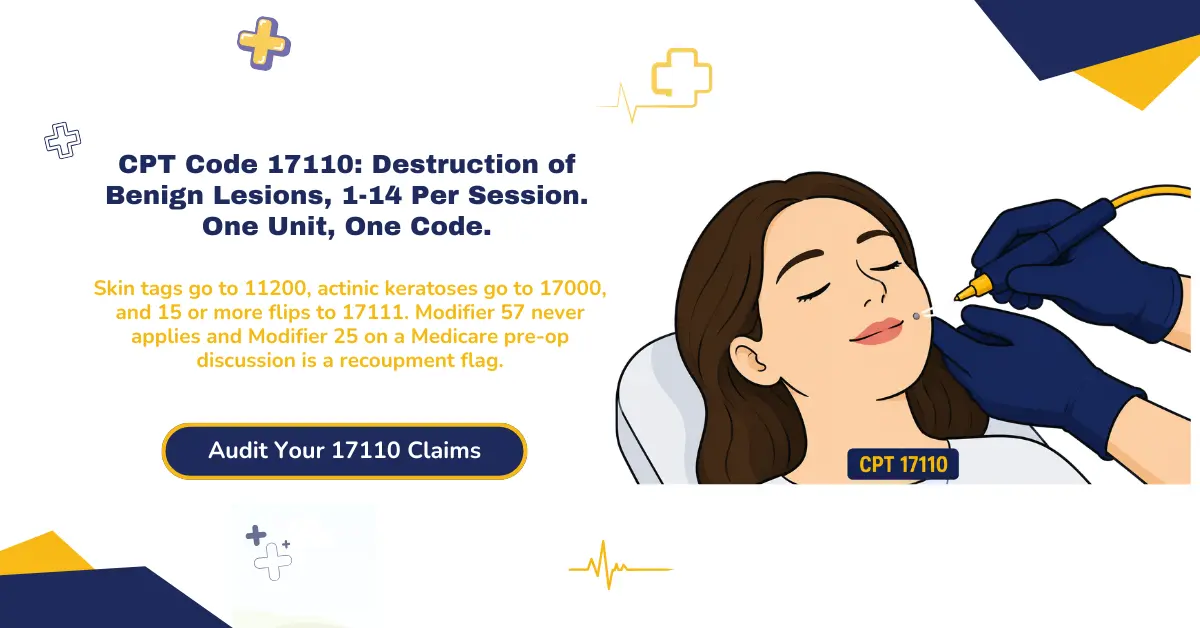
CPT code 17110 covers the destruction of benign skin lesions, excluding skin tags and cutaneous vascular proliferative lesions, for 1 to 14 lesions treated in a single session.
The code applies no matter which method you use, whether cryotherapy, electrosurgery, laser surgery, chemosurgery, or surgical curettement. You bill it as one unit per session, regardless of how many lesions you treat.
CPT 17110 is a session-based code, not a per-lesion code. Whether a provider destroys one wart or fourteen seborrheic keratoses in a single encounter, the claim carries the same code with one unit of service in box 24G. Billing multiple units triggers an automatic edit.
Effective January 1, 2026, the AMA updated the short description of CPT 17110 as part of its annual AMA CPT code set revision. Teams that haven’t refreshed charge capture templates to match the revised descriptor can see claim-scrubbing rejections.
Dermatology and primary care practices that bill CPT 17110 cleanly protect revenue that errors quietly erase. ClaimMax RCM’s dermatology billing service handles charge capture, modifier application, and pre-submission claim review for benign lesion destruction claims from end to end.
What CPT Code 17110 Covers: Included Lesions, Methods, and Hard Exclusions
CPT 17110 sits in the Destruction Procedures on Benign or Premalignant Lesions of the Integumentary System section of the AMA CPT manual. The full 2026 descriptor reads: “Destruction (eg, laser surgery, electrosurgery, cryosurgery, chemosurgery, surgical curettement), of benign lesions other than skin tags or cutaneous vascular proliferative lesions; up to 14 lesions.”
What Lesion Types and Destruction Methods Does CPT 17110 Cover?
Covered lesion types include viral warts (verruca vulgaris, plantar warts, and flat warts), molluscum contagiosum, seborrheic keratoses, milia, and other benign neoplasms when they’re medically necessary to treat.
The method doesn’t drive the code. Cryosurgery with liquid nitrogen, electrosurgery, non-vascular laser ablation, chemosurgery with cantharidin or trichloroacetic acid, and surgical curettement all map to the same code.
A coder doesn’t switch the CPT code based on which method the provider used. The operative note has to record the method, but the code stays 17110 regardless.
CPT 17110 applies to the destruction of benign skin lesions by any method, as long as the lesion count is 1 to 14 in a single session.
What CPT 17110 Does Not Cover: Four Explicit Exclusions
Skin tags and fibrous papules fall outside CPT 17110. For skin tag removal, use CPT 11200 (up to and including 15 skin tags) or CPT 11201 (each additional 10). Billing 17110 for a skin tag is a code mismatch that draws a denial, as the CMS Billing Article A54602 lays out.
Cutaneous vascular proliferative lesions, including port-wine stains and hemangiomas, are excluded. These map to CPT 17106, 17107, or 17108 based on the surface area treated.
Premalignant lesions, including actinic keratoses, don’t belong on 17110. They code to the 17000 series: 17000 for the first lesion, 17003 for each additional lesion through the 14th, and 17004 for 15 or more in one session.
Malignant lesions need excision codes, not destruction codes. Use the 11600 through 11646 range based on lesion size and anatomical site.
CPT 17110 in 2026: The Descriptor Change and What Reimbursement Looks Like Now
Two changes from the past year touch every CPT 17110 claim you submit in 2026. The AMA updated the short descriptor effective January 1, 2026, and the CY 2026 PFS Final Rule set two separate conversion factors that drive Medicare payment.
The 2026 AMA Descriptor Update: What Changed and Why It Matters for Claim Submission
The AMA’s CPT 2026 code set, released in fall 2025 and effective January 1, 2026, revised the short description of CPT 17110. The change tightened the exclusion language around cutaneous vascular proliferative lesions, keeping 17110 aligned with the dedicated vascular codes 17106 through 17108.
Billing teams whose charge capture templates still carry the prior short description can see scrubbing rejections from payers that have moved their edits to the 2026 descriptor. The fix is a charge master update to the current AMA CPT 2026 language before your next submission cycle.
CPT 17110 Reimbursement in 2026: Medicare Rates, RVUs, and Commercial Payer Ranges
Reimbursement for CPT code 17110 in 2026 comes down to a handful of numbers.
| Data Point | 2026 Value |
|---|---|
| Work RVU (wRVU) | Approximately 0.68 |
| Total non-facility RVUs | Approximately 1.2 (rounded) |
| 2026 conversion factor (QP / APM) | $33.5675 |
| 2026 conversion factor (non-QP) | $33.4009 |
| Medicare national average (non-facility) | Approximately $39 to $43 (locality-adjusted) |
| Commercial payer range (price transparency) | Approximately $125 to $185 |
Source: 2026 CMS Physician Fee Schedule (RVU26A) and federal hospital price transparency data. Actual Medicare payment varies by locality under the GPCI adjustment.
The spread between Medicare’s roughly $40 non-facility rate and the upper end of commercial contracts isn’t an anomaly. Medicare builds physician payment from RVUs, while commercial payers negotiate their own rates. Practices with a heavy Medicare mix should pull locality-adjusted rates from the CMS Physician Fee Schedule lookup before benchmarking revenue.
For practices reconciling those rates against their contracts, ClaimMax RCM’s payer contract benchmarking work flags underpayments against the fee schedule before they age out.
CPT 17110 can be FSA-eligible or HSA-eligible when the procedure is medically necessary, meaning the lesion meets the documentation criteria under LCD L35498. Cosmetic-only removal doesn’t qualify under IRS rules for these accounts. Patients should confirm eligibility with their plan administrator before counting on reimbursement from tax-advantaged funds.
How to Bill CPT 17110: The Session Rule, Unit Box, and 17111 Boundary
CPT code 17110 carries four billing rules that apply to every claim. Get any one of them wrong, and you’re looking at either a denial or an overpayment risk. The CMS Billing Article A57482 spells out the correct configuration for each one.
Rule 1: Always bill one unit of service. Per CMS A57482: “When billing the destruction of multiple other benign lesions use CPT 17110 or 17111 with a ‘1’ in the unit box.” That holds whether the provider destroys one lesion or fourteen. More than one unit triggers an edit that rejects the excess.
Rule 2: Use 17111 when 15 or more lesions are destroyed in one session. CPT 17110 covers 1 to 14 lesions, and CPT 17111 covers 15 or more. Per CMS A57482: “CPT 17110 and CPT 17111 may not be reported together.” Treat 20 lesions in one session, and you report 17111 alone.
Rule 3: The ICD-10 diagnosis code has to match the procedure code. Per CMS A57482: “If a provider bills a benign skin lesion CPT code, it is not correct to use a malignant diagnosis code.” A benign procedure with a malignant diagnosis is a common 17110 audit trigger that flags the claim for review.
Rule 4: Cosmetic removal needs special handling. When a patient asks for cosmetic-only removal of a benign lesion, with no symptoms and no functional impairment, Medicare won’t cover it. Per CMS A54602, the GY modifier signals that the service falls outside any Medicare benefit. For a formal denial, submit ICD-10 code Z41.1 with the GY modifier.
An Advance Beneficiary Notice of Non-Coverage belongs in the chart before any cosmetic removal. All four rules are part of the pre-submission clean claim standards that keep these claims from aging in accounts receivable.
CPT 17110 Modifier Rules: When You Need One and When You Don’t
CPT code 17110 doesn’t require a modifier when you bill it alone for the destruction of 1 to 14 benign lesions. Bill one unit, no modifier attached. Modifiers come into play only when the encounter creates a specific billing scenario.
Does CPT 17110 Need a Modifier?
No, CPT 17110 doesn’t inherently require a modifier. A standard, uncomplicated benign lesion destruction goes out as one clean unit. You add a modifier only when the encounter creates a distinct situation: a same-day E/M, a second procedure, a cosmetic removal, or a return inside the global period. The table below maps each one.
The Complete Modifier Table for CPT 17110 Claims
| Modifier | Name | When to Apply to CPT 17110 | Documentation Required | Key Audit Risk |
|---|---|---|---|---|
| 25 | Significant, separately identifiable E/M | E/M for an unrelated condition on the same day (see the LCD restriction below) | E/M note that stands alone, independent of the lesion removal | Most audited modifier in minor dermatological procedures |
| 51 | Multiple procedures | A second distinct procedure in the same session | Both procedures fully documented | Payers may reduce the secondary procedure |
| 58 | Staged procedure | Planned retreatment within the 10-day global period | Staged plan documented before the original procedure | Cannot cover an unplanned return visit |
| 59 | Distinct procedural service | Same-day 17000 and 17110 for different lesion types, or a biopsy on a separate lesion | Separate site and lesion documented | Overbroad use triggers unbundling audits |
| GY | Statutory exclusion | Cosmetic-only removal not covered by Medicare | ABN issued before the procedure; Z41.1 diagnosis | Missing ABN creates a patient liability dispute |
| GZ | Expected denial | Service expected to be denied, no ABN issued | Use GY with an ABN instead | Compliance exposure without an ABN |
| XS | Separate structure | CMS-preferred alternative to 59 for a separate anatomical site | Same as 59, but more specific | Preferred by CMS over 59 for anatomical separation |
The WPS LCD Rule on Modifier 25 That Every Dermatology Biller Must Know
The CMS Billing Article A57482 (the WPS Medicare article, updated December 31, 2025) holds a restriction that cuts against what most billing guides teach about Modifier 25. It states:
“Removal of benign lesions is elective surgery and generally pre-scheduled. It is inappropriate to report an E&M service with a -25 modifier on the same date of service as these surgeries for the usual pre/post-operative care associated with these surgeries.”
For Medicare patients, that means a provider can’t append Modifier 25 to a same-day E/M when the E/M is the routine pre-operative evaluation, the consent discussion for the removal, or standard post-procedure wound assessment.
Modifier 25 fits only when the E/M addresses a separate, independently documentable problem. A patient whose warts are being frozen also presents with a blood pressure concern, or an unrelated rash that carries its own history, examination, and medical decision-making.
Commercial payers may run different rules, so the restriction above applies to Medicare claims specifically. Verify individual commercial contracts before you apply or withhold Modifier 25 there. For the full NCCI logic governing Modifier 59, including how it interacts with the X-modifier family, see ClaimMax RCM’s guide to Modifier 59 billing rules.
The Global Period for CPT 17110: What the 10-Day Window Means for Every Claim
Yes, CPT code 17110 carries a 10-day global surgical period. Routine follow-up tied to the destruction, including wound checks, post-procedure assessments, and complication management, folds into the initial procedure payment for those 10 days and can’t be billed separately.
What Is the Global Period for CPT 17110?
CPT 17110 has a 10-day global period. That window classifies it as a minor surgical procedure under CMS global surgery rules, per CMS Billing Article A54602, and it carries three billing implications.
First, routine post-operative visits within 10 days aren’t separately payable, since they sit inside the 17110 payment. Second, Modifier 58 applies to a planned staged retreatment during the window. Third, Modifier 79 applies to an unrelated procedure during the global period.
Why Modifier 57 Does Not Apply to CPT 17110
Modifier 57 (Decision for Surgery) applies only to major surgical procedures that carry a 90-day global period. CPT 17110 carries a 10-day global period, which is the minor surgery classification. Because 17110 is minor surgery, Modifier 57 never applies, and attaching it is a billing error.
A provider who wants to separately bill an E/M on the day of or the day before a destruction encounter uses Modifier 25 on the E/M code, subject to the LCD restriction above, not Modifier 57 on the procedure.
Per CMS A57482: “The modifier -57 cannot be used since the decision to perform the dermatological procedure is considered a routine preoperative service and a visit or consultation should not be billed.” Put plainly, Modifier 57 doesn’t apply to CPT 17110 because the code carries a 10-day minor surgical global period, not a 90-day major surgical period.
Medical Necessity for CPT 17110: What the LCD Requires and Which ICD-10 Codes Support It
Yes, Medicare covers CPT code 17110 when the procedure is medically necessary. That determination runs through CMS Local Coverage Determination L35498, Removal of Benign Skin Lesions, along with its Billing and Coding Articles A54602 and A57482.
Does Medicare Pay for CPT 17110? The LCD L35498 Coverage Criteria
Medicare covers CPT 17110 when the medical record documents that the lesion meets one or more of the following criteria from LCD L35498:
- The lesion shows one or more of these characteristics: bleeding, itching, or pain; a change in physical appearance such as reddening or pigmentary change; recent enlargement; or an increase in number.
- The lesion has physical evidence of inflammation, including purulence, oozing, edema, or erythema.
- The lesion obstructs an orifice, or it restricts vision or function.
- There is clinical uncertainty about the diagnosis, particularly where malignancy is a realistic consideration based on the lesion’s appearance.
- For warts specifically, destruction is covered when the wart is periocular with chronic recurrent conjunctivitis, shows spread from one body area to another (especially in immunosuppressed patients), is condyloma acuminata or molluscum contagiosum, or is a genital wart associated with cervical dysplasia or pregnancy.
These findings belong in the history and physical or progress note before the claim goes out. A note that records only “patient requests removal” doesn’t satisfy the LCD, and the claim will be denied.
When Medicare Will Not Cover CPT 17110: The Non-Covered Indications from the LCD
Medicare won’t cover CPT 17110 when the removal is performed for any of these reasons:
- The lesion is asymptomatic and poses no threat to health or function, and the patient wants it gone solely to improve appearance.
- Emotional distress or personal dissatisfaction with how the lesion looks, with no documented physical symptom.
- Documentation that says only “irritated skin lesion” or “inflamed seborrheic keratosis” without recording the underlying symptoms. The LCD names both of those phrases as insufficient on their own.
In these non-covered cases, the provider issues an Advance Beneficiary Notice of Non-Coverage before the procedure and submits the claim with ICD-10 code Z41.1 and Modifier GY if the patient wants a formal Medicare denial.
ICD-10 Diagnosis Codes That Support Medical Necessity for CPT 17110
The diagnosis tied to a CPT 17110 claim has to be a covered benign lesion diagnosis. A malignant or premalignant ICD-10 code paired with 17110 draws an automatic clinical-coding mismatch denial.
| ICD-10 Code | Description | When to Use with CPT 17110 |
|---|---|---|
| B07.0 | Plantar wart | Wart on the plantar surface of the foot, the most common 17110 pairing |
| B07.9 | Viral wart, unspecified | Common wart or flat wart, unspecified location |
| B07.8 | Other viral warts | Warts on the face, hand, or other specific sites |
| L82.1 | Inflamed seborrheic keratosis | Seborrheic keratosis with documented inflammation |
| L82.0 | Seborrheic keratosis | Without inflammation, so document symptoms or functional impairment |
| B08.1 | Molluscum contagiosum | Viral skin infection, common pediatric and immunocompromised indication |
| L72.0 | Epidermal cyst | Only when the cyst is destroyed, not excised |
| A63.0 | Anogenital (venereal) warts | Condyloma acuminata in the anogenital region |
| L57.0 | Actinic keratosis | Use with the 17000 series, NOT with 17110; listed here to prevent a mismatch |
That last row matters. L57.0 for actinic keratosis pairs with CPT 17000, 17003, or 17004, never with 17110. Submitting 17110 with L57.0 draws a clinical-coding mismatch denial and opens audit exposure.
Claims denied for thin LCD L35498 documentation are recoverable with the right appeal. ClaimMax RCM’s medical necessity denial recovery team finds the documentation gap and rebuilds the appeal around it.
CPT 17110 vs. 17000 vs. 17111 vs. 11200: The Comparison Every Coder Gets Wrong
Four codes handle the destruction of skin lesions in the integumentary system. Coders confuse them because the procedures look identical in the room. The difference comes down to lesion type and count, and getting either one wrong draws a denial.
What Is the Difference Between CPT 17000 and CPT 17110?
CPT 17000 is for premalignant lesions, specifically actinic keratoses, and CPT 17110 is for benign lesions such as warts, seborrheic keratoses, molluscum contagiosum, and other non-cancerous growths.
The two families also bill additional lesions differently. CPT 17000 is a base code for the first premalignant lesion, and each additional premalignant lesion through the 14th uses the add-on code CPT 17003, billed once per lesion. Destroy 15 or more, and CPT 17004 replaces the 17000 plus 17003 combination outright.
CPT 17110 works on a different logic. It’s a single flat code for 1 to 14 benign lesions billed as one unit, with no add-on code no matter how many lesions you treat.
| CPT Code | Lesion Type | Count Rule | Add-On Code? | When to Switch |
|---|---|---|---|---|
| 17000 | Premalignant (actinic keratoses only) | First lesion, 1 unit | Yes, 17003 for each additional lesion 2 through 14 | Treat 15+ AKs: switch to 17004 |
| 17003 | Premalignant (add-on) | Per additional lesion | Add-on to 17000 only | Cannot be used alone |
| 17004 | Premalignant (15 or more) | 15 or more, 1 unit | No add-on | Replaces 17000 + 17003 at 15+ AKs |
| 17110 | Benign (warts, SKs, molluscum) | 1 to 14, 1 unit | None | Treat 15+ benign lesions: switch to 17111 |
| 17111 | Benign (15 or more) | 15 or more, 1 unit | None | Mutually exclusive with 17110 |
| 11200 | Skin tags only | Up to 15 tags, 1 unit | 11201 for each additional 10 | Not destruction, a different code family |
Can You Bill CPT 17110 and 17000 Together?
Yes, CPT 17110 and CPT 17000 can be billed together on the same date of service, but only when the provider destroys different types of lesions in the same session.
When a provider treats both premalignant lesions (actinic keratoses) and benign lesions (warts, seborrheic keratoses) at one visit, both code families are reportable. Per the CMS NCCI Policy Manual, Modifier 59 or XS goes on the lower-valued code to clear the bundling edit and mark two distinct procedures on separate lesions.
A concrete example: a provider destroys 3 actinic keratoses on a patient’s face and 5 seborrheic keratoses on the back in the same encounter.
Claim line 1: CPT 17000 (first AK) plus CPT 17003 x2 (second and third AK), with ICD-10 L57.0.
Claim line 2: CPT 17110-59 (5 benign SKs), with ICD-10 L82.1.
That capture takes both services, uses Modifier 59 to clear the NCCI edit, and links each procedure to its own diagnosis. Billing 17000 five times instead of 17000 plus 17003 x4 is the most common premalignant-destruction error, and it draws automatic denials.
The 6 CPT 17110 Billing Errors That Dermatology Practices Pay For
Dermatology and primary care practices bill cpt code 17110 often enough that small recurring errors compound into real revenue loss. These six account for the bulk of 17110 denials and audit findings.
Error 1: Billing Multiple Units Instead of One Unit Per Session
The unit-box error is the most common 17110 denial. A coder who treats 8 lesions sometimes bills 8 units. CMS A57482 is explicit: bill one unit of service regardless of lesion count, up to 14. Extra units hit an edit that denies everything above the first.
Error 2: Using CPT 17110 for Skin Tag Removal
Skin tags aren’t benign lesions under 17110, since the code excludes them outright. The AMA descriptor reads “other than skin tags or cutaneous vascular proliferative lesions.” Using 17110 for a skin tag draws a clinical-coding mismatch denial. The correct code is CPT 11200 for up to 15 tags.
Error 3: Pairing CPT 17110 With an Actinic Keratosis Diagnosis Code
ICD-10 L57.0 (actinic keratosis) is a premalignant diagnosis, and CPT 17110 is a benign destruction code. Pairing them draws an automatic mismatch denial. Actinic keratosis treatment belongs on the 17000 series, not 17110. The mismatch also flags the claim for audit, since it reads as a code-selection problem.
Error 4: Billing CPT 17110 and 17111 Together on the Same Claim
CPT 17110 and CPT 17111 are mutually exclusive. No combination of the two on the same date of service is payable. Treat 20 lesions, and you bill only 17111. Per CMS A57482, billing both draws a bundling denial that no modifier, including 59, can override.
Error 5: Appending Modifier 25 to the E/M for a Routine Pre-Op Discussion
This is the compliance error most billing guides miss. Per WPS LCD A57482, Modifier 25 is inappropriate when the same-day E/M is the routine evaluation and consent discussion before a scheduled benign lesion destruction. Billing Modifier 25 for that pre-procedure discussion on Medicare claims draws an audit flag and a recoupment risk, not a separate payment.
Error 6: Performing Cosmetic Removal Without an ABN and GY Modifier
When a patient asks for cosmetic-only removal, with no symptoms and no functional impairment, the provider issues an Advance Beneficiary Notice of Non-Coverage before the procedure. Submitting to Medicare without an ABN and GY modifier creates patient liability exposure and a compliance problem. The correct claim uses Z41.1 with the GY modifier.
Practices that watch these errors recur across their 17110 volume usually share one root cause: no systematic pre-submission review catches them before they reach the payer. ClaimMax RCM’s denial prevention for dermatology practices team finds the root-cause pattern across your actual claim file and builds the fix into the workflow, so the same denial doesn’t repeat.
Frequently Asked Questions About CPT 17110 Billing
These are the questions billing teams and providers ask most about cpt code 17110.
Can You Bill 99213 and 17110 Together?
Yes, CPT 99213 and CPT 17110 can be billed together on the same day, but only when a significant, separate E/M goes beyond the lesion destruction. The E/M has to address a different problem that would have justified the visit on its own. Modifier 25 goes on the 99213, with its own standalone note.
For Medicare patients, the WPS LCD A57482 restriction applies: Modifier 25 is inappropriate for the routine pre- or post-operative evaluation of the elective destruction itself. For more on documentation and level selection in the office, see ClaimMax RCM’s CPT 99213 billing guide.
Is CPT Code 17110 Considered a Surgery?
Yes, CPT 17110 is a surgical procedure. It sits in the Surgery section of the AMA CPT manual, under Integumentary System and Destruction Procedures on Benign or Premalignant Lesions. It’s classified as minor surgery, not major surgery.
That distinction drives the billing. CPT 17110 carries a 10-day global period, not a 90-day one, so Modifier 57 never applies, and the pre-procedure E/M rules follow the minor surgical global package under A57482.
Can You Bill CPT 17110 and 11055 Together?
Yes, CPT 17110 and CPT 11055 can be billed together on the same date of service when both procedures hit separate, distinct lesions that are documented independently. CPT 11055 covers the paring of a benign hyperkeratotic lesion, typically a callus or corn.
When a provider destroys a wart (17110) and pares a callus (11055) in one session, both codes are reportable. Modifier 59 or XS goes on the lower-valued code to clear the NCCI edit. The operative note has to name each lesion separately with its location, type, and treatment.
How Often Can CPT 17110 Be Billed?
CPT 17110 can be billed as often as it’s medically necessary. There’s no CMS-mandated frequency cap on how many times per year the code goes out for a given patient. It’s billed per session, so a patient who returns for a second treatment on a different date supports a new 17110 charge.
Individual payers can set their own frequency edits in their coverage policies. Check the payer’s policy before assuming unlimited coverage.
Is CPT 17110 FSA or HSA Eligible?
Yes, CPT 17110 can be FSA-eligible or HSA-eligible when the procedure qualifies as medically necessary under IRS rules for tax-advantaged accounts. Medically necessary destruction, where the lesion meets the LCD L35498 criteria, typically qualifies. Cosmetic-only removal that misses those criteria doesn’t qualify as a medical expense under IRS Publication 502. Patients should confirm eligibility with their plan administrator first.
How ClaimMax RCM Handles CPT 17110 Billing for Dermatology and Primary Care Practices
CPT code 17110 is a high-volume code in dermatology and primary care. A single recurring error, wrong units, a missing Modifier 59, or Modifier 25 on a bundled pre-op E/M, compounds into revenue leakage and audit exposure across a month. ClaimMax RCM’s certified coders review every 17110 claim against the six error types above before submission.
The team covers charge capture review, ICD-10 verification against the LCD L35498 medical necessity criteria, modifier application, NCCI bundling compliance, and pre-submission claim scrubbing for every benign lesion destruction claim. When a same-day E/M is present, the team applies the right modifier protocol for the payer, whether commercial rules or the WPS LCD A57482 Medicare restriction.
Cosmetic removals get the correct ABN workflow, GY modifier assignment, and Z41.1 diagnosis pairing before submission. Denied claims are worked within 48 hours with root-cause identification, so the pattern doesn’t repeat.
Practices billing CPT 17110 at volume do best with a partner who knows the LCD rules at the code-pair level, not only the AMA descriptor. ClaimMax RCM’s full revenue cycle management operation covers every step from charge capture through payment posting.
Reach out to review your current medical billing for dermatology and primary care workflow, and the team handles the complexity so your clinical staff doesn’t have to.
Sources and Official References for CPT 17110 Billing Guidance
This article reflects the 2026 AMA CPT code set descriptor for CPT 17110, available through the AMA CPT code set. Medicare coverage and billing rules draw on CMS Local Coverage Determination L35498, the CMS Billing Article A54602, and the CMS Billing Article A57482, updated December 31, 2025.
Reimbursement data reflects the CY 2026 PFS Final Rule and the CMS Physician Fee Schedule lookup, with commercial figures from federal price transparency files. NCCI bundling rules come from the CMS NCCI Policy Manual. The AAPC CPT 17110 reference serves as a code lookup. Every external link points to a government or association source, never a competitor.