What Is Modifier 95 in Medical Billing? The 2026 AMA Definition and Three Core Conditions
Modifier 95 in medical billing is a CPT add-on code that identifies a synchronous telemedicine service rendered via a real-time interactive audio and video telecommunications system. That’s the official AMA definition, and it’s the language payers expect on the claim.
Here’s what it tells your payer: the encounter happened over live video, not in person, and both audio and video stayed active the whole time.
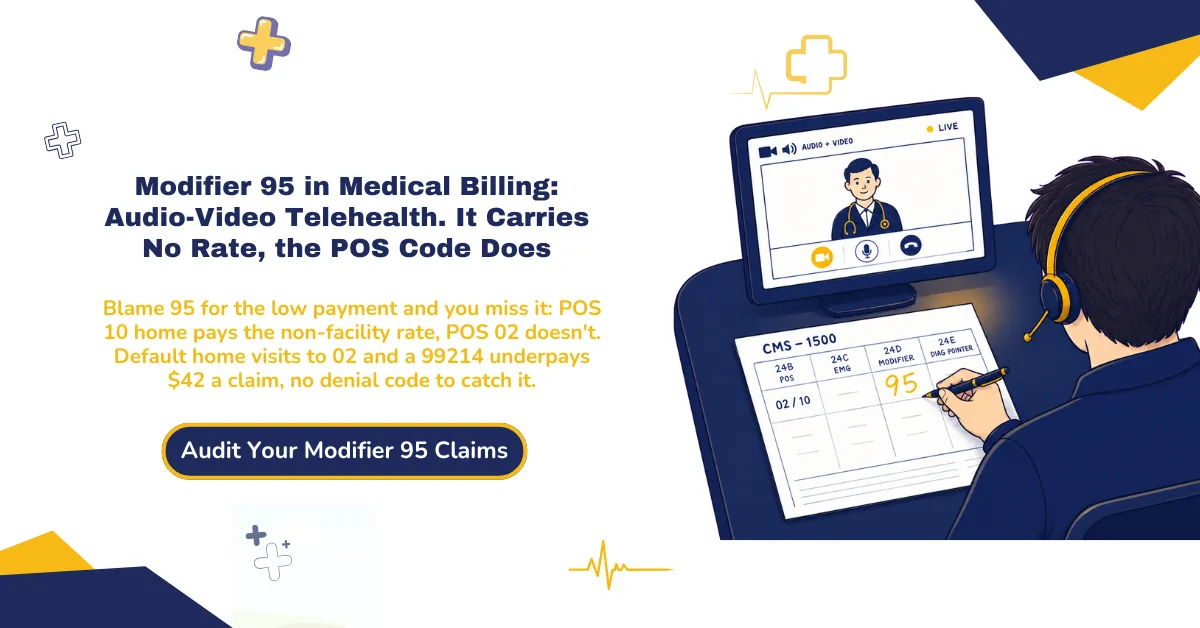
You append it in Box 24D on the CMS-1500 form alongside the eligible CPT code in Box 24C, with the matching Place of Service code in Box 24B.
Three facts decide every modifier 95 in medical billing claim: when it applies, which codes qualify, and what the payer pays. Here’s each one.
When to use it: append modifier 95 to CPT codes listed in Appendix P of the CPT manual when both audio and video run in real time. For Medicare claims, confirm the code also appears on the CMS Medicare Telehealth Services List. Appendix P and the CMS list overlap, but they aren’t identical.
When not to use it: don’t use modifier 95 for audio-only calls, for asynchronous store-and-forward services, for in-person visits, or for CPT codes 98000-98015 billed to commercial payers that adopted them. Audio-only takes Modifier 93. Store-and-forward takes Modifier GQ. For 98000-98015, the modality is written into the code descriptor.
Payer rules in 2026: commercial payers require modifier 95 to flag standard E/M codes as telehealth. Medicare leans on Place of Service codes, POS 02 and POS 10, from the CMS Place of Service Code Set, as its main telehealth identifier for standard professional claims.
Medicare still requires modifier 95 for outpatient therapy delivered by hospital-employed physical, occupational, and speech-language therapists. That’s the one professional-claim exception worth memorizing.
2026 policy status: Section 6209 of the Consolidated Appropriations Act, 2026 (H.R. 7148, signed February 3, 2026) extended Medicare telehealth flexibilities through December 31, 2027. Modifier 95 stays operative through that date.
The three conditions that decide whether modifier 95 applies, synchronous service, both audio and video active, and CPT code eligibility, are covered next.
When to Use Modifier 95: Appendix P, the Medicare Telehealth Services List, and CPT Code Eligibility
Modifier 95 in medical billing applies only when the CPT code passes two checks. It has to appear in AMA CPT Appendix P. And for Medicare claims, it has to be on the CMS Medicare Telehealth Services List.
Appendix P is the AMA’s list of CPT codes that support modifier 95. Its parallel is CPT Appendix T, the list for Modifier 93, the audio-only code. Two lists, two modalities. You can pull the current codes from CPT Appendix P before you bill.
The Medicare Telehealth Services List is a different animal. CMS publishes its own list through the annual Physician Fee Schedule. It overlaps with Appendix P, but it isn’t identical. For Medicare claims, the code has to sit on both lists. Lean on Appendix P alone and Medicare claims draw CO-96 denials.
Here’s a representative slice of eligible codes: 99202-99215 for office and outpatient E/M, 90832, 90834, and 90837 for individual psychotherapy, 90839 and 90840 for crisis psychotherapy, 90846 and 90847 for family therapy, and 98016 for a brief virtual check-in.
The AMA introduced CPT codes 98000-98015 for telehealth E/M in 2025. For commercial payers and Medicaid programs that adopted them, modifier 95 isn’t needed, because the modality is written into the code descriptor.
Medicare didn’t adopt 98000-98015. Medicare providers keep billing traditional E/M codes (99202-99215) with modifier 95 and the right POS code. Check which track your payer uses before you submit.
One more swap to know: CPT 98016 replaced G2012 for brief virtual check-ins effective January 1, 2024. If a practice still submits G2012 for virtual check-ins, those claims deny with CO-96. The replacement code is 98016.
Which modifier rides along with these CPT codes depends on whether the visit used audio-video or audio-only. The comparison table below sorts out where each legacy modifier fits in 2026.
Modifier 95 vs. Modifier 93 vs. GT vs. GQ vs. FQ vs. G0: The 2026 Complete Comparison
Modifier 95 in medical billing shares the telehealth space with five other modifiers. Modifier 93 is the one it gets confused with most, because both cover synchronous telehealth over different technologies. Mixing them up is the most common telehealth coding error by volume in 2026.
| Modifier | Technology | CPT Reference List | Payer Acceptance | Payment Impact | Audit Risk |
|---|---|---|---|---|---|
| 95 | Synchronous audio and video | Appendix P | Medicare professional claims, most commercial payers, most Medicaid | POS code determines the rate, not the modifier | High; the most audited telehealth modifier |
| 93 | Synchronous audio-only (no video) | Appendix T | Medicare permanent for behavioral health; non-behavioral through December 31, 2027; verify commercial payers | Same POS-driven rate as 95 | Highest; needs a documented reason video wasn’t used |
| GT | Synchronous audio and video (legacy) | HCPCS Level II | Critical Access Hospital Method II institutional claims only; retired for Medicare Part B since 2018 | Not applicable for professional claims | Not applicable for professional claims |
| GQ | Asynchronous store-and-forward | HCPCS Level II | Alaska and Hawaii federal telehealth demonstration programs only | Not applicable outside demo programs | Low; limited use |
| FQ | Audio-only on FQHC or RHC claims | HCPCS Level II | Federally Qualified Health Centers and Rural Health Clinics only | Same POS-driven rate | Low; FQ applies only to FQHC and RHC claim types |
| G0 | Synchronous audio and video for acute stroke telehealth (telestroke) | HCPCS Level II | Medicare for telestroke scenarios | Often the POS 02 facility rate | Low; condition-specific |
Some sources say Modifier 93 applies only to Opioid Treatment Programs, Rural Health Clinics, and Federally Qualified Health Centers. That restriction belongs to Modifier FQ, not Modifier 93. Any eligible provider can use Modifier 93 when the service is audio-only and the CPT code sits on Appendix T. Mislabeling 93 as FQHC and RHC only produces unnecessary claim avoidance.
Don’t put GT on Medicare professional claims. CMS retired it for Part B in 2018. Pair GT and 95 on the same service line and the clearinghouse rejects it before the payer ever sees it. A rejection follows a different path from a denial.
The POS-to-modifier pairing rule, modifier 95 for audio-video and modifier 93 for audio-only, comes from the CMS Claims Processing Manual Pub. 100-04 Chapter 26.
The GT versus 95 question comes up so often in 2026 that it gets its own section.
Modifier GT or Modifier 95 for Telehealth: Who Uses Which in 2026?
For Medicare professional claims in 2026, the answer is Modifier 95. CMS retired GT for Part B in 2018. Here’s who still uses it and why.
| Scenario | Correct Modifier | Why |
|---|---|---|
| Medicare Part B professional claim, synchronous audio-video | Modifier 95 | CMS retired GT for Part B effective 2018 |
| Some state Medicaid programs, synchronous audio-video | Modifier GT or 95 | Verify each state’s current bulletin; some Medicaid programs still require GT |
| Commercial payers with older contracts | Modifier GT or 95 | Some legacy contracts reference GT; check the payer’s current telehealth policy |
| Critical Access Hospital Method II, institutional claim | Modifier GT | GT remains required on CAH Method II institutional claims only |
Don’t pair GT and 95 on the same claim line. Clearinghouses reject claims that carry both modifiers on one service line before they ever reach the payer.
Before you switch a code range from GT to 95, pull the payer’s current telehealth policy bulletin. Some commercial payers and Medicaid programs still expect GT on specific codes. Verify each payer’s active modifier list every year, not once at enrollment.
Noridian JF Part B, California’s Medicare Administrative Contractor for professional claims, follows the standard CMS rule: Modifier 95 for professional audio-video telehealth. Noridian doesn’t accept GT on Part B professional claims.
Separate from the GT question, providers keep asking whether modifier 95 changes how much Medicare pays. The answer is no, and the reason matters for billing decisions.
Does Modifier 95 Affect Payment? The Rate Truth That Surprises Most Billers
Modifier 95 doesn’t affect your payment rate. The Place of Service code decides whether you get the facility rate or the non-facility rate, not the modifier.
POS 02, used when the patient gets telehealth from a non-home location, pays the lower facility rate. POS 10, used when the patient is at home, pays the higher non-facility rate. For CPT 99214 in 2026, that gap runs about $42 per claim. Modifier 95 carries no rate adjustment in Medicare’s fee schedule.
Picture a telehealth practice billing 200 home visits a month under POS 02 instead of POS 10. The modifier 95 confusion costs about $8,400 a month in Medicare underpayment, paid at the wrong rate, with no denial code and no ERA flag.
The most common place modifier 95 in medical billing gets blamed for low payments is when the real problem is the wrong POS code. The audit trail starts with the ERA, not the modifier field.
Medicare’s handling of modifier 95 sits apart from commercial payer rules, and that split drives more confusion than the rate question does.
Does Medicare Accept Modifier 95 in 2026? The Three-Layer Answer
Medicare Standard Professional Claims: POS Codes Do the Work
For standard Medicare professional telehealth claims, modifier 95 isn’t required. CMS uses Place of Service codes to flag telehealth: POS 02 when the patient sits at a non-home location, POS 10 when the patient is at home.
The CMS Claims Processing Manual Pub. 100-04 Chapter 26 says POS 02 and POS 10 must pair with modifier 93 for audio-only or modifier 95 for audio-video. The manual requires the modifier. In practice, Medicare’s system reads the POS code to set payment, and the modifier confirms how the visit was delivered.
Some Medicare Administrative Contractors add their own guidance. Noridian JF Part B, California’s MAC, tells providers to append modifier 95 to services approved for telemedicine. Follow your MAC’s current guidance over the general CMS instructions.
The Medicare Exception: Outpatient Therapy Claims Need Modifier 95
Here’s the exception where Medicare flat-out requires modifier 95: outpatient therapy delivered via telehealth by hospital-employed physical therapists, occupational therapists, and speech-language pathologists.
When a hospital-employed PT, OT, or SLP delivers telehealth, the hospital’s institutional billing team submits a UB-04 with modifier 95 on the therapy line. CMS covers this in the CMS MLN901705 Telehealth and Remote Monitoring Booklet from December 2025. The distant-site physician’s professional claim on a CMS-1500 follows the standard POS rules.
This is one corner of modifier 95 in medical billing where the institutional claim type, not the POS code, decides whether the modifier is required.
If your practice bills hospital-employed therapy via telehealth and you’re not sure whether modifier 95 belongs on the institutional claim, ClaimMax RCM’s medical billing services for telehealth practices include claim-type verification in pre-submission scrubbing.
CPT 98000-98015: When Modifier 95 Disappears from Medicare Claims
The AMA rolled out CPT codes 98000-98015 for telehealth in 2025 with the modality built into each descriptor. Medicare declined to adopt them. Medicare providers keep billing traditional E/M codes (99202-99215) with POS codes and modifier 95.
Commercial payers and some Medicaid programs that did adopt 98000-98015 don’t require modifier 95 on those codes, because the code itself signals the delivery mode.
Commercial payers don’t handle modifier 95 the way Medicare does, and BCBS and UHC are the two cases practices ask about most.
Does BCBS Accept Modifier 95? Does UHC? The 2026 Commercial Payer Guide
Commercial payers handle modifier 95 their own way, and BCBS and UHC are the two most common scenarios practices ask about.
Does BCBS Accept Modifier 95 in 2026?
Yes. Blue Cross Blue Shield plans accept modifier 95 for synchronous audio-video telehealth across most commercial plans in 2026.
BCBS requirements shift by state affiliate. Anthem Blue Cross of California and Blue Shield of California both require modifier 95 on audio-video telehealth claims when you bill traditional E/M codes (99202-99215). BCBS of Texas requires modifier 95 for behavioral health telehealth. BCBS of North Carolina requires modifier 95 and POS 10 for home-based sessions.
Getting modifier 95 in medical billing right for a BCBS claim comes down to the affiliate, the plan, and the code set. Many BCBS plans apply telehealth parity, matching the in-person rate when the POS code is correct.
If your BCBS affiliate adopted CPT codes 98000-98015, modifier 95 isn’t required on those codes, because the modality is in the descriptor. Verify your specific affiliate’s telehealth policy bulletin before you submit; policies update every year, and stale information produces CO-4 denials.
State-by-state BCBS modifier and POS requirements for behavioral health codes are in the BCBS behavioral health telehealth billing guide.
Does UnitedHealthcare Accept Modifier 95 in 2026?
Yes. UnitedHealthcare accepts modifier 95 for synchronous audio-video telehealth on standard E/M codes.
UHC adopted several CPT 98000-98015 codes for commercial plans starting in 2025. On those codes, modifier 95 isn’t required. For traditional E/M codes like 99213-99215, modifier 95 still flags the claim as telehealth. UHC Medicare Advantage plans can differ from traditional Medicare fee-for-service, so check the specific MA plan’s provider manual.
California Payer Note: Medi-Cal and Modifier 95
California Medi-Cal managed care plans accept modifier 95 for synchronous audio-video telehealth in most cases. Each managed care organization keeps its own modifier requirements, so verify with the specific Medi-Cal MCO before you submit.
The E/M code paired with modifier 95 most often on commercial claims is 99214, and that pairing has its own rules.
Can You Bill 99214 With Modifier 95? E/M Code Pairings and the G2211 Add-On
Yes. CPT 99214 sits on the CMS Medicare Telehealth Services List and in Appendix P, which makes it eligible for modifier 95 when the encounter is synchronous audio-video and the patient’s location reports as POS 02 or POS 10.
Three conditions apply. The visit ran on real-time audio and video. The payer requires modifier 95 on that plan type; standard Medicare professional claims don’t, and most commercial payers do. And the documentation confirms both the modality and the session length.
| CPT Code | Modifier 95 Eligible | Condition |
|---|---|---|
| 99202-99215 | Yes | Listed in Appendix P and on the CMS telehealth list |
| 99211 | Yes, but seldom billed via telehealth | 99211 needs no MDM or time, which creates documentation gaps on telehealth |
| 99421-99423 (e-visits) | Yes | Online digital E/M; verify payer coverage |
| 98016 (brief virtual check-in) | Yes | Medicare-accepted code, replaced G2012 |
Do You Add Modifier 95 to G2211?
No. Append modifier 95 to the base E/M code, for example 99214-95, not to G2211. G2211 is an add-on code that rides the primary E/M. If the primary E/M used telehealth, the claim line shows 99214 with modifier 95, and G2211 appears on its own line without modifier 95.
Some commercial payers deny G2211 when the primary code carries modifier 95. They argue that telehealth lacks the longitudinal-care complexity G2211 is built for. Verify your payer’s G2211-and-telehealth policy before you bundle them on one claim.
The documentation behind modifier 95 claims, what the clinical note has to say, is where most audits find their opening.
Modifier 95 Documentation Requirements: The Clinical Note Template That Survives a Payer Audit
Modifier 95 claims that survive payer audits share one thing: the clinical note answers eight specific questions the auditor asks first. Miss any one of them, and the encounter turns into recoverable revenue at risk.
- Modality statement. Write: This encounter was conducted via real-time synchronous audio and video telecommunications using [PLATFORM NAME], a HIPAA-compliant interactive telecommunications system.
- Patient location. Write: Patient was located at [HOME ADDRESS / CLINIC NAME / FACILITY TYPE] at the time of service. This entry drives the POS code; home equals POS 10, non-home equals POS 02.
- Provider location. Write: Provider was located at [PROVIDER OFFICE ADDRESS / DISTANT SITE ADDRESS] at the time of service.
- Patient consent. Write: Patient provided informed consent for telehealth services on [DATE], or per standing consent on file dated [DATE]. Consent rules for audio-only claims sit in the HHS Medicare telehealth billing guide.
- Video continuity. Write: Audio and video were active and functioning throughout the encounter, with no interruption to the video feed. If video drops: Video was unavailable after [TIME] due to [REASON]; the service continued as audio-only, consistent with Modifier 93 documentation.
- Start and end time. Write: Session start [HH:MM]. Session end [HH:MM]. Total encounter time [X] minutes.
- Medical necessity for the telehealth modality. Write: Telehealth delivery was appropriate for this encounter, followed by a brief reason, such as the patient’s geographic location, patient preference, or continuity of an established care relationship.
- Clinical content summary. A standard SOAP or DAP note covering the encounter’s diagnostic and therapeutic content.
If video drops mid-session and the provider keeps going audio-only, the modifier switches from 95 to 93. The note has to record the exact time video was lost and why the session continued.
When modifier 95 in medical billing rides on a claim without documentation that answers all eight elements, the claim clears initial adjudication and fails the post-payment audit. The correction window on recouped claims runs 30 to 90 days, depending on the payer.
Build the eight elements into the EHR so they’re captured at the visit, not reconstructed after the audit letter lands.
After documentation, the next claim-construction question is modifier order, how modifier 95 stacks with modifier 25 and G2211 on the same claim.
Modifier Stacking: How to Code 95 and Modifier 25 Together on the Same Claim
Yes. When a telehealth visit also involves a separately identifiable service that needs modifier 25, list modifier 25 before modifier 95. Payment modifiers, the ones that affect reimbursement, come before descriptive modifiers.
On the claim line, the order reads: CPT code first, then modifier 25, then modifier 95. A moderate-complexity established-patient telehealth visit with a separately billable minor procedure on the same date reads 99214-25-95, with POS 10 for a patient at home or POS 02 for a non-home location.
Some clearinghouses reject claims where the modifier order is reversed. They check modifier sequence before they transmit to the payer. Wrong order produces a clearinghouse rejection that adds days to the collection cycle before the payer ever sees the claim.
Document that the E/M service was significant and separately identifiable from the pre- and post-procedure work. The telehealth delivery of that E/M is what modifier 95 signals; modifier 25 signals the clinical separation.
Modifier 93 versus modifier 95 is the more basic stacking decision, and the step-by-step framework for that choice comes next.
Modifier 93 or Modifier 95? The 2026 Step-by-Step Decision Framework
The modifier 93 versus modifier 95 decision comes down to four sequential checks. Work through them in order; each check rules out one modifier.
Step 1. Was the service delivered in real time? If no, the service was asynchronous, recorded and reviewed later, and neither modifier 93 nor 95 applies. Use Modifier GQ for asynchronous services in applicable programs.
Step 2. Did both audio and video run throughout the entire encounter? If yes, modifier 95 applies. If no, move to Step 3.
Step 3. Was the service audio-only because video was unavailable or the patient declined it? If yes, modifier 93 applies, as long as the CPT code is on Appendix T and the note documents why video wasn’t used.
If the provider didn’t start video at all, modifier 93 doesn’t apply; the service has to qualify as a real audio-only encounter.
Step 4. Is the CPT code on the correct appendix list? Modifier 95 needs Appendix P eligibility. Modifier 93 needs Appendix T eligibility. Append the wrong modifier to a code that’s on neither list, and you draw CO-4 and CO-96 denials at the same time.
Working these four steps before every telehealth claim shrinks modifier 95 in medical billing errors down to a documentation question: either the note supports the modifier you picked, or it doesn’t. When the note supports it, the claim pays. When it doesn’t, the appeal needs a corrected note, not a modifier change.
POS code selection runs parallel to modifier selection; POS is set by patient location, not by the modifier you choose. How POS and modifier interact is covered in the POS 02 telehealth billing rules guide.
Even with the right modifier picked, specific claim-construction errors produce denial patterns. The five most common come next, with the CARC codes that name each one.
Modifier 95 Claim Denials: Five CARC Codes, Their Root Causes, and the Fix
The most expensive modifier 95 billing error doesn’t produce a denial code at all. When a practice defaults every telehealth claim to POS 02 instead of POS 10 for home visits, the claim pays at the facility rate. No CARC fires. The shortfall keeps stacking up unseen.
2026 CPT Modifier 95 Claim Denial Reference Table
| CARC Code | Denial Reason | Modifier 95 Trigger Scenario | Root Cause | Fix |
|---|---|---|---|---|
| CO-4 | Modifier inconsistent with the procedure code, or a required modifier is missing | Modifier 95 on a CPT code not in Appendix P, or modifier 95 left off when the commercial payer requires it | EHR auto-populates the modifier with no Appendix P validation check | Build an Appendix P lookup into pre-submission scrubbing; verify CPT eligibility before each claim |
| CO-5 | Procedure code inconsistent with the place of service | POS 11 (in-office) billed on a telehealth claim that carries modifier 95 | Legacy EHR template defaults to POS 11, never updated for the telehealth workflow | Audit claim templates every quarter; POS 10 or POS 02 belongs on all modifier 95 claims |
| CO-96 | Non-covered charge | A CPT code billed with modifier 95 isn’t on the payer’s specific telehealth code list | The CMS Medicare Telehealth Services List differs from Appendix P, and the two get treated as identical | Cross-check the CPT code against the payer’s telehealth list, not Appendix P alone |
| CO-97 | Service included in another billed service | The distant-site provider billed Q3014 (originating-site fee) on the same professional claim as modifier 95 | Originating-site fee billed by the wrong entity; only the originating facility bills Q3014 | Remove Q3014 from professional claims; it belongs only on the originating site’s institutional claim |
| PR-204 | Service not covered under the patient’s current benefit plan | The commercial plan doesn’t cover that CPT code as telehealth under the patient’s enrolled plan | Benefit verification didn’t confirm telehealth coverage for this code under this plan tier | Verify CPT telehealth coverage per payer and per plan type before scheduling |
Q3014 originating-site billing rules are covered in CMS MLN Matters MM14315.
These five CARC patterns cover the bulk of modifier 95 in medical billing denials across Medicare and commercial payers. Three of them, CO-4, CO-5, and CO-96, trace back to EHR default settings and pre-submission workflow gaps, not to coding errors in the encounter.
When CO-4 or CO-96 keeps firing on the same code ranges across multiple payers, that’s a claim-construction pattern that needs a structural fix, not a one-off correction.
ClaimMax RCM’s telehealth modifier denial recovery team runs root-cause analysis on CARC patterns before any resubmission, because the workflow that built the denial will keep building it.
Underneath all these claim rules sits the 2026 legislative framework that decides how long modifier 95 stays relevant, and what changes in 2027.
2026 Telehealth Policy Update: Section 6209, December 31, 2027, and What Changes in 2027
On February 3, 2026, the President signed H.R. 7148, the Consolidated Appropriations Act, 2026. Section 6209 of that law extended all major Medicare telehealth flexibilities through December 31, 2027, per the American Bar Association telehealth extension summary. Modifier 95 stays operative through that date.
Geographic restrictions stay lifted. Medicare beneficiaries can receive telehealth from any location in the United States and its territories through December 31, 2027, with no rural-area requirement and no originating-site facility requirement.
Audio-only telehealth coverage continues through December 31, 2027. Behavioral health audio-only is permanent; CMS made that change through earlier rulemaking. For non-behavioral health services, audio-only runs under the December 31, 2027 extension.
Frequency limits on subsequent inpatient, nursing facility, and critical care telehealth visits came off for good on January 1, 2026 in the CY 2026 Medicare Physician Fee Schedule Final Rule. These aren’t part of the extension; they’re permanent.
H.R. 7148 also plants a future requirement: HHS has to set up unique billing codes or modifiers for Medicare providers who contract third-party platforms to deliver telehealth. That’s a new accountability layer, not active yet, but practices that contract telehealth technology vendors should watch for CMS guidance starting in late 2026.
For practices billing modifier 95 in medical billing for behavioral health, the permanent audio-only authorization under Modifier 93 means the December 31, 2027 date doesn’t apply to those specific claims. Confirm which services fall under the permanent authorization versus the extension before you submit after that date.
The table below pulls every operative modifier 95 rule from this guide into one quick-reference format.
Modifier 95 Quick Reference Table: 2026 Rules at a Glance
The table below pulls every operative modifier 95 rule for 2026 into one reference.
| Element | 2026 Rule |
|---|---|
| Full name | Modifier 95: Synchronous Telemedicine Service Rendered Via a Real-Time Interactive Audio and Video Telecommunications System |
| Introduced by | American Medical Association, January 2017 |
| Technology required | Synchronous real-time audio and video on a HIPAA-compliant platform |
| Code eligibility list | CPT Appendix P (AMA) plus the CMS Medicare Telehealth Services List (Medicare claims) |
| Claim form field | Box 24D of the CMS-1500 professional claim form |
| POS codes used with | POS 02 (patient not at home) and POS 10 (patient at home) |
| Medicare standard professional claims | POS code identifies telehealth; modifier 95 confirms the modality |
| Medicare institutional exception | Required for hospital-employed PT, OT, and SLP outpatient therapy claims |
| Audio-only modifier | Modifier 93; don’t use modifier 95 for audio-only |
| Modifier GT status | Retired for Medicare Part B since 2018; CAH Method II only |
| CPT 98000-98015 | Modifier 95 not required when these codes are used; modality is in the descriptor |
| Legislative authority | Section 6209, Consolidated Appropriations Act 2026 (H.R. 7148, February 3, 2026) |
| Extension through | December 31, 2027 |
| Primary denial codes | CO-4, CO-5, CO-96, CO-97, PR-204 |
These rules are current as of June 2026 and subject to CMS annual Physician Fee Schedule updates.
Modifier 95 Billing Errors Piling Up in Your Claim Data? ClaimMax RCM Finds Them.
POS 02 defaults, CO-4 patterns, and silent modifier underpayments don’t always show up on a denial dashboard. They show up in payment variance analysis, when someone compares what the claim paid against what it should have paid.
ClaimMax RCM finds modifier 95 error patterns across Medicare and commercial payer ERAs before a practice realizes the losses have been adding up. The analysis is free. The reporting is yours to keep.