
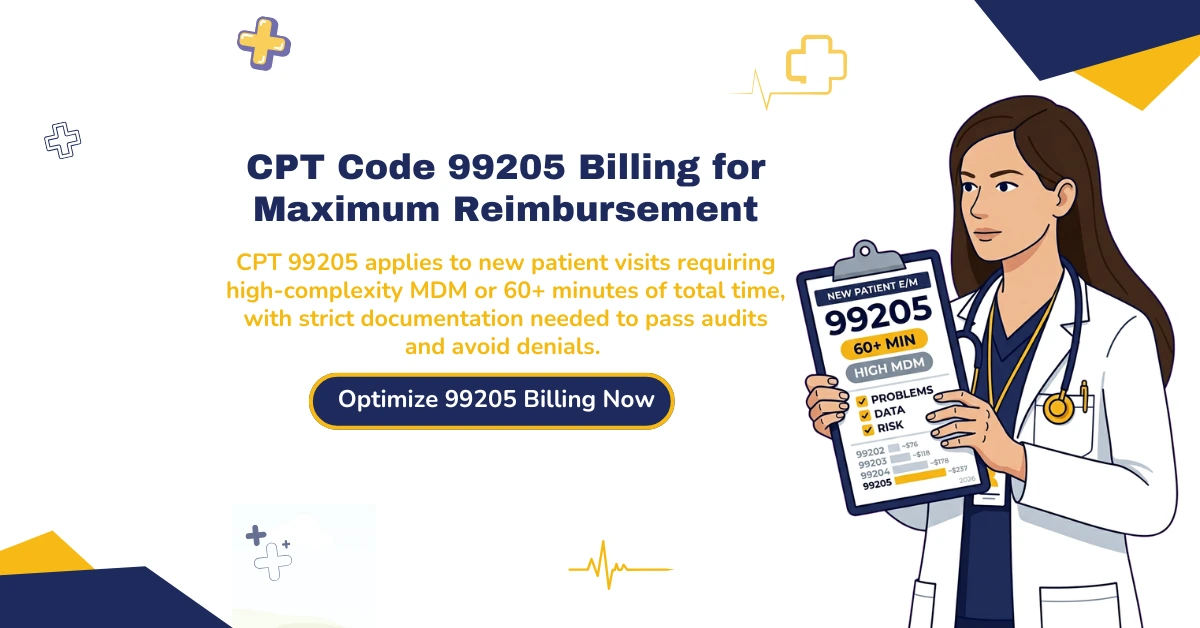
| Fact | Detail |
| Code | 99205 |
| Short Description | New patient office or other outpatient E/M visit |
| Patient Type | New patient; no professional services from the same provider, same specialty, or same group within the prior three years |
| MDM Level Required | High complexity |
| Minimum Time | 60 minutes of total provider time on the date of the encounter |
| Two Pathways | High complexity MDM or 60-plus minutes of total time; select one. Both methods are independent. |
| Work RVU (2026) | 3.17 |
| Total RVU Non-Facility (2026) | 7.09 |
| Total RVU Facility (2026) | 4.80 |
| 2026 Medicare Non-Facility Rate | Approximately $236.81 (subject to locality adjustment; source: CMS CY 2026 MPFS) |
| 2026 Medicare Facility Rate | Approximately $160.32 |
| 2026 Conversion Factor | $33.4009 (non-QP) or $33.5675 (qualifying APM participant) |
| Required Modifier | Modifier 25 when billing with a same-day procedure; Modifier 95 or GT for telehealth |
| G2211 Add-On Eligible | Yes; not payable with Modifier 25 unless the same-day service is an AWV, vaccine, or Part B preventive service |
| Prolonged Services | 99417 for commercial payers (75-plus minutes); G2212 for Medicare (89-plus minutes) |
| Audit Risk Level | High. CPT 99205 carries the highest reimbursement in the new patient E/M range and is among the most frequently reviewed codes by RAC contractors for documentation adequacy. |
| RAC Review Pattern | Practices billing more than 25 to 30 percent of new patient visits at 99205 may trigger statistical outlier review. All MDM elements must be explicitly documented, not implied by diagnosis. |
| Prior Auth Required | Varies by payer. Medicare Advantage plans and commercial payers with specialty referral requirements frequently require prior authorization for high-complexity new patient evaluations. |
What Is CPT Code 99205?
CPT 99205 Official Description and CMS Short Descriptor
The AMA CPT Professional Edition defines the code this way:
“Office or other outpatient visit for the evaluation and management of a new patient, which requires a medically appropriate history and/or examination and high level of medical decision making. When using total time on the date of the encounter for code selection, 60 minutes must be met or exceeded.”
CMS short descriptor: “Office o/p new hi 60 min.”
CPT code 99205 is the highest-reimbursed code in the new patient E/M range. It’s also one of the most frequently reviewed by Medicare Recovery Audit Contractors in post-payment audits. Both facts carry direct compliance implications for any practice billing this code regularly.
The HHS Office of Inspector General has consistently flagged new patient E/M coding at Levels 4 and 5 as a payment integrity priority across multiple annual Work Plans. RAC contractors recovered more than $900 million in improper E/M payments over the most recent multi-year audit cycle. That enforcement history shapes how post-payment reviews are conducted today.
Managing high-complexity E/M coding compliance is one of the core functions of ClaimMax RCM’s revenue cycle management team. Documentation accuracy for 99205 isn’t a billing detail; it’s a risk management issue.
What Level of Care Is 99205?
CPT 99205 represents Level 5, the highest level of E/M care for new patients in outpatient and office settings. It surpasses 99204, which requires moderate complexity, and it’s the most intensive code in the 99202 through 99205 new patient range. For established patients, the equivalent level is 99215.
Payer analytics systems flag practices whose new patient distribution skews disproportionately toward Level 5. That analysis runs automatically; no complaint or audit tip is needed to trigger it. Practices billing 99205 at a disproportionately high rate will be identified through statistical comparison long before any individual claim review begins.
Who Qualifies as a New Patient?
The AMA definition is precise: “A patient is considered new if they have not received any professional services from the physician or another physician of the same specialty and subspecialty in the same group practice within the past three years.”
New patient misclassification ranks among the top three audit triggers for CPT code 99205 compliance reviews. The three-year rule applies across the entire group practice for the same specialty. A patient seen by any cardiologist in your group within the prior three years is an established patient for every cardiologist in that group, not just the provider currently billing.
Covering and on-call encounters within the same specialty count toward the rule. You can’t correct this error at billing review; it must be caught at scheduling or registration. By the time a claim reaches the coding desk, the misclassification is already in place.
Two Pathways to Select 99205: MDM or Time
Providers select the 99205 CPT code using one of two independent pathways: high complexity MDM or 60 or more minutes of total time on the date of the encounter. This dual-pathway framework has been active since the 2021 AMA E/M guidelines overhaul. Both methods are entirely independent.
The compliance principle is straightforward. Select whichever method the documentation most clearly and completely supports. Choosing time-based coding when time documentation is ambiguous, or MDM-based coding when MDM elements aren’t fully evidenced in the note, creates the exact gap that post-payment reviewers find. The selected method must be fully supported in writing, not just clinically justifiable.
99205 Time Requirements: Updated for 2026
Total Time on Date of Encounter: 60 Minutes Minimum
CPT code 99205 requires a minimum of 60 minutes of total provider time on the date of the encounter. Per the AMA’s current language, “60 minutes must be met or exceeded.” The prior 60 to 74 minute range framework has been replaced with minimum threshold language.
That distinction matters for documentation. A note stating “60 to 74 minutes” describes a range. A note stating “total time: 64 minutes” records a specific, verifiable number. The specific figure survives post-payment scrutiny. The range invites a challenge.
This is total time on the date of the encounter, not face-to-face time only. The 99205 time requirement includes pre-visit and post-visit work, as long as the activities qualify. Understanding what qualifies is the foundation of compliant 99205 CPT code description time documentation. The AAFP’s evaluation and management time and MDM reference provides additional guidance on total time calculation.
Activities That Count Toward Total Time
Two categories determine what goes into your time count. Document only qualifying activities; including non-qualifying time inflates the record and creates a different compliance exposure.
Activities that count toward total time:
- Reviewing patient records, test results, and imaging before or after the visit
- Obtaining and reviewing separately gathered history
- Performing a medically appropriate history and/or examination
- Counseling and educating the patient, family, or caregiver
- Ordering medications, tests, or referrals
- Care coordination with other providers when not separately reported
- Documenting clinical information in the EHR
- Independently interpreting diagnostic results when not separately reported
- Communicating results or recommendations to the patient
Activities that do not count:
- Staff time (nurses, MAs, care coordinators)
- Time spent on separately reported services
- Travel time
- General teaching not specific to this patient
- Administrative tasks unrelated to clinical decision-making
Compliant Time Documentation: The Audit Defense Standard
Recording “60 minutes” without describing contributing activities fails the post-payment review standard. A bare time entry can’t be independently verified, and it’s one of the most consistent causes of time-based 99205 denials.
Here’s what compliant documentation looks like:
“Total clinician time on the date of service: 67 minutes. Activities included: review of external hospital discharge summary and cardiology records from [Institution] dated [Date] (14 minutes); face-to-face comprehensive evaluation and history (28 minutes); independent interpretation of ECG performed in office (6 minutes); care coordination call with referring physician (5 minutes); EHR documentation (14 minutes). Time excludes separately billed services.”
Compare that to “Spent 67 minutes with patient.” That’s a bare statement, unverifiable, and it invites a denial. The description of contributing activities is what makes the entry defensible in post-payment review.
Time-Based vs. MDM-Based Coding: The Compliance Choice
The two methods are fully independent. No requirement exists to document total time when billing by MDM. Whichever method you select, the documentation must completely and explicitly support it.
| CPT Code | Minimum Time | MDM Level | 2026 Non-Facility Rate | Audit Risk Note |
| 99202 | 15 min | Straightforward | Approx. $76 | Lower audit profile; lower reimbursement |
| 99203 | 30 min | Low | Approx. $118 | Moderate; time clustering at exactly 30 min triggers review |
| 99204 | 45 min | Moderate | Approx. $178 | High; frequent comparison target in RAC reviews |
| 99205 | 60 min | High | Approx. $237 | Highest; 25 to 30% billing frequency is the outlier threshold |
| 99205 + 99417 | 75-plus min (commercial) | N/A | Per additional unit | Commercial payers only; do not bill 99417 to Medicare |
| 99205 + G2212 | 89-plus min (Medicare) | N/A | Per additional unit | Medicare only; 14-minute higher threshold than 99417 |
Medical Decision Making (MDM) Requirements for CPT Code 99205
What Is High Complexity MDM?
High complexity medical decision making for CPT code 99205 requires meeting at least two of three MDM elements at the high level: the number and complexity of problems addressed, the amount and complexity of data reviewed and analyzed, and the risk of complications and morbidity or mortality from patient management.
Meeting two of three elements clinically is different from documenting two of three elements to the audit standard. Auditors evaluate the written record. Each element must be explicitly documented in the note, not implied by the diagnosis code, not inferred from visit length, and not assumed from the patient’s history. Write it out explicitly. That’s what survives review.
The CMS Medicare Learning Network E/M Services Guide reinforces the documentation standard: the record must support the level billed, not just describe the clinical encounter.
Element 1: Number and Complexity of Problems
To meet the high threshold for this element, the patient’s condition must fall into one of two AMA-defined categories:
- One or more chronic illnesses with severe exacerbation, progression, or side effects of treatment
- One acute or chronic illness or injury that poses a threat to life or bodily function
Clinical examples from cardiology and oncology presentations:
- New-onset heart failure with acute decompensation
- Unstable angina in a new cardiology patient with possible obstructive coronary artery disease
- Newly diagnosed lymphoma requiring staging workup and treatment decision
- Severe refractory arrhythmia requiring urgent intervention
- Acute hepatic failure with encephalopathy
Audit documentation standard for Element 1: state the specific condition and its severity classification directly in the note. “Hypertension, uncontrolled” is not equivalent to “acute hypertensive urgency with end-organ risk.” Write the severity language explicitly. Don’t leave it to inference from the ICD-10 code; the auditor won’t make that inference for you.
Element 2: Amount and Complexity of Data
The AMA framework uses three categories for this element. You must meet at least two of the three to satisfy the high threshold:
- Category 1: Tests, documents, orders; three or more reviewed, ordered, or resulted
- Category 2: Independent interpretation of a test performed by another provider, not separately reported
- Category 3: Discussion with an external physician who independently evaluated the patient
Audit documentation standard for Element 2: identify each source individually by name, date, or institution. “Reviewed records” is insufficient. “Reviewed cardiac catheterization report from [Institution], dated [Date], showing three-vessel disease” satisfies the standard. State “independent interpretation” explicitly when applicable; “ECG reviewed” alone doesn’t meet it.
Element 3: Risk of Complications and/or Morbidity
The AMA provides these examples of high-risk treatment decisions:
- Drug therapy requiring intensive monitoring for toxicity
- Decision regarding emergency major surgery
- Decision regarding hospitalization or escalation of care
- Decision not to resuscitate or to de-escalate care
- Parenteral controlled substances
Audit documentation standard for Element 3: name the treatment decision and the specific risk it carries. “Started new medication” doesn’t meet the standard. “Initiated chemotherapy requiring intensive monitoring for myelosuppression” does. Document the drug name, the risk it carries, and the monitoring plan. Risk must appear in the plan section, not just in the assessment.
MDM Summary Table: High Complexity with Audit Documentation Standard
| MDM Element | High Threshold (AMA) | Audit Documentation Standard |
| Problems | Severe exacerbation or life-threatening condition | State severity classification explicitly in the note; “threat to bodily function” must appear as written language, not be deducible from the ICD-10 code |
| Data | Extensive (two of three AMA categories) | Identify each data source by name, date, or institution; state “independent interpretation” explicitly when applicable; “records reviewed” fails the audit standard |
| Risk | High risk of morbidity or mortality | Name the treatment decision and the specific risk it carries; document monitoring plan; risk statement must appear in the plan section, not only in the assessment |
If two elements meet high complexity, MDM supports 99205 even when the third is at a lower level. Auditors apply this as a floor. Two of three elements documented to the high standard is the operative requirement. The note must show both explicitly.
99205 Documentation Requirements and Audit Defense Checklist
What Documentation Is Needed for CPT Code 99205?
Documentation for CPT 99205 must clearly demonstrate either high complexity MDM across at least two of three elements, or 60 or more minutes of total provider time with a description of contributing activities. Both pathways require a medically appropriate history and/or examination. The medical record must show the clinical reasoning establishing why the patient’s condition qualifies as high complexity, not just what the diagnoses are.
The difference between documentation that survives post-payment review and documentation that doesn’t is specificity, not clinical accuracy. The same encounter can involve excellent care and still fail an audit. Audit-ready documentation requires explicitly naming complexity, not implying it through diagnosis codes or visit structure.
The 10-Point Audit Defense Documentation Checklist
- Patient status confirmed as new: verify through EHR and prior claims data before the encounter, not at billing.
- Code selection method specified: state clearly in the note whether 99205 was selected by high complexity MDM or by 60-plus minutes of total time. Both methods are independent.
- If time-based: record total minutes as a specific number with a description of the activities contributing to that time. A bare time number without activity description fails post-payment review.
- If MDM-based: address all three MDM elements explicitly. Problems named with severity classification, data sources identified individually by name and date, risk stated with the specific treatment decision providing evidence.
- Medically appropriate history and/or examination documented: proportionate to the presenting complaint and specific enough for an independent reviewer to assess its clinical relevance.
- Assessment with specific ICD-10-CM codes: avoid unspecified codes when documentation supports a specific code. ICD-10 specificity mismatches trigger CO-11 denials.
- Treatment plan with specific management decisions: medications named, tests specified, referrals identified, hospitalization decision documented when applicable, monitoring plan stated.
- Provider attestation: the billing provider personally performed the service or directly supervised it. If a resident or non-physician practitioner participated, document their role and the supervising provider’s substantive involvement.
- If a same-day procedure was also performed: Modifier 25 appended to 99205, and the E/M note stands independently with its own chief complaint, history, assessment, and plan, fully separate from the procedure documentation.
- Prior authorization confirmed: when the payer requires it, the authorization number must be documented on the claim. A missing authorization number is a preventable administrative denial that typically can’t be recovered retroactively.
Sample Audit-Ready Documentation: Cardiology New Patient Scenario
Scenario: 58-year-old male, new patient referred for evaluation of exertional chest pain and a newly abnormal nuclear stress test from his primary care physician. No prior cardiology evaluation on record. The provider reviews the referring physician’s notes, the external stress test report, and a prior emergency department ECG independently. A comprehensive cardiac history and physical examination follows. The provider independently interprets the stress test, which shows a significant reversible perfusion defect. Given the possible obstructive coronary artery disease and threat to life, the provider decides to initiate an urgent cardiac catheterization referral and starts aspirin and a beta-blocker. Total time: 72 minutes.
Abbreviated audit-ready note format:
Chief Complaint: Exertional chest pain, abnormal stress test.
Data Reviewed: External nuclear stress test from [Institution] dated [Date], independently interpreted, showing reversible perfusion defect consistent with significant ischemia. Emergency department ECG from [Date] reviewed. Referring physician notes reviewed. Three external sources documented individually.
Assessment: (1) Possible significant obstructive coronary artery disease; cannot exclude acute coronary syndrome; threat to life or bodily function. (2) Hypertension, controlled on current therapy.
Plan: Urgent cardiac catheterization referral; decision for invasive procedure given threat to life from possible coronary obstruction. Initiated aspirin 81mg and metoprolol; high-risk decision requiring monitoring for medication tolerance and adverse effects.
MDM Rationale: High complexity: threat to life (Element 1 high); independent test interpretation plus three external data sources (Element 2 high); decision for urgent invasive procedure plus high-risk medication initiation (Element 3 high). Code selection method: high complexity MDM.
Three documentation failures specific to this presentation:
- “Stress test reviewed” without stating independent interpretation and clinical significance fails Element 2.
- “Chest pain” without documenting “threat to life” fails Element 1.
- “Started medications” without naming the drugs or classifying the risk fails Element 3.
Documentation that doesn’t explicitly state severity classifications, name individual data sources, or record the risk element in the treatment plan creates the gap post-payment reviewers find. ClaimMax RCM’s billing team reviews every 99205 claim for documentation-to-code alignment before submission. Learn how our medical billing service protects your high-complexity E/M revenue.
CPT Code 99205 Reimbursement Rates: 2026 Updated
Medicare Reimbursement for 99205 in 2026
The 2026 Medicare reimbursement rate for CPT code 99205 is approximately $236.81 in non-facility (office) settings and approximately $160.32 in facility (hospital outpatient) settings. These rates are based on a total non-facility RVU of 7.09 and the CMS CY 2026 MPFS Final Rule conversion factor of $33.4009 for non-qualifying APM participants, or $33.5675 for qualifying APM participants.
Verify your specific rate using the CMS Medicare Physician Fee Schedule Lookup Tool. Geographic GPCI adjustments apply in every locality, and rates can vary by more than $60 per encounter between low-cost and high-cost regions.
Knowing the correct expected rate is the foundation of underpayment detection. Practices without systematic payment posting verification allow payer remittance errors to accumulate silently. A payment posting specialist uses the RVU-based expected payment calculation to flag remittances below the contracted or fee schedule benchmark before they age into undetectable revenue loss.
2026 Medicare Locality Rate Reference with Payment Accuracy Thresholds
| Locality | Non-Facility Rate | Facility Rate | Payment Accuracy Threshold |
| National Average (0) | Approx. $215.75 | Approx. $175.64 | Flag if posted below $210 |
| Manhattan NY (210201) | Approx. $275.29 | Approx. $231.93 | Flag if posted below $265 |
| Los Angeles CA (1220201) | Approx. $241.63 | Approx. $193.82 | Flag if posted below $233 |
| Chicago IL (240202) | Approx. $239.14 | Approx. $190.21 | Flag if posted below $230 |
| Houston TX (441218) | Approx. $222.11 | Approx. $181.88 | Flag if posted below $213 |
| Miami FL (350209) | Approx. $208.85 | Approx. $171.43 | Flag if posted below $200 |
2026 Dual Conversion Factor
For the first time in Medicare’s history, CMS finalized two separate conversion factors for 2026. Non-QP clinicians use $33.4009. Qualifying APM participants use $33.5675.
The billing configuration implication is direct: practices must know which conversion factor applies to each billing clinician before configuring expected payment benchmarks in their payment posting system. A misconfigured threshold creates false positives that flag correct payments, or false negatives that miss actual underpayments. Both errors carry a cost.
Year-Over-Year Reimbursement History with Compliance Context
| Year | Non-Facility Rate | Conversion Factor | Compliance Note |
| 2021 | Approx. $224.36 | $34.89 | Post-2021 E/M guidelines: MDM and time replace history and exam as code selection drivers |
| 2022 | Approx. $244.99 | $34.61 | Peak reimbursement; audit volume increases with higher payment |
| 2023 | Approx. $220.95 | $33.06 | CF reduction; documentation standard unchanged |
| 2024 | Approx. $220.36 | $33.29 | G2211 launched; new audit pattern for longitudinal care claims |
| 2025 | Approx. $229 | $32.35 | Cigna R49 launched October 2025; automated downcoding begins |
| 2026 | Approx. $236.81 | $33.40 (non-QP) | Dual CF; PE shift; G2211 expansion; audit surface increases |
Accurate reimbursement for 99205 depends on correct rate configuration and systematic payment verification against expected amounts. ClaimMax RCM’s payment posting service reconciles every ERA and EOB at the procedure code level, flagging underpayments on 99205 and other E/M codes against contracted benchmarks.
CPT Code 99205 RVU Breakdown: Work RVU, Practice Expense, and Malpractice Components (2026)
Work RVU, Practice Expense RVU, and Malpractice RVU
The total RVU for CPT code 99205 is 7.09 in non-facility settings and 4.80 in facility settings. The work RVU (wRVU) is 3.17, reflecting physician cognitive effort and time. Practice expense and malpractice RVUs differ significantly between settings because of how CMS allocates overhead costs across POS codes.
| Component | Non-Facility (Office) | Facility | Notes |
| Work RVU (wRVU) | 3.17 | 3.17 | Identical in both settings |
| Practice Expense RVU | 3.15 | 1.06 | Non-facility higher; 2026 change: non-facility PE plus 4%, facility PE minus 7% |
| Malpractice RVU | 0.77 | 0.57 | Higher in non-facility setting |
| Total RVU | 7.09 | 4.80 | Drives Medicare payment calculation at each POS |
The 2026 PE shift applies here. CMS applied plus 4% to non-facility indirect PE RVUs and minus 7% to facility PE RVUs. Office-based practices billing POS 11 see a slight rate benefit. Hospital-employed providers billing POS 22 see a modest reduction. Update your expected payment benchmarks to reflect the correct POS before verifying remittances.
Payment Calculation and Payment Posting Application
Payment formula: Total RVU times GPCI Adjustment times Conversion Factor.
National average example (non-facility, non-QP): 7.09 times 1.0 times $33.4009 equals approximately $236.81.
The payment posting application is the part most practices miss. Calculate the expected payment for every 99205 claim before posting the remittance. Flag any payment below the threshold. Practices without that verification layer allow systematic underpayments to age past the appeal window before detection, and once that window closes, the revenue is gone.
Modifiers Used with CPT Code 99205: Complete Compliance Reference
The most commonly used modifier with CPT 99205 is Modifier 25, which indicates a significant, separately identifiable E/M service performed on the same date as a procedure. For telehealth, Modifier 95 or Modifier 93 applies. Certain payers also require prior authorization documentation before claim submission, a compliance step most modifier references omit entirely.
| Modifier | Description | When Required | Audit Compliance Requirement |
| 25 | Significant separately identifiable E/M same DOS | When a procedure is also performed on the same date | E/M note must stand independently with its own chief complaint, history, assessment, and plan; merged note fails audit standard |
| 95 | Synchronous audio-video telehealth | Real-time audio-video visits | POS 02 or POS 10; document patient consent and platform; verify payer preference for 95 vs. GT |
| 93 | Audio-only telehealth | When patient cannot access video | Not covered by all payers; document reason video was unavailable |
| 24 | Unrelated E/M during post-op global period | New patient visit unrelated to prior procedure | Document visit is unrelated to surgical diagnosis; different ICD-10 code required |
| GC | Resident under teaching physician supervision | Teaching hospital settings | Attending attestation required; resident time cannot be counted in billing provider’s total time |
| 57 | Decision for major surgery | When 99205 results in decision for major surgery within 90-day global | Document surgical decision explicitly and its basis in high-complexity findings |
Source: AMA Modifier 25 Reporting Guide; CMS Medicare Claims Processing Manual.
Modifier 25: Documentation Requirements for Audit Defense
The AMA states that different diagnoses aren’t required to justify billing both an E/M and a procedure on the same day. What the E/M documentation must do, clearly and independently, is demonstrate that the evaluation was significant and separately identifiable from the procedure’s inherent work.
Documentation standard: the E/M note must include its own chief complaint, history, assessment, and plan, entirely separate from the procedure note. A merged note covering both without clearly distinguishing between the two is one of the most consistent Modifier 25 audit failures for high-complexity E/M codes. Some payers require a separate diagnosis for the E/M when Modifier 25 is appended; verify the specific payer policy before submission.
Cigna R49 Program: Four-Step Compliance Response Protocol
Effective October 1, 2025, Cigna launched the Evaluation and Management Coding Accuracy program (R49), which algorithmically reviews 99204 and 99205 claims and may automatically adjust them down one level when documentation doesn’t support the billed code. This is an automated edit applied before payment, not a manual review.
Four-step compliance response protocol:
Step 1: Audit your current 99205 Cigna claims to identify which MDM documentation elements most frequently fail automated review. The most consistent failure is sparse Element 2 documentation, with “records reviewed” listed without naming sources.
Step 2: Replace generic MDM language with specific language. Phrases like “complex patient” or “multiple issues addressed” activate the algorithm. “Three external records reviewed by name and date,” “independent ECG interpretation showing ST-depression,” and “decision for hospitalization given threat to bodily function” do not.
Step 3: Build Cigna-specific documentation prompts into provider note templates for new high-complexity encounters.
Step 4: Monitor Cigna remittance advice for systematic downcodes. Prepare targeted appeal letters citing AMA MDM language and CMS E/M guidelines. Track appeal outcomes to identify recurring documentation gaps.
Prior Authorization Compliance for 99205 Encounters
Certain payers require prior authorization for high-complexity new patient evaluations, particularly Medicare Advantage plans, commercial payers with specialty referral requirements, and some Medicaid managed care organizations. When authorization is required, the number must appear in the correct claim field. An administrative denial from a missing authorization number is typically not reversible on appeal.
Pre-service compliance workflow: confirm prior authorization before scheduling, document the authorization number in the EHR at the time of approval, and ensure the billing system carries it to the claim automatically. Authorization obtained after the date of service is retroactive, and most payers decline it.
Prior Authorization Action Item: Review all active payer contracts for plans requiring prior authorization for new patient visits in your specialty. A missing authorization number on a 99205 claim is a preventable administrative denial that can’t typically be recovered retroactively.
ClaimMax RCM’s prior authorization services manage the full authorization request, tracking, and documentation workflow for new patient encounters across all payer types.
99204 vs 99205: How to Choose the Right Code, and Why Getting It Wrong Carries Risk in Both Directions
The primary difference between CPT 99204 and 99205 is the complexity level. CPT 99204 requires moderate complexity MDM and a minimum of 45 minutes of total time. CPT 99205 requires high complexity MDM and a minimum of 60 minutes. The reimbursement difference is approximately $53 to $59 per encounter at Medicare non-facility rates.
99204 vs 99205 Side-by-Side Comparison Table
| Factor | 99204 (Moderate) | 99205 (High) | Audit Risk Note |
| MDM Level | Moderate | High | 99205 documentation must explicitly meet two of three elements at the high threshold |
| Minimum Time | 45 min | 60 min | Time clustering at exactly 45 or 60 min is a statistical audit trigger |
| Problems Element | Multiple chronic or one worsening condition | Severe exacerbation or life-threatening condition | “Life-threatening” language must appear in the note, not be implied by the diagnosis code |
| Data Element | Moderate data review | Extensive (two of three AMA categories) | External sources must be named individually by institution and date |
| Risk Element | Prescription drug management or minor surgery | Hospitalization, intensive monitoring, emergency surgery | Name the specific high-risk decision in the plan section |
| 2026 Medicare Rate (Non-Facility) | Approx. $178 | Approx. $237 | Rate difference drives audit interest in 99205 upgrades |
| Work RVU | 2.60 | 3.17 | wRVU difference is the basis for underpayment detection between the two levels |
| Prolonged Services (Commercial) | 99417 at 75-plus min | 99417 at 75-plus min | Same commercial threshold for both codes |
| Prolonged Services (Medicare) | G2212 at 89-plus min | G2212 at 89-plus min | Same Medicare threshold for both codes |
The Dual Audit Risk at the Moderate-to-High Threshold
The code level transition from 99204 to 99205 carries audit risk in both directions, and both directions matter for a compliant billing operation.
Coding 99204 when high complexity MDM is genuinely documented and the encounter exceeds 60 minutes is an undercoding error. It’s a revenue problem, but it also signals inconsistent documentation-to-code mapping that payer analytics can identify as a pattern across a practice.
Coding 99205 when the documentation only supports moderate complexity MDM is overcoding. That’s a compliance problem, the kind that produces post-payment audit findings, recovery demands, and in patterns of repeated miscoding, potential referral to the OIG.
The right billing workflow catches both directions of error before the claim reaches the payer. Code selection should reflect what the documentation actually and completely supports, not what the provider believes the clinical encounter warranted.
Clinical Scenario: Is It 99204 or 99205?
New patient: 54-year-old female referred for a newly discovered lung mass found incidentally on imaging performed for an unrelated purpose. No respiratory symptoms. The provider performs a complete new patient history and physical, reviews the external CT scan independently, reviews the referring physician’s primary care records, and calls a pulmonologist to discuss urgent bronchoscopy. Given that possible malignancy can’t be excluded, the provider initiates an urgent referral. Total time: 52 minutes.
MDM analysis: the threat-to-life assessment for possible malignancy, independent CT interpretation, discussion with an external pulmonologist, and decision for urgent invasive referral all point toward high MDM. Time is 52 minutes, below the 60-minute threshold for time-based 99205.
Code selection by MDM: if documentation explicitly supports all three elements at the high threshold, 99205 is defensible. Code selection by time: 52 minutes supports only 99204. This scenario illustrates exactly why MDM documentation specificity determines the correct code. A vague note that doesn’t state “threat to life” explicitly would support only 99204, regardless of the clinical reality.
New Patient E/M Code Range: 99202 Through 99205 Comparison
The new patient office E/M code range consists of four active codes: 99202 through 99205. CPT 99201 was deleted effective January 1, 2021. Each code level carries a distinct complexity threshold, time requirement, reimbursement rate, and payer audit profile. Understanding the full range matters because payers analyze code distribution across the range, not just individual claims.
| CPT Code | MDM Level | Min. Time | 2026 Non-Facility Rate | Work RVU | Payer Audit Trigger |
| 99202 | Straightforward | 15 min | Approx. $76 | 0.93 | Practices billing all new patients at 99202 regardless of complexity distribution |
| 99203 | Low | 30 min | Approx. $118 | 1.60 | Time entries clustering at exactly 30 minutes; MDM elements stated but not documented to audit standard |
| 99204 | Moderate | 45 min | Approx. $178 | 2.60 | Upcoding to 99205 without explicit high complexity MDM documentation; G2211 appended without longitudinal care context |
| 99205 | High | 60 min | Approx. $237 | 3.17 | New patient billing frequency above 25 to 30 percent at Level 5; time clustering at exactly 60 minutes; documentation that states “high complexity” without evidencing the elements |
CPT 99205 sits at the top of the new patient E/M hierarchy. The revenue difference between the lowest active code (99202 at approximately $76) and the highest (99205 at approximately $237) is over $160 per encounter. That spread makes code distribution a primary target for payer statistical analysis.
Practices whose new patient coding skews heavily toward Level 5 will be identified through statistical outlier review. The question isn’t whether payers will look; it’s whether your documentation supports the distribution they’ll find. Only the new patient CPT code range of 99202 through 99205 remains active. The office visit CPT code for new patients no longer includes 99201.
99205 vs 90792: Psychiatry and Behavioral Health E/M Coding
CPT 90792 is a psychiatric diagnostic evaluation with medical services. CPT 99205 is a general evaluation and management code. Psychiatrists and psychiatric nurse practitioners should use 90792 for initial psychiatric diagnostic evaluations and 99205 when the visit focuses primarily on medical E/M with high complexity MDM that isn’t a formal psychiatric diagnostic evaluation.
When to Use 99205 vs 90792 for Psychiatric Evaluations
90792 is designed specifically for psychiatric diagnostic evaluation. It’s the appropriate code when the primary purpose of the visit is a formal diagnostic evaluation to establish a mental health diagnosis. That’s the service the code was built for.
99205 is a general E/M code applicable across all specialties. It applies when the encounter is primarily medical E/M, for example a new patient evaluation by a psychiatrist focused on managing a complex medication regimen for severe treatment-resistant depression with significant medical comorbidities. In that scenario, the clinical work is high-complexity medical decision-making rather than a formal diagnostic intake.
The compliance rule is absolute: 99205 and 90792 can’t be billed together on the same date of service. The provider must determine which code most accurately reflects the primary nature of the encounter. Billing 99205 when the service was genuinely a psychiatric diagnostic evaluation is incorrect coding regardless of whether MDM documentation would technically support the E/M level. The nature of the service determines the applicable code, not the complexity of the patient.
Which Code Pays More, and Why That Shouldn’t Drive the Decision
99205 generally reimburses slightly higher than 90792 under 2026 Medicare rates. That fact is irrelevant to code selection. Billing 99205 instead of 90792 because it reimburses higher is the definition of upcoding when the service was a psychiatric diagnostic evaluation. Document the nature of the encounter clearly and let the documentation determine the code; don’t let the reimbursement rate determine the documentation.
Prolonged Services with CPT 99205: 99417 vs G2212, Compliance Rules and Denial Risks
Prolonged service add-on codes are among the most frequently denied add-on codes in E/M billing, not because the clinical service wasn’t rendered, but because the wrong code was submitted to the wrong payer. The 99417 and G2212 distinction isn’t optional compliance knowledge. Submitting the wrong prolonged code is a categorical denial that payers won’t reverse.
Commercial Payers: CPT 99417
For non-Medicare payers, prolonged time beyond 99205’s threshold is reported with CPT 99417, billed in units of each additional 15 minutes. AMA thresholds:
| Total Time | Correct Billing (Commercial) |
| 60 to 74 min | 99205 only |
| 75 to 89 min | 99205 + 99417 x1 |
| 90 to 104 min | 99205 + 99417 x2 |
| 105-plus min | 99205 + 99417 x3 or more |
Documentation requirements for 99417: time-based code selection must be stated for the base 99205, total minutes must exceed the threshold, and a description of activities during the prolonged time must appear in the note. CPT 99417 is not payable to Medicare. Billing it to Medicare produces a denial that can’t be appealed as a coverage matter.
Medicare: HCPCS G2212
For Medicare patients, prolonged time uses G2212 with a higher threshold than 99417. The 14-minute difference between the two thresholds is the most common source of prolonged service billing errors.
| Total Time | Correct Billing (Medicare) |
| 60 to 74 min | 99205 only |
| 75 to 88 min | 99205 only (G2212 threshold NOT met) |
| 89 to 103 min | 99205 + G2212 x1 |
| 104 to 118 min | 99205 + G2212 x2 |
G2212 is not payable to commercial payers. The 89-minute minimum threshold is absolute; there is no rounding or exception.
The Compliance-Critical Distinction: One Scenario, Two Different Correct Answers
An 80-minute 99205 visit is billed as 99205 plus 99417 x1 for commercial payers. The same visit is billed as 99205 only for Medicare, because G2212’s 89-minute threshold isn’t met and 99417 doesn’t apply to Medicare.
Billing the wrong code to the wrong payer is a categorical denial. Billing G2212 to a commercial payer or 99417 to Medicare produces denials that aren’t overturnable through clinical appeal. They’re wrong-code submissions, not medical necessity disputes.
Documentation Requirements for Prolonged Services
Both 99417 and G2212 require the following in the medical record:
- Time-based code selection clearly stated for the base 99205; MDM-based billing doesn’t support prolonged service add-on codes
- Total minutes documented as a specific number exceeding the applicable threshold
- Description of activities during the prolonged time beyond the base threshold
- Confirmation that separately billed services are excluded from the time count
Source: CMS Medicare Claims Processing Manual, Chapter 12.
Telehealth and CPT 99205: 2026 Coverage Rules and Compliance Requirements
Can You Bill 99205 via Telehealth?
Yes. CPT 99205 can be billed for telehealth encounters when all MDM or time requirements are fully met. The encounter must be synchronous audio-video for most payers and for Medicare. CMS confirms 99205 on the 2026 List of Telehealth Services. The same documentation standards that apply in-person apply to telehealth; time entries and MDM documentation must be equally specific regardless of the visit modality.
Place of Service, Modifier, and Compliance Requirements
| Element | Requirement |
| POS for telehealth (not patient’s home) | POS 02 |
| POS for telehealth from patient’s home | POS 10 |
| Modifier (synchronous audio-video) | Modifier 95 (CMS standard); Modifier GT required by some commercial payers and Medicaid |
| Modifier (audio-only) | Modifier 93 when patient cannot access video; not covered by all payers |
| Technology platform | Real-time interactive audio and video via HIPAA-compliant platform |
| State consent requirement | Many states require documented patient consent confirming the patient agrees to receive care via telehealth and understands remote evaluation limitations; verify state-specific requirements |
| Documentation | Note that the visit was conducted via telemedicine; specify platform used; document patient consent where required |
The state consent requirement row is a compliance element that most telehealth billing guides omit. A telehealth 99205 claim that lacks documented patient consent in a state requiring it creates an audit vulnerability that isn’t visible until a payer audit surfaces the missing consent form.
For practices billing CPT 99205 and other high-complexity E/M codes for telehealth visits, ClaimMax RCM’s telehealth medical billing services manage modifier accuracy, POS assignment, and state-specific consent compliance.
Nine Audit Triggers for CPT Code 99205, and How to Defend Every Claim
CPT 99205 claims face post-payment review more frequently than any other code in the new patient E/M range because the combination of high reimbursement and complexity-based code selection creates the broadest surface area for documentation-to-code mismatches. The nine triggers below are the specific patterns that RAC contractors and Medicare Administrative Contractors identify in pre-payment and post-payment review for 99205 claims.
Nine Audit Triggers for 99205 Claims
Trigger 1: New Patient Status Misclassification. Billing 99205 for a patient seen by the same provider, same specialty, or same group within the prior three years. RAC Enforcement Pattern: automated cross-reference of the claim against prior visit history in the MAC’s claims database. This is a system-level review that doesn’t require a human auditor to initiate. Resolution: build a patient status verification step into scheduling or registration. By the time the claim reaches billing, the misclassification has already occurred.
Trigger 2: High Complexity MDM Stated Without Documentation. Writing “high complexity MDM” in the assessment section without evidencing the elements. Problems not severity-classified, data sources not individually identified, risk not named in the treatment plan. RAC Enforcement Pattern: medical reviewer checks for three-element documentation and flags “complexity stated but not evidenced” as a documentation deficiency supporting downcode to 99204. Resolution: each MDM element must be explicitly named in the note. “High complexity” as a standalone conclusion fails medical review every time.
Trigger 3: Time Entry Without Activity Description. Recording “62 minutes” without describing contributing activities. A bare time number can’t be independently verified. RAC Enforcement Pattern: time-based claims without activity descriptions are flagged by post-payment review algorithms. Time entries that exactly match the code’s minimum threshold are among the highest-flagged patterns in the data. Resolution: document specific activities and the time each consumed. Exact-threshold time entries without supporting activity descriptions are a primary statistical flag.
Trigger 4: Billing Frequency Exceeding Specialty Benchmark. A practice billing more than 25 to 30 percent of new patient visits at 99205 when the specialty norm is significantly lower. RAC Enforcement Pattern: statistical outlier analysis compares the practice’s 99205 billing frequency against all practices of the same specialty in the MAC region. Outliers are selected for review regardless of individual claim documentation quality. Resolution: conduct quarterly internal distribution analysis. If your 99205 frequency significantly exceeds specialty peers, document the patient acuity factors driving that distribution proactively.
Trigger 5: G2211 Without Longitudinal Care Documentation. Appending G2211 to 99205 for encounters where the note describes a one-time or acute-only evaluation without any reference to ongoing care coordination or the provider’s longitudinal relationship with the patient. RAC Enforcement Pattern: G2211 claims are reviewed for longitudinal care context. A new patient note that describes an acute evaluation without future care coordination intent doesn’t support G2211. Resolution: only append G2211 when documentation explicitly reflects the provider’s role as the focal point for the patient’s ongoing care management. Write it in the note.
Trigger 6: Modifier 25 Without Standalone E/M. Appending Modifier 25 to 99205 when the E/M note doesn’t stand independently from the procedure documentation. RAC Enforcement Pattern: merged notes covering both the evaluation and the procedure are flagged for Modifier 25 non-compliance. The reviewer looks for an E/M note with its own chief complaint, history, assessment, and plan, fully separate from any procedure note. Resolution: the E/M note must be structurally independent from the procedure note; same date of service, different documentation sections, each internally complete.
Trigger 7: MDM Data Element Without Named Sources. The data element is documented as “extensive” but external records are referenced generically with phrases like “records reviewed” or “prior notes reviewed” without naming the source, institution, or date. RAC Enforcement Pattern: generic data source references fail the AMA documentation standard and are treated as the element not having been met during medical review. This converts high complexity MDM to moderate, downcoding the claim. Resolution: name every external source individually. “Hospital discharge summary from [Institution] dated [Date] reviewed” satisfies the standard. “Records reviewed” does not.
Trigger 8: Prior Authorization Number Missing from Claim. Submitting 99205 to a payer that requires prior authorization without the authorization number in the required claim field. RAC Enforcement Pattern: administrative denial on adjudication, automated, not clinical. Most payers won’t reverse this denial even on appeal because the authorization requirement is a condition of payment, not a clinical coverage question. Resolution: confirm authorization before every new patient encounter for every payer that requires it. The authorization number must be in the EHR and carry to the claim automatically.
Trigger 9: Templated or Copy-Paste Documentation. Clinical notes that appear structurally identical across multiple patients, suggesting auto-populated fields rather than individually documented encounters. RAC Enforcement Pattern: documentation audits identify copy-paste patterns through identical or near-identical language across multiple dates of service for the same patient or across multiple patients. This pattern is treated as evidence that the documentation doesn’t reflect individual encounters. Resolution: EHR templates must guide documentation, not pre-fill it. Each note must reflect the specific clinical findings of that individual encounter.
| Trigger | RAC Enforcement Pattern | Prevention Priority |
| New patient misclassification | Automated cross-reference at MAC level | System-level verification at scheduling |
| MDM stated without evidence | Medical reviewer downcode to 99204 | Explicit element documentation in note |
| Bare time entry | Automated flag at exact threshold | Activity description required for every time entry |
| Frequency outlier | Statistical outlier selection by MAC region | Quarterly distribution analysis and acuity documentation |
| G2211 without longitudinal context | Medical review for longitudinal care documentation | Longitudinal care intent stated explicitly in note |
| Modifier 25 without standalone E/M | Merged note flag | Independent E/M documentation required |
| Data sources not named | Element not credited; downcode to 99204 | Individual source identification by name and date |
| Prior auth missing | Administrative denial; non-reversible | Pre-service authorization confirmation required |
| Templated documentation | Pattern audit flag; documentation validity challenged | Individual encounter documentation for each patient |
Audit risk and claim denials for 99205 share the same root cause: a billing workflow that hasn’t been built around the compliance requirements of each payer in your portfolio. ClaimMax RCM’s billing team reviews every 99205 claim for the nine triggers above before submission, catching documentation gaps and configuration errors before they become denials or post-payment findings. Our denial management services file appeals within 24 hours when denials occur. Our AR follow-up team tracks every outstanding 99205 claim before it ages past the appeal window. Learn how our medical billing service protects your high-complexity E/M revenue.
CPT 99205 Audit Risk and Compliance Considerations (2026)
Why 99205 Is a High-Audit-Risk Code
CPT 99205 is a high-audit-risk code because it carries the highest reimbursement in the new patient office visit range. Payers monitor billing patterns for 99205, and practices billing a disproportionately high percentage of new patient visits at Level 5 may trigger automated statistical outlier review or manual post-payment audit. Cigna’s R49 algorithmic downcoding program targets 99205 specifically.
The specific risk threshold: when more than 25 to 30 percent of new patient visits are billed at 99205, some MAC regions apply heightened scrutiny. A practice at 40 percent 99205 new patient billing in a specialty where the regional average is 15 percent will be identified by statistical analysis without a complaint or tip triggering the review.
Self-Audit Checklist for 99205 Compliance
For every 99205 encounter, verify:
- Patient was genuinely new: three-year rule confirmed through EHR and claims data, not assumed.
- High complexity MDM evidenced across two or more of three elements, not just stated.
- Problems documented with explicit severity language (“severe exacerbation,” “threat to bodily function”), not implied by ICD-10 code.
- Data sources specified by name and date, not referenced generically.
- Risk explicitly documented in the plan section: treatment decision named with specific risk level.
- Time documentation includes activity description if time-based selection was used.
- Time excludes separately billed services and staff time.
- Assessment and plan reflect the documented complexity, not boilerplate language.
- Prior authorization confirmed and authorization number on the claim when required.
- Modifier 25 appended with standalone E/M documentation when a same-day procedure was performed.
Split and Shared Visit Rules: 2026 Update
When a physician and a non-physician practitioner both see the same new patient on the same date, 2026 rules require clear documentation of which provider performed which portion. If billing by time, the billing provider must have spent more than 50 percent of the total time. If billing by MDM, the billing provider must have performed the substantive portion of the MDM.
The note must name the billing provider and document their specific involvement, not just list two providers without specifying roles. Vague attestations like “I was present for the visit” don’t satisfy the substantive involvement standard. Practices with split/shared documentation questions should review ClaimMax RCM’s revenue cycle management services for E/M compliance configuration.
Which Providers Can Bill CPT Code 99205?
Eligible Provider Types
CPT code 99205 can be billed by physicians (MD and DO), nurse practitioners, and physician assistants when they personally perform the encounter and document high complexity MDM or 60 or more minutes of total time.
| Provider Type | Can Bill 99205? | Compliance Note |
| Physician (MD, DO) | Yes | Must be enrolled with each payer; NPI must match service location on file |
| Nurse Practitioner (NP) | Yes | Bills under own NPI; Medicare pays at 85% of physician fee schedule |
| Physician Assistant (PA) | Yes | Bills under own NPI; Medicare pays at 85% of physician fee schedule |
| Clinical Psychologist | Payer-specific | Some payers allow E/M codes within scope; verify before billing |
| Registered Nurse | No | Cannot independently bill E/M codes under any payer |
| Medical Assistant | No | Cannot independently bill E/M codes under any payer |
Only time personally spent by the billing provider counts toward the 60-minute threshold. Staff time cannot be included under any circumstances. This rule applies to NPs, PAs, and physicians equally.
Incident-To Billing and CPT 99205: The Audit Pattern
Incident-to billing does not apply to CPT 99205. Incident-to applies only to established patients. CPT 99205 is a new patient code and can never be billed incident-to under any payer.
RAC audit pattern: when a new patient code appears under a physician NPI but documentation shows the encounter was performed entirely by a non-physician practitioner without direct physician involvement, the claim fails the incident-to standard. The correct workflow is for the non-physician practitioner to bill under their own NPI. Provider credentialing with each payer is a prerequisite.
ClaimMax RCM’s credentialing services manage the full payer enrollment process for both physicians and non-physician practitioners so providers are authorized to bill before the first claim is submitted.
When to Use CPT 99205, and When Not To
Appropriate Clinical Scenarios for 99205
CPT 99205 is appropriate when the new patient encounter genuinely involves high complexity MDM, specifically when the patient’s condition poses a threat to life or bodily function, requires extensive data review, and involves a high-risk treatment decision, or when total provider time exceeds 60 minutes with documentation fully supporting that time.
Appropriate clinical scenarios for this new patient CPT code:
- New patient with newly diagnosed malignancy requiring comprehensive workup and specialist coordination
- Initial evaluation of severe major depressive disorder with active suicidal ideation requiring safety planning and a possible hospitalization decision
- New patient with acute myocardial infarction symptoms or unstable angina requiring urgent cardiac workup
- Multi-system complex disease evaluation where two or more chronic illnesses are in severe exacerbation simultaneously
- Complex trauma history with dissociative symptoms requiring extensive history gathering from multiple external sources and discussion with prior treating providers
When 99205 Is Not Appropriate
These encounter types don’t support 99205, even when the visit feels complex:
- Lengthy but clinically straightforward visits: a 65-minute intake with a single uncomplicated condition can support 99205 by time, but not by MDM. Select the method your documentation actually supports.
- Comprehensive new patient intakes with extensive history-taking but no genuinely high-risk treatment decision: extensive history alone doesn’t constitute high data complexity.
- Stable chronic conditions that don’t pose an immediate threat: stable hypertension, controlled diabetes, and routine chronic condition management don’t meet the high MDM threshold regardless of diagnosis count.
- Documentation that supports moderate but not high MDM: bill 99204. Accurate coding means billing at the right level, not the highest level.
- Routine new patient wellness encounters: preventive services use a separate code set entirely.
Billing 99205 for every new patient regardless of complexity is the single fastest path to RAC outlier selection. Accurate coding means matching code to documentation, not optimizing code level per encounter.
Key E/M Changes Affecting CPT Code 99205 (2021 Through 2026)
2021: The E/M Framework Overhaul
The January 1, 2021 changes fundamentally restructured how new patient E/M codes are selected:
- History and exam no longer drive code selection; MDM or time does.
- CPT 99201 was deleted; only 99202 through 99205 remain active for new patients.
- Time changed from face-to-face only to total time on the date of the encounter.
- “Medically appropriate” history and exam replaced the rigid multi-element component requirements.
These changes remain the active framework through 2026. The most compliance-significant change: MDM-based code selection now requires explicit documentation of each element. The old model allowed implied complexity through a thorough history and exam. The AMA’s new model requires stated complexity in MDM-specific language, and auditors evaluate the record accordingly.
2024: Time Threshold Language Update
AMA revised the time language from “60 to 74 minute range” to “60 minutes must be met or exceeded.” The practical documentation impact: record a specific total time number, not a range. The compliance principle didn’t change; the language clarification makes the documentation standard more precise and removes the ambiguity that bare range entries created.
2026: What’s New This Year and What It Means for Compliance
Four changes affect CPT code 99205 directly in 2026:
Change 1: Dual Conversion Factors. Non-QP providers use the CMS physician fee schedule 2026 rate of $33.4009; qualifying APM participants use $33.5675. Compliance implication: payment posting expected amounts must be configured to the correct conversion factor per billing clinician. Wrong configuration produces false underpayment flags or missed actual underpayments.
Change 2: Practice Expense Shift. Non-facility PE RVUs increased by plus 4%; facility PE RVUs decreased by minus 7%. Compliance implication: expected payment benchmarks for 99205 at POS 11 should be updated upward from prior-year baselines. Out-of-date benchmarks miss legitimate underpayments.
Change 3: G2211 Expansion. G2211 is now reportable with home visit codes in addition to office codes. Compliance implication: the expansion increases the audit surface for G2211 misuse. Any provider appending G2211 to home visit codes must ensure the longitudinal care documentation standard is explicitly met in the record.
Change 4: Cigna R49 Program Continuation. Algorithmic downcoding of 99204 and 99205 continues from October 2025 into 2026 under the Cigna R49 program. Compliance implication: Cigna claims require explicit MDM documentation. The automated review doesn’t distinguish between a rushed note and a genuinely straightforward encounter; it evaluates what’s written.
Frequently Asked Questions About CPT Code 99205
What is CPT code 99205?
CPT code 99205 is the highest-level evaluation and management code for new patient office or outpatient visits. It requires high complexity medical decision making or a minimum of 60 minutes of total provider time on the date of the encounter. It’s used for patients with severe, complex, or life-threatening conditions. It’s also the highest-reimbursed code in the new patient E/M range and one of the most frequently reviewed by RAC contractors for documentation adequacy.
How many minutes does a 99205 visit require?
CPT code 99205 requires a minimum of 60 minutes of total provider time on the date of the encounter. Per AMA’s current language, “60 minutes must be met or exceeded.” This includes face-to-face evaluation, record review, test ordering, care coordination, counseling, and documentation. Staff time doesn’t count. Document the total as a specific number and list contributing activities; a bare time entry without activity description fails post-payment review.
What documentation is needed for 99205?
Documentation must demonstrate either high complexity MDM across at least two of three elements, with problems described using severity language, data sources individually named, and risk explicitly stated in the plan, or 60-plus minutes of total time with an activity description. Both require a medically appropriate history and/or examination. Unspecified “high complexity MDM” without evidencing the elements doesn’t survive medical review.
What is the difference between 99204 and 99205?
CPT 99204 requires moderate complexity MDM and 45 or more minutes. CPT 99205 requires high complexity MDM and 60 or more minutes. The 2026 Medicare non-facility rate difference is approximately $53 to $59 per encounter. Coding risk runs in both directions: undercoding 99205 as 99204 is a revenue problem; overcoding 99204 as 99205 is a compliance problem. Both error types carry financial consequences.
What is the RVU for CPT 99205?
The total RVU for CPT 99205 is 7.09 in non-facility (office) settings and 4.80 in facility settings. The work RVU is 3.17, practice expense RVU is 3.15 non-facility or 1.06 facility, and malpractice RVU is 0.77 non-facility or 0.57 facility. Medicare payment equals total RVUs multiplied by the 2026 conversion factor ($33.4009 for non-QP clinicians), adjusted by the geographic GPCI for the provider’s locality.
How much does Medicare pay for 99205 in 2026?
The 2026 Medicare non-facility rate for CPT code 99205 is approximately $236.81. The facility rate is approximately $160.32. Geographic locality adjustments produce a range from approximately $200 to $276 across MAC regions. CMS finalized two conversion factors for 2026: $33.4009 for non-QP clinicians and $33.5675 for qualifying APM participants. Verify your specific rate at the CMS Physician Fee Schedule Search Tool for your locality.
Does CPT 99205 need a modifier?
Modifier 25 is required when billing 99205 with a same-day procedure; the E/M note must stand independently from the procedure documentation. Modifier 95 applies for synchronous telehealth. Modifier 24 applies when the new patient visit is unrelated to an active surgical global period. Cigna’s R49 program algorithmically downcodes 99205 when documentation is insufficient; Modifier 25 documentation must be particularly airtight for Cigna claims.
Is there a risk of audit using 99205 often?
Yes. CPT 99205 is a high-audit-risk code because of its high reimbursement. Practices billing more than 25 to 30 percent of new patient visits at Level 5 may trigger automated statistical outlier review. Cigna’s R49 program algorithmically downcodes 99205 claims when documentation is insufficient. Conduct quarterly self-audits to verify that billing frequency reflects genuine clinical complexity and that documentation explicitly supports the level billed.
What are the most common audit triggers for 99205?
The nine primary audit triggers for CPT 99205 are: new patient misclassification, high MDM stated without documentation, bare time entries at the 60-minute threshold, billing frequency above the specialty outlier threshold, G2211 appended without longitudinal care context, Modifier 25 without a standalone E/M note, data sources not individually named, prior authorization number missing from the claim, and templated documentation patterns. Each trigger has a distinct RAC enforcement pattern.
Can a nurse practitioner bill CPT 99205?
Yes. Nurse practitioners can bill CPT 99205 under their own NPI when they personally perform the encounter and document high complexity MDM or 60-plus minutes of total time. Medicare pays NPs at 85% of the physician fee schedule rate, approximately $201 for a non-facility 99205 versus $237 for a physician. CPT 99205 can’t be billed incident-to for new patients under any payer. The NP must be enrolled through credentialing services with each payer before billing.
What is the difference between 99417 and G2212 for prolonged services with 99205?
CPT 99417 applies to commercial payers when total time exceeds 74 minutes (first unit at 75-plus minutes, each additional 15 minutes). HCPCS G2212 applies to Medicare with a higher threshold: first unit requires 89-plus minutes. An 80-minute 99205 visit qualifies for 99205 plus 99417 for commercial payers but 99205 alone for Medicare because G2212’s 89-minute threshold isn’t met. Using the wrong prolonged code for the wrong payer produces a categorical denial that isn’t reversible.
What should I look for in a billing service for 99205 audit compliance?
A billing service built for 99205 audit compliance should review documentation-to-code alignment before submission, manage Cigna R49 compliance, configure payer-specific prior authorization workflows, and file denial appeals with MDM-specific documentation. ClaimMax RCM provides a full medical billing service covering 99205 coding accuracy review, prior authorization management, denial management, and AR follow-up. Practices with recurring 99205 downcodes or audit findings benefit most from a billing partner whose workflow is designed for first-submission claim defense. Contact ClaimMax RCM to review your current 99205 billing configuration.
[Author Name], CPC, has [X] years of experience in evaluation and management coding, payer compliance review, and revenue cycle management for multi-specialty healthcare practices. This work focuses on E/M audit defense, new patient code accuracy, and denial recovery across Medicare, Medicare Advantage, Medicaid, and commercial payer portfolios. [Author] has represented practices during Medicare Recovery Audit Contractor reviews and developed E/M coding compliance protocols at ClaimMax RCM.
Sources
- American Medical Association. CPT Professional Edition 2026. American Medical Association; 2025. ama-assn.org
- Centers for Medicare and Medicaid Services. CY 2026 Medicare Physician Fee Schedule Final Rule. cms.gov/medicare/payment/fee-schedules/physician
- Centers for Medicare and Medicaid Services. CY 2026 Medicare Physician Fee Schedule Final Rule Fact Sheet. cms.gov/newsroom/fact-sheets
- Centers for Medicare and Medicaid Services. Medicare Claims Processing Manual, Chapter 12. cms.gov
- Centers for Medicare and Medicaid Services. Evaluation and Management Services Guide. MLN006764. cms.gov
- Centers for Medicare and Medicaid Services. List of Telehealth Services for Calendar Year 2026. cms.gov
- American Academy of Family Physicians. Evaluation and Management Coding Reference. aafp.org
- HHS Office of Inspector General. Work Plan. oig.hhs.gov
- American Medical Association. Modifier 25 Reporting Guide. ama-assn.org
- Cigna. Evaluation and Management Coding Accuracy Program (R49). cigna.com
The reimbursement figures in this article are national estimates based on the 2026 CMS Physician Fee Schedule and are provided for reference purposes only. Actual payment varies by geographic locality, payer contract, provider type, and claim-specific factors. Verify current rates through the CMS Physician Fee Schedule Look-Up Tool or your specific payer contract.