What Is CPT Code 98008?
CPT code 98008 reports a synchronous audio-only evaluation and management visit with a new patient, requiring a medically appropriate history and/or examination, straightforward medical decision making, and more than 10 minutes of medical discussion. The American Medical Association introduced it effective January 1, 2025.
You’ll find the 98008 CPT code in the CPT book, but you won’t find it on a paid Medicare remittance. The payer on the card decides whether the claim clears, and that one fact drives most of the decisions below.
The coding team behind ClaimMax RCM medical billing maintains this guide against current CPT descriptors and the CY 2026 Medicare Physician Fee Schedule. We update it whenever CMS publishes new telehealth rulemaking.
CPT 98008 at a glance
| Attribute | Value |
|---|---|
| Patient type | New patient |
| Technology | Synchronous audio-only |
| Medical decision making | Straightforward |
| Discussion requirement | More than 10 minutes |
| Time threshold | 15 minutes met or exceeded when coding by time |
| Practical time range | 15 to 29 minutes |
| Code family | Telemedicine Evaluation and Management Services |
| Effective date | January 1, 2025 |
| Medicare status | Status indicator I, not valid for Medicare purposes |
| Modifier | None required on 98008 |
| Office visit equivalent | CPT 99202 |
Table 1. CPT 98008 specification summary. Source: AMA CPT code set, CY 2026 Medicare Physician Fee Schedule.
Who can report CPT 98008
A physician, nurse practitioner, or physician assistant who bills E/M services has to perform the encounter personally. Clinical staff time doesn’t count toward the total, and it won’t support the code on its own.
The provider also has to join the call and make the clinical decisions. A medical assistant collecting history before the provider picks up isn’t billable time under 98008 CPT code rules.
The Official CPT 98008 Descriptor and What Each Clause Requires
The full 98008 CPT code description sits in the AMA CPT codebook under Telemedicine Evaluation and Management Services:
98008 Synchronous audio-only visit for the evaluation and management of a new patient, which requires a medically appropriate history and/or examination, straightforward medical decision making, and more than 10 minutes of medical discussion. When using total time on the date of the encounter for code selection, 15 minutes must be met or exceeded.
Clause by clause: what the descriptor demands
| Clause | What it requires |
|---|---|
| Medically appropriate history and/or examination | The treating provider determines the scope. No element counts apply |
| Straightforward medical decision making | The lowest MDM tier: minimal problems, minimal or no data, low risk |
| More than 10 minutes of medical discussion | Real-time verbal exchange. Applies under both selection pathways |
| 15 minutes must be met or exceeded | Conditional. Applies when you select the code by total time |
Table 2. The four operative clauses in the 98008 CPT code description. Source: AMA CPT code set.
What the descriptor does not say
The descriptor publishes a floor and stops. It names no upper limit for 98008 CPT, and it gives no guidance on what to do at 30 minutes.
That ceiling comes from somewhere else. 98009 opens at 30 minutes, so a 30-minute new patient audio-only visit belongs to 98009 and 98008 tops out one minute earlier. Published sources quote the 15 to 29 minute range without saying where the 29 came from.
The ACAAI telemedicine code guidance carries the complete descriptor set alongside the CMS payment position, which makes it a useful cross-check when a payer rep gives you a different answer than the contract does.
MDM or Time: The Two Ways to Select CPT 98008
Two independent pathways support this code. Pick one and document it. Mixing them creates an audit problem that surfaces months after the claim paid.
Pathway A: selecting by medical decision making
Straightforward MDM supports 98008 CPT code on its own. The encounter still needs more than 10 minutes of medical discussion, and no 15-minute total applies.
A straightforward MDM visit involves one self-limited problem, minimal or no data reviewed, and minimal risk from the treatment discussed. Document the problem addressed, the data considered, and the risk level.
Pathway B: selecting by total time
Total time on the date of the encounter has to meet or exceed 15 minutes. The more-than-10-minute discussion requirement still applies on its own.
Count the minutes the provider personally spent on the encounter date. Reviewing outside records, ordering medications, documenting in the chart, and coordinating care all count toward the total.
Leave out the scheduling call and the minutes your staff spent reaching the patient. Time already billed under another CPT code stays out too. Those exclusions cost practices a level of service on audit more often than any other time error.
Does CPT 98008 require 15 minutes?
No. The 15-minute total applies only when you select the code by time. The 10-minute discussion floor is mandatory under both pathways, and the 15-minute total is mandatory under one.
A 12-minute audio-only visit with straightforward MDM and 11 minutes of medical discussion supports 98008. A 20-minute visit where the provider talked for 8 minutes doesn’t, because the discussion never cleared 10.
Where CPT 98008 Sits in the 98000 to 98016 Telehealth Family
98008 opens the audio-only half of the AMA’s telemedicine section. The section arrived with the 2025 CPT code set and carries into 2026 unchanged.
The three subgroups
| Range | Modality | Patient types | Selection basis |
|---|---|---|---|
| 98000 to 98007 | Synchronous audio-video | New: 98000 to 98003. Established: 98004 to 98007 | MDM or total time |
| 98008 to 98015 | Synchronous audio-only | New: 98008 to 98011. Established: 98012 to 98015 | MDM or total time, plus more than 10 minutes of discussion |
| 98016 | Brief communication technology service | Established only | 5 to 10 minutes, patient-initiated |
Table 3. Structure of the telehealth CPT codes 2026 family. Source: AMA CPT code set.
For the audio-video half of this family, see the ClaimMax CPT 98000 audio-video guide, which covers the 10-minute rule that applies to 98008 through 98015 and doesn’t apply to 98000.
What replaced 99441, 99442, and 99443
The AMA deleted telephone codes 99441, 99442, and 99443 on January 1, 2025. HCPCS G2012 went with them, replaced by 98016. A 2026 claim carrying any of those four codes denies before it reaches an adjudicator, which makes the 99442 replacement code question a charge-master problem rather than a coding one.
Telephone codes and audio-only codes aren’t the same thing, and the AMA drew the distinction on purpose. The old telephone codes covered established patients only, the patient had to initiate the call, and a time cap applied.
Audio-only codes work differently. They cover new and established patients, the provider can initiate the encounter, and no cap applies. The AMA telehealth CPT guidance documents why the panel built the set this way.
CPT 98008 vs 98009 vs 98010 vs 98011: The New Patient Audio-Only Ladder
Four codes cover new patient audio-only visits. MDM level and time threshold separate them, and both ladders climb together.
| Code | MDM | AMA threshold | Practical range |
|---|---|---|---|
| 98008 | Straightforward | 15 minutes | 15 to 29 minutes |
| 98009 | Low | 30 minutes | 30 to 44 minutes |
| 98010 | Moderate | 45 minutes | 45 to 59 minutes |
| 98011 | High | 60 minutes | 60 to 74 minutes |
Table 4. New patient audio-only time ladder. AMA thresholds are published floors. Practical ranges close at the next code threshold. Source: AMA CPT code set.
The AMA publishes the floors. Each ceiling in that table comes from the next code’s floor, which is why you won’t find the practical ranges printed in the codebook.
What is CPT code 98009?
98009 reports a synchronous audio-only new patient visit at low medical decision making, with more than 10 minutes of medical discussion. Coding by time instead, 30 minutes must be met or exceeded.
What is CPT code 98010?
98010 reports the same encounter at moderate medical decision making. The time threshold sits at 45 minutes. Secondary sources circulate a 40-minute figure, and billing a 42-minute visit as 98010 on that basis creates a level-of-service problem on review.
What is CPT code 98011?
98011 reports the same encounter at high medical decision making, with a 60-minute threshold under time-based selection. It closes the new patient audio-only range.
The 98011 CPT code description also carries the only prolonged-services instruction in this half of the family.
When prolonged services apply
At 75 minutes or more, report 99417 with 98011. Nothing below that threshold qualifies, because 98008, 98009, and 98010 sit too low to leave a complete 15-minute prolonged unit above them.
The ClaimMax 99417 prolonged services rules guide covers the Medicare side of that pairing, where CMS assigns 99417 the same status indicator I that blocks 98008.
CPT 98012 to 98015: The Established Patient Audio-Only Codes
The established patient ladder mirrors the new patient ladder at lower time thresholds, because the provider already knows the chart.
| Code | MDM | AMA threshold | Practical range |
|---|---|---|---|
| 98012 | Straightforward | 10 minutes exceeded | 11 to 19 minutes |
| 98013 | Low | 20 minutes | 20 to 29 minutes |
| 98014 | Moderate | 30 minutes | 30 to 39 minutes |
| 98015 | High | 40 minutes | 40 to 54 minutes |
Table 5. Established patient audio-only time ladder. Source: AMA CPT code set.
What is CPT code 98012?
98012 reports a synchronous audio-only established patient visit at straightforward medical decision making. The 98012 CPT code description contains a wording difference the rest of the family doesn’t share.
Every other code in the range says the threshold must be met or exceeded. 98012 says 10 minutes must be exceeded. An 11-minute visit qualifies, and a visit that lands at 10 minutes flat falls short.
What is CPT code 98013?
98013 covers the same encounter at low medical decision making, with a 20-minute threshold under time-based selection.
What is CPT code 98014?
98014 covers moderate medical decision making at 30 minutes. The 98014 CPT code description otherwise matches its siblings clause for clause.
What is CPT code 98015?
98015 covers high medical decision making at 40 minutes and closes the audio-only range. At 55 minutes or more, report 99417 alongside it.
New or established: the three-year test
A new patient has received no professional service from this provider, or from a same-specialty provider in the same group, within the past three years. Everyone else is established.
Billing 98008 for a patient your partner saw 18 months ago produces a denial your front desk could have prevented at registration. Rebill 98012 through 98015 by MDM or time.
CPT 98008 vs 99202, 98000, and 98016: The Crosswalks Billing Teams Get Wrong
Four comparisons account for most of the confusion around this code. Each one has a different answer.
98008 vs 99202: same encounter, different modality
98008 and 99202 describe a new patient encounter at straightforward complexity with comparable time. The modality separates them, and so does the payer.
| Audio-only | Office equivalent | Patient | MDM |
|---|---|---|---|
| 98008 | 99202 | New | Straightforward |
| 98009 | 99203 | New | Low |
| 98010 | 99204 | New | Moderate |
| 98011 | 99205 | New | High |
| 98012 | 99212 | Established | Straightforward |
| 98013 | 99213 | Established | Low |
| 98014 | 99214 | Established | Moderate |
| 98015 | 99215 | Established | High |
Table 6. Audio-only to office visit crosswalk by patient status and MDM level. These are clinical equivalents, not payment equivalents and not payer-mandated substitutions. Source: AMA CPT code set.
Some tools still suggest comparing 98008 against 99201. The AMA deleted 99201 on January 1, 2021, so the comparison you want is 99202. For the documentation standard under that code, see the ClaimMax 99202 documentation standard guide.
98008 vs 98000: audio-only vs audio-video
Both cover a new patient at straightforward MDM. 98000 requires real-time audio and video, and it carries no discussion-minute requirement. 98008 runs on audio alone and needs more than 10 minutes of medical discussion.
If the video connection drops mid-encounter and only audio comes back, report the service that made up the majority of the visit. The ClaimMax 98000 audio-video breakdown covers that scenario and the rate math behind it.
98008 vs 98016: why the 24-hour rule does not apply
98016 carries two restrictions that trip people up. The service can’t relate to an E/M visit in the previous 7 days, and it can’t lead to one in the next 24 hours.
Those conditions belong to 98016 alone. CPT 98008 carries no 7-day lookback and no 24-hour exclusion, and search tools have been attaching 98016’s limits to it.
98008 vs 98012: new vs established
Patient status is the only difference. Same modality, same straightforward MDM tier, same discussion floor. 98008 needs 15 minutes under time-based selection and 98012 needs more than 10.
Does Medicare Pay CPT Code 98008?
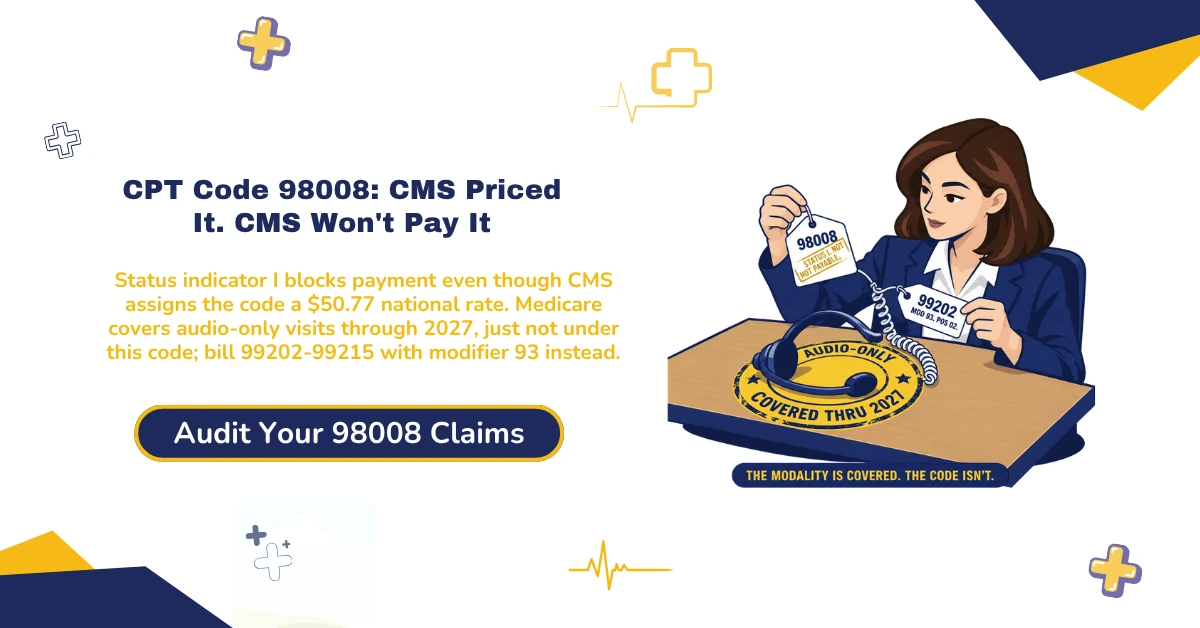
No. Traditional Medicare doesn’t pay the 98008 CPT code. Submit it to Medicare fee-for-service and the claim denies.
What status indicator I means
CMS assigns every code in the fee schedule a status indicator that controls payability. 98000 through 98015 carry status indicator I, which CMS defines as not valid for Medicare purposes.
A code with status indicator I never reaches medical review. The edit fires at the front of adjudication, so no documentation you attach changes the outcome and no modifier corrects it. Noridian, one of the Medicare Administrative Contractors, states the same position in its telehealth E/M guidance to providers.
Medicare covers audio-only, but not this code
Two facts about Medicare and audio-only telehealth run alongside each other, and reading one without the other costs practices money.
Medicare covers the audio-only modality through December 31, 2027. Medicare doesn’t cover the audio-only code set. A beneficiary can receive a covered audio-only telehealth visit from a distant-site provider, and that same visit denies if your biller reports it as 98008.
Bill the modality through the office visit codes. The next section covers the substitution.
What CMS decided for 2026
CMS received a request to add the telemedicine E/M codes to the Medicare Telehealth Services List and declined it in the CY 2026 Physician Fee Schedule final rule, CMS-1832-F. Status indicator I carried forward unchanged.
98016 is the one exception CMS reimburses in this family, because it replaced HCPCS G2012 rather than duplicating an existing office visit code.
If the same telehealth denial keeps repeating under one payer, the problem sits in the routing rule, not the individual claim. ClaimMax RCM’s denial management services team sorts each denial into correction, records, or appeal, then traces the pattern back to what produced it. Ask us to look at a 90-day sample.
What to Bill Medicare Instead of CPT 98008
Medicare identifies a telehealth encounter through the place of service code and the modifier. It doesn’t use a telehealth-specific CPT code, and that design choice is what forces two billing pathways inside one practice.
The substitution table
| Encounter type | Bill to Medicare | POS | Modifier |
|---|---|---|---|
| Audio-only E/M | 99202 to 99215 | 10 or 02 | 93 (FQ for FQHC and RHC) |
| Audio-video E/M | 99202 to 99215 | 10 or 02 | None required |
| Brief virtual check-in | 98016 | 10 or 02 | None |
| Online digital E/M (e-visit) | 99421 to 99423 | Standard POS | None |
Table 7. Medicare substitution pathway for telehealth encounters. Source: CMS CY 2026 Physician Fee Schedule, AAFP telehealth coding guidance.
That fourth row corrects a claim in circulation. Several published guides say the 98008 family replaced the e-visit codes. 99421 through 99423 remain active and payable, and the AMA deleted 99441 through 99443 alone.
For the place of service side of this decision, see the ClaimMax POS 02 telehealth guide.
Modifier 93 and the FQ exception
Append modifier 93 to the office visit code when the encounter ran on audio alone. The AAFP telehealth coding guidance states the Medicare position without hedging: Medicare didn’t adopt 98008 to 98015, and modifier 93 goes on the substitute claim.
Federally qualified health centers and rural health clinics work under one extra rule. Modifier FQ, modifier 93, or both are acceptable on those claims, since FQ and 93 carry the same meaning in those settings.
Why CMS made this decision
CMS determined that the telemedicine E/M codes duplicate existing office visit codes reported with a telehealth modifier and the correct place of service. The agency found no programmatic need for a second code set describing the same work.
Agree with the reasoning or not, the operational answer stays the same. Route Medicare claims to the 99202 through 99215 series and keep the 98008 CPT code on commercial claims where the plan accepts it.
Which Payers Accept CPT 98008 in 2026
Adoption follows the contract, not the carrier logo. The same national payer can accept 98008 on one product and require 99202 with modifier 93 on another.
Medicare, commercial, and Medicaid at a glance
| Payer type | Accepts 98008 | Bill instead | Verification step |
|---|---|---|---|
| Medicare fee-for-service | No | 99202 to 99215 with POS and modifier 93 | None needed, the rule is fixed |
| Medicare Advantage | Varies by plan | Confirm per plan | Provider manual, in writing |
| Commercial | Often, varies by contract | 99202 to 99215 with modifier 93 where not accepted | Plan-level policy, not carrier-level |
| State Medicaid | Varies by state | Per state manual | State fee schedule and telehealth supplement |
Table 8. Payer pathway by plan type. Source: CMS, state Medicaid telehealth supplements.
Two state Medicaid programs that cover the code
Wisconsin ForwardHealth covers the telehealth CPT codes 98000 through 98015 for evaluation and management services. Virginia Medicaid includes the series in its telehealth services supplement.
Two state programs tell you nothing about the other 48. Pull your own state fee schedule and telehealth supplement before you load CPT 98008 into the charge master.
How to verify at the plan level
Ask the payer rep for the policy document, not the answer. A rep who says yes to a code hasn’t given you anything you can show an auditor 14 months later when the plan recoups.
Date the confirmation and file it with the contract. Commercial plans revise telehealth policy on their own schedules, and a 2025 confirmation doesn’t cover a 2026 claim.
Coverage confirmation belongs in the pre-service workflow rather than the billing queue. Behavioral health and primary care practices carry the heaviest audio-only volume, and ClaimMax matches AAPC-certified coders to each area through our specialty billing coverage.
Does CPT 98008 Need a Modifier? The 93, 95, FQ, and GT Rules
No modifier belongs on 98008. The descriptor already states the service ran on synchronous audio-only technology, so modifier 95 repeats information the code carries.
| Modifier | Meaning | Use with | Do not use with |
|---|---|---|---|
| 93 | Synchronous audio-only | 99202 to 99215 for Medicare audio-only | 98008 to 98015 |
| 95 | Synchronous audio-video | 99202 to 99215 for commercial audio-video | 98008 to 98015, any audio-only claim |
| FQ | Audio-only, FQHC and RHC | Same meaning as 93 in those settings | Non-FQHC and non-RHC claims |
| GT | Legacy audio-video | Critical Access Hospital Method II institutional claims | Professional claims, or paired with 95 |
| BB, BC | Proposed platform identifiers | Not in effect for 2026 | Any current claim |
Table 9. Telehealth modifier assignment for 2026. Source: AMA CPT, CMS claims processing guidance, AAFP.
Why modifier 95 does not belong on 98008
Modifier 95 signals audio and video. 98008 describes an audio-only encounter, so the two contradict each other on the same claim line, and most clearinghouses hold the line before it reaches the payer.
A few plans ask for 95 on the 98000 series for internal tracking. Check the plan policy before your team builds that rule into the scrubber, because adding it where the payer doesn’t want it trips an edit.
When modifier 93 applies
Modifier 93 identifies a service the provider delivered by telephone or another audio-only system with no video. Append it to the office visit code on Medicare claims, and leave it off 98008 through 98015 on commercial claims.
That split confuses teams hunting for a single telephone visit cpt code, since the answer moves with the payer. Medicare wants 99202 through 99215 with modifier 93 attached. Commercial plans that adopted the series want 98008 with nothing attached.
Documentation carries modifier 93. Your note has to confirm the provider had audio-video available and the patient either could not access video or declined it. A note reading “phone visit” fails both tests.
Modifier FQ for FQHC and RHC settings
Federally qualified health centers and rural health clinics can append FQ, 93, or both. The two carry identical meaning in those settings, so a claim with only one of them still reads correctly to the MAC.
Is modifier GT still valid?
GT left Medicare Part B professional claims in 2018. It survives on Critical Access Hospital Method II institutional claims, and pairing GT with 95 on one service line gets that line rejected at most clearinghouses.
Practices searching cpt code for telephone visit guidance from before 2019 keep finding GT instructions that no longer apply to professional billing.
POS 10 or POS 02: The Place of Service Decision on Audio-Only Claims
The place of service code reports where the patient sat, not where the provider sat. That single rule settles most POS disputes before they start.
POS 10 means the patient connected from a private residence, and it prices at the non-facility rate. POS 02 covers every other patient location, and it prices at the lower facility rate.
| Element | POS 10 | POS 02 | POS 11 |
|---|---|---|---|
| Patient location | Home or private residence | Clinic, SNF, school, workplace, any non-home site | Physician office, in person |
| Rate applied | Non-facility, the higher rate | Facility, the lower rate | Non-facility |
| 2026 rate on 99214 | Approximately $158 | Approximately $116 | Approximately $158 |
| Common error | Coded as 02 out of habit | Applied to every telehealth claim by default | Used for telehealth, which misprices the claim |
Table 10. Place of service selection for telehealth claims. Source: CMS Place of Service Code Set, CY 2026 Medicare Physician Fee Schedule.
The rate gap your denial report won’t show
Coding a home visit as POS 02 doesn’t produce a denial. It produces a payment at the wrong rate, and no ERA exception fires. On a 99214 the gap runs about $42 per claim, which reaches roughly $8,400 a month for a practice billing 200 telehealth visits.
Your team won’t find that shortfall in the denial report, because the claim processed as paid. It surfaces only when someone audits payment data by patient location.
How to pick the right POS every time
Confirm the patient’s location at the start of the encounter and write it in the note. Match the POS on the 98008 CPT code claim, or on the Medicare substitute, to what the note says.
Auditors read utilization patterns alongside individual claims. A practice showing POS 02 on 100% of telehealth claims implies no patient ever connected from home, and that pattern draws a post-payment review on its own. The ClaimMax place of service rules guide walks through the documentation each POS code requires.
CPT 98008 Reimbursement: RVUs, Rates, and Why an Assigned Rate Is Not a Payable Rate
CMS publishes relative value units and a national rate for 98008, and Medicare still won’t pay the code. Both statements hold at the same time.
The 2026 RVU and rate breakdown
| Setting | Work RVU | Practice expense | Malpractice | Total RVU | National rate |
|---|---|---|---|---|---|
| Non-facility, office | 0.90 | 0.56 | 0.06 | 1.52 | $50.77 |
| Facility, hospital outpatient | 0.90 | 0.20 | 0.06 | 1.16 | $38.75 |
Table 11. CPT 98008 assigned RVU and national rate, CY 2026. These values are assigned, not payable under Medicare fee-for-service. Source: CY 2026 Medicare Physician Fee Schedule, national unadjusted.
Three qualifiers travel with those numbers. They’re national unadjusted figures, so your locality geographic practice cost index moves them. CMS assigned them, and status indicator I blocks payment on all of them. They apply to CY 2026, and CMS revalues the fee schedule each year.
Run your own locality through the CMS Physician Fee Schedule tool rather than working from a national average.
Why a non-payable code still has a Medicare rate
CMS assigns relative values to codes it declines to pay, so every code holds a defined position in the fee schedule. Status indicator I governs payability, and it says nothing about valuation.
A lookup tool returning $50.77 reports the assigned value. Send the claim to Medicare fee-for-service and it denies regardless of what the tool displayed. Billing teams price against those published figures and then wait on money that never posts.
What that rate does to your commercial contract
Commercial contracts often price as a percentage of the Medicare physician fee schedule. When a contract indexes to the assigned 98008 rate, billing the 98008 CPT code to that payer can return less than billing 99202 with modifier 93 for the same encounter.
The established patient tier shows the gap with confirmed figures.
| Code | Description | Total RVU | 2026 non-facility rate |
|---|---|---|---|
| 98012 | Audio-only, established, straightforward, 10 minutes | 1.13 | $37.74 |
| 99212 | In-office, established, straightforward | 1.78 | $59.45 |
| Difference | Same complexity tier | 0.65 RVU | $21.71, or 36.5% lower |
Table 12. Assigned value comparison across modality at one complexity tier. Source: CY 2026 Medicare Physician Fee Schedule national averages.
Before you switch a payer over to the 98000 series, pull the allowed amount on both codes from your last 90 days of remittances and compare them line by line. A below-market telehealth fee schedule is worth raising at renewal, and ClaimMax RCM reviews payer fee schedules for code coverage and rate accuracy before signature, so you know what the contract pays on audio-only before you sign it.
The same RVU math applied to the audio-video half of the family appears in the ClaimMax 98000 reimbursement breakdown.
Documentation Requirements for CPT 98008
Your note has to prove three things without help from the claim: the patient qualifies as new, the encounter ran on real-time audio, and either straightforward MDM or the time threshold was met.
| # | Element | What the note must state |
|---|---|---|
| 1 | New patient status | No professional service from this provider or a same-specialty group member within the past three years |
| 2 | Modality | Real-time synchronous audio-only, with the platform named |
| 3 | Discussion duration | More than 10 minutes, with start and end times recorded |
| 4 | Selection basis | Straightforward MDM, or total time with the counted activities listed |
| 5 | Patient location | Home, clinic, or other site, supporting the place of service on the claim |
| 6 | Consent | Patient consented to telehealth delivery, per applicable state law |
| 7 | Video rationale | Why video was not used, when the payer requires modifier 93 on the substitute claim |
Table 13. Documentation checklist for a defensible CPT 98008 claim. Source: AMA CPT E/M guidelines, CMS documentation standards.
What auditors check first
Reviewers start with the new patient determination and the modality statement. Both are binary, and both fall apart fast against a chart.
Write the modality into the note as a sentence rather than a checkbox. Something along these lines works: this encounter ran on real-time, two-way synchronous audio-only technology on a HIPAA-compliant platform, with the patient located at home, consent obtained before the visit, and more than 10 minutes of medical discussion documented.
Your EHR template can carry that sentence with the variable fields exposed. Templates that bury modality in a dropdown produce notes an auditor reads as silent on the question.
Why CPT 98008 Claims Deny and How to Fix Each One
Six causes account for most denied 98008 lines. Sending the code to Medicare fee-for-service accounts for more of them than the other five combined.
| # | Denial cause | What happened | The fix |
|---|---|---|---|
| 1 | Billed 98008 to Medicare FFS | Status indicator I, not payable | Rebill 99202 to 99215 with the correct POS and modifier 93 |
| 2 | Payer never adopted the series | The contract runs on office visit codes | Confirm plan policy, rebill with modifier 93 where required |
| 3 | Modifier 95 appended to 98008 | A redundant modality flag trips an edit | Remove the modifier and resubmit |
| 4 | Established patient billed as 98008 | The patient was seen within three years | Rebill 98012 to 98015 by MDM or time |
| 5 | Discussion under 10 minutes | The encounter falls outside the descriptor | Report 98016 if the criteria fit, or do not bill |
| 6 | POS contradicts the note | The claim location conflicts with documentation | Correct the POS to the documented patient location |
Table 14. Common 98008 CPT code denial triggers and corresponding corrections.
Reading the remittance
Pull the CARC and the RARC together. The CARC gives your team the adjustment category and the RARC gives the specific reason, and one without the other sends the claim into the wrong work queue.
Five codes carry most of these denials. CO-16 covers missing or invalid information, CO-96 covers non-covered charges, CO-97 covers services bundled into another payment, CO-4 covers modifier inconsistency, and PR-204 covers services the plan doesn’t cover for that member.
Correction or appeal: how to decide
Wrong code for the payer, wrong POS, and a redundant modifier all route to a corrected claim. Filing an appeal on those wastes the window while the clock runs.
Check the timely filing deadline before your team touches anything else. Then fix the root cause upstream, so the same denial stops repeating next week.
What to do when a 98008 claim already denied
Aged telehealth denials behave differently from fresh ones. Once a claim passes 60 days, your AR team is working against the appeal deadline rather than the payment cycle, and ClaimMax AR follow-up services work those buckets on a defined cadence by payer.
When one denial repeats across a single payer, the correction sits upstream of the claim. ClaimMax RCM’s telehealth denial recovery team traces the pattern back to the routing rule that produced it and fixes it there. If your telehealth denials keep landing in the same bucket, we can review a 90-day sample.
How to Set Up CPT 98008 Billing in Your Practice
Configuration causes most 98008 problems, not coding. The code itself is straightforward. Billing systems break when one payer routing rule tries to cover a code set that needs two.
Seven steps to a clean audio-only workflow
- Flag 99441, 99442, 99443, and G2012 as invalid in the billing system, so your team can’t select them at charge entry.
- Build two payer pathways. Medicare routes to 99202 through 99215 with the place of service and modifier 93. Commercial routes to the 98008 series wherever the plan accepts it.
- Confirm 98008 acceptance in writing at the plan level for your top payers, and date every confirmation.
- Add patient location, modality, consent, and discussion duration as required fields in the encounter template.
- Load 98008 through 98015 into the fee schedule at charges reflecting your commercial contracts, not the Medicare assigned rate.
- Set a scrubber edit that blocks 98008 on any Medicare fee-for-service claim before submission.
- Audit 20 to 30 telehealth claims from the past 60 days for deleted codes, POS errors, and modifier mismatches.
The step most practices skip
Step 6 prevents the denial instead of working it afterward, and the difference between those two approaches runs about 30 days of aging per claim.
Building the dual routing takes about half a day for someone who has done it before. Teams building it from scratch alongside daily claim volume turn it into a recurring denial source, which is where the medical billing service team at ClaimMax comes in: we build the payer routing rules and the scrubber edits inside your existing system rather than moving you onto a new one.
Run the telehealth claim audit again 90 days after implementation, filtering for the same three error types. Patterns surface faster in a batch than they do one denial at a time.
What Most Coding Pages Get Wrong About CPT 98008
Six claims about this code circulate widely enough to reach billing teams through search results and vendor summaries. Each one costs money in a different way.
| Common claim | Correct position | Why the confusion exists |
|---|---|---|
| 98008 requires 15 minutes | 15 minutes applies only under time-based selection. The MDM pathway needs more than 10 minutes of discussion | Sources copy the time column without the conditional attached |
| Medicare does not cover audio-only | Medicare covers audio-only through December 31, 2027, but not through 98008 | Modality coverage and code acceptance are separate questions |
| Medicare pays 98008 at a reduced rate | CMS assigns RVUs, and status indicator I blocks payment | Rates sit in the fee schedule file, payment does not |
| 98008 is an acupuncture code | 98008 is synchronous audio-only telemedicine E/M. Acupuncture runs 97810, 97811, 97813, and 97814 | An auto-generated fee-schedule taxonomy error |
| 98008 carries a 24-hour exclusion | That restriction belongs to 98016 | Code-family cross-contamination in summarized sources |
| 98008 replaced 99421 to 99423 | The AMA deleted 99441 to 99443 alone. E-visit codes stay active | Both sets describe non-face-to-face work |
Table 15. Corrections to circulating claims about the 98008 CPT code description. Source: AMA CPT code set, CY 2026 Medicare Physician Fee Schedule.
The acupuncture error deserves a note, since it appears on a fee-schedule site that ranks on the first page for this code. Any tool that classifies CPT 98008 under acupuncture procedures is reading a category field it populated by automation, not by review. Check the code section in the CPT book before you trust a rate lookup on anything else it tells you.
What Changes for Audio-Only Billing in 2027
Nothing about the status of 98008 is scheduled to change. The Medicare framework underneath the substitute codes moves instead, and a practice reading that telehealth was extended can walk away thinking 98008 turned payable.
The December 31, 2027 deadline
Medicare telehealth flexibilities run through December 31, 2027 under the Consolidated Appropriations Act, 2026, signed February 3, 2026 as H.R. 7148. The behavioral health in-person visit waiver runs alongside it.
Unless Congress acts again, geographic and originating site restrictions return for non-behavioral services after that date, and audio-only coverage for those services ends. Practices carrying a heavy telehealth panel should model that scenario now rather than in the fourth quarter of 2027. The HHS telehealth policy updates page tracks the current dates.
Proposed platform modifiers BB and BC
CMS published the CY 2027 Physician Fee Schedule proposed rule on July 14, 2026 under CMS-1848-P. The rule proposes two telehealth platform modifiers, BB and BC, to identify services delivered through third-party virtual platforms.
CMS declined again to add 98000 through 98015 to the Medicare Telehealth Services List, and status indicator I is proposed to carry into 2027 unchanged. Read the Federal Register CY 2027 rule for the full text of record.
Treat BB and BC as pending rather than active. Nothing in a proposed rule takes effect on its own, so track the final rule before your team changes a workflow or adds either modifier to the charge master.
CPT Code 98008 Frequently Asked Questions
What is CPT code 98008?
CPT 98008 reports a synchronous audio-only evaluation and management visit with a new patient at straightforward medical decision making, with more than 10 minutes of medical discussion.
What is the description of CPT code 98008?
The descriptor calls for a medically appropriate history and/or examination, straightforward MDM, and more than 10 minutes of medical discussion. Coding by time instead, 15 minutes must be met or exceeded.
Is 98008 for a new or established patient?
New patients only. A new patient has received no professional service from the provider, or a same-specialty provider in the group, within the past three years. Established audio-only visits run 98012 through 98015.
Does CPT 98008 require 15 minutes?
No. The 15-minute total applies when you select the code by time. Straightforward MDM plus more than 10 minutes of medical discussion supports the code without any time threshold.
What is the time requirement for CPT 98008?
More than 10 minutes of medical discussion under both pathways. Under time-based selection, total time on the encounter date has to reach 15 minutes, with 15 to 29 minutes as the practical range.
Can you bill 98008 by MDM instead of time?
Yes. Straightforward MDM supports 98008 on its own. Document the problem addressed, the data reviewed, and the risk level, and record the discussion minutes separately.
Is CPT 98008 covered by Medicare?
No. CMS assigned 98008 a fee schedule status indicator of I, meaning not valid for Medicare purposes, so a Medicare fee-for-service claim carrying the code denies. Bill 99202 through 99215 with modifier 93 instead.
What is the Medicare reimbursement rate for 98008?
CMS assigns roughly 1.52 total RVUs and a national non-facility rate near $50.77 for 2026. Medicare will not pay that amount, because status indicator I blocks payment. Treat the figure as a contracting benchmark.
Which payers accept CPT 98008?
Commercial plans and several state Medicaid programs accept it, including Wisconsin ForwardHealth and Virginia Medicaid. Medicare does not. Confirm acceptance at the plan level in writing, since adoption varies by contract.
Does CPT code 98008 need a modifier?
No modifier is required. The descriptor already states the service ran on synchronous audio-only technology, so modifier 95 repeats what the code carries and can trip a clearinghouse edit.
Do you use modifier 93 or 95 with 98008?
Neither. Modifier 93 belongs on the Medicare substitute claim using 99202 through 99215. Modifier 95 signals audio-video and contradicts the 98008 descriptor.
What place of service is used with 98008?
POS 10 when the patient connects from home, and POS 02 from any other patient location. POS 10 prices at the non-facility rate, which pays higher than the facility rate attached to POS 02.
What is the difference between 98008 and 99202?
Both describe a new patient encounter at straightforward complexity. 98008 covers the visit delivered by audio alone, and 99202 covers it in the office. Medicare pays 99202 and denies 98008.
What is the difference between 98008 and 98012?
Patient status. 98008 covers new patients at 15 minutes under time-based selection, and 98012 covers established patients at more than 10 minutes. Modality and MDM tier match.
What is the difference between 98008 and 98016?
98016 is a brief patient-initiated check-in of 5 to 10 minutes for established patients, and it cannot relate to an E/M visit in the prior 7 days. 98008 carries no such restriction.
Does 98008 replace 99441?
The AMA deleted 99441 through 99443 on January 1, 2025 and replaced them with the audio-only range, 98008 through 98015. A phone visit that once billed as 99441 now maps to this family by patient status and MDM.
Can 99417 be billed with 98008?
No. Within the audio-only family, 99417 pairs with 98011 at 75 minutes and 98015 at 55 minutes. 98008 sits at the lowest threshold in the new patient range, so no complete prolonged unit exists above it.
Why was my CPT 98008 claim denied?
Six causes account for most denials: Medicare submission, a payer that never adopted the series, modifier 95 appended, an established patient, discussion under 10 minutes, or a POS conflict with the note. Read the CARC and RARC together before you correct or appeal.
Telehealth CPT codes 2026 rules haven’t changed the 98008 CPT code descriptor, and the CY 2027 proposed rule keeps status indicator I in place.
Get Your Telehealth Claims Reviewed
Running two payer pathways inside one billing system is where most practices lose the thread. One routing rule sends 98008 to a commercial plan that pays it, and the same rule sends it to Medicare, where it denies before anyone reads the chart.
Your billing staff can build the split and maintain the payer-rule tracking alongside daily claim volume. Most teams find the maintenance harder than the build, because commercial telehealth policy changes on each plan’s own schedule.
If that work is sitting on someone who already has a full queue, ClaimMax RCM can take the build and the ongoing tracking. Start with a free revenue cycle analysis, and we’ll show you what your telehealth claims are doing before you commit to anything.