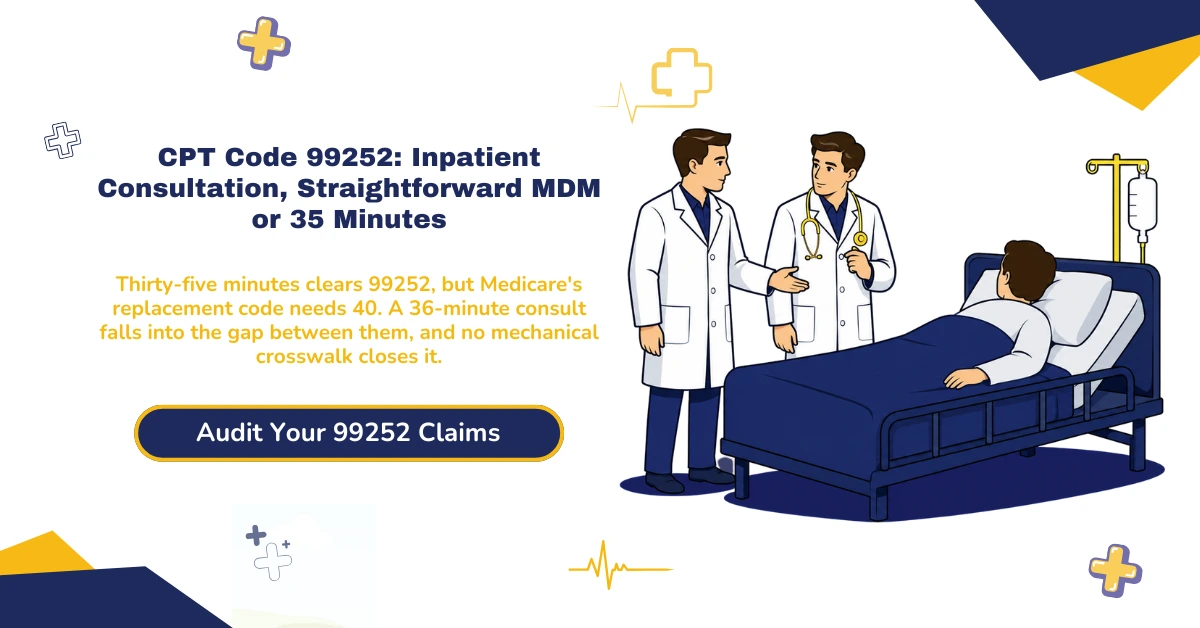
The 99252 CPT code remains active in 2026. It reports an inpatient or observation consultation for a new or established patient, selected by straightforward medical decision making or by at least 35 minutes of total time on the encounter date. Traditional Medicare doesn’t reimburse the standard consultation codes, and commercial recognition changes by payer and product.
| Attribute | Required answer |
|---|---|
| Code | 99252 |
| Service | Inpatient or observation consultation |
| Patient type | New or established |
| MDM | Straightforward |
| Minimum time | 35 minutes |
| Code selection | MDM or total time |
| Traditional Medicare | Not recognized for standard consultation payment |
| Commercial insurance | Payer and product specific |
| Follow-up during same stay | Usually subsequent care family |
| Core consultation evidence | Request, clinical reason, and report |
Two separate questions sit behind every CPT code for inpatient consult claim. One asks whether the code exists in the current CPT book. Payment is a separate question the plan answers. A 99252 CPT code description can stay accurate for years while a plan that dropped consultations keeps returning the claim as non-covered.
| Key takeawaysCPT 99252 remains active in 2026.It applies to inpatient or observation consultations.Select it by straightforward MDM or by at least 35 minutes.Confirm payer recognition before submission. |
Is CPT 99252 Still Valid in 2026?
Yes. CPT code 99252 remains an active inpatient or observation consultation code in 2026. On January 1, 2023, the American Medical Association deleted 99251 during the E/M restructuring, which left 99252 as the first active level in the family. The current 99252 CPT code descriptor calls for straightforward medical decision making, or at least 35 minutes of total time.
What Changed When CPT 99251 Was Deleted?
History and examination still belong in the note, and the descriptor still asks for both when they’re medically appropriate. Neither one sets the level anymore. Since January 1, 2023, coders pick the level from medical decision making or from total time, and old bullet-counting worksheets don’t apply to either pathway.
Observation sits inside the same family. A consultant seeing a patient under observation status reports from the same range used for admitted inpatients. CPT extends that range to nursing facility residents and patients in a partial hospital setting as well.
Valid CPT Status Does Not Guarantee Payer Payment
| Question | Answer |
|---|---|
| Is 99252 active in CPT? | Yes |
| Does every payer reimburse it? | No |
| Does Medicare nonpayment mean deletion? | No |
| Should the payer policy be checked? | Yes |
The confusion usually comes from mixing CPT status with Medicare payment policy. One belongs to the AMA, the other belongs to the payer, and they move on different schedules. You can read the current descriptor language in the AMA E/M consultation guidelines.
When Can a Provider Bill CPT 99252?
A provider can consider the 99252 CPT code when another physician or appropriate source requests an opinion on a specific clinical issue, the consultant performs the first consultation of that stay, and the payer recognizes consultation codes. All three have to hold at once. Miss one and the encounter belongs somewhere else in the E/M section.
The Service Must Be a Requested Consultation
Another physician or an appropriate source has to ask first, and that ask needs to name a condition, a problem, or a clinical question. An order reading “cardiology consult” with nothing after it gives an auditor nothing to work with.
A patient or family member who asks for a specialist visit doesn’t create a reportable consultation under CPT rules. Neither does a routine visit from a physician who already manages the patient. Those encounters get a standard E/M code for the setting instead.
The Patient May Be New or Established
CPT doesn’t split inpatient consult CPT codes into separate new-patient and established-patient families, so 99252 covers both. The question that matters at the claim level is whether this is the consultant’s first service during the stay. AMA guidance allows one consultation per consultant per admission.
When the Encounter Does Not Qualify
- No documented request from a physician or appropriate source
- Routine inpatient management by the team already treating the patient
- Any follow-up visit after the consultant’s initial consultation
- A second initial consultation from the same specialty and group in one stay
- Immediate assumption of care with no opinion sent back to the requester
- A payer that doesn’t recognize the CPT code for inpatient consult services
Picture a hospitalist asking cardiology to evaluate a new rhythm abnormality and recommend a plan. That request can support a consultation. A cardiologist already running the patient’s daily cardiac care can’t treat tomorrow’s visit the same way.
Sometimes the note reads like a consultation and the payer’s rules point somewhere else. ClaimMax RCM’s payer-specific medical billing services check the code against the plan’s own policy before the claim reaches adjudication.
How Straightforward MDM Supports CPT 99252
When medical decision making selects the 99252 CPT code, the encounter has to support straightforward MDM. The level rests on three elements: the problems addressed, the data reviewed and analyzed, and the risk of the management decision. Two of the three have to reach straightforward before the code holds up.
Two of the Three MDM Elements Must Be Met
| MDM element | Straightforward threshold | Documentation focus |
|---|---|---|
| Problems addressed | One self-limited or minor problem | Show what the consultant evaluated |
| Data | Minimal or none | Identify what was reviewed, not what exists |
| Risk | Minimal | Document the management decision itself |
Don’t treat those columns as points to collect. Two elements carry the level, and medical necessity sits above all of it. A reviewer who finds two elements sitting higher won’t leave the encounter at 99252.
What Straightforward MDM Looks Like
A hospitalist asks dermatology to look at a stable rash on a patient admitted for something unrelated. The consultant examines the site, pulls no outside records, recommends a topical agent, and sends the opinion back. One minor problem, minimal data, minimal risk.
No diagnosis maps to straightforward MDM on its own. That same rash on a neutropenic patient with a rising white count moves all three elements in a different direction. Work performed at the encounter sets the level.
What Moves the Encounter Above 99252
More complex problems, deeper data analysis, or higher management risk push the encounter past straightforward. Low MDM points toward the 99253 CPT code once the request, the documentation, and the payer’s policy all line up. The AMA CPT evaluation and management resource tracks the current guideline structure. Time runs on its own track, covered next.
How the 35-Minute Rule Works for CPT 99252
CPT 99252 requires at least 35 minutes of total physician or qualified healthcare professional time on the date of the encounter when time selects the code. The AMA writes that threshold as a floor to be met or exceeded, so 34 documented minutes doesn’t reach it.
Time Must Be Met or Exceeded
Coding tables get this one wrong often. The descriptor says 35 minutes must be met or exceeded, and it never says “35 to 44 minutes.” That second number traces back to the 45-minute threshold on 99253 and forms no part of the 99252 CPT code requirement.
A provider doesn’t have to satisfy both pathways. Straightforward MDM alone supports the code. A documented total of 35 qualifying minutes alone supports it. Medical necessity still applies on either route.
Which Activities Count Toward Total Time?
- Preparing to see the patient, including record review
- Obtaining or reviewing separately obtained history
- Performing the evaluation
- Counseling the patient, family, or caregiver
- Ordering medications, tests, or procedures
- Communicating with other professionals when not separately reported
- Documenting the encounter and coordinating care when not separately reported
What Cannot Be Counted?
- Time spent on a service the practice reports separately
- Travel
- General teaching unrelated to that patient’s management
- Work performed by clinical staff
- The same minutes claimed twice when two professionals work together
How to Document the Time Clearly
Write the number and the work behind it: “Total physician time on the date of service: 37 minutes, including record review, patient evaluation, communication with the requesting physician, and documentation.”
A line reading “more than 35 minutes spent” with nothing behind it hands a reviewer an easy downcode. Give the total and the activities behind it. That costs one sentence.
What Documentation Is Required for CPT 99252?
A defensible 99252 CPT code note identifies who requested the consultation, why they wanted an opinion, what the consultant found, and how those findings went back to the requester. The record also has to support straightforward MDM or at least 35 minutes. A diagnosis and an exam won’t carry the claim alone.
Request: Who Asked for the Consultation?
- Name or role of the requesting physician or appropriate source
- Date or clinical context of the request
- A statement that an opinion or advice was requested
- The request captured somewhere in the medical record
A verbal request works in most shared inpatient records as long as somebody writes it down. An order, a line in a progress note, or a standalone request all do the job. A conversation nobody documented doesn’t.
Reason: What Clinical Question Needed an Opinion?
“Consult requested” fails this test. The record needs the specific problem, the diagnosis under consideration, or the management question driving the ask. Cardiology consultation requested by the hospitalist for management recommendations on a newly identified rhythm abnormality clears the bar.
Report: What Was Communicated Back?
The consultant’s findings, assessment, opinion, and recommendations belong in the record and have to reach the requesting source. Centene’s Ambetter inpatient consultation policy requires a documented request, a documented consultant opinion, and communication by written report. Other payers set their own terms for inpatient consultation CPT documentation.
Add the MDM or Time Evidence
- Medically appropriate history or examination
- Problems addressed at that encounter
- Data reviewed or analyzed
- Risk of the management decision
- Total time and qualifying activities, when time selects the code
- Final recommendations and the communication back to the requester
Practices billing inpatient consult CPT codes without this checklist find the gap six months later, when a payer asks for records and the request never made it into the chart.
Where CPT 99252 Is Reported: Inpatient, Observation, POS 21 and POS 22
The CPT code inpatient consultation family covers hospital inpatients and patients under observation. One inpatient consultation CPT code range serves both statuses. The professional claim’s place of service and the payer’s status rules still have to match what the record documents.
Hospital Inpatient Consultations
POS 21 fits the professional claim when the patient carries formal inpatient status, and facility documentation should back that up. You can’t read status off the floor the bed sits on.
Observation Consultations
Observation counts as an outpatient hospital status. POS 22 applies to on-campus outpatient hospital services, and POS 19 covers off-campus locations. The room a patient occupies doesn’t decide the status. Only the documented order and the payer’s instructions do.
How Status Changes Affect the Stay
A move from observation to inpatient counts as one stay for the initial-versus-subsequent framework, and the consultant doesn’t earn a second initial consultation out of it. Confirm the status order, the specialty, and every prior same-stay service before coding it.
POS 21 Versus POS 22
| Factor | POS 21 | POS 22 |
|---|---|---|
| Setting | Inpatient hospital | On-campus outpatient hospital |
| Common status | Admitted inpatient | Observation or hospital outpatient |
| Claim check | Confirm the inpatient order | Confirm outpatient or observation status |
| Main risk | Inpatient POS without inpatient status | Missing status, or defaulting to office POS |
ClaimMax RCM covers the on-campus and off-campus split in its POS 22 billing guide. Once the status, the documentation, the code, and the claim fields agree, the ClaimMax team behind hospital revenue cycle management holds that alignment from charge capture through remittance for every hospital consult CPT codes claim.
CPT 99252 Versus 99253, 99254 and 99255
The current inpatient consultation CPT family runs from the 99252 CPT code through 99255. Each step up requires higher MDM or a higher minimum time. Select the level the encounter supports rather than defaulting to the bottom or the top of the range.
Inpatient and Observation Consultation Code Table
| CPT code | MDM | Minimum total time | Main distinction |
|---|---|---|---|
| 99252 | Straightforward | 35 minutes | First active consultation level |
| 99253 | Low | 45 minutes | Low MDM or a 45-minute floor |
| 99254 | Moderate | 60 minutes | Moderate MDM or 60 minutes |
| 99255 | High | 80 minutes | High MDM or 80 minutes |
The AAFP E/M code table carries the same thresholds and flags 99251 as deleted. CPT 99254 and 99255 sit at the moderate and high end of that range. Add-on code 99418 covers prolonged inpatient or observation services and attaches to 99255 at 95 minutes, never to 99252.
Why CPT 99251 Is No Longer in the Active Range
The 99251 CPT code left the active family on January 1, 2023, which made 99252 the entry point. Skip the “Level 2” shorthand when you train staff. Coders who learn that label end up mixing the old five-code structure with the current four-code range.
One more trap shows up inside the range. A 45-minute encounter doesn’t support the 99253 CPT code when the coder selects by MDM and the note shows only straightforward complexity. Pick one selection method and carry it all the way through.
Does Medicare Pay CPT 99252?
Traditional Medicare doesn’t recognize the 99252 CPT code or the other standard consultation codes for Part B payment. For services on or after January 1, 2010, the practitioner reports the E/M code that describes where the visit happened and the level of service documented. Medicare never deleted 99252. It stopped paying for it.
Which E/M Codes Does Medicare Expect Instead?
| Encounter stage and setting | Possible Medicare family | Selection basis |
|---|---|---|
| Practitioner’s qualifying initial hospital inpatient service | 99221 to 99223 | MDM or code-specific time |
| Consultant seeing a patient in observation status | 99202 to 99215 | MDM or code-specific time |
| Later medically necessary hospital service | 99231 to 99233 | MDM or code-specific time |
That second row catches good billing teams. CMS instructs that the treating practitioner bills the hospital inpatient or observation care codes, while other practitioners consulting during observation report outpatient service codes instead.
Medicare does still pay two sets of telehealth consultation G codes, G0406 through G0408 and G0425 through G0427. The CMS Evaluation and Management Services booklet from May 2026 lists both. Telehealth coverage has run on a series of extensions, so confirm current terms before building the workflow.
Why CPT 99221 Is Not an Automatic Replacement
The gap here is time, not complexity. CPT 99252 needs straightforward MDM or 35 minutes. Its counterpart, 99221, accepts straightforward or low MDM with a 40-minute floor. A consultant who documents 36 minutes and straightforward MDM clears 99252 and misses 99221 by four minutes.
Recode the service, not the number. Review the note, the encounter stage, the provider’s role, the patient’s status, and the payer’s rule before anything gets converted. ClaimMax RCM’s CPT 99222 billing guide covers the initial-care side of the 99221 to 99223 range in the same depth.
When Modifier AI Applies
Modifier AI identifies Medicare’s principal physician of record, the admitting or attending physician overseeing the case. It belongs on that physician’s initial hospital care code. A consultant who performs an initial evaluation reports the same code range and leaves AI off.
Do Commercial Payers Accept CPT 99252?
Some commercial plans recognize the 99252 CPT code and others require a standard hospital E/M code instead. The payer’s name alone won’t answer it. Confirm the member’s product, line of business, current policy, effective date, and provider contract before the claim gets built.
Verify the Payer, Product, and Member Plan
- Identify the exact payer on the card
- Confirm the line of business
- Separate traditional Medicare, Medicare Advantage, Medicaid, commercial, workers’ compensation, and auto coverage
- Confirm the member’s specific product
- Locate the current consultation reimbursement policy
- Check that policy’s effective date
- Review contract or member-plan exceptions
Medicare Advantage deserves its own step. A plan carrying the Medicare name may follow CMS-style reporting or may pay consultations outright, and its own reimbursement policy governs unless another requirement controls.
Staff who know the payer but not the exact product rule lose claims in that gap. ClaimMax RCM’s payer and plan verification closes it before anyone builds the claim, and the check covers plan benefits, network status, coordination of benefits, and prior authorization.
Current Examples of Commercial Nonrecognition
| Payer example | Current consultation position | What it demonstrates |
|---|---|---|
| UnitedHealthcare Commercial and Individual Exchange | Doesn’t reimburse 99242 to 99245 or 99252 to 99255 under its current policy | A commercial insurer may follow CMS-style reporting |
| Blue Cross and Blue Shield of Illinois | Stopped reimbursing 99242 to 99245 and 99252 to 99255 effective November 18, 2024 | Payer policies change on dated effective dates |
| Other commercial and state products | May differ | Plan-level verification stays necessary |
The UnitedHealthcare consultation policy directs providers to report the appropriate E/M code describing the service. Illinois providers get the same instruction from the BCBSIL consultation reimbursement policy, which names 99221 to 99223, 99304 to 99306, and 99202 to 99215 as the reporting alternatives.
Build a Consultation-Code Payer Matrix
Keep one working grid your team updates instead of relying on memory. Seven columns cover it: payer, product, codes accepted, effective date, alternative family, source, and last verified.
CPT 99252 Versus 99221, 99222 and 99231
The 99252 CPT code description covers a requested consultation, while 99221, 99222, and 99231 describe hospital care with no request requirement attached. Payer recognition decides which family a practice can report. The note decides which level inside that family holds up.
| Code | Service category | MDM | Minimum time |
|---|---|---|---|
| 99252 | Initial inpatient or observation consultation | Straightforward | 35 minutes |
| 99221 | Initial hospital inpatient or observation care | Straightforward or low | 40 minutes |
| 99222 | Initial hospital inpatient or observation care | Moderate | 55 minutes |
| 99231 | Subsequent hospital inpatient or observation care | Straightforward or low | 25 minutes |
Consultation Code Versus Initial Hospital Care
Consultation documentation carries the request, the clinical reason, and the report back. Initial hospital care codes carry none of that, and a hospital care code doesn’t turn into a consultation because another physician asked the provider to see the patient.
ClaimMax RCM’s guide to 99222 initial hospital care walks through the moderate-MDM side of that family, and the CPT 99231 billing guide covers the subsequent-care rules that follow the first encounter.
Consultation Code Versus Subsequent Hospital Care
CPT 99231 applies to a later hospital or observation service, and a consultation doesn’t repeat because the consultant returns the next morning. “Initial” ties to the reporting practitioner, the specialty, the group, and the stay, never to the admission date alone.
Use the Documented Service, Not a Mechanical Crosswalk
One formula covers it: payer rule, plus encounter stage, plus provider role, plus documented MDM or time, equals the final code. A table labeled “99252 replacement code: 99221” skips four inputs and produces denials at scale.
Can CPT 99252 Be Billed More Than Once During the Same Stay?
A consultant reports one initial inpatient or observation consultation per admission. Later medically necessary services move to the subsequent hospital care family when the payer recognizes that pathway. Commercial rules add their own limits on top.
Initial Consultation Versus Follow-Up Care
A second encounter from the same consultant isn’t another initial consultation because the calendar changed. Evaluate the later visit as follow-up, and let that day’s work set the level. ClaimMax RCM’s subsequent hospital care coding guide breaks down how the levels split.
Same Specialty and Same Group Considerations
Claims systems evaluate services by physician, specialty, subspecialty, group, date, and stay. Two same-specialty physicians in one group can’t each assume a separate initial consultation. Check the payer’s policy before submitting multiple initial services.
When a Different Specialty Performs Its First Service
A physician from a different specialty can perform their own first evaluation during the stay. That fact alone doesn’t make 99252 the right code. The service still needs a request, documentation, and a recognizing payer.
One sequencing rule catches experienced coders. A consultant who sees the patient in another setting earlier the same day, then again after admission, reports that second encounter from the subsequent care range instead of an initial code.
Why CPT 99252 Claims Get Denied
Five causes drive most 99252 CPT code denials: a payer that doesn’t recognize consultations, a missing request or report, unsupported MDM, insufficient documented time, and the wrong encounter stage or setting. Four of the five get caught before submission if somebody checks.
| Denial cause | What usually went wrong | First review action |
|---|---|---|
| Consultation code not recognized | Payer follows CMS-style policy | Confirm the current payer and product rule |
| Missing request | Requesting source never documented | Review the order, note, and referral record |
| Missing clinical reason | “Consult requested” carries no question | Locate the condition or management issue |
| Missing report | Findings never went back to the requester | Review the consultant note and communication |
| Unsupported MDM | Note doesn’t reach straightforward on two elements | Reassess problems, data, and risk |
| Time below threshold | Fewer than 35 qualifying minutes documented | Don’t infer or add undocumented time |
| Wrong encounter stage | Follow-up billed as another initial consultation | Review the same-stay service history |
| Wrong status or POS | Claim data and patient status disagree | Confirm the order, status, POS, and date |
| Duplicate or same-specialty edit | Multiple initial services triggered payer logic | Review group, specialty, and rendering provider |
| Incorrect automatic crosswalk | Scrubber changed the code without note review | Return the claim for coder validation |
Frequency edits deserve a separate look. Centene’s inpatient consultation policy denies a consultation line billed within five days of another inpatient consult procedure, which catches legitimate second-specialty consults.
Corrected Claim, Reconsideration, or Appeal?
File a corrected claim when the original code was wrong, the claim data was incomplete, or the payer tells you to resubmit.
Appeal when the plan accepts the code under its policy, the documentation supports the service, or the claim processed under the wrong product logic.
Skip the appeal when the plan excludes the code outright, or when fixing it would mean adding work nobody documented.
Teams that appeal every 99252 denial the same way burn 60 days before anyone spots the ones that can’t win. ClaimMax RCM’s consultation-code denial management separates the claims that need a correction from the claims worth challenging, and the free revenue cycle audit shows how many of each you’re sitting on.
CPT 99252 Billing Examples for Common Hospital Scenarios
Five scenarios cover most inpatient consult CPT code decisions a hospital practice faces. Each one runs the same five checks: patient setting, provider role, payer rule, documentation, and reporting conclusion.
Commercial Payer Accepts the Consultation Code
A hospitalist requests a specialist’s opinion on an admitted patient and documents the clinical question. The consultant documents straightforward MDM and sends recommendations back, and the member’s commercial product recognizes consultations.
Coding result: 99252 may be appropriate once the request, the report, and the MDM all appear in the record.
Medicare Patient With a Qualifying Initial Service
Same clinical service, same specialist, traditional Medicare coverage. Medicare doesn’t recognize the consultation family, so the coder reviews whether the note supports an initial hospital care code on its own terms.
Coding result: don’t submit 99252 because the service felt consultative. Recode from the documentation.
Observation Patient Seen by a Consultant
A patient sits in observation status and a consultant performs the first requested evaluation. The billing team confirms the status order and the place of service before coding.
Coding result: 99252 may fit a recognizing payer, while traditional Medicare sends the same consultant to the office or outpatient visit codes.
Follow-Up Visit After the Initial Consultation
The consultant returns the following morning to reassess. Nothing about that visit makes it a new consultation, and the payer’s follow-up rules take over.
Coding result: report from the subsequent care family rather than repeating 99252.
Transfer of Care Instead of Consultation
The requesting physician hands over full management and the specialist accepts it, with no advisory opinion expected back. CPT dropped its own transfer-of-care definition in 2023, so the payer’s policy governs this call.
Coding result: review the encounter as ongoing care rather than treating it as a consultation by default.
CPT 99252 Reimbursement, RVUs, and Fee-Schedule Confusion
The 99252 CPT code description carries no universal reimbursement amount. Traditional Medicare doesn’t recognize the standard consultation code for payment, and commercial reimbursement depends on the payer’s policy, the contract, the locality, and the allowed amount.
Why There Is No Universal 99252 Payment Rate
A billed charge isn’t an allowed amount, and an allowed amount isn’t a payment. Contracted rates change by payer and by provider, and patient responsibility shifts where the final dollars land. No single national figure captures that.
An RVU or Fee Listing Does Not Guarantee Coverage
Coding databases display RVU and fee data for consultation codes, and staff read that display as proof of coverage. Medicare assigns these codes a status indicator marking them invalid for payment. The CMS Medicare Claims Processing Manual also notes that published RVUs aren’t always usable for separate Medicare payment.
How Practices Should Estimate Commercial Payment
- The current contract and fee schedule
- The payer product and the facility setting
- The allowed amount and the adjustment reason on the remittance
- Historical payment patterns for that plan
Frequently Asked Questions About CPT 99252
Is CPT code 99252 still valid in 2026?
Yes. CPT code 99252 remains active. The AMA deleted 99251 in 2023, not 99252, which left 99252 as the first level in the inpatient or observation consultation range. Payment recognition stays payer specific and has nothing to do with code validity.
How much time is required for CPT 99252?
At least 35 minutes of total physician or qualified healthcare professional time on the encounter date, counting only qualifying activities. The threshold has to be met or exceeded. Straightforward medical decision making works as an alternative pathway when time falls short.
Does Medicare pay for CPT 99252?
Traditional Medicare doesn’t recognize the standard consultation codes for Part B payment. No automatic replacement code exists. Select the E/M code the documented service supports, based on the setting, the encounter stage, and the level of work performed.
Can CPT 99252 be used for an observation patient?
Yes under the current CPT structure, since the family covers inpatient and observation status alike. The payer has to recognize consultation codes, and the documented status and place of service have to match the actual encounter.
What documentation supports an inpatient consultation?
The request from a physician or appropriate source, the specific clinical reason, the consultant’s findings and recommendations, and communication back to the requester. Add either the MDM evidence or the total qualifying time, depending on which pathway selects the level.
What is the difference between 99252 and 99253?
CPT 99252 needs straightforward medical decision making or 35 minutes. The 99253 CPT code needs low medical decision making or 45 minutes. Apply one selection method cleanly rather than borrowing the time from one pathway and the complexity from the other.
Can CPT 99252 be billed for a follow-up visit?
Not as another initial consultation. Evaluate the follow-up under the subsequent care family and check the payer’s policy alongside the same-stay service history for that consultant, specialty, and group before the claim goes out.
Is CPT 99221 always the replacement for 99252?
No. CPT 99221 carries its own requirements, including a 40-minute time floor that a 36-minute consultation misses. Review the encounter stage, the MDM, the time, the provider’s role, and the payer’s policy before converting anything.
Build a Payer-Specific CPT 99252 Workflow Before the Claim Goes Out
Accurate consultation billing depends on four things lining up: the consultation itself, the documented level, the patient’s setting, and the payer’s current policy. When one piece goes missing, the claim gets rejected before anyone reads the clinical work.
How ClaimMax RCM Supports Consultation Billing
ClaimMax RCM connects payer and product verification, prior authorization, CPT and E/M coding review, claim scrubbing, submission, payment posting, denial review, and appeals under one team. Orthopedic groups, hospitalists, and every other specialty reporting inpatient consultations get the same full-service medical billing workflow.
ClaimMax RCM Pricing
| ClaimMax service | Pricing |
|---|---|
| Full-service medical billing | 3.49% of payer collections |
| Verification of benefits | Included at no separate charge |
| Prior authorization | Included at no separate charge |
| Revenue cycle audit | Free, before any commitment |
| Credentialing | $120 per insurance |
ClaimMax RCM charges 3.49% of payer collections for full medical billing, with verification of benefits and prior authorization included at no separate charge. Every account starts with a free revenue cycle audit. Credentialing runs $120 per insurance. That combination is what affordable, expert billing looks like for an orthopedic group or any specialty working to maximize collections from payers.
| Consultation claims stalling at payer edits, documentation gaps, or incorrect code conversions? Let’s review the workflow before more revenue moves into denial follow-up. Review My Billing Workflow |