The 99243 CPT code reports an office or other outpatient consultation for a new or established patient, selected by low medical decision making or at least 30 minutes of total time on the encounter date.
CPT 99243 is still an active code. Medicare Part B doesn’t recognize it for payment, and CMS instructs providers to report the appropriate E/M visit code instead. Other payers set their own policies, so recognition varies by product and contract.
This guide covers consultation qualification, documentation, payer recognition, replacement coding when a plan rejects this office consultation CPT code, and the denial patterns that follow.
CPT 99243 at a Glance
Code validity and payer payment are two different questions for the 99243 CPT code. You can meet every documentation requirement and the payer still won’t pay. Check both before the claim goes out.
The table lists the current 99243 CPT code description, including the two ways a clinician can reach this level, as described in AAFP’s E/M coding guidance.
| Field | Current requirement |
|---|---|
| Service reported | Office or other outpatient consultation |
| Patient status | New or established patient |
| Level selection by MDM | Low medical decision making |
| Level selection by time | At least 30 minutes of total time on the encounter date |
| History and examination | Medically appropriate, and not used to select the level |
| CPT status | Active |
| Medicare Part B | Not recognized for payment |
| Other payers | Policy and plan specific |
| Core consultation condition | A request for an opinion or advice from an appropriate source, with the consultant’s findings reported back |
Older sources still circulate a CPT code 99243 description built on pre-2023 rules. If a page requires a detailed history and examination, or a typical 40-minute face-to-face visit, it hasn’t been updated since 2022.
What Does CPT 99243 Mean in 2026?
The 99243 CPT code definition last changed in 2023, and the requirements have held since. It covers an office or other outpatient consultation for a new or established patient, selected through low medical decision making or at least 30 minutes of total time on the encounter date.
Current CPT 99243 Definition in Plain English
Under the current framework, two things decide whether the 99243 CPT code fits the encounter: the setting, and which selection method the record supports. Either method works on its own. A note can reach this level on documented low medical decision making (MDM) without reaching 30 minutes, or on documented time alone.
History and examination still belong in the note, and neither one sets the level. Consultations picked up that approach in 2023, when the descriptors moved to a medically appropriate standard. The AMA E/M revisions page documents that change and was last updated January 26, 2026.
Outdated 99243 CPT Code Description Language to Ignore
Current CPT 99243 requirements no longer depend on a detailed history and detailed examination.
| Outdated or incorrect claim | Current position | Where it comes from |
|---|---|---|
| Detailed history required | Medically appropriate history or examination | Pre-2023 descriptor |
| A detailed examination sets the level | History and examination don’t select the level | Pre-2023 descriptor |
| Typical 40-minute face-to-face visit | At least 30 minutes of total time on the encounter date | Pre-2023 descriptor |
| Established patients only | New or established patient | Never in the descriptor |
| Moderate medical decision making | Low medical decision making | Never in the descriptor |
| Medicare pays a fee for the code | Medicare Part B doesn’t recognize it for payment | Medicare payment policy |
The first three lines come from the pre-2023 descriptor. Most pages carrying them were accurate when someone published them, which is why the CPT code 99243 definition on an older page can read as authoritative and still mislead a coder.
Neither of the next two ever appeared in any version of the descriptor, and the last line belongs to payer policy. We checked every requirement in the table above against current sources in July 2026.
How Is the 99243 CPT Code Selected by MDM or Total Time?
Two selection methods reach this level, and the record only has to support one. A clinician picks the level either through low medical decision making or through total time on the encounter date. Choose whichever the note actually documents, then stop.
Selecting 99243 Through Low Medical Decision Making
CPT 99243 corresponds to low medical decision making. MDM gets scored on three elements: the number and complexity of problems addressed, the amount and complexity of data reviewed and analyzed, and the risk of complications or morbidity from patient management. Two of those three have to meet or exceed the low standard, per AAFP’s E/M coding guidance.
History and examination stay in the note for clinical reasons. Neither one moves the MDM score.
One illustrative encounter: a specialist evaluates a single stable chronic problem, reviews a limited set of outside records, and recommends a low-risk management change. That shape often supports low MDM. It isn’t a guarantee, and a coder still has to score the three elements against the documentation in front of them.
Selecting 99243 Through Total Time
At least 30 minutes of total time on the encounter date supports this level when time drives the selection. MDM doesn’t also have to reach low. The 30 minutes belongs to the physician or qualified healthcare professional (QHP) personally, all of it falls on the encounter date, and the note should state the total.
Treat 30 minutes as a floor, not a range. Some sources publish a 99243 CPT code description time of 30 to 39 minutes, borrowing the range format from the office visit codes. The descriptor doesn’t work that way. The next consultation level starts its own count at 40 minutes, which Section 9 compares directly.
What Time Can Be Counted?
Countable activities include preparing to see the patient, obtaining or reviewing separately obtained history, performing a medically appropriate examination, counseling the patient or caregiver, ordering medications and tests, documenting in the record, and communicating with other professionals when that work isn’t separately reported.
Four categories stay out of the count:
- Time any clinical staff member spends, including a scribe working alongside the physician
- Time on procedures or services billed separately
- Work performed on a date other than the encounter date
- The same minutes counted twice when two professionals share the visit
AAFP is direct about the documentation habit that protects a time-based level: record the specific total, and skip the template statement that assigns identical minutes to every visit of the same level. Auditors read repeated round numbers as a pattern.
A supported level and a paid claim are still two different outcomes, since payer edits sit between them. When the record holds up but a plan’s edits keep shifting, ClaimMax RCM’s medical billing services review the code, the plan policy, and the claim logic before the claim leaves your system, rather than after a denial lands.
When Does an Encounter Qualify as a Consultation?
An encounter qualifies as a consultation when another provider asks for an opinion on a specific problem, the consultant evaluates the patient and forms that opinion, and the findings go back to whoever asked. All three have to happen.
- Request. A physician, qualified healthcare professional, or other appropriate source asks for an opinion or advice on a defined clinical question.
- Render. The consultant evaluates the patient, reviews the problem in question, and forms a recommendation.
- Report. The consultant sends the findings and recommendations back to the requesting provider.
Coders shorthand this as request, render, and report. Treat it as a memory aid, because the documentation each payer expects on top of it varies.
A Provider Requests an Opinion or Advice
Both the requesting provider and the reason belong in the record. A specialist consultation CPT code won’t hold up on a referral slip carrying nothing but a diagnosis and the specialty being asked to see the patient. The request has to show which clinical question needs answering.
A generic referral document only proves that someone sent the patient over. Patients and family members don’t count as an appropriate source, so an encounter the patient arranged on their own falls outside the consultation family no matter who they end up seeing.
The Consultant Renders an Evaluation and Recommendation
Ordering diagnostic tests or starting treatment during the visit doesn’t cancel the consultation by itself. Payer policy and the documented intent decide that, and plenty of legitimate consultations end with the consultant writing an order.
Findings Are Reported Back
The report-back step is where these claims usually fall apart. Practices document the evaluation carefully and then never document that anyone sent it anywhere. TRICARE, for one, requires that the attending provider request the consultation and that a written report go back, per TRICARE’s consultation policy. Other payers word their requirements differently.
Consultation, Referral, or Transfer of Care?
Three encounters that look identical on a schedule:
- Consultation. A primary care physician asks a cardiologist for an opinion on unexplained palpitations and expects findings back. That encounter supports a CPT code for office consultation where the payer recognizes the family.
- Referral or transfer. The patient goes to the cardiologist to take over ongoing management, with no request for an opinion attached.
- Patient-initiated. The patient books the cardiologist directly.
Searching for a CPT code for referral returns the consultation family, and that’s the trap, since a referral and a consultation describe different services. Worth knowing that CPT dropped its own definition of “transfer of care” in 2023, so the phrase now belongs to payer policy and clinical intent rather than the code set.
Whatever the front desk typed on the schedule, outpatient consult CPT codes follow what the record documents.
What Documentation Supports the 99243 CPT Code?
Documentation for CPT code 99243 should establish the consultation request, the reason for the opinion, the service performed, the supported MDM or time level, and the communication of findings back to the requester. The medical record has to carry all five. A payer reviewing the claim looks for the request and the report first, since those two elements separate a consultation from an office visit that got coded as one.
Document the Request and Reason
The record should identify who requested the consultation, what clinical problem needs an opinion, how the request arrived, and why the consultation is medically necessary. Request format varies by payer. Some accept a documented verbal request; others expect a written order or referral sitting in the chart.
Support Low MDM or Total Time
When MDM drives the level, the note has to support low medical decision making on its own. When time drives it, the record states the exact total, the encounter date, the activities performed, and confirmation that separately reported procedure time stayed out of the count. The 99243 CPT code description gives the coder those two paths and no third one.
A minute-by-minute breakdown isn’t required unless a specific payer policy calls for one.
Show the Opinion and Plan
The assessment and plan should make the consultant’s thinking visible: what the consultant concluded, what the consultant recommended, which tests or treatments went in, and whether follow-up was advised. A note that documents the examination thoroughly and stops short of the opinion hasn’t documented a consultation.
Record Communication Back
The record should show that the consultant’s findings reached the requesting provider. A routed EHR note can support that. It won’t automatically satisfy every payer, and some plans want the report itself in the chart rather than a routing log.
Seven elements support an office consultation CPT code at this level:
- Requesting provider or other appropriate source
- Specific reason for the consultation
- Medically appropriate history or examination
- Low MDM or documented total time
- The consultant’s assessment
- Recommendations or treatment plan
- Communication of findings back to the requester
Is CPT 99243 Still Valid in 2026?
Yes. CPT 99243 is still active in the CPT code set for an office or outpatient consultation that meets the current requirements. Medicare Part B doesn’t recognize it for payment. Commercial and government plans set their own policies, so validity and payment stay separate questions on every claim.
CPT 99243 Remains an Active Code
An active CPT code can still be excluded by a payer. 99243 sits in the code set because the AMA maintains it there, and payment depends on whether a given plan agreed to reimburse consultations at all. Your own fee schedule behaves the same way: a service can sit on it at a set charge while some of your contracts don’t cover it.
The current CPT 99243 requirements haven’t changed since 2023, which is why a coder can trust a 2023 descriptor and still get the claim denied.
The Consultation Family Changed in 2023
CPT consultation codes for the office and outpatient setting now start at 99242. The AMA deleted 99241 effective 2023 and kept four levels, matched to the four levels of medical decision making. The code covered by this guide holds the low-MDM position in that group. Section 9 lines all four up against their time thresholds.
Does Medicare Cover CPT 99243?
No. Medicare Part B doesn’t recognize CPT 99243 for payment, and that covers the whole office consultation family, 99242 through 99245. The code itself is still active in the CPT code set. Report the appropriate recognized E/M visit code instead, selected on its own merits. Commercial plans set their own policies, and some still pay consultations while others stopped.
Medicare Part B Does Not Recognize CPT 99243
CMS’s May 2026 Evaluation and Management Services booklet states that Medicare doesn’t recognize outpatient consult CPT codes 99242 through 99245 for Part B payment purposes, and it tells practitioners to report the correct E/M visit code instead. The same booklet applies that restriction to inpatient consultation codes 99252 through 99255. See the CMS E/M guidance.
Nonrecognition says nothing about medical necessity. A cardiologist who evaluates palpitations at a primary care physician’s request performed a service Medicare will pay for. Only the code on the claim changes.
Build that replacement code from scratch. Patient status, setting, supported MDM, and documented total time all get evaluated again. Skipping that step and defaulting to 99203 or 99213 is where practices lose money, which Section 10 covers.
Medicare Advantage Requires Plan-Level Verification
Medicare Advantage plans follow Medicare coverage rules and still publish their own reimbursement policies and claim edits. Verify the product, not the brand.
One payer can run a commercial book, several MA products, and a managed Medicaid plan, each with a different consultation policy. A policy you confirmed for one product tells you nothing reliable about the rest.
Commercial Payer Policies Are Not Uniform
Blue Cross and Blue Shield of Texas stopped reimbursing consultation codes 99242 through 99245 and 99252 through 99255 effective November 18, 2024, directing providers to the office, outpatient, or inpatient E/M code matching the setting and complexity of the visit, per the BCBSTX consultation policy.
One plan’s decision isn’t a commercial standard. Some payers still reimburse a CPT code for office consultation when the record supports it, and others dropped the family years ago. Read the policy attached to the contract you actually bill.
Some Programs Still Recognize Consultations
TRICARE covers qualifying consultations requested by the attending provider and requires a written report back. Medicaid treatment of consultation codes varies by state program, managed care plan, and current fee schedule.
Five payer categories, and 99243 needs a different check in each one.
| Payer category | General position | Required provider action |
|---|---|---|
| Medicare Part B | 99243 not recognized | Select the appropriate recognized E/M code |
| Medicare Advantage | Product specific | Verify the exact plan policy |
| Commercial payer | Contract and policy specific | Check the current consultation reimbursement policy |
| Medicaid | State and plan specific | Review the current state or MCO guidance |
| TRICARE | Qualifying consultations may be covered | Meet request and report requirements |
Practices running several payer products need that policy check wired into the rest of the claim. ClaimMax RCM’s revenue cycle management services connect payer verification to coding, submission, posting, and follow-up, so a plan’s consultation policy gets applied before submission instead of discovered on a remittance.
How Does CPT 99243 Compare With 99242, 99244, and 99245?
CPT 99242, 99243, 99244, and 99245 are four increasing levels of office or outpatient consultation. They match straightforward, low, moderate, and high medical decision making. When time selects the level, the thresholds are 20, 30, 40, and 55 minutes. The 99243 CPT code holds the low position.
Every 99242 CPT code description in the family shares the same conditions.
| Code | MDM level | Minimum time when selected by time | Primary distinction |
|---|---|---|---|
| 99242 | Straightforward | 20 minutes | Lowest remaining outpatient consultation level |
| 99243 | Low | 30 minutes | Low-MDM consultation |
| 99244 | Moderate | 40 minutes | Moderate-MDM consultation |
| 99245 | High | 55 minutes | High-MDM consultation |
All four apply to new or established patients, report an office or other outpatient consultation, allow selection by MDM or total time, call for a medically appropriate history or examination, and have to meet consultation requirements wherever the payer recognizes the family.
Read that time column as a floor. Twenty minutes doesn’t make 99242 a 20-minute appointment; it means 99242 needs at least that much documented time when time drives the selection.
99242 Versus 99243
CPT code 99242 needs straightforward MDM or at least 20 minutes. Move up to 99243 and the requirement becomes low MDM or at least 30 minutes. One MDM level apart, 10 minutes apart on the time path.
99243 Versus 99244
The 99244 CPT code requires moderate MDM or at least 40 minutes. A serious-sounding diagnosis doesn’t get a note to 99244 on its own. The 99244 CPT code description turns on documented moderate MDM or documented time, so a note supporting low MDM stays at 99243 no matter how the condition reads.
CPT 99243 Versus 99203, 99213, and 99214
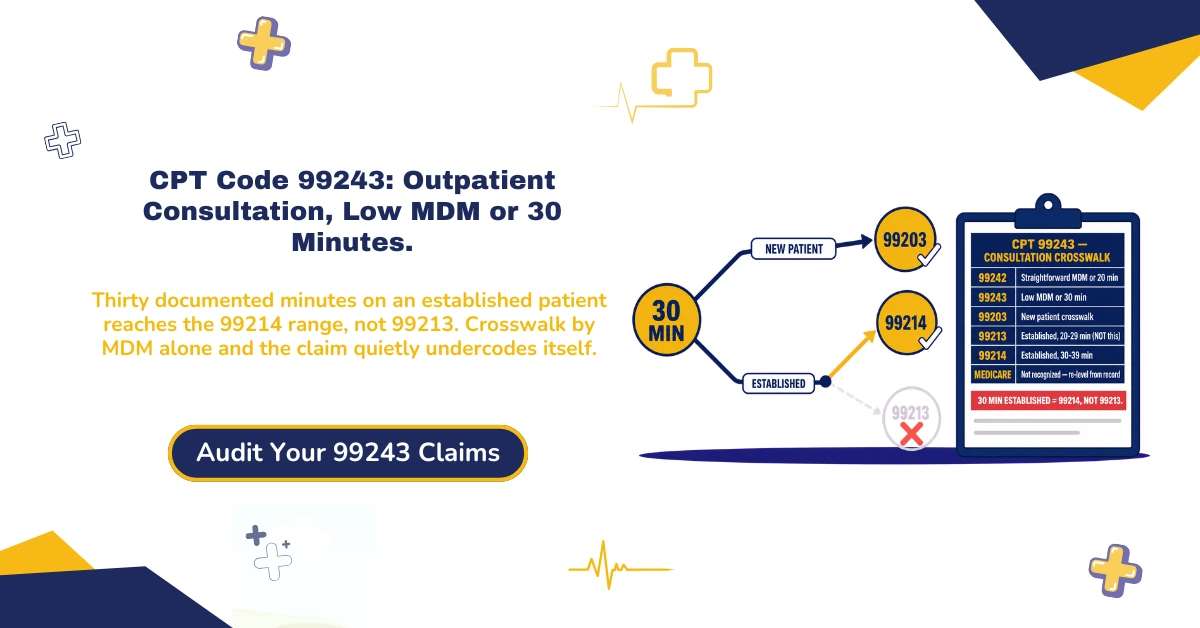
Does CPT 99243 always crosswalk to 99203 or 99213? No. The office visit code that replaces the 99243 CPT code depends on which method the record supports. A low-MDM note usually lands on 99203 for a new patient or 99213 for an established one. A time-based note can land somewhere else entirely, because the office visit codes carry time ranges and the consultation codes carry minimum thresholds.
CPT 99243 Versus 99203 for a New Patient
Both codes can sit on low MDM, and both can involve 30 minutes of documented time. AMA sets 99203 at low MDM or 30 to 44 minutes for a new-patient office or outpatient visit. Two differences matter: 99243 needs a qualifying consultation and a payer that recognizes the family, while 99203 just needs the visit to meet the payer’s new-patient rules.
CPT 99243 Versus 99213 for an Established Patient
AMA puts 99213 at low MDM or 20 to 29 minutes. An established-patient encounter documented on low MDM often supports this office visit E/M code once the payer refuses consultations. Review the record on its own terms first.
Why 30 Minutes May Support 99214
Thirty documented minutes on an established patient reaches the 99214 range, which AMA sets at 30 to 39 minutes. Nobody should downshift that visit to 99213 just because 99243 and 99213 share the same MDM level. Time-selected and MDM-selected notes replace differently, and this is where practices quietly undercode.
Potential office visit E/M code alternatives that require independent record review
| What the record supports | New patient alternative | Established patient alternative |
|---|---|---|
| Low MDM | 99203 | 99213 |
| 30 documented minutes | 99203 | Potentially 99214 |
| Higher supported MDM | Select independently | Select independently |
What Code Replaces the 99243 CPT Code When a Payer Does Not Accept It?
No single code replaces 99243. Work through five checks, in order, and the replacement E/M code falls out of the record instead of a lookup table.
Step 1: Confirm the Payer and Line of Business
Identify the exact product behind the claim: Medicare Part B, Medicare Advantage, commercial insurance, Medicaid fee-for-service, Medicaid managed care, or TRICARE and other government programs. The brand on the card doesn’t tell you the policy.
Step 2: Identify the Setting
Pin down where the service happened. Office, hospital outpatient department, telehealth, observation, inpatient, and other outpatient locations all route to different office outpatient E/M codes.
Step 3: Determine New or Established Status
Apply the payer’s patient-status rules before picking a family. Medicare counts a patient as new when no physician or qualified healthcare professional of the same specialty in the same group practice has provided a professional service in the previous three years.
Step 4: Re-Level the Visit
Select CPT code 99243’s replacement through supported MDM or documented total time. The consultation level doesn’t set the answer, which Section 10 works through in detail.
Step 5: Verify Add-On Eligibility Separately
Neither Medicare add-on code substitutes for consultation reimbursement.
G2211 is a Medicare add-on for visit complexity tied to an ongoing, inherently complex patient relationship. CMS allows it with office and outpatient E/M codes 99202 through 99205 and 99211 through 99215, and, starting January 1, 2026, with home or residence codes. It needs its own documented basis.
G2212 covers prolonged office or outpatient time, and CMS lists it only alongside 99205, 99215, and 99483. A 99203, 99213, or 99214 replacement can’t carry it.
Do not configure an automated one-to-one conversion from 99243 to another E/M code without reviewing the encounter. ClaimMax RCM’s payer-specific claim review connects the plan policy, the documented level, patient status, and the final code before the corrected claim goes out.
Where Can CPT 99243 Be Reported, and What About Telehealth?
Telehealth does not change Medicare’s nonrecognition of CPT 99243. An outpatient consultation CPT code belongs on a claim carrying the place of service where the patient actually received care, and telehealth delivery adds a second layer of payer rules on top of that.
Office and Other Outpatient Settings
Three place of service codes cover most of this family: POS 11 for office, POS 19 for off-campus outpatient hospital, and POS 22 for on-campus outpatient hospital, per the CMS place-of-service code set. Recognizing the code and recognizing it in every setting are separate payer decisions.
Telehealth Requires Payer-Specific Verification
A commercially insured CPT 99243 telehealth consultation can be paid when the plan accepts the code and the encounter meets the plan’s telehealth rules. Check the covered service list, the modifier, and the place of service, since CMS defines POS 02 as telehealth outside the patient’s home and POS 10 as telehealth in the patient’s home.
Medicare handles telehealth consultations through separate HCPCS codes rather than the CPT family. CMS’s May 2026 booklet lists G0406 through G0408 and G0425 through G0427 as recognized telehealth consultation codes for payment. CMS updates the Medicare telehealth services list annually, effective each January 1.
How Much Does CPT 99243 Reimburse?
There’s no single national reimbursement amount for CPT 99243. Payment moves with the payer, product, contract, geographic market, network status, place of service, modifier use, billed charge, and date of service. Any figure quoted as a national average for this code is guesswork.
Medicare Part B has no payable 99243 rate at all, since Medicare doesn’t recognize the code. Every CPT 99243 reimbursement figure a practice collects comes from a commercial or Medicaid contract, so the 99243 fee schedule question is really a contract question.
A rate one payer allows says nothing about the next one.
How a Practice Should Verify Its Actual Rate
Pull the 99243 reimbursement rate from your own data, in this order:
- Review the contracted fee schedule for that payer and product
- Check the payer portal for current rates and consultation policy
- Review recent ERA data for the code
- Compare the allowed amount against the contracted rate
- Investigate variances instead of writing them off
ClaimMax RCM’s payment posting services compare payer payments against negotiated contract rates and flag underpayments while dispute windows are still open.
Can CPT 99243 Be Billed With a Procedure on the Same Day?
CPT 99243 may be reported with a same-day procedure only when the payer recognizes the consultation code and the record supports a significant, separately identifiable E/M service. Modifier 25 doesn’t create separate payment when the underlying work is bundled.
A Procedure Does Not Automatically Support a Separate Consultation
Payment for a minor procedure already includes the routine evaluation and the decision to perform it. Billing a same-day consultation on top of that requires documentation of work above and beyond the usual service tied to the procedure.
Ask what the consultant did that the procedure didn’t already cover. If the note only supports examining the site and deciding to proceed, the payer has a fair argument that the E/M work sits inside the procedure payment.
When Modifier 25 May Apply
Modifier 25 fits when the E/M service is significant, when it’s separately identifiable from the procedure, when the same practitioner performs both on the same date, when the documentation supports the separate work, and when the payer’s rules allow separate reporting.
A different diagnosis isn’t required. Plenty of legitimate same-day consultation claims carry one diagnosis, and plenty of unsupported ones carry two.
CMS states that only a significant and separately identifiable E/M service, unrelated to the decision to perform the minor surgical procedure, should be reported with modifier 25, per current CMS modifier 25 guidance.
Audit exposure runs in both directions now. The HHS Office of Inspector General opened a project on March 16, 2026, reviewing Part B claims from 2023 through 2025 where a same-day E/M service was paid alongside a minor surgical procedure with no modifier 25 appended. Underusing the modifier when it was appropriate creates risk too.
Why Is the 99243 CPT Code Denied?
Eight patterns cover almost every 99243 denial. Find yours in the table, then work the review column before touching the claim.
| Denial pattern | Likely cause | Correct next action |
|---|---|---|
| Code not recognized | Payer excludes consultation codes | Review the policy and select a supported code from the record |
| Consultation criteria missing | Request, reason, or report is absent | Review the documentation before changing the claim |
| Incorrect patient status | Wrong new or established alternative | Apply the payer’s patient-status rules |
| Level unsupported | MDM or total time doesn’t support 99243 | Re-level the encounter |
| Same-day bundling | Procedure and E/M work not separately supported | Review the modifier 25 requirements |
| Duplicate E/M | Another E/M code was reported for the same encounter | Review provider, group, date, and service details |
| Telehealth edit | Code, modifier, or POS not accepted | Check the plan’s telehealth policy |
| Underpayment | Claim paid below the contract | Compare the ERA against the fee schedule |
A consultation-code denial and an underpayment need opposite responses, so read the remittance before assuming which one you have. CMS notes that NCCI edits apply to services reported by the same provider for the same beneficiary on the same date, and it directs claim-specific questions to the payer or Medicare contractor that issued the denial.
Corrected Claim or Appeal?
File a corrected claim when the original carried a clerical or coding error that the existing documentation already supports fixing: a wrong POS, a missing modifier, the wrong patient-status family.
A denial appeal is the right route when the submitted code was correct, the contract supports it, the consultation request and report were documented, and the payer misapplied its own policy. Appeals also fit when the claim needs additional documentation or policy evidence attached.
Not every 99243 claim denied by a payer should be rebilled with a different code. Replacing a supported consultation with an office visit gives up revenue the contract entitled you to.
ClaimMax RCM’s denial management services review the payer edit, the documentation, the contract terms, and the appeal route before a claim gets changed or resubmitted. Claims already aging past the first denial move into accounts receivable follow-up.
Review Your Denied Claims
CPT 99243 Frequently Asked Questions
What is CPT code 99243 used for?
The 99243 CPT code reports an office or outpatient consultation for a new or established patient. Selection runs through low medical decision making or at least 30 minutes of total time on the encounter date. The payer has to recognize consultation codes for the claim to pay.
Is CPT 99243 still valid?
Yes. CPT 99243 is an active code in the current CPT code set. Validity and payment are separate questions, since Medicare Part B doesn’t recognize it and commercial plans differ. Verify the specific payer and product before submitting.
Is CPT 99243 covered by Medicare?
No, not under Medicare Part B. CMS’s current booklet states that Medicare doesn’t recognize office and outpatient consultation codes 99242 through 99245. Report the appropriate recognized E/M visit code instead, selected from the record rather than crosswalked automatically from the consultation level.
What is the difference between 99242 and 99243?
One medical decision making level and 10 minutes. CPT 99242 needs straightforward MDM or at least 20 minutes of total time. CPT 99243 needs low MDM or at least 30 minutes. Both apply to new or established patients in the outpatient setting.
What documentation is required for CPT 99243?
Five elements make up the 99243 documentation requirements: the consultation request, the specific reason for the opinion, the service performed and the consultant’s recommendation, the supported MDM or documented total time, and the report back to the requesting provider.
Does a denied CPT 99243 claim have to be rebilled?
Not automatically. Determine first whether the denial came from an incorrect code, unsupported documentation, or a payer error. Correct genuine errors through a corrected claim, and appeal claims the record and contract already support.
How ClaimMax Helps Practices Manage Consultation-Code Billing
Consultation coding fails at the handoffs. A coder confirms the policy, then the claim goes out under a stale edit. A denial gets worked, and nobody feeds the cause back into the scrubber.
Connect Payer Rules With the Full Claim Workflow
ClaimMax RCM runs payer-policy verification, medical coding review, claim scrubbing, submission, payment posting, denial management, AR follow-up, and reporting as one workflow under one team. For consultation codes specifically, that means the plan’s current position on 99242 through 99245 gets applied at scrubbing, not discovered on a remittance three weeks later.
Practices tracking several products get the same benefit in reverse. When a payer changes its consultation policy, the change lands in the edit rules once instead of spreading through eight coders at different speeds.
Not Sure Whether Your Consultation Claims Are Coded Correctly?
ClaimMax RCM can review the payer rules, documentation, denial patterns, and payment history behind your consultation claims. You’ll see which problems need coding corrections, which need payer appeals, and which need a workflow change before the same denial repeats.
Ongoing support runs through full medical billing services and denial management support.
Get a Free RCM Analysis