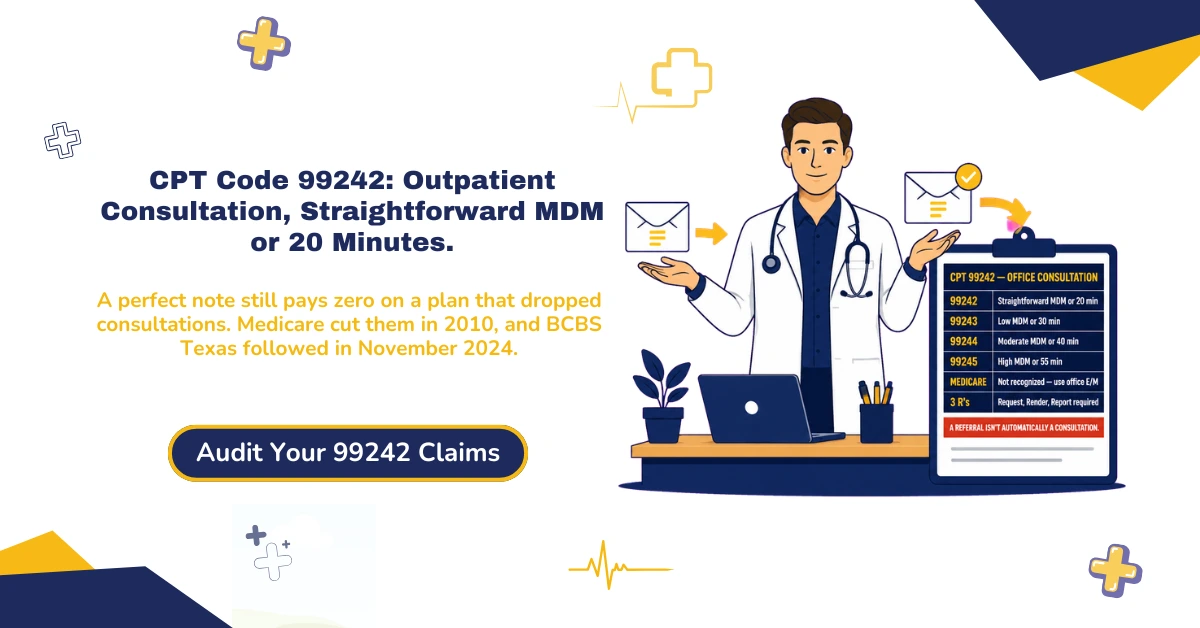
CPT 99242 reports an office or other outpatient consultation for a new or established patient. Select the level with straightforward medical decision making, or at least 20 minutes of qualifying total time on the encounter date. The encounter has to meet consultation requirements separately, and the payer has to recognize outpatient consultation codes.
Getting the level right won’t get you paid on its own. CPT 99242 carries three separate tests, and the claim fails when one breaks. Your record has to name who requested the opinion, show the service you performed, and document the written report you sent back.
Payer recognition catches orthopedic and surgical practices hardest, since referring physicians send them specific clinical questions all week. Medicare Fee-for-Service stopped paying consultation codes in 2010. Some commercial plans still pay the 99242 CPT code, others dropped it, and two products under one brand can differ.
Verify the payer rule before the claim goes out. Finding it after the denial posts burns your appeal window. The office consultation CPT code only pays when your documentation and the payer’s policy line up in advance, which is what payer-specific medical billing services catch.
What is CPT code 99242?
The 99242 CPT code covers an office or other outpatient consultation for a new or established patient, selected by straightforward medical decision making or at least 20 minutes of total time on the encounter date.
| Element | Where 99242 stands |
|---|---|
| Service category | Office or other outpatient consultation, including home, residence, and emergency department |
| Patient status | New or established |
| MDM level | Straightforward |
| MDM method | Two of the three elements must meet the level |
| Time route | At least 20 minutes |
| Time period | The encounter date only |
| History and examination | Medically appropriate, and no longer level-determining |
| Consultation status | Must qualify on its own |
| Payer acceptance | Must be verified per plan |
Practices searching for the CPT code for outpatient consult services land on this family, 99242 through 99245. Patient status doesn’t change which set applies. The AAFP consultation code table lists the same four levels for new and established patients.
Two details trip people up. The 99242 CPT code description leaves out history and examination scoring, so a longer note won’t raise the level. An active CPT code isn’t a payable one.
Coders looking up the CPT code 99242 definition tend to stop at the level requirements. Two questions come before that. Does the encounter qualify as a consultation, and does this specific plan still recognize the family?
When does an encounter qualify as a consultation?
An encounter qualifies as a consultation when another physician, qualified healthcare professional, or appropriate source asks for your opinion or advice, you perform and document the service, and you send a written report back to whoever asked. A patient who books with your specialist on their own doesn’t create one.
Those three conditions come from the CPT consultation guidelines. The 99242 CPT code sits inside this family, so the level rules don’t matter until all three hold.
Someone has to ask for your opinion
The request comes from another physician, a qualified healthcare professional, or an appropriate source. CPT names non-clinical examples including a lawyer and an insurance company. A patient or family request doesn’t qualify.
Write it into the record. The request can be verbal or written, and UTMB consultation guidance from June 2026 confirms either form works as long as the chart shows it.
Orthopedic groups watch this break weekly. A primary care office sends the patient over with a standing referral order and no clinical question. Nothing in it asks for an opinion.
You perform and document the service
Evaluate the problem you were asked about, then document your findings, your reasoning, and your recommendations. A medically appropriate history and examination belong in the note, though neither sets the level.
You can start treatment. CPT states a consultant may begin diagnostic or therapeutic services at the same visit or a later one, so ordering an MRI or injecting a joint won’t cost the consultation.
You send a written report back
CPT requires a written report. Your opinion and any services you ordered or performed have to reach the requesting source in writing. Practices skip this step more than any other, and auditors check it first.
Format is where payers differ. A routed note, a letter, or a documented electronic transmission can each satisfy it, and your chart has to show the report went out. Denials on CPT code 99242 for missing consultation support usually start here.
How to select CPT 99242 by MDM or total time
Select CPT 99242 using straightforward medical decision making, or at least 20 minutes of qualifying total time on the encounter date. When you use MDM, two of the three elements have to reach the straightforward level. Consultation requirements stay a separate test either way.
Pick one route per encounter. Mixing them, or averaging them, gives an auditor something to unwind later.
Selecting 99242 with straightforward MDM
Three elements decide the MDM level. Count the number and complexity of problems you addressed, the amount and complexity of data you reviewed and analyzed, and the risk of complications or morbidity from how you managed the patient.
The overall level lands where two of the three elements meet it. CPT 99242 applies when two elements support straightforward MDM and the encounter doesn’t reach low. All three don’t have to sit at the same level, and the AMA outpatient coding guidance spells that rule out.
At the straightforward level, CPT’s own examples read like this: one self-limited or minor problem, minimal or no data reviewed, and minimal risk from the management you chose.
Don’t let a diagnosis label pick the code. A minor sprain doesn’t automatically produce straightforward MDM, and a scary-sounding diagnosis doesn’t automatically produce moderate. Read the problems, the data, and the management risk together, the way a reviewer will.
Selecting 99242 with total time
Twenty minutes has to be met or exceeded. Count your own time as the billing physician or qualified healthcare professional, and count it only on the encounter date. Both face-to-face and qualifying non-face-to-face work belong in that total.
CPT counts these activities toward your total time:
- Preparing to see the patient, including reviewing tests
- Obtaining or reviewing separately obtained history
- Performing a medically appropriate examination or evaluation
- Counseling and educating the patient, family, or caregiver
- Ordering medications, tests, or procedures
- Documenting clinical information in the health record
- Coordinating care that you don’t report separately
Four things stay out of the count. Clinical staff time doesn’t belong to you. Work you did on another date doesn’t carry over. Travel doesn’t count, and neither does time inside a service you’re reporting separately.
Document which route you used
When time picks the code, record the actual total and say what you did during it. If MDM picks it, record the clinical facts behind the elements you’re relying on.
Identical times on every note draw attention fast. So does a padded narrative written to look complex. A short note that supports the work beats a long one that buries it.
CPT code 99242 documentation requirements
Documentation for the 99242 CPT code needs to name the requesting professional, state the reason for the consultation, record your evaluation and recommendations, prove a written report went back, and support either straightforward MDM or at least 20 minutes of qualifying time.
Document the request and the reason
Your note should identify who asked, their role when it matters, and the specific problem they raised. It should also show they wanted an opinion rather than handing you the patient’s ongoing care.
One line handles it. Something like “Consultation requested by Dr. Alvarez for evaluation and recommendations regarding right shoulder impingement” gives a reviewer the source and the reason at once. Treat it as an example, not required wording.
Document the evaluation and what you advised
Record the medically appropriate history and examination you performed, your assessment, the reasoning behind it, and the records or tests you reviewed. Add your recommendations, anything you ordered or performed, the follow-up plan, and who carries the condition forward.
Old history and examination element counting has no role here. Bullet counts from the 1995 and 1997 guidelines won’t protect a level under the current rules.
Prove the report went back
Keep whatever shows the written report reached the requesting source. A routed note, a letter, a documented electronic message, or a copy notation can each do the job. Don’t assume one EHR function satisfies every payer.
Support the MDM or time route
For MDM, write down the problems you addressed, the data you reviewed, and the management risk, with enough fact behind two of the three elements. With time, write down the actual total, the encounter date, and proof that separately reported services stayed out.
Run this checklist before the note leaves your queue:
- Requesting source and consultation reason are both documented
- The requested service was performed
- A medically appropriate evaluation appears in the note
- Your findings and recommendations are recorded
- Evidence shows the written report went back
- Straightforward MDM or qualifying total time is supported
- Payer recognition was verified for this specific plan
Coding accuracy only pays off when the rest of the cycle keeps up. Revenue cycle management services should connect the consultation note to code selection, payer policy, submission, remittance, and follow-up.
When consultation notes reach billing without the request, the reason, or the report-back evidence, fix the workflow before the next batch goes out.
Consultation, referral, and transfer of care aren’t the same
A consultation is a request for your opinion, followed by your documented service and a written report back. Transfer of care happens when another practitioner hands you the management of a specific problem or the patient’s entire care. Referral is a loose operational word that can mean either one.
What makes it a consultation
Another professional or appropriate source asks for advice on a specific problem. You evaluate it, form an opinion, and send findings and recommendations back. The requesting practitioner keeps using your advice in the care they provide.
Ordering a test or recommending treatment won’t settle the question by itself. Look at the original request, whether a report was expected back, and who owns the condition after the visit.
Why referral means almost nothing on a claim
The word referral covers a request for a specialist opinion, an administrative authorization, an instruction to start treatment, a network requirement, or a full handoff of a condition. Five meanings, one word, and none of them establishes consultation eligibility.
What transfer of care looks like
CPT is direct here. Services provided for the management of the patient’s entire care, or for the care of a specific condition, get reported with the appropriate new or established patient office visit codes instead.
The 99242 CPT code isn’t the fallback when that happens. Reassess the office or outpatient family from the original record and pick the level the documentation supports.
| What happened | Consultation status | Why |
|---|---|---|
| Opinion requested, service done, written report sent | Can qualify | Advisory service asked for and returned |
| Patient self-schedules | Doesn’t qualify | No requesting source exists |
| Patient sent for ongoing management | Likely transfer of care | Responsibility moved to you |
| You order imaging while forming advice | Not decided by the order | Purpose and responsibility control |
| Payer referral number on file | Not enough alone | Authorization isn’t a clinical request |
| Payer accepts consultation codes | Still not enough | Documentation and level are separate tests |
Does Medicare pay CPT code 99242 in 2026?
No. Medicare Fee-for-Service doesn’t recognize CPT 99242 for Part B payment. Report an appropriate Medicare-recognized E/M code for the setting and the documented service instead. Medicare Advantage, Medicaid, commercial plans, and workers’ compensation each set their own rules and have to be checked one at a time.
Medicare Fee-for-Service
CMS has excluded consultation codes from Part B payment since January 1, 2010. Section 30.6.10 of the CMS consultation-services policy instructs physicians to report the E/M code that represents where the visit happened and how complex it was.
Don’t run a fixed crosswalk. Reassess place of service, new or established status, and the documented MDM or time against the code you’re switching to. The alternative code carries its own thresholds.
For Medicare-specific documentation material, CMS keeps its E/M guidance pages current. Treat those as Medicare policy only, since they say nothing about what a commercial plan expects from a consultation.
Medicare Advantage, Medicaid, and commercial plans
Medicare Advantage organizations set consultation policy by plan and product, and their rules don’t mirror Fee-for-Service. State Medicaid agencies differ from each other, and managed care plans often differ from their own state’s policy.
| Payer | What you have to verify |
|---|---|
| Medicare Fee-for-Service | Use a Medicare-recognized E/M code instead |
| Medicare Advantage | Plan policy and your provider contract |
| State Medicaid | State fee schedule and provider manual |
| Medicaid managed care | MCO manual and plan-level policy |
| Commercial insurance | Exact product, network, and contract terms |
| Workers’ compensation | Jurisdiction rules for that program |
One commercial payer, as an example
Blue Cross and Blue Shield of Texas stopped reimbursing outpatient and inpatient consultation codes 99242 through 99245 and 99252 through 99255 for dates of service on or after November 18, 2024. Its BCBSTX consultation policy directs those services to an office, outpatient, or inpatient E/M code matching the location and complexity.
That policy applies to BCBSTX. It doesn’t cover every Blue Cross plan, every HCSC company, or every commercial payer in Texas, and treating it as a national rule costs you money on plans that still pay the family.
Five steps before you submit
- Identify the exact payer and plan product on the claim
- Confirm whether that product recognizes outpatient consultation codes
- Confirm referral, authorization, and report requirements
- Reassess the correct E/M family and level when consultations aren’t recognized
- Record the verified rule, its source, and its effective date in your payer matrix
Eligibility verification won’t finish this job. An eligibility response confirms active coverage, benefits, network status, and authorization requirements. It rarely tells you whether a plan pays a specific consultation code, so your staff needs the provider manual, the payment policy, or written confirmation from a network representative.
Looking up rates for the replacement code
Skip searching for a Medicare rate on 99242. CMS states that its fee schedule lookup tool doesn’t display Medicare Part B non-payable codes, so a blank result is the policy answer. Once you’ve picked the recognized alternative, that same tool gives you pricing and RVUs by locality.
If consultation-code edits keep bouncing across one payer, ClaimMax RCM will run a free revenue cycle audit on your payer mix and show you where the pattern starts. Payer-specific billing support costs 3.49% of collections, with verification of benefits and prior authorization included at no extra charge.
CPT 99242 compared with 99243, 99244, and 99245
CPT 99242 is the lowest active outpatient consultation level and needs straightforward MDM or at least 20 minutes. The 99243 CPT code needs low MDM or at least 30 minutes, 99244 needs moderate MDM or at least 40 minutes, and the 99245 CPT code needs high MDM or at least 55 minutes.
| Code | MDM level | Minimum total time | Position in the family |
|---|---|---|---|
| 99242 | Straightforward | 20 minutes | Lowest active level |
| 99243 | Low | 30 minutes | Low MDM consultation |
| 99244 | Moderate | 40 minutes | Moderate MDM consultation |
| 99245 | High | 55 minutes | Highest active level |
| +99417 | Add-on | 70 minutes or longer | Prolonged service with 99245 |
Each minimum has to be met or exceeded. When MDM picks the code, two of the three elements have to reach that level. The 99244 CPT code description carries the same structure as the rest, so nothing about moderate MDM changes the two-of-three math.
CPT deleted 99241 in 2023, which makes 99242 the entry point. Appointment length doesn’t select a code, and diagnosis severity doesn’t set the MDM level.
All four levels sit behind the same two gates. The encounter has to qualify as a consultation, and the payer has to recognize the family. A perfect 99244 note pays nothing on a plan that dropped consultations.
One habit worth breaking: calling the 99242 CPT code a level 2 office visit. It belongs to a different family than 99202 and 99212, with separate payer policies attached.
When to use CPT 99242 instead of office E/M codes
Use CPT 99242 when the encounter meets consultation requirements, the documentation supports the level, and the payer recognizes outpatient consultation codes. Switch to an office E/M code for an ordinary office visit, a transfer of care, a patient-initiated specialist visit, or a payer that dropped consultations.
New patient office codes
CPT 99202 through 99205 cover new patient office visits, and you pick the level by MDM or total time. A new patient sent to you for ongoing care doesn’t qualify for consultation coding, whatever the fax cover sheet says.
Anyone searching for a new patient consult CPT code needs one of these two families. CPT 99202 requirements and the CPT 99203 billing guide cover the thresholds.
Watch the time gap. CPT 99242 and 99202 both run on straightforward MDM, but 99242 needs 20 minutes and 99202 needs 15.
Established patient office codes
CPT 99212 through 99215 run on MDM or total time. Code 99211 sits apart as a minimal established patient service, and AAFP confirms MDM and time don’t apply.
An established patient can still generate a consultation when another professional asks for an opinion and the payer accepts the family. The CPT 99213 decision guide walks through that level.
Follow-ups go the same way. CPT sends follow-up visits in the consultant’s office, whoever initiated them, to codes 99212 through 99215.
| What the encounter looks like | Likely code family |
|---|---|
| Opinion requested, report sent, payer accepts | 99242 to 99245 |
| New patient sent for ongoing treatment | 99202 to 99205 |
| Established patient, ordinary management | 99212 to 99215 |
| Minimal established patient service | 99211 |
| Medicare Fee-for-Service outpatient visit | Medicare-recognized office E/M |
| Patient books on their own | Office E/M family |
Don’t build a fixed crosswalk from this table. Publishing 99242 equals 99202 as a rule ignores that the office code has to stand on the original record. A denial on CPT code 99242 gets fixed by rereading the note.
Can modifier 25 be used with CPT 99242?
For a payer that recognizes the 99242 CPT code, modifier 25 may be accepted when the consultation is a significant, separately identifiable E/M service furnished the same day as another procedure. Documentation and payer rules both have to support it.
CMS pays a same-day E/M service inside a global fee period when the work goes above and beyond the usual pre-operative and post-operative care, per section 30.6.6 of the claims processing manual.
- The payer recognizes the underlying consultation code
- The E/M work is significant and separately identifiable
- The work goes beyond what the procedure already includes
- One practitioner performs both services on the same date
- The note documents each service on its own terms
A separate diagnosis isn’t required. CMS states that different diagnoses aren’t needed when reporting an E/M service on the same date as a procedure, and a different diagnosis alone doesn’t prove modifier 25 was appropriate.
Modifier 25 won’t make 99242 payable under Medicare Fee-for-Service. Pick the Medicare-recognized code first, then apply the modifier there if the same-day work supports it.
Modifier 32 rarely belongs on a 99242. CPT reserves it for consultations mandated by a third party, which excludes the ordinary physician-requested consultation, and Medicare makes no payment adjustment for it.
Can an outpatient consultation be furnished through telehealth?
An outpatient consultation can be furnished through telehealth when the clinical service, state law, and payer policy allow it. The 99242 CPT code isn’t automatically the right billing code. Some payers require a telemedicine E/M family that contains no consultation code, which moves the encounter out of the family entirely.
Medicare telehealth rules changed in February 2026. The Consolidated Appropriations Act, 2026 extended the pandemic-era flexibilities, and HHS telehealth policy now shows patients receiving non-behavioral telehealth at home, with no geographic restriction, through December 31, 2027.
None of that makes 99242 payable. Medicare Fee-for-Service still doesn’t recognize consultation codes, so pick a recognized service first, then confirm it appears on the CMS list of telehealth services for 2026. CMS again declined to add telemedicine codes 98000 through 98015.
Verify these before submitting
- Whether the payer recognizes outpatient consultation codes
- Whether it wants a telemedicine E/M code instead
- Whether audio and video is required, or audio-only is allowed
- Which place of service code fits the patient’s location
- Whether modifier 95, modifier 93, or another element applies
- Whether the request and written report requirements are met
- Whether state law and licensure cover the encounter
Don’t assume modifier 95 travels with this code. Our modifier 95 billing rules guide covers the reporting and place-of-service pairing, and none of it makes 99242 and modifier 95 automatically reportable together.
Potential CPT 99242 denial causes and correction paths
Potential 99242 CPT code denials come from payer nonrecognition, missing consultation documentation, transfer-of-care classification, unsupported MDM or time, same-day edits, and telehealth mismatches. What you do next depends on the remittance advice, the payer policy, your contract, and the record.
Read the whole remittance before touching the claim. The group code tells you who owes the balance, the reason code explains why payment differs from the billed amount, and the remark code adds what it leaves out.
| Potential cause | What to inspect | What to do next |
|---|---|---|
| Payer dropped consultations | Current policy and contract | Correct the code when the record supports it |
| Request not documented | Original order and chart | Use only what existed at the encounter |
| Written report unsupported | Routed note and transmission record | Supply the existing report evidence |
| Transfer of care | Who manages the problem now | Reassess the office E/M family |
| MDM unsupported | Problems, data, and risk | Correct the level only if supported |
| Time unsupported | Total-time statement and activities | Correct only if qualifying time was documented |
| Modifier edit | Procedure pairing and NCCI edits | Remove or correct the modifier |
| Telehealth mismatch | Code family, modifier, and place of service | Correct what the payer rules allow |
| Timely filing | Submission date and correction deadline | Follow the payer’s appeal policy |
The five-step correction workflow
- Read the full ERA, EOB, or payer message end to end
- Identify the group code, reason code, and remark code
- Compare the payer rule against the original medical record
- Choose a corrected claim, reconsideration, appeal, or adjustment
- Add the verified rule and its effective date to your payer matrix
One line you don’t cross: never create consultation documentation after the fact to make a claim payable. Work with what existed at the encounter, the referral evidence on file, and late entries that follow your documentation policy.
When the same consultation problem repeats across one payer, trace it to the upstream cause before you file again. Denial management services exist for that pattern, and the audit that finds it costs nothing.
CPT 99242 reimbursement and payment verification
Medicare Fee-for-Service doesn’t pay a claim reported with the 99242 CPT code as an outpatient consultation. Commercial reimbursement moves with your contract, the plan product, your market, network status, and place of service. Check the contract. A national average won’t tell you what this plan pays.
Medicare
No 2026 Medicare payment amount exists to publish for this code, since Part B doesn’t recognize it. Pick the Medicare-recognized alternative and verify its rate through the CMS lookup tool or your MAC, expecting variation by locality and setting.
Commercial payers
Pull the executed contract and fee schedule, then confirm the exact plan product on the claim. Your billed charge isn’t your expected payment, and two products under one payer brand can carry different allowed amounts.
Verifying what the payer sent
- Match the ERA or EOB line to the claim you submitted
- Confirm which CPT code the payer processed
- Identify the allowed amount and the contractual adjustment
- Confirm the patient responsibility figure
- Compare the allowed amount against your contract
- Route underpayments, denials, and unresolved balances
- Track recovery activity through AR
That comparison is where short payments surface. Anyone searching the CPT code 99242 description for a dollar figure comes up empty, so the contracted rate on the replacement code becomes your benchmark. Payment posting services and accounts receivable follow-up catch the gap while it’s still collectible.
Frequently asked questions about CPT 99242
Is CPT 99242 still a valid code in 2026?
Yes. CPT 99242 remains an active outpatient consultation code, and CPT deleted 99241 in 2023. Validity and payment are separate questions, so an active code can still go unpaid under Medicare or a commercial policy.
Is CPT 99242 for new or established patients?
Either one. The consultation family covers new and established patients alike, as long as the encounter meets consultation requirements and the payer recognizes the codes. Patient status matters once you switch to an office E/M code.
Can a patient self-refer for CPT 99242?
No. A patient-initiated appointment doesn’t create the request CPT requires. Your record needs another physician, qualified healthcare professional, or appropriate source asking for an opinion, along with the reason behind it.
Can the consultant order testing or start treatment?
Yes. CPT allows a consultant to begin diagnostic or therapeutic services at the same visit or a later one. Weigh the original request, the written report you sent back, and who carries the condition forward.
Is the 20-minute requirement face-to-face time?
No. Count your qualifying time as the billing physician or qualified healthcare professional on the encounter date. Face-to-face and qualifying non-face-to-face work both count. Clinical staff time, other dates, and separately reported services stay out.
What’s the difference between 99242 and 99243?
CPT 99242 needs straightforward MDM or at least 20 minutes. Move to 99243 and you need low MDM or at least 30 minutes. Both still have to satisfy consultation requirements, and the payer still has to recognize the family.
Can CPT 99242 be used for telehealth?
Don’t assume it applies. Verify whether the payer wants a consultation code, a telemedicine E/M code, or an office E/M code, then confirm modality, modifier, place of service, state law, and your consultation documentation.
Does Medicare pay the 99242 CPT code?
No. Medicare Fee-for-Service hasn’t recognized consultation codes for Part B payment since January 1, 2010. Report a Medicare-recognized E/M code that fits the setting and your documentation, and check Medicare Advantage plans one at a time.
What does the 99242 CPT code description leave out?
History and examination scoring. The descriptor calls for a medically appropriate history and examination, then sets the level by straightforward MDM or 20 minutes. Note length won’t change which code you report.
How ClaimMax RCM supports outpatient consultation billing
Consultation claims fail in predictable places, and the fix almost always sits upstream of the claim. Orthopedic, spine, and surgical groups carry the heaviest consultation volume, and they watch the same payer rules break in the same order every month.
ClaimMax RCM runs that whole path, from identifying the exact plan product through recording the verified rule in your edit matrix.
- Identify the exact payer and plan product on every consultation
- Confirm whether that product recognizes outpatient consultation codes
- Verify referral and authorization requirements before the visit
- Check that the request and written report workflow is documented
- Review MDM or total-time support ahead of submission
- Reconcile the ERA or EOB and route denials and underpayments
- Add the verified payer rule to your edit matrix
Pricing is simple. Consultation claim billing runs at 3.49% of collections, and verification of benefits and prior authorization come with it instead of arriving as separate line items. Credentialing and contracting is billed apart from that, at $120 per insurance.
Start with the audit, which costs nothing. We review your consultation claims, your payer mix, and the edits behind your denials, then show you where the pattern starts. If consultation denials have been eating your team’s week, book the free revenue cycle audit and we’ll take the follow-up off your plate.
The CPT 99242 billing decision in one minute
Before you report this code, confirm all seven:
- Another professional or appropriate source requested an opinion
- The reason for the consultation is documented
- You performed and documented the requested service
- A written report went back to the requesting source
- Straightforward MDM or at least 20 minutes is supported
- Two of the three MDM elements support the level when you used MDM
- The payer recognizes outpatient consultation codes
When any one of those fails, sort out the documentation, the E/M family, the level, or the payer route before the claim goes out.