
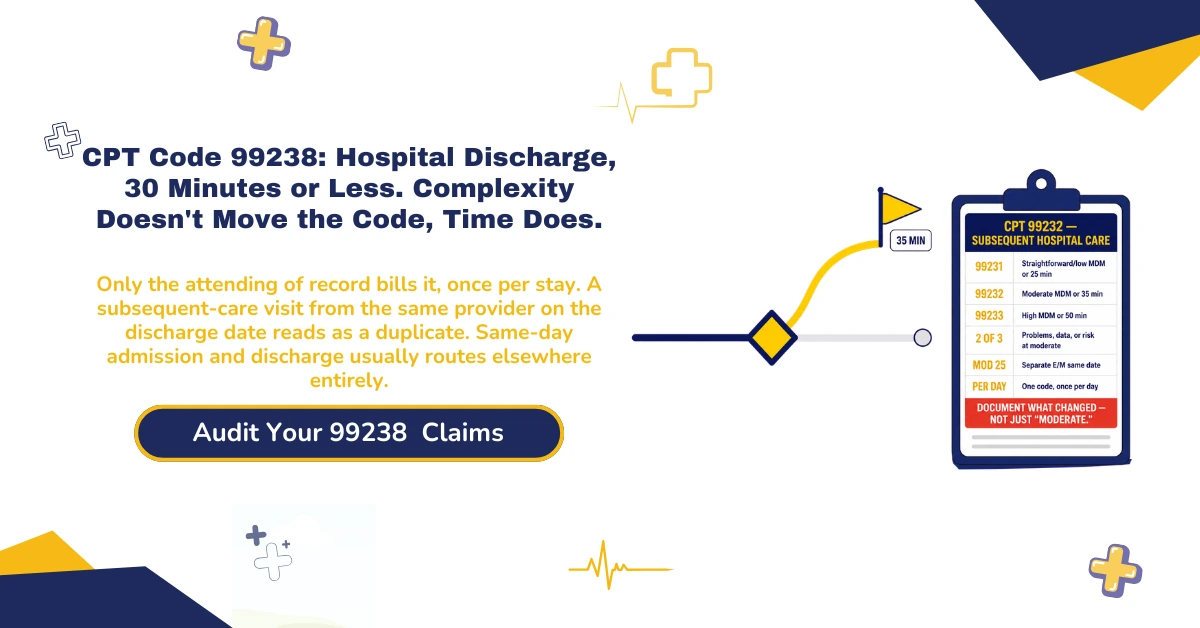
CPT 99238 reports hospital inpatient or observation discharge-day management when the physician’s supported discharge time is 30 minutes or less on the date of the encounter. The code sits inside the merged hospital inpatient and observation E/M family, and Medicare generally expects the attending provider of record to report it. Total time selects the code, not medical decision making.
Coding teams often run into the same five mix-ups with this discharge CPT code. They treat a complex case as automatic grounds for the higher-time code, or they assume the discharge summary alone proves the visit happened.
They also confuse a same-day admission and discharge with a discharge on a later calendar date. And they sometimes let a consultant’s note stand in for the attending’s own discharge work, or mix up inpatient and observation status even though both can support 99238 when the record backs it up.
This guide walks through 99238 versus 99239, time documentation, same-day discharge coding, provider eligibility, place-of-service rules, denial triggers, 2026 reimbursement, and audit prevention for anyone reporting the CPT code for hospital discharge management.
The code remains inside the combined hospital inpatient and observation E/M family that took effect in 2023. AMA’s CPT Evaluation and Management page, last updated January 26, 2026, confirms that the earlier standalone observation codes were deleted and folded into the hospital-care code set that already included 99238 and 99239 AMA CPT E/M guidance. That update did not change what the code itself covers.
ClaimMax RCM built this CPT 99238 guide to turn those rules into decisions a coder or attending physician can act on before the claim goes out.
99238 at a Glance
CPT 99238 is a time-based code. It applies when the physician’s supported discharge-management time runs 30 minutes or less, and it covers hospital inpatient or observation discharge-day management. The attending provider of record generally reports it, and Medicare pays for only one discharge service per stay. Same-day admission and discharge usually routes to a different code family entirely.
The 99238 CPT code description places the service within hospital inpatient or observation discharge-day management, selected by time, not diagnosis count or clinical complexity. The table below summarizes CPT code 99238 at a glance.
| Field | Required content |
|---|---|
| Code | 99238 |
| Service category | Hospital inpatient or observation discharge-day management |
| Time | 30 minutes or less |
| Code selection basis | Total qualifying discharge-management time |
| Selected by MDM? | No |
| Typical billing provider | Attending provider of record |
| Frequency | One discharge service per stay |
| Companion code | 99239, for more than 30 minutes |
| Same-day admission and discharge | Usually 99221-99223 or 99234-99236, depending on Medicare duration rules |
| Inpatient POS | POS 21 |
| Observation POS | POS 22 |
| Main audit concern | Unsupported time, wrong provider, wrong date, or same-day code conflict |
The table above answers the fastest lookup questions in one place. Everything else in this guide expands on the rows that carry real audit risk: time support, provider identity, and same-day conflicts.
Is 99238 a Low-Complexity Discharge Code?
No. The distinction between 99238 and 99239 is the supported discharge-management time, not whether the case looks routine or clinically complex.
The AMA merged hospital inpatient and observation E/M codes into one structure starting in 2023, and 99238 and 99239 stayed inside that merged family. Nothing about that structure singles out this hospital discharge CPT code as a default or low-complexity option; time alone decides which of the two codes applies.
What Does 99238 Cover on the Discharge Date?
CPT 99238 may include the final patient assessment, a review of the hospital course, discussion with the patient or caregiver, medication reconciliation, continuing-care instructions, prescriptions, referral forms, and discharge-record preparation, when those activities apply to the case. Coordination with receiving providers or facilities can count too. Not every discharge touches every item on that list.
Discharge activities that may count
The table below breaks down what this discharge CPT code may include on the day of discharge.
| Activity | What the note should show |
|---|---|
| Final assessment | Evaluation of discharge readiness |
| Hospital-course review | Discussion of the reason for admission, treatment, and outcome |
| Medication management | Reconciliation, prescriptions, and medication instructions |
| Patient education | Follow-up, warning signs, diet, activity, and self-care |
| Caregiver communication | Instructions to family or caregivers where relevant |
| Care coordination | Communication with case management, therapy, home health, a skilled nursing facility, or another physician |
| Documentation | Orders, records, referrals, and discharge-summary work |
| Follow-up planning | Specialist, primary care, rehabilitation, or diagnostic follow-up |
What 99238 Does Not Represent
The CPT 99238 description covers physician work, not facility operations. The code does not represent the patient’s total length of stay, the hospital facility’s discharge charge, nursing or administrative staff time, a discharge-destination code, a patient discharge-status code, a separate payment for every discharge task, or a code selected by diagnosis count or MDM level.
Professional service versus facility billing
As a 99238 procedure code, the service bills on the physician’s professional claim. The physician or other qualified billing professional submits that claim. The hospital’s institutional claim for the same stay runs through a separate billing structure entirely.
Discharge billing holds up only when documentation, coding, charge capture, and claim editing agree before the claim goes out. ClaimMax RCM’s medical billing services manage all four stages under one team.
A practice that keeps finding discharge codes billed under the wrong provider, date, or setting usually needs a pre-submission review, not another correction after the payer already denied the claim.
99238 vs 99239: The 30-Minute Coding Decision
CPT 99238 applies when discharge-management time is 30 minutes or less, and CPT 99239 applies once that time exceeds 30 minutes. Time is cumulative across qualifying activities performed on the encounter date. Complexity alone does not select either code, and neither code is chosen by medical decision making.
The table below lines up the 99238 CPT code against 99239 on every factor that matters for code selection.
| Decision point | 99238 | 99239 |
|---|---|---|
| Discharge-management time | 30 minutes or less | More than 30 minutes |
| Selected by MDM | No | No |
| Selected by diagnosis count | No | No |
| Selected by length of stay | No | No |
| Total time documentation | Strongly recommended | Necessary to support more than 30 minutes |
| Same-day admission and discharge | Usually routes to 99221-99223 or 99234-99236 instead | Same restriction applies |
| Billing provider | Attending provider of record under Medicare rules | Same |
| Frequency | One discharge service per stay | One discharge service per stay |
Providers documenting more than 30 minutes should review ClaimMax RCM’s complete CPT 99239 billing, time, and documentation guidance.
Four time examples
Example 1, 20 minutes: report 99238 once every other billing requirement is met.
Example 2, exactly 30 minutes: report 99238. The higher-time code only starts once qualifying work passes the 30-minute mark, so 31 minutes is the real floor for 99239.
Example 3, 31 minutes: report 99239, provided the record documents more than 30 minutes.
Example 4, 45 minutes with no time statement: don’t default to either code. Follow the organization’s provider-query and coding policy, and confirm the record supports a billable discharge encounter before choosing one. Defaulting straight to 99238 hides undercoding as easily as an unsupported 99239 creates an overpayment.
Why complexity can affect time but does not select the code
A complex discharge can take longer, and that extra time may support 99239. The record still has to document the actual total time, since time, not case complexity, decides which code applies.
Does Time Have to Be Documented for 99238?
The safest practice is to document total discharge-management time for both code choices. CPT 99238 doesn’t state a separate minimum number of minutes, but the record should still support that the service falls in the 30-minutes-or-less range. A missing time statement can leave a supported 99239 looking unsupported, and it can equally hide undercoding on a 99238 claim.
No minimum time is not the same as no time documentation
A minimum threshold tells a provider how many minutes they must reach before billing a code. A ceiling works the other way: it tells them the service must stay under that mark. The 99238 time requirement is a ceiling of 30 minutes, and 99239 kicks in once time passes it. Total time gives the coder the evidence to place a case correctly.
Medicare’s discharge-day management policy for hospital inpatient and observation visits sits inside the CMS Claims Processing Manual, which frames the service around total qualifying time on the date of the encounter.
Total minutes versus an activity-by-activity breakdown
A total-time statement is the main goal for the note. The 99238 time requirement itself doesn’t call for a minute-by-minute activity log; a defensible total is enough in most cases. Breaking time into individual activities can strengthen the record further, but providers don’t need to log a separate count for every task unless a specific payer requires that level of detail. The note has to connect the stated time to real discharge-management work.
Strong and weak time statements
Strong: “Total discharge-day management time was 24 minutes, including patient counseling, medication reconciliation, follow-up planning, and completion of discharge orders.”
Weak: “Patient discharged. Time spent.”
Unsupported: “Extensive time spent arranging discharge.”
Words like “extensive” or “a while” don’t tell an auditor which side of the 30-minute line the encounter falls on. Only a specific number does that.
What to do when the time statement is missing
Meeting the 99238 documentation requirements starts with what the record already contains, not what someone reconstructs after the claim gets flagged.
When a time statement is missing, review the rest of the discharge documentation before assuming anything. Confirm whether the record otherwise supports a billable discharge encounter, then follow the organization’s coding policy. Query the provider when that’s compliant and the gap is significant. Don’t reconstruct time from unrelated records, and don’t report 99239 without documentation that supports more than 30 minutes.
Payers that downcode an unsupported 99239 typically move it to 99238. The visit itself still gets paid, since the record supports a discharge encounter even when it fails to support the extra time.
A prebill documentation review can catch unsupported time before it turns into a downcode, an undercode, or a payer dispute.
Who Can Bill 99238 and How Often?
Under Medicare rules, the attending provider of record reports CPT 99238. Only one 99238 or 99239 is payable per patient, per hospital stay. Consulting and co-managing providers generally report their own appropriate E/M service when their work is separately medically necessary, and the same discharge work can’t be billed twice by two different providers.
Two questions come up constantly: who can bill 99238, and how many times can you bill 99238 across one hospital stay? Medicare answers both with one underlying limit: one attending provider bills one discharge service per stay.
CMS maintains an approved automated Recovery Audit issue on this exact overlap: a subsequent hospital visit, billed under 99231 through 99233, by the same provider on the same date as discharge-day management gets treated as an overpayment CMS same-day unbundling guidance.
Attending provider of record
The attending provider carries responsibility for the discharge-management service. Both the medical record and the claim should reflect that role clearly. Avoid switching between “attending,” “principal physician,” and other payer-specific terms without defining which one a given claim relies on.
Consulting and co-managing providers
Seeing the patient on the discharge date doesn’t make a consultant eligible to report the attending’s discharge code. Their own medically necessary work may fall under a different E/M family, subject to payer rules. Not every consultant visit on the discharge date is separately payable.
Can an NPP bill the code?
A physician assistant or nurse practitioner may report an E/M service when the payer, state scope-of-practice rules, and the provider’s documented role all allow it. Medicare’s teaching, split/shared, and billing-provider rules need separate evaluation; an NPP doesn’t automatically qualify to bill the discharge code independently in every case.
How many times can the code be billed?
Only one hospital inpatient or observation discharge-day management service, either 99238 or 99239, is payable per patient, per hospital stay, under Medicare policy. That limit applies across the whole stay, regardless of how many physicians or specialties touched the case. It doesn’t reset per provider, and it doesn’t allow both 99238 and 99239 on the same stay.
Same-Day Admission and Discharge Coding Rules
A patient leaving the hospital on the admission date doesn’t automatically call for a separate discharge-day code. For Medicare, the correct code family depends on two things: whether admission and discharge happened on the same calendar date, and whether the stay ran under eight hours or reached at least eight but less than 24 hours.
The correct same day admit discharge CPT code depends on the calendar-date pattern and Medicare’s duration rules, laid out below.
| Admission and discharge pattern | Medicare coding direction |
|---|---|
| Same calendar date, less than 8 hours | Report 99221-99223 as supported |
| Same calendar date, 8 or more but less than 24 hours | Report 99234-99236 |
| Different calendar dates | Report the applicable initial or subsequent care, then 99238 or 99239 on the discharge encounter date |
| Same provider reports subsequent care plus discharge on the discharge date | Do not report both, under the CMS same-provider rule |
| Documentation completed later than the encounter | Report the service based on the actual encounter date, not the paperwork completion date |
CMS’s current evaluation and management guide sets out this length-of-stay framework directly, including the split between stays under eight hours and same-day stays of eight hours or more CMS E/M Services Guide.
Stay of less than eight hours
This rule runs off the same calendar date, not the total hours in the building. The provider reports the applicable initial hospital inpatient or observation code, and no separate discharge code gets added. Falling under eight hours doesn’t set the specific level within 99221-99223 on its own; the usual initial-care requirements still apply.
Stay of at least eight but less than 24 hours
Evaluate 99234 through 99236 once the stay reaches eight hours but stays under 24 on the same calendar date. This range is where most same day admit and discharge CPT code confusion shows up, since 99238 and 99239 don’t apply here at all. The combined service still has to meet its own documentation and selection requirements, and providers shouldn’t add 99239 on top of it.
Admission and discharge on different calendar dates
An admission and discharge same day CPT pattern is a different scenario entirely from admission and discharge on different calendar dates. A stay under 24 clock hours can still cross two calendar dates, and that distinction matters more than the raw hour count. When the dates differ, the discharge-day code can be reported on the later encounter date once every other requirement is met.
Can You Bill 99223 and 99238 on the Same Day?
Generally not, when admission and discharge happen on the same calendar date. Medicare routes those stays to the initial-care or combined admission-and-discharge families instead, based on duration. When admission and discharge fall on different calendar dates, each service gets reported on its own date.
Date, duration, and status should get validated before charge entry, since the wrong code family can’t get corrected later by adding a modifier.
Can 99238 Be Billed for Observation Care? POS 21 vs POS 22
CPT 99238 may apply to an eligible hospital inpatient or observation discharge encounter when every coding requirement is met. On the professional claim, inpatient hospital services generally use POS 21, while observation services furnished in an on-campus outpatient hospital generally use POS 22. The place of service has to match the patient’s documented status and the actual service location.
CMS defines POS 21 as inpatient hospital, POS 22 as on-campus outpatient hospital, POS 23 as hospital emergency room, and POS 11 as office. Observation CPT codes merged into the same hospital inpatient family back in 2023, so 99238 was never a separate “observation-only” code. Getting the 99238 place of service right matters as much as getting the time right.
When POS 21 applies
Use POS 21 when the patient carries formal inpatient status, and reflect that status on the claim, not the physician’s office location or billing address. Being physically inside a hospital building doesn’t by itself justify POS 21.
When POS 22 applies
Observation care is generally an outpatient hospital status, and POS 22 identifies an on-campus outpatient hospital setting. The status order, the encounter record, and the claim should all agree. Payer-specific edits and off-campus locations sometimes need a separate review, and POS 22 never describes a physician’s office. Providers asking whether they can bill 99238 for observation care get the same answer as inpatient discharges: yes, once status, location, and date line up.
| Clinical and billing situation | Status | Typical professional POS | Coding direction |
|---|---|---|---|
| Patient discharged after inpatient stay | Inpatient | 21 | Use the supported discharge code when requirements are met |
| Patient discharged from observation on a different calendar date | Outpatient observation | 22 | The discharge code may apply when other rules are met |
| Patient admitted and discharged from observation on the same date | Outpatient observation | 22 | Apply the same-day duration rules before selecting a code |
| Patient evaluated only in the emergency department | Emergency department | 23 | Don’t treat an ED departure as an observation discharge automatically |
| Service performed in a physician office | Office | 11 | This CPT code for hospital discharge management does not apply |
CMS maintains the full place-of-service code set and description used on every professional claim CMS Place of Service codes.
Status is not the same as physical location
A patient can occupy the same hospital bed while classified as inpatient, outpatient observation, emergency department, or outpatient hospital. The documented status in the chart decides which discharge CPT code for hospital settings applies, not which building the patient happens to occupy.
99238 Documentation Requirements and Audit-Ready Note Examples
Documentation should show that the eligible billing provider performed a discharge-day encounter, name the actual encounter date, support the patient’s inpatient or observation status, describe the discharge-management work, and record the total time used to select CPT 99238 over its companion code. A discharge summary can contribute to that record, but it shouldn’t stand in as automatic proof that every professional billing requirement got met.
Neither the 99238 CPT code description nor the CPT code 99238 description in the CPT manual spells out an exact documentation template; both set the time and service boundaries. The checklist below reflects what auditors look for.
Required documentation elements
- Patient identity and the actual discharge encounter date
- Inpatient or observation status
- The billing provider’s role as attending of record, or otherwise eligible under the applicable payer policy
- The clinical assessment supporting discharge readiness
- A summary of the hospital course, outcomes, and unresolved issues
- Follow-up instructions covering warning signs, activity, diet, and continuing care, as applicable
- Medication reconciliation, prescriptions, and patient education, when performed
- Care coordination with family, case management, a receiving facility, or another clinician, where relevant
- Discharge orders and referrals
- Total discharge-management time, stated as supported minutes
- Signature, date, and credentials
Minimum support versus best-practice detail
The 99238 documentation requirements above aren’t a mandate to complete every line for every discharge. Use “as applicable” for tasks that weren’t medically necessary for that case. 99238 medical necessity turns on whether the discharge work was clinically needed, not on how many boxes the note checks. A long checklist doesn’t make up for an encounter that never happened, and providers don’t need a separate minute count for every activity unless a specific payer demands it.
These 99238 coding examples show the gap between a defensible note and one that invites a denial.
Strong documentation example
“Patient evaluated on the date of discharge and found clinically stable for discharge. Hospital course, medication changes, warning signs, and the follow-up plan were reviewed with the patient and caregiver. Discharge orders and cardiology follow-up were completed. Total discharge-day management time was 24 minutes.”
Treat this as an educational model, not a template to copy word for word into every chart.
Weak documentation example
“Discharged home. See summary.”
This note carries no provider role, no encounter detail, no time, no instructions, and no link between the discharge summary and the professional service billed.
Provider-query trigger example
A discharge narrative can describe extensive work with no total time attached, and the claim hasn’t gone out yet. That’s a provider-query moment, not a guessing moment. The organization’s compliant query process should confirm the time before a coder assigns 99238 or 99239, not after the payer already flagged it.
Repeated documentation gaps get fixed through provider education and a prebill review, not through isolated corrections after a denial already landed.
99238 Denials, Audit Risks, Global Periods, and Modifier Errors
CPT 99238 claims can get denied or recouped when the record doesn’t support the discharge encounter, the wrong provider reports it, admission and discharge happen on the same date under a different code family, the place of service conflicts with patient status, another same-provider visit gets billed on the discharge date, or related work already sits inside a surgical global package.
CMS treats that last overlap as a recurring audit issue: the Recovery Audit review covered earlier counts 99231 through 99233 as overpayments when billed with 99238 or CPT 99239 by the same provider on the same date. The table below maps common 99238 denial reasons to their root cause and the fix that clears them.
| Denial or audit risk | Likely root cause | Required review | Corrective direction |
|---|---|---|---|
| Wrong same-day code family | Admission and discharge occurred on the same calendar date | Admission time, discharge time, and calendar dates | Correct to the supported initial or combined code family |
| Time not supported | Note lacks total minutes or conflicts with the reported level | Full discharge record and query policy | Query before billing where compliant, or correct the unsupported code |
| Same-provider duplicate E/M | 99231-99233 billed with discharge management | Provider, date, specialty, and group | Remove or correct the duplicate service |
| Wrong billing provider | Consultant or non-attending provider reported the discharge code | Attending designation and provider role | Correct the provider or code family where supported |
| Duplicate discharge service | More than one discharge service billed for the stay | Patient stay and claim history | Retain only the properly supported service |
| Status or POS conflict | POS doesn’t match inpatient or observation status | Status order and actual service location | Correct the claim data |
| Global-package conflict | Related postoperative discharge work billed separately | Procedure date, global indicator, and relationship | Determine whether the service is bundled or unrelated |
| Wrong encounter date | Code reported based on the paperwork date | Actual provider-patient encounter | Correct the date of service |
| No supported encounter | Record shows paperwork only | Face-to-face or qualifying-encounter documentation | Don’t appeal without supporting evidence |
| Underpayment after adjudication | Payer allowed amount differs from the contract or fee schedule | ERA, EOB, contract, and locality | Route to payment review or underpayment dispute |
Global surgical period
Discharge work related to a recent surgery may already sit inside the global surgical package, so a discharge code’s existence doesn’t make it separately payable. Review the surgeon, provider group, global period, and payer rules before adding a modifier in response to a denial alone.
A CPT 99238 global period conflict usually traces back to routine postoperative work billed as though it were unrelated. CMS’s Global Surgery Booklet, updated December 2025, covers current coding, billing, and payment requirements for these scenarios CMS Global Surgery Booklet.
Modifier 24 versus modifier 25
| Modifier | General purpose | Don’t use it to |
|---|---|---|
| 24 | Unrelated E/M service during a postoperative period | Reclassify related discharge work as unrelated without evidence |
| 25 | Significant, separately identifiable E/M service on the same date as another procedure or service | Bypass an edit automatically or replace missing documentation |
The right 99238 modifier decision depends on documented relatedness, not on whichever modifier happens to clear the edit. CMS states that NCCI-associated modifiers, including 24 and 25, apply only under appropriate clinical circumstances 2026 Medicare NCCI Manual.
Corrected claim or appeal?
Submit a corrected claim for this discharge CPT code when the code family, POS, or date was wrong, a duplicate line went out, or a modifier needs fixing and the documentation supports it. Appeal instead when the original claim for this hospital discharge CPT code was accurate but the payer misapplied its own policy, provided the filing window is still open.
Skip the appeal when the record doesn’t support the encounter, the time category can’t get established, the work sits inside a related global package, or a different code family applies.
Root-cause prevention workflow
A 99238 audit typically starts with provider role, encounter date, and documented time. From there:
- Classify the denial.
- Validate the record and provider role.
- Identify the correct code or claim action.
- Resolve the current claim.
- Feed the cause into prebill edits and provider education.
Tracking 99238 denial reasons this way turns isolated fixes into fewer denials next quarter. ClaimMax RCM’s denial management services combine claim recovery with root-cause analysis, so the same failure doesn’t repeat into the next billing cycle. A claim still unpaid after correction or appeal belongs in a structured accounts receivable workflow, not an aging report nobody’s working.
99238 Reimbursement in 2026: What Determines Payment?
CPT 99238 doesn’t have one universal reimbursement figure for every provider. Medicare payment depends on the code’s work, practice-expense, and malpractice RVUs, the local geographic practice-cost indices, the applicable 2026 conversion factor, participation status, and other payment adjustments. Commercial payment depends on the payer contract and can differ substantially from the Medicare Physician Fee Schedule.
CMS calculates Physician Fee Schedule payment from RVUs, geographic adjustments, and a conversion factor. For 2026, CMS finalized two conversion factors: $33.57 for qualifying APM participants and $33.40 for nonqualifying participants CMS 2026 PFS Final Rule. Neither number is the allowed amount for one code by itself.
| 2026 Medicare payment inputs | Value or instruction |
|---|---|
| Qualifying APM conversion factor | $33.57 |
| Nonqualifying conversion factor | $33.40 |
| Work RVU | Pull from the current CMS 2026 RVU file |
| Practice-expense RVU | Use the applicable facility value |
| Malpractice RVU | Pull from the current CMS file |
| Geographic adjustment | Select the provider’s Medicare locality |
| Final allowed amount | Confirm through the CMS PFS tool or MAC |
| Commercial allowed amount | Confirm against the payer contract |
Why one national dollar amount is misleading
Medicare localities differ from each other, and the qualifying and nonqualifying conversion factors set two different starting points before locality even enters the math. Facility and nonfacility values can differ too. Commercial contracts follow a separate negotiation entirely, and a payer’s allowed amount isn’t what the practice collects once coinsurance and deductibles come out.
How to find your practice’s 2026 99238 payment amount
A specific 99238 Medicare reimbursement number only means something once the locality and QP status are attached to it. A billing analyst can pull CPT code 99238’s current RVUs from the CMS Physician Fee Schedule Look-Up Tool for the practice’s own locality, select calendar year 2026, confirm facility versus nonfacility pricing, and record QP or non-QP status CMS PFS Lookup Tool.
Checking the CPT 99238 fee schedule value before quoting a number to a physician or finance committee prevents most of the confusion that shows up later. Every 99238 reimbursement figure a practice collects starts with RVUs pulled for that code and locality, not a number carried over from last year.
Payment versus reimbursement performance
Correct coding doesn’t guarantee full collection on its own. Payment still needs a check for contractual adjustment accuracy, payer underpayment, coinsurance and deductible allocation, secondary-payer routing, and denial or bundling adjustments.
ClaimMax RCM’s payment posting services compare payer adjudication against the originating claim and the contracted rate, flagging underpayments while dispute windows are still open.
The fee schedule sets the payment framework. Accurate posting and contract reconciliation determine whether the practice collects what the claim earned.
How ClaimMax RCM Prevents 99238 Revenue Leakage
We are ClaimMax RCM, a full-service revenue cycle management company supporting healthcare providers with coding, claim submission, payment posting, denial management, and accounts receivable follow-up under one team. CPT 99238 is a small code with a long list of ways to lose money on it, and prevention works better than correction.
Before claim submission
Before a 99238 claim goes out, the team runs:
- Patient-status validation
- Provider-role verification
- Encounter-date validation
- Time-category validation
- Same-day code-family checks
- POS validation
- Global-period review
- Documentation-query routing
- Duplicate-service edits
After payer adjudication
After the payer responds:
- ERA and EOB review
- Denial categorization
- Underpayment detection
- Corrected-claim preparation
- Appeal support
- Aging follow-up
- Root-cause feedback into prebill rules
ClaimMax RCM’s revenue cycle management services cover this entire workflow, from front-end eligibility and authorization through back-end submission, posting, denials, and AR follow-up.
ClaimMax RCM service pricing
ClaimMax RCM runs full-service medical billing at 3.49% of payer collections. Verification of benefits and prior authorization are included at no separate charge, and every new account starts with a free revenue cycle audit before any commitment. Credentialing runs $120 per insurance application.
These are ClaimMax RCM’s service fees, not the Medicare or commercial reimbursement amount for 99238. That combination is what affordable, expert billing looks like at ClaimMax RCM: pricing built to maximize claim collections from payers, whether the discharge is managed by a hospitalist, an orthopedic surgeon, or any other qualified healthcare professional reporting this code.
If discharge claims keep landing on the wrong provider, date, or code family, a free ClaimMax RCM workflow review can show where the gaps sit before the next claim goes out.
When provider groups should consider outside RCM support
These 99238 billing guidelines only help when claims follow them. Common triggers for outside RCM support include:
- Repeated same-day code conflicts
- Missing discharge-time statements
- Consultant-and-attending billing confusion
- POS errors
- Rising underpayments
- Discharge claims aging without follow-up
- Appeals that don’t cite official policy
- Staff spending too much time on corrections
Frequently Asked Questions About 99238
What is CPT code 99238 used for?
CPT 99238 reports hospital inpatient or observation discharge-day management when the physician’s supported time is 30 minutes or less on the encounter date. The 99238 CPT code definition covers final assessment, care coordination, and discharge paperwork, generally billed by the attending provider.
What is the difference between 99238 and 99239?
99238 covers 30 minutes or less; CPT 99239 covers more than 30 minutes. Neither gets chosen by medical decision making. See the full 99238 versus 99239 comparison earlier in this guide for the complete decision table.
Does time have to be documented for 99238?
CPT 99238 has no separately stated minimum, but documenting total time is still the safest practice. A missing time statement doesn’t automatically default the case to 99238; the coder should confirm the record supports a billable encounter first.
Can 99238 be billed with POS 22?
Yes, for an eligible observation discharge furnished in an on-campus outpatient hospital setting. These 99238 billing guidelines still require status, location, and date to line up, matching the same-day duration rules covered earlier in this guide.
Can 99238 be billed on the same date as admission?
Generally not, as a separate discharge service, when admission and discharge land on the same calendar date. Medicare routes those stays to the initial hospital-care codes, such as CPT 99222, or to 99234 through 99236, based on how long the stay lasted.
How many times can 99238 be billed?
One hospital inpatient or observation discharge-day service, either 99238 or 99239, is payable per patient, per hospital stay, under Medicare rules. That limit holds regardless of how many physicians or specialties were involved in the case.
Can 99238 be billed during a global surgical period?
Related postoperative work may already sit inside the global surgical package, since the 99238 CPT description doesn’t carve out an exception for it. An unrelated E/M service still needs its own documentation and modifier before it’s separately payable.
Can a physician bill the code when a patient dies?
Yes. The physician who personally performs the pronouncement may report the applicable discharge-day service under Medicare rules, using the pronouncement date even when paperwork gets finished later. The record should support the encounter, the time, and the work performed.
Final Discharge Billing Action Checklist
Before claim submission, confirm:
- The patient’s inpatient or observation status
- The actual discharge encounter date
- The eligible billing provider
- The supported total discharge-management time
- The correct code family, POS, and same-day edit logic
After adjudication, confirm:
- The payer processed the correct code
- Contractual adjustments are accurate
- Underpayments or denials get routed promptly
- The root cause gets corrected before the next claim goes out
Unsure where your hospital discharge claims are losing revenue? Get a Free RCM Analysis and see where documentation, coding, claim-edit, and payment gaps are costing your practice.