
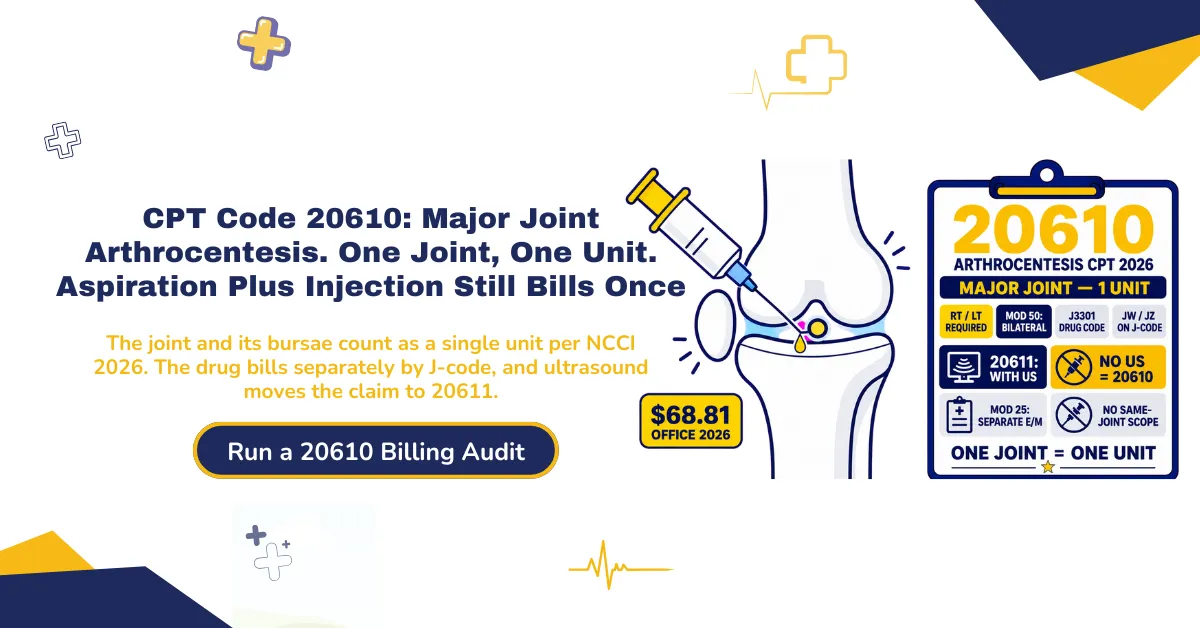
CPT code 20610 describes arthrocentesis, aspiration, and/or injection of a major joint or bursa (such as the shoulder, hip, knee, or subacromial bursa) without ultrasound guidance. It covers diagnostic aspiration, therapeutic injection, or both performed during the same encounter on the same joint.
Per CMS NCCI Policy Manual Chapter IV effective January 1, 2026, one unit of service applies to the joint and its surrounding bursae, regardless of how many aspirations or injections are performed.
This guide is written for billing specialists, practice managers, and healthcare providers in orthopedic, rheumatology, sports medicine, and pain management settings who bill the arthrocentesis cpt code to Medicare, Medicaid, and commercial payers.
It covers the billing intelligence that prevents denials and recovers missed revenue: 2026 Medicare rates by site of service, the modifier decision matrix, NCCI bundling rules, J-code and JW/JZ drug billing, the LCD covered diagnosis list, and the NCCI Q3 2026 update. Don’t treat any of these as optional. Each one is a live denial source in 2026.
The 2026 Medicare rates for CPT 20610 vary by site of service: the physician office rate is $68.81 nationally, the hospital outpatient department rate reaches $313.60 under APC 5441, and the ambulatory surgery center rate is $38.94 under the CMS ASC payment system.
ClaimMax RCM is a California-based revenue cycle management company that prepares and defends joint injection claims across Medicare, Medicare Advantage, Medicaid, and commercial payers.
What Is CPT Code 20610?
The official AMA CPT 20610 descriptor, maintained in the Current Procedural Terminology system, reads: “Arthrocentesis, aspiration and/or injection, major joint or bursa (eg, shoulder, hip, knee joint, subacromial bursa); without ultrasound guidance.” The 20610 cpt code description sits in the General Introduction or Removal Procedures on the Musculoskeletal System range, codes 20100 through 20999.
The arthrocentesis cpt code covers three distinct clinical activities that can be performed alone or in combination on the same joint during one encounter: arthrocentesis (needle entry into the joint space), aspiration of synovial fluid when performed, and therapeutic injection of medication when performed.
All three activities in any combination on the same joint during one encounter equal one unit of service. Don’t bill two units because both aspiration and injection were performed. The 20610 cpt code description never supports unit multiplication within a single joint.
Per CMS NCCI Policy Manual Chapter IV effective January 1, 2026, CPT code 20610’s unit of service covers the joint and its immediately surrounding bursae as a single billable unit.
A provider who injects the glenohumeral joint and also aspirates the subacromial bursa of the same shoulder during the same encounter reports one unit of CPT code 20610, not two separate units.
That’s the NCCI 2026 clarification that prevents systematic overbilling in orthopedic and rheumatology practices.
Three things aren’t included and must be billed separately: the medication injected (billed via HCPCS J-codes), ultrasound guidance (if used, switch to CPT 20611 with permanent recording and reporting), and a separately identifiable evaluation and management service when a distinct clinical problem is addressed with modifier 25.
The ACEP Arthrocentesis and Injection FAQ confirms the ultrasound exclusion rule: when imaging guidance is used, 20611 applies, not 20610.
Which Joints and Bursae Qualify for CPT 20610?
CPT 20610 applies to major joints and bursae only. The AMA distinguishes joint size into three categories (small, intermediate, and major) and assigns a different code family in the arthrocentesis code family to each. Getting the major joint classification wrong produces a code mismatch denial at submission.
Shoulder Joint and Subacromial Bursa
The glenohumeral joint (shoulder) qualifies as a major joint under CPT 20610. Common clinical indications include rotator cuff-related inflammation, adhesive capsulitis, glenohumeral osteoarthritis, and synovitis.
The subacromial bursa of the same shoulder is specifically named in the CPT 20610 descriptor. Per NCCI 2026 Chapter IV, injection into the glenohumeral joint and the subacromial bursa in the same encounter equals one unit of 20610, not two separate units.
Hip Joint and Trochanteric Bursa
The hip joint (coxofemoral joint) qualifies as a major joint. Common billing scenarios include intraarticular hip injection for osteoarthritis (M16.xx), diagnostic aspiration for suspected septic arthritis, and corticosteroid injection for inflammatory arthritis flares. The hip injection cpt code for procedures performed without ultrasound guidance is CPT 20610.
The trochanteric bursa also qualifies under CPT 20610. The greater trochanteric bursa injection cpt code is CPT 20610 for landmark-guided procedures and CPT 20611 when ultrasound guidance is used with permanent recording and reporting.
Knee Joint
The knee is the most frequently injected major joint under CPT 20610 in outpatient settings. Corticosteroid injection, hyaluronic acid viscosupplementation (with J-code billing), and diagnostic aspiration for effusion evaluation are the three primary billing scenarios. Laterality documentation (right knee versus left knee) is required for every knee claim under CMS billing instructions.
Other Qualifying Major Structures
The ankle joint (tibiotalar articulation), elbow joint, and wrist joint all qualify as major joints under CPT 20610. The AMA CPT code family 20600 to 20611 lists wrist, elbow, and ankle examples under both 20605 (intermediate) and 20610 (major), so the specific articulation injected determines the correct code.
The distinction between CPT 20605 (intermediate joints) and CPT 20610 (major joints) matters most for elbow, wrist, and ankle claims: the primary large articulations at these locations (tibiotalar, humeroulnar, and radiocarpal) qualify for CPT 20610, while smaller associated articulations at the same anatomical region qualify for CPT 20605.
Using CPT 20610 for an acromioclavicular joint injection is incorrect coding. The AC joint is an intermediate joint coded under CPT 20605.
Joints That Do Not Qualify for CPT 20610
Small joints (fingers, toes, MCP joints, and IP joints) take CPT 20600 without ultrasound or CPT 20604 with ultrasound. Intermediate joints (acromioclavicular, temporomandibular, and olecranon bursa) take CPT 20605 without ultrasound or CPT 20606 with ultrasound.
The acromioclavicular joint specifically takes CPT 20605, not 20610, a common billing error in shoulder injection claims. Ganglion cysts regardless of location take CPT 20612, not CPT 20610.
CPT Code 20610 vs CPT 20611: The Decision That Costs Practices $35.40 Per Claim
CPT 20610 and CPT 20611 cover the same procedure on the same major joint or bursa. The only distinction: CPT 20610 is performed without ultrasound guidance. The 20611 cpt code description adds “with ultrasound guidance, with permanent recording and reporting” as the only difference between the two codes.
CPT code 20611 carries a three-element documentation standard that most billing teams get wrong, and both overbilling and underbilling start here. Ultrasound must be used for real-time needle guidance, not merely present in the room. Images must be permanently recorded and stored in the medical record. A separate interpretation report must be documented and stored.
If any of the three elements is missing, CPT 20611 isn’t supportable. Bill CPT 20610 instead, even if ultrasound was used. Using CPT 20611 without all three documentation elements is overcoding that creates RAC audit exposure.
The undercoding side has a price too. The 2026 Medicare non-facility rates: CPT 20610 pays $68.81 nationally, and cpt code 20611 pays $104.21 nationally. The difference is $35.40 per claim.
A practice performing 50 ultrasound-guided injections monthly that bills 20610 instead of 20611 because ultrasound documentation is incomplete loses approximately $1,770 monthly in legitimate reimbursement. The fix is documentation discipline, not code avoidance.
Per CMS NCCI Policy Manual Chapter IX effective January 1, 2026, ultrasound guidance code 76942 is not separately reportable alongside CPT 20611 because ultrasound guidance is inherent to the CPT 20611 procedure. When fluoroscopy guides the needle instead of ultrasound, report CPT 20610 and add-on code 77002 on the same claim.
The two guidance modalities follow different NCCI rules, since fluoroscopic guidance isn’t bundled into 20610’s descriptor the way ultrasound is bundled into 20611.
Both codes have a zero-day global period. The pre-procedure assessment and the decision to inject are included in either procedure’s payment. A same-day evaluation and management service is billable with modifier 25 only when a separately identifiable clinical problem is addressed beyond the injection decision.
Billing teams frequently over-apply modifier 25 to planned injection visits, which generates CO-97 bundling denials. For a decision guide on same-day E/M scenarios, see ClaimMax RCM’s CPT 99213 billing guide for same-day E/M services.
The CMS Billing and Coding: Intraarticular Knee Injections of Hyaluronan article confirms that both CPT 20610 and CPT 20611 may be billed for intraarticular injections, and that only one unit is reported per joint when aspiration and injection occur in the same session.
When NOT to Use CPT Code 20610
CPT code 20610 is the correct code for major joint arthrocentesis without ultrasound, but five clinical scenarios require a different code entirely.
First, ultrasound-guided procedures. When ultrasound guidance is used with real-time needle visualization, permanent image recording, and a separate interpretation report, use cpt code 20611 instead. Using CPT 20610 when all three documentation elements support 20611 is undercoding with a $35.40 per-claim revenue loss.
Second, small joint injections (fingers, toes, MCP joints, and IP joints). Use CPT 20600 without ultrasound or CPT 20604 with ultrasound instead. Billing CPT 20610 for a finger joint injection is a code mismatch denial at first submission.
Third, intermediate joint injections (acromioclavicular joint, temporomandibular joint, and olecranon bursa). Use CPT 20605 without ultrasound or CPT 20606 with ultrasound instead. The AC joint is the most common intermediate-joint coding error in shoulder billing.
Fourth, trigger point injections into muscles. Use CPT 20552 for one or two muscles or CPT 20553 for three or more muscles instead. CPT 20610 covers joint spaces and bursae only, and trigger points sit in muscle tissue, not joints, making this one of the top coding errors in orthopedic and pain management billing.
Fifth, same-joint arthroscopy on the same date. Per CMS NCCI Policy Manual Chapter IV effective January 1, 2026, CPT codes 20600 through 20611 are not separately reportable with open or arthroscopic joint procedures performed on the same joint at the same encounter. This bundling restriction is absolute: modifier 59, modifier XS, and other unbundling modifiers cannot override it.
Billing teams that have recurring 20610 denials from code mismatch errors, wrong joint classification, or bundling violations can identify the root cause pattern before the same error repeats across hundreds of claims. ClaimMax RCM’s denial management services for orthopedic and musculoskeletal claims review denial trend data by CPT code, modifier, and payer to stop preventable 20610 denials at the source.
CPT 20610 Modifier Rules: RT, LT, 50, 25, 59, 76, and 77
CPT 20610 modifier requirements are some of the most commonly misapplied rules in joint injection billing. Missing RT or LT on a unilateral claim, applying modifier 50 when a payer requires separate RT/LT lines, and attaching modifier 25 to the procedure code instead of the E/M code are the three most frequent errors.
Does CPT Code 20610 Need a Modifier?
CPT 20610 doesn’t require a modifier as a universal rule, but CMS billing instructions effectively require laterality modifiers in practice. CMS instructs providers to indicate which joint was treated by using RT or LT on every unilateral 20610 claim. Missing laterality is the most common cause of modifier-related 20610 denials at Medicare contractors.
Laterality Modifiers RT and LT
RT (right side) indicates the procedure was performed on the right joint. LT (left side) indicates the left joint. CMS requires RT or LT on every unilateral CPT 20610 claim per the billing instructions in CMS article A52420 for intraarticular injections.
Claims submitted without RT or LT generate automated edit flags at most Medicare Administrative Contractors. The claim doesn’t automatically deny, and it may process with a request for additional information, but bilateral edit flags fire when laterality is absent, which delays payment and increases rework labor cost.
Modifier 50 for Bilateral Procedures
When the same major joint is injected on both sides during one encounter (both knees, both shoulders, or both hips), report modifier 50 to indicate a bilateral procedure. CMS pays modifier 50 claims at 150% of the unilateral rate, approximately $103.22 for bilateral CPT 20610 claims nationally in 2026.
Medicare contractors prefer bilateral CPT 20610 claims submitted as two separate claim lines: CPT 20610 with modifier RT on the first line and CPT 20610 with modifier LT on the second line. Most commercial payers accept modifier 50 on a single claim line for bilateral procedures.
Using Medicare’s RT/LT two-line format for a commercial payer that accepts modifier 50 doesn’t cause a denial, but using the modifier 50 single-line format for a Medicare contractor that expects RT/LT lines can trigger a bilateral edit that delays payment.
The question “is cpt code 20610 a bilateral procedure” has a two-part answer: the code is unilateral by default, and bilateral billing uses either modifier 50 or separate RT/LT lines depending on the payer. Verify the individual payer’s bilateral billing preference before submission. Using the wrong format produces an automatic denial that requires resubmission, not an appeal.
Modifier 25 for Same-Day Evaluation and Management
Modifier 25 must be appended to the E/M code, not to CPT 20610, when a significant and separately identifiable evaluation and management service is performed on the same date as the injection. The E/M must address a problem beyond the decision to inject.
The pre-procedure assessment and the decision to perform the injection are already included in the CPT 20610 payment under the zero-day global period. A planned injection visit without a new or distinct clinical problem doesn’t support a same-day E/M with modifier 25.
The documentation test: cross out all documentation related to the injection. What remains must independently support the E/M code. If nothing remains, don’t bill the E/M.
Modifier 59 for Multiple Non-Symmetrical Joints
When a provider injects two different non-symmetrical joints in the same encounter (for example, the left shoulder and the right knee), report CPT 20610 twice and append modifier 59 to the second unit. Document each injection separately with individual laterality, indication, and medication details.
The claim should show 20610-LT for the left shoulder and 20610-59-RT for the right knee, or the equivalent X-modifier (XS).
Modifiers 76 and 77 for Repeat Procedures
Modifier 76 applies when the same provider repeats CPT 20610 on the same joint on the same date, for example a repeat aspiration due to rapid fluid reaccumulation. Modifier 77 applies when a different provider repeats the procedure on the same date. Both modifiers require documentation of the clinical reason for the repeated procedure.
CMS confirms the RT/LT modifier requirements for CPT 20610 and 20611 in the CMS Billing and Coding: Hyaluronans Intra-articular Injections article. For the full clean claim pre-submission checklist that includes modifier verification as a required step, see ClaimMax RCM’s guide to clean claim requirements in medical billing.
Medicare Reimbursement and 2026 RVU Data for CPT 20610
Yes, Medicare covers CPT 20610 when the procedure is medically necessary and properly documented. The 2026 Medicare payment reflects the CMS CY2026 Physician Fee Schedule Final Rule (CMS-1832-F), which established the updated conversion factor and RVU values effective January 1, 2026.
The 2026 cpt code 20610 rvu breakdown from CMS PFS RVU26A (effective January 1, 2026) shows a work RVU of 0.77, a non-facility practice expense RVU of 1.16, and a malpractice RVU of 0.13. Those 20610 cpt code rvu values produce a total non-facility RVU of 2.06, a Medicare national rate of $68.81, and a global period of 0 days.
The cpt code 20610 fee schedule data confirms the same figures: a total non-facility RVU of 2.06 and a Medicare national rate of $68.81 effective January 1, 2026.
The 2026 Medicare payment for CPT 20610 varies by site of service: the physician office (POS 11) non-facility rate is $68.81 per CMS PFS RVU26A effective January 1, 2026; the hospital outpatient department (POS 22, APC 5441) payment is $313.60 per CMS OPPS Addendum B 2026; the ambulatory surgery center rate is $38.94 per CMS ASC rates effective April 2026.
The HOPD figure includes both the facility payment to the hospital and the professional component paid to the physician at the facility rate. For accurate current rates, refer to the Medicare.gov 2026 Procedure Price Lookup for CPT 20610.
The 20610 cms guidelines for 2026 payment come from the CMS CY2026 Physician Fee Schedule Final Rule (CMS-1832-F), which introduced two separate conversion factors: one for Qualifying APM Participants (QPs) and one for non-QPs. The majority of independent orthopedic and rheumatology practices bill under the non-QP conversion factor.
Geographic GPCI adjustments at the MAC level modify both rates from the national averages listed above.
Understanding how site of service affects physician reimbursement under CPT 20610 matters most for hospital-employed providers. ClaimMax RCM’s guide to Place of Service 22 billing rules for hospital outpatient joint injections covers the HOPD billing mechanics for POS 22 in detail.
For practices evaluating whether their CPT 20610 revenue cycle is capturing the full reimbursement available by site, ClaimMax RCM’s guide to revenue cycle management and medical billing for healthcare practices provides the full-cycle framework.
Documentation Requirements That Protect Every 20610 Claim
To protect every CPT code 20610 claim from denial, the procedure note must document each of the following seven elements.
The specific joint or bursa treated, with its anatomical name and laterality (“right knee joint” or “left subacromial bursa,” never “knee” or “shoulder” alone).
Whether the procedure was aspiration, injection, or both, stated explicitly in the procedure note rather than implied by the medication entry.
The clinical indication and supporting diagnosis, naming the specific condition that justifies the procedure (degenerative joint disease, an inflammatory arthritis flare, or a joint effusion under evaluation).
The medication name, concentration, and dose for any therapeutic injection, with the specific HCPCS drug code that supports J-code billing on the same claim.
The volume, color, and consistency of any synovial fluid aspirated, plus whether specimens went to the laboratory and which specific tests were ordered.
Explicit confirmation that no ultrasound guidance was used (supporting CPT 20610), or documentation that permanent recording occurred and a separate interpretation report is stored (supporting CPT 20611).
Per CMS Medicare billing guidance for intraarticular injections and CMS NCCI Policy Manual Chapter IV effective January 1, 2026, confirmation of imaging guidance status (performed or not performed) is a documentation requirement distinct from the procedure description itself.
A note that documents what was injected without documenting whether imaging guidance was used creates a code-selection ambiguity that post-payment auditors use to challenge CPT 20611 claims retroactively.
Patient tolerance and the immediate post-procedure response, including the monitoring period that followed the injection.
Before the procedure note is written, confirming the patient’s benefits for both the 20610 procedure and any applicable J-code drug coverage is a front-end requirement that prevents the most common payer-limit denials. ClaimMax RCM’s guide to eligibility verification and prior authorization for joint injection claims covers the benefit verification steps for injectable joint medications.
The widely circulated four-item documentation standard covers the joint, the indication, the medication, and the aspirated fluid. The aspiration-versus-injection distinction, the imaging guidance confirmation, and the tolerance record are absent from it. Those three missing items account for three of the six most common documentation failures that generate post-payment audit recoupment under the 20610 cms guidelines.
J-Code Drug Billing for CPT 20610: JW, JZ, and EJ Modifier Requirements
CPT 20610 covers the physician’s work in performing the arthrocentesis procedure. It doesn’t include the cost of the medication injected. Under Medicare and most commercial payer rules, the drug administered during the joint injection is billed separately using the applicable HCPCS Level II J-code. Missing this step costs practices hundreds of dollars per injection day.
Why the Medication Must Be Billed Separately
Medicare Part B doesn’t include drug supply, other than local anesthetic, in the CPT 20610 payment. When a corticosteroid, hyaluronic acid product, or other therapeutic agent is injected, the practice must report the medication separately with its applicable HCPCS J-code linked to the same date of service and the same diagnosis.
The CMS Billing and Coding: Intraarticular Knee Injections of Hyaluronan (A56157) article confirms that the charge for the drug must be included on the same claim as CPT 20610 or CPT 20611 using the appropriate HCPCS Level II code.
For HA series that require prior authorization from Medicare Advantage or commercial payers before the first injection, ClaimMax RCM’s prior authorization services for injectable joint medications manages the full authorization workflow and J-code benefit verification before the first claim submission.
Common J-Codes Paired With CPT 20610
Corticosteroids lead the list. J3301 covers triamcinolone acetonide per 10mg, with billed units equal to the milligram dose divided by 10. J1020, J1030, and J1040 cover methylprednisolone acetate at 20mg, 40mg, and 80mg respectively. J1100 covers dexamethasone sodium phosphate per 1mg, with units equal to milligrams administered.
Hyaluronic acid products each carry a distinct J-code: J7321 for Hyalgan, J7322 for Synvisc or Synvisc-One, J7323 for Euflexxa, and J7325 for Orthovisc, all billed per dose. Billing the wrong HA J-code for a specific product generates a HCPCS mismatch denial at the MAC level.
The cpt code 20610 and j2001 combination is payer-dependent: some plans include local anesthetic in the procedure payment while others allow separate J-code billing for the intraarticular anesthetic agent. J2001 covers lidocaine HCl at 10mg, so verify the payer’s policy before adding the line.
JW and JZ Modifiers for Single-Dose Container Compliance
Under the CMS discarded drug policy effective January 1, 2017 and continuing through 2026, every HCPCS J-code billed alongside CPT 20610 for a Medicare Part B claim requires either the JW modifier (for discarded amounts from single-dose containers that qualify for separate payment) or the JZ modifier (as an attestation that no drug was discarded from the single-dose container).
Omitting both JW and JZ on any J-code line creates a systematic compliance exposure. The CMS Discarded Drug Policy page details the requirements and the effective dates that govern every J-code line billed under Medicare Part B.
The practical math: a 40mg triamcinolone injection from a 40mg single-dose vial with no waste bills as four units of J3301 plus J3301-JZ as the zero-discard attestation. A 20mg injection from a 40mg single-dose vial bills as two units of J3301 administered plus two units of J3301-JW discarded on a separate line.
The CMS Medicare Claims Processing Manual Chapter 17 provides the operational framework for JW and JZ line item construction.
EJ Modifier for Hyaluronic Acid Injection Series
The EJ modifier, “subsequent delivery for a current course of therapy,” is required on the HCPCS drug code for the second and each subsequent injection in a hyaluronic acid series billed to Medicare. A typical Synvisc-One series is three weekly injections. Visit 1 bills J7322 without EJ, Visit 2 bills J7322-EJ, and Visit 3 bills J7322-EJ.
Omitting the EJ modifier causes the payer to treat each injection as the first in a new series, triggering quantity-limit denials on the second and third visits. The denial fires because the plan’s coverage allows one HA product per series, and without EJ, two submissions look like two separate series.
These quantity-limit denials can’t be corrected by appeal. They require resubmission with the modifier attached, which makes EJ the only safeguard against this systematic denial for high-volume HA injection practices.
NCCI Bundling Rules for CPT 20610: Q3 2026 Edits and Same-Joint Restrictions
CMS posted the 2026 Quarter 3 NCCI Procedure-to-Procedure (PTP) edit files on June 1, 2026, with an effective date of July 1, 2026. As of June 5, 2026, practices have 26 days to audit CPT 20610 code-pair combinations against the Q3 2026 edit file before the new restrictions take effect.
Practices that wait for denial notifications instead of proactive edit file review absorb preventable revenue loss across every claim affected by the new edits.
The NCCI PTP edit file defines which procedure codes can’t be billed on the same claim as CPT 20610 in the same encounter, and it’s the authoritative source for those determinations. Every billing team responsible for orthopedic, rheumatology, or pain management claims should pull the current file and run a top 50 CPT pairs audit against their 20610 claim templates.
The current edit files are available at the CMS NCCI PTP Edits quarterly posting.
Per CMS NCCI Policy Manual Chapter IV effective January 1, 2026, the same-joint arthroscopy bundling restriction for CPT codes 20600 through 20611 is an absolute restriction with no modifier override.
No modifier, including modifier 59, the X-modifiers (XE, XS, XP, XU), or any other unbundling modifier, can separate CPT 20610 from an open or arthroscopic procedure performed on the same joint in the same encounter.
The CMS NCCI Policy Manual Chapter IV 2026 provides the full policy language governing arthrocentesis code bundling.
The same-joint restriction doesn’t prevent billing CPT 20610 for a different joint treated in the same encounter as arthroscopic surgery. If the knee undergoes arthroscopy and the same-day encounter includes an injection of the left shoulder, the shoulder injection is separately reportable with appropriate laterality modifiers and documentation. Both joints must be clearly documented as separate procedures.
The answer to “can you bill cpt code 20610 twice” in a single encounter depends on whether the two procedures were performed on different joints: two different joints mean two separately reportable units of CPT 20610 with appropriate modifiers, while the same joint treated twice means one unit regardless of how many times the needle was inserted.
Understanding NCCI bundling mechanics across procedure code families is a quarterly compliance discipline, not a one-time setup. ClaimMax RCM’s guide to NCCI bundling rules for same-day procedure billing covers the quarterly review process that prevents bundling denials before they reach the payer.
Common Conditions and ICD-10 Code Pairings for CPT 20610
Medicare coverage for CPT 20610 is governed by Local Coverage Determinations (LCDs) issued by each Medicare Administrative Contractor. The LCD for 20610 defines the covered diagnosis codes that establish medical necessity for the procedure. Submitting the procedure with a diagnosis outside the covered list generates a CO-50 denial (Medical Necessity Not Met) that’s rarely recoverable without an appeal.
The specific LCD criteria in your jurisdiction can be found through the CMS Medicare Coverage Database.
The following ICD-10-CM codes are among the most commonly covered diagnoses for CPT 20610 claims under Medicare LCDs. Verify the specific covered code list with your MAC before submission.
For the knee and hip, M17.11 covers primary osteoarthritis of the right knee, M17.12 covers primary osteoarthritis of the left knee, M17.31 and M17.32 cover unilateral post-traumatic osteoarthritis of the right and left knee, and M16.11 and M16.12 cover unilateral primary osteoarthritis of the right and left hip.
For the shoulder and trochanteric region, M75.0 covers adhesive capsulitis of the shoulder, M75.10 covers rotator cuff syndrome of an unspecified shoulder, M75.11 and M75.12 cover rotator cuff syndrome of the right and left shoulder, and M70.61 and M70.62 cover trochanteric bursitis of the right and left hip.
For inflammatory and mechanical presentations, M10.061 and M10.062 cover idiopathic gout of the right and left knee, M05.661 covers rheumatoid arthritis of the right knee with involvement of other organs and systems, and M25.361 and M25.362 cover stiffness of the right and left knee, not elsewhere classified.
The ICD-10-CM laterality in the diagnosis code must match the laterality modifier on the CPT 20610 claim line in every submission. Billing CPT 20610 with modifier RT (right side) alongside M17.12 (primary osteoarthritis, left knee) creates a laterality conflict that payers identify through automated claim edits, resulting in a CO-16 or CO-50 denial that requires clinical documentation review before resubmission.
Bilateral injection claims require bilateral diagnosis codes: both M17.11 and M17.12 when both knees are injected.
Orthopedic and rheumatology practices with recurring CO-50 medical necessity denials on CPT 20610 claims often have a systematic ICD-10 to CPT pairing issue rather than a documentation problem. ClaimMax RCM’s ICD-10 coding for post-injection adverse events covers additional condition-specific coding scenarios that arise during joint injection encounters, including vasovagal responses.
For a full denial recovery analysis on CPT 20610 medical necessity denials, contact ClaimMax RCM’s denial management services for orthopedic and musculoskeletal claims team to identify the pattern and fix it at the workflow level.
Six Billing Scenarios for CPT 20610 With 2026 Rates
These six scenarios represent the most common CPT 20610 billing situations orthopedic, rheumatology, and pain management practices encounter daily in 2026.
Scenario 1 (Planned Corticosteroid Knee Injection): A patient presents for a pre-planned right knee corticosteroid injection for osteoarthritis (M17.11). The physician injects 40mg triamcinolone acetonide without ultrasound guidance. Bill CPT 20610-RT with four units of J3301 and J3301-JZ as the zero discard attestation if the full vial was used.
The 2026 Medicare non-facility rate is $68.81. Don’t bill a same-day E/M. This is a planned procedure.
Scenario 2 (Bilateral Knee Injections, Medicare): A patient receives corticosteroid injections in both knees. For Medicare, the 20610 cpt code bilateral format is separate claim lines, CPT 20610-RT on line one and CPT 20610-LT on line two, each with J3301 units and the JW or JZ modifier on the drug line, rather than modifier 50.
The 2026 Medicare national bilateral payment is approximately $103.22, or 150% of $68.81.
Scenario 3 (New Problem and Injection Same Day): A patient presents for shoulder pain evaluation, and the physician diagnoses rotator cuff syndrome (M75.11) and performs an intraarticular injection. Bill 99213-25 for the separately identifiable evaluation, CPT 20610-RT, and the J-code. The E/M documentation must stand independently of the injection note.
Scenario 4 (Aspiration Plus Injection, Same Joint): The physician aspirates synovial fluid from the left knee for diagnostic analysis and then injects a corticosteroid in the same session. Bill CPT 20610-LT with the J3301 units, one unit of CPT 20610 only, not two.
Per NCCI and CMS billing guidance, aspiration and injection of the same joint in one encounter equal one unit.
Scenario 5 (Two Different Major Joints, Same Visit): The physician injects the left shoulder (M75.12) and the right knee (M17.11) in the same encounter. Bill CPT 20610-LT for the left shoulder, CPT 20610-59-RT for the right knee with modifier 59 marking the distinct service on a different joint, and the drug J-codes for each injection. Two units total.
Scenario 6 (Ultrasound-Guided Hip Injection): The physician uses real-time ultrasound guidance with saved images and a separate interpretation report for a left hip injection, meeting every element of the 20611 cpt code description.
With ultrasound, the hip injection cpt code is 20611, not 20610, so bill cpt code 20611 with modifier LT plus the J-code. The 2026 Medicare non-facility rate is approximately $104.21.
Billing CPT 20610 when CPT 20611 is clinically supported and properly documented costs the practice $35.40 per claim in legitimate reimbursement. Billing CPT 20611 without proper ultrasound documentation creates post-payment audit exposure. The decision between CPT 20610 and CPT 20611 is always a documentation decision, not a code selection decision.
Frequency Limitations and Payer Authorization Requirements for Joint Injections
Medicare doesn’t establish a hard per-year frequency limit for CPT 20610 by national policy. Coverage is determined claim by claim based on medical necessity documentation. Medicare contractors actively scrutinize accounts with very high 20610 billing frequency, especially for the same joint, and elevated utilization triggers additional documentation requests (ADRs) and potential targeted probe and educate (TPE) reviews.
Commercial payers set explicit frequency limits. BlueCross BlueShield policies commonly limit CPT 20610 to four services per anatomical site within a 30-day period. Exceeding that limit without prior authorization produces a CO-96 or CO-119 denial (maximum benefit reached). Track each patient’s injection history by joint and payer to prevent frequency-limit denials before submission.
Hyaluronic acid injection series billed under J7321 through J7325 require prior authorization from most commercial payers and many Medicare Advantage plans before the first injection date. Some Medicare Advantage plans specifically require documentation of failed corticosteroid therapy before authorizing HA products. Obtaining HA authorization after the injection series has begun results in retroactive denial of all unauthorized dates of service.
Medicaid and Medicaid MCO frequency and coverage policies for CPT 20610 vary by state and plan. Some state programs limit arthrocentesis coverage to specific joint conditions with documented prior conservative treatment failure. California Medi-Cal, for example, applies MCO-specific authorization rules that differ from the state FFS program.
ClaimMax RCM’s guide to Medicaid billing requirements for joint injection procedures covers the state-level verification workflow.
Medicaid MCO authorization rules for CPT 20610 differ from state FFS Medicaid rules, from Medicare rules, and from commercial payer rules. A practice that treats the same rules as universal across all four payer types will encounter four different denial patterns. The only protection is payer-specific prior authorization verification before every injection encounter, not after the first denial.
Medicare Advantage HMO and HMO-POS plans now require PCP referrals for specialist joint injection visits under UnitedHealthcare’s January 2026 policy change, enforced beginning May 1, 2026. Missing the PCP referral on a specialist 20610 claim generates a PR-242 denial classified as provider liability.
ClaimMax RCM’s guide to the PR-242 denial code for referral and authorization denials maps the prevention and recovery workflow for this specific denial type.
Frequently Asked Questions About Arthrocentesis Billing
These eight questions reflect the billing scenarios and compliance decisions practices encounter most when billing CPT 20610 for major joint arthrocentesis.
What is included in CPT code 20610?
CPT code 20610 includes arthrocentesis of a major joint or bursa, whether the provider aspirates fluid, injects medication, or both, as one unit per joint per encounter. Per NCCI 2026 Chapter IV, the joint and its surrounding bursae count as a single billable unit. The injected medication isn’t included and bills separately via HCPCS J-codes.
What is the difference between CPT code 20610 and 20611?
CPT 20610 covers major joint arthrocentesis without ultrasound guidance. CPT 20611 covers the same procedure with ultrasound guidance, permanent image recording, and a separate interpretation report. The 2026 Medicare non-facility rate for CPT 20610 is $68.81, while cpt code 20611 pays $104.21 nationally. Using 20610 when 20611 is supported costs $35.40 per claim.
Does 20610 include ultrasound guidance?
No. The 20610 cpt code description states “without ultrasound guidance.” When ultrasound is used with permanent recording and a separate interpretation report, CPT 20611 is the correct code. Using 20610 when documented ultrasound guidance supports 20611 is undercoding.
Does Medicare pay for CPT code 20610?
Yes. Medicare covers CPT 20610 when it’s medically necessary and properly documented. The 2026 rates: $68.81 in a physician office, $313.60 in a hospital outpatient department (APC 5441) per CMS OPPS Addendum B 2026, and $38.94 in an ambulatory surgery center per CMS ASC rates effective April 2026. GPCI adjustments modify these rates by MAC locality.
Does CPT code 20610 need a modifier?
CPT 20610 doesn’t require a modifier universally, but CMS billing instructions effectively require laterality modifiers in practice. Append RT or LT for laterality, modifier 50 for bilateral claims (commercial payers) or separate RT/LT lines (Medicare), and modifier 59 for two non-symmetrical joints in one encounter.
Is CPT 20610 a surgical procedure?
No. CPT 20610 is a medical procedure, not a surgical one. It uses needle insertion without incision or tissue removal and carries a zero-day global period. The assessment and injection decision are included in the payment, not separately billable without modifier 25.
Can you bill CPT code 20610 twice in the same encounter?
You can bill two units in one encounter only when two different major joints are treated, for example the right shoulder and the left knee. You can’t bill two units for the same joint, even when both aspiration and injection are performed. Per NCCI 2026, one joint equals one unit.
What are the Medicare guidelines for CPT 20610?
Medicare guidelines for CPT 20610 cover five areas: documentation requirements (seven elements, including laterality, indication, medication, and imaging guidance status), modifier rules (RT or LT on every unilateral claim), J-code billing (JW or JZ required for single-dose containers), NCCI bundling restrictions (no separate billing alongside same-joint arthroscopy), and LCD covered diagnosis requirements (unrecognized diagnoses trigger CO-50 denials).
How ClaimMax RCM Protects CPT 20610 Revenue
CPT 20610 billing errors compound fast in high-volume orthopedic and rheumatology practices. Missing J-code lines, misapplied modifiers, undocumented laterality, and same-joint arthroscopy bundling violations don’t generate obvious error flags. They generate systematic revenue loss that ages quietly in accounts receivable reports until it’s past the appeal window.
ClaimMax RCM’s medical billing service for orthopedic and pain management practices handles CPT 20610 billing across the full claim lifecycle: pre-submission eligibility verification for the procedure and J-codes, NCCI compliance checking against the quarterly edit file, modifier verification, denial root cause analysis, and AR follow-up before claims age past payer deadlines.
For practices with recurring 20610 denials or revenue gaps from undocumented ultrasound guidance, missing drug codes, or frequency-limit issues, ClaimMax RCM’s revenue cycle management for orthopedic injection practices provides the systematic fix. Contact us to start with a free CPT 20610 denial audit.
This guide is for billing and revenue cycle professionals and reflects CPT, HCPCS, NCCI, and CMS payment data current as of June 2026, including the CY2026 Physician Fee Schedule (CMS-1832-F) and the Q3 2026 NCCI PTP edit files effective July 1, 2026. CPT codes and descriptors are maintained and copyrighted by the American Medical Association. Verify all codes, rates, LCD criteria, and payer policies against current CMS, MAC, and payer sources before claim submission. Authored by a CPC-credentialed ClaimMax RCM billing specialist.