


Subtotal $0.00

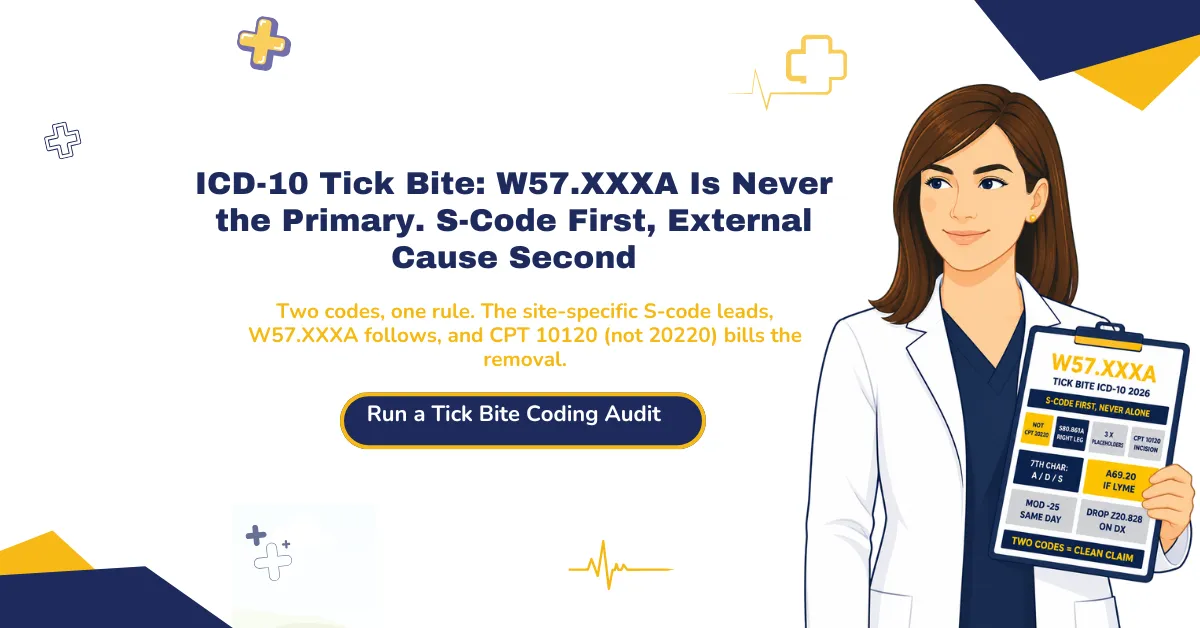
ICD-10 tick bite coding requires two diagnosis codes per FY2026 ICD-10-CM Official Guidelines: a primary site-specific injury code (S-code) that documents where the bite occurred, and a secondary external cause code (W57.XXXA) that documents the tick as the cause. The injury S-code must always be listed first.
Here’s the structure every clean tick bite claim follows:
- External cause code: W57.XXXA covers “bitten or stung by nonvenomous insect and other nonvenomous arthropods, initial encounter,” and it’s active as of October 1, 2025 under FY2026 ICD-10-CM. Note: use W57.XXXD for subsequent encounters, or W57.XXXS for sequela (long-term complications).
- Injury code: W57.XXXA pairs with an S-code from the injury chapter that names the body part. Three quick examples are S80.861A (right lower leg), S30.861A (abdominal wall), and S00.06XA (scalp). For other locations, the complete body-site reference table is below.
- Complications: If the bite develops into infection, add L08.9 (local infection of the skin, unspecified). If Lyme disease is confirmed, use A69.20 or a specific A69.xx subcode. If symptoms are present but Lyme isn’t confirmed yet, add R21 (rash) or R50.9 (fever, unspecified).
Per the FY2026 April 1, 2026 update, W57.XXXA remains active and unchanged for dates of service April 1 through September 30, 2026. This guide is verified against both the October 1, 2025 and April 1, 2026 FY2026 ICD-10-CM Official Guidelines release documents.
What Is the ICD-10 Code for a Tick Bite?
The ICD-10 code for a tick bite used to document the external cause is W57.XXXA. It’s never submitted alone. It must be paired with an S-code that identifies the anatomical site where the bite occurred.
W57.XXXA officially reads “bitten or stung by nonvenomous insect and other nonvenomous arthropods, initial encounter.” It sits in Chapter 20 of ICD-10-CM, the External Causes of Morbidity chapter.
Ticks code as “nonvenomous” for a reason that confuses billers. Ticks don’t inject venom as their primary mechanism of harm, so ICD-10-CM groups them with other nonvenomous bites. The disease-transmission risk doesn’t change that.
That’s why W57.XXXA alone is never enough to bill. It describes the how, not the condition treated. Payers need a code that establishes what was wrong and where.
Here’s the two-code pairing in practice. A patient presents with a tick bite on the right lower leg. The correct ICD 10 for tick bite coding is S80.861A (primary, injury site) plus W57.XXXA (secondary, external cause). The incorrect version is W57.XXXA alone, which puts an external cause code in the primary position and triggers claim edits and payer reviews.
For every other anatomical location, the complete body-site table further down covers the specific S-code you’ll need.
The Two-Code Requirement That Prevents Tick Bite Claim Denials
The most common icd 10 code tick bite error is submitting W57.XXXA as the only diagnosis code. When the S-code is missing, payers flag the claim for edit review, because an external cause code alone doesn’t establish what condition was treated or why the visit was medically necessary.
The two-code structure has a clean logic. Each code answers a different question, and the payer needs both.
- Code 1, the S-code: answers “what did the provider treat, and where?” This establishes medical necessity.
- Code 2, W57.XXXA: answers “how did the injury occur?” This is context, not the condition.
Here are three correct pairings in the format payers expect:
- S00.06XA + W57.XXXA: tick bite on the scalp, initial encounter
- S80.861A + W57.XXXA: tick bite on the right lower leg, initial encounter
- S30.860A + W57.XXXA: tick bite on the lower back and pelvis, initial encounter
The sequencing rule is absolute. Per FY2026 ICD-10-CM Official Guidelines, external cause codes can never be the first-listed or principal diagnosis. Submitting W57.XXXA in position 1 on the CMS-1500 won’t always generate an outright denial on first pass. It will, however, create medical necessity mismatches and audit flags that compound across multiple claims.
That’s the difference between a coding rule and a revenue problem. A correctly sequenced tick bite icd 10 claim is the start of a clean revenue cycle management workflow that keeps payer edits off your AR. ClaimMax RCM’s medical billing service reviews ICD-10 sequencing on every tick bite and injury-chapter claim before submission.
7th Character Rules for Tick Bite Coding: A, D, and S
The 7th character in tick bite ICD-10 codes tells payers what treatment phase the encounter represents. Every icd 10 tick bite code carries one, and getting it wrong is a fast way to trigger a downcode on an otherwise clean claim.
Each character maps to a specific phase. Here’s what separates them.
A, initial encounter. Used when the patient is receiving active treatment. “Active treatment” under FY2026 guidelines means the condition is being actively managed, not simply that it’s the first visit. If a patient comes in on visit 3 but is still on doxycycline prophylaxis, the encounter is still A as long as active treatment continues.
D, subsequent encounter. Used after active treatment ends and the patient is in routine follow-up or the healing phase. If the bite wound is healing and the patient is back for a wound check only, D applies.
S, sequela. Used when the current encounter treats a condition that’s the direct result of a previous tick bite that has already resolved. A chronic skin scar at the former bite site is the classic example.
One format rule trips up the icd 10 for tick bite coding more than any other. W57.XXXA requires three placeholder X characters before the 7th character. Without them, the code is incomplete and gets rejected at the clearinghouse. The full seven-character string reads as a W, a 5, a 7, three placeholder X characters, and then the 7th character A.
Providers who want to see how encounter-specific coding logic extends into the next code set can reference ClaimMax RCM’s ICD-11 denial prevention playbook.
ICD-10 Tick Bite Codes by Body Site: Complete 2026 Reference Table
ICD-10-CM has no single code labeled “tick bite.” Every claim needs an insect bite code specific to the documented location. The table below covers the most commonly reported body-site codes, all verified active under the FY2026 ICD-10-CM code set effective October 1, 2025. Match each icd 10 tick bite code to the site the provider charted.
| Body Site | ICD-10 Code | Official Description | FY2026 Status |
|---|---|---|---|
| Scalp | S00.06XA | Insect bite (nonvenomous) of scalp, initial encounter | Active |
| Ear | S00.46XA | Insect bite (nonvenomous) of ear, initial encounter | Active |
| Neck | S10.16XA | Insect bite (nonvenomous) of neck, initial encounter | Active |
| Right upper arm | S40.861A | Insect bite (nonvenomous) of right upper arm, initial encounter | Active |
| Left upper arm | S40.862A | Insect bite (nonvenomous) of left upper arm, initial encounter | Active |
| Right shoulder | S40.261A | Insect bite (nonvenomous) of right shoulder, initial encounter | Active |
| Left shoulder | S40.262A | Insect bite (nonvenomous) of left shoulder, initial encounter | Active |
| Abdominal wall | S30.861A | Insect bite (nonvenomous) of abdominal wall, initial encounter | Active |
| Lower back and pelvis | S30.860A | Insect bite (nonvenomous) of lower back and pelvis, initial encounter | Active |
| Right buttock | S30.870A | Insect bite (nonvenomous) of right buttock, initial encounter | Active |
| Left thigh | S70.362A | Insect bite (nonvenomous) of left thigh, initial encounter | Active |
| Right thigh | S70.361A | Insect bite (nonvenomous) of right thigh, initial encounter | Active |
| Right lower leg | S80.861A | Insect bite (nonvenomous) of right lower leg, initial encounter | Active |
| Left lower leg | S80.862A | Insect bite (nonvenomous) of left lower leg, initial encounter | Active |
| Unspecified site | S60.96XA | Superficial injury, unspecified wrist/hand/fingers, initial encounter | Use cautiously, see note |
Note on multiple sites: When a patient has tick bites at more than one location, code each site separately. There’s no single “multiple sites” tick bite code in ICD-10-CM. Two bites require two S-codes, each paired with W57.XXXA.
Note on unspecified site: S60.96XA is used by some practices for unspecified site encounters, but it codes specifically to the wrist, hand, and finger region. If the chart documents no identifiable site, confirm with the provider before defaulting to this code. Payers and CMS have flagged over-reliance on unspecified codes as an audit trigger.
Note on laterality: Use the right-side code when the right side is documented, and the left-side code when the left is documented. For codes without a right or left distinction, like some trunk codes, the unspecified form applies automatically.
There’s no code specifically labeled “tick bite” in ICD-10-CM. Tick bites code under the nonvenomous insect bite category for the body region where the bite occurred, and every code above is verified active under the FY2026 set. Picking the correct S-code per documented site is a foundational step in ClaimMax RCM’s 13 steps of revenue cycle management framework.
How to Code a Tick Bite in 2026: The Three-Step Workflow
Coding a tick bite cleanly comes down to three steps, in order. The workflow is operational, not clinical, so run it top to bottom every time.
Step 1: Select the site-specific injury S-code (primary). The provider’s note has to document where the bite is. Pull the matching S-code from the injury chapter (Chapter 19). Right lower leg documented? Use S80.861A. If the note doesn’t specify a location, query the provider before defaulting to an unspecified code. The S-code goes in position 1.
Step 2: Add W57.XXXA as the secondary external cause code. W57.XXXA goes in position 2. Verify the 7th character matches the encounter type: A for active treatment, D for follow-up, S for sequela. Confirm the three X placeholders are there, because W57.XXXA without them gets rejected at the clearinghouse.
Step 3: Add complication or symptom codes if documented. Infection present? Add L08.9 (local infection of the skin). Lyme symptoms documented but not confirmed? Add R21 (rash) or R50.9 (fever). Lyme confirmed? Replace the symptom codes with A69.20 or the appropriate A69.xx subcode. Don’t add complication codes the note doesn’t support.
That’s the full tick bite icd10 workflow. Before ordering tick-borne disease labs with the encounter, confirming coverage through eligibility verification and prior authorization keeps the extra claim lines from denying.
Here’s the freshness piece that matters for 2026. This icd 10 for tick bite workflow applies to dates of service under both the October 1, 2025 and the April 1, 2026 FY2026 ICD-10-CM update periods. W57.XXXA and the S-code families above are unchanged in both updates, so the steps don’t shift mid-year.
CPT Codes for Tick Removal: The Correct Codes and the Error to Avoid
Two billing guides currently indexed in search results list CPT 20220 as the code for tick removal. CPT 20220 is the code for bone biopsy by trocar or needle. It has no connection to tick removal.
A claim submitted with CPT 20220 for a tick removal encounter fails the CPT-to-ICD linkage review, because bone biopsy codes require musculoskeletal-chapter diagnosis codes, not injury-chapter codes.
With that cleared up, here’s the correct CPT code for tick removal decision framework.
Simple tick removal, no incision. The provider removes the tick with fine-tipped tweezers. No incision happens, so it’s an Evaluation and Management (E/M) service, not a surgical procedure. Bill the appropriate E/M code, and there’s no separate CPT for tweezer removal. Established-patient removals often qualify for 99212 CPT code billing when the visit is low-complexity.
Complex removal, incision required. The tick’s mouthparts are embedded in subcutaneous tissue and need a minor incision to extract. Use CPT 10120 (incision and removal of foreign body, subcutaneous tissues, simple). For a tougher extraction, use CPT 10121 (complicated).
Evaluation only, tick removed at home. The patient shows up after removing the tick themselves. Bill only the E/M code that fits the visit complexity. Don’t bill a removal procedure, because the procedure wasn’t performed in the office.
The CDC’s tick bite guidance confirms fine-tipped tweezers as the clinically recommended removal tool, which supports why simple removal bills as an E/M service rather than a surgical procedure.
One modifier rule closes the loop. When CPT 10120 and a separately identifiable E/M service happen on the same date, say the provider also evaluates Lyme risk and prescribes prophylaxis, append Modifier -25 to the E/M code. Without it, Medicare and most commercial payers bundle the E/M into the procedure and deny it.
Prophylactic antibiotic prescriptions after a tick bite may also need prior authorization from commercial payers, so confirming coverage first prevents a denial on the medication line.
The correct icd 10 tick removal coding still follows the two-code rule, and full icd 10 code for tick removal accuracy depends on it: the site-specific S-code plus W57.XXXA, with the CPT describing the service performed. ClaimMax RCM’s denial management services team corrects CPT-to-ICD mismatches on tick removal claims and other injury-chapter encounters before they age into AR.
Tick-Borne Disease ICD-10 Codes and the Confirmed Diagnosis Transition Rule
When a tick bite leads to a confirmed tick-borne illness, the icd 10 tick bite framework changes entirely. The injury codes give way to infectious disease codes, and the external cause code shifts to the secondary position.
Lyme disease carries the widest code set you’ll work with, all in the A69.2x series and all active under FY2026.
| ICD-10 Code | Description | Use When |
|---|---|---|
| A69.20 | Lyme disease, unspecified | Confirmed Lyme, no specific manifestation documented |
| A69.21 | Meningitis due to Lyme disease | Lyme confirmed with documented meningitis |
| A69.22 | Other neurologic disorders in Lyme disease | Lyme with peripheral neuropathy or other neurological involvement |
| A69.23 | Arthritis due to Lyme disease | Lyme confirmed with documented joint involvement |
| A69.29 | Other conditions associated with Lyme disease | Lyme confirmed with another documented manifestation |
Other tick-borne diseases code outside the A69 series. The most common ones:
- A77.0: Rocky Mountain Spotted Fever (Rickettsia rickettsii)
- A79.82: Human granulocytic anaplasmosis
- B60.0: Babesiosis
- A93.1: Colorado tick fever
Here’s the rule that keeps these claims clean. Once Lyme disease is confirmed by clinical or laboratory criteria, the Z20.828 exposure code and any symptom codes (R21, R50.9) come off the claim. Replace them with the specific A69.xx code that matches the documented manifestation.
Continuing to code Z20.828 after a confirmed Lyme diagnosis is a documentation error. The confirmed disease code implies the prior exposure, so it doesn’t need to be stated separately.
The sequence shifts at the point of confirmation. Before Lyme confirmation, you code the S-code (primary), W57.XXXA (secondary), Z20.828 (if prophylaxis is prescribed), and R21 or R50.9 (symptoms, if present). After Lyme confirmation, you code A69.20 or the specific A69.xx (primary) plus W57.XXXA (secondary, optional per payer).
California Medi-Cal providers billing for tick-borne disease encounters should also verify MCO-specific rules for the A69.xx series, since Medi-Cal Managed Care plans may require prior authorization for extended Lyme disease treatment. ClaimMax RCM’s billing for Medicaid team supports California provider billing under Medi-Cal and Covered California plans.
Six Clinical Billing Scenarios for Tick Bite Encounters
The six scenarios below cover the most common tick bite billing situations providers run into, from a simple tweezer removal to prophylaxis documentation and place-of-occurrence coding. Each one shows the full icd 10 tick bite pairing for that encounter. Every tick bite icd 10 scenario here is verified against the FY2026 ICD-10-CM code set and ClaimMax RCM’s billing compliance framework.
Scenario 1: Simple Tick Removal During an Office Visit
Setup: an established patient presents with a tick on the scalp. The provider removes it with fine-tipped tweezers. No incision, no systemic symptoms.
- Primary: S00.06XA (insect bite, nonvenomous, of scalp, initial encounter)
- Secondary: W57.XXXA (bitten or stung by nonvenomous arthropod, initial encounter)
- Procedure: 99212 (E/M, established patient, low complexity)
Note: there’s no separate CPT for tweezer removal. The E/M code covers the encounter in full. Don’t add CPT 10120 when no incision was made.
Scenario 2: Tick Bite With Prophylaxis, the Z20.828 and Doxycycline Scenario
Setup: the provider evaluates a deer tick attachment of confirmed 36-plus hours in a Lyme-endemic area. No rash or systemic symptoms yet. The provider prescribes single-dose doxycycline prophylaxis per CDC guidance.
- Primary: the S-code for the documented bite site, such as S80.861A for the right lower leg
- Secondary: W57.XXXA (external cause)
- Additional: Z20.828 (contact with and suspected exposure to other communicable diseases, used here for Lyme exposure)
- E/M code based on visit complexity, often 99213 or 99214 when counseling time runs long
Per the CDC Tickborne Diseases reference manual, the prophylactic dose is 200 mg doxycycline as a single dose for adults, and 4.4 mg/kg as a single dose for children under 45 kg. The note must document the criteria: confirmed deer tick species, 36-plus hours of attachment, and endemic-area exposure. Without it, Z20.828 lacks clinical justification.
If a separately identifiable E/M service happens at the same encounter, append Modifier -25. Providers ordering broad lab panels alongside the workup, including lipid panels, can reference ClaimMax RCM’s hyperlipidemia ICD-10 code guide for diagnosis-to-CPT pairing.
Scenario 3: Observation Encounter After Tick Exposure, Z03.818
Setup: a patient presents after finding a tick on their skin. The tick wasn’t attached, or attachment time was minimal. No bite wound is confirmed, no symptoms are present. The encounter is for evaluation and observation only.
- Primary: Z03.818 (encounter for observation for suspected exposure to other biological agents ruled out)
- Secondary: W57.XXXA (external cause, nonvenomous arthropod contact)
- E/M code based on visit complexity
Note: Z03.818 applies when the provider documents that the encounter is for observation following suspected exposure and rules out active injury or infection. It isn’t interchangeable with Z20.828. Z03.818 is an observation encounter code. Z20.828 is an exposure contact code used when prophylaxis or further workup is warranted.
Scenario 4: Follow-Up Visit After Active Treatment Ends
Setup: a patient returns for a wound check 14 days after the initial tick bite encounter. The site is healing, no new symptoms, active treatment has ended.
- Primary: the S-code with 7th character D (subsequent encounter), such as S80.861D for the right lower leg
- Secondary: W57.XXXD (subsequent encounter for nonvenomous arthropod bite)
- E/M code based on visit complexity
Note: the shift from A to D has to happen on both codes at once. If S80.861D is used but W57.XXXA still goes out, the encounter-type coding is internally inconsistent and the payer can flag it.
Scenario 5: Multiple Tick Bites at Different Sites
Setup: a patient presents after outdoor activity with confirmed tick bites on the right lower leg and the neck.
- Primary: S80.861A (right lower leg, initial encounter)
- Secondary site: S10.16XA (neck, initial encounter)
- External cause: W57.XXXA (one external cause code covers the full encounter)
- E/M code based on complexity
Note: each anatomical site gets its own S-code. W57.XXXA appears once per encounter, not once per bite. Two bite sites means two S-codes plus one W57.XXXA.
Scenario 6: Tick Bite in a Forest Setting, Y92.71 Place of Occurrence
Setup: documentation confirms the bite occurred during a hiking trip in a forested area. The payer or reporting system requires place-of-occurrence coding.
- Primary: the S-code for the documented site
- Secondary: W57.XXXA
- Tertiary, when required: Y92.71 (forest as the place of occurrence of the external cause)
Note: Y92.71 is a place-of-occurrence code, never the principal diagnosis. It’s tertiary and supplemental, and not all payers require it. The AAPC tick bite guide references it in a multi-code case (S30.860A, S10.86XA, L08.9, W57.XXXA, Y92.71) for a pelvis-and-neck bite with secondary infection. Outdoor recreational medicine and occupational health see it more than primary care does.
Tick Bite Coding Errors That Trigger Claim Denials
The errors below account for the majority of tick bite claim denials and audit flags that ClaimMax RCM encounters in accounts receivable reviews. Each one names the mistake, the consequence, and the fix.
Error 1: W57.XXXA in the primary position. The error is submitting W57.XXXA in Box 21 position A on the CMS-1500 with no S-code. The consequence is the payer flagging an external cause code in the principal position, with no way to assess medical necessity. The fix: always put the S-code in position 1, W57.XXXA in position 2 or later.
Error 2: wrong 7th character, A on a follow-up. The error is submitting W57.XXXA and S80.861A on a wound check two weeks out, after active treatment ends. The consequence is active-treatment coding on a subsequent-care visit, creating a necessity mismatch against claim history. The fix: switch to W57.XXXD and the D-variant S-code.
Error 3: CPT 20220 submitted for tick removal. The error is billing CPT 20220 (bone biopsy) instead of CPT 10120 for an embedded extraction. The consequence is a failed CPT-to-ICD linkage, since CPT 20220 crosswalks to musculoskeletal codes that don’t match W57.XXXA. The fix: CPT 10120 for incision-based removal, or an E/M code for tweezer removal.
Error 4: Z20.828 kept after Lyme is confirmed. The error is continuing to code Z20.828 after A69.20 is established. The consequence is an internally inconsistent claim that codes both the exposure and the confirmed disease at once. The fix is dropping Z20.828 once Lyme is confirmed and coding A69.20 or the specific A69.xx subcode as primary.
Error 5: missing X placeholders in W57.XXXA. The error is entering the code as W57.A instead of W57.XXXA. The consequence is an invalid code that gets rejected at the clearinghouse. The fix is the full seven-character string every time: a W, a 5, a 7, three placeholder Xs, and the 7th character A. No shortcuts.
Knowing the icd 10 tick bite errors that drive denials is half the battle, and catching them before submission is the other half. ClaimMax RCM’s what is a clean claim in medical billing framework includes pre-submission sequencing checks on every injury-chapter claim, tick bite encounters included. Providers with recurring tick bite denials can reach the ClaimMax RCM coding team directly.
Frequently Asked Questions: ICD-10 Tick Bite Coding
What is the ICD-10 code for a tick bite?
The ICD-10 code used to document a tick bite as an external cause is W57.XXXA. It can’t be submitted alone. It has to be paired with a site-specific S-code that describes where the bite occurred. The S-code goes in position 1, and W57.XXXA goes in position 2.
How do you code for a tick bite?
Coding a tick bite requires two ICD-10 codes. First, select the injury-chapter S-code for the bite location, like S80.861A for the right lower leg. Second, add W57.XXXA as the secondary external cause. If complications exist, add L08.9 for local infection, or A69.20 once Lyme is confirmed. That two-code structure is the core of icd 10 tick bite billing.
What CPT code is used for tick removal?
Simple tick removal with tweezers is billed under the appropriate E/M code, like 99212, since no surgical procedure is performed. If the tick needs a minor incision, use CPT 10120 (simple) or CPT 10121 (complicated). CPT 20220, which shows up in some online billing guides, is a bone biopsy code and isn’t correct for tick removal.
What is the ICD-10 code for a tick bite in the lower back?
The ICD-10 code for a tick bite on the lower back and pelvis is S30.860A (insect bite, nonvenomous, of lower back and pelvis, initial encounter). Pair it with W57.XXXA as the secondary external cause code. Use S30.860D for a follow-up visit after active treatment ends.
What is the difference between W57.XXXA and W57.XXXD?
W57.XXXA is used while the patient is receiving active treatment for the tick bite. W57.XXXD is used for follow-up visits after active treatment ends and the patient is in the healing phase. The 7th character A means active treatment is ongoing. The 7th character D means the encounter is routine follow-up care.
Can W57.XXXA be submitted as the primary diagnosis on a claim?
No. W57.XXXA is an external cause code under Chapter 20 of ICD-10-CM. Per FY2026 Official Guidelines, external cause codes can never be the principal or first-listed diagnosis. A site-specific injury S-code from Chapter 19 has to lead the claim, with W57.XXXA in the secondary position.
What is Z20.828 used for in tick bite coding?
Z20.828 (contact with and suspected exposure to other communicable diseases) is used when a provider prescribes prophylactic doxycycline after a high-risk tick bite in a Lyme-endemic area, before any diagnosis is confirmed. Once Lyme disease is confirmed, Z20.828 is replaced by the appropriate A69.xx code. It shouldn’t appear on the same claim as a confirmed Lyme diagnosis.
How do you code multiple tick bites at different sites?
Each bite location is coded separately in ICD-10-CM. If a patient has bites on the scalp and the right lower leg, submit S00.06XA for the scalp and S80.861A for the leg. One W57.XXXA covers the full encounter as the external cause code, no matter how many bite sites are present.
Providers coding other injury-chapter conditions alongside tick bite visits, including autonomic or cardiovascular responses to tick-borne illness, can reference ClaimMax RCM’s hypotension ICD-10 code and hypothyroidism ICD-10 code guides for related diagnosis sequencing.
Tick Bite Billing That Pays Clean: Work With ClaimMax RCM
Tick bite coding errors involving wrong sequencing, incorrect CPT codes, and Z20.828 retained after a Lyme diagnosis are among the most preventable sources of claim denials in primary care and urgent care billing. ClaimMax RCM reviews every tick bite and injury-chapter claim for sequencing accuracy, 7th character consistency, and CPT-to-ICD linkage before submission.
Our full-service revenue cycle management team covers medical billing, denial management, prior authorization, credentialing, and AR follow-up for practices across all 50 states.
For practices with recurring tick bite, insect bite, or injury-chapter claim issues, ClaimMax RCM’s denial management services team finds the root cause and fixes it at the workflow level. Contact ClaimMax RCM to run a denial audit on your tick bite claims and see where revenue is leaking.

