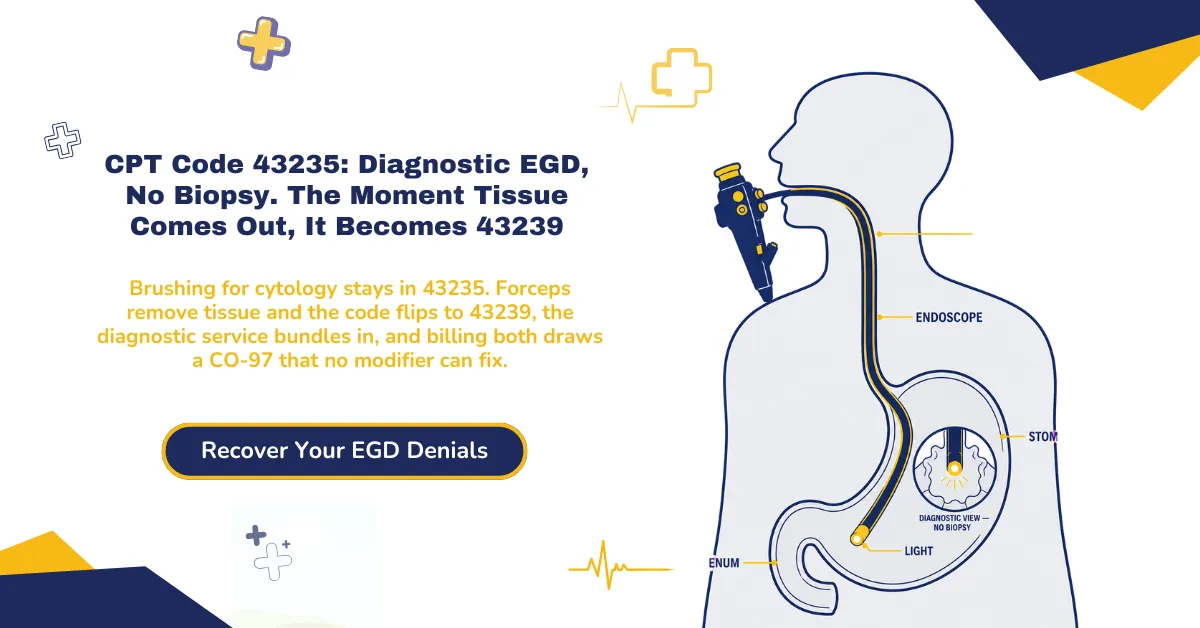
CPT code 43235 is the billing code for a diagnostic esophagogastroduodenoscopy (EGD), a flexible upper GI endoscopy that examines the esophagus, stomach, and duodenum without tissue removal or therapeutic intervention.
Procedure: CPT 43235 covers visual inspection of the upper GI tract, including specimen collection by brushing or washing when performed, but no biopsy and no therapy.
Exclusions: If tissue is removed for biopsy, use CPT 43239. If bleeding is controlled, use CPT 43255. If dilation is performed, use CPT 43249. If CPT 43889 appears on the same claim, don’t report CPT 43235 alongside it.
Documentation Requirements: Medical records must support medical necessity and include the clinical indication, extent of the examination to D2 or the documented stop point, segmental findings, any specimens collected by brushing or washing, and the post-procedure status.
Gastroenterology practices billing high volumes of EGD claims face CO-97 bundling denials, modifier errors, and medical necessity gaps that compound across hundreds of claims per month. ClaimMax RCM‘s GI claim denial recovery team stops these patterns before they reach the payer.
This guide covers the 2026 code descriptor, the comparison with CPT 43239, every applicable modifier with documentation language, NCCI bundling rules including the 43889 restriction, Medicare reimbursement rates, ICD-10 diagnosis pairings, and a pre-submission denial prevention checklist.
Every rule is sourced from CMS, the AMA, and the ASGE. For the billing workflow that keeps EGD claims clean from the start, see ClaimMax RCM’s GI medical billing service.
What Changed for CPT 43235 in 2026
CPT 43889 Now Bundles With CPT 43235
CPT 43889 (endoscopic sleeve gastroplasty) was introduced effective January 1, 2026. Payers treat CPT 43235 as bundled into CPT 43889 when both appear on the same claim for the same session. Don’t report 43235 alongside 43889 under any modifier.
Bariatric endoscopy practices billing combined EGD and sleeve gastroplasty sessions must report only CPT 43889 for that session. The diagnostic component is absorbed into the more comprehensive therapeutic code.
The 2026 Medicare Conversion Factor Affects CPT 43235 Payment
The 2026 CMS Physician Fee Schedule uses two conversion factors: $33.57 for qualifying APM participants and $33.40 for non-qualifying participants. Multiply the applicable conversion factor by the total RVUs for CPT 43235 in your site of service to estimate your Medicare payment before locality adjustment.
The 2025 conversion factor was $32.35, so 2026 represents an increase for most practices. The rate difference between APM and non-APM participants means two physicians billing the same code at the same facility can receive different payments.
NCCI PTP Edit Table Updates (Q3 2026)
The CMS National Correct Coding Initiative updates its Procedure-to-Procedure edit tables quarterly. Q3 2026 edits took effect July 1, 2026. Pull the current NCCI PTP edit file from the CMS NCCI Policy Manual Chapter 4, 2026 before submitting EGD claims.
GI billing teams that pair CPT 43235 or CPT 43239 with another endoscopy code on the same date of service need the current quarter’s edit file, not a cached version from the prior period.
Prior-quarter edit tables produce automatic denials when a new bundling restriction has taken effect. The edit table is the controlling document, not your billing system’s default pairings.
What CPT Code 43235 Covers
The AMA’s official CPT code descriptor reads: “Esophagogastroduodenoscopy, flexible, transoral; diagnostic, including collection of specimen(s) by brushing or washing, when performed.” CPT 43235 covers the base EGD examination. Brushing or washing for cytology is included in the code payment. No additional code is reported when only specimens collected by brushing or washing are taken during the same session.
When Gastroenterologists Use CPT 43235
Use CPT 43235 when the EGD is diagnostic: the physician inspects the esophagus, stomach, and duodenum, documents findings, and may collect specimens by brushing or washing only. No tissue removal, no bleeding control, no dilation, no stent placement, no biopsy. The following presentations support CPT 43235 under the LCD L35350 Upper GI Endoscopy coverage criteria:
- Persistent dysphagia with no prior workup
- Unexplained upper GI bleeding or melena
- Iron-deficiency anemia requiring investigation
- Chronic GERD symptoms with alarm features
- Persistent nausea and vomiting unresponsive to treatment
- Unexplained weight loss in patients over 50
- Surveillance for Barrett’s esophagus (diagnostic only, no biopsy taken)
- Suspected gastritis or peptic ulcer disease
ICD-10 Diagnosis Codes That Support CPT 43235
Pair CPT 43235 with the diagnosis code that matches the documented clinical indication. The table below shows the most common ICD-10 codes used with CPT 43235 and their coverage status under CMS Billing and Coding Article A57414.
| ICD-10 Code | Description | Coverage Status |
|---|---|---|
| K21.00 | GERD with esophagitis, without bleeding | Covered |
| K21.9 | GERD without esophagitis | Covered |
| K92.1 | Melena | Covered |
| K29.70 | Gastritis, unspecified, without bleeding | Covered |
| K31.5 | Obstruction of duodenum | Covered |
| R13.10 | Dysphagia, unspecified | Covered |
| D50.9 | Iron-deficiency anemia, unspecified | Covered |
| R11.10 | Vomiting, unspecified | Covered |
| K22.70 | Barrett’s esophagus without dysplasia | Covered |
Unspecified codes carry higher review risk when documentation supports a more specific code. Use the most specific ICD-10 code the clinical record supports.
For the clean claim requirements that apply to every EGD submission, see ClaimMax RCM’s clean claim requirements for EGD.
CPT Code 43235 vs CPT 43239: When the Code Changes
CPT 43235 and CPT 43239 describe the same base procedure, an upper GI endoscopy performed through the mouth, but differ at one decision point: whether tissue was removed. That single clinical decision determines which code the claim carries and whether billing both codes on the same claim triggers an automatic denial.
CPT 43235 vs CPT 43239 Comparison Table
| Feature | CPT 43235 | CPT 43239 |
|---|---|---|
| Official AMA Name | EGD, flexible, transoral; diagnostic | EGD, flexible, transoral; biopsy, single or multiple |
| Action Taken | Visual inspection; brushing or washing for cytology if performed | Visual inspection plus tissue removal with biopsy forceps for histological analysis |
| Tools Used | Flexible endoscope only | Flexible endoscope plus biopsy forceps or sampling instruments |
| Biopsy Included | No. Brushing or washing for cytology only. | Yes. Tissue is removed for pathological examination. |
| Reimbursement | Lower, diagnostic base rate | Higher, additional complexity for biopsy |
| Denial Risk When Miscoded | CO-97 fires when 43235 billed alongside 43239 on same claim | CO-50 fires when biopsy documented but 43235 was selected instead of 43239 |
Brushing or washing collects cells from the mucosal surface without removing tissue. Cytology analysis follows. That collection is included in CPT 43235 at no additional code.
Biopsy uses forceps to remove a tissue sample for histological analysis. That action requires CPT 43239. The distinction isn’t in what the pathologist does with the specimen but in how the gastroenterologist collected it.
The Cytology vs Biopsy Rule
CPT 43235: Covers visual inspection and specimen collection by brushing or washing for cytology. No tissue removal during the session.
CPT 43239: Covers visual inspection plus biopsy, single or multiple. When forceps remove tissue, the diagnostic service is bundled into CPT 43239. Don’t report CPT 43235 alongside CPT 43239 for the same session.
Practices that perform same-day EGD and colonoscopy should review the same-day colonoscopy billing rules before submitting both codes on one claim, because the family-code bundling logic applies to both endoscopy families.
For the ASGE’s official code pairing reference, see the ASGE EGD CPT coding reference.
Can You Bill CPT 43235 and CPT 43239 Together?
The Direct Answer: No. CPT 43235 and CPT 43239 cannot be billed together for the same patient encounter on the same date of service.
The Coding Rule: CPT 43239 is a child code to the base diagnostic procedure CPT 43235. The moment tissue is removed for biopsy, the diagnostic service is absorbed into CPT 43239, and CPT 43235 is no longer separately reportable for that session.
Result of Billing Both: Submitting CPT 43235 and CPT 43239 on the same claim triggers National Correct Coding Initiative unbundling edits. The payer issues a CO-97 denial, which means the claim was included in a previously adjudicated benefit, in this case, the biopsy code that already includes the diagnostic service.
What to Bill: If no tissue was removed, bill CPT 43235 only. If a biopsy was taken at any point during the session, regardless of how many biopsy sites were sampled, bill CPT 43239 only.
If the original pre-certification was for a diagnostic EGD and the procedure changed to a biopsy EGD during the session, the claim should reflect what was performed, not what was authorized. The claim correction goes to documentation, not to a modifier.
Modifiers for CPT 43235
CPT code 43235 doesn’t require a modifier on every claim. Three modifiers have specific and appropriate applications with this code. Four modifiers are misapplied on EGD claims. Knowing the difference prevents CO-4 denials before the claim reaches the payer.
Modifier 52 (Reduced Service) for Incomplete EGD
Modifier 52 applies when the EGD began but couldn’t reach D2 due to anatomical obstruction, such as a tight stricture, and no therapeutic service was performed. The procedure was reduced, not discontinued.
Document the specific stop point and the clinical reason. Example documentation language: “EGD reduced due to critical stricture at [location]; unable to advance to D2. No therapy performed. Patient tolerated procedure without acute adverse event.”
Modifier 52 applies when the physician makes a discretionary decision to reduce the service. If the incomplete exam was due to a patient safety risk after anesthesia induction, use Modifier 53 instead.
Modifier 53 (Discontinued Procedure) for Patient Safety
Modifier 53 applies when the EGD started after anesthesia induction but was discontinued because a patient safety event occurred. Document the safety event and the specific scope withdrawal moment.
Example documentation language: “Procedure discontinued post-induction due to hypoxia. Scope withdrawn. Patient stabilized. Procedure not completed.”
Modifier 22 (Increased Procedural Services)
Modifier 22 applies when the EGD required greater effort than typical, such as when anatomical abnormalities extended the procedure time. This modifier requires documentation that describes what made the service more complex.
Without specific documentation language supporting the increased effort, payers deny the Modifier 22 claim as unsupported. State the exact complexity element, the additional time, and the clinical reason in the operative note.
Modifier 25 (Same-Day Evaluation and Management Service)
Modifier 25 goes on the E/M code, not on the CPT 43235 line. When a gastroenterologist performs a separate, significant E/M service on the same day as an EGD, Modifier 25 on the E/M code signals the distinct service.
The 2026 NCCI documentation requirements for Modifier 25 on same-day E/M plus endoscopy claims require three things in the E/M note: a separate chief complaint, a separate HPI, and an independent clinical assessment beyond the EGD decision.
When Not to Use Modifier 59 With CPT 43235
Modifier 59 doesn’t unbundle CPT 43235 from CPT 43239 or from other EGD family codes in the same session. The NCCI Modifier Indicator for CPT 43235 paired with CPT 43239 is 0, meaning no modifier can override the edit.
Applying Modifier 59 to bypass this bundling pair is a billing compliance violation. Use Modifier XS only when a same-day colonoscopy was performed at a separate anatomical site and is documented as a distinct service.
Modifier XS (Same-Day Colonoscopy)
When a gastroenterologist performs an EGD (CPT 43235) and a colonoscopy (CPT 45378) on the same day, Modifier XS on the colonoscopy code signals a distinct service at a separate anatomical site.
The operative report must document EGD findings and colonoscopy findings independently. One combined operative note doesn’t support Modifier XS.
Modifier errors on EGD claims produce CO-4 denials at the payer level and CO-97 denials when stacking errors compound. ClaimMax RCM’s EGD denial management process reviews modifier configuration across all active EGD claim lines before submission.
NCCI Edits and Bundling Rules for CPT 43235 (2026)
The CMS NCCI Policy Manual governs which CPT codes can appear together on the same claim line. For CPT 43235, three NCCI rules govern what happens to GI billing claims.
The Comprehensive Code Rule
A diagnostic endoscopy is bundled into a more extensive surgical endoscopy performed in the same session. When the EGD moves from diagnostic to biopsy, CPT 43235 is absorbed into CPT 43239. The payer pays for the more comprehensive service only.
Reporting CPT 43235 alongside CPT 43239, 43255, 43249, or any other therapeutic EGD family code on the same claim triggers an immediate NCCI edit denial for the 43235 line.
CMS NCCI Policy Manual Chapter 4, effective January 1, 2026, states: “A surgical endoscopy includes a diagnostic endoscopy. The diagnostic endoscopy shall not be reported separately.”
CPT 43889 Bundling (New January 2026)
CPT 43889 (endoscopic sleeve gastroplasty) was introduced on January 1, 2026. Payers bundle CPT 43235 into CPT 43889 when both codes appear for the same session. The AMA coding note for CPT 43889 prohibits reporting a diagnostic EGD alongside it.
Bariatric endoscopy practices that perform a combined diagnostic EGD before the sleeve gastroplasty must report only CPT 43889 for the session.
Medically Unlikely Edits (MUE) for CPT 43235
CMS Medically Unlikely Edits cap the maximum units of CPT 43235 that a single provider can bill for a single patient on a single date of service. The MUE for CPT 43235 is 1 unit per date of service.
Submitting two or more units of CPT 43235 for the same patient on the same date produces a CO-144 denial. Confirm your charge capture system doesn’t auto-populate units above one for CPT 43235 on high-volume GI claim days.
Integral Services Not Separately Reportable With CPT 43235
These services are integral to CPT 43235 and can’t be billed separately on the same claim:
- Venous access (CPT 36000)
- Infusion or injection services related to the endoscopy (CPT 96360 through 96379)
- Non-invasive pulse oximetry (CPT 94760, 94761)
- Anesthesia provided by the performing physician
These codes appear on many GI billing claim forms and generate automatic NCCI edit denials when paired with CPT 43235. Remove each of them from the claim before submission.
Sedation Coding With CPT 43235 in 2026
Beginning January 1, 2017, CMS removed moderate sedation from the relative value units for gastrointestinal endoscopy services, including CPT 43235. Practices that don’t bill sedation separately for EGD procedures under Medicare are missing a distinct, separately compensated service.
Medicare Sedation Codes for CPT 43235 (G0500 and 99153)
When the same physician or qualified healthcare professional who performs the EGD also provides moderate sedation, bill G0500 for the first 15 minutes of intra-service time and CPT 99153 for each additional 15 minutes. CMS requires documentation of all three:
- Total intra-service time in minutes
- Sedation level (moderate/conscious sedation)
- Presence of an independent trained observer throughout the sedation
Missing any one of these three documentation elements produces a denial on the sedation line under 2026 requirements.
Commercial Payer Sedation Codes (99152 and 99153)
Commercial payers use CPT 99152 for the first 15 minutes of moderate sedation provided by the same physician performing the procedure, not G0500. Use G0500 for Medicare claims only. Submit CPT 99153 for each additional 15-minute block for both Medicare and commercial payers.
Verify the payer’s current sedation modifier and documentation requirements before submitting, because payer policies update independently of CMS guidance.
If an anesthesia professional provides deep sedation or general anesthesia for the EGD, don’t bill G0500 or CPT 99152. Bill anesthesia codes per the payer’s anesthesia billing policy under the anesthesiologist’s own claim.
CPT 43235 Reimbursement and Medicare Payment in 2026
Medicare covers CPT 43235 under Medicare Part B for outpatient services when the claim is supported by a documented medical necessity and a covered ICD-10 diagnosis code under LCD L35350.
CPT 43235 Global Period (0 Days)
CPT code 43235 carries a 0-day global period. No pre-procedure or post-procedure evaluation and management visits are bundled into the code payment. A patient returning the following day with a complication or an unrelated complaint generates a separately billable visit.
2026 Medicare Reimbursement Rates for CPT 43235
The 2026 Medicare national average payment for CPT 43235 varies by site of service. Use the Medicare.gov procedure price for CPT 43235 and the CMS Physician Fee Schedule Look-Up Tool to verify the current payment in your locality.
| Site of Service | Total Approved Amount | Medicare Pays (80%) | Patient Copay (20%) |
|---|---|---|---|
| Hospital Outpatient Department | $1,036 | $829 | $207 |
| Ambulatory Surgical Center | See Medicare.gov for current ASC rate | Varies | Varies |
| Non-Facility (Physician Office) | Use CMS PFS Look-Up Tool | Varies by locality | Varies |
Data: Medicare.gov Procedure Price Lookup, 2026 national averages. Verify your locality-adjusted rate at the CMS Physician Fee Schedule Look-Up Tool.
Commercial Payer Rates for CPT 43235
Commercial payer reimbursement for CPT 43235 varies by contract and geography. Based on federal price transparency filings, national average commercial rates range from approximately $346 (BCBS) to $469 (Cigna) for CPT 43235. These are averages.
Practices that haven’t renegotiated GI billing contracts since 2023 may be billing below current market rates for this code.
When Aetna or UnitedHealthcare requires prior authorization for EGD procedures performed in an ambulatory surgical center, a missing authorization number on the claim produces a non-covered denial that can’t be recovered on appeal. ClaimMax RCM’s gastroenterology billing services manages pre-procedure authorization across all major commercial payers.
ICD-10 Codes and Medical Necessity for CPT 43235
Medical necessity for CPT 43235 is governed by LCD L35350. The payer evaluates the ICD-10 diagnosis code on the claim against the covered indications list in the LCD. A code mismatch produces a CO-50 denial.
Updated 2026 LCD Indications for CPT 43235
CMS updated the covered indications for upper GI endoscopy under LCD L35350 for 2026. Three new covered indications under LCD L35350 for 2026:
- Unexplained weight loss with no prior diagnostic workup
- Refractory GERD not responding to standard pharmacotherapy
- Abnormal imaging findings requiring endoscopic correlation
One previously acceptable indication was narrowed: “rule out malignancy” is no longer sufficient as a standalone indication without supporting clinical evidence in the record. The physician’s note must link the endoscopy request to a specific symptom cluster, a prior test result, or a named condition.
ICD-10 Specificity and Audit Risk
Unspecified ICD-10 codes (those ending in .9 or labeled “unspecified”) are valid when documentation doesn’t support a more specific code. When documentation does support specificity and the coder uses an unspecified code, the claim carries elevated audit and ADR request risk.
Specificity rule: for GERD, use K21.00 (GERD with esophagitis, without bleeding) when esophagitis is documented. Use K21.9 (GERD without esophagitis) when esophagitis isn’t present. Submitting K21.9 when the operative report documents esophagitis is a coding accuracy failure.
See the ICD-10 reference table in the “What CPT Code 43235 Covers” section above for the full code list. Pairing the correct ICD-10 code with CPT 43235 is the first line of medical necessity defense.
Clinical Scenarios: When to Bill CPT 43235 and When to Switch Codes
Scenario 1 – Pure Diagnostic EGD, Brushings Only
Clinical Situation: A patient presents with persistent dysphagia. The gastroenterologist advances to D2, documents mucosal findings, and takes brushings for cytology. No tissue is removed.
Correct Code: CPT 43235
Why: The procedure is diagnostic. Brushings for cytology are included in cpt code 43235 and don’t add a separate code.
Documentation Language: “EGD, diagnostic. Indication: persistent dysphagia (meets LCD L35350 criteria). Extent: to D2. Specimens: brushings for cytology only; no biopsy, no therapy. Post-procedure status: stable.”
Denial Risk if 43239 Used Instead: CO-11 (inconsistent diagnosis/procedure code pair) if the pathology report shows cytology only, with no tissue biopsy.
Scenario 2 – Diagnostic EGD, Biopsy Taken During the Procedure
Clinical Situation: A planned diagnostic EGD reveals a mucosal lesion. The physician collects a biopsy sample using forceps.
Correct Code: CPT 43239 only. Drop CPT 43235 from the claim.
Why: Tissue was removed, so the diagnostic service is bundled. Don’t stack CPT 43235 on the same claim.
Documentation Language: “EGD with biopsy. Indication: abnormal mucosal lesion, duodenal body. Single biopsy specimen collected via forceps for histological analysis. No additional therapeutic intervention.”
Denial Risk if Both Codes Billed: CO-97 (payment included in another adjudicated benefit), automatic NCCI edit.
Scenario 3 – Incomplete EGD Due to Stricture, No Therapy
Clinical Situation: A tight esophageal stricture prevents the scope from reaching D2. The physician documents the findings and withdraws the scope without dilation or any therapeutic procedure.
Correct Code: CPT 43235 with Modifier 52 (reduced service)
Why: The procedure started but couldn’t reach the standard endpoint. No therapeutic intervention occurred.
Documentation Language: “EGD reduced due to critical esophageal stricture at [location]; unable to advance beyond mid-esophagus. No dilation or therapy performed. Patient tolerated without acute adverse event.”
Denial Risk Without Modifier 52: CO-B7 or a payer-specific bundling edit when the procedure documentation doesn’t match the code’s full descriptor.
Scenario 4 – EGD and Colonoscopy Same Day
Clinical Situation: A gastroenterologist performs a diagnostic EGD and a diagnostic colonoscopy during the same procedure session.
Correct Code: CPT 43235 (EGD) and CPT 45378 (colonoscopy) with Modifier XS on CPT 45378.
Why: These are separate procedures at distinct anatomical sites. Modifier XS signals a separate structure when both procedures happen in the same operative setting.
Documentation Language: “EGD (CPT 43235) and colonoscopy (CPT 45378-XS) performed sequentially. EGD findings: [document separately]. Colonoscopy findings: [document separately]. Separate operative notes for each procedure.”
Denial Risk Without Modifier XS: NCCI edit denial on CPT 45378 as bundled into the EGD claim.
California and Medi-Cal Billing Considerations for CPT 43235
California gastroenterology practices bill CPT 43235 under the Noridian Healthcare Solutions MAC (Jurisdiction E for California). Noridian applies the same LCD L35350 medical necessity criteria as national Medicare guidelines, but California GPCI adjustments affect the locality-adjusted payment rate for CPT 43235.
Medi-Cal Coverage for CPT 43235
Medi-Cal covers CPT 43235 for eligible beneficiaries when the procedure meets medical necessity criteria. Medi-Cal Managed Care Organization (MCO) plans add their own prior authorization requirements on top of the state fee-for-service rules.
California GI practices billing Medi-Cal MCO plans must verify prior authorization requirements plan-by-plan before scheduling. A missing Medi-Cal MCO authorization for CPT 43235 produces a claim denial that most plans won’t retroactively approve.
For the full California Medi-Cal billing framework, including MCO enrollment verification and timely filing windows, see ClaimMax RCM’s Medi-Cal billing for GI practices guide.
Denial Prevention Checklist for CPT 43235 Claims
Run this checklist before submitting any cpt code 43235 claim. Each item maps to a specific denial pattern covered in this guide.
- Biopsy performed? If yes, switch to CPT 43239. Remove CPT 43235 from the claim.
- Sedation coded by payer type? Medicare: G0500 plus 99153 with intra-service time and independent observer documented. Commercial: 99152 plus 99153.
- Integral services on the claim? Remove venous access (36000), infusion codes (96360 through 96379), and pulse oximetry (94760, 94761) from the EGD claim line.
- Units correct? CPT 43235 bills at 1 unit per date of service. The MUE is 1. No exceptions.
- Extent of examination documented? State “to D2” or document the specific stop point with the clinical reason.
- Modifier required? 52 for incomplete (stricture, physician discretion). 53 for discontinued (patient safety post-anesthesia). Don’t append Modifier 59 to bypass NCCI bundling pairs.
- Same-day colonoscopy? Add Modifier XS to CPT 45378. Write separate operative notes for each procedure.
- CPT 43889 on the same claim? If CPT 43889 is on the claim for the same session, remove CPT 43235. They can’t appear together.
- ICD-10 specificity? Use the most specific ICD-10 code the clinical record supports. Avoid unspecified codes when documentation allows a specific one.
EGD claims that pass all nine checkpoints above clear submission with the documentation and configuration for first-pass acceptance.
When denial patterns repeat across multiple EGD claims despite correct coding, the issue is usually charge capture configuration or payer-contract ambiguity. ClaimMax RCM’s EGD denial management process reviews denial trend data by CPT code, modifier, and payer to stop recurring EGD billing errors at the root cause.
Frequently Asked Questions About CPT Code 43235
What is the difference between CPT code 43235 and 43239?
CPT 43235 is a diagnostic EGD with no tissue removal. CPT 43239 is an EGD that includes a biopsy, single or multiple. When tissue is removed during the endoscopy, use CPT 43239 only and drop CPT 43235 from the claim. Brushing or washing for cytology during a CPT 43235 EGD doesn’t change the code to CPT 43239.
Can you bill CPT 43235 and CPT 43239 together?
No. CPT 43239 is a child code that includes the diagnostic service of CPT 43235. Billing both together triggers NCCI unbundling edits and a CO-97 denial. Bill only the most comprehensive code that describes what the gastroenterologist performed during the session.
Does CPT 43235 require a modifier?
Not on every claim. Modifier 52 applies when the EGD was reduced but not discontinued. Modifier 53 applies when the procedure was discontinued after anesthesia for patient safety reasons.
Modifier 25 applies to the E/M code when a separately identifiable evaluation service was performed the same day as the EGD. Don’t use Modifier 59 to bypass NCCI bundling pairs for EGD family codes.
Is CPT code 43235 considered surgery?
Yes. CPT 43235 falls under the Surgery section of the CPT manual, within the Digestive System endoscopic procedures. It’s a minimally invasive outpatient procedure. For billing purposes, it carries a 0-day global period, meaning no pre-procedure or post-procedure E/M visits are bundled into the payment.
Is modifier 52 or 53 for incomplete endoscopy?
Modifier 52 is for reduced services at the physician’s discretion. Modifier 53 is for procedures discontinued after anesthesia due to a patient safety risk.
For an EGD stopped before completion because of a tight stricture with no safety event, use Modifier 52. If the scope was introduced after anesthesia and stopped because of hypoxia or cardiac instability, use Modifier 53.
Is CPT 43235 related to gastroenterology?
Yes. CPT 43235 falls within the gastroenterology CPT code range (43235 through 43259 and 43270), which describes EGD procedures performed by gastroenterologists and GI-focused general surgeons. The code is also used by internists and other providers credentialed to perform upper GI endoscopy. California GI practices bill CPT 43235 under Noridian Jurisdiction E.