Same-day admission and discharge is one of the more misread parts of hospital evaluation and management codes. A patient can be admitted and discharged on the same calendar date, and that alone still doesn’t clear the bar for CPT 99236.
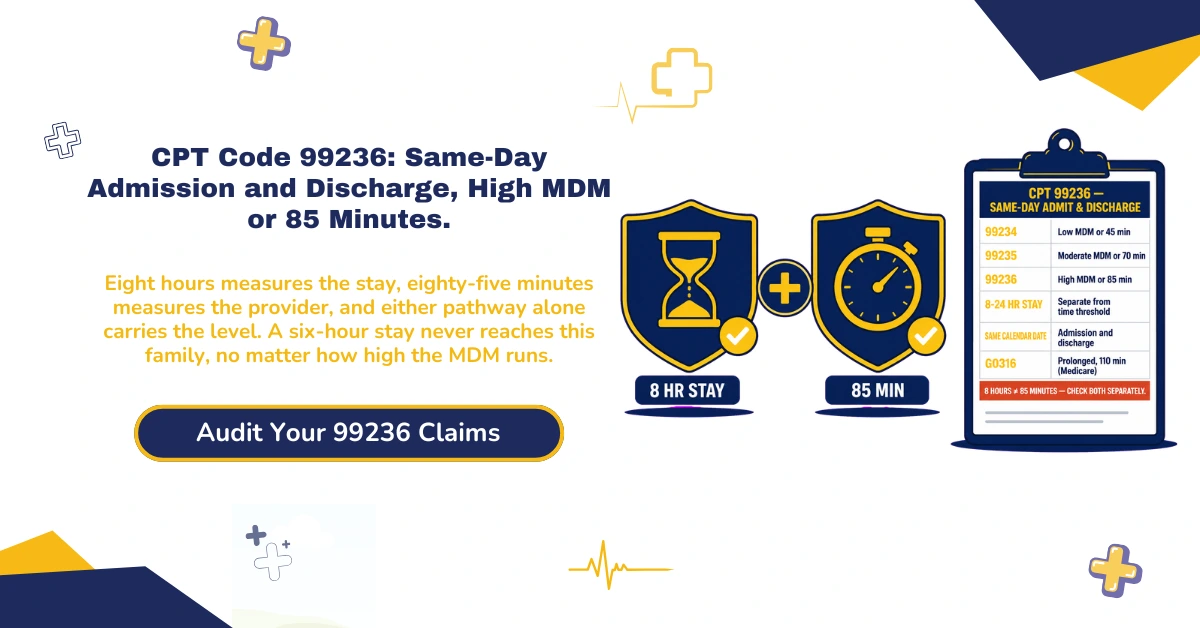
CPT code 99236 reports the highest level of hospital inpatient or observation care built around a same-day admission and discharge. Medicare generally expects a stay of at least 8 hours but fewer than 24, with admission and discharge on the same calendar date. The level comes down to high MDM or at least 85 minutes of qualifying practitioner time, not how long the stay ran.
Before that claim goes out, the stay length, the decision-making or documented time, and the admission and discharge work all need to hold up on their own.
This guide covers the eligibility test, high MDM, the 85-minute pathway, what the documentation has to show, how 99236 compares with 99234 and 99235 in the same-day admit and discharge CPT code family, where Medicare and commercial payer rules split, and how to avoid a denial or downcode.
ClaimMax RCM works with hospitalists, physician groups, and billing teams to connect documentation, coding, and claim submission across the revenue cycle. That’s what matters most on same-day claims, where one missed detail can turn a payable encounter into a downcode or a denial.
A workflow review often turns up exactly where a documentation gap or a coding mismatch is holding up a claim that should already be paid.
What Is CPT Code 99236?
Most searches for a 99236 code description want two things fast: what the code covers, and what decides the level.
CPT 99236 in Plain English
CPT code 99236 covers the highest level of hospital inpatient or observation evaluation and management care built around a same-day admission and discharge. It sits at the top of the same-day code family, above 99234 and 99235, and it applies whether the patient’s status is inpatient or observation, not observation care alone.
What Work Does the Code Include?
At a high level, the same-day service includes:
- Evaluating the reason for admission
- Taking a medically appropriate history or performing an exam
- Assessing the patient’s condition
- Making diagnostic and treatment decisions
- Reassessing the patient when that happens during the stay
- Evaluating and planning for discharge
- Documenting the work tied to the reported service
None of this work is optional. It all has to show up in the record.
What Determines the Level?
The level itself for CPT 99236 comes down to one of two paths: high MDM, or at least 85 minutes of qualifying total time. A medically appropriate history and exam are still required for every visit, but how long they take doesn’t decide whether the service lands at 99234, 99235, or 99236.
Neither pathway is automatic, and the record has to support whichever one the practice selects. That combined scope also separates 99236 from a subsequent-day hospital visit code.
AMA guidance on the 2023 E/M restructuring confirms that when several observation-only codes were folded into the hospital care code set, the same-day admission and discharge family, 99234 through 99236, was kept intact as its own group. See the AMA E/M guidance for the full 2023 revision summary.
That’s the 99236 CPT code description in plain terms. The table below breaks the same attributes down one at a time.
| Attribute | CPT 99236 |
| Code category | Hospital inpatient or observation E/M |
| Service type | Admission and discharge services |
| MDM level | High |
| Time threshold | 85 minutes, when selecting by time |
| Patient status | Inpatient or observation |
| New or established distinction | Not used to select the code |
| Reporting unit | One qualifying service for the date |
That combined-encounter distinction, not two separate visits stitched together, is what the eligibility test in the next section checks first.
When Does Same-Day Admission and Discharge Qualify for 99236?
Same-day admit and discharge CPT code questions almost always come down to the same four gates.
A qualifying claim generally clears Medicare’s bar for CPT code 99236 when four things line up: admission and discharge fall on the same calendar date, the stay runs at least 8 hours but under 24, the record documents both the admission and the discharge work, and the selected level holds up under high MDM or total qualifying time.
Admission and Discharge on the Same Calendar Date
Calendar date, not elapsed time, controls whether an encounter belongs to the same-day family. A patient admitted at 10:00 p.m. and discharged at 6:30 a.m. the next morning stayed under 24 hours, but that stay crosses 2 calendar dates. Elapsed hours alone can’t put that encounter into 99234 through 99236.
By contrast, a patient admitted at 9:00 a.m. and discharged at 5:00 p.m. that same day clears this particular gate without any date question at all.
At Least 8 Hours but Fewer Than 24 Hours
The 8-hour threshold and the 85-minute threshold measure two different things, and mixing them up is one of the more common coding mistakes on same-day claims. Plenty of guides on this topic blur the two anyway, treating a long stay as if it automatically proves enough practitioner time, which it doesn’t.
| Do not confuse these thresholds8 hours measures how long the patient’s stay lasted.85 minutes measures how much time the reporting practitioner personally spent on the case.Meeting one doesn’t satisfy the other. Both get checked separately. |
The current CMS E/M Services Guide confirms this same structure directly: an 8 or more hour, under-24-hour stay with same-calendar-date discharge routes to 99234 through 99236, while a shorter same-day stay routes elsewhere.
Admission and Discharge Services Must Both Be Supported
Documented admission and discharge services must both be supported in the record. That generally means:
- An admission order or documented admission status
- An initial professional assessment
- Clinical management notes from during the stay
- A discharge evaluation
- Discharge instructions or a discharge plan
- Clear documentation of the reporting practitioner’s involvement
Exactly how a payer wants that documented, including whether it expects two separately timed notes, varies by payer, so check the specific policy before assuming a format. A record that only shows the admission, or only the discharge, leaves the claim exposed even when the dates and the hours both check out.
Inpatient or Observation Setting
CPT 99236 isn’t limited to one patient-status category. It’s easy to mistake 99236 for simply the CPT code for inpatient admission, but the same descriptor covers observation care just as directly. None of the codes in this family function as observation CPT codes limited to a single patient status either.
The professional code by itself doesn’t determine which status applies, and place of service and the payer rules tied to each status come later in this guide.
That flexibility is what lets the same fact pattern, an 8-hour stay with high MDM, support 99236 whether the hospital classified the patient as inpatient or as observation. The inpatient vs observation question matters for other reasons covered later, but it doesn’t gate access to 99236 itself.
| Eligibility check before selecting 992361. Were admission and discharge on the same calendar date?2. Did the stay meet the applicable duration rule?3. Did the reporting practitioner perform the qualifying professional services?4. Is high MDM supported, or were at least 85 minutes documented?5. Does the payer recognize the same reporting rule?If any answer is no, don’t move straight to 99236. |
Keeping all five aligned across status, documentation, coding, and claim edits on every encounter is usually the harder part. That’s the gap coordinated hospital RCM services are built to close, catching a status or documentation mismatch before a payer edit turns it into a denial or a recoupment.
When CPT Code 99236 Does Not Apply
CPT 99236 shouldn’t get selected just because a patient was admitted and discharged within 24 hours. A stay under 8 hours, a discharge on a different date, unsupported high MDM, thin practitioner time, or missing admission and discharge work can each point to a different hospital E/M code instead.
Stay Under 8 Hours on the Same Date
For Medicare, a same-day stay under 8 hours generally routes to the applicable initial hospital inpatient or observation code, CPT code 99222 among them, rather than to 99234 through 99236. Don’t separately report 99238 or 99239 for a same-day stay that never reached 8 hours. The initial code gets selected by its own MDM or time rules, same as any other initial hospital visit.
Admission and Discharge on Different Calendar Dates
Once admission and discharge land on different calendar dates, this stops being a simple same-date reporting question. Report the applicable initial hospital code on the admission date, then report discharge management on the discharge date once CPT code 99238 or CPT code 99239 meets its own requirements, chosen by the discharge-management time documented.
Crossing Midnight Requires Careful Analysis
Two separate issues can coexist here, and collapsing them into one rule is where guides go wrong. The admission date and the discharge date determine which code family applies in the first place. Separately, current CMS guidance treats a continuous professional service that spans two calendar dates as one service, with the qualifying time attributable to the date the encounter started.
Don’t reduce that to “crossing midnight always means an initial code plus a discharge code.” The reporting practitioner still has to check the admission date, the discharge date, the encounter’s actual start, whether the work was continuous, and the specific payer’s policy before picking a code family.
The MDM or Time Does Not Support Level 3
A qualifying same-day stay can still land at 99234, 99235, or 99236. Duration decides whether the same-day family is even in play. MDM or practitioner time decides which of the three levels applies once it is, and a longer stay by itself never substitutes for either measurement.
| Scenario | Likely code family | Reason |
| Same date, fewer than 8 hours | 99221 to 99223 | Medicare same-day threshold not met |
| Same date, 8 to fewer than 24 hours | 99234 to 99236 | Select level by MDM or time |
| Different admission and discharge dates | Initial code plus 99238 or 99239 | Separate-date reporting |
| Qualifying stay, moderate MDM, under 85 minutes | 99235 | High MDM or 85 minutes not supported |
| Qualifying stay, fewer than 85 minutes but high MDM | 99236 may still qualify | MDM pathway can carry the level |
| Qualifying stay, 85 minutes but only moderate MDM | 99236 may still qualify | Time pathway can carry the level |
Verify each row against the specific payer’s own policy before treating it as a final answer; Medicare’s rule isn’t automatically every commercial plan’s rule, and a payer that hasn’t adopted the same 8-hour framework needs its own separate check before a claim goes out under this table.
The Medicare Claims Processing Manual sets out the federal detail behind this same date-and-duration routing logic in full.
99234 vs 99235 vs CPT Code 99236
99234 represents straightforward or low MDM, or 45 minutes. 99235 represents moderate MDM, or 70 minutes. 99236 represents high MDM, or 85 minutes. All three include qualifying same-date admission and discharge services, and diagnosis severity alone doesn’t move an encounter between them.
99234 for Straightforward or Low MDM
99234 sits on the 45-minute pathway, or straightforward-to-low MDM, when MDM sets the level. It isn’t a code for a simple patient; it’s a code for a same-day stay where the documented complexity and time both land at the lower end of the family. A patient can carry a serious-sounding diagnosis and still land at 99234 if the actual work that day was limited.
99235 for Moderate MDM
99235 sits on the 70-minute pathway, or moderate MDM. A common risk here is downcoding or upcoding when the note doesn’t clearly separate moderate complexity from high complexity, which is exactly the distinction Section 6 covers in depth. Two patients admitted with the same working diagnosis can land at different levels once the actual data reviewed and the actual risk decisions on that date get compared side by side.
99236 for High MDM
99236 sits on the 85-minute pathway, or high MDM, meaning at least 2 of the 3 MDM elements reach the high level when MDM is the selection method. There’s no requirement to hit both high MDM and 85 minutes at once; either pathway independently supports the level. A stay that never approaches 85 minutes of practitioner time can still land here when the problems addressed and the management risk both clear the high bar on their own.
| Code | MDM | Time, when used | Core distinction |
| 99234 | Straightforward or low | 45 minutes | Lowest same-day level |
| 99235 | Moderate | 70 minutes | Moderate clinical complexity |
| 99236 | High | 85 minutes | Highest same-day level |
Time has to be met or exceeded, not approximated. MDM and time work as alternative pathways, not a blend. A medically appropriate history and exam are still required for every visit, medical necessity still has to support the service, and payer-specific rules still need their own check.
Use MDM or Time, Not a Blended Shortcut
Don’t combine moderate MDM with thin time and call the result 99236. Don’t count clinical staff time toward the physician or QHP’s total, since that total belongs to the reporting practitioner alone. Don’t assume the most severe diagnosis on the chart automatically creates high MDM without the management work to back it up, and don’t select 99236 simply because it carries the highest reimbursement of the three. Each of those shortcuts tends to surface later as a downcode, not as a saved minute during the encounter.
How High-Level MDM Supports CPT Code 99236
Selecting 99236 through medical decision-making requires the encounter to support a high level in at least 2 of the 3 MDM elements: problems addressed, data reviewed and analyzed, and risk of patient management. A severe diagnosis by itself doesn’t establish high MDM. The record has to show the work, the decisions, and the risk the reporting professional actually addressed, not the label attached to the chart.
The AMA confirms that an E/M level may be selected using MDM or documented time, and that the three MDM sub-components themselves weren’t materially rewritten during the 2021 and 2023 E/M overhauls, only the surrounding definitions and elements were revised. That stability is useful here: a coder trained on the current 2-of-3 structure is reading the same underlying framework CMS expects on audit.
The 2-of-3 MDM Rule
| MDM element | High-level concept | Documentation focus |
| Problems addressed | Severe or life-threatening problem | What was evaluated and actively managed |
| Data | Extensive review and analysis | Tests, records, independent interpretation, external discussion |
| Risk | High management risk | Treatment, escalation, hospitalization, surgery, toxicity monitoring |
At least 2 of the 3 elements need to meet or exceed the high level. All 3 aren’t required every time.
Problems Addressed
The record needs to show the problem was actively evaluated or managed, not just named. Potential high-level patterns include a severe exacerbation or progression of a chronic condition, an acute or chronic illness threatening life or bodily function, significant clinical instability, or a condition requiring urgent, high-risk management.
A diagnosis name alone doesn’t determine MDM. The assessment and plan have to show why that problem carried high complexity during that specific encounter. Two admissions with an identical primary diagnosis can land at different problem-complexity levels once the actual evaluation, the actual instability, and the actual urgency of that day’s decisions get compared instead of the diagnosis label alone.
Data Reviewed and Analyzed
This element can include review of external records, ordering and reviewing unique tests, use of an independent historian, independent interpretation not separately reported, or discussion of management or interpretation with an external professional. Listing data isn’t the same as analyzing it, and a coder should be able to verify each item from the note itself, not infer it from a lab flowsheet sitting elsewhere in the chart.
| Weak wording | Stronger documentation approach |
| Labs reviewed | Identify the tests reviewed and why they affected management |
| Discussed with specialist | Identify the specialist and the management issue discussed |
| Imaging reviewed | State whether interpretation was independent and not separately reported |
Risk of Patient Management
Relevant management decisions include drug therapy requiring intensive toxicity monitoring, emergency major surgery decisions, escalation or de-escalation of hospital-level care, treatment carrying high morbidity risk, or goals-of-care decisions when clinically relevant. Not every IV medication, hospital admission, or specialist consult automatically creates high risk on its own; the risk element still needs a specific decision behind it, not just a category of treatment that sounds intensive.
A High-Risk Diagnosis Does Not Automatically Equal High MDM
Diagnosis severity and MDM are related, not identical. The record has to reflect the management decisions made during that specific encounter, and a copy-forward problem list doesn’t prove active management. Templates can’t substitute for patient-specific rationale, and medical necessity still has to align with the code selected. A chart that repeats yesterday’s assessment word for word, with today’s date swapped in, tends to read as unsupported the moment a reviewer compares two consecutive days side by side.
Pulling all of that together into one working list gives a coder or reviewer something concrete to check against, rather than a general impression of complexity.
| MDM checklist for 99236At least 2 of the 3 MDM domains reach the high levelProblems were actively addressed, not just listedData elements are identifiable and specificManagement risk is tied to an actual decisionThe assessment and plan are patient-specificDocumentation supports why same-day discharge was appropriateNo separately reported work is counted again |
The AMA E/M revisions FAQs walk through this 2-of-3 framework directly, alongside the full MDM element definitions.
When high-MDM claims get routinely downcoded, the documentation-to-code handoff is usually the actual problem, not the clinical work itself.
CPT Code 99236 Time Requirement: How the 85 Minutes Work
When selecting CPT code 99236 by time, the reporting physician or qualified healthcare professional (QHP) has to meet or exceed 85 minutes of qualifying total time on the date of the encounter. That’s practitioner work time, not the patient’s total time in the hospital. The separate 8-hour Medicare rule concerns the length of the qualifying stay, and the two figures answer different questions entirely.
85 Minutes Is Provider Time
The 85-minute threshold applies to the reporting professional’s own qualifying work, not the span between the admission timestamp and the discharge timestamp. A 10-hour observation stay by itself doesn’t prove 85 minutes of provider work happened inside it. The provider still has to document total time whenever the level gets selected by time rather than MDM, and that total belongs to one reporting practitioner’s own effort, not the combined activity of the whole care team.
Activities That May Count
Qualifying professional activities performed on the encounter date generally include:
- Preparing to see the patient
- Reviewing relevant records or tests
- Obtaining or reviewing history
- Performing a medically appropriate examination
- Counseling and educating the patient or family
- Ordering medications, tests, or procedures
- Referring or communicating with other healthcare professionals
- Independently interpreting results when not separately reported
- Coordinating care
- Documenting the service
Verify the current official activity list against the CPT manual during drafting rather than copying this list forward indefinitely, since CPT wording gets revised and a stale list is one of the easier accuracy gaps for a reviewer to catch. Non-face-to-face work on this list counts the same as time spent at the bedside, provided it’s genuinely tied to that patient on that date.
Activities That Do Not Count
Clinical staff time doesn’t count toward the physician or QHP’s total, and neither does travel, general teaching that isn’t specific to the patient, separately reported procedures, time already counted toward another billed service, administrative work unrelated to the encounter, or concurrent time that can’t be attributed appropriately. A practitioner juggling two patients at once can’t assign the same clock minutes to both encounters.
Total Time Must Be Documented
A defensible note states the total qualifying time, the date of service, the relevant categories of work performed, exclusion of any separately reported procedures, and the identity of the reporting physician or QHP. That doesn’t require an unnecessary minute-by-minute diary unless a specific payer’s policy calls for one; a clear total tied to named categories of work generally does the job.
8 Hours and 85 Minutes Are Not Interchangeable
| Threshold | Measures | Used for |
| 8 hours | Patient’s qualifying hospital or observation stay | Medicare access to the same-day code family |
| 85 minutes | Physician or QHP qualifying time | Selection of 99236 by time |
| High MDM | Clinical decision-making complexity | Selection of 99236 by MDM |
Time-Based Example
Patient stay of 9 hours, provider total qualifying time of 88 minutes, moderate MDM: 99236 may be selected through time if every other requirement and the specific payer’s rules are met. Contrast that with a patient stay of 11 hours, provider time of 62 minutes, and moderate MDM: 99235 may be the more appropriate code once time falls short of the threshold, even though the second patient’s stay actually ran longer than the first.
Include “potential” or “may” in any worked example like these, since final code selection always depends on the complete record and the applicable payer’s own rules, not on the hours and minutes alone.
The ACEP observation coding FAQ lists 85 minutes as the threshold that must be met or exceeded for 99236, consistent with the framing above.
CPT Code 99236 Documentation Requirements
Documentation for 99236 needs to establish the qualifying hospital setting, admission and discharge services, the applicable stay duration, medical necessity, and the level-selection pathway. When coding by MDM, the record has to support high MDM. When coding by time, the record has to state at least 85 minutes of qualifying practitioner time.
Admission Documentation
The note should address the date and time of the admission or observation order, the reason for hospital-level care, the presenting problem, a medically appropriate history and examination, the initial assessment, and the initial treatment or diagnostic plan, tied clearly to the reporting practitioner’s own involvement. None of that means creating extra documentation solely to push the code level higher; the goal is a complete record of what happened at admission, not a longer one.
MDM Documentation
This connects back to Section 6 without repeating it in full. The documentation should identify problems actively addressed, relevant data reviewed or analyzed, the management decisions made, the clinical risk involved, and the rationale for treatment, monitoring, or discharge. A reviewer reading only this encounter’s note, without knowing the patient beforehand, should still be able to see the same high-complexity picture the code claims.
Time Documentation
This connects back to Section 7. The note should identify total qualifying time, the encounter date, the categories of work performed, the practitioner who performed the service, and exclusion of any separately billed procedures. Exact start and stop times aren’t universally required for the base code unless the specific payer’s policy calls for them, but the total itself has to be stated plainly rather than implied.
Discharge Documentation
This should cover the final evaluation, the patient’s condition at discharge, the discharge diagnosis, medication reconciliation, patient or caregiver instructions, the follow-up plan, return precautions where clinically appropriate, coordination with other professionals, and the date and time of discharge. A discharge note that reads like a form completed on autopilot rarely survives a closer audit look, even when every field is technically present.
Admission and Discharge Must Tell One Clinical Story
The record should show why hospital-level care was necessary, what the provider evaluated and managed, why high MDM or 85 minutes was supported, what changed during the stay, and why the patient could be discharged safely. That narrative connection holds up better on audit than isolated template fields ever do, since it shows a reviewer the clinical reasoning tying the admission decision to the discharge decision, rather than two checklists that happen to share a chart.
| 99236 documentation checklistPatient status: inpatient or observation context statedAdmission: order, date, reason, and professional assessmentStay duration: dates and times sufficient to evaluate the payer ruleMedical necessity: why hospital-level care was reasonableMDM pathway: high level in at least 2 of 3 domainsTime pathway: at least 85 qualifying minutesDischarge: final evaluation, instructions, and follow-upReporting professional: clear physician or QHP involvementSignature: authenticated per applicable requirementsCode consistency: no conflicting same-date E/M reporting |
Accurate documentation still has to move through coding validation, claim scrubbing, submission, payment posting, and follow-up, which is where coordinated medical billing services protect the full claim rather than only the code.
ClaimMax RCM can review the path from provider documentation through final claim submission to identify where otherwise supportable hospital E/M services are getting downcoded, denied, or left unpaid.
Is CPT Code 99236 Inpatient or Observation?
The Code Can Apply to Either Status
CPT 99236 belongs to the hospital inpatient or observation E/M family. It may describe qualifying professional services for a patient in either status. The status doesn’t determine whether the level is 99234, 99235, or 99236, since MDM or practitioner time determines the level after all reporting requirements are met.
Observation remains an outpatient status. An inpatient admission is not the same thing as observation, but the same professional CPT family applies across both settings. The facility status, the professional code, and the professional place of service all still have to agree with the actual encounter.
POS 21 for an Inpatient Hospital
CMS defines POS 21 as an inpatient hospital. Use it when the patient is formally admitted as an inpatient, not merely because the patient occupied a hospital bed. Patient status should be confirmed from the admission order and the hospital record, not assumed from the physical setting.
POS 22 for an On-Campus Outpatient Hospital
Observation on the hospital’s main campus generally aligns with POS 22. Observation status remains outpatient even when the patient stays in a hospital room, and the professional claim should reflect the setting where the face-to-face service actually occurred.
POS 19 for an Off-Campus Outpatient Department
POS 19 is worth naming here too, so POS 22 doesn’t look like the only outpatient-hospital option. CMS currently defines POS 19 as an off-campus outpatient hospital, POS 21 as inpatient hospital, and POS 22 as an on-campus outpatient hospital. CMS advises providers to use POS codes on professional claims to identify where services were rendered and to verify payer-specific reimbursement policies on top of that.
| Question | Inpatient | Observation |
| Patient classification | Inpatient | Outpatient |
| Common professional POS | 21 | 22 or 19 |
| May the 99234 to 99236 family apply? | Yes | Yes |
| Level selected by status alone? | No | No |
| Level selected by MDM or time? | Yes | Yes |
Confirm current POS definitions directly against the CMS Place of Service Code Set before submitting an unfamiliar code, and see POS 22 in medical billing for the full facility-rate and compliance picture behind that specific code.
Who Can Report CPT Code 99236?
The Reporting Practitioner Must Perform the Qualifying Service
The professional record should identify who performed the admission service, who performed the discharge service, whether those professionals belong to the same group, who performed the substantive portion, which NPI appears on the claim, and who signed and dated the record. Any physician who merely saw the patient once during the stay isn’t automatically the one who can report 99236.
Treating and Consulting Practitioners
The treating or responsible practitioner reports the applicable hospital E/M service once requirements are met. Another practitioner providing an independent consultation doesn’t automatically report that same admission-and-discharge code. Medicare hasn’t recognized inpatient consultation CPT codes for Part B payment in years, so a Medicare consultant should select the appropriate recognized E/M family based on the setting and the service performed, while commercial payers may keep their own separate consultation policy.
| Practitioner role | Coding question |
| Treating practitioner | Did this practitioner perform the qualifying admission and discharge work? |
| Consultant | Which E/M family does this payer recognize for the consultation? |
| Concurrent practitioner | Was the practitioner independently managing another condition? |
Split or Shared Visits
Under current CMS policy, the physician and the nonphysician practitioner must belong to the same group, and the service has to occur in a facility setting. The billing practitioner performs the substantive portion, defined as more than 50 percent of combined practitioner time or the substantive part of the MDM. Modifier FS identifies the split or shared service, both professionals should be identifiable in the record, and the billing practitioner signs and dates the documentation.
Teaching-Physician Services
The decision points that matter here: was a resident involved, was the teaching physician present for the required portion, does the teaching physician’s documentation support personal participation, and does the claim comply with current Medicare teaching-physician rules? A resident’s note alone, without the teaching physician’s own documented involvement, doesn’t support billing under the teaching physician.
| Modifier AI is not automaticModifier AI identifies the principal physician of record for applicable initial hospital care reporting.Don’t append it routinely to 99236 without confirming the code family and the payer’s specific instruction. |
A final or subsequent visit by a practitioner who isn’t reporting the admission-and-discharge service itself generally falls to CPT code 99231 instead.
Prolonged Services and Modifiers With CPT Code 99236
Medicare Uses G0316 for Prolonged Hospital E/M Services
For Medicare, G0316 is the prolonged-service code associated with hospital inpatient or observation E/M services. When CPT code 99236 is selected by time, the current CMS threshold for the first unit is 110 total minutes, counted from the date of the encounter through 3 days after.
The primary E/M level has to be selected using time before G0316 applies at all. Don’t add G0316 when 99236 was selected only through MDM, and don’t count separately reported services toward that total. Additional units require additional qualifying time under current CMS rules.
| Medicare G0316 threshold with 99236First unit of G0316: 110 total minutes, when 99236 is selected by time.Compare: 99223 (initial, high) uses 90 minutes; 99233 (subsequent, high) uses 65 minutes.Recheck this figure against current CMS guidance immediately before publication. |
Can 99236 and 99418 Be Billed Together?
Not for Medicare. Medicare uses G0316 rather than CPT 99418 for this code family. A commercial payer that recognizes 99418 may permit it alongside 99236 when the current CPT time requirements and that payer’s own policy are both met, so verify the specific plan before assuming a universal commercial threshold.
Modifier FS
FS identifies a split or shared E/M service. It isn’t a general modifier for every 99236 claim. When prolonged services get reported on a split or shared visit, the substantive portion is determined through practitioner time.
Modifier 25
Modifier 25 may apply only when a significant and separately identifiable E/M service was provided, another procedure or service was also reported that day, the separate work is supported in the documentation, and the current NCCI edit and payer policy permit separate reporting. A different diagnosis isn’t always required for the modifier to apply.
Modifier 57
Modifier 57 relates to an E/M service that results in the initial decision for major surgery. Don’t append it just because surgery happened to occur later; the note has to show the E/M service itself produced that decision.
Verify NCCI Edits Before Submission
Billing teams should check the current quarter’s NCCI PTP file, the column 1 and column 2 relationship, the modifier indicator, the specific payer’s edit, the global surgical policy, and whether the documentation genuinely supports a distinct service. CMS updates NCCI procedure-to-procedure edits quarterly, and a modifier doesn’t automatically override an edit just because it’s technically available.
| Situation | Code or modifier | Core caution |
| Medicare prolonged hospital E/M | G0316 | Base level must be selected by time |
| Commercial prolonged service | 99418, when recognized | Verify CPT and payer thresholds |
| Split or shared service | FS | Same-group and substantive-portion rules apply |
| Separate E/M with procedure | 25 | Service must be significant and distinct |
| Initial decision for major surgery | 57 | Must represent the actual surgery decision |
| NCCI edit pair | Payer-specific | Check the current edit before billing |
See the CMS E/M resource hub and the CMS NCCI E/M Policy Manual for the split-or-shared and prolonged-service framework behind this table.
A pre-submission edit review should confirm the primary code, the modifier, any add-on code, the payer rule, and the supporting documentation before the claim leaves the billing system.
CPT Code 99236 Reimbursement in 2026
There’s no single national payment amount for 99236 that applies to every provider. Medicare reimbursement depends on the code’s RVUs, the applicable 2026 conversion factor, geographic adjustments, practitioner status, claim details, and other payment policies. Commercial reimbursement depends on the provider’s contract and that payer’s fee schedule.
2026 Medicare Conversion Factors
| 2026 practitioner category | Conversion factor |
| Qualifying Advanced APM participant | $33.57 |
| Nonqualifying participant | $33.40 |
CMS finalized these separate 2026 conversion factors and also updated geographic practice cost indices and malpractice RVUs alongside them. Don’t multiply a conversion factor by one RVU value and present the result as a universal allowed amount; the work RVU, practice-expense RVU, malpractice RVU, geographic indices, facility setting, qualifying APM status, and any current CMS correction all still apply on top of it.
Commercial Payer Payment
Commercial reimbursement may differ because of contracted fee schedules, percent-of-Medicare arrangements, bundling policies, prior authorization or notification rules, modifier recognition, and timely filing or documentation requirements specific to that payer. None of that can be assumed from the Medicare figures above; each contract sets its own terms.
Monitor Underpayments, Not Only Denials
An approved claim can still be underpaid because of the wrong fee schedule, an incorrect contractual adjustment, missing modifier recognition, the wrong place of service, or an incorrect payer configuration. Payment posting services built to catch exactly this pattern belong beside any hospital E/M claim review.
Use the CMS PFS Look-Up Tool for locality-specific research, and see the CMS 2026 PFS final rule for the source behind both conversion factors.
Compare the payer’s allowed amount against the contracted rate before closing a balance as paid in full.
Common CPT Code 99236 Denial Reasons and Audit Triggers
Across E/M services broadly, CMS’s own improper-payment reviews attribute the largest share to incorrect coding, with insufficient or missing documentation making up most of the remainder. Those figures describe E/M services overall, not 99236 specifically, but the pattern maps closely onto where 99236 claims actually fail.
Date and Duration Conflict
Common examples: admission and discharge on different dates, a stay under 8 hours, facility timestamps conflicting with the professional claim, or a same-day family chosen from elapsed hours alone.
High MDM Is Not Supported
Common examples: only 1 of the 3 MDM domains reaches the high level, serious diagnoses listed without active management, vague or duplicated data review, risk asserted without a documented decision, or copied-forward text that doesn’t reflect the actual encounter.
The Time Statement Is Incomplete
Common examples: no total time documented, “more than 85 minutes” with no context, staff time folded in, a separately reported procedure counted again, or time from another date included without a valid prolonged-service basis.
POS, Practitioner, or Modifier Error
Common examples: POS 21 used for observation, POS 22 used despite inpatient status, a billing NPI that doesn’t match the substantive-portion practitioner, missing modifier FS on a split or shared service, or modifier 25 or 57 appended without a supported distinct service.
Duplicate or Mutually Inconsistent E/M Reporting
Watch for conflicts with 99221 to 99223, 99231 to 99233, 99238 or 99239, another same-date admission-and-discharge code, an unsupported prolonged code, or work already included in the primary service. Check the current NCCI file before treating any pair as universally prohibited.
| Denial trigger | Evidence to review | Corrective action |
| Wrong date family | Admission and discharge timestamps | Recode to the correct date-based family |
| Stay under threshold | Facility status and duration | Review the initial hospital code instead |
| Unsupported high MDM | Assessment, data, and risk | Correct the level or improve future documentation |
| Missing time | Total-time statement | Use MDM if supported, or correct the record lawfully |
| Wrong POS | Status order and service location | Correct POS and resubmit when permitted |
| Split or shared error | Practitioner time and MDM | Identify the billing practitioner and modifier FS |
| Duplicate service | Claim history and NCCI edits | Remove, or appeal with supported distinctness |
An appeal packet generally needs the claim and remittance, the denial or edit reason, the admission order, status documentation, admission and discharge timestamps, provider notes, MDM support, the time statement, modifier support, the current payer policy, and a corrected claim or appeal rationale. Never alter an original medical record improperly after an audit request; track the root cause instead.
See the CMS NCCI PTP edits for the current quarterly edit file.
When CPT code 99236 claims keep getting downcoded or denied, ClaimMax’s denial management services can trace the failure to documentation, status, coding, modifier, payer-edit, or follow-up errors and build a prevention workflow around the actual root cause.
CPT Code 99236 Coding Examples and Decision Tree
| Decision tree1. Did admission and discharge occur on the same calendar date? No: review the initial and discharge code families. Yes: continue.2. Does the encounter meet the applicable stay-duration rule? No: review 99221 to 99223. Yes: continue.3. Which selection method supports the level? Straightforward or low MDM, or 45 minutes: 99234. Moderate MDM, or 70 minutes: 99235. High MDM, or 85 minutes: 99236.4. Are status, POS, practitioner, modifier, and documentation requirements all supported? No: correct the claim before submission. Yes: submit the supported code. |
Scenario 1: High MDM on a Qualifying Same-Day Stay
Patient stay of 9 hours, same calendar date, high MDM, practitioner time of 72 minutes: potential code 99236 through MDM. The provider doesn’t need 85 minutes when high MDM independently supports the level.
Scenario 2: Moderate MDM With 74 Minutes
Patient stay of 10 hours, same calendar date, moderate MDM, practitioner time of 74 minutes: potential code 99235. A qualifying stay doesn’t automatically justify the highest code in the family.
Scenario 3: Stay Under 8 Hours
Patient stay of 6 hours, same calendar date, high MDM: potential Medicare route 99221 to 99223. High MDM doesn’t erase the applicable same-day duration rule.
Scenario 4: The Stay Crosses Midnight
Admission at 11:00 p.m. Monday, discharge at 7:30 a.m. Tuesday, total stay of 8.5 hours, different calendar dates: potential route is initial care on the admission date and discharge management on the discharge date. Fewer than 24 elapsed hours doesn’t mean same-calendar-date reporting.
Scenario 5: Split or Shared Service
Physician time of 50 minutes, NPP time of 38 nonoverlapping minutes, combined qualifying time of 88 minutes, physician performing more than half: potential billing practitioner is the physician, with modifier FS. Both practitioner involvement and the substantive-portion rules still have to be documented.
Across all five scenarios, the same pattern repeats: duration opens or closes the door to the family, and MDM or time decides the level once the door is open. Neither pathway substitutes for the other, and neither erases a failed eligibility gate from Section 3.
How ClaimMax RCM Protects Revenue From CPT Code 99236 Claims
Pre-Bill Validation
Before a 99236 claim goes out, ClaimMax verifies the admission and discharge dates, the stay duration, patient status, place of service, the MDM or time pathway, the reporting practitioner, split or shared requirements, modifier and NCCI edits, payer-specific policy, and overall claim consistency.
Claim Submission Through Final Payment
The connected workflow runs from documentation review through code-level validation, claim scrubbing, electronic submission, payer response monitoring, payment posting, underpayment identification, denial correction or appeal, AR follow-up, and root-cause reporting. ClaimMax RCM works as a full revenue cycle partner here, not only a coding vendor.
ClaimMax RCM Pricing
| ClaimMax service | Pricing |
| Full-service medical billing | 3.49% of payer collections |
| Verification of benefits | Included at no additional charge |
| Prior authorization | Included at no additional charge |
| Credentialing | $120 per insurance |
| Initial revenue cycle audit | Free before commitment |
ClaimMax RCM charges 3.49% of payer collections for full-service medical billing. Verification of benefits and prior authorization are included at no additional charge, and credentialing costs $120 per insurance.
That combination is what affordable, expert billing looks like at ClaimMax RCM: pricing built to help a practice maximize what it actually collects from payers on 99236 and every other hospital E/M code, whether the admitting provider is a hospitalist, an orthopedic surgeon, or any other qualified healthcare professional reporting this code. Verification of benefits and prior authorization aren’t required specifically for 99236; they’re part of ClaimMax’s wider full-service revenue cycle model, alongside coding validation, claim submission, and denial follow-up.
One older ClaimMax page still displays a different promotional rate at the time of writing. Reconcile that pricing conflict site-wide before this article goes live, so search engines and language models don’t surface two different numbers from the same domain.
Request a free hospital E/M revenue cycle audit through ClaimMax’s revenue cycle management services or its hospital billing support team to see where coding, documentation, denial, underpayment, or follow-up gaps may be affecting collections.
CPT Code 99236 FAQs and Final Provider Checklist
Frequently Asked Questions
Can CPT 99236 be billed without seeing the patient?
No practitioner should report the code without personally performing and documenting the required professional services. The record has to support the reporting practitioner’s own involvement in the qualifying admission and discharge work, and split or shared services still need separate compliance with substantive-portion and modifier rules.
How often can CPT 99236 be billed?
Report one supported same-day admission-and-discharge service for the applicable patient, date, and practitioner or group arrangement, per that payer’s policy. Don’t report multiple levels from the 99234 to 99236 family for the same combined service.
Is 85 minutes always required?
No. The level may be selected through high MDM or through at least 85 minutes of qualifying practitioner time. When using MDM, at least 2 of the 3 MDM elements need to support the high level.
Can 99236 and 99418 be billed together?
Medicare uses G0316 rather than CPT 99418 for prolonged hospital E/M services. A commercial payer may recognize 99418 alongside 99236 when current CPT and payer-specific time rules are both met, so verify the payer before submitting the claim.
What is the difference between 99236 and 99233?
99236 includes qualifying admission and discharge services on the applicable same date. CPT 99233 represents high-level subsequent hospital inpatient or observation care on a later day of the stay and doesn’t include the combined admission-and-discharge service that defines 99236.
What is the difference between 99236 and 99238 or 99239?
99236 combines qualifying admission and discharge work in the same-day family. Codes 99238 and 99239 describe hospital discharge-day management alone and generally get used when the discharge is reported separately from the admission date, chosen by discharge-management time rather than MDM.
What happens if the stay is under 8 hours?
Under current Medicare guidance, review the initial hospital inpatient or observation codes 99221 to 99223 rather than the 99234 to 99236 same-day family, and select that level using its own MDM or time rules. Verify commercial-payer policy separately, since it may not mirror Medicare’s 8-hour threshold.
Can 99236 be reported for observation care?
Yes. The code family covers hospital inpatient or observation care. Observation remains an outpatient status, so the professional place of service generally reflects an outpatient hospital setting such as POS 22 or POS 19.
Final Provider Checklist
- Admission and discharge dates support the selected code family
- The applicable duration requirement is met
- Patient status and POS are consistent
- High MDM or 85 minutes supports the level
- Admission and discharge work are documented
- Practitioner and split or shared rules are satisfied
- Modifiers, prolonged services, NCCI edits, and payer policy are verified
Conclusion
CPT 99236 protects reimbursement for legitimate high-complexity same-day work, and it creates real audit exposure the moment date, duration, MDM, time, status, or documentation stop lining up with each other. A connected RCM workflow should validate the claim before submission and stay involved through final payment, not just at the coding step.
See where ClaimMax RCM can strengthen your hospital E/M workflow before coding gaps become denials, downcodes, or unpaid balances.