CPT code 33882 describes endovascular repair of the thoracic aorta using a branched endograft multipiece system with a fenestration for the left subclavian artery, and it took effect on January 1, 2026.
CPT code 33882 at a glance
- Effective date: January 1, 2026
- Work RVU: 35.00 (CMS final, CY2026)
- Global period: 090
- Status: New Category I code, CPT 2026
Two things decide whether a 33882 claim survives review: the aortic zone your surgeon documented, and whether your charge master still carries codes the AMA deleted on January 1. Both go wrong more often than the case volume suggests.
What CPT Code 33882 Covers
CPT code 33882 covers deployment of a branched endograft multipiece system in the thoracic aorta, along with the sizing, catheterization, angioplasty, and imaging work required to complete the repair.
The five components of the 33882 descriptor
The 33882 CPT code description breaks into five parts, and each one maps to something your surgeon either did or didn’t do.
| Descriptor component | What it means in the operative note |
|---|---|
| Branched endograft multipiece system | A modular device deployed in separate pieces, not one tube |
| Aorto-aortic tube device with a fenestration | The main body carries a designed opening for the side branch |
| Fenestration for left subclavian artery stent graft(s) | The branch goes into the left subclavian artery |
| Aortic tube endograft extensions | Extensions spanning left common carotid level to celiac level |
| Included work | Sizing, device selection, target zone angioplasty, catheterization, imaging |
The descriptor reads like a parts list because a modular endoprosthesis is a parts list. Assigning a thoracic branch endograft CPT code starts with the device description, and the coder works backward from there.
Device architecture drives the selection. A repair spanning three aortic segments with plain tube devices and extensions still falls outside 33882, because the surgeon placed no branch and cut no fenestration.
Treating 33882 as shorthand for multi-segment thoracic endovascular aortic repair produces the wrong code. Segment count plays no part in the decision. The branch architecture decides it.
One more shift worth catching. The American Medical Association dropped the word “descending” from these descriptors in CPT 2026, so the family now describes the thoracic aorta as a whole, and code selection follows the most proximal extent of coverage. The SIR coding guidance confirms the restructure.
What Is Bundled Into CPT 33882
CPT 33882 bundles pre-procedure sizing and device selection, all target zone angioplasty, all nonselective catheterizations and left subclavian selective catheterization, and all associated radiological supervision and interpretation.
Services included in the 33882 payment
- Pre-procedure sizing and device selection
- All target zone angioplasty
- All nonselective catheterization and left subclavian artery selective catheterization
- All associated radiological supervision and interpretation
What this means for your charge capture
The AMA deleted radiological supervision and interpretation codes 75956 through 75959 outright. They aren’t bundled, they’re gone, and that distinction changes what your team has to do about them.
A bundled code still exists and still sits on the superbill waiting for someone to check it. A deleted code has to come off the charge master entirely. Leave 75956 through 75959 in the system and a biller will eventually append one to a 33882 claim.
That claim comes back. The payer reads the imaging as already paid inside the procedure, denies the line, and sometimes holds the whole claim while someone sorts it out.
Selective catheterization outside the treatment zone may still be separately reportable, so the correction runs both directions. Stripping every catheterization code off the encounter undercodes the case.
When the Branch Vessel Is Not the Left Subclavian Artery
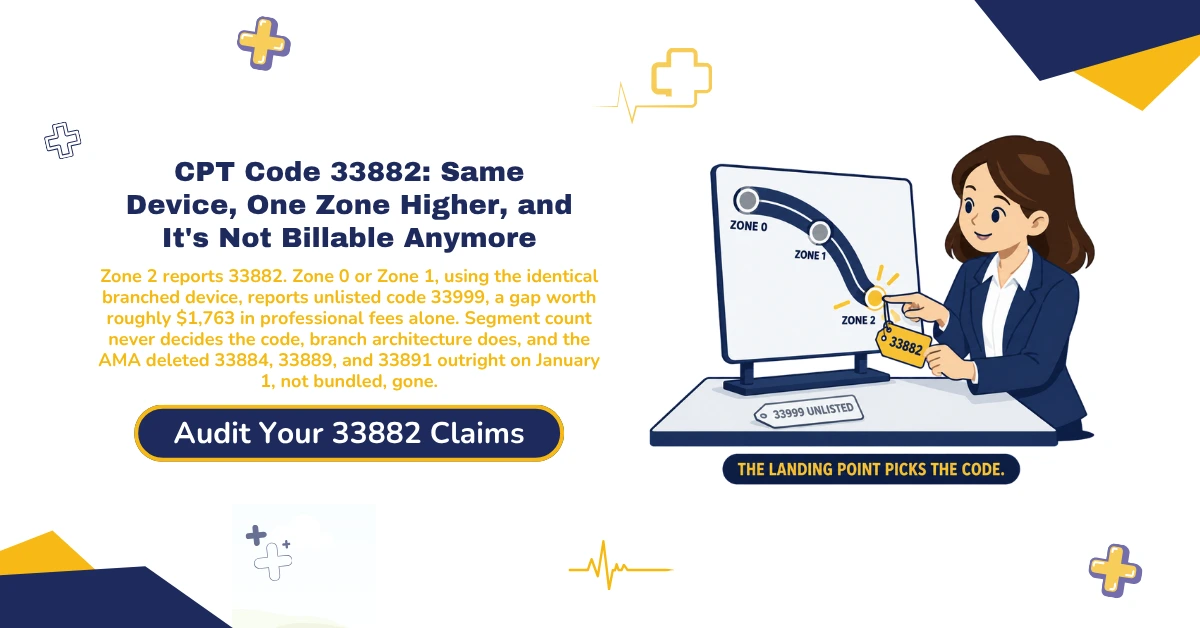
CPT 33882 describes a branched system with a fenestration for the left subclavian artery. When the surgeon places the side branch into a different vessel, the descriptor no longer matches, and unlisted code 33999 may apply instead.
That distinction is worth roughly $1,763 in professional fees, before the facility side.
Zone 2 versus Zone 0 and Zone 1
Gore’s 2026 hospital coding guide draws the line by aortic zone.
| Aortic zone | Where the side branch sits | Reported with |
|---|---|---|
| Zone 2 | Left subclavian artery, landing distal to left common carotid | 33882 |
| Zone 1 | Left common carotid, landing distal to innominate | 33999 (unlisted) |
| Zone 0 | Proximal to innominate, typically with full arch debranching | 33999 (unlisted) |
Why the anatomy changes the code
Move the branch up from the subclavian to the left common carotid and you’ve moved into Zone 1. Same device, same manufacturer, different code.
Zone 1 repairs usually require a carotid-subclavian bypass first. Zone 0 can require full arch debranching, which carries its own stroke risk and its own operative time. None of that open work sits inside the 33882 descriptor, which is why the unlisted code applies. A peer-reviewed zone deployment study lays out the anatomy behind it.
Volume is moving toward the harder zones. The branched device now carries FDA approval across Zones 0, 1, and 2, so the cases your team sees least often are the ones growing fastest.
The ICD-10-PCS side
Facility coders need the procedure-code mapping too:
- Zone 2: 02VX3EZ with 02VW3DZ
- Zone 0 and Zone 1: 02VX3EZ plus a debranching bypass code such as 031209K, 031209Y, or 03120AK
What usually happens is simpler than it sounds. The coder reads “thoracic branch endograft” in the operative note, reaches for the obvious thoracic branch endograft CPT code, and sends the claim. Sometimes it denies. Sometimes it pays and resurfaces in a post-payment review two years later.
Check the zone before you pick the code.
CPT 33880 vs 33881 vs 33882: How to Choose
Code selection across the TEVAR family is determined first by device architecture, and second by whether the repair is an initial deployment or a delayed extension placed after a previous procedure.
The decision tree
- Was the device a branched or fenestrated multipiece system? If yes, go to step 2. If no, go to step 3.
- Was the side branch placed in the left subclavian artery? Yes reports 33882. No reports 33999.
- Was an aorto-aortic tube device deployed with coverage of the left subclavian origin? Yes reports 33880. No reports 33881.
- Was this a delayed extension after a prior repair? A proximal extension reports 33883. A distal extension reports 33886.
Four questions, and the first one carries the most weight. If your team runs this sequence the same way every time, the cystoscopy code selection framework on our site follows the same logic for a different surgical family.
Quick reference: cardiovascular CPTs and descriptions for the 2026 TEVAR code family
The 33880 CPT code description for 2026 differs from what your 2025 codebook says, so work from this cardiology RVU table rather than memory.
| Code | What it reports | 2026 work RVU | Status |
|---|---|---|---|
| 33880 | Tube device, covers left subclavian origin | 26.33 | Current |
| 33881 | Tube device, no left subclavian coverage | 21.97 | Current |
| 33882 | Branched multipiece system, left subclavian fenestration | 35.00 | New for 2026 |
| 33883 | Delayed proximal extension | 19.41 | Current |
| 33886 | Delayed distal extension | 19.41 | Current |
The failure mode shows up in the operative note. Surgeons dictate device brand names, and the CPT code 33881 or 33882 decision needs architecture. A coder reading “thoracic branch endoprosthesis, 40 by 150” has no way to know from that line whether a fenestration was used.
Query the surgeon. A one-line addendum confirming branch configuration costs less than an appeal.
What Changed in the 2026 TEVAR CPT Code Family
CPT 2026 deleted three codes from the thoracic endovascular repair family, revised four, and added one, with every change effective January 1, 2026.
Codes deleted January 1, 2026
| Deleted code | What it used to report | What to do now |
|---|---|---|
| 33884 | Each additional proximal extension | Report under the revised 33883 structure |
| 33889 | Open subclavian to carotid artery transposition | Report per the revised CPT 2026 transposition guidelines |
| 33891 | Bypass graft, transcervical retropharyngeal carotid-carotid | Report 35602, new for 2026 |
Anyone searching a 33889 CPT code description in 2026 is looking at a code that no longer exists. Same for 33884 and 33891.
Any claim dated January 1, 2026 or later carrying 33884, 33889, 33891, or 75956 through 75959 will reject. Check the charge master, not just the scrubber.
Scrubbers catch what someone configured them to catch. A deleted code sitting in the fee schedule passes straight through if nobody updated the edit.
If your charge master still carries the deleted TEVAR codes, that’s a fixable afternoon. Our coders run charge master audits against the current code set, and the deleted-code sweep is usually the first thing we find. We handled the same cleanup when the AMA retired the deleted consultation codes in the E/M family.
Codes revised for 2026
The AMA revised 33880, 33881, 33883, and 33886, and two structural changes run through all four. The word “descending” came out of the descriptors. Imaging guidance became fully inclusive.
The new companion code: 35602
35602 covers carotid-contralateral carotid bypass using a graft other than vein, valued at 23.53 work RVUs for 2026. It’s the reporting path for work that used to land on 33891. State coverage lists confirm both as part of the Indiana 2026 code update, alongside the other new vascular CPT codes for 2026.
CPT 33882 Reimbursement, RVUs, and the Valuation Gap
CMS finalized a work RVU of 35.00 for CPT code 33882 in the CY2026 Physician Fee Schedule final rule, with payment policy effective January 1, 2026.
What the RUC recommended versus what CMS finalized
The AMA RUC recommended 39.00 work RVUs. CMS finalized 35.00.
That gap runs 4.00 work RVUs. At the CY2026 conversion factor of $33.4009, the difference lands near $133.60 per case below what the specialty societies asked for.
Two groups need to know that number. Practices running wRVU-based physician compensation will over-project if their model was built on the RUC figure, and the variance compounds across a surgeon’s annual volume. Practices with contracts benchmarked as a percentage of Medicare need the final value, not the recommendation, in the calculation.
Cardiovascular work carries this kind of valuation churn more than most specialties, which is why our vascular surgery billing specialists track the final rule rather than the proposed one.
Why CMS called the older codes misvalued
Imaging and thoracic repair were reported together on more than 75 percent of claims. That frequency flagged the family as potentially misvalued under the CMS Misvalued Codes Initiative, the AMA RUC reviewed it, and the bundling that followed pulled the work RVUs down.
Providers sometimes read the drop as a payment cut applied for its own sake. The work didn’t disappear. It moved inside the primary code, and the valuation moved with it.
2026 work RVU comparison
| Code | 2025 wRVU | 2026 wRVU |
|---|---|---|
| 33880 | 34.58 | 26.33 |
| 33881 | 29.58 | 21.97 |
| 33882 | New | 35.00 |
| 33883 | 21.09 | 19.41 |
| 33886 | 18.09 | 19.41 |
| 35602 | New | 23.53 |
Medicare payment and global period
33882 carries a 090 global period. National payment runs near $1,763 at the CY2026 conversion factor of $33.4009, before geographic adjustment through GPCI.
Verify the figure against the current CMS relative value file for your locality before you load it into a fee schedule. The CMS coverage article A53124 covers the endovascular repair policy these codes fall under.
One caution on published rates. Several code-lookup sites list a non-facility payment for 33882. Nobody performs branched thoracic endograft repair in an office, so treat the facility rate as the operative figure and ignore the non-facility column.
Cardiovascular coding guidelines change on this cadence every year, and the practices that catch it early are the ones whose revenue cycle reporting flags variance between expected and posted payment at the code level.
Prior Authorization Requirements for CPT Code 33882
Commercial payers generally require prior authorization for CPT code 33882, while some state Medicaid programs list the code as covered with no authorization required.
Commercial versus Medicaid
On the commercial side, 33882 appears on 2026 vascular intervention authorization lists under thoracic endovascular aneurysm repair, with authorization marked as required.
Medicaid runs differently in at least one state. The Indiana Medicaid bulletin BT2025188 lists 33882 as covered with no prior authorization required under fee-for-service, while managed care entities set their own rules separately.
Why this creates denials
A billing team learns the rule from whichever payer they hit first, then applies it everywhere. That goes wrong in both directions.
Skip authorization on a commercial case and the denial is administrative, which means most payers won’t reverse it after the fact. Chase authorization a Medicaid program never required and you’ve spent staff hours on a phone queue for nothing.
Our prior authorization services team builds the matrix payer by payer, because the rule for thoracic endovascular aortic repair isn’t portable across plans.
Emergent cases sit outside all of this. Aortic rupture and acute dissection don’t wait for a payer to answer the phone. Retro-authorization pathways vary by payer, and the clinical indication has to be documented at the time of service rather than reconstructed during the appeal.
Verify authorization per payer and per plan before elective cases. Document the emergent indication in the operative note when the case isn’t elective.
Authorization rules that differ by payer are where elective vascular cases lose money. If your team is verifying case by case without a payer matrix, that’s worth fixing before the next scheduled repair.
Operative Note Documentation That Supports CPT Code 33882
Supporting CPT code 33882 requires the operative note to document the device architecture, the branch vessel, the treatment span, and each bundled component of the procedure.
The nine documentation elements
- Branched or fenestrated multipiece system used
- Aorto-aortic tube device deployed
- Fenestration used for left subclavian artery stent graft placement
- Aortic zone documented as Zone 0, Zone 1, or Zone 2
- Treatment span from left common carotid level to celiac level
- Pre-procedure sizing and device selection performed
- Target zone angioplasty performed
- Nonselective and left subclavian selective catheterization performed
- Imaging guidance and interpretation performed
The two elements auditors look for first
Start with the zone. Without it, nobody downstream can defend the choice between 33882 and 33999, and the appeal has nothing to argue from.
Then the bundled work. Imaging and catheterization aren’t separately payable, so teams stop documenting them. An auditor reading that note sees work that was never performed, and the bundled payment becomes a question rather than a settled fact.
Multi-provider groups feel this more sharply, because documentation habits vary surgeon to surgeon and the denial pattern follows the dictator rather than the payer. That’s the case for provider-level billing accuracy as a standing report rather than an annual audit.
Build the zone and the device architecture into the operative note template. A surgeon dictating from a prompt gets it right more often than a surgeon recalling it case by case, and branched thoracic repairs come around too rarely for recall to be reliable.
The same discipline applies to the branched thoracoabdominal devices a TAMBE CPT code would cover, where the visceral branches multiply the documentation burden.
ICD-10 Codes That Support Medical Necessity for CPT Code 33882
Medical necessity for CPT code 33882 rests on the ICD-10-CM diagnosis code describing the thoracic aortic pathology treated, and that diagnosis has to match what the surgeon documented.
Diagnosis codes commonly paired with thoracic endovascular aortic repair
| ICD-10-CM | Description |
|---|---|
| I71.01 | Dissection of thoracic aorta |
| I71.1 | Thoracic aortic aneurysm, ruptured |
| I71.2 | Thoracic aortic aneurysm, without rupture |
| I71.5 | Thoracoabdominal aortic aneurysm, ruptured |
| I71.6 | Thoracoabdominal aortic aneurysm, without rupture |
| Z95.828 | Presence of other vascular implants and grafts |
Treat those as common pairings rather than an approved list. Your Medicare Administrative Contractor sets coverage through its Local Coverage Determination, each commercial plan sets its own medical policy, and both get updated. The BCBS Florida medical policy shows how one payer frames the criteria.
Reporting the follow-up encounter
Z95.828 doesn’t describe the repair. It describes a patient who already carries a graft, which makes it the diagnosis for surveillance imaging and post-repair encounters rather than the index procedure. Coding surveillance CT with Z95.828 while coding the original repair to I71.2 is the correct split, and our imaging code documentation guide covers the imaging side.
An endoleak found after a prior repair follows the same logic. Search an endoleak ICD 10 pairing and you’ll land on a complication code, which points the procedure toward a delayed extension under 33883 or 33886.
That matters because several sources list endoleak and endograft migration as indications for 33882. Those terms belong to the delayed-extension descriptors. A surgeon treating an endoleak in a graft placed two years ago is performing an extension, and 33882 reports an initial deployment.
Modifiers That Apply to CPT 33882
CPT code 33882 carries a 090 global period, and the modifiers that apply to it most often reflect co-surgeon involvement, assistant surgeon involvement, and services furnished inside the global window.
Modifiers you will actually use
| Modifier | Name | When it applies |
|---|---|---|
| 62 | Two surgeons | Each surgeon performs a distinct part of the repair. Both report 33882 |
| 80 | Assistant surgeon | Assistant role documented distinctly in the operative note |
| 82 | Assistant, qualified resident unavailable | Teaching hospital setting, unavailability documented |
| 22 | Increased procedural services | Work substantially beyond the usual, with a supporting narrative |
| 51 | Multiple procedures | Separately reportable procedures in the same session |
| 24 | Unrelated E/M in the global period | Unrelated visit inside the 90 days |
| 78 | Related return to the OR | Unplanned related procedure inside the global window |
| 79 | Unrelated procedure in the global period | Unrelated procedure inside the 90 days |
Modifiers that do not apply
Bilateral modifier 50 has no application to an aortic repair. A patient has one aorta.
Preventive-services modifier 33 doesn’t apply either, because 33882 reports a therapeutic endovascular repair rather than a screening service. Both modifiers show up on automated code pages for this code, generated from a surgical template rather than from the descriptor.
Why co-surgeon billing matters here
Branched arch repair often brings a vascular surgeon together with a cardiac or interventional colleague. Modifier 62 requires both operative notes to establish distinct work, and the payment split follows from that documentation.
When only one surgeon dictates, the second claim has nothing to stand on. Cardiology billing guidelines treat this as a documentation problem rather than a coding problem, and the fix sits with the surgeons before it reaches your coders.
Confirm the co-surgeon and assistant-at-surgery indicators for 33882 against the current CMS relative value file before you bill either modifier. Those indicators govern payability, and they’re published per code.
NCCI Edits, MUEs, and What You Cannot Bill With 33882
The National Correct Coding Initiative publishes quarterly procedure-to-procedure edits and medically unlikely edits that determine which codes report alongside 33882 and how many units CMS will pay.
What the descriptor already bundles
Section 3 covers the included work in full. Four categories generate most bundling denials on this code: radiological supervision and interpretation, nonselective catheterization, left subclavian selective catheterization, and target zone angioplasty.
What may still be separately reportable
Open arterial exposure for delivery of the endograft generally stays separate. Selective catheterization outside the treatment zone can be reported, subject to edit status, and codes in the 36245 and 36247 range come into play depending on vessel order.
Diagnostic angiography remains billable when it meets the established criteria and the decision to treat followed from those findings. Intravascular ultrasound depends on payer policy, so confirm the CPT code for IVUS against the edit file for your setting.
Ultrasound guidance for vascular access under CPT 76937 carries its own documentation requirement, including a permanently recorded image. When the branch configuration falls outside any listed code, CPT code 37799 and the cardiac unlisted code 33999 are the reporting paths.
How to check the current edits
CMS releases NCCI edits quarterly, and the Practitioner and Hospital Outpatient tables are separate files carrying different values. Look up 33882 in the table matching your setting, for the quarter matching the date of service.
Published edit pairs go stale within 90 days. A list printed from a blog in January tells you nothing about an October claim.
Bundling denials on high-dollar surgical claims are often recoverable when the operative note supports the separate service. If your team is writing off CO-97 denials on vascular cases without opening the note, a second look is worth the time.
Common Denials on CPT 33882 and How to Prevent Them
Most denials on CPT 33882 trace back to one of four causes, and three of them are preventable before the claim leaves your system.
The four denial patterns
| Denial cause | Prevention |
|---|---|
| Wrong code for the aortic zone | Document the zone. Zone 0 and Zone 1 don’t report 33882 |
| Deleted code on the claim | Remove 33884, 33889, 33891, and 75956 through 75959 from the charge master |
| Bundled service billed separately | Confirm the service falls outside the treatment zone before reporting it |
| Missing prior authorization | Verify per payer and per plan before elective cases |
Working the denial when it happens
Categorize by CARC and RARC rather than by payer. The same root cause surfaces across plans under different labels, and payer-level tracking hides the pattern your coders need to see.
Pull the operative note before anyone drafts an appeal. On a branched repair the defensible argument sits in the device description and the zone, and an appeal written from the claim alone argues the wrong point.
Track timely filing from the original submission date rather than the denial date. Our denial management services team works the CARC categories first for exactly this reason, and that ordering recovers more than working the queue chronologically.
What usually happens instead: the remit says the service is included in another procedure, the biller accepts the edit as correct, and a four-figure claim gets adjusted off without anyone opening the note. Some of those adjustments are recoverable, and a vascular coding cheat sheet at the desk catches them before the write-off posts.
The audit exposure
A claim that pays isn’t a claim that’s safe. Zone-mismatched coding on a procedure valued above 35 work RVUs fits the profile that surfaces in post-payment review, and recoupment arrives with interest long after the documentation window closed. Specialty-matched coders cost less than the interest on a recouped year.
Device Names, Branch Configurations, and the Codes They Map To
Operative notes identify devices by brand name rather than by graft architecture, and the code depends on architecture, so somebody has to map one to the other before the claim goes out.
Mapping the note to the code
| What the note describes | Coding path |
|---|---|
| Single-branch thoracic device, branch into left subclavian, Zone 2 | 33882 |
| Single-branch thoracic device, branch into left common carotid or proximal, Zone 0 or Zone 1 | 33999, unlisted |
| Aorto-aortic tube device with extensions, no branch or fenestration | 33880 or 33881, by left subclavian coverage |
Read the left column as what you’ll find in a dictation, because that’s the level of detail most notes carry.
Thoracoabdominal branched devices are a different family
Multi-branch thoracoabdominal devices extend below the thoracic segment into the visceral vessels. Anyone looking up a TAMBE CPT code is working in the fenestrated and branched abdominal family, not the thoracic one.
The descriptor span settles it. 33882 runs from the left common carotid level to the celiac artery, so a repair continuing past the celiac falls outside this code entirely. A TAMBE CPT code assignment starts from the visceral branches and works up. The Zone 0/1 post-approval study documents how far the arch indications now extend.
Build four fields into the operative note template: device manufacturer, model, branch count, and branch target vessel. A coder reading those four lines never has to infer architecture from a product name, and the query volume to your surgeons drops to near zero.
Five Coding Mistakes That Show Up on 33882 Claims
Several errors about CPT 33882 have circulated since the code took effect, and each one produces a predictable coding or payment consequence.
- Treating 33882 as a descending aorta code. The 2026 descriptors removed the word “descending.” These codes describe the thoracic aorta, and code selection follows the most proximal extent of coverage.
- Selecting 33882 because the repair covered multiple segments. Segment count doesn’t determine the code. A multi-segment repair using tube devices and extensions reports 33880 or 33881. Branch architecture determines 33882.
- Using a non-facility payment figure. Branched thoracic endograft repair happens in a hospital. Use the facility rate, adjusted for your locality through GPCI.
- Applying template modifiers. Bilateral modifier 50 has no application to the aorta, and preventive-services modifier 33 doesn’t apply to a therapeutic endovascular repair.
- Coding endoleak repair as 33882. An endoleak or graft migration addressed after a prior repair is a delayed extension, reported with 33883 or 33886.
All five surface in a pre-submission review. All five cost more after a recoupment letter arrives, when the cardiovascular coding guidelines you needed were published 10 months earlier and the new vascular CPT codes for 2026 were sitting in a codebook nobody opened. A vascular coding cheat sheet taped inside the coder’s desk drawer prevents more of these than another round of training does.
2026 Compliance Checklist for Thoracic Endograft Billing
Practices billing thoracic endovascular repair in 2026 should complete six checks before the next scheduled case.
- Remove 33884, 33889, 33891, and 75956 through 75959 from the charge master
- Add zone documentation to the thoracic endograft operative note template
- Recalculate wRVU-based compensation models against the CMS final values
- Build a per-payer prior authorization matrix for elective thoracic aortic cases
- Confirm co-surgeon and assistant indicators against the current CMS relative value file
- Re-check NCCI edits for 33882 each quarter in the table matching your setting
Most of these take an afternoon. Item one produces immediate rejections if your team skips it, so start there and work down. Any coders’ specialty guide 2026 edition will carry the same code set, and the cardiology RVU table in this article matches what CMS published in the final rule.
Frequently Asked Questions About CPT Code 33882
What is CPT 33882?
CPT 33882 reports endovascular repair of the thoracic aorta using a branched endograft multipiece system. The device includes an aorto-aortic tube component with a fenestration for a left subclavian artery stent graft, plus extensions running from the left common carotid level to the celiac artery.
When did CPT 33882 take effect?
January 1, 2026, as part of the CPT 2026 code set. The AMA added it alongside revisions to 33880, 33881, 33883, and 33886, and deletions of 33884, 33889, and 33891.
What is the difference between 33880, 33881, and 33882?
33880 and 33881 report an aorto-aortic tube device, separated by whether the graft covers the left subclavian origin. 33882 reports a branched or fenestrated multipiece system with a fenestration for a left subclavian stent graft.
What is the work RVU for CPT 33882?
CMS finalized 35.00 work RVUs for CY2026. The AMA RUC had recommended 39.00, so the finalized value sits 4.00 work RVUs below the specialty society recommendation.
Does CPT 33882 have a global period?
Yes, 090. Routine post-operative care inside those 90 days is bundled into the procedure payment. Use modifier 24 for an unrelated E/M visit, 78 for a related return to the OR, and 79 for an unrelated procedure.
What CPT code is used for a TEVAR procedure?
The 2026 family runs 33880, 33881, 33882, 33883, and 33886. Codes 33884, 33889, and 33891 were deleted effective January 1, 2026. Code selection depends on device architecture and whether the extension is initial or delayed.
Was CPT 33884 deleted?
Yes, effective January 1, 2026. It previously reported each additional proximal extension prosthesis. That work now falls under the revised 33883 structure.
What replaced CPT 33891?
CPT 35602, new for 2026, covering carotid-contralateral carotid bypass using a graft other than vein. It carries 23.53 work RVUs for 2026.
Can imaging be billed separately with 33882?
No. Radiological supervision and interpretation is included in the code, and the AMA deleted codes 75956 through 75959 effective January 1, 2026. Remove them from the charge master rather than leaving them on the superbill.
Does CPT 33882 require prior authorization?
Commercial plans generally require it, with 33882 appearing on 2026 vascular intervention authorization lists. At least one state Medicaid program lists it as covered without authorization under fee-for-service. Verify per payer and per plan.
Getting Thoracic Endograft Claims Paid Correctly
Branched thoracic repair sits in an awkward spot for most billing teams. The case volume stays low enough that the zone rule never becomes muscle memory, and the dollar value runs high enough that a single wrong code costs more than a month of denials in primary care.
Frequency is the problem. A coder who sees one of these a quarter will look up the same zone distinction four times a year and get it wrong once. A coder who sees 40 office visits a day never looks anything up.
That gap is what a documented workflow closes. Low-volume, high-dollar procedures reward process over recall, and the process costs one afternoon to build.
If your team handles thoracic endograft cases a few times a year, ClaimMax RCM can help you build the zone check, the payer matrix, and the charge master sweep into a workflow your coders run the same way every time.
Sources
- SIR, Coding Q&A: New and revised codes for 2026
- CMS Medicare Coverage Database, Article A53124
- Indiana Medicaid, Bulletin BT2025188 and BT202630
- PubMed, zone deployment study, PMID 41492499
- ClinicalTrials.gov, Zone 0/1 post-approval study
- BCBS Florida, thoracic aorta stent graft medical policy