


Subtotal $0.00

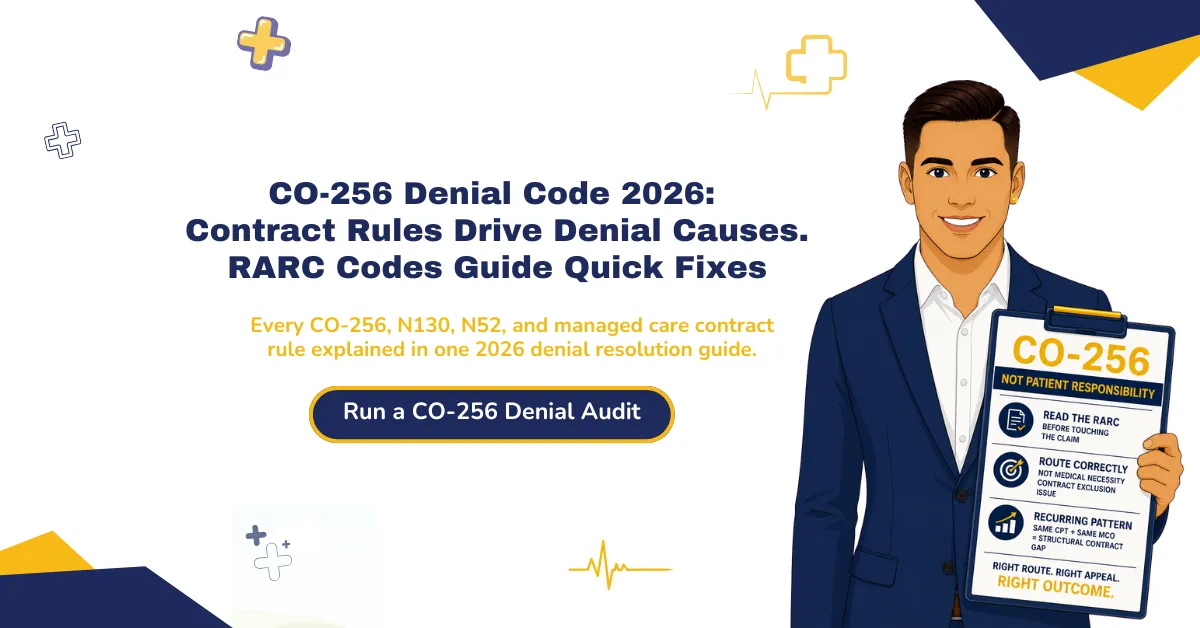
The CO-256 denial code appears on your 835 Electronic Remittance Advice when a managed care payer determines the billed service falls outside the terms of the managed care contract between your practice and the payer. CO is the Claim Adjustment Group Code, which X12 officially defines as Contractual Obligation. The number 256 is the Claim Adjustment Reason Code, officially defined by X12 as “Service not payable per managed care contract.” You can’t bill the patient for a CO group code adjustment. The financial responsibility stays with the provider.
In 2026, with CMS-0057-F effective since January 1, prior authorization failures that trigger co 256 denial code now come with mandatory specific denial reasons you can address directly in the appeal. This guide covers the official description, every root cause, the RARC crosswalk, and the ClaimMax quick-fix checklist.
CO-256 Denial Code: Quick Reference
Code: CO-256 Full X12 Description: Service not payable per managed care contract Group Code: CO (Contractual Obligation) CARC Active Since: June 2, 2013 CARC List Last Modified: November 1, 2025 (confirmed active) Patient Billing Allowed: No. CO group code means provider absorbs the adjustment. Primary RARC Paired: N130 (Consult plan benefit documents for restrictions on this service)
The complete active CARC list including CARC 256 is maintained by X12 at the X12 CARC official list. X12 publishes the CARC list in coordination with the Washington Publishing Company for HIPAA-mandated transaction standards. The co-256 denial code meaning is clear in the official source: this is a contractual denial, not a clinical one. The ANSI X12 835 standard governs this format across all payers.
What Does the CO-256 Denial Code Description Mean? Breaking Down Every Word
Understanding the co 256 denial code descriptions operationally means reading each word as a diagnostic question. No other denial code in the CO group puts the managed care contract itself at the center of every investigation step. When billing managers see CO-256, the description is the instruction set.
The CO-256 Description Word by Word: A Diagnostic Framework
The official X12 language is: “Service not payable per managed care contract.” Here’s what each element tells you about what went wrong.
Service: Which specific CPT or HCPCS code triggered the denial? The word “service” is the procedure. Your investigation starts with the exact code on the denied line.
Not payable: The payer made a payment determination of zero. This isn’t a request for more information. This is a final contractual adjudication. The managed care plan isn’t asking you to resubmit with different documentation. It’s telling you the contract doesn’t allow payment.
Per: The cause is the contract. Not the patient’s benefit coverage. Not a coding error. The preposition “per” points directly to the managed care contract as the governing document.
Managed care contract: The specific signed participation agreement between your practice and the payer governs this denial. Pull that document before taking any other action.
Four words in the official CARC 256 description map to four separate investigation steps. Billing teams that route CO-256 without reading the co-256 denial code description are working the denial without the instructions.
How CO-256 Appears on Your 835 ERA
CO-256 appears in the CAS (Claim Adjustment) segment of the 835 transaction. CAS01 is the group code (CO). CAS02 is the reason code (256). CAS03 is the adjustment dollar amount. Your billing software combines these three fields and displays “CO-256” on your denial report. On a paper EOB, you’ll see “CO 256” or “co256” in the denial code column. The ANSI X12 835 transaction standard governs this format across all payers. ClaimMax RCM’s revenue cycle management process reads the CAS segment before routing any CO-group denial to ensure the investigation goes to the right workflow from day one.
CO-256 vs CO-24 vs CO-50: Three Codes That Look Identical on the Remittance
CO-256, CO-24, and CO-50 all carry the CO group code and all produce zero payment. That’s where the similarity ends. Their causes, resolution paths, and appeal strategies are completely different. Routing any of them through the wrong workflow wastes your team’s time and closes timely filing windows.
The co 256 denial code descriptions make clear this is a contract issue. CO-24 and CO-50 each point somewhere completely different. CAQH CORE operating rules govern 835 ERA standards that produce all three codes in the same CAS segment format, but what each code signals requires a different investigation path.
| Code | Official X12 Description | What It Means | Root Cause | Resolution Path |
|---|---|---|---|---|
| CO-256 | “Service not payable per managed care contract” | The managed care contract between your practice and the payer doesn’t allow payment for this specific service | Contract exclusion, missing PA, out-of-network status, or enrollment gap | Pull the managed care contract, review exclusions, network status, and authorization requirements |
| CO-24 | “Charges are covered under a capitation agreement/managed care plan” | You’ve already been paid for this service through a fixed monthly capitation payment | Billing a capitated service separately on fee-for-service | Verify whether the service is carved out of your capitation agreement, if excluded, appeal with contract language |
| CO-50 | “These are non-covered services because this is not deemed a ‘medical necessity’ by the payer” | The payer’s clinical review determined the service wasn’t necessary | Clinical determination, not a contract limitation | Appeal with clinical documentation proving medical necessity, not a contract issue |
Submitting a medical necessity appeal for a CO-256 denial is the most common routing error in managed care billing. CO-256 is a contract issue, not a clinical one. RARC N130 accompanying CARC 256 confirms this: “Consult plan benefit documents” points to the contract, not the clinical record. The 256 denial code on your remittance is always telling you to go to the contract first.
Is CO-256 the Patient’s Responsibility? No: and Here Is Why
No. CO-256 isn’t the patient’s responsibility. The CO group code (Contractual Obligation) assigns financial liability to the provider, not the patient. Per CMS guidance, beneficiaries may be billed only when Group Code PR (Patient Responsibility) is used with a claim adjustment. CO-256 uses the CO prefix. The provider absorbs this adjustment. The co 256 denial code is a contractual obligation between the practice and the payer.
Three Scenarios Where CO-256 Cannot Be Billed to the Patient
Contract Exclusion: If the managed care contract doesn’t cover the service your practice delivered, the contract governs. The patient had no role in negotiating your network participation agreement. Billing the patient for a contractual exclusion violates your payer agreement.
Missing Prior Authorization: If CO-256 fired because your team didn’t secure prior authorization as required by the managed care contract, that’s a provider-side process failure. The authorization requirement is between you and the payer. The patient isn’t liable for your practice’s authorization workflow.
Out-of-Network Status: Your credentialing status with the MCO is a provider-side condition. If your practice wasn’t enrolled in the patient’s managed care network on the date of service, the patient isn’t responsible for your enrollment status. Understanding the co-256 denial code description confirms this at every level: the liability sits with the provider under any contract exclusion scenario.
Six Reasons Your Claim Got a CO-256: Root Causes and What Each One Means for Your Workflow
Getting the root cause right before you take any action on CO-256 is the difference between working the right problem and wasting your team’s time on the wrong one. Work through all six before routing the denial. Every CO-256 claim denial has a cause that maps to one of these categories.
Cause 1: Out-of-Network Provider Status
The rendering provider isn’t enrolled in the patient’s managed care network on the date of service. When the plan restricts coverage to in-network providers, services from out-of-network providers trigger CO-256 because the managed care contract between your practice and the payer doesn’t cover that service relationship. Verify network status in the payer portal before any other investigation step. CO group code on the remittance confirms the provider, not the patient, absorbs this adjustment. CMS requires this group code assignment for contractual denials across all Medicare Advantage plan structures.
Cause 2: Contract Exclusions for the Billed Service
Some managed care contracts explicitly exclude specific CPT codes, treatment categories, or service lines. These exclusions vary by contract, by MCO, and by individual employer group plan within the same payer. A service covered in last year’s contract may be excluded in the current contract year without advance notice. The resolution requires reviewing the current contract’s exclusion schedule, not the payer’s general benefit summary. The co 256 denial code descriptions for this cause are clear in the official X12 language: “per managed care contract” means the contract exclusion schedule governs every investigation step. HMO contracts tend to have tighter exclusion lists than PPO contracts for the same payer.
Cause 3: Missing or Invalid Prior Authorization
Prior authorization failures trigger CO-256 when the managed care contract requires pre-approval before certain services are rendered. Under CMS-0057-F, effective January 1, 2026, payers must now provide a specific denial reason when an authorization is denied. That specific reason is your appeal foundation. ClaimMax RCM’s prior authorization services team verifies authorization requirements before service delivery, preventing the most common CO-256 trigger in managed care billing. The phrase “service not payable per managed care contract” in this cause context means the contract’s authorization requirement wasn’t satisfied.
Cause 4: Provider Not Enrolled or Credentialed With the MCO
A provider may be licensed and contracted with a commercial payer but not enrolled as a participating provider in the specific managed care organization that payer administers. This enrollment gap is most common with Medicare Advantage plans, Medicaid managed care organizations, and IPA-delegated networks where MCO enrollment is managed separately from general network credentialing. ClaimMax RCM’s credentialing services team confirms MCO-specific enrollment status before the first claim submits. This is the denial code co 256 scenario that most practices discover only after the first claim comes back denied.
Cause 5: Exceeded Benefit Limits or Frequency Restrictions
Most managed care contracts cap the frequency, quantity, or duration of specific services. Physical therapy visit limits, lab test frequency windows, and imaging authorization windows are common examples. When a provider bills beyond the limit specified in the managed care contract, CO-256 fires for the excess claims. The fix isn’t a medical necessity appeal. It’s a contract review to confirm the actual limit and whether a frequency exception applies. HMO and PPO contracts often carry different frequency caps for the same service under the same payer umbrella.
Cause 6: Place of Service Mismatch Under Payer Contract Rules
Some managed care contracts specify that certain CPT codes are reimbursable only in specific clinical settings. When a service is billed with a POS code that doesn’t match the contract’s setting requirement for that procedure, CO-256 fires. This isn’t a general POS coding error. It’s a contract-specific POS restriction. For California practices operating under the Knox-Keene Health Care Service Plan Act, payer POS restrictions must align with the DMHC-approved plan terms, and those terms may differ from your standard commercial payer contract. The co 256 denial code california angle makes this cause specific to Knox-Keene regulated plans in ways that don’t apply in other states.
CO-256 RARC Crosswalk: What the 256 Remark Code on Your Remittance Tells You First
The remark code alongside CO-256 on your remittance is your routing signal. Read it before touching the claim. N130 and N52 each point to a different investigation, and routing the wrong one wastes time on the wrong problem. The co 256 denial code descriptions change depending on which RARC accompanies them. The co-256 denial code without a RARC defaults to contract review. All active RARC descriptions including N130 and N52 are maintained at the X12 RARC official list.
| RARC Code | Official X12 Description | What It Signals | Your Next Action |
|---|---|---|---|
| N130 | Consult plan benefit documents/guidelines for information about restrictions for this service | The denial is based on plan-specific restrictions in the managed care contract or benefit document | Pull the managed care contract’s exclusion schedule and benefit grid for the specific CPT code billed |
| N52 | Patient not enrolled in the billing provider’s managed care plan on the date of service | Enrollment or assignment mismatch, the patient wasn’t assigned to your managed care entity on the date of service | Verify patient’s managed care plan assignment on the service date in the payer portal before appealing anything |
| N627 (Historical) | Service not payable per managed care contract (DEACTIVATED) | This RARC was deactivated with the instruction “Consider Use CARC 256,” CARC 256 was created specifically to absorb this denial scenario | Same resolution as current CO-256, appears on older remittances and legacy payer systems only |
N130 sends your team to the contract. N52 sends your team to the eligibility system. Reading the co 256 denial code descriptions on your ERA before routing every CO-256 is the single fastest investigation step your team controls. No RARC defaults to contract review. Getting this routing right from the ERA posting saves every investigation hour that follows. The RARC N627 historical note confirms why co-256 exists: CARC 256 replaced N627 precisely to create a dedicated X12-standardized code for managed care contract denials.
How to Fix a CO-256 Denial: The ClaimMax Quick-Fix Checklist for Billing Teams
CO-256 doesn’t resolve through generic resubmission. It resolves through contract investigation. Work through this checklist in sequence before routing any co 256 denial code descriptions to a write-off, an appeal queue, or a resubmission workflow. This checklist covers every stage of the CO-256 revenue cycle workflow from ERA posting to final co 256 denial code resolution.
CO-256 Quick-Fix Checklist: ClaimMax RCM
Step 1: Read the RARC first. Pull the 835 ERA and locate the remark code alongside CO-256. N130 sends you to the contract. N52 sends you to the enrollment system. No RARC defaults to contract review.
Step 2: Pull the managed care contract. Locate the signed participation agreement between your practice and the specific payer that issued the denial. Verify whether the billed CPT code is covered, whether it requires prior authorization, and whether any place of service restrictions apply.
Step 3: Verify network status and MCO enrollment. Confirm the rendering provider’s network status on the date of service in the payer portal. Confirm two separate records: commercial network status AND MCO product enrollment. These are different enrollment files in most payer systems.
Step 4: Check prior authorization records. Confirm whether PA was required and obtained. Under CMS-0057-F, denied authorization requests now include a specific denial reason. That reason is your appeal foundation if you need it.
Step 5: Determine your path. Valid write-off (contract confirms the service isn’t payable and no retroactive fix applies). Corrected resubmission (provider ID, POS code, or enrollment gap identified and corrected). Formal appeal (service should be covered under the contract and you have documentation to prove it).
Step 6: For out-of-network scenarios, pursue a Single Case Agreement. A single case agreement (SCA) is a one-time negotiated authorization from the MCO allowing an out-of-network provider to be reimbursed at an agreed rate for a specific patient’s specific service episode. The SCA is the most underused CO-256 recovery strategy in managed care billing. Initiate SCA requests within 15 business days of the first CO-256 denial for high-value patients. SCA windows close when treatment ends.
Step 7: Escalate recurring CO-256 patterns to contract amendment. When CO-256 fires repeatedly for the same CPT code and the same managed care plan, the root cause is structural. Contact the payer’s provider contracting department and request a contract amendment. Individual claim resolution won’t fix a structural contract gap. The co-256 denial code action at the pattern level is always a contracting conversation, not a claims one.
California Practices: Additional CO-256 Consideration
For practices operating under California’s Knox-Keene Health Care Service Plan Act, the California Department of Managed Health Care (DMHC) oversees managed care plan contracts and has jurisdiction over certain CO-256 dispute situations. When a CO-256 denial from a Knox-Keene regulated plan can’t be resolved through the payer’s standard appeals process, California providers may file an Independent Medical Review (IMR) or Independent Dispute Resolution (IDR) request with the DMHC. California practices managing repeated CO-256 denials from specific Knox-Keene plans have regulatory remedies that providers in other states don’t. The SCA process in California also follows DMHC-specific timelines that differ from standard commercial payer SCA timelines. The complete California IMR and IDR filing process for managed care denials is available at the California Department of Managed Health Care.
When CO-256 denials are already aging in your remittances and the contract investigation is behind, every day without action is a day closer to a closed timely filing window. ClaimMax RCM’s denial management services team identifies CO-256 patterns by payer and CPT code and works every resolvable denial before the appeal deadline. When CO-256 claims are already past the primary appeal window, ClaimMax RCM’s AR follow-up team traces every aging denial and pursues every remaining recovery path.
How to Prevent CO-256 Denials Before They Hit Your Remittance
Most CO-256 denials are preventable. These controls catch managed care contract gaps, authorization failures, and network status errors before they become remittance adjustments. Front-end prevention confirms CO group code doesn’t apply before the claim submits, so patient billing compliance is never at risk. Provider enrollment verification is the first and most critical step. Tracking co 256 denial code descriptions by payer and CPT code monthly lets your team spot contract gaps before they become denial patterns.
Front-End Controls (Before Service Delivery)
Verify the patient’s specific managed care plan and confirm whether the rendering provider is enrolled in that MCO product before scheduling, not just the commercial network. Being in-network with the payer doesn’t guarantee participation in every managed care product the payer administers.
Confirm prior authorization requirements for the specific CPT code under the patient’s managed care contract before the appointment. Authorization requirements vary by CPT code, by MCO, and sometimes by individual employer group plan within the same payer.
Check benefit limits and frequency restrictions in the managed care contract before scheduling repeat visits. Billing beyond the contract’s allowed frequency generates a CO-256 denial that can’t be appealed without a contract amendment.
ClaimMax RCM’s eligibility verification and prior authorization process confirms MCO product enrollment, authorization requirements, and benefit limits at the scheduling stage, before the first claim is created. CARC 256 shouldn’t appear on your remittance if your front-end verification process is built to catch these gaps. This is where credentialing accuracy connects directly to claim outcomes: a Medicare Advantage enrollment gap that your credentialing records missed at enrollment becomes a CO-256 denial pattern across every affected patient’s claims.
Mid-Cycle and Back-End Controls
Confirm the Place of Service code matches the managed care contract’s POS requirements for each CPT code before the claim transmits. Some contracts restrict reimbursement to specific clinical settings regardless of where the service was performed.
Route CO-256 denials by RARC on the same day the ERA posts. N130 goes to contract review. N52 goes to enrollment verification. Mixing CO-256 with coding denials in a generic denial queue delays the correct investigation. Patient Responsibility codes are a separate workflow entirely and should never be routed through the same queue as CARC 256.
Build a CO-256 tracking report by payer and CPT code and review it monthly. Recurring CO-256 on the same payer and CPT combination signals a structural contract gap that needs amendment, not ongoing individual claim resolution. The co-256 denial code description (“service not payable per managed care contract”) is the same for every occurrence, but the cause behind each occurrence is what your tracking report reveals. For practices building broader denial prevention workflows across ICD-10 and CPT coding, ClaimMax RCM’s ICD-11 denial prevention playbook covers the documentation and coding controls that prevent the most common claim-level denial patterns alongside contract-level denials like CO-256.
2026 Regulatory Updates That Change How CO-256 Denials Are Issued and Appealed
Three regulatory changes in 2025 and 2026 directly affect how CO-256 denials are issued, investigated, and appealed. Practices still using pre-2026 workflows are missing appeal rights these rules created. The co 256 denial code in 2026 operates inside a regulatory environment that didn’t exist 18 months ago.
CMS-0057-F: What Changed for CO-256 Appeals on January 1, 2026
CMS-0057-F, the CMS Interoperability and Prior Authorization Final Rule, went into operational effect January 1, 2026. It applies to Medicare Advantage organizations, Medicaid managed care plans, CHIP managed care entities, and QHP issuers on the Federally-Facilitated Exchanges. Two specific changes affect CO-256 appeals directly. First, standard prior authorization decisions must now be made within 7 calendar days, and urgent decisions within 72 hours. Second, payers can no longer issue generic authorization denials. They must provide a specific denial reason.
When a CO-256 denial is rooted in a prior authorization failure, that specific reason is your targeted appeal foundation rather than a generic resubmission. The CMS-0057-F specific denial reason requirement is the regulatory mechanism that prevents payers from issuing the generic “service not payable” language as a complete denial without justification. CMS-0057-F changed what X12 835 ERA denial data has to contain for regulated plans. The full CMS-0057-F Interoperability and Prior Authorization Final Rule regulatory text and compliance requirements are at the CMS-0057-F page. This is also the regulatory anchor that makes the RARC N627 historical note relevant: CMS-0057-F’s specific denial reason requirement is the modern upgrade of what RARC N627 was trying to capture before it was deactivated. The 256 denial code in 2026 now comes with a reason you can target.
CMS-0062-P and the 2026 Appeal Thresholds: What’s Next and What You Can Escalate Now
CMS-0062-P, released April 10, 2026, with a public comment deadline of June 15, 2026, proposes extending prior authorization reform to drugs covered under both medical and pharmacy benefits. The proposed compliance date for the included NCPDP standards is October 1, 2027. For CO-256 workflows, this signals that specialty pharmacy authorizations managed through managed care contracts will face the same reform requirements as medical service authorizations. Practices managing drug-related managed care denials should monitor CMS-0062-P’s final form.
The Federal Register CY 2026 AIC Adjustment sets the ALJ hearing threshold at $200 (up from $190 in 2025) and the Federal District Court threshold at $1,960 (up from $1,900). For Medicare claims denied with CO-256, these thresholds determine your formal escalation options, and claims may be aggregated to meet them. X12 standards underpin both the 835 ERA format CMS-0057-F builds on and the HL7 FHIR API requirements coming in 2027. The full threshold adjustments are documented at Federal Register CY 2026 ALJ Appeal Threshold Adjustments.
CO-256 Denial Code Example: What It Looks Like in Practice
Here is what co256 looks like on a real remittance and what the correct resolution sequence is. This co256 scenario is the one most billing managers encounter first.
Named Scenario: Pulmonology Group, Sleep Study, Expired Authorization
A pulmonology group submits a claim for a sleep study. The patient’s managed care plan requires prior authorization for the specific CPT code billed. The authorization was obtained but had expired by two days before the service date. CO-256 fires on the 835 ERA with RARC N130.
The ClaimMax resolution sequence for this scenario: Pull the managed care contract and confirm the authorization requirement for this CPT code. Pull the expired authorization and the dates. Under CMS-0057-F effective January 1, 2026, the prior authorization denial must include a specific denial reason. Pull that reason. Build the appeal directly addressing that specific reason, not a generic medical necessity letter. File a retroactive authorization request alongside the formal appeal with the clinical justification the payer identified as missing. This is the co 256 denial code descriptions investigation that confirms Path 3 in the checklist: formal appeal with contract language showing the service should be payable with a corrected authorization date.
Frequently Asked Questions About the CO-256 Denial Code
What Does Denial Code 256 Mean?
CO-256 means the billed service is not payable under the managed care contract between the provider and the payer. X12 officially defines CARC 256 as “Service not payable per managed care contract.” The CO group code means the provider absorbs the adjustment. The patient cannot be billed for a CO group code denial. The co 256 denial code descriptions are unambiguous on this: contractual obligation, not patient responsibility.
Schema Answer: “CO-256 means the billed service is not payable under the managed care contract. X12 defines CARC 256 as ‘Service not payable per managed care contract.’ The provider absorbs the adjustment. The patient cannot be billed.”
Is CO-256 a Condition Code or a Claim Adjustment Reason Code?
CO-256 is a Claim Adjustment Reason Code, not a condition code. The official X12 description is “Service not payable per managed care contract.” trytwofold.com incorrectly describes CO-256 as “service not covered by the patient’s insurance,” which is wrong. CO-256 is a contractual denial based on the provider-payer agreement, not the patient’s benefit coverage.
Schema Answer: “CO-256 is a Claim Adjustment Reason Code, not a condition code. X12 officially defines it as ‘Service not payable per managed care contract,’ a contractual denial between the provider and payer, not a patient coverage issue.”
What Is the Code CO-256 in Medical Billing?
CO-256 is the pairing of the CO Claim Adjustment Group Code (Contractual Obligation) and CARC 256 (Service not payable per managed care contract). puredi.com defines CO-256 as a procedure-place of service mismatch, which is factually incorrect. CO-256 is a managed care contract denial, not a POS mismatch code. The 256 remark code that accompanies it (typically N130 or N52) points to the correct investigation path.
Schema Answer: “CO-256 pairs the CO group code (Contractual Obligation) with CARC 256 (Service not payable per managed care contract). It’s a managed care contract denial, not a POS mismatch as some sources incorrectly state.”
Is the CO-256 Denial the Patient’s Responsibility?
No. CO-256 isn’t the patient’s responsibility. The CO group code (Contractual Obligation) assigns financial liability to the provider. GoHealthcare Practice Solutions incorrectly states “the patient is responsible” for CO-256, which is wrong. Per CMS guidance, only PR group code adjustments create patient billing obligations.
Schema Answer: “No. CO-256 is not the patient’s responsibility. The CO group code assigns liability to the provider, not the patient. Only PR group code adjustments create patient billing obligations.”
Can You Appeal a CO-256 Denial Code?
Yes, CO-256 can be appealed when the service is actually covered under the managed care contract and the payer applied the wrong exclusion, or when prior authorization was obtained but wasn’t reflected in the payer’s system. Under CMS-0057-F effective January 1, 2026, authorization-related CO-256 denials must include a specific denial reason you can address directly in the appeal.
Schema Answer: “Yes, CO-256 can be appealed when the service is covered under contract and the payer applied the wrong exclusion, or when PA was obtained but not reflected. CMS-0057-F now requires payers to provide a specific denial reason for authorization-related denials.”
What Is the Official CO-256 Denial Code Description?
The official CO-256 denial code description from X12 is: “Service not payable per managed care contract.” CARC 256 has been active since June 2, 2013. The CARC list was last modified November 1, 2025, confirming CO-256 remains active and unchanged in the current official X12 code library.
Schema Answer: “The official CO-256 description from X12 is: ‘Service not payable per managed care contract.’ CARC 256 has been active since June 2, 2013 and was confirmed active on the November 1, 2025 CARC list.”
What Is the Difference Between CO-256 and CO-24?
CO-24 means the service was already paid through a capitation agreement. You can’t bill separately for a capitated service. CO-256 means the managed care contract doesn’t allow payment at all for the specific service or service scenario. The resolution paths are completely different. CO-24 requires a capitation carve-out review. CO-256 requires a contract exclusion review.
Schema Answer: “CO-24 means the service was already paid through capitation. CO-256 means the managed care contract doesn’t allow payment for the specific service. CO-24 requires capitation review. CO-256 requires contract exclusion review.”
What Is the 256 Remark Code on a CO-256 Denial?
The remark code most often paired with CO-256 is RARC N130: “Consult plan benefit documents/guidelines for information about restrictions for this service.” RARC N52 (“Patient not enrolled in the billing provider’s managed care plan on the date of service”) also pairs with CO-256 for enrollment-related denials. RARC N627 was the historical predecessor to CARC 256, deactivated with the instruction “Consider Use CARC 256.”
Schema Answer: “RARC N130 (‘Consult plan benefit documents for restrictions’) and RARC N52 (‘Patient not enrolled in the MCO on date of service’) are the primary remark codes paired with CO-256. RARC N627 was deactivated with the note ‘Consider Use CARC 256.'”
Stop Working CO-256 Denials One Claim at a Time: How ClaimMax RCM Fixes the Pattern
You’ve got the official X12 description, the RARC routing rules, the six root causes, the seven-step checklist, and the 2026 regulatory changes that created new appeal rights. The gap between knowing this and having it built into your billing workflow is where CO-256 denials stop being isolated claim problems and start being systemic managed care contract problems that cost your practice real money every billing cycle.
ClaimMax RCM builds the CO-256 investigation and resolution workflow your billing team needs: RARC-based routing from the day the ERA posts, contract review triggers for N130 denials, enrollment verification workflows for N52 denials, SCA negotiation for out-of-network scenarios, and contract amendment escalation for recurring CO-256 patterns. We don’t work denials one at a time. We fix the pattern.
ClaimMax RCM’s medical billing service is built for practices that are done treating CO-256 as a one-claim problem. Get your free managed care denial audit. We’ll identify your top CO-256 payer patterns, review your current contract exclusion triggers, and show you exactly where your CO-256 volume is coming from and how to stop it.
All CARC and RARC definitions in this article are sourced from the X12 Claim Adjustment Reason Code list and X12 Remittance Advice Remark Code list, maintained by X12 in coordination with the Washington Publishing Company under HIPAA electronic transaction standards. CARC 256 has been active since June 2, 2013. The CARC list was last modified November 1, 2025. RARC N130 and N52 descriptions are from the current active X12 RARC list. RARC N627 was deactivated effective July 1, 2014 with the notation “Consider Use CARC 256.” CMS-0057-F operational requirements are effective January 1, 2026, and apply to Medicare Advantage, Medicaid managed care plans, CHIP managed care entities, and QHP issuers on the Federally-Facilitated Exchanges. CMS-0062-P was released April 10, 2026, with a public comment deadline of June 15, 2026, and has not been finalized. California Knox-Keene information reflects the California DMHC regulatory framework as of May 2026. Federal Register CY 2026 ALJ hearing threshold: $200. Federal District Court threshold: $1,960. CARC and RARC codes, regulatory requirements, and appeal thresholds are subject to change. Verify current codes and requirements with the X12 official lists, your Medicare Administrative Contractor, and your managed care contracts before taking any action. This article does not constitute legal, compliance, or contract advice.


