| The short answerWhat it is: Prior authorization outsourcing hands requirement checks, document gathering, submission, follow-up, and appeal prep to an outside team. Your physicians keep clinical decisions and peer-to-peer calls.Cost: CMS estimates prior authorization (PA) costs providers $20 to $50 an hour for about 13 hours a week, roughly $34,000 and 700 hours per provider each year. Outsourcing pays off only when the vendor fee plus your retained work costs less per request.Turnaround: Since January 1, 2026, covered Medicare Advantage, Medicaid, and CHIP plans must decide non-drug requests within 72 hours (expedited) or seven calendar days (standard). An outside team can shorten only the days before submission.Denials: A missing authorization comes back as CARC 197, and an exceeded one as CARC 198. Outsourcing helps most when those codes rank high on your remits. No vendor can promise an approval.2027: Covered payers must run Prior Authorization APIs starting January 1, 2027. MIPS treats electronic prior authorization as an optional bonus measure for 2027, and a new drug measure becomes required in 2028. |
It’s Tuesday afternoon. A lumbar MRI sits on Thursday’s schedule, the authorization still shows pending in the payer portal, and the patient has called twice. Your coordinator is toggling between three portals and a fax queue while the front desk asks whether to hold the slot.
Once that scramble repeats every week, practices start pricing out prior authorization outsourcing. You need answers to three narrow questions: what each request costs you today, whether an outside team shortens the wait patients feel, and whether it cuts authorization denials or moves the same work to a new desk.
Most authorization delays start inside the practice, days before the payer’s clock begins. A missing imaging report or an unsigned order can hold a request for half a week, and no federal deadline covers that stretch of time.
What Prior Authorization Outsourcing Covers and What Stays With Your Practice
Prior authorization outsourcing means an outside team handles the administrative side of payer approvals: confirming whether a service needs authorization, gathering chart documents, submitting the request, following up, and preparing appeals. Your physicians keep the clinical decisions, the signed orders, and the peer-to-peer conversations with payer reviewers.
Most outsourcing agreements split prior authorization tasks along these lines:
| Task | Outsourced team | Your practice |
|---|---|---|
| Check whether the CPT or HCPCS code needs PA for this payer and plan | Runs the requirement check | Confirms the order details |
| Pull notes, imaging, and lab results | Gathers records and flags medical necessity gaps | Documents the clinical details |
| Submit by portal, X12 278, fax, or phone | Submits and logs the reference number | No action needed |
| Track status and answer requests for more information | Follows up on a set schedule | Answers clinical questions |
| Peer-to-peer review | Schedules the call and preps a summary | Physician joins the call |
| Appeal a denial | Drafts the appeal | Physician reviews and signs |
| Match the approval to the scheduled service and the claim | Checks codes, units, and dates | Billing confirms before filing |
Your payer contract answers who is responsible for obtaining prior authorization. For in-network care, it usually names the ordering or rendering provider’s office. Hiring a vendor moves the work to another desk, and your practice still owns the outcome when a request gets missed.
Some practices buy prior authorization services as a stand-alone contract. Others get them inside end-to-end revenue cycle management, where the team that wins the approval also files the claim it protects. That setup closes the gap between an approved request and a paid claim, which is where CARC 197 denials often start.
Eligibility verification and prior authorization answer different questions. A coverage check confirms the patient’s plan is active on the date of service, while authorization confirms the payer approved a specific service. Patients can pass one check and fail the other, a split our guide to eligibility verification vs prior authorization covers in detail.
How Much Prior Authorization Work Physician Practices Carry in 2026
In the 2025 AMA prior authorization survey, fielded in December 2025, the American Medical Association (AMA) found each physician completes about 40 prior authorization requests a week. Physicians and staff spend about 13 hours a week on them, and 40% of practices have staff who work only on prior authorization.
The AMA drew 1,000 respondents from the Medscape panel: 400 primary care physicians and 600 specialists, all practicing in the U.S. and handling PAs in a typical week. Nearly one-third said their requests are often or always denied. That figure reflects physician perception, not a measured transaction rate.
Scale those averages to a five-physician group and the queue gets heavy. You’re looking at roughly 200 requests and 65 staff hours a week, about 1.6 full-time employees at 40 hours each. That’s our arithmetic from the survey averages, so your own count will differ.
Forty requests a week per physician adds up to a part-time job, and most practices never posted that job or hired anyone to do it.
The Medical Group Management Association surveyed more than 230 practice leaders for its MGMA 2026 Regulatory Burden Report. Of those leaders, 90% said their prior authorization burden grew over the previous 12 months, and members ranked Medicare Advantage as the most burdensome payer type, followed by commercial plans, Medicaid, and traditional Medicare.
Your specialty mix shapes these numbers. An orthopedic group ordering MRIs and injections carries a heavier queue than a primary care office billing mostly E/M visits, as our breakdown of orthopedic prior authorization challenges shows. In the AMA survey, 74% of physicians said denials have increased over the past five years.
Cost Impact: What Prior Authorization Costs In-House vs Outsourced
The Centers for Medicare & Medicaid Services (CMS) estimates prior authorization costs providers $20 to $50 an hour for about 13 hours a week, roughly $34,000 and 700 hours per provider each year, according to its electronic prior authorization page. Outsourcing saves money only when the vendor’s fee plus the work your staff still do costs less per request.
The Full Cost of In-House Prior Authorization
Treat the CMS figure as an estimate. CMS multiplied an hourly range by survey hours; it didn’t audit what practices spend. You still get the best federal starting point from it, and you can swap each input for your own payroll and time data.
Per-request research lands in a similar range. A peer-reviewed prior authorization cost study indexed on PubMed Central reports an average cost of $20 to $30 per request for providers and $40 to $50 for private payers. Keep that range in mind when a vendor quotes a single-digit price.
Some online figures look far lower because they measure a narrower slice of work. The Council for Affordable Quality Healthcare (CAQH) counts the labor needed to conduct a transaction and leaves out the time spent gathering documentation. A single-digit cost per transaction usually reflects that narrow touch time.
Electronic submission does shrink that slice. In the 2025 CAQH Index, electronic adoption for medical PA reached 40%, up from 31% in the 2023 Index. CAQH estimates providers save about 15 minutes per authorization when they send it through the X12 278 standard instead of fax, email, or mail.
Before you compare any quote, add up the costs that never show up in one salary line:
- Loaded wages, benefits, and overtime
- Physician time spent on peer-to-peer calls
- Payer portal and software access
- Retraining each time payer rules change
- Coverage when your coordinator is out
- Rework on prior authorization denials
A prior authorization specialist salary is only the opening number in that math. Add benefits, payroll taxes, overhead, and the cost of rehiring after turnover before you hold it up against a vendor’s per-request price.
How Outsourced Prior Authorization Services Are Priced
Vendors price outsourced prior authorization services in four common ways, and each model shifts risk differently:
| Model | How you pay | Usually fits | Watch for |
|---|---|---|---|
| Per request | A flat fee for each authorization | Uneven or seasonal volume | Separate charges for status checks and appeals |
| Dedicated remote specialist | A monthly or hourly rate | Steady volume in one specialty | Gaps when that person is out |
| Percentage of collections inside full RCM | A share of collected revenue | Practices outsourcing billing too | Whether PA sits inside the scope |
| Hybrid of software and staff | A platform fee plus exception handling | High volume and a strong EHR | Who owns denied cases |
The dedicated specialist model works like adding a prior authorization virtual assistant to your team. Practices that want that setup often pair it with a HIPAA-compliant billing virtual assistant who logs into their EHR and payer portals on a set schedule.
Before you outsource prior authorization, ask for a price on each line: new submissions, status checks, requests for more information, appeals, peer-to-peer scheduling, urgent or after-hours work, and drug PAs. A low headline price can leave out the hardest work, and those exclusions surface later as change orders.
A Cost Model You Can Run on Your Own Numbers
Before you sign a prior authorization outsourcing contract, compare marginal cost per request instead of comparing salaries. Run your numbers through this formula:
Annual net benefit = yearly PA volume × (your internal cost per request minus the vendor fee minus your retained cost per request minus any added rework per request) minus yearly setup and oversight cost
The example below is illustrative, not a benchmark:
- Volume: 12,000 requests a year at 25 minutes of staff touch time each
- Loaded labor: $32 an hour, or $13.33 per request ($160,000 a year)
- Vendor fee: $9 per request
- Retained staff time: five minutes per request for clinical questions and QA, or $2.67
- Outsourced cost per request: $11.67
- Annual difference: about $20,000
- Year-one setup and oversight: $15,000, leaving about $5,000 net in this illustration
In that illustration, a $1 change in the vendor fee moves the annual result by $12,000. A low per-request price loses its value the first time an incomplete submission turns into an appeal your staff has to write.
The larger return often shows up as fewer rescheduled procedures and fewer physician interruptions. Count that value only if you put the freed hours to work, such as moving a coordinator to AR follow-up or cutting overtime.
Build your baseline before you talk to vendors:
- Time-study two weeks of PA work, sorted by payer.
- Count requests per physician per week.
- Pull 90 days of CARC 197 and 198 denials from your 835 remittances.
- Log every procedure you rescheduled because an authorization was still pending.
Most billing contracts leave prior authorization with the practice, so it deserves its own line when you compare in-house vs outsourced billing costs. Leave it out, and the comparison will look cleaner than your real workload.
Want a second set of eyes on the math? We can run this model with your request volume and 90 days of remits as part of a revenue cycle management review.
Turnaround Time: How Long Does Prior Authorization Take Under the 2026 Rules?
Under CMS-0057-F, Medicare Advantage, Medicaid, and CHIP plans must decide non-drug prior authorization requests within 72 hours for expedited requests and seven calendar days for standard requests, starting January 1, 2026. Those limits apply to the payer’s clock. For your patient, how long prior authorization takes also depends on every day before the request reaches the payer.
CMS-0057-F Decision Clocks by Payer Type
CMS-0057-F decision deadlines for non-drug items and services, effective January 1, 2026, by coverage type:
| Coverage | Standard request | Expedited request | What to know |
|---|---|---|---|
| Medicare Advantage | 7 calendar days | 72 hours | Program rules allow an extension of up to 14 days for some requests |
| State Medicaid fee-for-service | 7 calendar days | 72 hours | Calendar time, including weekends |
| Medicaid managed care | No more than 7 calendar days | No more than 72 hours | State contracts can set shorter limits |
| CHIP fee-for-service and managed care | 7 calendar days | 72 hours | Same clocks as Medicaid |
| Marketplace (QHP) plans on HealthCare.gov | Not changed by CMS-0057-F | Not changed | Earlier QHP timelines still apply |
| Employer and other commercial plans | Not covered by this rule | Not covered | State law or plan terms set deadlines |
| Prescription drugs | Excluded | Excluded | Separate rules apply; CMS-0062-P remains a proposal |
Your team should know three details from the CMS timeframes FAQ. The clocks apply whether a request arrives by API, portal, fax, or phone. A payer that asks for documents it never listed in its requirements can’t pause or restart the clock, and program rules allow some requests up to 14 more calendar days.
Since the CMS prior authorization rule took effect in 2026, covered payers must also give a specific reason with each denial, which tells your team what to fix before resubmitting. Save the expedited prior authorization route for cases where waiting could seriously jeopardize the patient’s life, health, or ability to regain function, and document that urgency in the request.
The Four Clocks Your Patients Feel
Your patients don’t feel the payer’s clock alone. They feel the full wait, from the day the physician signs the order to the day someone calls with an answer. Splitting that wait into four timestamps shows you where the days go:
- Order to complete request: requirement check, records, and physician input on your side
- Submission to payer decision: the CMS clock on the payer’s side
- Denial to appeal decision: shared between your team and the payer
- Order to final answer: the full wait your patient experiences
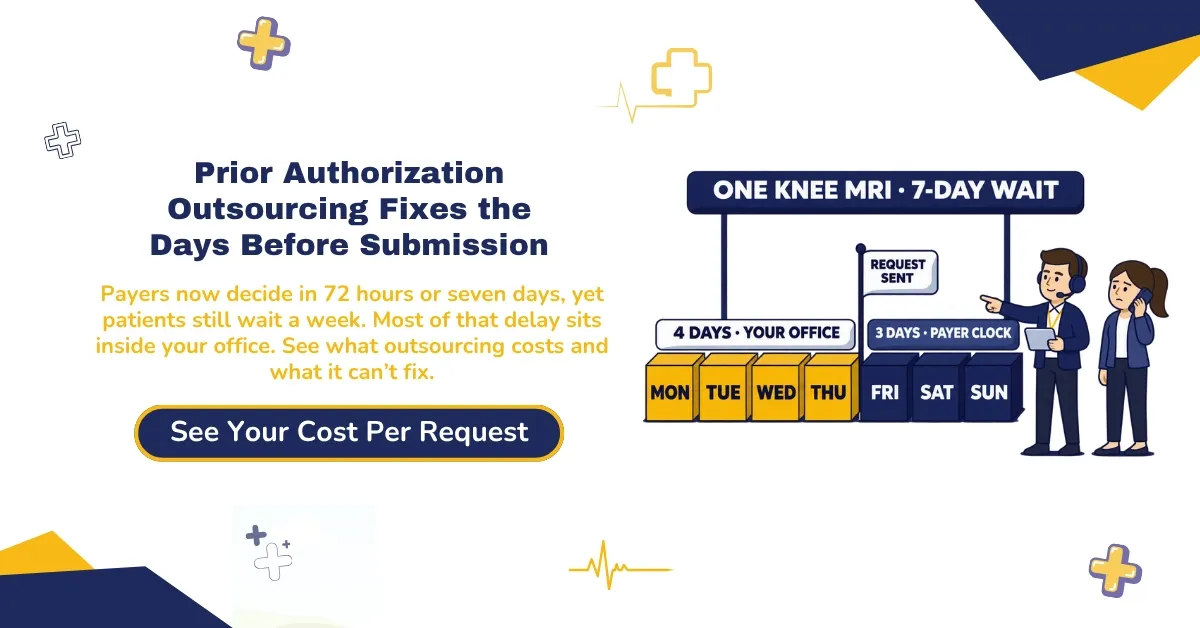
Picture a knee MRI ordered on Monday. The outside imaging report arrives Thursday, so the request goes out Friday, and the payer decides three days later. Your payer met its deadline, yet the patient waited a full week, and prior authorization processing time inside the office caused four of those seven days.
A payer can meet every federal deadline while your patient still waits a week, because the payer clock starts only when your request goes out.
What Payers Reported for 2025 and Why Practices Still Feel Slower
KFF reviewed the first public metrics insurers posted under CMS-0057-F. In its KFF analysis of 2025 payer metrics, median response times for standard requests came in around one day in Medicare Advantage and Medicaid managed care and about 0.9 days in the ACA Marketplace. Expedited requests in Medicare Advantage had a median of about 0.4 days.
Practice leaders describe a different year. In a September 1, 2026 MGMA Stat turnaround poll, 44% of medical group leaders said payer turnaround got slower in 2026 than in 2025, 40% said it stayed about the same, and 7% said it got faster. With 178 responses, the poll works as a signal, not a national estimate.
Both data sets can be true at once. Medians hide the slow cases at the tail, and insurers don’t report results by service type. Your pre-submission days, requests pended for missing records, and peer-to-peer scheduling never show up in a payer’s median. The 2025 numbers also come from the older 14-day standard.
Where an Outsourced Team Can Shorten Turnaround and Where It Can’t
Prior authorization outsourcing can shorten the first clock and tighten follow-up and appeal start times. An outside team has no control over how fast a payer’s medical reviewer works. Ask every vendor to report prior authorization turnaround time in two parts: the days it controls and the days the payer controls.
Request timestamps for all four clocks in each monthly report. A vendor that reports only total turnaround can look better on paper because payers sped up in 2026, even if its own work slowed down.
If pending authorizations keep stalling your schedule, we can map where the days go before a request ever reaches the payer, starting with your eligibility and authorization verification workflow.
Denial Impact: How Authorization Gaps Turn Into Claim Denials
A missing authorization usually comes back on the remit as claim adjustment reason code (CARC) 197, and a service billed past the approved units or dates comes back as CARC 198. Prior authorization outsourcing reduces these denials by catching gaps before submission and matching each approval to its claim. No vendor can make a payer approve care outside its criteria.
What the CO 197 Denial Code and Related Authorization Codes Mean
X12 claim adjustment reason codes for authorization problems, as listed in November 2026:
| Code | X12 description | Status | Usual cause | First fix |
|---|---|---|---|---|
| CO-197 | Precertification/authorization/notification/pre-treatment absent | Active | No approval on file, or the approval doesn’t match the billed service | Confirm whether an approval exists, then check payer retro rules |
| CO-198 | Precertification/notification/authorization/pre-treatment exceeded | Active | Units, visits, or dates went past the approval | Request an extension or added units before the next visit |
| CO-15 | The authorization number is missing, invalid, or does not apply to the billed services or provider | Deactivated May 1, 2018 | Legacy code | Current remits use 197 or 198 |
The CO 197 denial code pairs reason 197 with the CO group code, which stands for contractual obligation. Under a CO adjustment, the practice typically can’t bill the patient for the denied amount, so an authorization gap lands on your revenue line instead of the patient’s statement. See the X12 claim adjustment reason codes for the full list.
The CO 198 denial code points to an approval that existed but ran out: too many units, too many visits, or a date outside the approved window. If your software still labels a denial with the CO 15 denial code, check the payer’s crosswalk, because X12 deactivated CARC 15 on May 1, 2018.
The Authorization-to-Claim Match Check
An approval protects a claim only when the claim describes the same service. Picture a shoulder MRI approved under a general shoulder pain diagnosis. The results show a rotator cuff tear, and the claim goes out with the more specific code. Some payers deny that claim because the diagnosis no longer matches the approval.
Run these seven checks before any authorized service goes out on a claim:
- Match the CPT or HCPCS code to the approved code.
- Keep billed units or visits within the approved count.
- Confirm the date of service falls inside the approval window.
- Confirm the rendering provider and NPI match the approval.
- Confirm the facility or place of service matches.
- Recheck the diagnosis if testing changed it.
- Enter the authorization number in CMS-1500 box 23 or loop 2300 REF G1 on the 837P.
Our breakdown of front-end denial failures covers the same mismatches from the front desk’s side, including expired approvals and approvals issued to a different provider or location.
How to Read Prior Authorization Denial Rates Without Getting Misled
A prior authorization denial rate can describe five different groups of requests. Mixing them up produces alarming numbers that fall apart under review. Read every statistic against this ladder:
- All requests submitted
- Initial denials
- Denials that someone appealed
- Appeals the payer overturned
- Final adverse decisions after appeal
The first public metrics give a clean baseline. KFF found insurers denied 12% of standard requests in Medicare Advantage, 14% in Medicaid managed care, and 18% in the ACA Marketplace during 2025. Appeals overturned 67% of appealed standard denials in Medicare Advantage, 47% in Medicaid managed care, and 43% in the Marketplace.
Few denials ever reach appeal. In KFF’s review of Medicare Advantage data for 2024, only 11.5% of denied requests went to appeal, and plans overturned 80.7% of those appeals in part or in full. Most denials went unappealed, which is different from saying 80% of all denials were wrong.
The HHS Office of Inspector General (OIG) found a sharper pattern for skilled nursing facility (SNF) admissions. In its OIG June 2026 SNF report, plans denied 12% of SNF admission requests, enrollees and providers appealed 18% of those denials, and plans overturned 95% of the appeals. That study covers payer-side review only.
A single-practice view adds perspective. An orthopedic prior authorization study of 30,003 requests at a group of more than 40 physicians found payers approved 97% on the first try in 2020, 2% on appeal, and 1% stayed denied. A low final denial rate can still hide hours of rework.
Retro Authorization: When You Can Fix It After the Service
Each payer sets its own retro authorization rules. Some accept a retroactive prior authorization request after an emergency, same-day urgent care, or coverage the plan granted retroactively. Others refuse retro requests outright, and the windows that do exist tend to run short. Check the payer’s provider manual before you count on any window.
If a payer turns down a retro authorization, your remaining path is a prior authorization denial appeal backed by the clinical record and an explanation of why the request couldn’t go in first. Weigh that cost, since Premier estimated appealing a denied claim cost providers $57.23 per claim in 2023.
The trend points the wrong way for practices. Kodiak Solutions data cited in an HFMA denial trends report shows initial denial rates tied to prior authorization and precertification rose to 1.56% in 2025 through November, up from 1.46% in 2024. Learning how to reduce prior authorization denials starts with tracking your monthly CARC 197 and 198 share.
If CARC 197 keeps showing up on your remits, our authorization denial recovery team can trace each one back to the point where the approval and the claim split apart.
When to Outsource Prior Authorization and When to Keep It In-House
Outsource prior authorization when your measured cost per request runs higher than a vendor’s all-in cost, when CARC 197 and 198 rank among your top denials, or when one coordinator’s absence stalls the schedule. Keep the work in-house when volume is low, your payers are simple, or your physicians write most of the clinical content anyway.
Use these six signals to see whether prior authorization outsourcing fits your practice:
| Signal | Leans toward outsourcing | Leans toward in-house |
|---|---|---|
| Weekly requests per physician | Near or above the AMA average of about 40 | Well below that average |
| Staff hours on PA | A full-time role or more | A few hours a week |
| Authorization denials | CARC 197 or 198 in your top five denial reasons | Rare on your remits |
| Payer mix | Heavy Medicare Advantage and commercial volume | Mostly traditional Medicare, which requires PA for a limited set of services |
| Specialty | Imaging, injectables, surgery, or therapy | Mostly E/M visits |
| Coverage | One coordinator with no backup | A trained team with cross-coverage |
You can also split the work. Keep simple, high-approval requests in-house and send complex payers, overflow, and appeals to a prior authorization company. The benefits of outsourcing prior authorization show up where your own team runs thinnest, so start the handoff there.
Test before you commit. Run a 60 to 90 day pilot on one payer or one location and compare it with the baseline you built earlier. Judge the prior authorization outsourcing pilot on all four clocks and your CARC 197 and 198 share instead of how smooth it felt.
Smaller offices feel the coverage risk first. If one person runs every authorization, a single sick week can freeze the surgical schedule, which is why billing support for small practices often bundles authorization work with eligibility checks.
How to Compare Prior Authorization Companies Before You Sign
Compare prior authorization companies on scope, definitions, and accountability before price. Ask what each fee covers, how the vendor reports the time it controls versus the payer’s time, who owns denials and appeals, how it protects patient data under a business associate agreement, and whether its staff can work inside your EHR.
Questions to Ask Every Prior Authorization Company
- Which tasks does your fee include, and what’s billed separately?
- How do you define “approval rate” and “turnaround”?
- Do you report vendor time and payer time separately?
- Who drafts appeals and schedules peer-to-peer calls?
- Which of our payers and specialties does your staff handle today?
- Where is the work performed, and by whom?
- Can your team work inside our EHR and payer portals?
Vendors that answer with specifics tend to offer full-scope outsourced prior authorization services. Vague answers often signal a submission-only service that hands every hard case back to your staff.
Contract Terms That Protect Your Practice
Write these six metrics into the service agreement, each with a clear definition:
| Metric | Define it as | Why it matters |
|---|---|---|
| Time to submit | Complete packet to payer submission | Shows the part the vendor controls |
| Payer decision time | Submission to decision, reported separately | Keeps payer speed from flattering the vendor |
| First-pass completeness | Share submitted without a records request | Predicts avoidable denials |
| Authorization denial share | CARC 197 and 198 as a percentage of all denials, monthly | Tracks the outcome you pay for |
| Appeal start | Days from denial to appeal filed | Protects appeal deadlines |
| Aging backlog | Requests past their expected decision date | Catches stalls early |
Watch how pricing shapes behavior. A pure per-submission fee can reward volume over judgment, and a success fee tied only to approvals can create pressure around medical necessity. Blend the fee with quality terms such as prior authorization turnaround time, first-pass completeness, and denial share. Treat this as contract advice; no regulation requires it.
Ask for these numbers in the same format you’d use for your medical billing KPIs, and review them every month. A prior authorization outsourcing partner that can’t produce them by payer isn’t measuring the work you pay for.
HIPAA, Offshore Teams, and System Access
The HHS business associate guidance lists claims processing or administration, data analysis, billing, and practice management among business associate functions. A vendor handling your authorizations will touch protected health information (PHI), so you need a business associate agreement (BAA), and the vendor needs one with each subcontractor before sharing PHI.
That HHS guidance contains no blanket ban on offshore work. It requires the BAA chain and security safeguards wherever the work happens. Ask any offshore prior authorization outsourcing team to name every subcontractor and work location in the contract, and limit access to the minimum necessary records your prior authorization services require.
Switching vendors carries its own risk. Carry every open authorization number and expiration date into the new system before cutover, as our guide to switching billing companies safely explains step by step.
What Changes in 2027: Payer APIs, MIPS, Drug Rules, and Pledges
Starting January 1, 2027, payers covered by CMS-0057-F must run a Prior Authorization API, though CMS did not require real-time decisions. Insurers separately pledged real-time approvals for most requests by 2027, and that pledge is voluntary. Under the 2027 MIPS rules, electronic prior authorization is an optional bonus measure, and a new drug measure becomes required in 2028.
Binding rules, voluntary pledges, and proposals on the prior authorization calendar, as of November 2026:
| Date | Change | Binding? | What to do now |
|---|---|---|---|
| January 1, 2026 | 72-hour and seven-day decision clocks, specific denial reasons | Yes, for covered payers | Track payer decision time |
| March 31, 2026 | First public payer PA metrics | Yes, for covered payers | Compare your payers’ posted denial rates |
| January 1, 2026 to December 31, 2031 | WISeR Model in Arizona, New Jersey, Ohio, Oklahoma, Texas, and Washington | Yes, for selected Original Medicare services in those states | Check whether your services appear on the list |
| January 1, 2027 | Payer Prior Authorization APIs | Yes, for covered payers | Ask your EHR vendor about connection plans |
| 2027 | Real-time approvals for most requests | No, a voluntary insurer pledge | Don’t plan staffing around it |
| CY 2027 and CY 2028 | MIPS electronic PA optional for bonus points in 2027; drug measure required from 2028 | Yes, for MIPS clinicians | Confirm your EHR’s certification |
| Pending | CMS-0062-P drug prior authorization rule | No, still a proposed rule | Recheck its status before relying on it |
The CMS Prior Authorization API page confirms the 2027 API requirement and states that the rule does not require real-time decisions. Insurers listed their voluntary real-time goal in the 2025 insurer prior authorization pledge, and the AMA’s 2027 QPP final rule summary covers the MIPS measures.
Outsource, Automate, or Both?
Payer APIs cut portal clicking and status calls. Your staff will still write medical necessity documentation, handle exceptions, and argue denials. As automation spreads, we expect the value of outsourcing to shift toward documentation quality, denial work, and reporting, though that’s our read of the market rather than a CMS forecast.
Ask your EHR vendor whether its product holds certification to the three criteria in the ONC HTI-4 final rule: coverage requirements discovery, documentation templates and rules, and prior authorization support. Then ask any outsourcing partner how its team will work with your EHR once CMS-0057-F payer APIs go live.
Prior Authorization Outsourcing FAQs
How much does it cost to outsource prior authorization?
Prior authorization outsourcing quotes vary by pricing model: a per-request fee, a dedicated specialist billed monthly or hourly, or a percentage of collections inside full revenue cycle management. CMS estimates in-house PA work at about $34,000 a year per provider, so compare each quote with your own cost per request and ask what it leaves out, such as appeals.
Is outsourcing prior authorization worth it?
Outsourcing prior authorization is worth it when your measured internal cost per request exceeds the vendor’s all-in cost, or when the staff hours you free up go to work that brings in revenue. A 60 to 90 day pilot on one payer usually settles the question, as long as you record a baseline before the pilot starts.
What happens if prior authorization is denied?
If a payer denies a prior authorization, you can fix and resubmit the request, ask for a peer-to-peer review, or file an appeal. Payers covered by CMS-0057-F must give a specific reason for each denial. If the service already took place without approval, the claim usually denies under CARC 197, and the practice typically absorbs the loss.
Can prior authorization be done retroactively?
Sometimes, and only when the payer allows it. Retroactive prior authorization usually applies to emergencies, urgent same-day care, or coverage the plan granted retroactively, and payers that allow it tend to set short request windows. Check the payer’s provider manual or contract before the service whenever approval timing looks uncertain, and document why the request couldn’t go in first.
Does an approved prior authorization guarantee payment?
No, an approval doesn’t guarantee payment. The claim still has to pass eligibility on the date of service, correct coding, medical necessity review, and a match between the approved service and the billed service. A diagnosis change after testing, extra units beyond the approval, or a different rendering provider can still trigger a denial after the payer approved the request.
Does the CMS prior authorization rule apply to commercial insurance?
No. The CMS-0057-F decision clocks cover Medicare Advantage, Medicaid, and CHIP plans for non-drug items and services. Plans on the federal Marketplace kept their earlier timelines, and employer-sponsored plans follow state law or their own plan terms. Check each commercial payer’s contract and your state’s prior authorization statute for the deadlines that apply to those patients.
Is prior authorization outsourcing HIPAA compliant?
Outsourced PA work can meet HIPAA requirements when the vendor signs a business associate agreement, extends it to every subcontractor that touches patient data, and limits access to the minimum necessary records. HIPAA has no official certification, so treat any “HIPAA-certified” label as marketing language and ask for the BAA, security policies, and audit rights instead.
Do prior authorization companies handle peer-to-peer reviews?
Prior authorization companies can schedule peer-to-peer reviews and prepare the clinical summary, but the treating physician has to take the call with the payer’s reviewer. A strong summary lists the payer’s criteria, the matching chart evidence, and the prior treatments the patient tried, so the call stays short and focused on what the reviewer needs.
Start With One Month of Your Own Authorization Data
Before you talk to any vendor, pull 30 days of request volume, staff touch time, CARC 197 and 198 denials, and rescheduled procedures. Those four numbers show whether prior authorization services belong in-house, with a partner, or split between the two, and they give you a baseline to hold any prior authorization outsourcing partner to.
If you’d like help reading those numbers, the team at ClaimMax RCM reviews authorization workflows as part of our full-service RCM support. We’ll also tell you when keeping the work in-house makes more sense for your practice.
Sources Used in This Guide
- American Medical Association, 2025 AMA Prior Authorization Physician Survey
- CMS, Electronic Prior Authorization overview
- CMS, Improving Prior Authorization Processes FAQ (CMS-0057-F timeframes)
- CMS, Prior Authorization API
- CMS, CMS-0062-P Interoperability Standards and Prior Authorization for Drugs Proposed Rule
- CMS, WISeR (Wasteful and Inappropriate Service Reduction) Model
- CMS, 2025 insurer prior authorization pledge announcement
- American Medical Association, 2027 QPP final rule fact sheet
- MGMA, 2026 Regulatory Burden Report
- MGMA Stat, September 1, 2026 prior authorization turnaround poll
- KFF, Prior Authorization Metrics Provide New Insights into Insurer Practices, but Gaps Remain (August 13, 2026)
- KFF, Medicare Advantage Insurers Made Nearly 53 Million Prior Authorization Determinations in 2024
- CAQH, CAQH Index
- PubMed Central, prior authorization cost study
- PubMed, Prior Authorizations Approvals and Denials: An Analysis From a Large Orthopaedic Practice
- HHS Office of Inspector General, June 2026 report on SNF prior authorization denials (OEI-09-24-00331)
- X12, Claim Adjustment Reason Codes
- HHS, Business Associates guidance
- HFMA, Battle of the bots intensifies over denials
- ASTP/ONC, HTI-4 Final Rule