
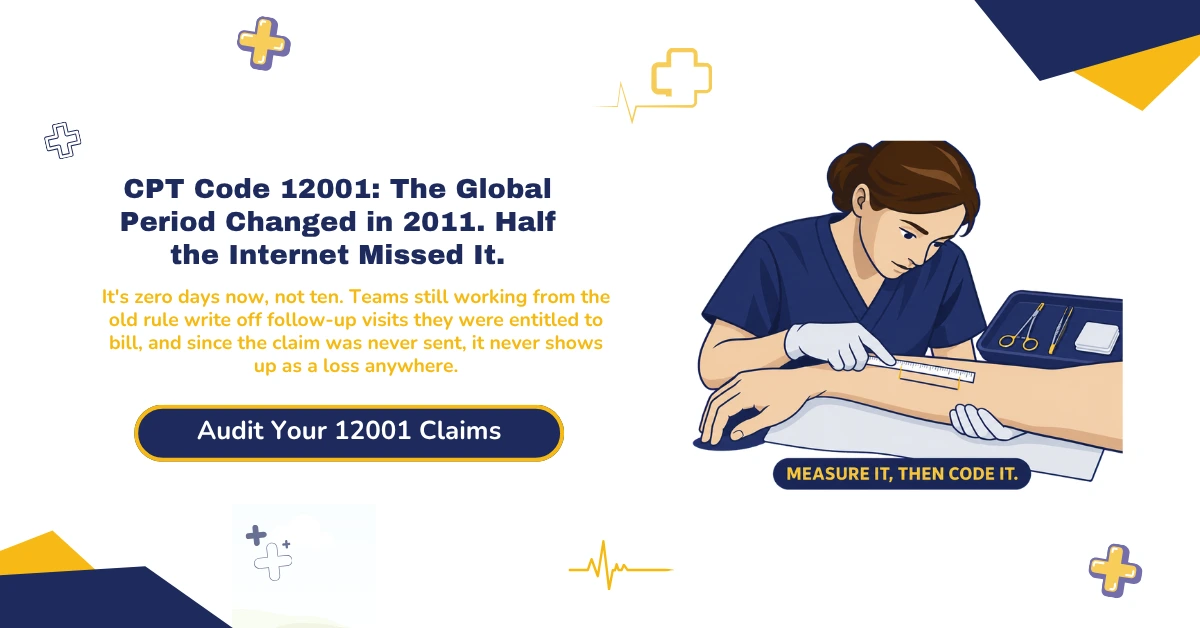
CPT code 12001 reports simple repair of superficial wounds measuring 2.5 cm or less on the scalp, neck, axillae (armpits), external genitalia, trunk, and extremities including hands and feet. The code carries a global period of 000, meaning zero postoperative days. Closure must be single-layer using sutures, staples, or tissue adhesive.
Key takeaways
- Scope: wounds 2.5 cm or less, single-layer closure, on the scalp, neck, axillae, external genitalia, trunk, or extremities. Facial wounds go to a different code series.
- Global period: 000, not 10 days. Medicare changed this in the 2011 Physician Fee Schedule, and plenty of coding articles still carry the old figure.
- Modifier 25: attaches to the E/M code, never to 12001 itself. That single detail causes a large share of same-day denials.
- 2026 status: the 12001 CPT code wasn’t revised or deleted this year. What changed is the payment, and most billing teams haven’t caught it yet.
What CPT Code 12001 Covers
CPT code 12001 reports a simple, single-layer closure of a superficial wound on six anatomic areas: the scalp, neck, axillae, external genitalia, trunk, and extremities including hands and feet. The AMA CPT code set sets the descriptor, and the 2.5 cm ceiling is measured in centimeters.
That last group matters more than people expect. Extremities means arms and legs, and it explicitly includes hands and feet. A finger laceration, a laceration on the dorsum of the foot, a cut across the palm: all of them fall under the 12001 CPT code when the size and depth criteria are met.
Here’s where teams lose money on this one. Some references drop “including hands and feet” from the site list entirely. A biller working from that list won’t code a hand repair to 12001, which is the single most common laceration presentation in urgent care. That’s not a denial. It’s a claim nobody ever submitted.
Across the repair claims ClaimMax RCM works, the site-grouping error shows up more often than the size error.
Body areas covered by CPT 12001
| Included under 12001 | Excluded, use 12011-12018 |
|---|---|
| Scalp | Face |
| Neck | Ears |
| Axillae (armpits) | Eyelids |
| External genitalia | Nose |
| Trunk | Lips |
| Extremities, including hands and feet | Mucous membranes |
Facial repairs have their own series even when the closure is clinically identical. Payers run automated site-mismatch edits, so a facial laceration billed as 12001 gets caught on adjudication rather than on appeal.
What Qualifies as a Simple Repair
Simple repair under CPT requires three conditions to be met at the same time: the wound involves only epidermis, dermis, or subcutaneous tissue; the closure is single-layer; and the repaired length is 2.5 cm or less. Miss any one and 12001 is the wrong code.
The three criteria that must all be met
- Tissue depth. Epidermis, dermis, or subcutaneous tissue only. No fascia, muscle, tendon, nerve, or vessel involvement.
- Closure method. One layer, using sutures, staples, or tissue adhesive such as 2-cyanoacrylate, alone or in combination.
- Size. 2.5 cm or less, measured in centimeters regardless of whether the wound is straight, curved, or stellate.
Subcutaneous tissue belongs in that first criterion. Some sources say simple repair excludes it, and that’s backwards. Coders working from the wrong definition push routine closures into the intermediate range, which reads as an upcoding pattern on audit.
Closure methods that do not qualify as a repair
Not every closure is a billable repair. Simple laceration repair CPT codes assume a specific set of materials, and using something outside that set changes what you report.
| Closure method used alone | Correct reporting |
|---|---|
| Adhesive strips only | E/M code, not a repair code |
| Chemical cauterization only | E/M code |
| Electrocauterization only | E/M code |
| Silver nitrate for hemostasis | Not separately billable |
| Silver nitrate for granulation tissue | CPT 17250 |
| Tissue adhesive, Medicare patient | HCPCS G0168 |
| Tissue adhesive, non-Medicare patient | 12001-12021 by complexity |
Two notes on that table. Silver nitrate sticks and solution are office supplies, so they never get billed separately, and 17250 applies only when you’re destroying hypergranulation tissue, not when you’re stopping bleeding. The Dermabond CPT code question splits by payer: Medicare wants G0168, most commercial plans want the standard repair code. Related destruction scenarios show up in our benign lesion destruction billing guide.
How to Choose the Right Wound Repair Code
Three variables decide which wound repair CPT code applies, and they resolve in a fixed order: complexity first, then anatomic site grouping, then length in centimeters. Complexity comes first because it determines which code family you’re in before length matters at all.
The three-step code selection path
STEP 1 COMPLEXITY
Single layer, clean, superficial -> Simple (12001-12021)
Layered closure or heavy contamination -> Intermediate (12031-12057)
Extensive undermining, stents, retention -> Complex (13100-13160)
STEP 2 ANATOMIC SITE GROUPING (simple repairs)
Scalp, neck, axillae, genitalia, trunk, extremities -> 12001-12007
Face, ears, eyelids, nose, lips, mucous membranes -> 12011-12018
Previously closed wound that reopened -> 12020 or 12021
STEP 3 LENGTH IN CENTIMETERS
2.5 cm or less -> 12001
2.6 to 7.5 cm -> 12002
7.6 to 12.5 cm -> 12004
Step 2 has a wrinkle almost everyone misses. Codes 12020 and 12021 sit inside the 12001 to 12021 range, so they get lumped in as “simple repair” constantly. They aren’t. Both describe treatment of superficial wound dehiscence, meaning a surgical wound that was already closed and reopened. Different clinical event, different code. What is the description of CPT code 12021? Dehiscence treatment with packing.
For the broader debridement, NPWT, and active wound management families, our wound care CPT codes guide maps the full picture.
CPT 12001 versus 12002: the most common crossover
Both codes cover the same anatomic sites under the same simple repair criteria. Length is the only difference. The 12001 CPT code stops at 2.5 cm, and 12002 picks up from 2.6 cm through 7.5 cm.
Measurement timing is where the sources disagree. Some say measure before closure, since edges approximate differently once sutured. Others say measure the repaired wound. CPT instructs you to report the length of the wound repaired, so measure the closure.
The practical answer is simpler than the debate. Write the number down and note when you took it. A record that says “small laceration sutured” with no centimeter figure fails on documentation request no matter which timing convention you follow.
CPT Code 12001 Global Period
CPT code 12001 carries a global period of 000, meaning zero postoperative days. Only the date of the procedure sits inside the global surgical package. Follow-up wound checks and suture removal performed on any later date are separately reportable using an appropriate E/M code.
Why some sources still say 10 days
Medicare revised the global surgery period for CPT codes 12001 to 12018 from 10 days to 0 days in the 2011 Medicare Physician Fee Schedule. RVUs were reduced at the same time to strip out the postoperative work that had been built into them.
That change is 15 years old. You’d never guess it from what’s still circulating. Coding articles, forum threads, and calculator sites still list a 10-day global on this code, and the correction never propagated.
The AAP Pediatric Coding Newsletter documented the change when it happened. The ACEP Surgical Package FAQ states the current position plainly: care following simple wound repair is separately reportable beginning the day after the procedure. Indicator definitions live in the CMS Global Surgery Booklet.
Billing teams read the stale version and write off follow-up visits they had every right to bill. That’s not a coding error. It’s revenue handed back voluntarily.
Simple, intermediate, and complex don’t share a global period
| Repair type | Code range | Global period |
|---|---|---|
| Simple | 12001-12021 | 000 |
| Intermediate | 12031-12057 | 010 |
| Complex | 13100-13160 | 010 |
| Incision and drainage | 10060, 10061 | 010 |
That table is the part that trips people up. The 12001 CPT code global period is zero, but the codes sitting right next to it in the same section carry 10 days. Our incision and drainage codes guide covers the 010 side of that split.
So the error runs both directions. Bill a follow-up inside 10 days of an intermediate repair and you’ll eat a denial or a takeback. Write off a follow-up after a simple repair and you gave away money nobody asked you for. Same patient, same wound, opposite outcome, decided entirely by how the closure got documented.
Sorting out which of those two is happening in your data is exactly what our denial management services team does first on a wound repair account.
If your adjustment log has post-repair visits sitting in it on simple closures, that’s recoverable revenue. Worth pulling the last 12 months before you decide it isn’t.
Can You Bill Separately for Suture Removal After CPT 12001
Yes, on a later date. Because CPT 12001 carries a zero-day global period, a return visit for suture removal or a wound check is separately reportable using an appropriate E/M code. Suture removal performed on the same date as the repair stays bundled into the repair.
When suture removal is billable and when it isn’t
| Scenario | Reporting |
|---|---|
| Same provider, later date, simple repair (000 global) | E/M code, separately billable |
| Same provider, within 10 days, intermediate or complex repair (010 global) | Bundled, not separately billable |
| Different provider removing another provider’s sutures | Office visit E/M, or HCPCS S0630 |
| Removal requiring anesthesia | CPT 15851 |
| Same date as the repair | Included in the repair |
The suture removal CPT question gets asked constantly, and the honest answer is that it depends entirely on which repair preceded it. Nobody can answer it from the removal visit alone.
S0630 and 15851, the two codes most teams miss
Two codes cover situations the standard E/M doesn’t.
HCPCS S0630 applies when a different physician or clinic removes sutures placed elsewhere. It’s an S-code, which means Medicare doesn’t recognize it, and commercial coverage varies by plan. Check the payer before you send it.
CPT 15851 is removal of sutures or staples requiring anesthesia. That’s the pediatric case, mostly, where sedation is the only way the removal happens. Billing an office visit E/M for a sedated removal understates the service every time.
Neither code shows up in most 12001 guidance, and both get missed in exactly the situations where they’d pay.
CPT Code 12001 Modifiers
Billed alone for a standalone laceration repair with no other services on the claim, CPT 12001 requires no modifier at all. Modifiers apply only in specific scenarios: a same-day E/M, a second repair at a different site, or multiple procedures in one session.
Start there, because most modifier guidance for this code starts by listing a dozen options that don’t apply. A 2.5 cm closure doesn’t need an assistant surgeon.
The modifier decision matrix
| Scenario | Modifier | Goes on which code | Why |
|---|---|---|---|
| 12001 billed alone | None | n/a | No modifier required |
| Significant separate E/M, same date | 25 | The E/M code, not 12001 | Identifies a distinct evaluation |
| Second repair, different site, same date | 59 or XS | The lower-valued repair code | Clears the NCCI edit |
| Multiple non-repair procedures, same session | 51 | 12001 | Payers may apply the reduction automatically |
| Unrelated E/M during another code’s global period | 24 | The E/M code | Separates unrelated care |
Column three does the real work. The 12001 CPT code modifier question almost always turns out to be a Modifier 25 question, and Modifier 25 goes on the evaluation and management code. Not on 12001. Put it on the procedure and the E/M bundles and denies, which is a fix that costs an appeal instead of a keystroke.
Same-day E/M plus minor procedure is the highest-volume pairing in urgent care, and our ED Level 3 modifier rules guide covers the documentation side of it.
Why X modifiers are replacing 59
Medicare has been steering claims away from blanket Modifier 59 toward the X{EPSU} subsets: XE for a separate encounter, XP for a separate practitioner, XS for a separate structure, and XU for an unusual non-overlapping service.
For a second wound at a different anatomic site, XS is the correct subset. It says specifically what 59 only implies. The CMS NCCI Policy Manual 2026 sets the standard, and commercial payers increasingly follow it.
Modifiers that don’t apply to CPT 12001
LT and RT don’t apply here. Skin is one continuous organ, not a paired organ, so laterality modifiers have nothing to attach to. Assistant surgeon modifiers 80, 81, and 82 aren’t supportable on a single-layer closure of 2.5 cm or less either.
CPT Code 12001 Reimbursement in 2026
Medicare reimbursement for CPT code 12001 is calculated under the Resource-Based Relative Value Scale, not set as a flat fee. The 2026 national non-facility amount is [INSERT 2026 NON-FACILITY RATE], and your actual payment moves with locality, place of service, and which conversion factor applies to the billing clinician.
How the 2026 rate is calculated
CMS publishes the formula. Nobody in this space shows it, which is why the numbers floating around for this code contradict each other.
Non-Facility Payment =
[(Work RVU x Work GPCI)
+ (Non-Facility PE RVU x PE GPCI)
+ (MP RVU x MP GPCI)]
x Conversion Factor
For CPT 12001 in 2026, the components are [INSERT WORK RVU] work, [INSERT NON-FACILITY PE RVU] non-facility practice expense, and [INSERT MP RVU] malpractice.
Four things move that result:
- GPCI. Each of the three components gets adjusted by your locality’s geographic practice cost index. A code paying one amount in rural Idaho pays a different amount in Manhattan.
- Conversion factor. 2026 has two. The standard factor is $33.4009. Qualifying APM participants get $33.5675. That split started January 1, 2026.
- Place of service. Facility PE is lower than non-facility PE, because in a facility the hospital carries the overhead and bills separately.
- Sequestration. A 2% reduction applies on the payment side, after the fee schedule amount is calculated.
One more that rarely gets mentioned: for nonparticipating physicians, the Medicare limiting charge is the fee schedule amount multiplied by 1.0925. That’s the ceiling on what you can charge the patient, and it’s set by law.
Confirm your locality-adjusted figure with the CMS PFS Look-Up Tool before you quote a number to anyone.
The 2026 efficiency adjustment cut this code
Here’s what almost nobody has connected to this code yet.
CMS finalized a negative 2.5% efficiency adjustment for CY 2026, applied to the work RVUs and intraservice time of roughly 7,700 non-time-based codes. CPT 12001 is a non-time-based procedural code. It’s in scope. The CMS CY 2026 PFS Fact Sheet and the CY 2026 PFS Final Rule both document it.
So the code didn’t change. The payment did.
Put a 2025 remittance next to a 2026 remittance for an identical 12001 claim and the numbers won’t match. That gap has nothing to do with your coding, your documentation, or your payer contract. It’s a policy change that landed quietly in a rule most practices skimmed for the conversion factor and moved on.
Most teams haven’t reconciled 2026 remittances against the new RVUs yet. If your repair collections look light and nobody can explain why, that’s usually the first place to look. Our wound care reimbursement rates guide walks the same math across the broader wound care families.
Commercial and Medicaid rates for CPT 12001
Commercial contracts typically pay above Medicare for this code, but the spread is entirely a function of your negotiated rate. There’s no national commercial rate for the 12001 CPT code, and the ranges published in various places don’t agree with each other because they’re averaging different sample sets.
Medicaid varies by state and by managed care organization. Some state programs benchmark to a percentage of the Medicare fee schedule. Others negotiate independently. Pull your state’s fee schedule rather than using the MPFS as a proxy.
NCCI Bundling Rules for CPT 12001
Simple repair codes 12001 to 12021 bundle into several procedure families and are not separately reportable for the same lesion or injury. The three that matter most are adjacent tissue transfer, lesion excision, and foreign body removal. Debridement performed to prepare a wound for closure is also included.
What CPT 12001 bundles into
| Primary procedure | Bundling rule for 12001 |
|---|---|
| Adjacent tissue transfer, 14000-14350 | Repair is included. Codes 12001-13160 not separately reportable for the same lesion. |
| Benign lesion excision, 11400-11446 | Simple repair is included in the excision. |
| Malignant lesion excision, 11600-11646 | Simple repair is included in the excision. |
| Foreign body removal, same wound | Repair bundles with removal. Document the removal, do not bill it. |
| Debridement to prepare the wound | Included in the repair payment. |
One distinction saves a lot of appeals here. Intermediate and complex repairs can be separately reportable alongside lesion excision when the work is clinically distinct and documented that way. Simple repair can’t. The 12001 CPT code is included in the excision, full stop.
The less-complex-included principle
CMS applies a general rule across CMS NCCI edits: when two procedures differ only by complexity, the less complex is included in the more complex and isn’t separately reportable, unless the services happen at a separate encounter or a separate anatomic site.
That’s why stacking two repair codes on one wound fails every time. It’s also why site documentation carries so much weight. A separate anatomic site is the thing that makes a second repair code survivable, and it has to be in the note before the claim goes out.
MUE units for CPT 12001
A Medically Unlikely Edit caps the units of service payable for a code on one date for one patient. Units above the cap auto-deny, and the fix is an appeal with documentation rather than a corrected resubmission.
CMS publishes CMS Medically Unlikely Edits on a quarterly cycle, and some MUE values are designated confidential and aren’t released publicly. Teams running annual checks against the CPT book miss the mid-year revisions entirely.
Billing Multiple Wound Repairs on the Same Day
Wounds of the same complexity within the same anatomic site grouping are added together and reported as one code based on the combined length. Wounds in different site groupings are reported separately, each under its own code. Complexity and site grouping decide whether lengths combine, not the number of wounds.
The additive length rule
| Presentation | Correct reporting |
|---|---|
| Two trunk wounds, 1.5 cm and 1.5 cm, both simple | Combined 3.0 cm. Report 12002. Not two units of 12001. |
| Scalp wound 2.1 cm and trunk wound 1.8 cm, both simple | Same site grouping. Combined 3.9 cm. Report 12002. |
| Scalp wound 2.0 cm simple, facial wound 1.5 cm simple | Different site groupings. Report 12001 and 12011 separately. |
| Extremity wound 2.0 cm simple, extremity wound 4.0 cm intermediate | Different complexity. Report the intermediate first, then the simple with a distinct-service modifier. |
Row one is the error auditors find most. Two separate 12001 lines for two trunk wounds looks reasonable on the encounter form and fails on adjudication, because the combined 3.0 cm crosses into 12002 territory.
Report the higher complexity first
When repairs of different complexity happen on the same date, list the higher-valued repair on the first line without a modifier. The lower-valued code goes below it with the distinct-service modifier attached.
That ordering isn’t cosmetic. Payers apply multiple-procedure payment reduction based on line order, so putting the lower-valued code on line one lands the reduction on the wrong service. Our minor procedure modifier rules guide covers how that reduction works.
And here’s why almost nobody catches it. The claim doesn’t deny. It posts as paid, just short, and it sits in the paid column looking exactly like a clean claim.
ICD-10 Codes That Support CPT 12001
Every CPT 12001 claim requires at least one ICD-10-CM code establishing medical necessity for the repair. S-category injury codes are the standard pairing. Laterality and encounter type must match the clinical record wherever the code structure provides them, because payers validate both automatically.
Common ICD-10 pairings for the 12001 CPT code
| ICD-10-CM | Description | Denial risk if wrong |
|---|---|---|
| S01.01XA | Laceration without foreign body of scalp, initial encounter | Missing “A” suffix triggers CO-11 |
| S71.011A | Laceration without foreign body, right thigh, initial encounter | Unspecified laterality triggers CO-11 |
| S61.411A | Laceration without foreign body, right hand, initial encounter | Hand and finger codes are distinct families |
| S31.110A | Laceration without foreign body, abdominal wall RUQ, initial encounter | Trunk codes require quadrant specificity |
| S41.111A | Laceration without foreign body, right upper arm, initial encounter | Shoulder and arm are separate code families |
Encounter type does more work than people expect. The seventh character carries the whole story: “A” for initial, “D” for subsequent, “S” for sequela. Send a suture removal visit with an “A” suffix and you’ve told the payer the injury just happened.
Diagnosis specificity is one of the seven things that separate a paid claim from a reworked one. Our guide to clean claim requirements covers the rest.
Is CPT 12001 diagnosis agnostic?
Not in practice, though the question is a fair one.
No LCD or NCD restricts CPT 12001 to a defined diagnosis list, and in that narrow technical sense the code is diagnosis agnostic. Coverage isn’t gated by a specific ICD-10 pairing the way it is for many imaging and lab codes. The CMS Wound and Ulcer Care article documents where those gates do exist.
What actually happens is different. Payers run medical necessity edits, laterality validation, and encounter-type checks on the diagnosis you send. An unspecified code where a specific one exists denies, even when the procedure was correct and the diagnosis was technically true.
Why CPT 12001 Claims Get Denied
Three failures cause most CPT 12001 denials: no wound measurement in centimeters, wrong anatomic site grouping, and Modifier 25 omitted from a same-day E/M. All three are documentation problems that get caught before submission, not payer errors that require an appeal.
The seven denial triggers and how to prevent each
| Denial trigger | Typical CARC | Prevention |
|---|---|---|
| No wound measurement in centimeters | CO-16, CO-50 | Require a cm field in the procedure note template |
| Facial laceration billed as 12001 | CO-11, CO-4 | Validate site grouping at charge entry, not at coding |
| Modifier 25 missing on same-day E/M | CO-97 | Scrub every E/M plus minor procedure pair pre-submission |
| Two 12001 lines instead of one 12002 | CO-97, CO-18 | Apply the additive rule before the claim leaves |
| Closure method not documented | CO-50 | Template field for sutures, staples, or adhesive |
| Repair billed alongside lesion excision | CO-97 | Run the NCCI check at scrub, not at appeal |
| Dehisced wound billed as 12001 | CO-11 | Route reopened wounds to 12020 or 12021 |
Every row on that list is preventable at submission. None of them require a clinical change, and none of them are the payer being difficult.
Working the pattern behind a repeating trigger is what our root-cause denial analysis team does before touching a single appeal, because fixing one claim without fixing the template just means the same denial returns next month.
The denial nobody catches
Two problems on this code never appear in a denial report.
The first is the line-order underpayment from the multiple-repair rule. It posts as paid. Nothing flags.
The second is bigger. Teams working from the old 10-day global period write off post-repair visits they were entitled to bill. No claim was ever submitted, so nothing denied, so nothing shows up anywhere. It’s revenue that simply never existed on paper.
A denial you can see is a problem you can work. A claim you never sent is invisible, and that second category is where the 12001 CPT code quietly costs practices the most.
Aged repair denials compound the same way. Once a claim passes the payer’s appeal window it stops being recoverable, which is why our aging AR recovery team works wound repair claims by aging bucket rather than by dollar value.
If nobody on your team can say for certain whether you’ve been billing post-repair visits on simple closures, that’s worth checking before the appeal windows close. It’s a pattern we see often enough that it usually takes about a day to answer.
What Changed for CPT 12001 in 2026
CPT 12001 was not revised, deleted, or replaced in the 2026 CPT code set. The descriptor, anatomic scope, size threshold, and closure-method definitions all carry forward unchanged. Four CMS policy changes affect what the code pays, and none of them touch how you code it.
The code itself is unchanged
The AMA CPT 2026 code set took effect January 1, 2026 and contained 418 editorial changes: 288 new codes, 84 deletions, and 46 revisions. The integumentary repair series wasn’t among them.
CPT 12001 remains active and valid for 2026 claims. Anyone waiting on a replacement code or a descriptor revision can stop looking. There isn’t one.
Four CMS changes that affect what CPT 12001 pays
- Efficiency adjustment, negative 2.5%. Applied to work RVUs and intraservice time across roughly 7,700 non-time-based codes for CY 2026. CPT 12001 is a non-time-based procedural code and falls in scope.
- Dual conversion factors, effective January 1, 2026. $33.4009 standard, $33.5675 for qualifying APM participants. Which one applies depends on the billing clinician’s QP status, not on the code.
- NCCI Policy Manual 2026. Effective January 1, 2026, posted December 24, 2025. CMS updates it annually, and your bundling rules should align to this edition rather than a prior year’s.
- Quarterly file cadence. CMS released RVU26B on March 10, 2026 under Transmittal 13673, effective April 1, 2026. MUE files move on the same quarterly rhythm.
Global surgery indicators, multiple procedure indicators, and the rest of the payment policy flags for this code live in the fee schedule rather than the CPT book. Definitions are published in the Noridian MPFS indicators reference, and locality-specific amounts through the Palmetto GBA fee lookup or your own MAC’s tool.
None of this changes how you select the code. All of it changes what lands on the remittance.
Common Myths About CPT Code 12001
Four claims about this code circulate widely and all four are wrong. Each one costs money in a different direction.
Myth 1: The code carries a 10-day global period. It carried one until 2011, when Medicare moved codes 12001 to 12018 to a 000 global and reduced the RVUs to match. The old figure survives in articles and calculators that were never updated. Practices reading it write off follow-up visits that were fully billable.
Myth 2: Codes 12001 to 12021 are all simple repairs. Codes 12020 and 12021 describe treatment of superficial wound dehiscence, not laceration repair. They apply to a surgical wound that was already closed and reopened. Coding a dehisced wound as a fresh repair misstates the clinical event and draws a medical necessity denial.
Myth 3: Simple repair excludes subcutaneous tissue. Subcutaneous tissue is included in the simple repair definition. Coders working from the wrong version push routine single-layer closures into the intermediate range, which reads as an upcoding pattern once enough of them stack up in one provider’s data.
Myth 4: Modifier 25 goes on 12001. Modifier 25 belongs on the evaluation and management code. Put it on the repair and the E/M bundles into the procedure and denies, which turns a keystroke into an appeal. ACEP’s NCCI FAQ covers the same-day rules in detail.
Frequently Asked Questions About CPT Code 12001
What is CPT code 12001 used for?
CPT code 12001 reports simple, single-layer repair of a superficial wound measuring 2.5 cm or less on the scalp, neck, axillae, external genitalia, trunk, or extremities including hands and feet. Facial wounds use 12011 to 12018 instead.
Is there a global period for CPT 12001?
Yes. CPT 12001 carries a global period of 000, meaning zero postoperative days. Only the procedure date sits inside the global surgical package. Medicare moved this code from 10 days to 0 days in the 2011 Physician Fee Schedule.
Does CPT 12001 include suture removal?
No. Because the code carries a zero-day global period, routine suture removal on a later date is not bundled into the repair payment. A return visit for removal is separately reportable using an appropriate E/M code.
Does CPT 12001 require a modifier?
Usually not. The 12001 CPT code needs no modifier when billed alone with no other services. Modifier 25 applies to a same-day E/M code, and Modifier 59 or XS applies to a second repair at a different anatomic site.
What is the cost of CPT code 12001?
The 2026 national non-facility Medicare allowed amount is [INSERT 2026 NON-FACILITY RATE]. Actual payment varies by locality through GPCI adjustment, by place of service, and by which of the two 2026 conversion factors applies to the billing clinician.
What is the difference between CPT 12001 and 12002?
Length only. Both codes cover simple repair on the same anatomic sites under identical criteria. CPT 12001 applies to wounds 2.5 cm or less. CPT 12002 applies to wounds from 2.6 cm through 7.5 cm.
Can CPT 12001 be billed with an E/M code?
Yes, when the evaluation is significant and separately identifiable from the decision to repair. Modifier 25 goes on the E/M code, never on 12001. Without it, payers bundle the E/M into the repair and deny it.
What is included in CPT 12001?
Local anesthesia, routine wound cleansing, simple hemostasis, the closure itself, and the first dressing are all included in the payment. None of these are separately billable alongside the repair code on the same claim.
Can you bill for laceration repair with glue?
Yes. Tissue adhesive such as 2-cyanoacrylate is an accepted closure method. Medicare patients use HCPCS G0168 when adhesive is the sole closure, while most commercial payers accept the standard repair code. Confirm payer preference before submitting.
Can I charge for suture removal?
Yes, on a date after a simple repair, using an appropriate E/M code. A different clinic removing another provider’s sutures may report HCPCS S0630. Removal requiring anesthesia is reported with CPT 15851 instead.
What qualifies as a complex repair?
Complex repair, codes 13100 to 13160, requires more than layered closure. Qualifying elements include extensive undermining, scar revision, debridement of complicated lacerations, retention sutures, or stents. Layered closure by itself is intermediate repair, not complex.
Is CPT 12001 diagnosis agnostic?
Not in practice. No LCD or NCD restricts CPT 12001 to specific diagnoses, but payers apply medical necessity edits, laterality validation, and encounter type checks. An unspecified ICD-10 code where a specific one exists still denies.
What are the requirements for a CPT 12001 wound repair?
Three conditions must all be met. The wound involves only epidermis, dermis, or subcutaneous tissue. Closure is single-layer using sutures, staples, or tissue adhesive. Repaired length is 2.5 cm or less on a qualifying site.
What is CPT code 12031 used for?
CPT 12031 reports intermediate repair of the scalp, axillae, trunk, or extremities, 2.5 cm or less. Intermediate means layered closure or a heavily contaminated wound requiring cleaning. Unlike 12001, intermediate repairs carry a 10-day global period.
Getting CPT 12001 Claims Paid the First Time
Four things decide whether a repair claim pays cleanly: the complexity you documented, the site grouping you assigned, the centimeter figure in the note, and whether your team knows which global period applies. Get all four right and this code is uneventful. Miss one and the claim either denies or quietly underpays.
That’s the frustrating part. CPT 12001 looks like the simplest code in the integumentary section, and the descriptor fits on one line. Four separate rule sets govern it, though, and three of them live outside the CPT book: in the fee schedule, the NCCI manual, and the quarterly MUE file.
None of those update on the same schedule, which is how a practice ends up compliant with a rule that changed 15 years ago.
What we actually do with this code is unglamorous. Pre-submission scrubbing on every E/M plus minor procedure pair. Site grouping validated at charge entry rather than at coding. Denials categorized by CARC before anyone drafts an appeal. Line-order review on any claim carrying more than one repair. Our medical billing services run the same checks across every surgical code family.
If your repair claims are paying but the numbers feel light, or your adjustment log has post-repair visits in it that shouldn’t be there, that’s a specific thing to look at rather than a general concern. We can usually tell you within a day whether it’s happening.