What Is POS 02 in Medical Billing? The 2026 Definition Every Telehealth Biller Needs
Place of Service 02, reported as POS 02 on professional claims, is the two-digit telehealth billing code the Centers for Medicare and Medicaid Services assigns when a provider delivers a virtual service and the patient isn’t in their private residence.
The patient’s physical location during the encounter drives the code. If the patient is at a clinic, workplace, skilled nursing facility, school, or hospital, POS 02 applies. If the patient is at home, POS 10 applies instead.
Official CMS Name: Telehealth Provided Other than in Patient’s Home. CMS defines POS 02 as the location where health services are provided or received through telecommunication technology when the patient isn’t in their home.
Claim Form Placement: POS 02 is entered in Box 24B of the CMS-1500 professional claim form. The code maps to the CLM05 service type indicator in the 837P electronic transaction.
Patient Location Requirement: The patient has to be physically outside their private residence during the telehealth encounter. Settings include clinics, hospitals, skilled nursing facilities, schools, workplaces, hotels, and shelters.
Medicare Rate Classification: CMS reimburses professional claims billed with POS 02 at the facility payment rate. The facility rate is lower than the non-facility rate that applies when the patient is at home under POS 10.
Home Telehealth Rate Change: Starting January 1, 2024, under the CY 2024 Medicare Physician Fee Schedule final rule, CMS pays telehealth services furnished in the patient’s home at the non-facility rate. That’s why billing POS 10 instead of POS 02 for home-based telehealth produces a higher physician payment.
Effective Date: CMS revised the POS 02 definition effective January 1, 2022. Medicare systems began processing POS 02 and POS 10 under the updated definitions on April 1, 2022. The prior description used POS 02 for all telehealth, and the 2022 revision split home and non-home telehealth into two codes.
The sections below explain how patient location decides the code, how the rate difference affects physician payment, which modifiers pair with POS 02, and what changed in 2026.
Where POS 02 Goes on the Claim: Box 24B, the CMS-1500, and What the 837P Requires
The Centers for Medicare and Medicaid Services defines Place of Service 02 as a location where health services or health-related services are provided or received through telecommunication technology when the patient isn’t located in their home.
The complete CMS Place of Service Code Set, last updated February 17, 2026, contains every active two-digit POS code with its description.
POS 02 is reported in Box 24B of the CMS-1500 professional claim form. Box 24B tells the payer’s adjudication system which payment methodology applies.
In the 837P electronic transaction, POS 02 maps to the CLM05-1 segment. The clearinghouse validates POS 02 against the CPT code in that claim line to confirm the service sits on the Medicare Telehealth Services List.
When the service location differs from the billing provider’s address, Box 32 on the CMS-1500 has to reflect the address where the patient’s side of the telehealth encounter occurred. That address must match the provider’s active enrollment record in PECOS.
A character mismatch between Box 32 and the PECOS record produces a Return to Provider, not a denial. The effect on the collection cycle is the same: days lost and timely filing exposure.
POS codes appear on professional claims only. The institutional UB-04 facility claim doesn’t use POS 02. When a hospital-employed physician delivers a telehealth service, the physician’s billing team submits a CMS-1500 with POS 02 in Box 24B.
The hospital’s billing team separately submits a UB-04 with the right Type of Bill code and the relevant telehealth modifier. Teams moving from independent practice to hospital employment confuse the two forms and add POS codes to UB-04 claims. The clearinghouse rejects those claims at intake.
CMS assigned the current POS 02 definition effective January 1, 2022, replacing the prior broad use of POS 02 that predated POS 10. That split defines POS 02 in medical billing today.
Patient Location Decides the Code: POS 02 vs POS 10 vs POS 11 in 2026
One factor determines which telehealth POS code applies: where the patient is sitting during the encounter. The code doesn’t follow the provider’s location. It doesn’t follow the service type. It follows the patient’s physical location at the moment of the visit.
The difference between POS 02 and POS 10 isn’t only administrative. It produces different payment rates. Per the CY 2024 Medicare Physician Fee Schedule final rule, effective January 1, 2024, telehealth where the patient is at home pays the non-facility rate. Telehealth where the patient is outside the home pays the lower facility rate.
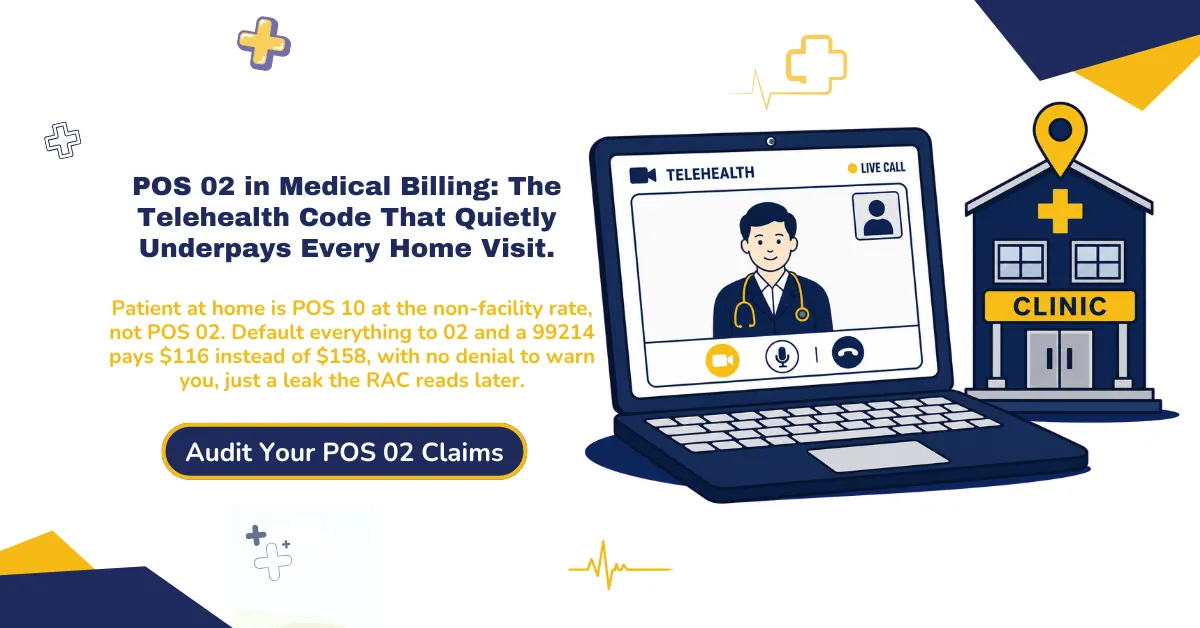
For a common E/M visit like 99214, the 2026 non-facility Medicare rate is about $158 and the facility rate is about $116. That $42 per-claim gap compounds across a high-volume telehealth practice into thousands in monthly revenue. This is POS 02 in medical billing at its most expensive.
| Feature | POS 02 (Telehealth Outside Home) | POS 10 (Telehealth at Home) | POS 11 (Office In-Person) |
|---|---|---|---|
| Official CMS Name | Telehealth Provided Other than in Patient’s Home | Telehealth Provided in Patient’s Home | Office |
| Patient location during service | Any non-home setting: clinic, SNF, school, workplace | Patient’s private residence or temporary home | Physician’s office, patient is present |
| Provider location | Remote, any location | Remote, any location | Same office as patient |
| 2026 Medicare payment rate | Facility rate (lower) | Non-facility rate (higher), effective Jan 1, 2024 | Non-facility rate (standard) |
| 2026 Medicare rate for 99214 | Approximately $116 | Approximately $158 | Approximately $158 |
| Required telehealth modifier | Modifier 95 (audio-video) or 93 (audio-only) | Modifier 95 (audio-video) or 93 (audio-only) | No telehealth modifier; in-person visit |
| Most common denial when wrong | CO-58 (location conflict with documentation) | CO-58 (location conflict with documentation) | CO-4 (modifier inconsistency if telehealth modifier added) |
| Box 24B entry | 02 | 10 | 11 |
The most expensive error on this table is using POS 02 when the patient is at home. On a practice billing 200 telehealth visits per month, that error costs about $8,400 in monthly Medicare underpayment ($42 per claim across 200 claims). It doesn’t trigger an initial denial. The claim pays at the wrong rate.
Most California commercial payers, including Anthem Blue Cross of California and Blue Shield of California, follow the Medicare POS 02 vs POS 10 distinction. Payer contracts that reference the Medicare PFS methodology carry the same rate gap. Billing POS 02 for a home-based visit under those plans produces the same underpayment it does under Medicare.
For behavioral health and psychotherapy practices where telehealth is the majority of visits, this rate difference shows up most in codes like 90834 and 90837. Our telehealth psychotherapy billing guide shows exact 2026 rates on those codes by POS code and payer.
Is Place of Service 02 Facility or Non-Facility? The Definitive 2026 Answer
POS 02 is a facility setting. Medicare and commercial payers reimburse professional claims billed with POS 02 at the facility payment rate, which is lower than the non-facility rate that applies to POS 10 and POS 11.
POS 02 is classified as a facility code because the patient is at a healthcare location outside their home when receiving the telehealth service. In CMS’s payment logic, a facility setting means a separate entity is incurring overhead costs for the patient’s care location.
Because a facility absorbs those costs separately, the physician’s professional payment drops to reflect that the physician isn’t covering overhead.
CMS codified this classification in the Medicare Physician Fee Schedule. The MPFS uses practice expense relative value units to calculate the professional fee. In a facility setting like POS 02, the practice expense RVUs sit lower because the facility covers expenses the physician would otherwise bear.
In a non-facility setting like POS 10 or POS 11, the practice expense RVUs sit higher because the physician absorbs all operational costs.
Starting January 1, 2024, CMS confirmed that home-based telehealth under POS 10 produces the non-facility rate. Any claim that should have been POS 10 but was billed as POS 02 is underpaid.
The patient-location audit trail in the clinical note is what payers and RAC contractors use to find this pattern. That makes POS 02 in medical billing a quiet revenue leak when the default is wrong.
The most common facility versus non-facility misclassification on telehealth claims happens when a practice defaults all telehealth visits to POS 02 from a legacy EHR template, regardless of where the patient is. Patients connecting from home should bill POS 10.
The EHR default doesn’t know where the patient is. The biller has to capture that information at scheduling or check-in, not at claim submission.
For practices managing telehealth across multiple payers with varying POS rules, building the patient-location capture step into the pre-visit workflow stops this default error from compounding. ClaimMax RCM’s telehealth medical billing services include this workflow checkpoint as part of standard claim scrubbing.
When to Use POS 02 and When Not To: Five Clinical Scenarios with CPT Codes
Use POS 02 when all three conditions are met: the service is delivered via real-time telehealth technology, the patient isn’t in their private residence, and the service is listed on the CMS Medicare Telehealth Services List or covered by the applicable payer’s telehealth policy. That’s the core test for POS 02 in medical billing.
Don’t use POS 02 when the patient is at home. Use POS 10. Don’t use POS 02 for in-person services. Use POS 11, 22, 23, or the applicable in-person code.
Don’t use POS 02 for audio-only telehealth when the patient is at home. Use POS 10 with Modifier 93. Don’t use POS 02 for store-and-forward telemedicine. Use POS 18.
Neurology Telehealth at a Rural Clinic: A neurologist delivers a telehealth consultation to a patient at a rural health clinic 200 miles away. The patient isn’t at home. CPT 99213 or 99214 bills with POS 02 and Modifier 95. The clinic separately bills Q3014 for the originating site facility fee.
Psychiatry Session at a Community Mental Health Center: A psychiatrist delivers a 53-minute individual psychotherapy session to a patient at a community mental health center. The patient is present at the center, and the psychiatrist is remote. CPT 90837 bills with POS 02 and Modifier 95. The center may bill Q3014 if it qualifies as an originating site.
Chronic Care Follow-Up at a Workplace Health Clinic: A primary care provider follows up a patient’s chronic disease management plan during a telehealth session run from the patient’s workplace health clinic. The workplace clinic isn’t the patient’s home. CPT 99214 bills with POS 02 and Modifier 95.
Pediatric School-Based Telehealth Consultation: A pediatrician connects remotely with a student at a school health center for a behavioral health evaluation. The student is at school, not at home. CPT 99213 bills with POS 02. The school may serve as an originating site for Q3014 billing depending on Medicare originating site eligibility.
Skilled Nursing Facility Telehealth Consultation: A hospitalist provides a post-discharge telehealth follow-up to a patient at a skilled nursing facility. The patient is at the SNF, not at home. CPT 99308 or 99309 bills with POS 02 and Modifier 95. CMS permanently removed frequency limits on subsequent nursing facility telehealth visits in the CY 2026 PFS final rule.
Behavioral health practices see these scenarios most, since telehealth carries the bulk of their visits. Our behavioral health telehealth billing rates guide maps 90837 reimbursement by POS code, payer, and state.
California Medi-Cal and most California commercial payers recognize POS 02 for these scenario types. Verify each payer’s specific telehealth coverage policy and originating site eligibility before submitting claims from school-based or workplace locations, which some California managed care plans handle differently than CMS.
Modifier 95, Modifier 93, Modifier GT, and Modifier FQ: Which One Pairs with POS 02
POS 02 tells the payer where the patient is. The modifier tells the payer how the service was delivered. These are two separate, independent coding elements.
A claim for home-based telehealth still needs Modifier 95 for audio-video, but POS 10, not POS 02, carries the location signal. Confusing these two elements produces the most common telehealth modifier denial. That confusion sits at the center of POS 02 in medical billing.
| Modifier | What It Signals | When to Use with POS 02 | When NOT to Use with POS 02 |
|---|---|---|---|
| Modifier 95 | Synchronous audio-video telehealth (real-time, interactive) | POS 02 claims for audio-video encounters with most Medicare and commercial payers | Not required on Medicare claims where POS 02 alone signals telehealth; verify each MAC |
| Modifier 93 | Audio-only telehealth (telephone, patient can’t or won’t use video) | POS 02 claims when the patient is at a non-home location but video is unavailable or refused; documentation has to state the reason | When video was available and used; use Modifier 95 instead |
| Modifier GT | Via interactive audio and video (legacy, largely obsolete) | Critical Access Hospitals billing under Method II only | Medicare professional claims; GT is deprecated for professional claims, and you can’t combine GT and 95 on the same claim line |
| Modifier FQ | Audio-only telehealth at a Federally Qualified Health Center or Rural Health Clinic | FQHCs and RHCs billing audio-only telehealth alongside Modifier 93 | Non-FQHC and non-RHC providers; Modifier FQ applies only to these facility types |
Modifier GT is no longer required by Medicare on professional claims. The exception is Critical Access Hospitals billing under Method II, where GT remains necessary. Pairing Modifier GT with Modifier 95 on the same claim line is a denial trigger. Most clearinghouses reject claims that carry both modifiers on one service line.
Modifier 95 requires the clinical note to document that the service ran via real-time, interactive, two-way audio-video technology. The note should state the platform used, that the patient consented, and that the session was synchronous. Without this documentation, payers can deny Modifier 95 claims on audit even when the modifier was applied correctly.
Modifier 93 requires documentation of two specific elements: that the provider had audio-video capability available, and that the patient either couldn’t use or didn’t consent to video.
A clinical note that says only “phone visit” without documenting why video wasn’t used falls short of Modifier 93 compliance under Medicare. The HHS Medicare telehealth billing guide confirms that audio-only documentation has to include the reason video wasn’t used.
Modifier FQ applies only to Federally Qualified Health Centers and Rural Health Clinics. When an FQHC or RHC provides audio-only telehealth, the claim carries both Modifier 93 for the audio-only modality and Modifier FQ for FQHC or RHC status. General practices that aren’t FQHCs or RHCs don’t use Modifier FQ.
2026 Telehealth Policy: Why the December 31, 2027 Extension Matters for POS 02 Claims
Medicare telehealth flexibilities are extended through December 31, 2027. The Consolidated Appropriations Act, 2026 (H.R. 7148) set this timeline. Any source stating that geographic restrictions or originating site limitations returned in 2025 is citing superseded information. The CMS Telehealth FAQ (February 2026), updated February 26, 2026, confirms the current applicable dates.
The CY 2026 Medicare Physician Fee Schedule introduced three changes that affect POS 02 in medical billing directly. First, CMS permanently removed frequency limits on subsequent inpatient, skilled nursing facility, and critical care telehealth visits, so practices billing subsequent nursing facility codes at POS 02 are no longer under the prior 14-day cap.
Second, CMS set the CY 2026 qualifying APM conversion factor at $33.57, a $1.22 increase from $32.35, and the non-qualifying conversion factor at $33.40, a $1.05 increase.
Third, starting in CY 2026, CMS adds services to the Medicare Telehealth Services List on a permanent basis only, ending the provisional category that created billing uncertainty. CMS finalized these conversion factors in the CY 2026 Medicare Physician Fee Schedule Final Rule.
One change requires action before January 1, 2027. CMS has announced that new codes and modifiers will be required for certain telehealth claim types starting on that date.
Practices that haven’t updated their claim templates and billing system modifiers by December 31, 2026 will submit incorrectly formatted claims on January 2, 2027. ClaimMax RCM updates client billing configurations ahead of that deadline.
The behavioral health in-person visit requirement isn’t currently active. Section 1834(m) of the Social Security Act requires a qualifying in-person, non-telehealth visit within six months before the first mental health telehealth service. That requirement becomes effective after December 31, 2027.
Providers and patients who established a behavioral health telehealth relationship before that date aren’t currently subject to the six-month in-person visit requirement.
Audio-only telehealth using Modifier 93 is permitted under Medicare through December 31, 2027. This isn’t provisional. It sits under the same Consolidated Appropriations Act, 2026 timeline. The next section covers audio-only billing mechanics, including the documentation the clinical note has to contain.
Audio-Only Billing with POS 02: Modifier 93, CPT 98016, and the Patient-Refuses-Video Protocol
Audio-only telehealth delivered at a non-home location uses POS 02 with Modifier 93. The patient’s location still sets the first code: POS 02 if the patient is outside the home, POS 10 if the patient is at home.
The modifier then signals the delivery mode. Patient location and service modality stay independent in POS 02 in medical billing.
Modifier 93 audio-only services are covered through December 31, 2027 under the Consolidated Appropriations Act, 2026. For brief virtual check-ins of five to 10 minutes, CMS replaced HCPCS G2012 with CPT code 98016, effective January 1, 2024.
Practices still submitting G2012 for brief virtual check-ins receive CO-96 denials. The correct code is 98016, billed with POS 02 or POS 10 depending on patient location, with Modifier 93 for phone-only delivery.
Some commercial payers, including Anthem and UnitedHealthcare, adopted CPT codes 98008 through 98015 for audio-only evaluation and management services. Medicare continues to use traditional E/M codes (99202 through 99215) with Modifier 93 rather than the audio-only E/M code family. Verify each payer’s policy before applying the 98008 through 98015 family to claims at POS 02.
When a patient refuses video or lacks video capability, the clinical note has to document two facts. First: the provider had audio-video technology available and functioning at the time of the encounter. Second: the patient either couldn’t access video or declined it.
A note stating only “telephone visit” fails both documentation requirements and creates denial exposure on audit.
A compliant note states: “Real-time audio-video technology was available for this encounter. Patient declined video participation and consented to audio-only. Service is provided by telephone consistent with Medicare audio-only telehealth requirements under Modifier 93.”
Q3014 Originating Site Facility Fee: What It Is, Who Bills It, and the 2026 Amount
HCPCS code Q3014 is the telehealth originating site facility fee. The originating site is the location where the patient receives the telehealth service. For POS 02 claims, the patient’s location is a clinic, SNF, school, or other non-home facility. When that facility qualifies as a Medicare-approved originating site, it submits a separate claim for Q3014.
For CY 2026, the Medicare payment amount for HCPCS Q3014 is 80% of the lesser of the actual charge or $31.85. The MEI increase driving this rate for CY 2026 is 2.7%. The prior year CY 2025 amount was $31.01.
This fee applies only when the patient is at a Medicare-approved originating site, and home telehealth under POS 10 doesn’t produce a Q3014 claim. The CMS MLN Telehealth and Remote Monitoring Booklet documents the originating site fee structure.
The originating site facility bills Q3014. The distant site provider, the physician or practitioner delivering the telehealth service, doesn’t bill Q3014. This split matters for POS 02 in medical billing, because the patient’s non-home site is the biller.
Billing Q3014 as the distant site provider produces a CO-97 denial, since the code is bundled to the originating site’s reimbursement, not the professional fee. The CMS CY 2026 Physician Fee Schedule Summary (MM14315) names the CY 2026 amount.
California Medi-Cal recognizes originating site facility fees for qualifying provider locations. Medi-Cal originating site rules may differ from Medicare’s qualifying site list. Verify Medi-Cal’s current originating site eligibility requirements before billing Q3014 on Medi-Cal claims.
POS 02 Denial Patterns: The CARC Codes, the EHR Default Error, and the RAC Audit Signal
The most expensive POS 02 error doesn’t produce a denial. It produces a payment. When a practice defaults all telehealth visits to POS 02, including visits where the patient is at home, the claim for a 99214 pays about $116 instead of $158.
No denial code fires. No ERA exception appears. The claim processes as paid. The shortfall accumulates across every home-based visit until someone audits payment data by patient location.
When POS 02 errors do produce denials, four CARC codes appear most often:
| CARC Code | Denial Reason | POS 02 Trigger Scenario |
|---|---|---|
| CO-4 | Procedure code inconsistent with the modifier used, or required modifier missing | POS 02 billed without Modifier 95 or 93, or Modifier 95 billed with an in-person POS code |
| CO-96 | Non-covered charges | CPT code billed with POS 02 isn’t on the Medicare Telehealth Services List for that payer |
| CO-97 | Service included in another service already adjudicated | Distant site provider incorrectly billing Q3014 (originating site code) on the professional claim |
| PR-204 | Service not covered by this payer or payer type | Commercial payer doesn’t cover the service at POS 02 under the patient’s specific plan |
CO-4 denials on POS 02 claims almost always trace to one of two EHR defaults: the system is set to send all telehealth visits without a modifier, or the modifier list wasn’t updated when the payer deprecated Modifier GT.
Run a 90-day ERA audit filtering for CO-4 plus POS 02 in the same service line. A concentrated CO-4 pattern points to one of these two EHR configurations. This is where POS 02 in medical billing turns a coding setting into lost revenue.
RAC contractors target POS 02 claims for two audit patterns. First: post-pay review of the clinical note to confirm the patient wasn’t at home when POS 02 was billed. If the note says “patient connected from home” and the claim shows POS 02, the audit produces a recoupment demand.
Second: concentrated use of POS 02 with Modifier 95 on dates that post-COVID utilization data shows should split between POS 02 and POS 10. The RAC algorithm flags practices where 100% of telehealth claims show POS 02, which is unlikely unless patients never receive telehealth at home.
When POS 02 denial patterns have already piled up, the recovery path starts with identifying which denial type needs which fix. ClaimMax RCM’s telehealth denial recovery services separate underpayment audits from denial appeals before any resubmission begins, because the workflow for each is different.
Nine-Step Pre-Submission Checklist for POS 02 Telehealth Claims
Before submitting any POS 02 telehealth claim, run through all nine steps. Skipping step one, the patient location confirmation, makes every later step irrelevant. This is the discipline that keeps POS 02 in medical billing accurate at the source.
- Confirm Patient Location at the Time of Service. Ask directly at scheduling or check-in: is the patient at home or at another location? Home equals POS 10. Not at home equals POS 02. Capture this as a discrete field in your practice management system, not as a note in the clinical documentation.
- Verify the CPT Code Is on the Telehealth Services List. Confirm the CPT code for this visit is on the CMS Medicare Telehealth Services List, or on the specific payer’s approved telehealth code list for commercial claims. A code not on the list bills at POS 02 and receives a CO-96 denial.
- Select the Correct Modifier for the Delivery Mode. Audio-video uses Modifier 95. Audio-only uses Modifier 93. Confirm the session technology before selecting. Don’t let the billing system auto-populate the modifier without a delivery mode verification step.
- Document Why Video Wasn’t Used (Audio-Only Only). If Modifier 93 is used, the clinical note has to state that audio-video technology was available and the patient either couldn’t use video or declined it. A “phone visit” notation alone doesn’t satisfy this requirement.
- Confirm Box 32 Address Matches PECOS. If the service location differs from the billing address, Box 32 on the CMS-1500 has to reflect the patient’s actual location. That address must match the provider’s active PECOS enrollment record. A mismatch produces a Return to Provider.
- Check Payer Prior Authorization Requirements. Some commercial payers require prior authorization for POS 02 telehealth services. California Medi-Cal has plan-specific prior authorization rules for telehealth. Verify before the visit, not after the claim submits.
- Determine If the Originating Site Qualifies for Q3014. If the patient is at a clinic, SNF, or health center, determine whether that facility qualifies as a Medicare-approved originating site. If it does, the facility separately bills Q3014. The physician’s claim doesn’t include Q3014.
- Confirm the Rendering Provider’s Telehealth Enrollment. The rendering provider NPI has to be enrolled in Medicare as a telehealth-eligible provider type. Certain provider types added to the telehealth list during COVID-era flexibility periods need updated enrollment confirmation for continued coverage.
- Audit the ERA by POS Code After Payment Posts. When the ERA arrives, filter claims by POS code and review payment rates against the correct facility or non-facility rate for each code. Silent underpayments on POS 02 claims don’t trigger denial codes. The ERA audit is the only place they appear.
For practices managing telehealth billing across multiple payers and provider types, embedding all nine steps into a pre-submission claim scrubbing workflow stops both silent underpayments and active denials before they reach the payer. ClaimMax RCM’s ClaimMax telehealth billing workflow builds each step as a system-level edit, not a manual check.
POS 02 Quick Reference: 2026 Code Rules, Rates, and Modifiers at a Glance
The table below consolidates the operative POS 02 billing rules for 2026. Use it to verify any claim before submission.
| Element | POS 02 Rule or Value for 2026 |
|---|---|
| Official CMS Code Name | Telehealth Provided Other than in Patient’s Home |
| Claim Form Location | Box 24B of CMS-1500 (CLM05-1 in 837P) |
| Patient Location Requirement | Outside private residence: clinic, SNF, school, workplace, or any non-home setting |
| Provider Location | Any location; provider is remote |
| Medicare Rate Classification | Facility rate (lower than non-facility) |
| 2026 Medicare Rate, CPT 99214 | Approximately $116 (vs. $158 non-facility at POS 10) |
| Modifier for Audio-Video | Modifier 95 (synchronous audio-video telehealth) |
| Modifier for Audio-Only | Modifier 93 (audio-only when the patient can’t or refuses video) |
| Modifier GT Status | Deprecated for professional claims; exception for Critical Access Hospitals Method II only |
| Originating Site Facility Fee | HCPCS Q3014, billed by the originating site facility; $31.85 for CY 2026 |
| Current Extension Deadline | December 31, 2027 (Consolidated Appropriations Act, 2026, H.R. 7148) |
| Most Common Denial Code | CO-4 (missing or inconsistent modifier); CO-96 (service not on telehealth list) |
For the complete 2026 policy update affecting these codes, including the January 1, 2027 modifier requirement, see the 2026 telehealth policy section above.