
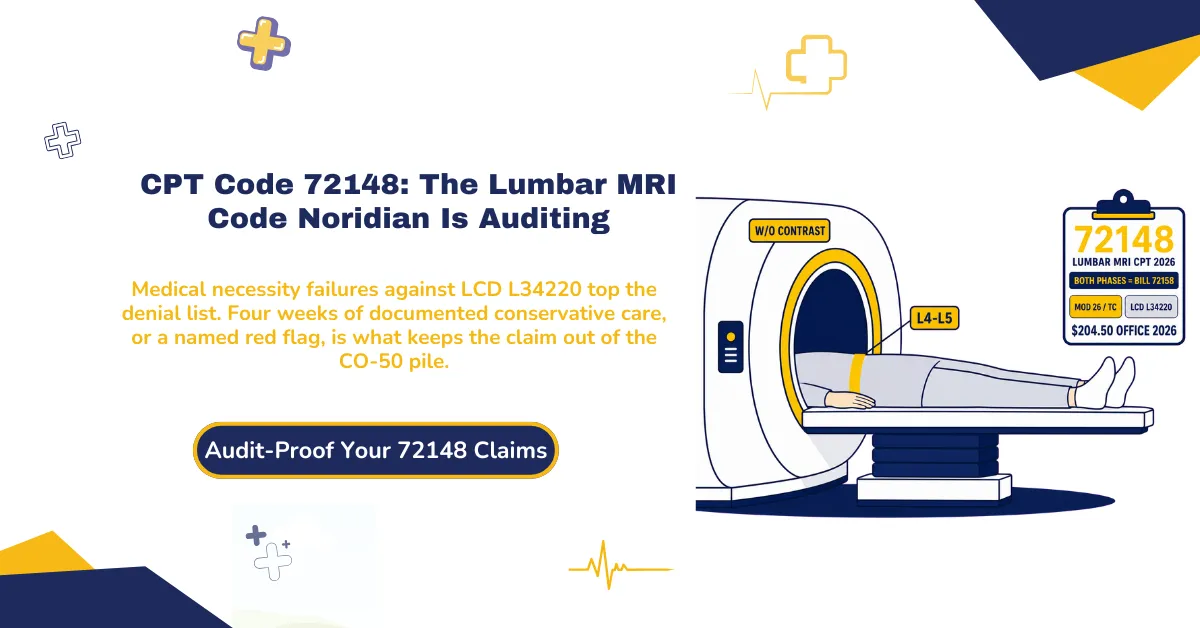
Medical necessity documentation failures for cpt code 72148 triggered an active Noridian Target Probe and Educate review in Q4 2025, and they’ve been the top denial reason in radiology for consecutive audit cycles. The exposure isn’t small. CPT 72148 accounts for roughly 2.8 million Medicare claims annually.
This guide covers the 2026 rates by site of service, modifier 26/TC split billing, LCD L34220 criteria, the California payer prior auth matrix, Noridian TPE defense, and denial appeal templates.
CPT 72148 accounts for approximately 2.8 million Medicare claims annually and was the subject of an active Noridian JE Part B Target Probe and Educate review in Q4 2025, with medical necessity documentation identified as the top denial reason.
| Field | Value |
|---|---|
| CPT Code | 72148 |
| AMA Full Descriptor | Magnetic resonance (e.g., proton) imaging, spinal canal and contents, lumbar; without contrast material |
| CMS Short Descriptor | MRI spine lumbar w/o dye |
| Code Type | Radiology |
| Work RVU | 1.44 |
| Total RVU (Non-Facility) | 5.74 |
| 2026 Non-Facility Rate | $204.50 |
| 2026 Facility Rate | $145.30 |
| 2026 CF (Non-QP) | $33.40 |
| 2026 CF (QP/APM Participant) | $33.57 |
| Annual Medicare Volume | 2.8 million claims |
| Patient Avg Cost-Share | ~$62 (Medicare.gov) |
| Governing LCD | L34220 (revised 10/23/2025) |
| MAC Jurisdiction | Noridian JE Part B |
| AUC Requirement | PAUSED since January 1, 2024 |
| Active TPE Review | Q4 2025 (results published) |
What Is CPT Code 72148?
Per the AMA CPT codebook, the full descriptor reads:
“Magnetic resonance (e.g., proton) imaging, spinal canal and contents, lumbar; without contrast material.”
The anatomical scope is the lumbar spine, L1 through the sacrum. It’s not cervical (C1-C7) and not thoracic (T1-T12). The MRI sequences captured under cpt code 72148 include T1-weighted imaging for bone marrow and disc morphology, T2-weighted imaging for fluid, disc hydration, and nerve root compression, and STIR or fat-suppressed sequences for edema, infection, and marrow lesions.
The “without contrast” scope means no gadolinium and no IV access required. The ordering physician must document why contrast wasn’t indicated when both sequences were considered.
72148 applies to disc herniation, radiculopathy evaluation, spinal stenosis workup, low back pain with red flags, and pre-surgical lumbar planning without hardware. It doesn’t apply to cervical or thoracic presentations. The code is reported once per study, not per sequence or imaging plane.
One 2026 coding note for the remittance side: the CMS short descriptor is “MRI spine lumbar w/o dye.” That’s the descriptor that appears on your remittance advice, so AR staff reconciling payments should recognize it as 72148.
CPT 72148 vs CPT 72149 vs CPT 72158: Which Code Applies?
The three lumbar MRI codes split on one variable: contrast. Picking the wrong one creates upcoding, downcoding, or a same-claim bundling denial.
| Code | Full Description | When to Use |
|---|---|---|
| 72148 | Lumbar MRI without contrast | No gadolinium administered; routine disc, nerve root, or soft tissue evaluation |
| 72149 | Lumbar MRI with contrast | Gadolinium administered; post-surgical hardware assessment, tumor workup, infection |
| 72158 | Lumbar MRI without and with contrast | Both sequences completed on the same date; use this, not 72148 plus 72149 |
The NCCI rule deserves its own callout. CPT codes 72148 and 72149 carry an NCCI Modifier Indicator of 0 for the same date of service and cannot be reported together on any claim. When a lumbar MRI study is performed both without and with contrast on the same date, the correct code is CPT 72158.
Practices that bill 72148 and 72149 together on the same claim receive an automatic denial with no appeal path on the bundling issue.
A common error pattern to flag: a facility bills 72148 (technical component) while the reading radiologist bills 72149 (professional component) on the same date for a without/with contrast study. The CPT mismatch between the facility and professional claims signals a documentation or coding inconsistency and generates payer inquiry. Both claims must report the same code.
The contrast documentation rule closes the loop. If gadolinium was administered, cpt code 72148 is incorrect regardless of how the order was written. The clinical record and the billing code must match the study that was actually performed.
Modifier 26 and TC: Split Billing Rules for CPT 72148
The highest-intent billing question on this code is who bills what. The answer follows equipment ownership and interpretation responsibility, and the cpt code 72148 modifier 26 decision starts there.
| Billing Scenario | What to Report | Who Reports It |
|---|---|---|
| Physician owns the MRI equipment and reads the study | 72148 (global, no modifier) | Single claim from physician/group |
| Hospital or IDTF owns scanner; radiologist reads independently | 72148-TC (facility) plus 72148-26 (radiologist) | Two separate claims |
| Teleradiology: remote read of an independently performed scan | 72148-26 only | Reading radiologist’s billing entity |
Modifier 26 carries four requirements:
- A signed, dated interpretation report in the medical record before billing
- The report must include the clinical indication, technique used, findings by structure, and impression
- Billing 72148-26 without the completed report generates a CO-50 medical necessity denial
- The report date must match the date of service on the claim
Modifier TC carries its own set:
- Documentation of the equipment used, sequences performed, and the contrast decision
- Site of service determines the TC rate (POS 11 non-facility versus POS 22 facility; Section 5 covers the dollar difference)
- The facility can’t bill Modifier TC for studies it didn’t technically perform
Additional modifiers apply in specific scenarios. Modifier 59 is required on the secondary study when MPPR applies on the same date (Section 6). Modifier 52 (reduced services) applies when the study was terminated before completion, with the reason documented in the record. Modifier 53 (discontinued) applies when the patient couldn’t remain for the full study, with circumstances documented.
Modifier 50 is never applicable to CPT 72148. The lumbar spine is a midline structure, and Modifier 50 is for bilateral paired structures.
The OIG pattern alert matters for split-ownership arrangements. The OIG has identified global billing of 72148 by radiologists who don’t own the imaging equipment as a recurring overpayment source.
When the scanner belongs to a hospital entity and a separately contracted radiologist performs the interpretation, billing globally shifts reimbursement from what the professional component alone supports to the full global rate.
Practices in this arrangement that bill globally face recoupment risk on post-payment review.
When a radiologist interprets a lumbar MRI performed at a hospital-owned facility, the correct billing is CPT 72148 with Modifier 26 for the professional component, while the hospital separately bills CPT 72148 with Modifier TC for the technical component. The OIG has identified global billing under these split-ownership arrangements as a recurring overpayment pattern.
The same professional and technical component billing rules that govern CPT 72148 also govern diagnostic studies like EEG claims under CPT 95819, where modifier 26 and TC determinations follow identical logic.
2026 Reimbursement Rates for CPT 72148
| RVU Component | Value |
|---|---|
| Work RVU | 1.44 |
| Total RVU (Non-Facility) | 5.74 |
| 2026 CF (Non-QP providers) | $33.40 |
| 2026 CF (QP/APM participants) | $33.57 |
| Non-Facility Allowed (Non-QP) | $204.50 |
| Facility Allowed (Non-QP) | $145.30 |
| Patient Avg Cost-Share (Medicare) | ~$62 |
[VERIFY: pull the full RVU breakdown (work, practice expense non-facility, practice expense facility, malpractice) from the 2026 CMS PFS Final Rule (CMS-1832-F) to complete this table. The 1.44 work RVU and 5.74 total non-facility RVU are confirmed.]
CPT 72148 carries a work RVU of 1.44 and a total non-facility RVU of 5.74. At the 2026 non-QP conversion factor of $33.40, Medicare reimburses $204.50 for office-based studies and $145.30 for hospital outpatient studies.
| Setting | POS Code | 2026 Medicare Rate |
|---|---|---|
| Physician office or private imaging center | 11 | $204.50 |
| Hospital outpatient department (HOPD) | 22 | $145.30 |
| Inpatient hospital | 21 | Professional component at facility rate; technical bundles to the inpatient DRG [VERIFY against CMS PFS] |
| Ambulatory surgery center | 24 | [VERIFY from 2026 CMS ASC payment file; do not publish blank] |
The rate difference between office and hospital outpatient settings reflects POS 22 billing rules that affect payment across all diagnostic services.
2026 is the first year CMS has published two separate conversion factors simultaneously. The 2026 Medicare Physician Fee Schedule introduced two separate conversion factors for the first time: $33.57 for qualified Alternative Payment Model participants and $33.40 for all other providers.
For 72148 claims specifically, the difference is $0.17 per claim. Across a high-volume radiology practice billing thousands of studies monthly, QPP participation status affects aggregate reimbursement meaningfully.
The 1.44 work RVU reflects the CMS permanent 2.5% efficiency adjustment applied across the 2026 PFS. The average reduction across 47 radiology codes is 2.15 percent.
The PAA query about cpt code 72148 cost means two different things depending on who’s asking. For providers, the 2026 Medicare rates are $204.50 (office) and $145.30 (hospital outpatient). For patients, Medicare.gov data shows an average cost-share of approximately $62 after the Part B deductible and 20 percent coinsurance.
Private payer rates vary by contract and can’t be generalized from Medicare benchmarks.
Multiple Procedure Payment Reduction: Same-Day Imaging With CPT 72148
When two or more diagnostic imaging studies are performed on the same patient on the same date, CMS MPPR rules apply. The study with the higher total RVU is the primary study and pays at 100 percent.
The secondary study’s technical component is reduced by 50 percent, and its professional component is reduced by 5 percent. Modifier 59 must be appended to the secondary study line item to prevent auto-denial.
From the lumbar-primary perspective: when cpt code 72148 is the primary study and a second spine MRI, such as a same-day cervical study under CPT 72141, appears on the same date, the 72148 claim pays at 100 percent. The second study pays at the reduced MPPR rate.
When CPT 72148 lumbar MRI and a second spine MRI study are performed on the same patient on the same date, MPPR rules reduce the technical component of the secondary study by 50 percent and the professional component by 5 percent. Modifier 59 must be appended to the secondary study line item.
The reconciliation trap is real. If your system expects full payment on both studies and the payer applies MPPR, the system flags a correct MPPR reduction as an underpayment or denial when it’s neither. The same MPPR logic applies across CMS service families, including the therapy reductions covered in our occupational therapy CPT codes guide.
Modifier 59 on the secondary study requires the clinical record to establish that both studies were separately ordered and medically necessary on the same date. Adding Modifier 59 without documentation of distinct medical necessity for each study is an audit trigger on post-payment review.
The biller checklist for same-day imaging:
- Identify which study has the higher total RVU; that’s the primary at 100 percent
- Confirm Modifier 59 is appended to the secondary study
- Verify your system applies the 50 percent TC reduction and 5 percent PC reduction to the secondary automatically
- Confirm both studies have distinct ICD-10 primary diagnoses, or a shared diagnosis with documented separate clinical necessity
LCD L34220: Medical Necessity Criteria That Govern Every CPT 72148 Claim
LCD L34220 is the Noridian JE Part B Local Coverage Determination governing Medicare coverage for lumbar spine MRI services, including cpt code 72148. The LCD was revised effective October 23, 2025. It’s the primary governing document that determines whether a 72148 claim adjudicates as medically necessary or generates a CO-50 denial.
Every practice billing 72148 to Medicare in Noridian jurisdictions, which cover California and seven other western states, must document against this LCD’s criteria on every claim.
LCD L34220, revised effective October 23, 2025, requires documentation of at least four weeks of failed conservative treatment before Medicare will approve coverage for CPT 72148 in non-urgent presentations. Conservative treatment includes physical therapy, chiropractic manipulation, NSAIDs, and muscle relaxants. The documentation must include:
- The specific treatment modalities used
- The frequency and duration of treatment
- The treating provider’s assessment of patient response
- Why the patient’s condition has not resolved with conservative care
The most common CO-50 denial path for 72148 is a clinical note that documents back pain without any treatment history. “Back pain, MRI ordered” is not a medically necessary indication under LCD L34220. “Low back pain with radiculopathy; six weeks of physical therapy completed without improvement; MRI ordered for surgical planning evaluation” is.
| Red Flag | Clinical Presentation |
|---|---|
| Trauma | Major trauma mechanism with acute neurological symptoms |
| Known cancer history | Malignancy history with new neurological symptoms or new-onset back pain |
| Fever | Unexplained fever with back pain (infection or abscess) |
| Unexplained weight loss | Unintentional weight loss with new back pain (malignancy pattern) |
| Active infection or IV drug use | Sepsis risk, spinal epidural abscess |
| Immunosuppression | Organ transplant recipient, chronic corticosteroid use, HIV |
| Night or supine pain | Pain that worsens when recumbent (infection, tumor) |
| Saddle anesthesia | Perianal or perineal numbness (cauda equina urgency) |
| Bladder or bowel dysfunction | New urinary retention, incontinence, or fecal incontinence |
| Progressive neurologic deficit | Worsening motor weakness, new drop foot, or expanding sensory deficit on serial examination |
LCD L34220 red flags that waive the four-week conservative treatment requirement include active cancer history with new neurological symptoms, unexplained fever with back pain, unintentional weight loss, IV drug use with spinal symptoms, saddle anesthesia, new bladder or bowel dysfunction, and progressive motor deficit on serial examination.
The documentation standard for red flag exceptions is objective. The clinical note must name the specific red flag, describe the objective findings rather than just the symptom, and state why immediate MRI is clinically necessary.
“Rule out pathology” without documented objective red flag findings doesn’t satisfy the LCD. “Progressive lower extremity weakness over 72 hours with decreased deep tendon reflexes bilaterally; MRI ordered urgently to evaluate for cauda equina syndrome” satisfies the LCD.
The coverage statement runs both ways. LCD L34220 covers cpt code 72148 for disc herniation with documented radiculopathy, spinal stenosis with neurogenic claudication or nerve root compression, spondylolisthesis with neurological symptoms, and pre-surgical lumbar evaluation.
It doesn’t cover 72148 for routine surveillance, non-specific back pain without a documented treatment trial, or imaging motivated by patient preference alone. The same LCD-governs-the-family logic applies across code sets, the way LCD L34587 governs the wound care CPT codes family.
ICD-10 Codes for CPT 72148: Medical Necessity Documentation
The payer’s first automated edit on every cpt code 72148 claim checks whether the primary diagnosis code supports the procedure. Non-specific codes without corroborating clinical documentation generate automatic medical necessity scrutiny before a human reviewer ever sees the claim.
| ICD-10 Code | Description | Documentation Requirement |
|---|---|---|
| M54.50 | Low back pain, unspecified | Requires conservative treatment history in the clinical note |
| M54.51 | Vertebrogenic low back pain | Must link to specific vertebral pathology documented on exam |
| M54.59 | Other low back pain | Specific etiology named in the clinical note |
| M51.16 | Intervertebral disc degeneration, lumbar region | Imaging order must specify disc levels and clinical symptoms |
| M51.26 | Other intervertebral disc displacement, lumbar region | Radiculopathy symptoms documented with dermatomal distribution |
| M48.06 | Spinal stenosis, lumbar region | Neurogenic claudication or nerve root compression documented on exam |
| M43.16 | Spondylolisthesis, lumbar region | Grade and symptom severity documented |
| M54.4x | Lumbago with sciatica | Dermatomal distribution and provocative testing documented |
The M54.5 family was expanded to M54.50, M54.51, and M54.59 effective October 1, 2021, and all three remain valid under the FY2026 ICD-10-CM file effective October 1, 2025. [VERIFY: blueprint flag resolved; confirm against the FY2026 file as a final pre-publication check.]
For CPT 72148 medical necessity documentation, the ICD-10 primary diagnosis must link directly to the clinical indication for lumbar MRI. Codes including M48.06 (spinal stenosis, lumbar region) and M51.26 (intervertebral disc displacement, lumbar region) carry strong LCD L34220 alignment when supported by documented neurological symptoms and failed conservative treatment.
Three patterns generate CO-50 denials when used as the sole primary diagnosis without supporting documentation. Z00.00 (routine exam): no medical necessity exists for diagnostic MRI on a well encounter. M79.3 (panniculitis): a soft tissue condition, not a spinal imaging indication.
M54.50 as the sole diagnosis with no clinical documentation trail generates automatic scrutiny on claims submitted to payers running LCD-edit logic.
The sequencing rule completes the picture. The primary diagnosis must be the condition motivating the MRI order. Secondary codes can include comorbidities affecting the clinical picture such as diabetes, obesity, or prior surgery. Sequencing a non-spine comorbidity as the primary diagnosis when the MRI was ordered for a lumbar indication causes CPT-to-ICD linkage failures.
California Payer Prior Authorization Requirements for CPT 72148
California ranks among the highest-scrutiny states for outpatient diagnostic imaging prior authorization. All four major commercial and Medicaid payers in the ClaimMax service market require authorization for cpt code 72148 in most plan configurations. A missing or misapplied prior auth is the fastest path from a valid clinical order to a CO-15 denial.
| Payer | Prior Auth Required | Documentation Required | Submission Method |
|---|---|---|---|
| Blue Shield of California | Yes (commercial plans; verify plan tier) | Clinical notes, conservative treatment history, ordering provider info | [VERIFY: 2026 Blue Shield CA provider portal name and URL] |
| Anthem California | Yes (most commercial plans) | LCD-aligned clinical documentation | [VERIFY: 2026 Anthem CA prior auth portal and requirements] |
| Health Net Medi-Cal | Yes (Medi-Cal managed care) | Prior auth plus LCD-aligned documentation; peer-to-peer available for denials | [VERIFY: Health Net Medi-Cal 2026 provider manual requirements] |
| UHC Community Plan (CA Medicaid) | Yes | Clinical review, treatment failure documentation | [VERIFY: UHC Community Plan CA 2026 prior auth requirements] |
ClaimMax RCM’s prior authorization services manage the full auth request, tracking, and documentation workflow for imaging and diagnostic procedures across all California payer types.
Five failure points account for most prior auth denials on this code:
- Missing four-week conservative treatment documentation in the auth submission (LCD L34220 requirement; payers mirror this standard)
- Auth obtained for 72149 (with contrast) but the claim submitted as 72148 (without contrast); the CPT code on the claim must exactly match the authorized code
- Authorization number missing from Box 23 of the CMS-1500
- Prior auth obtained but the service date falls outside the auth validity window
- Retrospective authorization requests denied; most California commercial payers don’t accept retro auth for elective imaging that lacked emergent justification
Health Net Medi-Cal and UHC Community Plan both operate as managed care organizations under California’s Medi-Cal program. Prior auth rules for 72148 under these plans track the Medi-Cal managed care framework rather than standard commercial rules. See ClaimMax’s Medi-Cal billing guide for program structure across California managed care organizations.
Noridian TPE Review: Protecting CPT 72148 Claims From Audit
Noridian JE Part B, the Medicare Administrative Contractor for California and seven other western states, conducted an active Target Probe and Educate review of cpt code 72148 claims during Q4 2025, covering dates of service October 1 through December 31, 2025.
Results have been published on the Noridian provider portal. [VERIFY: confirm the exact URL path on med.noridianmedicare.com and insert the published error rate, sample size, and top denial reason breakdown before publication.]
Noridian JE Part B conducted an active Target Probe and Educate review of CPT 72148 claims during Q4 2025 (October 1 through December 31, 2025). Published results identified medical necessity documentation failures against LCD L34220 criteria as the primary denial reason.
The specifics behind that finding: missing conservative treatment history, clinical notes that document symptoms without the treatment trial, and red flag exceptions claimed without objective supporting findings in the record.
TPE selection is automated. Providers are selected based on analysis of claim error rates, with no complaint or tip required. Practices with 72148 denial rates above the Noridian national benchmark are candidates. First-round TPE includes a documentation review and a provider education session.
Second-round TPE with an elevated error rate triggers further review options, including potential payment suspension authority. Getting the first round right matters.
The TPE defense checklist runs six items:
- The clinical note names the specific indication for lumbar MRI
- Conservative treatment history is present with modalities, dates, frequency, and patient response
- A red flag exception, if used, is named and supported by objective findings on physical examination
- The interpretation report is signed, dated, and includes indication, technique, findings by level, and impression
- Modifier 26 or TC is assigned correctly for the billing entity’s operational role
- The ICD-10 primary diagnosis is LCD L34220-aligned
RAC scrutiny on high-volume diagnostic studies follows a similar audit defense logic to TPE. See how echocardiogram claims handle documentation-level review in our CPT 93306 RAC audit defense guide.
2026 Regulatory Updates Affecting CPT 72148 Claims
The CMS Appropriate Use Criteria program for advanced diagnostic imaging, including CPT 72148 lumbar MRI, has been paused since January 1, 2024. A CMS.gov page confirmed this status as of March 10, 2026. No AUC or CDSM order is required on CPT 72148 claims submitted after January 1, 2024.
The practical implication: verify that your practice management system and EHR have suppressed any AUC prompts or CDSM order fields for 72148 orders placed after January 1, 2024. Including AUC order information on post-2024 claims is unnecessary.
Several billing guides currently indexed in search results still instruct billers to obtain AUC orders for cpt code 72148. That instruction was accurate before January 1, 2024. It’s outdated for every claim you’re submitting today.
The Q3 2026 NCCI update lands next. NCCI PTP table version 32.2 (Transmittal R13667CP), posted June 1, 2026 and effective July 1, 2026, should be reviewed at the practice level for any new bundling pairs involving CPT 72148. This article publishes June 6, 2026, a 25-day window before the effective date.
For 72148 billing, the established NCCI bundling rule to know is that contrast administration codes (CPT 96360 through 96379) aren’t separately reportable with CPT 72149 or 72158. For 72148 without contrast, no contrast is administered and this bundling scenario doesn’t apply. Review Transmittal R13667CP for any new 72148-specific pairs added with the July 1, 2026 effective date.
Confirm which conversion factor applies to your practice’s QPP participation status before configuring 2026 fee schedules for CPT 72148. Section 5 covers the full two-tier structure.
Denial Codes and Appeals: Recovering Denied CPT 72148 Claims
| Denial Code | Description | Root Cause for CPT 72148 | First Recovery Action |
|---|---|---|---|
| CO-50 | Not medically necessary | LCD L34220 criteria missing from clinical note | Appeal with complete note, four-week treatment history, ordering physician attestation |
| CO-97 | Bundled service | 72148 and 72149 billed together (NCCI Indicator 0) | Recode as 72158 if both sequences performed; resubmit with corrected code |
| CO-15 | Prior auth missing | Auth not obtained or not entered in Box 23 | Request retro auth if available; appeal with medical necessity documentation |
| CO-18 | Exact duplicate claim | Claim resubmitted before original adjudicated | Verify original claim status first; do not resubmit while the original is pending |
| CO-167 | Diagnosis not covered | ICD-10 primary diagnosis not LCD-aligned | Recode with correct primary ICD-10 and resubmit with updated documentation |
| PR-1 | Patient deductible | Part B deductible not met | Bill patient correctly; this is not a payer error and does not require resubmission |
CO-50 is the highest-volume denial for cpt code 72148 and the top finding from Noridian’s Q4 2025 TPE review. The appeal path: submit the complete clinical note, the conservative treatment history with dates and provider documentation, a copy of LCD L34220’s covered indications, and a signed attestation from the ordering physician confirming medical necessity.
Generic appeal letters without the specific LCD documentation evidence don’t succeed. Map the documentation line by line to the LCD criteria.
CO-97 resolution depends on what was actually performed. When 72148 and 72149 have already been billed together and denied, determine from the clinical record which study happened. If both sequences were completed on the same date, recode to 72158 and resubmit as a corrected claim.
If only one sequence was performed and the wrong code was used, recode to the correct single code. Don’t void both lines and resubmit without verifying the actual study from the radiology report.
CO-18 is the most preventable denial on this list. Resubmitting a 72148 claim while the original is still in payer hold generates an exact duplicate denial. Check claim status before any resubmission. For the full resolution workflow, see ClaimMax’s CO-18 duplicate claim denials guide.
Every item on this checklist is a clean claim requirement that prevents denial before it occurs:
- LCD-aligned ICD-10 code as the primary diagnosis
- Conservative treatment history or a documented red flag exception in the clinical note
- Modifier 26 or TC assigned correctly for the billing entity’s role
- Prior auth number in Box 23 for California payers
- AUC order field suppressed for post-January 1, 2024 claims
- Correct CPT: 72148 for without contrast, not 72149 or 72158
- Interpretation report signed, dated, and complete before billing Modifier 26
ClaimMax RCM’s denial management services team reviews 72148 and diagnostic imaging claims for root cause patterns, executes appeals within payer windows, and eliminates the coding configuration errors that generate repeat denials.
ClaimMax RCM: CPT 72148 Denial Recovery and Billing Compliance
At radiology volume, persistent 72148 medical necessity denials compound fast. A practice reading thousands of lumbar studies annually with an elevated CO-50 rate is writing off recoverable revenue every single month, and each unworked denial ages toward the timely filing wall.
ClaimMax RCM handles radiology billing compliance, denial recovery, and AR follow-up for imaging practices across California and nationwide. Contact ClaimMax RCM for a claims review, or start with the medical billing service and revenue cycle management services pages to see how the team works imaging claims from order to payment.
This guide is for billing and revenue cycle professionals and reflects the 2026 CMS Physician Fee Schedule (CMS-1832-F), LCD L34220 (revised October 23, 2025), NCCI PTP v32.2 (Transmittal R13667CP, effective July 1, 2026), and Noridian JE Part B TPE program data current as of June 6, 2026. CPT codes and descriptors are copyrighted by the American Medical Association. Verify all rates, LCD criteria, and payer policies against current CMS, Noridian, and payer sources before claim submission. Authored by Dr. Mateo Vargas, CPC, CPB, ClaimMax RCM.