
A practice submits a clean Medicaid claim. The clearinghouse confirms acceptance. Three weeks later, the ERA returns CARC 29: time limit for filing has expired. The biller checks the dates. The claim was submitted within what looked like a reasonable window. What happened?
Timely filing for Medicaid is the maximum period state Medicaid agencies and Managed Care Organizations allow providers to submit claims after the date of service, ranging from 90 days to 12 months depending on state, plan type, and provider category.
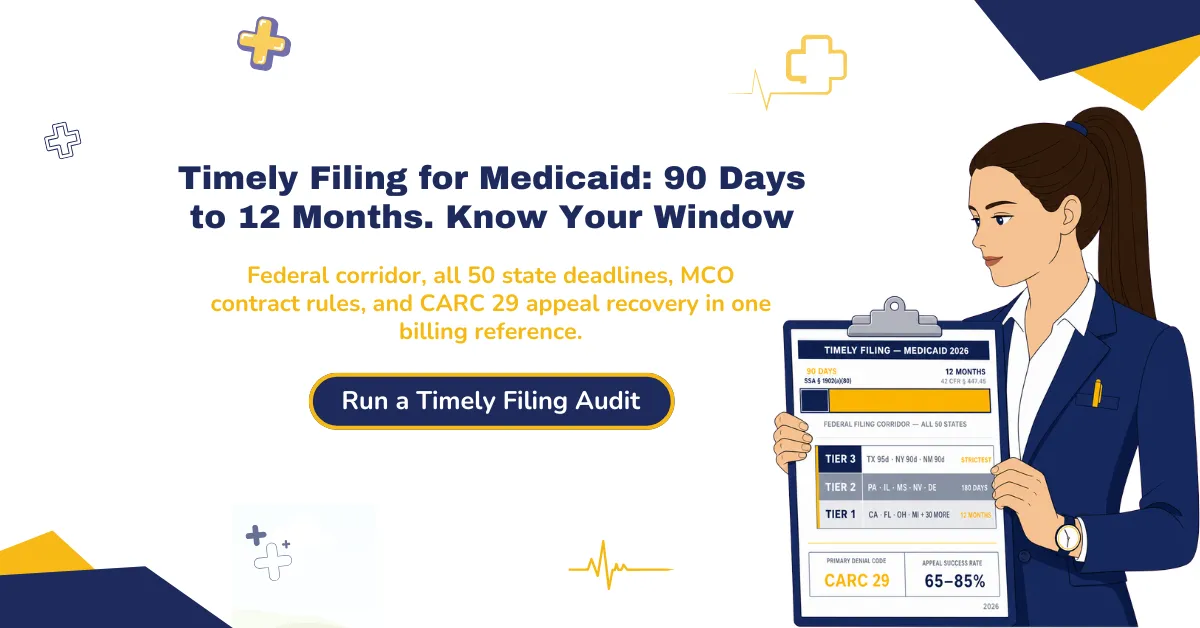
Per 42 CFR § 447.45, federal law caps the maximum at 12 months from the date of service, but states routinely set shorter deadlines through their State Plan or MCO contracts. Texas Medicaid applies 95 days. Pennsylvania applies 180 days. New York Medicaid applies 90 days for non-institutional claims.
Get the deadline wrong by one day and the revenue is gone.
The stakes climbed in 2026. CMS-0057-F took effect January 1, 2026, mandating FHIR-based prior authorization APIs across Medicaid payers. Post-PHE Medicaid unwinding continues to produce retroactive eligibility determinations that reset filing windows. CMS-2439-F’s managed care transparency provisions reshape MCO denial patterns.
This guide covers the federal framework (42 CFR § 447.45 plus Social Security Act § 1902(a)(80)), all 50 state deadlines, MCO contract variance, the seven federally recognized exceptions, the appeal letter framework with eight-document evidence matrix, and the EDI proof-of-timely-filing protocol, built specifically for the 2026 regulatory environment.
Claimmax RCM has spent the last 15 years protecting Medicaid revenue across the patchwork of state deadlines, MCO contracts, dual eligible crossover rules, and exception pathways most billing teams aren’t equipped to navigate. This is the playbook.
QUICK ANSWER: What Is the Timely Filing Limit for Medicaid?
The timely filing limit for Medicaid ranges from 90 days to 12 months from the date of service, depending on the state, Managed Care Organization, and provider type. Per 42 CFR § 447.45(d), federal law sets a maximum 12-month ceiling for original claim submission, while Social Security Act § 1902(a)(80) establishes a 90-day federal floor. States impose shorter deadlines through their State Plan or MCO contracts: Texas Medicaid applies 95 days, New York applies 90 days, Pennsylvania applies 180 days, and California Medi-Cal applies 12 months for fee-for-service claims per DHCS.
The Federal Foundation: What CMS Actually Requires Under 42 CFR § 447.45
Federal law creates both a ceiling and a floor for Medicaid timely filing. Most billing teams know the ceiling. Almost none know the floor. Both matter operationally, and understanding both is what separates a recoverable denial from permanent revenue loss.
42 CFR § 447.45(d): The 12-Month Federal Ceiling
The Centers for Medicare and Medicaid Services governs Medicaid timely filing through 42 CFR § 447.45, which states verbatim: “The Medicaid agency must require providers to submit all claims no later than 12 months from the date of service.” This regulation establishes the federal ceiling.
No state Medicaid program can allow providers more than 12 months to submit an original claim under fee-for-service rules. The 12-month period anchors to the date of service for outpatient claims and to the discharge date for inpatient and institutional claims.
See the full regulatory text at 42 CFR § 447.45 (eCFR). The 12-month ceiling applies to original claim submission, not corrected claims, appeals, or adjustments. Federal law explicitly permits states to set shorter limits through State Plan amendments or MCO contracts.
Approximately 30 of 50 states currently apply the full 12-month ceiling for fee-for-service claims. The remaining states impose shorter deadlines, with Texas Medicaid Fee-for-Service applying 95 days as the strictest in the nation for acute care.
For the broader Medicaid billing framework providers operate within, our Medicaid billing framework covers eligibility verification, MCO assignment, and claim submission workflow at depth.
Social Security Act § 1902(a)(80): The 90-Day Federal Floor
Federal law also establishes a minimum standard. Under Social Security Act § 1902(a)(80), enacted through the Deficit Reduction Act of 2005 (DRA 2005, Public Law 109-171), states must allow providers at least 90 days from the date of service to submit Medicaid claims. The 90-day period is a floor, not a ceiling.
States can’t legally set timely filing windows shorter than 90 days for original claim submission, but they can set windows anywhere between 90 days and 12 months.
The 90-day floor was specifically codified to prevent states from imposing impossibly short deadlines that would systematically deny providers reasonable submission windows. New York Medicaid Fee-for-Service operates at the 90-day floor for non-institutional claims, with documented exceptions extending up to 15 months. Texas Medicaid’s 95-day rule sits just above the federal floor.
The federal floor and ceiling together create a 90-day to 12-month corridor within which all 50 state Medicaid timely filing windows must operate.
Why the Federal Floor and Ceiling Both Matter
Most competitor content cites the 12-month ceiling and stops there. That’s incomplete. The federal floor matters operationally because it sets the absolute minimum window every state must honor, which becomes the appeal foundation when a state or MCO appears to enforce a shorter window than the law permits.
When a Medicaid MCO denies a claim filed at day 89, the 90-day floor under SSA § 1902(a)(80) becomes the basis for a federal preemption argument. Knowing the floor exists is what separates a recoverable denial from a permanent revenue loss.
The 90-day floor applies to fee-for-service Medicaid claim submission directly. MCO contracts can establish their own contracted deadlines, but state-level floor protections influence how those contracts get interpreted in disputes. This dual-anchor framework is what differentiates compliant timely filing management from amateur management.
How Federal Rules Interact with State Authority
States administer Medicaid under federal authority but maintain significant operational discretion through CMS-approved State Plan amendments. The State Medicaid Manual, maintained by CMS, provides the operational framework states use to set their specific timely filing windows.
Approximately 30 states use 12 months, five states use 180 days (Pennsylvania, Illinois, Mississippi, Nevada, Delaware), and three states use sub-180-day windows (Texas at 95 days, New York at 90 days, New Mexico at 90 days). Federal preemption can override state rules when state windows fall below the 90-day floor.
The 90-Day Floor and 12-Month Ceiling: How the Federal Framework Actually Works
The 90-day floor under Social Security Act § 1902(a)(80) and the 12-month ceiling under 42 CFR § 447.45(d) together establish what we call the federal Medicaid TF corridor. Every state Medicaid program in the United States, plus the District of Columbia and U.S.
territories, must set their original claim submission window somewhere between 90 days and 12 months from the date of service. No state can legally compress timely filing below 90 days. No state can extend it beyond 12 months for fee-for-service Medicaid without CMS waiver approval.
States at the 90-Day Floor (NY, TX, NM)
New York Medicaid Fee-for-Service: 90 days for non-institutional claims per eMedNY Provider Manual, with exceptions extending up to 15 months for documented circumstances. Texas Medicaid Fee-for-Service: 95 days per TMHP, sitting just 5 days above the federal floor. New Mexico Medicaid: 90 days per HSD Provider Manual, with exceptions available.
These three states represent the strictest end of the corridor, where every claim demands aggressive front-end submission discipline. Practices billing across multiple of these states need state-specific submission triggers built into their workflow for timely filing for Medicaid.
States at the 12-Month Ceiling (CA, FL, OH, MI, GA, NC + 25 More)
California Medi-Cal Fee-for-Service: 12 months from DOS per DHCS Provider Manual (note: Medi-Cal Managed Care plans operate under separate, plan-specific contracts, often six months). Florida Medicaid Fee-for-Service: 12 months per AHCA Medicaid Provider Handbook (Managed Medical Assistance plans use shorter contracted windows, often 180 days).
Ohio, Michigan, Georgia, North Carolina, Virginia, Washington, Arizona, Massachusetts, Indiana, Tennessee, Missouri, Maryland, Wisconsin, Minnesota, Colorado, Alabama, South Carolina, Kentucky, Oregon, Oklahoma, Connecticut, Iowa, Mississippi, and Arkansas all apply the 12-month ceiling for fee-for-service claims.
These states represent the maximum corridor end, where compliance discipline still matters because MCO contracts often impose shorter windows.
Why Claims Get Denied Inside the Corridor
The corridor framework would be simple if states alone enforced timely filing for Medicaid. The complication: Medicaid MCOs operate inside the corridor with contracted deadlines that may sit anywhere between 90 days and 12 months. A claim filed within the state’s 12-month FFS window can still deny under a 90-day MCO contract.
Understanding which entity (state Medicaid agency or MCO) actually adjudicated the claim determines which window applied.
Medicaid MCO Timely Filing: The 42 CFR § 438.3(s) Framework
As of 2026, over 70 percent of Medicaid beneficiaries are enrolled in Managed Care Organizations rather than fee-for-service Medicaid, per CMS Medicaid Managed Care Enrollment data. That’s approximately 65 to 68 million beneficiaries whose claims adjudicate under MCO contract rules, not state fee-for-service rules.
For most providers, MCO timely filing windows govern the majority of claim submissions, and those windows often run shorter than the state FFS deadline, sometimes as short as 90 days for behavioral health and specialized networks.
42 CFR § 438.3(s): What MCO Contracts Must Include
Per 42 CFR § 438.3(s) (eCFR), Medicaid MCO contracts must include provisions for timely claim submission. The regulation requires that MCOs publish their timely filing rules in provider contracts, online provider manuals, and EOC documents.
MCO timely filing limits must align with state Medicaid agency guidance but can be set shorter than the state fee-for-service deadline.
The regulation doesn’t establish a specific MCO floor below the federal 90-day Social Security Act § 1902(a)(80) floor, but most MCOs respect the 90-day floor in practice as a contract enforceability matter. MCOs that set sub-90-day windows risk federal preemption challenges in dispute scenarios.
Major Medicaid MCO Timely Filing Windows (2026 Reference)
| MCO | Typical Timely Filing Window (2026) | Notes |
|---|---|---|
| Molina Healthcare (Medicaid) | 90 to 180 days (state-specific) | Varies by state contract; many states 120 days |
| UnitedHealthcare Community Plan | 90 to 365 days (state-specific) | Check state-specific EOC |
| Centene/WellCare (Medicaid) | 90 to 365 days (state-specific) | State contract controls; 180 days common |
| Anthem/Elevance Health (Medicaid) | 90 to 365 days (state-specific) | Per provider agreement; Anthem Medicaid timely filing limit for corrected claims varies |
| Aetna Better Health (Medicaid) | 90 to 365 days (state-specific) | Timely filing for Aetna Medicaid: state contract controls; 120 days common |
| Amerigroup (Elevance) | 90 to 365 days (state-specific) | Check provider manual |
| Meridian Health Plan | 90 to 365 days (state-specific) | State contract controls |
| CareSource | 90 to 365 days (state-specific) | Verify per market; UHC Medicaid timely filing for corrected claims and Molina Medicaid timely filing for corrected claim follow plan-level rules |
Every Medicaid MCO provider contract must be reviewed for its specific timely filing clause. This is a non-negotiable step in RCM contract management. Posted MCO windows in provider portals supersede general guidance documents.
How MCO Rules Override State FFS Deadlines
When a state Medicaid program operates fee-for-service alongside MCOs, the MCO contract deadline applies to MCO-enrolled beneficiaries. Real-world example: Texas Medicaid FFS applies 95 days; Texas Medicaid managed care plans (Molina Healthcare of Texas, UnitedHealthcare Community Plan of Texas, Superior HealthPlan) each apply their own contracted deadlines.
A provider billing across multiple MCOs in a single state must track each MCO’s deadline separately as distinct payer rules.
The MCO Provider Contract Review Imperative
Many providers don’t realize their MCO contracts contain timely filing clauses different from the public-facing provider manual. Contract clauses can establish more restrictive (or in rare cases more permissive) windows than the manual. Annual contract review at credentialing renewal captures these clauses.
Practices that don’t audit MCO contracts annually accumulate compliance gaps that surface as denials later. Our complete Medicaid MCO billing framework covers each major MCO’s contract structure and timely filing variance at depth.
The 2026 Regulatory Update Stack: What Changed and What’s Coming
This is the freshness moat no competitor has. Zero competitors have embedded CMS-0057-F or CMS-2439-F at operational depth. Both are published 2024 final rules with 2026 compliance dates that directly affect Medicaid timely filing. Embedding both establishes authority beyond any static state-deadline list.
CMS-2439-F: Medicaid and CHIP Managed Care Final Rule
CMS published the Medicaid and CHIP Managed Care Final Rule (CMS-2439-F) on April 22, 2024, with effective date July 9, 2024 and phased implementation through 2026. The rule strengthens four areas that directly affect Medicaid timely filing: network adequacy standards, grievance and appeals timeframes, claims processing transparency, and standardized prior authorization timeframes.
MCOs must now respond to standard prior authorization requests within 7 calendar days and urgent requests within 72 hours. This compresses the prior authorization clock and reduces one of the documented exception bases for late claim submission.
The claims processing transparency provisions strengthen the documentation MCOs must provide on timely filing denials, supporting provider appeals. The grievance and appeals timeframe provisions create defined windows for MCOs to acknowledge and resolve timely filing disputes.
CMS-0057-F: Interoperability and Prior Authorization Final Rule (Effective January 1, 2026)
The CMS Interoperability and Prior Authorization Final Rule (CMS-0057-F), published January 17, 2024 with most provisions effective January 1, 2026, mandates that impacted Medicaid payers (FFS and MCOs) implement FHIR-based Prior Authorization APIs. Real-time PA decisions reduce one of the most common causes of delayed claim submission.
Electronic tracking of PA requests creates a documented audit trail providers can use to justify timely filing exceptions when PA delays cause submission delays.
Starting January 1, 2026, EHR and billing systems must be integrated with Medicaid payer APIs. Practices that aren’t connected face both PA delays AND timely filing denials simultaneously. The CMS-0057-F PA API mandate directly affects timely filing for Medicaid because PA delays are a documented exception basis.
Our prior authorization workflow service supports providers integrating FHIR-compliant PA tracking with timely-filing-aware claim submission.
Post-PHE Medicaid Unwinding: Continuing Implications Through 2026
The COVID-19 Public Health Emergency ended May 11, 2023, but its effects persist into 2026. Continuous enrollment provisions ended, triggering large-scale Medicaid redeterminations through 2024 and into 2025.
CMS State Health Officials (SHO) letters confirm that retroactive Medicaid eligibility changes entitle providers to extended timely filing periods from the date of eligibility determination, not the date of service. Patients whose Medicaid coverage lapsed and was reinstated give providers a fresh timely filing window from the new eligibility determination date.
This is one of the most underreported timely filing rules in the post-PHE environment.
What’s Coming Beyond 2026
The CMS Medicaid Data Quality Initiative will improve claims data quality reporting across state programs. Value-based care expansion in Medicaid introduces ACO models with different submission rules than FFS. CMS-2439-F managed care reporting requirements continue through 2027. Practices that build timely filing compliance infrastructure in 2026 are positioned for the 2027 to 2028 changes.
All 50 States + DC: Complete Medicaid Timely Filing Reference for 2026
Molina Healthcare, UnitedHealthcare Community Plan, Centene/WellCare, Anthem/Elevance Health, and Aetna Better Health each set state-specific Medicaid timely filing windows ranging from 90 to 365 days depending on contract. But before MCO rules apply, the state FFS window establishes the outer boundary. Here’s the complete reference.
How to Use This Reference
All deadlines below reflect state Medicaid Fee-for-Service (FFS) timely filing windows for original claim submission. Each state’s MCO plans operate under separate contracted deadlines that may be shorter. Always verify current deadlines with the state Medicaid agency provider manual or MCO contract before final submission decisions.
Resubmission and correction windows are listed where states publish them. For states marked “varies,” consult the specific MCO or contact the state Medicaid agency. All sources cited are official state Medicaid agency publications.
Tier 1: States with 12-Month (365-Day) Timely Filing Limits
| State | Filing Deadline | Resubmission Window | Official Source |
|---|---|---|---|
| Alabama | 12 months from DOS | 6 months post-denial | AL Medicaid Provider Manual |
| Alaska | 12 months | 180 days after denial | AK DHSS Provider Manual |
| Arkansas | 12 months | varies | AR DHS Medicaid Provider Manual |
| California (Medi-Cal FFS) | 12 months from DOS | 60 days for corrected claims | DHCS Provider Manual |
| Colorado | 12 months | varies | HCPF Provider Manual |
| Connecticut | 12 months | varies | DSS Provider Manual |
| Florida | 12 months | 6 months for adjustments | AHCA Medicaid Provider Handbook |
| Georgia | 12 months | varies | DCH Provider Manual |
| Hawaii | 12 months | varies | Med-QUEST Provider Manual |
| Idaho | 12 months | varies | IDHW Provider Portal |
| Indiana | 12 months | 90 days after denial | IHCP Provider Manual |
| Iowa | 12 months | 6 months correction | IA DHS Provider Manual |
| Kansas | 12 months | varies | KDHE Provider Manual |
| Kentucky | 12 months | 120 days resubmission | KY DMS Provider Bulletins |
| Louisiana | 12 months | 24 months for retroactive | LA LDH Provider Manual |
| Maine | 12 months | varies | ME DHHS Medicaid Provider |
| Maryland | 12 months | 6 months correction | MD MDH Provider Manual |
| Massachusetts | 12 months | varies | MassHealth Billing Guide |
| Michigan | 12 months | 120 days | MDHHS Provider Manual |
| Minnesota | 12 months | varies | MN DHS Provider Manual |
| Missouri | 12 months | varies | MO HealthNet Provider Manual |
| Montana | 12 months | varies | DPHHS Provider Manual |
| Nebraska | 12 months | varies | NE DHHS Provider Manual |
| New Hampshire | 12 months | varies | NH DHHS Provider Manual |
| North Carolina | 12 months | 180 days correction | NCTracks Portal Policy |
| North Dakota | 12 months | varies | ND DHS Provider Manual |
| Ohio | 12 months | 180 days resubmission | ODM Provider Agreement |
| Oklahoma | 12 months | 6 months resubmission | SoonerCare Provider Manual |
| Oregon | 12 months | varies | OHA Provider Guide |
| Rhode Island | 12 months | varies | EOHHS Provider Manual |
| South Carolina | 12 months | varies | SCDHHS Provider Manual |
| South Dakota | 12 months | 180 days | SD DSS Provider Manual |
| Tennessee | 12 months | 6 months | TennCare Policy |
| Vermont | 12 months | varies | VT DVHA Provider Manual |
| Virginia | 12 months | 6 months | VA DMAS Provider Manuals |
| Washington | 12 months | 24 months for retroactive | WA HCA Provider Guide |
| West Virginia | 12 months | varies | WV DHHR Provider Manual |
| Wisconsin | 365 days | 180 days | WI DHS ForwardHealth |
| Wyoming | 12 months | varies | WY WDH Medicaid Provider |
For California specifically, CalAIM’s expanded service categories (Enhanced Care Management, Community Supports) follow standard Medi-Cal 12-month timely filing rules but require additional documentation. Our California revenue cycle management 2026 guide covers the AB 3275 prompt pay law and Medi-Cal-specific workflow.
Tier 2: States with 6-Month (180-Day) Timely Filing Limits
| State | Filing Deadline | Resubmission Window | Notes |
|---|---|---|---|
| Delaware | 180 days | varies | DMMA Provider Manual |
| Illinois | 180 days | 180 days after denial | HFS Provider Notice |
| Mississippi | 180 days | 6 months resubmission | MS DOM Provider Manual |
| Nevada | 6 months (180 days) | varies | DHCFP Provider Manual |
| Pennsylvania | 180 days | 60 days correction | PA DHS Provider Handbook |
Pennsylvania, Illinois, and Mississippi historically operated at 180 days; Nevada and Delaware joined this tier in policy refreshes. Pennsylvania’s 180-day rule applies to AmeriHealth Caritas Pennsylvania, PA Health and Wellness, and other PA Medicaid managed care plans. Illinois Medicaid Fee-for-Service applies 180 days for non-institutional claims.
The Tier 2 states create the most operational timely filing for Medicaid risk because the 180-day window often expires before commercial primary insurance adjudication completes in COB scenarios.
Tier 3: States with Sub-180-Day Timely Filing Limits
| State | Filing Deadline | Notes |
|---|---|---|
| Texas | 95 days (acute) / 12 months (LTC) | TMHP Provider Bulletin; strictest in the nation for acute care |
| New York | 90 days (general) / up to 15 months (exceptions) | eMedNY Provider Manual |
| New Mexico | 90 days | HSD Provider Manual; exceptions available |
These three states represent the strictest end of the corridor, sitting at or just above the federal 90-day floor. Compliance discipline matters most in these states because a five-day administrative delay equals a permanent revenue loss. Texas LTC operates at 12 months while Texas acute care operates at 95 days, requiring claim-type-aware tracking.
District of Columbia and U.S. Territories
District of Columbia: 12 months from DOS per DC Department of Health Care Finance. Puerto Rico, U.S. Virgin Islands, Guam, American Samoa, and Northern Mariana Islands each operate Medicaid programs under federal authority with timely filing windows ranging from 12 months to specific local limits. Always verify current deadlines with the territorial Medicaid agency provider manual.
High-Volume State Deep Dives: Where Provider Search Concentrates
The 10 highest-volume Medicaid states get operational depth beyond the reference table. State-specific 2026 program updates embedded as freshness anchors.
California Medi-Cal: 12 Months FFS Plus CalAIM Implementation
California Medi-Cal Fee-for-Service requires claims within 12 months from the date of service per the California Department of Health Care Services (DHCS) Provider Manual. Medi-Cal Managed Care plans (Anthem, CalOptima, Health Net, LA Care, Molina, Partnership) maintain individual contracts with separate deadlines.
Corrected claims typically require submission within 60 days of original adjudication. California’s CalAIM initiative introduced Enhanced Care Management and Community Supports as new service categories in 2024 to 2025. CalAIM Enhanced Care Management claims follow standard Medi-Cal 12-month timely filing rules but require additional documentation supporting community-based services.
California Medi-Cal billing complexity extends beyond timely filing. Our California Medi-Cal RCM 2026 guide covers the full state-specific compliance framework.
Texas Medicaid: 95 Days for Acute, 12 Months for LTC, TMHP Calendar
Texas Medicaid Fee-for-Service applies 95 days from the date of service per Texas Medicaid and Healthcare Partnership (TMHP), one of the strictest deadlines in the nation. Texas Medicaid Long Term Care follows a 12-month rule.
Texas STAR, STAR Kids, and STAR+PLUS managed care programs operate under separate MCO contracts (Molina Healthcare of Texas, UnitedHealthcare Community Plan of Texas, Superior HealthPlan, Aetna Better Health of Texas, Amerigroup Texas, BlueCross BlueShield of Texas Medicaid).
TMHP publishes annual filing deadline calendars (TMHP Filing Deadline Calendar 2026) that account for weekends and holidays. When the 95th day falls on a weekend or holiday, the deadline extends to the next business day. Timely filing for Texas Medicaid demands claim-type-aware tracking built into the practice management workflow.
New York Medicaid: 90-Day Floor Plus 15-Month Exceptions Plus MRT II
New York Medicaid Fee-for-Service applies 90 days from the date of service per the eMedNY Provider Manual, with exceptions extending up to 15 months for documented circumstances. New York Medicaid Managed Care plans (Empire BlueCross, Fidelis Care, HealthFirst, Molina, UnitedHealthcare Community Plan, MetroPlus) maintain separate deadlines.
New York’s 1115 Waiver, approved by CMS in 2023 as the New York State Medicaid Redesign Team II (MRT II), introduced new managed care requirements affecting claims processing through 2026. Timely filing for NYS Medicaid demands zero administrative lag in high-volume environments.
Florida Medicaid: 12 Months FFS Plus MMA Plan Variance
Florida Medicaid Fee-for-Service requires claims within 12 months from the date of service per the Agency for Health Care Administration (AHCA) Medicaid Provider Handbook. Florida Managed Medical Assistance (MMA) plans (Humana, Molina, Staywell, Simply, United) maintain individual provider contracts, often with deadlines from 180 days to 12 months.
Timely filing for Medicaid Florida in an MMA context means verifying each plan’s contracted deadline before the 12-month FFS assumption leads to denial.
Pennsylvania Medicaid: 180 Days FFS Plus AmeriHealth Caritas
Pennsylvania Medicaid requires initial claims within 180 days from the date of service per the Department of Human Services Provider Handbook. Resubmissions and corrections must be filed within 365 days from the date of service. Claims with primary insurance EOBs must be submitted within 60 days of the adjudication date.
AmeriHealth Caritas Pennsylvania, PA Health and Wellness, Health Partners Plans, and other PA Medicaid managed care organizations follow this 180-day initial filing standard. Timely filing for PA Medicaid demands date-of-service-aware submission tracking from the first patient encounter.
Illinois Medicaid: 180 Days Plus ICP Expansion
Illinois Medicaid Fee-for-Service applies 180 days for non-institutional claims per the Illinois Healthcare and Family Services (HFS) Provider Notice. Institutional claim deadlines vary. Illinois Medicaid managed care plans (CountyCare, IlliniCare, Meridian, Molina Healthcare of Illinois, NextLevel Health) maintain MCO-specific timely filing rules.
Timely filing for Illinois Medicaid and the illinois medicaid timely filing for corrected claims window both require tracking from the original adjudication date for correction submissions.
Ohio, Michigan, Georgia, North Carolina (Combined)
Ohio: 12 months from DOS per Ohio Department of Medicaid (ODM); applies to FFS and MyCare plans. Michigan: 12 months from DOS per Michigan Department of Health and Human Services (MDHHS); 120 days for resubmissions; Meridian, Molina, Priority, McLaren operate under MCO contracts.
The timely filing limit for Medicaid in Michigan demands MCO-level contract review because MCO windows vary significantly from the state FFS standard.
Georgia: 12 months from DOS per Department of Community Health (DCH); the georgia medicaid timely filing limit for corrected claims is “varies” and requires direct DCH or MCO confirmation.
North Carolina: 12 months from DOS per NC Department of Health and Human Services Medicaid Provider Manual; 180 days correction window; NC Medicaid timely filing for corrected claims via NCTracks portal policy; nc medicaid timely filing for corrected claims requires the full NCTracks submission workflow.
Medicaid as Secondary Payer: COB Rules and the 42 CFR § 433.139 Framework
Medicaid is always the payer of last resort. When a patient has both commercial insurance and Medicaid, the commercial insurance pays first and Medicaid pays second. When a patient has Medicare and Medicaid (dual eligible), Medicare pays first and Medicaid pays second through the crossover claim mechanism (covered separately in Section 10).
The secondary payer status changes the timely filing math fundamentally because the timely filing clock anchors to the primary payer’s adjudication date, not the original date of service.
42 CFR § 433.139: The Third Party Liability Rule
Per 42 CFR § 433.139 (eCFR), Third Party Liability, when Medicaid is the secondary payer behind commercial insurance, the Medicaid timely filing clock starts from the date the primary payer processed the claim, not the date of service. This is one of the most misunderstood timely filing rules in medical billing.
CMS guidance confirms that states must allow providers to bill Medicaid within their standard timely filing period AFTER receiving the primary payer’s Explanation of Benefits (EOB). The rule preserves provider access to Medicaid secondary payment when commercial insurance processing extends beyond the original DOS-based timely filing window.
The timely filing limit for Medicaid secondary claims is not measured from the date of service. It’s measured from the date the primary payer adjudicated. Timely filing for Medicaid secondary claims and what is the timely filing limit for Medicaid secondary claims are questions the 42 CFR § 433.139 framework answers definitively.
COB Timeline Math: A Worked Example
Real-world COB timeline calculation for a Florida Medicaid secondary claim:
- Date of service: January 15, 2026
- Commercial insurance receives claim: January 20, 2026
- Commercial insurance processes claim: March 5, 2026 (49 days after DOS)
- Provider receives commercial EOB: March 10, 2026
- Medicaid timely filing clock starts: March 5, 2026 (commercial adjudication date)
- Florida state TF window: 12 months
- Medicaid TF deadline: March 5, 2027
In this scenario, even though 49 days passed between DOS and commercial adjudication, the provider still has the full 12-month Medicaid timely filing window from the adjudication date. The 12-month clock starts March 5, 2026, not January 15, 2026.
Common COB Workflow Failures
Three failures account for the majority of COB-related timely filing denials in 2026. First: practices treat the DOS as the timely filing clock anchor when Medicaid is secondary, prematurely flagging claims as “approaching deadline” when the clock hasn’t started.
Second: practices file Medicaid secondary claims without the primary payer EOB attached, triggering rejection and forfeiting the COB-extended window. Third: practices don’t track which payer is primary at intake, so the Medicaid secondary submission workflow doesn’t trigger when needed. COB scenarios require accurate primary payer identification at scheduling.
Our eligibility verification workflow guide covers the 270/271 transaction depth that prevents COB-related timely filing denials.
Dual Eligible Patients: Medicare Crossover Claims and Timely Filing
Approximately 12.8 million Americans are dually eligible for Medicare and Medicaid as of 2024 to 2025 per CMS Medicare-Medicaid Coordination Office (MMCO) data. For dual eligible patients, Medicare pays first and Medicaid pays second. Timely filing involves two separate timelines that providers must track independently.
Failure to coordinate the two timelines correctly is one of the top causes of preventable revenue loss in dual eligible billing.
The Two-Step Timely Filing Process for Dual Eligibles
Step 1, Medicare Timely Filing: Medicare timely filing limit: 12 months from date of service (standard FFS). Medicare Advantage: varies by plan, minimum 90 days.
Step 2, Medicaid as Secondary: Medicaid timely filing starts from Medicare adjudication date (not DOS). Most states allow standard timely filing period from Medicare EOB date. Some states have specific “crossover claim” deadlines that are SHORTER than the standard window.
The two-step process means providers must track both the Medicare clock (DOS-anchored) and the Medicaid clock (Medicare-adjudication-anchored) separately. The Medicaid clock doesn’t start until Medicare finishes.
Automatic vs Manual Crossover: The Hidden TF Trap
Crossover claims operate under two distinct mechanisms. Automatic Crossover: Medicare transmits the claim to the state Medicaid agency automatically through the Medicare Coordination of Benefits Contractor (COBC); the provider has no submission action required.
Manual Crossover: When the automatic transmission fails, the provider must submit separately to Medicaid within state timely filing limits FROM Medicare adjudication. The trap: many providers don’t know their crossover claims weren’t automatically transmitted until they discover failed claims after timely filing has lapsed.
CMS has worked with states to improve automatic crossover processing through 2025 to 2026, but gaps remain, and manual follow-up is still necessary for many claim types and many state systems. Practices that don’t surface failed automatic crossover claims through systematic tracking risk discovering the failure after timely filing has lapsed.
Our AR follow-up services include crossover claim tracking as standard workflow.
How to Verify Crossover Submission
Pull the Medicare ERA/RA after adjudication; look for the crossover indicator. Cross-reference with state Medicaid claim status portals within 30 days of Medicare adjudication. Track unmatched Medicare adjudications by date. Any Medicare-paid claim without a corresponding Medicaid adjudication signals manual crossover need. Establish a 30-day crossover audit cadence for all dual eligible claims.
The 7 Federally Recognized Timely Filing Exceptions
Most Medicaid timely filing denials carry appeal potential when providers can document one of the seven federally recognized exception bases. This is the recovery framework moat. MedStates lists 3 exceptions. OneMedBilling lists 4. The framework here covers all 7, each anchored to a specific CFR section, CMS guidance document, or regulatory authority.
Exception 1: Retroactive Medicaid Eligibility
When a patient is retroactively enrolled in Medicaid, the timely filing period begins from the date Medicaid eligibility was established, not the date of service, per CMS State Health Officials (SHO) letters. This exception is especially relevant in 2026 due to ongoing post-PHE Medicaid redeterminations.
Providers must maintain documentation of eligibility verification at time of service AND eligibility determination date as the foundation for the exception request. Documenting retroactive eligibility for timely filing for Medicaid exception requires real-time 270/271 verification at every encounter. Our eligibility verification workflow covers the documentation chain.
Exception 2: Third Party Liability and COB Situations
Per 42 CFR § 433.139 (covered in Section 9), Medicaid timely filing starts from primary payer adjudication date, not DOS. Documentation required: primary payer EOB with adjudication date, original claim submission to primary payer, and proof of Medicaid secondary submission within state timely filing window from EOB date.
This exception for timely filing for Medicaid secondary claims is the single most underused TF protection in 2026.
Exception 3: State Administrative or System Errors
Per 42 CFR § 447.45, if a state Medicaid system error caused the claim to be improperly rejected or not received, states must accept late claims when the provider can demonstrate the claim was submitted on time and the state’s system caused the failure.
Documentation required: original 277CA acknowledgment showing submission date, state portal screenshots showing failed transmission, and clearinghouse error reports.
Exception 4: Provider Enrollment Delays
Per CMS MLN Matters articles, when a provider’s Medicaid enrollment approval is pending or delayed through no fault of the provider, many states extend timely filing from the date of enrollment approval. CMS guidance supports this exception when enrollment delays are attributable to state processing times.
Documentation required: NPI registry confirmation dates, state Medicaid enrollment application receipt date, and enrollment approval date. Provider enrollment delays often trace to credentialing gaps that compound timely filing risk. Our credentialing services prevent the enrollment-date confusion that creates retroactive timely filing exposure.
Exception 5: Disaster and Public Health Emergency Declarations
Per Section 1135 of the Social Security Act, when the Secretary of HHS declares a public health emergency or when FEMA declares a major disaster, CMS can waive timely filing requirements. States can independently extend timely filing during state-declared emergencies. Documentation required: providers must reference the specific emergency declaration number and effective dates in the appeal request.
Exception 6: Prior Authorization or Precertification Delays
Multiple states explicitly recognize that if a required prior authorization was submitted timely by the provider but delayed in processing by the state or MCO, the timely filing period is extended by the duration of the PA processing delay.
Under CMS-0057-F (effective January 1, 2026), FHIR-based PA APIs create a documented audit trail providers can use for this exception. Documentation required: PA submission timestamp, PA approval timestamp, and the date difference between the two.
Exception 7: The “Good Cause” Standard
Most state Medicaid programs and MCOs allow providers to appeal timely filing denials under a “good cause” standard. This is the catch-all exception when the other six don’t apply.
Acceptable good cause documentation typically includes: system-generated confirmation of original submission attempt (clearinghouse reports), 277CA transaction acknowledgments, payer rejection notices with dates, provider attestation with corroborating documentation, and evidence of eligibility issues that couldn’t have been resolved earlier.
The good cause standard for what is the timely filing for an appeal Medicaid question differs by state but universally requires contemporaneous documentation.
Common Medicaid Timely Filing Denial Codes: How to Read Them and What to Do
Most competitor content mentions “claims get denied” without specifying CARC or RARC codes. That’s incomplete. The full denial code taxonomy with operational interpretation is what separates a recoverable denial from a written-off revenue line.
CARC 29: Time Limit for Filing Has Expired
CARC 29 is the most common Medicaid timely filing denial code. CARC 29 indicates “the time limit for filing has expired.” It applies to original claim submissions received by the payer after the timely filing window closed.
CARC 29 typically pairs with RARC N56 (procedure code billed is not correct/valid for the services billed) or RARC N382 (missing/incomplete/invalid patient identifier) when concurrent issues exist. CARC 29 denials carry strong appeal potential when the original submission can be documented through 277CA acknowledgments or clearinghouse reports.
PT practices face concentrated CARC 29 exposure due to high-volume billing patterns. Our physical therapy denial taxonomy covers PT-specific timely filing denial recovery.
CO 146: Out of Timely Filing Period
CO 146 is the alternative timely filing denial code, used by some payers (particularly Medicaid MCOs) instead of CARC 29.
CO 146 indicates “claim/service denied because the dates of service are not within the contractual timeframe.” CO 146 carries identical appeal pathways to CARC 29 and is recoverable with the same documentation requirements: 277CA acknowledgment, original submission timestamp, and clearinghouse report.
Timely filing for Medicaid that results in CO 146 rather than CARC 29 still follows the same seven-exception appeal framework.
N39011: Timely Filing Expired (Institutional Claims)
N39011 is the institutional claim equivalent of CARC 29. It appears on UB-04 institutional claims (837I transactions) and indicates timely filing expiration on facility-side billing. N39011 often appears on hospital claims, long-term care facility claims, and inpatient psychiatric facility claims. The remediation pathway mirrors CARC 29: document original submission, file appeal with supporting evidence, request good cause review.
CO 252 + RARC N706: MCO Plan-Level Rule Violation
CO 252 frequently appears on Medicaid MCO claims indicating “an attachment is required to adjudicate this claim.” CO 252 paired with RARC N706 (“missing claim type code”) often signals that the MCO is enforcing plan-specific timely filing rules through indirect denial codes.
When CO 252 + RARC N706 appears on a claim filed within state FFS window but outside MCO contract window, the appeal must be directed to the MCO with reference to the plan-specific contract terms.
How Denial Code Patterns Indicate Workflow Problems
Denial code clusters reveal workflow problems before they become catastrophic. High volume CARC 29 in a specific CPT range signals front-end coding delays. CARC 29 concentrated in a specific Medicaid plan signals the MCO deadline is shorter than tracked. CARC 29 for dual eligible patients signals a broken COB workflow.
N39011 on facility claims signals an institutional workflow breakdown. CO 252 plus RARC N706 patterns signal overdue MCO contract review. CARC 29 spikes post-PHE signal that a retroactive eligibility workflow for timely filing for Medicaid isn’t implemented that a retroactive eligibility workflow isn’t implemented. When these patterns appear, the fix isn’t appealing individual denials. The fix is rebuilding the upstream workflow.
TF denials carry distinct workflow patterns from clinical denials. Our denial management services triage timely filing denials by CARC pattern (CARC 29, CO 146, N39011) and route to the right resolution path systematically.
The Appeal Letter Framework: How to Recover a Medicaid Timely Filing Denial
ZERO competitors deliver an actual appeal letter framework or document evidence matrix. This is pure competitive moat. The 8-document matrix below becomes a definitive reference for how timely filing appeals get built.
When to Appeal (and When Not To)
Not every timely filing denial is appealable. The threshold for appeal is documented evidence supporting one of the seven exceptions covered in Section 11.
Appeal-worthy timely filing denials include: original submission proof exists (277CA, clearinghouse report); one of the 7 exceptions applies and can be documented; appeal window remains open (typically 30 to 180 days from denial date).
Non-appealable timely filing denials include: pure submission delays with no exception basis; denials past the appeal window; claims missing original submission documentation. The medicaid timely filing limit for appeals window varies by state: most allow 30 to 180 days from denial date.
The 8-Document Evidence Matrix
| # | Document | Purpose | Critical Detail |
|---|---|---|---|
| 1 | Original claim submission confirmation | Proves initial submission date | Must show date/time stamp from clearinghouse or payer portal |
| 2 | 277CA (Claim Acknowledgment) | Electronic proof of receipt | 277CA with accepted status is the strongest evidence |
| 3 | Clearinghouse submission report | Secondary proof | Print and retain for 7 years minimum |
| 4 | Eligibility verification records | Supports retroactive eligibility exceptions | 270/271 transaction records |
| 5 | Prior authorization records | Supports PA delay exception | Include submission date, response date, tracking numbers |
| 6 | EOB from primary payer | Supports COB exceptions | Shows date primary payer adjudicated |
| 7 | Enrollment documentation | Supports enrollment delay exception | NPI registry confirmation dates |
| 8 | Provider attestation letter | “Good cause” support | Must be signed by authorized provider representative |
The Standard Appeal Letter Structure
Every Medicaid timely filing appeal letter contains five components. Header block: Provider NPI, patient ID, claim number, date of service, denial date, denial code (CARC 29, CO 146, or N39011).
Statement of basis: Reference the specific exception (1 through 7) and its CFR authority (e.g., “Per 42 CFR § 433.139, this claim was filed within 12 months of primary payer adjudication on [DATE]”). Evidence inventory: numbered list of attached documents matching the 8-document matrix.
Specific request: “We request reconsideration and processing of this claim under the [specific exception] basis.” Authorized signature: must be signed by provider, billing director, or authorized representative. Robust 277CA proof depends on clean CMS-1500 submission upstream.
Our claim submission workflow guide covers the 12 common CMS-1500 form mistakes that compromise timely filing appeal documentation.
Appeal Submission Windows by State
Appeal submission windows vary by state and payer. California Medi-Cal allows 90 days from denial; Texas Medicaid allows 120 days; New York Medicaid allows 60 days; Florida Medicaid allows 90 days; Pennsylvania Medicaid allows 60 days; most Medicaid MCOs allow 60 to 90 days from denial date.
File appeals as early as possible. Late appeals automatically forfeit recovery rights. The medicaid timely filing limit for appeals is a hard deadline, not a soft guideline.
Appeal Success Rate Benchmarks
Per MGMA 2024 Cost of Denials Report data, Medicaid timely filing appeals carry a 65 to 85 percent success rate when documentation is complete. Practices that file appeals with the full 8-document evidence matrix and clear exception basis recover 80 percent or higher.
Practices that file partial documentation or use generic appeal letters recover under 40 percent. The documentation gap is what separates recovery from permanent revenue loss.
Specialty-Specific Medicaid Timely Filing Rules
Behavioral Health, LTC, FQHC, Dental, and HCBS each have distinct timely filing rules that general billing teams aren’t equipped to track. Specialty-specific rules are where preventable timely filing revenue loss concentrates.
Behavioral Health and Mental Health Medicaid Claims
Many states have separate timely filing rules for behavioral health Medicaid claims. Behavioral Health Organizations (BHOs) in carved-out states have their own deadlines. CMS Mental Health Parity Final Rule (published 2024) expanded behavioral health coverage, creating new billing categories with new timely filing tracking needs.
Crisis services, mobile crisis, and community mental health center (CMHC) claims may have differentiated timely filing windows. CPT codes commonly affected: 90834 (45-minute psychotherapy), 90837 (60-minute psychotherapy), 90832 (30-minute psychotherapy), 90791 (psychiatric diagnostic evaluation). Behavioral health timely filing for Medicaid demands CPT-specific awareness.
Our behavioral health billing for CPT 90834 guide covers the credential-based and payer-specific rules that compound timely filing complexity.
Long Term Care (LTC) Facility Claims
LTC facilities (nursing homes) often have different timely filing limits than acute care. Texas: LTC has a 12-month limit vs 95 days for acute care. Most states: UB-04 (institutional) claims for LTC have at minimum a 12-month timely filing window.
CMS Minimum Staffing Standards for Long Term Care Facilities Final Rule (published April 2024) increased documentation requirements, indirectly affecting billing timelines. LTC facilities billing under HCBS waivers face additional monthly cutoff windows.
Federally Qualified Health Center (FQHC) Claims
FQHCs bill under the Prospective Payment System (PPS) for Medicaid. FQHCs follow standard state Medicaid timely filing rules for FFS. Wrap-Around Claims: When FQHCs receive Medicaid MCO wrap-around payments, timely filing rules for the wrap are typically from MCO adjudication date.
New FQHCs entering the Medicaid system in 2025 to 2026 must verify their timely filing enrollment date carefully. Medicare crossover applies for dual eligible FQHC patients.
Medicaid Dental Coverage and Carve-Out MDOs
Medicaid dental timely filing varies dramatically by state. Many states carve out dental to managed dental organizations (MDOs), each with their own timely filing limits. CMS has pushed states to expand adult Medicaid dental coverage; new adult dental programs in multiple states mean new timely filing rules providers must learn.
Pediatric dental Medicaid (EPSDT-funded) follows separate timely filing rules in some states. Major MDOs include DentaQuest, Liberty Dental, Avesis, Skygen, and Envolve.
Home Health and HCBS Waiver Programs
Home health Medicaid claims follow state FFS rules for direct billing. HCBS Waiver programs (1915(c) waivers) may have specific timely filing requirements. Personal care attendant billing often has monthly claim submission requirements with specific cutoff dates. Monthly cutoffs are stricter than DOS-based timely filing windows.
Missing the monthly cutoff can lock out the entire month’s claims even within standard window. Our physical therapy billing CPT 97140 manual therapy guide covers the 15-minute increment compliance that interacts with monthly HCBS claim cutoffs.
EDI X12 5010 Proof of Timely Filing: The Audit-Grade Documentation Framework
Almost zero competitors cover the EDI proof-of-timely-filing framework at depth. This section establishes the technical authority foundation for timely filing appeal documentation.
837P and 837I: Where Submission Date Lives
Per CMS HIPAA Transactions and Code Sets ASC X12 5010 Standards, the 837P (Professional Claims) and 837I (Institutional Claims) transaction sets contain the original billing date in the CLM segment. The CLM segment timestamp is the foundation of every timely filing for Medicaid submission claim.
When a claim is generated by the practice management system and transmitted through the clearinghouse, the CLM segment date becomes the immutable record of original submission.
Loop 2300 DTP Segment: The DOS Reference Point
Loop 2300, DTP segment (Date of Service) is the reference point for timely filing calculation. The DTP segment contains the actual date of service for outpatient claims and the discharge date for inpatient claims. When timely filing is calculated, the DTP segment date establishes the start of the timely filing window.
Errors in DTP segment population directly cause timely filing denials, even when the submission was timely.
277CA Acknowledgment: The Highest Proof Standard
Per CMS MLN Matters publications, electronic submission records, specifically 277CA transactions with an accepted status, constitute the highest standard of proof for timely filing for Medicaid appeals. The 277CA Claim Acknowledgment is generated by the payer (or the clearinghouse on the payer’s behalf) when the claim is accepted into the adjudication queue.
The 277CA contains the date of receipt timestamp, which proves the claim was within the timely filing window. Providers without electronic submission tracking systems are at a systematic disadvantage in timely filing appeals. Your clearinghouse choice directly affects 277CA quality and timely filing audit defensibility.
Our clearinghouse selection guide covers the top 10 clearinghouses that produce timely-filing-audit-grade documentation.
999 Functional Acknowledgment: The Secondary Proof
The 999 Functional Acknowledgment (transaction set 999) is the EDI-level acknowledgment that the 837 file was received and structurally validated by the receiving system. The 999 confirms file receipt but does NOT confirm claim acceptance. The 277CA confirms claim acceptance. Both should be retained for 7 years per HIPAA documentation requirements as timely filing appeal evidence.
Why Paper Claims Are TF Vulnerable in 2026
Most state Medicaid programs accept paper claims, but paper claims often have shorter timely filing deadlines than electronic claims. Paper claims lack the timestamped 277CA acknowledgment trail. USPS delivery delays can push paper claims past timely filing deadlines through no fault of the provider, but appeal evidence is much weaker.
2026 reality: practices still submitting paper Medicaid claims face systemic timely filing risk.—
Post-PHE Medicaid Unwinding: The 2025 to 2026 Timely Filing Implications
The COVID-19 Public Health Emergency ended May 11, 2023, but its impact on Medicaid timely filing extends through 2026. Continuous enrollment provisions ended, requiring states to redetermine eligibility for every Medicaid beneficiary who maintained coverage during the PHE.
Patients who lost Medicaid coverage during redetermination and were later reinstated trigger retroactive eligibility scenarios that reset the timely filing clock. Patients whose Medicaid coverage was determined retroactively after the original date of service give providers a fresh timely filing window from the eligibility determination date.
Why Continuous Enrollment’s End Reset Filing Windows
Through 2024 and into 2025, states processed millions of redeterminations. The retroactive eligibility rule (per CMS State Health Officials letters) means the Medicaid timely filing clock doesn’t start on the DOS. It starts on the eligibility determination date. Providers who aren’t tracking this distinction are writing off recoverable revenue as bad debt.
Post-PHE unwinding created a wave of retroactive eligibility scenarios that most billing teams weren’t equipped to handle.
Retroactive Eligibility Determination Timing
Retroactive Medicaid eligibility timing varies by state: most states allow 90 days prior to application; some states allow up to 12 months retroactive coverage in specific scenarios; pregnant women and children often have longer retroactive windows under EPSDT; long-term care residents have separate retroactive eligibility rules under 1915(c) waivers.
When retroactive eligibility is granted, the timely filing for Medicaid window starts from the eligibility determination notice date. Documentation required: state Medicaid eligibility verification record (270/271 transaction or portal screenshot), eligibility determination notice with effective date, and original encounter claim with original DOS.
Workflow Triggers Practices Must Implement
Three operational triggers prevent retroactive eligibility timely filing losses. First: real-time 270/271 eligibility verification at every encounter, not periodic spot-checks. Second: monthly retroactive eligibility audit, pulling all self-pay encounters from 90 days prior, running 270/271 against current Medicaid status, filing new claims for any retroactively eligible.
Third: eligibility change notification monitoring, subscribing to state Medicaid eligibility change feeds where available. Practices that implement these three triggers recover 5 to 12 percent of revenue previously lost to retroactive eligibility gaps. Practices without these triggers continue absorbing the loss as bad debt.
Our 13 steps of revenue cycle management framework covers each control point where retroactive eligibility can be caught upstream.
The 2026 Compliance Calendar for Medicaid Timely Filing
Date-anchored compliance milestones for 2026. No competitor has a Medicaid timely filing compliance calendar.
January 2026 Milestones
| Date | Compliance Item | Source |
|---|---|---|
| January 1, 2026 | CMS-0057-F Prior Authorization API requirement effective | CMS-0057-F |
| January 1, 2026 | CMS-0057-F Patient Access API enhancements effective | CMS-0057-F |
| January 1, 2026 | CMS-0057-F Provider Access API requirement effective | CMS-0057-F |
| January 24, 2026 | CMS FY2025 Medicare improper payment data published | CMS Improper Payment Report |
| January 31, 2026 | TMHP Filing Deadline Calendar 2026 publication | TMHP |
| Q1 2026 | State Medicaid agencies publish 2026 provider manual updates | State Medicaid agencies |
CMS-0057-F Prior Authorization API, Patient Access API, and Provider Access API requirements all became effective January 1, 2026. Practices that aren’t connected face both PA delays AND timely filing for Medicaid denials simultaneously.
Q2 2026 Implementation Windows
Q2 2026 (April through June): CMS-2439-F MCO grievance and appeals timeframes implementation deadlines continue. Many state Medicaid agencies publish Q2 provider bulletins with timely filing rule clarifications. Behavioral Health Organization (BHO) contracts for the new fiscal year often include timely filing rule updates.
April 22, 2026 marks the two-year anniversary of CMS-2439-F publication and the full phased implementation milestone. Practices should review MCO contracts at Q2 2026 renewal cycles for timely filing clause changes.
Q3 to Q4 2026 Watchlist Items
Forward-looking watchlist for Q3 to Q4 2026 includes: new state Medicaid policy publications for FY 2027 (most states publish in October), continued post-PHE redetermination tail effects through Q3, and CMS Medicaid Data Quality Initiative reporting milestones.
Also on the watchlist: anticipated CMS guidance on value-based care claims submission rules, state-level managed care contract renewals with timely filing clause revisions, and continued OIG focus on Medicaid timely filing compliance audits in 2026 work plans. Practices should run Q3 internal timely filing compliance audits to position for FY 2027 changes.
Practices should run Q3 internal timely filing compliance audits to position for FY 2027 changes.
Medicaid Timely Filing Best Practices: The 4-Pillar Compliance Framework
Pillar 1: Know Your Timely Filing for Medicaid Deadlines (State Plus Plan Level)
Maintain a master timely filing matrix for every Medicaid product you bill. Include: state FFS deadline, each MCO deadline, specialty-specific variations, and corrected/secondary claim windows. Update matrix every October 1st (new fiscal year) and whenever you receive payer bulletins.
Subscribe to state Medicaid agency provider newsletters for real-time timely filing for Medicaid rule changes. Audit MCO contracts annually at credentialing renewal for timely filing clause updates.
Pillar 2: Document Every Submission Electronically
Retain 277CA transactions for minimum 7 years (HIPAA requirement). Screenshot or export payer portal submission confirmations. Use clearinghouse reporting to track claims from submission to adjudication. Flag claims approaching 50 percent of their timely filing window for follow-up. Build dashboards that visualize timely filing risk by payer and aging bucket. Establish a 7-year retention policy aligned with HIPAA documentation rules.
Pillar 3: Verify Eligibility at Every Encounter
Use real-time 270/271 eligibility transactions at check-in (not the night before). Verify Medicaid managed care plan assignment; plan changes occur monthly for many beneficiaries. Document eligibility verification results in the patient record with timestamps. Flag dual eligibles for special COB timely filing tracking. Run monthly retroactive eligibility audits on self-pay encounters. Subscribe to state Medicaid eligibility change notifications where available.
Pillar 4: Appeal Timely Filing Denials Systematically
Every timely filing denial should be reviewed for appeal eligibility within 7 days of denial. Document exception basis immediately upon receiving denial and pull supporting evidence. Submit appeals within payer’s appeal window (typically 30 to 180 days from denial date). Track appeal outcomes by exception type to improve timely filing for Medicaid recovery to identify systematic submission issues upstream.
Build appeal templates aligned with the 8-document evidence matrix from Section 13. Measure appeal success rate by quarter and target 70 percent or higher recovery. Practices managing 5,000 or more Medicaid claims annually with high MCO mix typically can’t sustain timely filing compliance in-house.
Our outsourcing revenue cycle management guide covers the operational threshold where outsourced timely filing management generates net revenue.
Frequently Asked Questions About Medicaid Timely Filing
What is the timely filing limit for Medicaid?
Medicaid timely filing limits range from 90 days to 12 months depending on the state, Managed Care Organization, and provider type. Per 42 CFR § 447.45(d), states can’t allow more than 12 months from the date of service, but may set shorter deadlines through their State Plan or MCO contracts.
What is the timely filing limit for PA Medicaid?
Pennsylvania Medicaid requires initial claims within 180 days from the date of service per DHS Provider Handbook. Resubmissions and corrections must be filed within 365 days from the date of service. AmeriHealth Caritas PA, PA Health and Wellness, and other PA Medicaid MCOs follow this 180-day standard.
What is considered timely filing for Medicaid?
A Medicaid claim is considered timely when received by the state Medicaid agency or MCO before the filing window expires, calculated from the date of service. Timeliness is based on receipt date, not postmark date. The 277CA acknowledgment with accepted status serves as the strongest electronic proof of timely filing.
What is the timely filing limit for Texas Medicaid?
Texas Medicaid Fee-for-Service requires claims within 95 days from the date of service per TMHP, one of the strictest deadlines nationally. Texas Medicaid Long Term Care follows a 12-month rule. Texas MCOs (Molina, UnitedHealthcare Community, Superior HealthPlan) operate under separate contracted deadlines.
What is the timely filing limit for Florida Medicaid?
Florida Medicaid Fee-for-Service requires claims within 12 months from the date of service per AHCA Medicaid Provider Handbook. Florida Managed Medical Assistance plans (Humana, Molina, Staywell, Simply, United) maintain individual provider contracts with deadlines often ranging from 180 days to 12 months.
What is the timely filing limit for California Medi-Cal?
California Medi-Cal Fee-for-Service requires claims within 12 months from the date of service per DHCS Provider Manual. Medi-Cal Managed Care plans (Anthem, CalOptima, Health Net, LA Care, Molina, Partnership) maintain individual contracts. Corrected claims typically require submission within 60 days.
What is the timely filing limit for New York Medicaid?
New York Medicaid Fee-for-Service requires claims within 90 days from the date of service per eMedNY Provider Manual, with exceptions extending up to 15 months for documented circumstances. NY Medicaid Managed Care plans (Empire BlueCross, Fidelis, HealthFirst, Molina, UnitedHealthcare) maintain separate deadlines.
What insurances have a 90-day timely filing limit?
New York Medicaid Fee-for-Service applies 90 days. Texas Medicaid acute care applies 95 days. Some Medicaid Managed Care Organizations apply 90-day windows, particularly for behavioral health and specialized networks. Humana commercial plans frequently use 90-day limits for participating providers.
What is the timely filing limit for corrected claims to Medicaid?
Corrected claim deadlines vary by state and MCO, typically ranging from 60 to 180 days from the original claim adjudication date. California Medi-Cal allows 60 days. Pennsylvania Medicaid allows 365 days from date of service for corrections. The timely filing limit for a corrected Medicaid claim and medicaid timely filing guidelines for corrected claims both require MCO-level contract verification.
What is timely filing for Medicaid secondary claims?
When Medicaid is secondary, the timely filing clock starts from the primary payer’s adjudication date per 42 CFR § 433.139, not the date of service. Most states allow the standard timely filing period (12 months in 30 states) from the primary payer’s EOB date for Medicaid as secondary payer.
Learn more about prior authorization services that reduce primary-side delays affecting this window.
How do you appeal a Medicaid timely filing denial?
Submit a timely filing exception request within the payer’s appeal window (typically 30 to 180 days from denial date) with documentation including 277CA acknowledgments, clearinghouse reports, eligibility verification records, prior authorization records, and primary payer EOBs. Appeal success rates reach 65 to 85 percent when documentation is complete.
What denial codes indicate a Medicaid timely filing issue?
The most common timely filing denial codes are CARC 29 (time limit for filing has expired), CO 146 (out of timely filing period), and N39011 (timely filing expired) on institutional claims. CO 252 frequently appears on MCO claims, often paired with RARC N706 indicating plan-level rule violation.
Conclusion: Your Medicaid Timely Filing Compliance Starts Here
What This Guide Covered
This guide covered the federal foundation of Medicaid timely filing under 42 CFR § 447.45 and Social Security Act § 1902(a)(80), the federal corridor framework that bounds all 50 state windows, the 42 CFR § 438.3(s) MCO contract framework governing 70 percent of Medicaid claims, and the 2026 regulatory update stack (CMS-0057-F plus CMS-2439-F plus post-PHE unwinding).
Also covered: all 50 state deadlines plus DC, the 7 federally recognized exceptions, the 5 most common denial codes, the appeal letter framework with 8-document evidence matrix, specialty-specific rules across 5 specialties, the EDI X12 5010 proof framework, and the 4-pillar compliance framework.
The Bottom Line for Healthcare Providers
Medicaid timely filing is the most preventable source of revenue loss in healthcare billing. Every timely filing denial is documentable. Every timely filing denial follows a known CARC or RARC pattern. Every timely filing denial has a known exception pathway. Every timely filing denial has a known appeal window.
The practices that master timely filing for Medicaid protect their Medicaid revenue are the practices that build timely filing for Medicaid compliance into their RCM workflow upstream, not as a post-denial cleanup task. The practices that lose Medicaid revenue are the ones that treat timely filing as someone else’s problem until the appeal window closes.
How Claimmax RCM Protects Your Medicaid Revenue
Claimmax RCM has spent 15 years building the timely filing compliance infrastructure most billing teams can’t sustain in-house. State-by-state deadline matrices. MCO contract reviews. 277CA documentation chains. 8-document appeal evidence packages. Real-time 270/271 eligibility verification. Post-PHE retroactive eligibility audits. Crossover claim tracking.
Specialty-specific timely filing workflows for behavioral health, LTC, FQHC, dental, and HCBS. We don’t sell software or platforms. We embed timely filing compliance into your RCM workflow. The result: timely filing for Medicaid compliance that keeps revenue where it belongs, in your practice. Free 90-day Medicaid timely filing audit available.
Contact our Medicaid billing specialists for state-specific deadline mapping, MCO contract review, and timely filing risk assessment.
About the Claimmax RCM Billing Specialists Team
This guide was written by the Claimmax RCM Billing Specialists Team and reviewed by a Senior Medicaid Billing Director and Certified Professional Coder (CPC). The team brings combined experience of over 75 years in Medicaid revenue cycle management across all 50 states, with specialized expertise in:
- Medicaid Fee-for-Service and Managed Care timely filing compliance
- 42 CFR § 447.45, § 438.3(s), and § 433.139 regulatory implementation
- CMS-0057-F and CMS-2439-F operational adoption
- Multi-state MCO contract review and timely filing matrix maintenance
- Timely filing appeal letter framework development and 8-document evidence matrix execution
- Post-PHE Medicaid unwinding timely filing risk mitigation
- Dual eligible Medicare crossover claim management
- Specialty timely filing for Medicaid across behavioral health, LTC, FQHC, dental, and HCBS
Our team has recovered millions in timely-filing-denied Medicaid revenue for healthcare practices across the United States. We don’t sell software or theory. We embed operational timely filing compliance into your RCM workflow.
For state-specific deadline mapping, MCO contract review, or timely filing risk assessment, contact the Claimmax RCM Medicaid billing specialists team directly.