
The One Decision That Determines Every Cystoscopy CPT Code
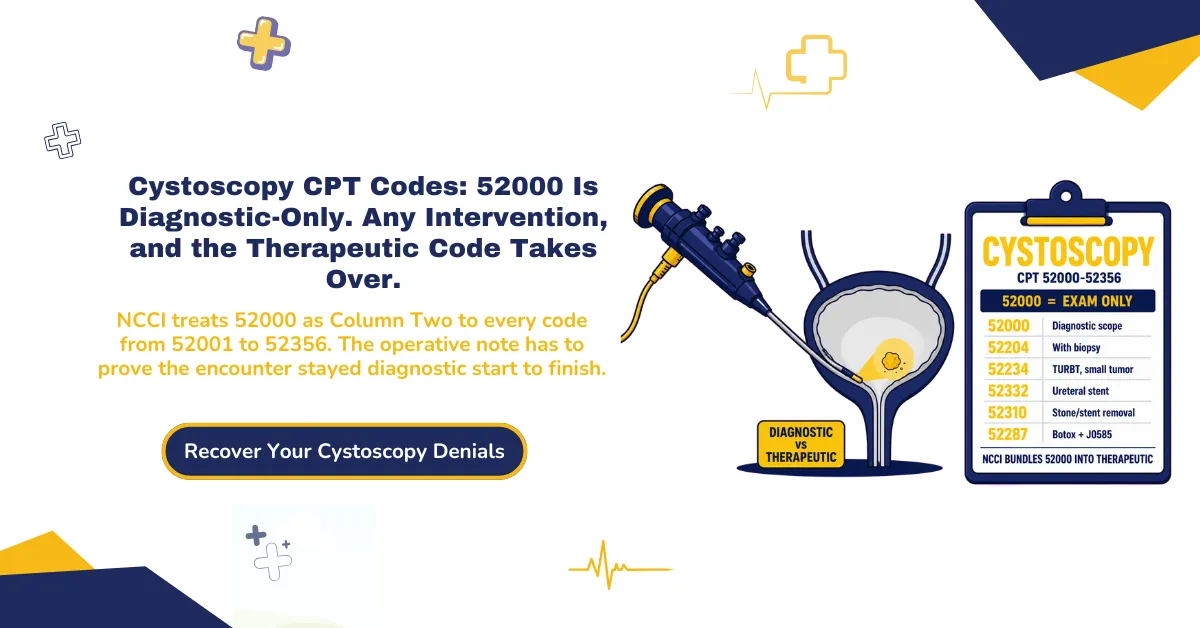
The correct cystoscopy CPT code depends on a single clinical decision made during the procedure: did the urologist examine only, or did the urologist also intervene?
If the scope went in and came back out with nothing removed, nothing placed, and nothing injected, you’re billing CPT 52000. The moment any intervention happens in that same encounter, the therapeutic code takes over, and 52000 can’t ride on the same claim.
Here’s where practices lose money. Payers deny claims where 52000 sits next to a therapeutic cystoscopy code. The NCCI Procedure-to-Procedure edit table treats 52000 as Column Two to every therapeutic code from 52001 through 52356, so the payer drops 52000 without ever asking for documentation.
Four codes cover most encounters. CPT 52000 is the diagnostic one. The other three are therapeutic.
- CPT 52000: diagnostic cystourethroscopy, examination only
- CPT 52204: cystoscopy with biopsy
- CPT 52332: cystoscopy with ureteral stent insertion
- CPT 52310: cystoscopy with removal of a calculus, stent, or foreign body
This guide walks through every billable code from 52000 through 52356, the 2026 Medicare rates for each one, the NCCI edit relationships behind the most common denials, and the documentation California payers audit.
The NCCI Bundling Error Behind the Most Cystoscopy CPT Code Denials
Payers run the NCCI Procedure-to-Procedure edit for 52000 before anyone reads a line of documentation. The edit fires the moment 52000 lands on a claim next to a therapeutic cystoscopy code.
Under the CMS NCCI edit structure, CPT 52000 is a Column Two code against every therapeutic cystoscopy code in the 52001 through 52356 family. The Column One code, the therapeutic one, gets paid. The Column Two code, 52000, gets denied. Per the CMS NCCI Procedure-to-Procedure edit tables, that Column Two assignment applies to practitioner and outpatient hospital claims alike.
CPT 52000 carries the AMA separate procedure designation. That’s the technical reason the edit treats it as Column Two: a separate procedure code bundles into the more comprehensive service performed at the same session, every time.
This single edit drives more urology denials than any coding mistake on the books.
ClaimMax Billing Essentials: 52000 Bundling Rules
- Use CPT 52000 for diagnostic-only encounters where no intervention happens
- Use the therapeutic code (52204, 52332, 52234, and so on) when any intervention happens, and don’t also bill 52000
- The one exception: 52000 performed as a clearly distinct service at a separate anatomical site, with Modifier 59 and operative-note language behind it. That exception is rare
When a cystoscopy claim gets denied under the NCCI 52000 edit, recovery starts with one question: was the encounter purely diagnostic, or did the urologist intervene? Diagnostic only, resubmit with the operative note. Both at the same encounter, the bundling stands, and the fix is cleaner code selection next time.
Resubmission only works when the operative note proves the encounter stayed diagnostic from start to finish. One line describing a biopsy or a fulguration buried in the body of the note, and the bundling holds on appeal.
California commercial payers, including Anthem Blue Cross and Blue Shield of California, follow Medicare NCCI edits for cystoscopy bundling. The outcome doesn’t change. Resubmitting without documentation rarely reverses the denial.
Urology denial recovery starts with systematic edit identification, long before a single appeal goes out.
2026 Medicare Cystoscopy CPT Code Rate Table
The 2026 Medicare Physician Fee Schedule, published under CMS-1832-F, applies a non-QP conversion factor of $33.4009 to cystoscopy procedure codes. The rates below reflect the CMS 2026 Physician Fee Schedule final rule, effective January 1, 2026.
CMS multiplies each code’s relative value units by that conversion factor to set the national payment. Geographic adjustment then shifts the final number by locality, so a California rate won’t match the national figure exactly.
Place of service drives the rate. A cystoscopy billed in an office (POS 11) uses the non-facility rate. The same code at an ASC (POS 24) or hospital outpatient (POS 22) uses the facility rate, which runs lower because the facility collects a separate OPPS payment.
The gap between the two professional rates isn’t small. CPT 52000 pays $216 in the office and $71 in a facility, because the office rate folds in the practice expense the facility carries on its own.
| CPT code | Descriptor | Non-facility | Facility | OPPS (APC) | ASC |
|---|---|---|---|---|---|
| 52000 | Diagnostic cystourethroscopy | $216 | $71 | $712 (APC 5372) | $311 |
| 52204 | Cystoscopy with biopsy | $302 | $82 | $712 | $383 |
| 52214 | Cystoscopy with fulguration, minor | $284 | $96 | $712 | $372 |
| 52224 | Cystoscopy with fulguration, under 0.5 cm | $302 | $82 | $712 | N/A |
| 52234 | TURBT, small (0.5 to 2.0 cm) | $389 | $108 | $1,847 | $502 |
| 52235 | TURBT, medium (2.0 to 5.0 cm) | $458 | $126 | $1,847 | $584 |
| 52240 | TURBT, large (over 5.0 cm) | $628 | $167 | $1,847 | $799 |
| 52281 | Cystoscopy with urethral dilation | $366 | $91 | $1,120 | $449 |
| 52332 | Cystoscopy with ureteral stent insertion | $452 | $123 | $1,847 | $584 |
| 52310 | Simple removal (bladder/urethra) | $298 | $83 | $712 | $376 |
| 52315 | Complicated removal | $405 | $114 | $1,120 | $511 |
| 52287 | Cystoscopy with Botox injection | $412 | $118 | $712 | $522 |
| 52260 | Hydrodistention, general anesthesia | $568 | $186 | N/A | N/A |
| 52265 | Hydrodistention, local anesthesia | $338 | $94 | N/A | N/A |
| 52005 | Cystoscopy with retrograde pyelogram | $264 | $82 | $712 | $339 |
The OPPS rate reflects hospital outpatient payment under the 2026 Outpatient Prospective Payment System. Bill from an ASC or hospital outpatient setting, and you collect the ASC or OPPS rate, not the non-facility PFS figure.
Read the table by place of service first, then by code. Use the non-facility column for office procedures, and the facility, OPPS, or ASC column for anything performed in a hospital or surgery center.
These rates reflect 2026 Medicare PFS data. Commercial payer rates track their own contracted fee schedules. California payers like Anthem Blue Cross of California and Blue Shield of California negotiate rates that usually run 110% to 135% of Medicare for in-network urology providers.
CPT 52000: Diagnostic Cystoscopy Billing Rules
CPT 52000 at a Glance
- Official AMA descriptor: cystourethroscopy, listed as a separate procedure
- What it covers: visual exam of the bladder and urethra, with or without ureteral catheterization and specimen collection, when no therapeutic intervention happens
- What it does not cover: biopsy (52204), fulguration (52214/52224), tumor resection (52234 to 52240), stent placement (52332), stent removal (52310), Botox injection (52287), stone removal, or urethral dilation. Any of these during the same encounter replaces 52000
Flexible vs. Rigid Scope: When the Distinction Matters
CPT 52000 covers cystoscopy with either a flexible or rigid scope. The AMA descriptor doesn’t separate the two for 52000. Here’s the catch in California: some Medi-Cal LCD policies and specific commercial contracts want the scope type documented.
A 52000 claim where the operative note doesn’t say whether the instrument was rigid or flexible fails LCD medical-necessity documentation at Medi-Cal and several California HMO payers. That’s a denial built on an omission, not a coding error.
Diagnostic Cystoscopy CPT Code: Common Billing Scenarios
- Use 52000 when the urologist inserts the scope, examines the bladder and urethra, and pulls the scope without taking tissue, placing a device, or injecting anything. The claim is complete with 52000 alone
- Use 52000 when ureteral catheterization collects urine specimens from the kidneys for diagnostic analysis. The catheter placement is bundled into 52000, not billed separately
- Do not use 52000 when the urologist finds a suspicious lesion and biopsies it. Switch to 52204
- Do not use 52000 when it precedes a therapeutic procedure in the same session. The NCCI edit bundles it into the therapeutic code, so bill the therapeutic code only
The only time 52000 rides alongside a therapeutic cystoscopy code is when it happened at a separate anatomical site, on a separate date, or as a distinct service at a separate time. That needs Modifier 59 plus operative-note language. Modifier 59 without the documentation pays today and gets recouped in post-payment review.
The recoup is the part that stings. A 52000 paid alongside a therapeutic code today looks like a win on the remittance, then shows up months later as a takeback when the reviewer reads the single operative note.
Diagnostic cystoscopy earns medical necessity when the encounter starts with hematuria (ICD-10 R31.0 through R31.9), recurrent UTI (N39.0), voiding dysfunction, or abnormal imaging. Per the AUA recurrent UTI clinical guideline 2025, cystoscopy isn’t a routine workup for an initial UTI.
CPT 52204 vs. CPT 52224: The Biopsy and Fulguration Decision
CPT 52204 and 52224 split on one question: did the urologist collect tissue or destroy it?
CPT 52204: Cystoscopy with Biopsy
Use 52204 for any encounter where the urologist removes bladder tissue for pathology. The number of biopsy sites, the forceps used, the specimen count, none of it changes the code. Bill 52204 once per encounter, no matter how many specimens go to the lab. The CPT code for cystoscopy with bladder biopsy is 52204.
Picture a four-quadrant bladder mapping where the urologist takes random biopsies from four sites. That’s still one 52204, billed once. The specimen count drives the pathology bill, not the cystoscopy code.
CPT 52224: Cystoscopy with Fulguration of Minor Lesions
Use 52224 for lesion destruction (fulguration, laser, cryosurgery) where no tissue goes to pathology. The lesion has to measure under 0.5 cm. Cross either line, a lesion over 0.5 cm or any tissue sent to pathology, and you’re in 52234 territory.
Fulguration treats the lesion in place. Nothing reaches the lab, so there’s no pathology specimen to support a biopsy code. Bill the destruction that happened, not a biopsy that didn’t.
ClaimMax Billing Essentials: 52204 and 52224 Same-Encounter Rules
- Bill 52204 only when a specimen is collected
- Bill 52224 only when lesion destruction happens without tissue collection
- Bill both on the same claim only when biopsy and fulguration happened at distinct anatomical sites, with Modifier 59 in the operative note. The modifier belongs in the note, not on the claim alone
The most common denial in this pair is 52204 and 52224 billed together without Modifier 59. The NCCI edit cancels the lower-paying code, and it doesn’t ask for documentation first.
TURBT CPT Codes: 52234, 52235, and 52240 Tumor-Size Rules
The TURBT code on any encounter has to match the largest tumor removed that session, not an average, not all tumors added together. These TURBT cystoscopy CPT codes share one hard limit: CMS Medically Unlikely Edits cap them at one unit per date of service. Payers deny a second TURBT code on the same claim.
TURBT Code Selection by Tumor Size
- Use CPT 52234 when the largest resected tumor measures 0.5 cm to 2.0 cm
- Use CPT 52235 when the largest resected tumor measures 2.0 cm to 5.0 cm
- Use CPT 52240 when the largest resected tumor measures over 5.0 cm
- Don’t bill more than one of these per date of service. The NCCI MUE cap is one unit per encounter
ClaimMax Billing Essentials: TURBT Documentation Requirements
Two things in the operative note get audited: the measured size of the largest tumor removed (not an estimate, not a range), and either completeness of resection or a clinical reason it wasn’t achieved. The CMS Medically Unlikely Edits for urology procedures enforce the one-unit cap.
The AUA non-muscle-invasive bladder cancer guideline wants tumor size, location, configuration, and number documented at initial diagnosis, and California payers citing LCD criteria audit for all four elements.
Resect five tumors in one session, and one TURBT code still bills for the encounter. The code matches the largest tumor removed, no matter how many smaller ones came out with it.
Completeness of resection carries as much weight as size. When the urologist can’t fully resect, the note needs the clinical reason, because the reviewer reading the LCD looks for it before paying the higher TURBT codes.
TURBT codes need a malignant bladder neoplasm as the primary diagnosis, usually C67.x (malignant neoplasm of bladder) with the specific sub-site. A TURBT claim carrying a benign or uncertain ICD-10 code gets denied for medical necessity at Medicare.
Match the C67 sub-site to the documented tumor location. C67.0 is the trigone, C67.1 is the dome, and the rest follow the bladder map. A nonspecific C67.9 pays, but a specific sub-site reads cleaner on audit.
California Medicaid (Medi-Cal) and several California Blue Shield plans lean on the Humana MUE policy as a reference for TURBT MUE adjudication. On most California payer systems, the one-unit-per-day cap is enforced at the clearinghouse.
CPT 52281: Urethral Stricture Dilation Billing and Documentation
CPT 52281 covers cystoscopy with calibration or dilation of a urethral stricture or stenosis. It also takes in meatotomy and an injection procedure for cystography when those happen, for male or female patients.
Here’s what the descriptor won’t tell you. The word stricture or stenosis has to appear in the operative note. Payers deny 52281 when the note says urethral dilation without naming an established stricture or stenosis behind it. The procedure name alone doesn’t carry the code. The pathology has to be named.
Treat it like a prior-auth note that names the diagnosis. The dilation is the treatment, the stricture is the reason, and the claim needs both on the page. A note documenting technique without naming pathology reads as a routine service that doesn’t clear medical necessity.
ClaimMax Billing Essentials: CPT 52281
- Use 52281 when the dilation treats a urethral stricture or stenosis confirmed in the note
- Use 52281 for meatotomy performed alongside cystoscopy for stricture management
- Don’t use 52281 for routine urethral dilation with no documented stricture or stenosis. That combination draws a medical-necessity denial at Medicare and California commercial payers
CPT 52281 vs. CPT 52000: Same-Session Rule
Diagnostic cystoscopy spots urethral pathology, the urologist dilates in the same session, and only 52281 bills. Don’t add 52000. The NCCI edit bundles 52000 into 52281 because the diagnostic scope is built into the dilation.
Run a quick check before submitting. Does the note name a stricture or stenosis, and does it describe the dilation? Both present, bill 52281 alone. Pathology missing, the claim won’t survive review.
At 2026 Medicare rates, the cystoscopy urethral dilation CPT code 52281 paid $366 in non-facility and $91 in facility settings. The non-facility rate applies in the urologist’s office procedure room.
CPT 52332: Ureteral Stent Placement Billing, 2026 Changes, and Prior Authorization
CPT 52332 reports cystoscopy with insertion of an indwelling ureteral stent, with or without ureteroscopy, ureter dilation, and guidewire placement. The code covers one stent per ureter. Bilateral placement bills two units with Modifier 50, or with -LT and -RT, depending on the payer.
Bilateral stent placement is where laterality billing trips practices up. One payer wants Modifier 50 on a single line. Another wants two lines with -LT and -RT. Bill it the wrong way for that payer, and one side denies as a duplicate.
Effective January 1, 2026, the 52332 descriptor folds imaging guidance into the procedure. Radiological supervision and interpretation codes like 74420, billed separately before, are now bundled. Bill 74420 with 52332 on a 2026 claim and you draw an automatic NCCI denial without a modifier override. The imaging is integral to the stent placement.
ClaimMax Billing Essentials: CPT 52332
- Use 52332 for each ureteral stent insertion, one unit per ureter
- Apply Modifier 50 for bilateral simultaneous placement when the payer takes -50. Use -LT and -RT when the payer wants separate-line billing
- Don’t separately bill radiological supervision codes with 52332 for dates of service on or after January 1, 2026
- Don’t bill 52000 with 52332. The NCCI bundling rule applies
Prior Authorization for CPT 52332
Most California commercial payers and California Medicare Advantage plans want prior authorization for 52332. Aetna California, Blue Shield of California, and several Medi-Cal managed care plans name ureteral stent insertion in their outpatient surgical policies.
Prior authorization for a stent isn’t a formality in California. The plan reviews medical necessity before the procedure, and a stent placed on a Friday without authorization can’t be back-authorized the following week.
A stent placement scheduled without confirmed authorization faces a medical-necessity non-authorization denial. ClaimMax RCM’s prior authorization support for cystoscopy procedures handles the request from first submission through payer follow-up.
The CPT code for cystoscopy with stent placement, 52332, reimburses $452 non-facility and $123 facility under the 2026 Medicare PFS. The OPPS rate for hospital outpatient stent placement is $1,847.
CPT 52310 and 52315: Stent and Calculus Removal Billing Rules
CPT 52310 and 52315 both cover cystoscopic removal of bladder or urethral calculi, foreign bodies, or stents. The split between them isn’t clinical. It’s a documentation call based on how hard the removal was.
52310 vs. 52315: Simple vs. Complicated Removal
CPT 52310 (simple removal): use it when the calculus, foreign body, or stent comes out without unusual difficulty. The note supports 52310 when standard cystoscopic technique did the job, with no mention of exceptional manipulation, fragmentation, or extended time.
CPT 52315 (complicated removal): use it when the note describes real difficulty, impaction, fragmentation, or circumstances that took substantially more physician work than a routine removal. The complication has to be written down. The word complicated in the descriptor doesn’t transfer to the claim without operative-note language behind it.
ClaimMax Billing Essentials: 52310 and 52315
- Don’t upgrade from 52310 to 52315 without note language documenting the specific complication
- Payers audit 52315 harder than 52310, because the rate gap (about $107 at the 2026 non-facility rate) fits a post-payment review pattern
- For ureteral stent removal by cystoscopy (pulled from the ureter, not the bladder), 52310 covers direct cystoscopic retrieval. Some payers treat that as a separate encounter-level call
California commercial payers including Anthem Blue Cross follow the Medicare complication-documentation standard for 52315. Upgrade to 52315 without note language citing specific complications, and the claim down-codes to 52310 on review.
Down-coding is the quiet version of a denial. The claim pays, but at the 52310 rate, and the difference never surfaces unless someone reconciles the remittance against the billed code. That’s revenue leaking through a documentation gap.
CPT 52287 and J0585: Botox Bladder Injection Billing and Drug Unit Calculation
Two codes, one claim. CPT 52287 bills the cystoscopy and injection. J0585 bills the drug. This pairing falls apart when the drug line is missing or the units are wrong, and a 52287 billed without J0585 captures the procedure while the drug reimbursement walks out the door.
J0585 Unit Calculation for Botox Bladder Injection
One unit of J0585 equals one vial of onabotulinumtoxinA (Botox). The standard Medicare-approved dose for overactive bladder is 100 units, which is one vial, so bill J0585 with one unit. The standard dose for neurogenic detrusor overactivity is 200 units, two vials, so bill J0585 with two units.
A practice that gives 200 units but bills J0585 at one unit recovers half the drug reimbursement on every neurogenic bladder claim. That’s not a rounding error. That’s real money, per claim, every time.
The fix costs nothing. Count the vials, match the J0585 units to the dose, and the drug reimbursement lands in full on the first pass.
The AUA overactive bladder treatment guideline puts Botox (intradetrusor onabotulinumtoxinA) as a third-line option after anticholinergic and beta-3 agonist therapy fail. Medicare and California commercial payers follow that step-therapy rule. A 52287 claim without documentation of prior failed oral therapy fails medical necessity.
ClaimMax Billing Essentials: CPT 52287 and J0585
- Use 52287 for intradetrusor injection of botulinum toxin under cystoscopic guidance
- Bill J0585 in units equal to the vials given: one unit per 100-unit vial
- Don’t bill J0585 without 52287 on the same claim
- Don’t bill 52287 without confirming prior authorization. California Anthem, Blue Shield of California, and Medi-Cal managed care plans require it, and a denial without authorization is non-appealable at most California payers
High Botox volume means the most exposure to J0585 unit errors, and each error is direct per-claim revenue loss. ClaimMax RCM’s urology billing service checks drug unit counts, authorization status, and LCD compliance on every 52287 claim before it goes out.
CPT 52287 reimburses $412 non-facility and $118 facility at 2026 Medicare rates. J0585 pays separately, based on the ASP drug pricing CMS publishes each quarter.
CPT 52260 and 52265: Hydrodistention Billing for Interstitial Cystitis
CPT 52260 and 52265 both report cystoscopy with dilation of the bladder for interstitial cystitis. Anesthesia type picks the code: 52260 for general or spinal, 52265 for local.
Cystoscopy Hydrodistention CPT Code: Anesthesia and Setting Rules
CPT 52260 needs general or spinal anesthesia documented in the note, and it usually happens at an ASC or hospital outpatient facility. CPT 52265 covers office- or clinic-based hydrodistention under local anesthesia, with or without sedation.
The 2026 Medicare non-facility rate for 52265 is $338. The facility rate for 52260 is $186. The OPPS rate is N/A for both, which means Medicare doesn’t separately pay the facility for hydrodistention as a distinct outpatient procedure. It bundles into the facility fee.
ClaimMax Billing Essentials: Interstitial Cystitis Prior Authorization
Most commercial payers, in California and nationally, want prior authorization for hydrodistention when the diagnosis is N30.1x (interstitial cystitis). Blue Shield of California wants documentation of three or more failed conservative treatments before it approves hydrodistention under 52260. The criteria live in the Blue Shield of California interstitial cystitis policy.
The operative note has to document three things payers audit: the volume of fluid instilled, the maximum intravesical pressure reached, and the duration of distention. Miss any one, and you’re looking at a post-payment recoupment at Medicare and a medical-necessity denial at commercial payers.
The three readings aren’t optional detail. They’re the proof the procedure met the clinical threshold for hydrodistention, and an auditor who can’t find them treats the encounter as a simple cystoscopy instead.
- Use 52260 when the note documents general or spinal anesthesia
- Use 52265 when the note documents local anesthesia
- Don’t upgrade 52265 to 52260 on anesthesia alone unless the note confirms general or spinal
CPT 52005: Retrograde Pyelogram Billing and Bundling Rules
CPT 52005 reports cystourethroscopy with insertion of a ureteral catheter, with or without irrigation, instillation, or ureteropyelography, and it excludes the radiographic service. That exclusion in the descriptor means the imaging, the retrograde pyelogram read, bills separately under radiology codes.
Retrograde Pyelogram CPT Billing: What Bills Separately
CPT 52005 covers the cystoscopic catheter placement and contrast injection. The pyelogram image interpretation bills separately under CPT 74420 (urography, retrograde, with or without KUB). Both can sit on the same claim. The NCCI doesn’t bundle 74420 into 52005, because the 52005 descriptor specifically excludes the radiographic service.
KUB stands for kidneys, ureters, and bladder, the flat-plate radiograph that often pairs with the retrograde study. CPT 74420 covers the read whether or not a KUB is included, so don’t bill a separate radiograph code for the same image.
Run a retrograde pyelogram during the same session as ureteral stent placement (52332), and the 52005 catheter work bundles into 52332. The cystoscopic component is built into the stent code. Bill 52332 for the stent and 74420 for the imaging. Don’t separately bill 52005 alongside 52332.
ClaimMax Billing Essentials: CPT 52005
- Use 52005 for catheter placement and contrast injection during retrograde pyelography when no stent goes in
- Add 74420 separately for the pyelogram image interpretation
- Don’t bill 52005 with 52332 at the same encounter. The NCCI edit bundles the catheter work into the stent code
CPT 52005 reimburses $264 non-facility and $82 facility at 2026 Medicare rates.
Ureteroscopy, Bulking Agent Injection, and Intraoperative Cystoscopy Codes
CPT 52351-52356: Cystoscopy with Ureteroscopy Codes
The 52351 to 52356 family covers ureteroscopy through a cystoscopic approach. These codes handle ureteroscopy, a separate group from the 52000 to 52332 range, because the scope enters the ureter, not only the bladder.
CPT 52351 covers diagnostic ureteroscopy with no intervention. 52352 adds lithotripsy with basket extraction. 52353 is lithotripsy alone. 52354 adds biopsy. 52355 covers resection of a ureteral or renal pelvis tumor. 52356 covers lithotripsy plus stent placement.
Match the ureteroscopy code to the most involved work performed. A diagnostic look that turns into lithotripsy with a stent bills as 52356, the comprehensive code, not three separate line items for each step.
Run ureteroscopy at the same encounter as cystoscopy, and only the most comprehensive ureteroscopy code bills. The diagnostic cystoscopy component, 52000, bundles into all of the 52351 to 52356 codes under NCCI edits.
CPT 51715: Durasphere and Bulkamid Injection (Bulking Agent)
Cystoscopic injection of a periurethral or transurethral bulking agent for stress urinary incontinence bills under CPT 51715, not any 52000-series code. That holds for both Durasphere (a synthetic bulking agent) and Bulkamid (a polyacrylamide hydrogel).
The code for cystoscopy with Durasphere injection is 51715, separate from the 52287 used for Botox. Bill J3490 (NOC drug) or the specific HCPCS for the agent as its own line item.
Cystoscopy with Hysterectomy: Intraoperative Coding
A urologist runs cystoscopy during a laparoscopic or abdominal hysterectomy to confirm ureter and bladder integrity, and CPT 52000 bills alongside the gynecological code. The cystoscopy has to read as a distinct, separately indicated service with its own indication in the note.
Use Modifier 51 or 59, payer depending. Payers apply the NCCI edit between 52000 and hysterectomy codes (58570 to 58573). With no modifier documentation, 52000 denies as bundled into the gynecological procedure.
Cystoscopy CPT Code Modifiers: When and How to Use Each
Cystoscopy CPT code billing leans on modifiers in four spots: same-day E/M services, bilateral procedures, distinct procedural services, and post-op period exceptions. Pick the wrong modifier in any of these, and you don’t only get a denial. You get a compliance flag.
Modifier 25: Same-Day E/M and Cystoscopy
Use Modifier 25 on the E/M code, not the cystoscopy code, when a separately identifiable E/M service happened the same day. The E/M has to stand for a condition distinct from the cystoscopy indication, or reflect decision-making beyond the routine pre-procedure check. Append it to the E/M. A Modifier 25 stuck on 52000 draws an automatic clearinghouse rejection.
Modifier 25 is the most over-applied modifier in urology billing. It belongs on a genuine separate service, not on the routine pre-procedure visit that’s already part of the cystoscopy payment.
Modifier 59: Distinct Procedural Service
Use Modifier 59 on a Column Two code when the procedure happened at a distinct site, separate session, or separate encounter. In cystoscopy billing, that’s 52000 performed as a genuine distinct diagnostic service apart from a same-day therapeutic code, or 52204 and 52224 at distinct sites.
The note has to state the distinct site or session. Modifier 59 with no documentation behind it is an audit trigger at Medicare and California commercial payers alike.
Modifiers LT and RT: Bilateral Procedures
Modifiers LT (left) and RT (right) apply to 52332, 52310, 52315, and 52005 for bilateral procedures. Some payers want Modifier 50 instead of separate-line LT and RT billing.
California payers like Anthem Blue Cross of California follow separate-line laterality billing, so verify the payer rule before submitting bilateral cystoscopy with stent placement. For facility billing for urology, the place-of-service code shifts modifier adjudication too.
Modifier 57: Decision for Major Surgery
Use Modifier 57 on an E/M code the day before or day of a major cystoscopy procedure (a 90-day global code) when that visit is the decision to operate. Most cystoscopy codes carry a 000-day global period, so 57 shows up rarely. The exception is a complex TURBT (52240) that some payers treat as a 90-day global.
When the global period is 000, skip Modifier 57 entirely. It belongs only to the rare cystoscopy code a payer classifies as major surgery.
The 2026 CMS NCCI Coding Policy Manual spells out when each modifier overrides a Column Two denial in the cystoscopy family.
Global Period for Cystoscopy CPT Codes: What Bills Separately
Yes, CPT 52000 is a surgical procedure code under the CPT set, filed under endoscopy, cystoscopy, urethroscopy, and cystourethroscopy procedures on the bladder. The surgical label doesn’t require a hospital or an OR, though. Most 52000 procedures happen in offices or ASCs.
CMS assigns a global surgery indicator of 000 to CPT 52000 and most cystoscopy codes in the 52000 to 52356 family. A 000 global period means the pre-op and post-op values cover only the day of the procedure. Post-procedure visits on any later day bill separately.
The 000 global period is good news for urology revenue. A patient who returns a week later with a related concern generates a billable visit, not free follow-up folded into the procedure payment.
What the 000 Global Period Means for Urology Billing
On the day of the cystoscopy, a separately identifiable E/M by the same provider needs Modifier 25 on the E/M code. On any date after, post-op visits tied to the cystoscopy bill with the right E/M code and no modifier. The visit stands on its own.
Per the CMS global surgery indicator definitions, a 000-period code pays for same-day pre-op and post-op work only.
CPT 52240 (large TURBT) carries a 010 global period at some payers, so post-op visits within 10 days fold into the payment. Verify the payer’s global period before billing post-TURBT follow-ups.
Confirm the indicator before writing off a post-op visit as bundled. Most cystoscopy codes pay separately for that later visit, and billing it right recovers revenue practices routinely leave on the table.
Cystoscopy Documentation Checklist: What Every Operative Note Must Include
Documentation gaps drive most post-payment recoupment in cystoscopy billing. This checklist mirrors the audit criteria CMS Recovery Audit Contractors and California commercial payers run against cystoscopy claims.
Auditors don’t read the claim. They read the note, then check whether the note supports the code that was billed. Every gap below is a place where a clean-looking claim falls apart under a records request.
Operative Note Checklist for Cystoscopy CPT Code Billing
- Scope type documented: flexible or rigid instrument named in the note. Required for Medi-Cal LCD compliance and California commercial medical-necessity review.
- Procedure performed stated: the specific procedure named (examination, biopsy, fulguration, stent placement, dilation). The name has to match the CPT code billed. A note that says cystoscopy performed without naming the intervention won’t support a therapeutic code.
- Anatomical findings documented: location, measured size, and appearance of any lesion, calculus, stricture, or abnormality. Required for TURBT codes 52234 to 52240 and stricture dilation (52281).
- Tissue collection documented: for a biopsy, the number of specimens and the collection sites. Supports 52204. A note that says biopsy taken with no site fails the audit.
- Stent laterality documented: left, right, or bilateral, with device type when relevant. Required for 52332 -LT and -RT adjudication.
- Anesthesia type documented: general, spinal, or local. Required to separate 52260 from 52265 on hydrodistention encounters.
- Prior failed therapies documented (Botox claims): for 52287, documentation of prior anticholinergic or beta-3 agonist failure. California payers audit this on pre-auth and post-payment review.
- Drug units documented (Botox claims): for J0585, the number of Botox vials in the note or anesthesia record. Post-payment review cross-checks the note against the J0585 units on the claim.
California commercial payers including Anthem Blue Cross, Blue Shield of California, and Health Net run all eight elements in post-payment clinical audits for bladder cystoscopy CPT code claims. A gap in any one produces a partial denial or a full recoupment request.
Build these eight elements into the operative-note template, and the audit stops being a threat. The documentation that supports the code is already there before anyone requests the record.
2026 Cystoscopy CPT Code Changes: What Took Effect January 1, 2026
The 2026 CPT set brings four changes that touch cystoscopy and urological endoscopy billing. Practices still running 2025 charge masters or superbills will hit automatic denials on the affected codes after January 1, 2026.
A charge master is only as current as its last update. Codes valid in December turn into rejections in January, and the claim system won’t warn the biller before the denial posts.
CPT 52597: New Code (Replaces 0421T)
CPT 52597 is new as of January 1, 2026, covering Aquablation of the prostate with robotic water-jet technology. CPT 0421T, the old Category III tracking code, captured this before. The move to Category I code 52597 gives Medicare and commercial payers a formal billing path. Drop 0421T from every 2026 superbill.
CPT 52647: Deleted
CPT 52647 (laser coagulation of the prostate) was deleted as of January 1, 2026. Bill it on a 2026 claim and you get an invalid-code rejection. The AMA and CMS haven’t named a direct replacement in the standard cystoscopy range, so confirm the correct path for laser coagulation with your MAC.
CPT 55700 and 55706 Deleted, Replaced by 55707-55715
CPT 55700 (prostate needle biopsy) and 55706 were deleted and replaced by a new prostate biopsy family, 55707 through 55715, as of January 1, 2026. The new codes sort biopsy by imaging guidance (transrectal ultrasound, MRI-guided, systematic, targeted). Pick from 55707 to 55715 based on the imaging documented in the note.
The prostate biopsy change is the one most likely to surprise a urology practice. The familiar 55700 is gone, and the replacement code depends on imaging the biller reads from the operative note.
CPT 52332 Imaging Guidance Change (2026)
As covered in the stent section, 52332 now carries imaging guidance in its descriptor as of January 1, 2026. Radiological supervision and interpretation codes billed separately with 52332 on 2026 dates of service draw NCCI denials.
Medi-Cal and Medicaid billing for urology procedures follow CMS CPT updates on a state-set timeline. California Medi-Cal adopted the 2026 changes on January 1, 2026. Confirm code adoption dates on your Medi-Cal provider portal before billing.
Cystoscopy CPT Code Selection: Decision Framework for Urology Billing
Pick the code that matches what the urologist documented, not what the procedure was scheduled as.
The ClaimMax Cystoscopy CPT Code Selection Framework
Diagnostic only, with nothing removed, nothing placed, nothing injected? Use CPT 52000, and keep every other cystoscopy code off the claim.
Biopsy taken? Use CPT 52204, and pull 52000 off the claim.
Lesion destroyed with no tissue collected? Use CPT 52224 (under 0.5 cm) or 52214 (minor fulguration). Don’t add 52000.
Bladder tumor resected? Use CPT 52234, 52235, or 52240 by the largest tumor size in the note. Bill one unit. Remove 52000.
Ureteral stent placed? Use CPT 52332. Drop 74420 if the date of service is January 1, 2026 or later. Remove 52000.
Stent or calculus removed from the bladder? Use CPT 52310 (simple) or 52315 (complicated, documented). Remove 52000.
Botox injected into the detrusor? Use CPT 52287, add J0585 at the right unit count, and verify prior authorization.
Bulking agent injected for incontinence? Use CPT 51715. No 52000-series code.
Work the list top to bottom on every operative note. The first intervention that matches sets the code, and 52000 comes off the claim the moment any therapeutic step appears.
Every cystoscopy CPT code in the 2026 fee schedule has one correct claim configuration. The operative note decides it. Payers don’t accept intent. They pay documentation.
For urology practices in California and nationally, ClaimMax RCM manages cystoscopy claim submission, NCCI edit review, prior authorization, and denial recovery as one complete revenue cycle service.