
Key Details About POS 19: The Off-Campus Outpatient Code Explained
Place of Service 19 stands for Off Campus-Outpatient Hospital. In medical billing, POS 19 identifies the location on a professional claim where an off-campus hospital provider-based department delivered outpatient services to a patient who didn’t require hospitalization.
Official CMS Name: Off Campus-Outpatient Hospital. CMS assigns this name to a portion of an off-campus hospital provider-based department that furnishes diagnostic, therapeutic, and rehabilitation services, effective January 1, 2016.
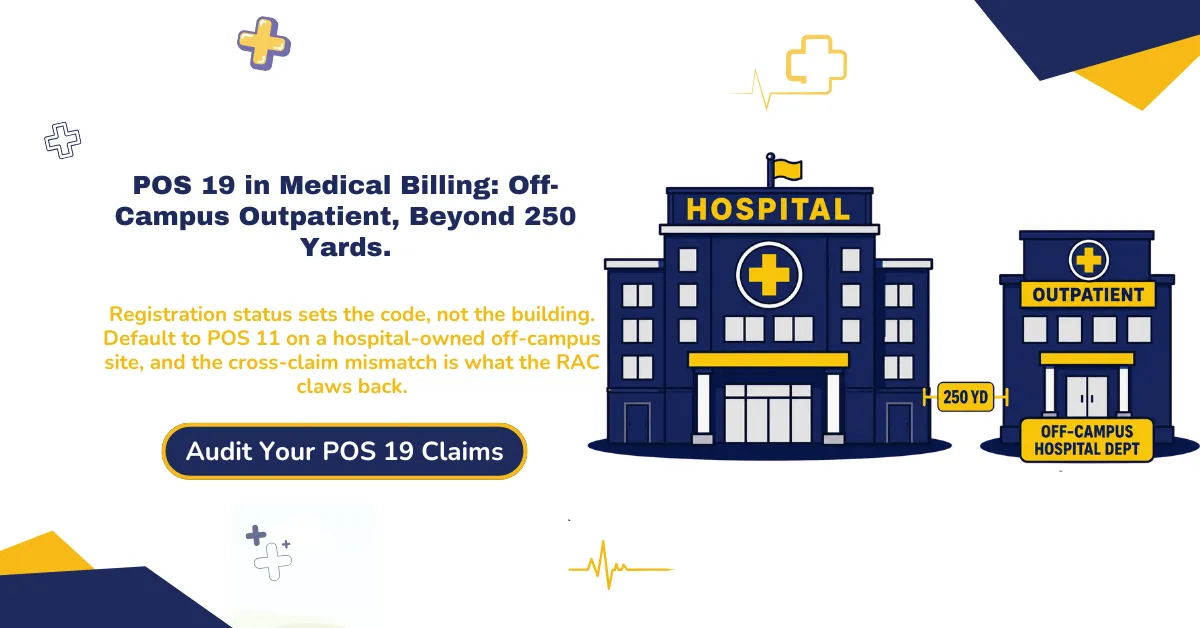
The 250-Yard Rule: A hospital facility counts as off-campus when it sits beyond 250 yards of the main hospital buildings, per 42 CFR 413.65. CMS regional offices can designate additional areas case by case.
Where It Goes on the Claim: POS 19 belongs in Box 24B of the CMS-1500 professional claim form. It doesn’t appear on the institutional UB-04 facility claim.
Medicare Reimbursement: Medicare pays professional claims at the facility rate when POS 19 is reported. The facility rate runs below the non-facility rate used for POS 11 because the hospital absorbs overhead, staffing, and supply costs at the off-campus department.
Registration Status Rule: Per the CMS Medicare Claims Processing Manual Chapter 26, reporting POS 19 is a minimum requirement when a patient is registered as a hospital outpatient, irrespective of where the face-to-face encounter occurs.
The 3-Day Rule: Services rendered at a POS 19 location within three days before an inpatient hospital admission can bundle into the inpatient payment under CMS payment policy, the same rule that applies to POS 22.
The sections below cover when POS 19 in medical billing is required, how it differs from POS 22 and POS 11, and what happens when a coder gets it wrong.
The Official CMS Descriptor and Box 24B: Where POS 19 Goes on the Claim
CMS defines Place of Service Code 19 as: ‘A portion of an off-campus hospital provider based department which provides diagnostic, therapeutic (both surgical and nonsurgical), and rehabilitation services to sick or injured persons who do not require hospitalization or institutionalization.’
This code is reported in Box 24B of the CMS-1500 professional claim form. Box 24B maps to the CLM05 service type indicator in the 837P electronic transaction.
When the service facility address differs from the billing provider address, Box 32 on the CMS-1500 has to reflect the off-campus location. That address must match the PECOS enrollment record for the specific off-campus site character for character.
The complete CMS Place of Service Code Set, updated February 17, 2026, lists every active code.
POS codes appear on professional claims only. The institutional UB-04 facility claim doesn’t use POS 19. The hospital’s facility claim uses the appropriate Type of Bill code and, for off-campus provider-based departments, appends modifier PO or PN on individual service lines.
Billing staff moving from independent practices to hospital-employed settings often confuse these two forms. The physician bills the CMS-1500 with POS 19. The hospital bills the UB-04 with the off-campus modifier.
CMS assigned POS 19 effective January 1, 2016. Claims with any date of service on or after that date can report POS 19 when processed on or after that date. POS 19 medical billing is valid at Medicare and most Medicaid programs that adopted the CMS POS code set.
The Registration Status Rule: The CMS Requirement Most POS 19 Guides Never Mention
The most common POS 19 error at hospital-acquired physician practices doesn’t happen because the coder doesn’t know the code. It happens because the biller doesn’t know the rule that triggers it. The rule isn’t geography alone. It’s patient registration status.
The CMS Medicare Claims Processing Manual Chapter 26 instructs that a physician or practitioner furnishing services under arrangement to a hospital must report at minimum POS 19 or POS 22, irrespective of the setting where the patient receives the face-to-face encounter.
Put another way, Medicare POS 19 or POS 22 is the minimum requirement for any professional claim when the patient is registered as a hospital outpatient, not only when the encounter occurs in a specific building.
- Use POS 19 when: the patient is registered as a hospital outpatient at an off-campus provider-based department and the service qualifies as hospital outpatient care under the hospital’s provider-based designation.
- Use POS 11 when: the service is delivered in a separately maintained, independently operated physician office that isn’t registered as a provider-based department with the hospital and isn’t treating the patient as a hospital outpatient.
The distinction matters because payers cross-reference the professional claim’s POS code against the hospital’s institutional facility claim. When the physician bills POS 11 but the hospital files a separate facility fee for the same encounter, the combination triggers a payment integrity flag.
Medicare auditors catch this pattern through automated cross-claim analysis. The physician overpays on the professional fee, and the claim carries a recoupment risk.
Verifying patient registration status at scheduling is part of the eligibility verification workflow, and it settles which POS code applies before the encounter happens.
California commercial payers, including Anthem Blue Cross of California and Blue Shield of California, apply the same Medicare registration-status logic for POS 19 in network contracts.
Billing POS 11 for an encounter at a hospital-owned off-campus clinic when the patient was registered as a hospital outpatient produces the same overpayment pattern under commercial contracts as it does under Medicare. It triggers contract audit rights under those agreements.
POS 19 vs POS 22 vs POS 11: The 2026 Rates and Rules Comparison
POS 19 and POS 22 both represent hospital outpatient departments. The one difference between them is distance from the main hospital campus. POS 19 applies when the department sits beyond 250 yards from the main hospital buildings. POS 22 applies when the department sits within that boundary.
Facility vs. Non-Facility: POS 19 is a facility setting. Medicare pays professional claims at the facility rate when POS 19 is reported. The facility rate uses a lower practice expense relative value unit than the non-facility rate applied to POS 11, because the hospital absorbs overhead costs at the off-campus department.
| Feature | POS 11 (Physician Office) | POS 19 (Off-Campus Outpatient) | POS 22 (On-Campus Outpatient) |
|---|---|---|---|
| Ownership | Physician-owned or independent | Hospital-owned, provider-based | Hospital-owned, provider-based |
| Distance from main campus | Not a hospital location | More than 250 yards from main buildings | Within 250 yards of main buildings |
| MPFS payment rate | Non-facility rate (higher) | Facility rate (lower) | Facility rate (lower) |
| Separate hospital facility fee | No | Yes (UB-04, modifier PO or PN) | Yes (UB-04, no off-campus modifier) |
| OPPS eligibility | No | Excepted sites only (modifier PO) | Yes |
| Section 603 site-neutral rules | Does not apply | Applies to non-excepted sites | Does not apply |
| Three-Day Rule | Does not apply | Applies | Applies |
The rate difference between POS 11 and POS 19 for the same CPT code can run from $30 to $80 per visit depending on the code. Across a high-volume practice, billing POS 11 for a hospital-owned off-campus location inflates physician payment, creates a cross-claim mismatch with the hospital’s facility fee, and triggers OIG audit protocols.
The 42 CFR 413.65 campus definition sets the hospital campus as the area within 250 yards of the main hospital buildings.
Most California commercial payers, including Anthem Blue Cross of California, Blue Shield of California, and Health Net, follow Medicare’s facility versus non-facility payment methodology for POS 19. Contracts that reference Medicare PFS methodology carry the same rate differential.
Verifying each payer’s POS 19 handling against the fee schedule is part of credentialing verification before seeing patients at any new off-campus location.
For providers at on-campus hospital outpatient departments, the ClaimMax POS 22 billing guide covers the parallel rules that apply when the facility sits within the 250-yard campus boundary.
Excepted vs Non-Excepted Departments: How BBA 2015 Section 603 Determines Your POS 19 Reimbursement
Section 603 of the Bipartisan Budget Act of 2015 created the payment split that makes POS 19 billing more complex than POS 22. The law stopped new off-campus hospital outpatient departments from receiving OPPS payment rates after November 2, 2015, and routed their payment to the Medicare Physician Fee Schedule instead.
Off-campus departments already billing before that date kept their OPPS rates with certain restrictions.
The Congressional Research Service site-neutral payment brief lays out how the law divides payment between OPPS and the fee schedule.
Excepted Off-Campus PBDs: a department that was billing under OPPS before November 2, 2015. Hospital institutional claims for these sites use modifier PO. These sites receive standard OPPS payment rates, subject to 2026 site-neutral expansions.
Non-Excepted Off-Campus PBDs: a department that began billing after November 2, 2015. Hospital institutional claims for these sites use modifier PN. These sites receive Medicare Physician Fee Schedule equivalent rates, not OPPS rates.
Modifier PO and modifier PN are institutional modifiers. They belong on the hospital’s UB-04 facility claim lines. They don’t appear on the physician’s CMS-1500 professional claim. The physician reports POS 19 in Box 24B of the CMS-1500 without appending PO or PN.
The hospital appends the right modifier to each service line on its institutional claim. Billing teams new to hospital-employed settings often attach PO or PN to CMS-1500 claims, which produces clearinghouse rejections.
Modifier PO reporting became mandatory beginning January 1, 2016, per the HHS PO modifier guidance for off-campus departments.
Effective January 1, 2026, CMS expanded site-neutral payment to drug administration services at excepted off-campus provider-based departments under the CY 2026 OPPS/ASC Final Rule. Drug administration APCs at grandfathered facilities now receive PFS-equivalent rates rather than full OPPS rates.
Rural sole community hospitals are exempt from this expansion. For practices with high chemotherapy or infusion volume at excepted off-campus sites, the rate reduction is material.
California Medicaid (Medi-Cal) and several California Medicare Advantage plans apply the Section 603 site-neutral logic in their payment methodologies for off-campus provider-based departments. The excepted or non-excepted designation that drives modifier PO versus PN is a required element of the provider enrollment record for California hospital outpatient departments billing these payers.
What Changed for POS 19 in 2026: Drug Administration Rates and Site-Neutral Expansion
Effective January 1, 2026, CMS expanded site-neutral payment to drug administration services at excepted off-campus provider-based departments. This is the most material 2026 change for providers billing place of service 19 at grandfathered off-campus sites. CMS estimated the change cuts OPPS spending by $290 million in 2026, with $70 million of that passed to Medicare beneficiaries through reduced coinsurance.
Before 2026, excepted off-campus departments received full OPPS payment for drug administration APCs, the billing codes that cover chemotherapy infusions, immunotherapy, and other physician-administered drugs.
Starting January 1, 2026, those same APCs pay at the PFS-equivalent rate rather than the OPPS rate at excepted off-campus sites. The reduction is specific to drug administration APCs. Other services at grandfathered excepted sites continue under standard OPPS rules.
CMS exempted rural sole community hospitals from the drug administration site-neutral expansion. If the off-campus department is provider-based to a rural SCH, the 2026 drug administration rate reduction doesn’t apply. Non-rural excepted off-campus departments don’t qualify for this exemption regardless of location.
Outside the drug administration expansion, CMS raised the overall OPPS payment rate by 2.6% for 2026. That figure reflects the 3.3% hospital market basket update reduced by a 0.7 percentage point productivity adjustment. The 2.6% increase applies to all services at OPPS-covered hospital outpatient departments, including POS 19 excepted sites, per the CY 2026 OPPS Final Rule.
CMS signaled in the CY 2026 rulemaking cycle that further site-neutral expansion may reach additional service categories in CY 2027. Health systems with significant POS 19 off-campus department volume should start tracking which service lines carry site-neutral risk as the 2027 proposed rule period approaches.
The Three-Day Rule and POS 19: When Off-Campus Services Bundle Into an Inpatient Admission
CMS payment policy applies the three-day rule to POS 19 the same way it applies to POS 22. Services rendered at a wholly-owned physician practice within three days before an inpatient hospital admission bundle into the inpatient payment and can’t be separately billed.
The three-day window covers the day of admission plus the two calendar days before the admission date. A patient who visits an off-campus hospital-owned cardiology clinic on Monday, returns Wednesday, and is admitted to the hospital on Wednesday triggers the three-day rule for the Monday visit. That Monday’s physician claim at POS 19 bundles into the inpatient admission DRG payment.
Services unrelated to the diagnosis that prompted the inpatient admission fall outside the bundling rule. The unrelated service has to be documented in the clinical note with a diagnosis code distinct from the admitting diagnosis. Without that documentation, payers apply the bundling rule to every service in the window regardless of clinical relationship.
Payers deny POS 19 claims billed separately within the three-day window when the unrelated-service documentation is missing. Unbundling these claims without documentation is a post-payment audit trigger under the OIG’s payment integrity monitoring.
Mid-Level Provider NPI Billing at POS 19 Locations
At POS 19 locations, a mid-level provider bills under that provider’s own National Provider Identifier. A nurse practitioner, physician assistant, clinical nurse specialist, or clinical nurse midwife delivering services at an off-campus hospital provider-based department can’t bill those services under the supervising physician’s NPI.
The one exception is shared or split billing. When a physician and a mid-level provider in the same group practice both take part in a patient’s evaluation or management service on the same date, the service can be billed under either provider’s NPI.
That allowance follows the shared/split service guidelines in the CMS Medicare Claims Processing Manual Publication 100-04, Chapter 12, Section 30.6.1.B.
Several California Medi-Cal managed care plans apply stricter shared/split rules than Medicare’s standard. At POS 19 locations billing Medi-Cal managed care, confirm the specific plan’s policy on split billing before submitting under the physician NPI. Non-compliant split billing at POS 19 sites produces medical necessity denials at several California Medi-Cal plans.
Incident-to billing doesn’t apply at POS 19 locations. The incident-to provision under Medicare Part B requires the supervising physician to be present in the office suite. Off-campus hospital outpatient departments aren’t office settings. No POS 19 claim may use incident-to as the basis for billing under the physician NPI.
POS 19 and Medicaid: Beneficiary Notice Requirements and State-Specific Payer Rules
When a Medicare beneficiary receives services at a POS 19 off-campus provider-based department, the hospital provides written notice before service delivery. The notice requirement exists because place of service 19 encounters often generate two bills: the physician’s professional fee on a CMS-1500 and the hospital’s facility fee on a UB-04.
Patients who assume they’re visiting a physician’s office are often surprised by the facility charge. Per 42 CFR 413.65, written notice goes to the patient before the encounter, or as soon as workable after stabilization in emergency situations.
The notice communicates two specific things: that the location is a hospital-based outpatient facility, and that the patient may receive a separate facility bill on top of the physician fee. CMS doesn’t mandate a specific form but requires the substance of both disclosures.
Hospitals that skip the notice face compliance exposure, not payment denial. OIG audit programs include provider-based status and notification compliance in their annual enforcement priorities.
Handling Medicaid billing for outpatient services at POS 19 locations follows state-specific adoption timelines. California Medi-Cal adopted POS 19 effective January 1, 2016, in line with the federal CMS implementation.
Most California Medi-Cal managed care plans accept POS 19 on professional claims and apply the same facility-rate methodology as Medicare. California commercial payers, including Anthem Blue Cross of California and Blue Shield of California, treat POS 19 as a facility code and contract for rates accordingly.
For hospital systems billing Medicaid across several states, each state Medicaid program keeps its own adoption confirmation and POS 19 handling policy. Confirming POS 19 acceptance and the applicable fee schedule before submitting Medicaid professional claims at a new off-campus location prevents systematic underpayment.
The Six POS 19 Billing Errors That Drive Denials, Recoupments, and OIG Flags
Six error patterns drive the majority of POS 19 in medical billing denials and post-payment recoupments. Each one has a different trigger, a different payer response, and a different recovery path. Identifying which error pattern is active in an aging report decides whether the fix is a resubmission, an appeal, or a workflow change.
Error 1: POS 11 Used for a Hospital-Owned Off-Campus Clinic
How it happens: the biller inherits a POS 11 template from before the hospital acquired the practice, and no one updates the EHR default.
What the payer does: Medicare pays the higher non-facility rate while the hospital bills its facility fee, and Recovery Audit Contractors flag the overpayment when they match the two claims. They open post-payment review and claw back the rate difference. No initial denial fires; the claim pays, then gets recouped.
Error 2: POS 19 Applied to a Non-Provider-Based Location
How it happens: a hospital-owned clinic that was never enrolled as a provider-based department gets billed with POS 19 because staff assume every hospital-owned location qualifies. POS 19 is valid only for locations that meet 42 CFR 413.65 provider-based status.
What the payer does: payers deny the claim because the service location address doesn’t match an enrolled provider-based department in their records. The denial returns as CARC CO-4 or CO-97.
Error 3: Service Facility Address Doesn’t Match PECOS
How it happens: the biller uses an abbreviated address or the wrong suite number in Box 32 of the CMS-1500. PECOS says ‘Suite 200’ and Box 32 says ‘Ste 200.’ The characters don’t match.
What the payer does: Medicare returns the claim as unprocessable because the service location can’t be verified against the enrollment record. This is a Return to Provider, not a denial. It adds days to the collection cycle and, near a timely filing deadline, creates write-off risk.
Error 4: PO or PN Appended to the CMS-1500 Professional Claim
How it happens: billing staff learn the PO and PN modifiers from coding training and add them to the physician’s CMS-1500 claim. These institutional modifiers belong on the hospital’s UB-04 facility claim only.
What the payer does: clearinghouses reject the CMS-1500 claim at intake because the modifier isn’t recognized in the professional claim format. The return reason reads modifier invalid for procedure or place of service.
Error 5: Three-Day Rule Ignored Before Inpatient Admission
How it happens: a patient visits the off-campus clinic on Tuesday, is admitted to the hospital on Wednesday, and the Tuesday POS 19 claim is billed separately without checking the admission date. The Tuesday service bundles into the Wednesday DRG payment.
What the payer does: the payer denies the separately billed POS 19 claim with CARC CO-97. Recovery needs documentation that the Tuesday service was unrelated to the admitting diagnosis.
Error 6: EHR Default POS Code Not Updated After Hospital Acquisition
How it happens: when a hospital acquires a physician practice, the EHR billing default stays POS 11 from the pre-acquisition setup, and no one reviews it during the transition. Every claim from the acquired practice files with POS 11.
What the payer does: individual claims pay at the higher rate, but the cumulative pattern shows up in RAC data analytics as a practice with a POS distribution inconsistent with its hospital employment. The audit starts without a single initial denial.
When several POS 19 error patterns run in the same billing system, recovery starts with identifying which error type drives each denial category before any resubmission. The ClaimMax RCM place of service denial recovery workflow finds the root cause, separates the recoupment exposure from the recoverable denials, and rebuilds the correct coding workflow before the next billing cycle.
2026 Claims Processing Update: What Off-Campus PBD Billing Teams Must Verify Before July 6, 2026
Effective July 1, 2026, CMS updated the fiscal intermediary shared system (FISS) editing logic for off-campus provider-based departments. Outpatient institutional claims now need a service facility address whenever claim lines carry modifiers ER, PO, or PN.
Claims missing that address with these modifiers get returned to the provider rather than denied. The implementation date is July 6, 2026.
For billing teams managing off-campus hospital outpatient departments, the edit carries three operational requirements:
- Address present: the service facility address appears on every institutional claim line carrying modifier PO, PN, or ER.
- Address matches PECOS: the address matches the enrolled address in PECOS character for character.
- Uniform formatting: the claim populates the address field with uniform formatting, since abbreviation differences between the claim and the PECOS record still trigger the return edit.
This edit applies to institutional claims only. Professional CMS-1500 claims fall outside the FISS address edit. Still, if the institutional claim returns due to an address error after the professional claim has already gone out, the mismatch between the returned institutional claim and the processed professional claim creates a coordination-of-benefits inconsistency that some payers flag at post-payment audit.
Before July 6, 2026, billing teams should audit the service facility address entries in their billing system against PECOS for every active off-campus PBD location. A single-character discrepancy between the claim address and the PECOS record produces a return on every subsequent institutional claim from that location until the enrollment record and the billing system template line up.
POS 19 Pre-Billing Compliance Checklist: Eight Steps Before Every Claim Submits
This checklist reflects the CMS enrollment, coverage, and claims processing requirements for POS 19 billing at off-campus hospital outpatient departments. Run it before the first claim submits from any off-campus location, and again at each quarterly audit.
- Provider-Based Status Confirmed: verify the off-campus location is enrolled as a provider-based department on the hospital’s CMS-855A form and shows as an active service location in PECOS. A claim from a location without provider-based enrollment isn’t eligible for POS 19 and draws a denial at payer claim edits.
- Off-Campus Distance Documented: confirm the service location sits beyond 250 yards from the main hospital buildings, per 42 CFR 413.65, and keep a distance measurement record in the credentialing file. Payer audits request this documentation during provider-based status reviews.
- Excepted or Non-Excepted Status Confirmed: determine whether the site was billing under OPPS before November 2, 2015 (excepted) or after that date (non-excepted). This status drives modifier PO versus PN on the hospital’s UB-04 and the facility rate the hospital receives.
- Box 24B Populated with POS 19: confirm the CMS-1500 carries code 19 in Box 24B and that the billing system default wasn’t inherited as POS 11 from a pre-acquisition setup. A POS 11 default on any claim from a hospital-owned off-campus site creates a systematic cross-claim mismatch.
- Box 32 Address Matches PECOS: confirm the service facility address in Box 32 matches the PECOS enrollment record for that off-campus location character for character. Suite abbreviation differences (Suite versus Ste) trigger return-to-provider edits at both professional and institutional claim levels.
- Patient Registration Status Verified: confirm the patient was registered as a hospital outpatient for the date of service. When registration status is unclear, POS 19 can still apply as the minimum required code under the CMS Medicare Claims Processing Manual Chapter 26 at an enrolled off-campus provider-based department.
- Three-Day Rule Reviewed: confirm no inpatient admission occurred within three calendar days after the date of service, and if one did, document whether the visit diagnosis was unrelated to the admitting diagnosis. The unrelated-service documentation appears in the clinical note with a distinct ICD-10 code.
- Mid-Level NPI Confirmed: if the rendering provider is a nurse practitioner, physician assistant, or clinical nurse specialist, confirm the claim bills under that provider’s own NPI. Shared or split billing under the supervising physician’s NPI applies only when documentation meets CMS Publication 100-04, Chapter 12, Section 30.6.1.B.
For hospital systems running multiple off-campus locations, the volume of pre-submission checks compounds fast across every location and every provider. ClaimMax RCM’s medical billing for hospital outpatient settings folds this checklist logic into the standard claim scrubbing workflow. Each POS 19 claim clears these eight verifications before it reaches the clearinghouse.
POS 19 Quick Reference: 2026 Code Summary, Rates, and Rules at a Glance
Use the table below as a quick reference for place of service 19 billing decisions in 2026. Every item reflects the current CMS code set and payment rules effective January 1, 2026.
| Topic | 2026 Specification |
|---|---|
| Official CMS Code Name | Off Campus-Outpatient Hospital |
| Effective Date | January 1, 2016 (valid on any claim processed on or after that date) |
| Claim Form | CMS-1500 professional claim, Box 24B |
| MPFS Payment Rate | Facility rate (lower than non-facility POS 11 rate) |
| Campus Threshold | More than 250 yards from main hospital buildings (42 CFR 413.65) |
| Excepted Site Identifier | Modifier PO on UB-04 institutional claim (not on CMS-1500) |
| Non-Excepted Site Identifier | Modifier PN on UB-04 institutional claim (not on CMS-1500) |
| 2026 Drug Administration Change | PFS-equivalent rate for excepted off-campus PBDs, effective Jan 1, 2026 |
| OPPS Rate Increase 2026 | 2.6% (3.3% market basket minus 0.7% productivity adjustment) |
| Three-Day Rule | Applies (same as POS 22) |
| Incident-To Billing | Does not apply |
| Mid-Level NPI | Must bill under rendering provider’s own NPI unless shared/split rules are met |
| Most Common Denial Code | CO-97 (benefit included in payment for another adjudicated service) |
| OIG Audit Risk | High; POS misuse is an active OIG payment integrity enforcement priority |
Every POS 19 billing decision at an off-campus hospital outpatient department carries both a revenue implication and a compliance dimension. The choice among POS 19, POS 22, and POS 11 sets how much the physician gets paid, whether the hospital can bill a separate facility fee, and whether the claim pattern matches the provider’s enrollment status.
Payers don’t treat POS errors as documentation issues. They treat them as payment integrity events.