


Subtotal $0.00

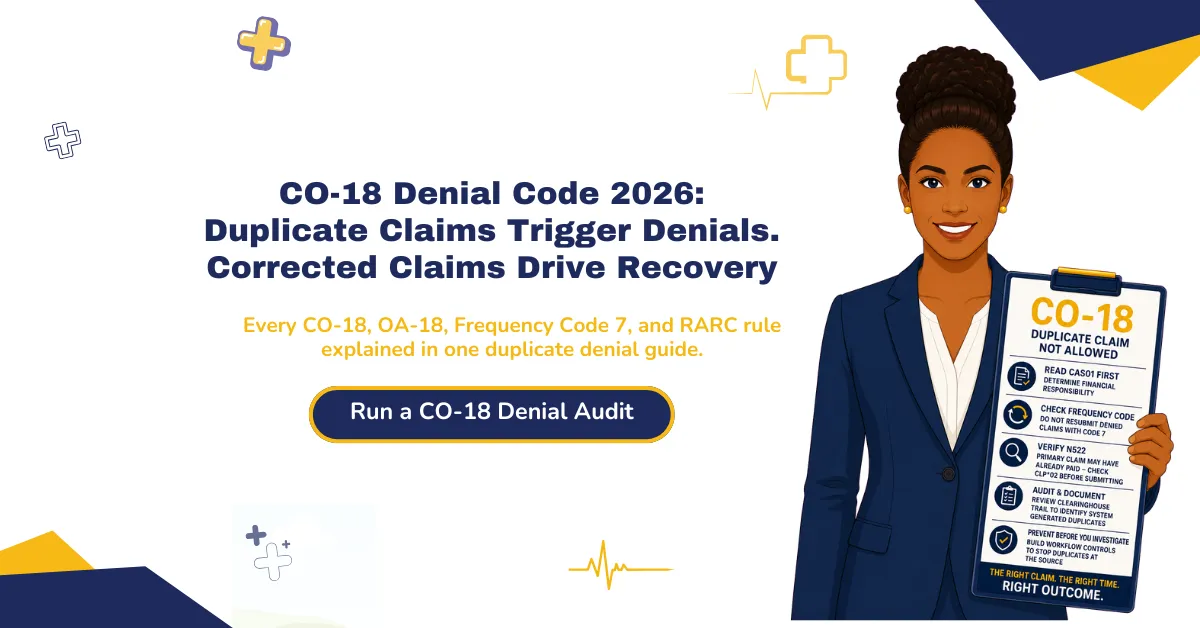
The CO-18 denial code appears on your 835 Electronic Remittance Advice and Explanation of Benefits as a two-part code. CO is the Claim Adjustment Group Code, which assigns financial obligation to the provider. The number 18 is the Claim Adjustment Reason Code (CARC), officially defined by X12 as “Exact duplicate claim/service.” X12 adds a usage rule no competitor page publishes: “Use only with Group Code OA except where state workers’ compensation regulations requires CO.” The payer determined the submitted claim matches one already in their system for the same patient, provider, date of service, procedure code, place of service, and billed amount. You don’t bill the patient for a CO adjustment.
In 2026, with the CARC list last updated November 1, 2025, and CORE 360 rules standardizing co-18 denial code handling across all payers since April 6, 2026, getting the resolution workflow right is more important than ever. This guide covers the official description, the OA-18 vs co18 denial code disambiguation, every root cause, the modifier table, the Frequency Code 7 corrected claim template, and the RARC crosswalk.
CO-18 Denial Code: Quick Reference
Code: CO-18 CARC: 18: Exact duplicate claim/service (X12 official) Group Code: CO (Contractual Obligation) CARC Active Since: January 1, 1995 CARC Last Modified: June 2, 2013 Patient Billing Allowed: No. CO group code means the provider absorbs the adjustment. Standard RARC Paired: N522 (Duplicate of a claim processed, or to be processed, as a crossover claim)
X12, the ANSI-chartered body responsible for HIPAA-mandated 835 transaction standards, publishes the CARC list in coordination with the Washington Publishing Company. The co 18 denial code description is “Exact duplicate claim/service” and has been unchanged since June 2, 2013. When the co 18 denial code patient responsibility question arises, the answer is always no: CO group code means the provider absorbs the adjustment.
What Is the CO-18 Denial Code? Official X12 Description and How It Appears on Your ERA
Understanding the co 18 denial code description at the code-component level tells your billing team exactly where to start the investigation. Three H3s below cover the official definition, the ERA structure, and the six fields the payer’s duplicate detection system checks.
The Official CARC 18 Definition From X12: Including the Usage Rule No Competitor Publishes
CARC 18’s official definition from X12 is: “Exact duplicate claim/service.” The full X12 entry includes a usage rule no competitor page states: “Use only with Group Code OA except where state workers’ compensation regulations requires CO.” That rule tells you everything. OA-18 is the standard. CO-18 is the workers’ comp exception and the commercial payer mapping variant. CARC 18 has been active since January 1, 1995 and was last modified June 2, 2013, meaning the definition is stable. The CARC list was last updated November 1, 2025, confirming CARC 18 remains active. The complete active CARC list including CARC 18 is maintained at the X12 CARC official list. For Medicare-specific guidance on duplicate claim denials including RARC N522, Noridian Reason Code 18 and RARC N522 is the MAC-level source. The co18 denial code sits at the intersection of X12 and Medicare policy that these two sources confirm.
How CO-18 Appears on Your 835 ERA: and Why You Can’t See Which Claim It Duplicated
CO-18 appears in the CAS segment of the 835 transaction. CAS01 is the group code (CO). CAS02 is the CARC (18). CAS03 is the dollar amount adjusted. Your billing software combines these and displays “CO-18” on your denial report. On a paper EOB, it shows as “CO-18” or “CO 18” with payer language such as “Duplicate Claim/Service.”
X12 published an official interpretation (RFI 1739) clarifying that the 835 standard doesn’t guarantee the duplicate claim number will appear on the remittance. Identifying the original claim requires matching payer claim control numbers, dates of service, and charge lines against prior remittances manually. ClaimMax RCM’s revenue cycle management process builds a payer claim control number cross-reference log that makes this manual match take minutes instead of hours. The co 18 denial code investigation starts at the ERA, not at the payer’s phone line.
The Six Duplicate Claim Matching Criteria: All Six Required for CO-18 to Fire
The payer’s duplicate detection system checks all six of these fields before returning CO-18. A single difference in any one of them flips the duplicate detection off.
- Patient identifier (member ID or subscriber ID)
- Provider number (NPI and billing NPI)
- Date of service (from date and through date)
- Procedure code (CPT or HCPCS code, including any appended modifiers)
- Place of service code (POS)
- Billed amount
A missing modifier, a different rendering NPI, or a corrected date looks different to the payer’s system even if the service was identical. Medicare distinguishes exact duplicates, which are auto-denied and trigger CO-18, from suspect duplicates, which are suspended for manual review. The denial reason code 18 in both cases signals the same CARC, but the underlying payer process differs. Understanding this distinction matters for the appeal strategy.
CO-18 vs OA-18: Why the Group Code Changes Your Resolution Workflow and Who Owes the Money
Same CARC. Different group code. The prefix determines who owes the money and which resolution path applies. If your remittance shows CO-18 when you expected OA-18, you’re not making an error. They share the same CARC 18. The denial code co 18 and OA-18 are two different billing outcomes tied to the same underlying duplicate detection result. The co18 denial code means provider absorbs. OA-18 means neither party automatically.
CO-18 vs OA-18 Comparison Table
| Code | Group Code | Who Absorbs the Adjustment | Standard Payer Context | Resolution Action |
|---|---|---|---|---|
| OA-18 | OA (Other Adjustment) | Neither provider nor patient automatically | Medicare, standard commercial payers following X12 rules | Investigate whether the duplicate is valid (write off) or erroneous (appeal). Do not bill the patient. |
| CO-18 | CO (Contractual Obligation) | Provider absorbs per payer contract | Workers’ compensation payers in states requiring CO, commercial payers with internal CO mapping | Investigate root cause before posting any write-off. Submit corrected claim through the payer’s replacement process if erroneous. Do not bill the patient. |
For Medicare claims, CMS guidance is explicit: beneficiaries may only be billed when Group Code PR accompanies an adjustment. CO and OA adjustments on Medicare claims are never patient responsibility. Under HIPAA Administrative Simplification requirements, all payers must use X12-approved CARCs and RARCs. This applies to Medicare Advantage plans as much as fee-for-service payers. The co-18 denial code appears under CO in commercial payer systems that map duplicate denials to the Contractual Obligation group per their internal contract rules.
When California Workers’ Compensation Regulations Require CO Instead of OA
X12’s usage rule permits CO with CARC 18 “where state workers’ compensation regulations requires CO.” California is one such state. California Labor Code 3700 establishes workers’ comp as mandatory, and California’s Division of Workers’ Compensation has specific billing requirements that affect group code assignment for duplicate claim adjustments. When a California workers’ comp payer returns CO-18, the resolution path follows that payer’s WC-specific duplicate claim procedures, separate from your standard commercial workflow. Workers’ comp payers in California have their own credentialing, billing cycles, and appeal timelines that don’t mirror Medicare or commercial payer processes. The denial code co 18 in a California WC context is a separate administrative track from everything else in your denial queue.
Is CO-18 the Patient’s Responsibility?
No. CO-18 is not the patient’s responsibility. The CO group code (Contractual Obligation) assigns financial liability to the provider. You cannot bill the patient for any adjustment carrying a CO group code, including CO-18.
This is the opposite of PR group code adjustments, which transfer financial responsibility to the patient. CO-18 is a duplicate claim processing determination. The patient had no role in submitting the claim twice. Billing the patient for a provider-side process error violates most payer contracts.
Three Scenarios Where CO-18 Definitively Cannot Be Billed to the Patient
Valid Duplicate: The original claim was correctly adjudicated and paid. Your team submitted the same claim twice. Post the CO-18 as denied. Close the account. No patient billing action follows from this scenario under any circumstances.
Corrected Claim Sent as New Original: Your team submitted a correction without Frequency Code 7. The payer flagged it as a duplicate. The billing error is on the provider’s side. The patient’s financial obligation didn’t change because your team used the wrong submission channel. This is the co 18 denial code resolution situation that most billing teams misclassify as a payer error.
CLP*02 Crossover Error: The primary payer crossed the claim to secondary automatically and your team also submitted manually. The secondary returned CO-18. The patient’s cost-share was already calculated by the primary. CO-18 from secondary doesn’t create a new patient obligation. OA-18 is equally non-billable to the patient. Neither CO group code nor OA group code adjustments create patient billing obligations.
Six Root Causes of CO-18 Denials: What Your Remittance Queue Is Actually Telling You
The root cause of a co18 denial code determines the resolution path before you take any other action. A valid duplicate closes immediately. An erroneous one requires a corrected resubmission or appeal. Getting this wrong at step one wastes resolution time and closes timely filing windows.
Cause 1: Exact Duplicate Submission
Your billing team submitted the same claim twice. The payer adjudicated the first and returned CO-18 on the second. All six duplicate detection criteria matched. This is the valid CO-18. There’s no appeal path. Post the second claim as denied, confirm the original was paid and posted correctly, and close the account. CARC 18 fires on the second claim. The first claim adjudicated normally.
Cause 2: Resubmission Without Corrections
Your team sent the same claim again after a denial for a different reason, without fixing the original error. The payer sees a matching claim it already has on file and returns CO-18 on the resubmission. You now have two problems: the original denial is still unresolved and the CO-18 is active on the resubmission. Check the original denial’s CAS segment for the first denial code before routing any CO-18 that followed a prior denial. The fix is addressing the original denial root cause, not the CO-18.
Cause 3: System or Clearinghouse Errors
Your billing software or clearinghouse transmitted the same claim twice through a technical failure: EHR synchronization errors, batch processing glitches, or delayed acknowledgment updates. The claim reached the payer twice without your team sending it twice. Confirm through your clearinghouse’s audit trail that two separate transmissions occurred before contacting the payer. A system-generated duplicate is a recoverable situation once you document the technical failure. Medicare Advantage plans route through clearinghouses that have specific acknowledgment timing rules. Delays in ACK receipt are the leading cause of system-generated co-18 denial code in MA billing.
ClaimMax RCM’s guide to clearinghouse rejections in medical billing covers the acknowledgment verification workflow that confirms whether a claim transmitted once or twice before it reaches the payer.
Cause 4: Coordination Gap Between Billing Staff
Two people submitted the same claim without knowing the other had already done so. This happens in practices without a centralized claim submission log: a billing manager resubmits while a staff member already sent it, or two departments submit for the same encounter independently. Every CO group code adjustment routes back to the provider side. Cause 4 is no exception. A single-source submission log accessible to every billing team member is the only structural fix for this cause.
Cause 5: Corrected Claim Submitted as New Original Without Frequency Code 7
This is the most common source of erroneous CO-18 denials. Your team needed to correct an error on the original claim. Instead of submitting it as a replacement claim using Frequency Code 7, they submitted a brand-new original. The payer sees a new claim matching the original and returns CO-18. Frequency Code 7 is the corrected claim indicator. It tells the payer this claim replaces the one already on file. Without it, every corrected claim looks like an exact duplicate. Most billing teams that classify these co 18 denial code denials as payer errors are actually looking at Cause 5.
The CMS Medicare Claims Processing Manual’s guidance on exact versus suspect duplicate claims and the replacement claim process is at CMS Medicare Claims Processing Manual duplicate claim detection. The co 18 denial code frequency code 7 connection is confirmed in this manual as the standard replacement claim workflow.
Cause 6: Secondary Payer Crossover Claims and the CLP*02 Signal
When a primary payer adjudicates a claim, they sometimes send it directly to the secondary automatically, called a crossover claim. Your billing team, not knowing the primary already crossed it, manually submits to the secondary. The secondary receives two submissions and returns CO-18 on the manual one. To prevent this: check the CLP02 field in the primary ERA before submitting to secondary. If CLP02 shows a value of 19, the crossover is already in progress. Don’t submit manually. On crossover claims, OA-18 is the typical result when the secondary uses standard X12 group code rules. CO-18 appears when the secondary is a workers’ comp plan. The denial code 18 in the crossover context requires the CLP*02 check before any other action.
Modifier Quick Reference: Which Modifier Prevents CO-18 on Legitimate Repeat Services
CO-18 fires on legitimate same-day repeat services when no modifier signals they’re distinct. The modifier doesn’t excuse a duplicate. It tells the payer the second service was separately billable from the first. Documentation must support every modifier. Check NCCI Version 32.1 (effective April 1, 2026) before applying modifier 59 to any code pair on a co18 denial code review. Modifier 76 on repeat procedures is the fastest path to resolving CO-18 on legitimate same-day repeats.
| Modifier | Official Name | When It Applies to CO-18 | What It Tells the Payer | Documentation Required |
|---|---|---|---|---|
| 59 | Distinct Procedural Service | Two CPT codes on the same date are distinct services with separate clinical indications | This is not a duplicate. It’s a separate, distinct procedure | Medical record must show separate clinical indications for each service on the same date |
| 76 | Repeat Procedure by Same Physician | The same procedure was performed a second time on the same date by the same provider | This is not a duplicate claim. It’s a medically necessary repeat of a previously performed procedure | Clinical reason for the repeat must be documented in the medical record |
| 77 | Repeat Procedure by Another Physician | The same procedure on the same date performed by a different provider | Different physician separately billed a repeat service | Both provider NPIs on the claim. Medical record must show both providers performed distinct encounters |
| 91 | Repeat Clinical Diagnostic Lab Test | Same lab test ordered more than once on the same day for clinical reasons | Multiple test results are medically necessary and separately billable | Clinical notes must state why repeated testing was required within the same day |
| 50, RT, LT | Bilateral Procedures | Bilateral procedures billed separately | Left and right side are separate billable services | Operative or procedure note must name both sides explicitly |
Every modifier in this table requires documentation support. A modifier without clinical documentation in the medical record loses the appeal. Using modifier 59 on bundled services to prevent CO-18 creates a second problem. Modifier 59 applied incorrectly to a bundled pair triggers CO-97 instead of resolving CO-18. Check NCCI Version 32.1 (effective April 1, 2026) before applying modifier 59 to any code pair. The co 18 denial code solution through modifiers requires documentation review before modifier selection, never after.
How to Fix a CO-18 Denial: The ClaimMax Quick-Fix Checklist and Frequency Code 7 Corrected Claim Template
The correct resolution action on CO-18 depends on what you find in the first step, not the second or third. Work through this checklist before touching the co18 denial code claim, then use the Frequency Code 7 template if it applies. The co 18 denial code resolution path splits at Step 4: valid duplicate closes, erroneous duplicate resubmits. The co 18 denial code solution is never generic resubmission.
CO-18 Quick-Fix Checklist: ClaimMax RCM
Step 1: Read CAS01 Before Any Other Action. Pull the 835 ERA. Locate the CAS segment. Read CAS01. If it shows CO, the provider absorbs the adjustment. If it shows OA, the financial assignment is different. Do not post any write-off and do not generate a patient statement before Step 2. Workers’ comp CO-18 may follow a payer-specific resolution path separate from standard commercial workflow.
Step 2: Confirm the Original Claim’s Adjudication Status. Log into the payer portal or run an EDI 276 claim status transaction. Locate the original claim. Confirm three things: whether it was paid, what the paid amount was, and whether the paid date and check number are available. If the original was paid and the second was an exact copy, the duplicate is valid. Post CO-18 as denied. Confirm original is posted. Close.
Step 3: Check CLP02 Before Any Secondary Billing. Before billing the secondary payer on any CO-18 from a secondary, go back to the primary ERA and locate CLP02. If CLP*02 shows 19, the primary already crossed the claim automatically. Your manual submission created the duplicate. Do not resubmit to secondary again.
Step 4: Determine Whether This Is a Valid or Erroneous Duplicate. Valid = original was paid, second submission matched all six criteria with no corrections. Erroneous = corrected claim submitted as new original without Frequency Code 7, or distinct services billed without modifiers, or a crossover claim also submitted manually.
Step 5: Submit the Corrected Claim or Close. For a valid duplicate: close at Step 2. For an erroneous duplicate from Cause 5: use the Frequency Code 7 template below. For an erroneous duplicate from missing modifiers: add the appropriate modifier from the Section 6 table and resubmit as a corrected claim with clinical documentation.
Frequency Code 7 Corrected Claim Reference: ClaimMax RCM
CMS-1500 Box 22 (Resubmission Code):
Left side: 7
Right side: [ORIGINAL CLAIM NUMBER / ICN / DCN from payer portal]
UB-04 Form Locator 4 (Bill Type, Frequency Code):
Enter 7 in the third digit position of the bill type code.
Example: Original bill type 131 becomes corrected bill type 137.
Cover note to attach to corrected claim:
“This claim is a replacement for claim [ORIGINAL CLAIM NUMBER] submitted
on [ORIGINAL SUBMISSION DATE]. Claim [ORIGINAL CLAIM NUMBER] was flagged
as a duplicate. This corrected claim [DESCRIBE THE CORRECTION MADE] and
replaces the original submission. Please process as a replacement claim
per Claim Frequency Code 7.”
The original claim number goes in Box 22 right side on the CMS-1500 or in the appropriate reference field on the UB-04. Without it, the payer’s system can’t link the replacement to the original, and the corrected claim may fire CO-18 again.
For CMS-1500 Box 22 completion rules and common corrected claim filing errors that generate CO-18 on resubmissions, ClaimMax RCM’s guide to common mistakes in filling CMS 1500 form covers the Box 22 resubmission code field in full. The co18 denial code frequency code 7 correction template above is the first copy-paste reference in the CO-18 SERP providing verbatim Box 22 and Form Locator 4 language.
When CO-18 denials are already aging in your queue past 30 days without resolution, every day without action is a day closer to a closed timely filing window. ClaimMax RCM’s denial management services team identifies CO-18 root causes by payer and routes every resolvable denial, whether valid duplicate close, corrected resubmission, or erroneous appeal, within 24 to 48 hours of ERA receipt. When CO-18 claims and write-offs are already accumulating in your AR, ClaimMax RCM’s AR follow-up team traces every aging denial back to its cause and works every remaining recovery path before the filing window closes.
CO-18 RARC Crosswalk: How the Remark Code on Your Remittance Tells You Which Fix Applies
The RARC on a co18 denial code denial is your resolution routing signal. Read it before taking any action. N522, N142, and N152 each require a different response. X12 maintains all active RARC descriptions at the X12 RARC official list. The RARC N522 crosswalk below is confirmed against Noridian’s Medicare denial resolution guidance.
The CO-18 RARC Reference Table
| RARC Code | Official Description | What It Means for CO-18 | Resolution Action |
|---|---|---|---|
| N522 | Duplicate of a claim processed, or to be processed, as a crossover claim | The primary payer crossed this claim to secondary automatically. Your manual submission created the duplicate. | Verify CLP02 in the primary ERA. If CLP02 = 19, do not resubmit to secondary. Confirm crossover with the secondary payer directly. |
| N142 | The original claim was denied. Resubmit a new claim, not a replacement claim. | You submitted a corrected replacement claim but the original was denied, not paid. A replacement chain can’t be built from a denied claim. | Submit a brand-new original claim. Do not use Frequency Code 7 on this submission. |
| N152 | Missing/incomplete/invalid replacement claim information | You submitted a corrected claim using Frequency Code 7, but the replacement identifiers were incomplete. The original claim number or replacement indicators were missing. | Resubmit as a corrected claim. Include the original claim number, Frequency Code 7, and all required replacement identifiers. |
N142 and N152 require opposite actions. N142 needs a new original claim. N152 needs a corrected replacement with complete identifiers. Getting these confused wastes your timely filing window on the wrong submission type. Noridian’s Medicare denial resolution guidance confirms N522 as the RARC paired with crossover duplicate denials in the Medicare fee-for-service system. N522 accompanies OA-18 when the secondary uses standard X12 group code rules, and CO-18 when the secondary is a workers’ comp plan following state CO-group requirements. The co 18 denial code RARC determines the exact filing path before any resubmission begins.
2026 Regulatory Updates That Change How CO-18 Denials Are Processed Across All Payers
Three regulatory changes in 2025 and 2026 directly affect how CO-18 denials are processed, reported, and resolved. Practices running pre-2026 duplicate denial workflows are missing these changes. The co18 denial code in 2026 operates under updated CORE 360 enforcement and updated CARC and RARC code sets that weren’t in effect 18 months ago. CMS has integrated these changes across Medicare, Medicaid, and commercial payer standards.
CARC and RARC Code Set Updates in 2026
The X12 CARC list (External Code List 139) was last modified November 1, 2025. CARC 18 itself was last modified June 2, 2013. The definition is stable. The RARC list (External Code List 411) was last modified March 4, 2026. Per CMS Transmittal R13666CP (March 25, 2026), contractors update CARC and RARC code sets three times per year: approximately March 1, July 1, and November 1. Practices that haven’t updated their ERA mapping logic against the November 2025 and March 2026 releases may be routing CO-18 denials through workflows that reference outdated RARC descriptions. Medicare fee-for-service CO-18 denials follow the Noridian and other MAC-specific RARC pairings that track the March 2026 RARC list update.
ClaimMax RCM’s payment posting service team updates ERA mapping rules against every CARC and RARC release cycle to keep CO-18 routing logic current with each code set update. Revenue cycle accuracy depends on mapping that matches the current X12 code set, not last year’s version.
CORE 360 Standardization: What April 6, 2026 Means for Your CO-18 Resolution Playbook
CMS Transmittal R13481CP, with implementation date April 6, 2026, enforces CORE 360 Uniform Use rules. These rules standardize how CARC, RARC, and Group Code combinations apply across all health plans: Medicare, Medicaid, and commercial payers. Before April 6, 2026, CO-18 resolution workflows sometimes varied significantly between payer types because Group Code and RARC combination rules weren’t uniformly enforced. After April 6, 2026, the same CO-18 triage logic, read the group code, check the RARC, follow the path, is more portable across all payer types than it was before CORE 360 enforcement. CORE 360 standardization applies to all group code assignments including PR, CO, and OA. CO-18 resolution workflows that correctly handle group codes benefit from the same standardization as PR-code patient billing workflows. The full CMS Transmittal R13481CP requirements are at CMS Transmittal R13481CP CORE 360.
How to Prevent CO-18 Denials Before They Hit Your Remittance
Most CO-18 denials are preventable before the claim ever reaches the payer. These controls catch duplicate submissions, wrong resubmission channels, and crossover claim errors at three workflow stages.
Front-End Controls (Before Submission)
Check claim status through your clearinghouse or payer portal before resubmitting any denied or unpaid claim. A claim that shows as non-receipt may still be in the payer’s system as pending. Submitting again creates a valid CO-18.
Maintain a centralized claim submission log accessible to all billing staff. Two people submitting the same claim from different workstations is the most preventable root cause of exact duplicate CO-18 denials.
Verify CLP*02 in every primary ERA before manually billing the secondary. A value of 19 means the crossover is already in progress. Manual submission creates a secondary CO-18.
Train billing staff to use Frequency Code 7 for every corrected claim, not a new original submission. Apply modifier 76 or 77 to every repeat procedure before submission, not after CO-18 fires. Check NCCI edit pairs before applying modifier 59 to any code pair generating CO-18 on repeat same-day services. Apply modifier 77 when a different physician performed the repeat service. These modifier decisions happen before submission, not during the denial resolution workflow.
Correct claim submission on the first pass is a core clean claim standard. ClaimMax RCM’s guide to what is a clean claim in medical billing covers the front-end accuracy requirements that prevent CO-18 from firing before the ERA arrives.
Mid-Cycle and Post-Submission Controls
Configure claim scrubbing software to flag same-patient, same-date, same-CPT submissions before they transmit. Automated duplicate detection at the pre-transmission stage catches what manual review misses during high-volume batch runs.
Post ERA adjustments within 24 hours of receipt. Unposted ERAs leave claim status ambiguous in your system. Billing staff resubmit claims that show as unpaid when the ERA sitting in the queue already shows they were paid.
Flag every CO-18 denial with its timely filing expiration date on the day it’s posted. Unworked CO-18 denials convert into timely filing losses when they age past the payer’s window.
Build a RARC N522 alert in your ERA workflow. When N522 accompanies a secondary CO-18, the investigation starts with the primary ERA’s CLP*02 field, not with the payer.
Frequently Asked Questions About the CO-18 Denial Code
What Is Denial Code CO-18?
CO-18 is a Claim Adjustment Reason Code (CARC) that appears on the 835 ERA and EOB when a payer determines the submitted claim is an exact duplicate of a previously submitted, pending, or paid claim. X12 defines CARC 18 as “Exact duplicate claim/service.” The CO group code means the provider absorbs the adjustment and cannot bill the patient.
Schema Answer: “CO-18 is CARC 18 on the 835 ERA, defined by X12 as ‘Exact duplicate claim/service.’ The payer found a matching claim already on file. CO group code means the provider absorbs the adjustment: no patient billing.”
How Do You Fix a CO-18 Denial Code?
Check the group code first. Pull the original claim’s adjudication from the payer portal. If the original was correctly paid and the second submission was an exact copy, post CO-18 as denied and close. If the second claim was a correction sent as a new original, resubmit it as a replacement using Frequency Code 7 in Box 22 of the CMS-1500.
Schema Answer: “Confirm the original claim was paid via payer portal. If a valid duplicate, post as denied and close. If a corrected claim was submitted as a new original, resubmit using Frequency Code 7 in CMS-1500 Box 22.”
What Does CO-18 Mean in Medical Billing?
CO-18 means “Exact duplicate claim/service” in US medical billing. CO is the Claim Adjustment Group Code (Contractual Obligation), assigning financial responsibility to the provider. The number 18 is the CARC, defined by X12. Together, CO-18 tells the billing team the payer found a matching claim already in their system and paid zero on the second submission.
Schema Answer: “CO-18 means ‘Exact duplicate claim/service’ per X12. CO assigns financial responsibility to the provider. CARC 18 is the duplicate indicator. The payer found a matching claim already on file and paid zero on the second.”
What Is the Difference Between CO-18 and OA-18?
Both CO-18 and OA-18 use CARC 18 (Exact duplicate claim/service). The group code differs. OA-18 uses Group Code OA (Other Adjustment) and is the standard X12 application for duplicate denials on most Medicare claims. CO-18 uses Group Code CO (Contractual Obligation) and applies in workers’ compensation jurisdictions or commercial payer systems with internal CO mapping. Neither allows patient billing.
Schema Answer: “CO-18 and OA-18 share CARC 18. OA-18 is the standard X12 duplicate denial; CO-18 applies to workers’ comp and certain commercial payers. Both are non-billable to patients.”
Is CO-18 the Patient’s Responsibility?
No. CO-18 isn’t the patient’s responsibility. The CO group code (Contractual Obligation) assigns the financial obligation to the provider. The patient had no role in the duplicate submission. Billing the patient for a CO group code adjustment violates most payer contracts.
Schema Answer: “No. CO-18 is not the patient’s responsibility. The CO group code assigns the financial obligation to the provider. Billing the patient for a CO adjustment violates payer contracts.”
What Is the Official CO-18 Denial Code Description?
The official CO-18 description from X12 is: “Exact duplicate claim/service (Use only with Group Code OA except where state workers’ compensation regulations requires CO).” CARC 18 has been active since January 1, 1995 and was last modified June 2, 2013. The CARC list was confirmed current as of November 1, 2025.
Schema Answer: “The official CO-18 description from X12: ‘Exact duplicate claim/service (Use only with Group Code OA except where state workers’ compensation regulations requires CO).’ Active since January 1, 1995, confirmed current November 1, 2025.”
What Causes a CO-18 Denial Code?
CO-18 has six root causes: exact duplicate submission, resubmission without corrections after a different denial, system or clearinghouse transmission errors, lack of coordination between billing departments, a corrected claim submitted as a new original without Frequency Code 7, and a manual secondary submission when the primary payer already crossed the claim to secondary automatically via CLP*02.
Schema Answer: “Six CO-18 causes: exact duplicate submission, uncorrected resubmission, clearinghouse transmission error, departmental coordination gap, corrected claim submitted as new original without Frequency Code 7, and crossover claim also submitted manually to secondary.”
When Does CO-18 Apply to California Workers’ Compensation Claims?
CO-18 applies to California workers’ comp claims when the payer’s group code assignment follows California’s workers’ compensation regulations, which require the CO group code instead of OA for duplicate claim adjustments. X12’s usage rule for CARC 18 explicitly permits CO “where state workers’ compensation regulations requires CO.” California Labor Code 3700 establishes the workers’ comp framework that drives this CO-group requirement. The co 18 denial code california context is governed by the DMHC and the California Division of Workers’ Compensation, not by standard commercial payer rules.
Schema Answer: “CO-18 applies to California workers’ comp when state regulations require the CO group code. X12 permits CO with CARC 18 ‘where state workers’ compensation regulations requires CO.’ California Labor Code 3700 establishes this framework.”
Stop Working CO-18 Denials Claim by Claim: How ClaimMax RCM Fixes the Pattern
You’ve got the X12 usage rule, the OA-18 vs CO-18 group code distinction, the six root causes, the RARC routing signals, the Frequency Code 7 template, and the prevention controls. The gap between having this information and having it built into your posting and submission workflows is where CO-18 denials stop being individual claim problems and start being systematic revenue leakage.
ClaimMax RCM builds CO-18 resolution into the workflow: CAS01 group code verification at every ERA posting, CLP*02 crossover checks before secondary billing, Frequency Code 7 corrected claim submissions for Cause 5 denials, RARC N522 routing alerts, and timely filing window tracking from the day the CO-18 posts. We fix the root cause, not the individual claim.
ClaimMax RCM’s medical billing service is built for practices that are done with CO-18 denials aging past 30 days in their AR queue. Request a free duplicate denial audit. We’ll identify your CO-18 root cause breakdown by payer, show you where Frequency Code 7 should have been used, and tell you exactly what your practice is leaving on the table every billing cycle.
All CARC and RARC definitions in this article are sourced from the X12 Claim Adjustment Reason Code list (External Code List 139) and X12 Remittance Advice Remark Code list (External Code List 411), maintained by X12 under HIPAA Administrative Simplification requirements. CARC 18 official description: “Exact duplicate claim/service (Use only with Group Code OA except where state workers’ compensation regulations requires CO).” CARC 18 active since January 1, 1995. Last modified June 2, 2013. CARC list last updated November 1, 2025. RARC list last updated March 4, 2026. CMS Transmittal R13481CP CORE 360 implementation date: April 6, 2026. NCCI Version 32.1 effective April 1, 2026. California workers’ compensation billing obligations reflect California Labor Code 3700 and California Division of Workers’ Compensation requirements as of May 2026. Frequency Code 7 Box 22 and Form Locator 4 instructions reflect standard CMS-1500 and UB-04 corrected claim submission requirements. All billing codes, regulatory requirements, and CARC/RARC descriptions are subject to change. Verify current codes through the X12 official lists and your payer-specific billing guidelines before taking any action. This article does not constitute legal, compliance, or billing advice.


