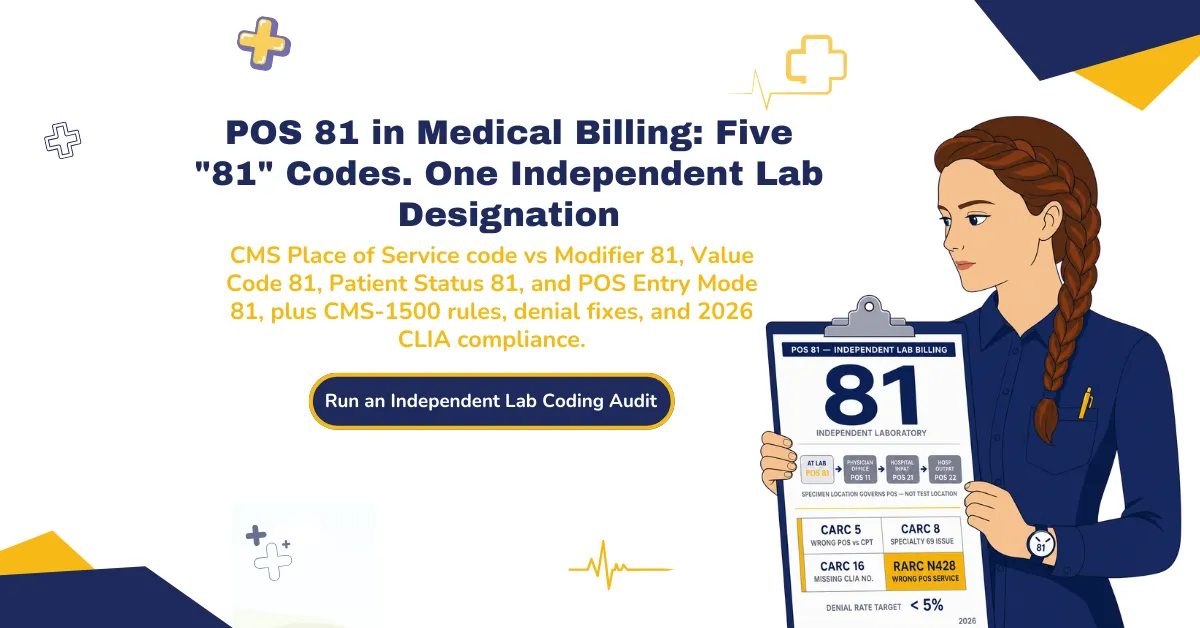
Independent labs lose 5% to 11% of revenue to POS code errors. That’s per HFMA MAP Keys benchmarks. POS 81 in medical billing sits at the center of those errors. CMS updated its Place of Service Code Set on February 9, 2026, and CLIA’s new paperless system went live March 1, 2026. POS 81 errors compound under both shifts.
POS 81 in medical billing (place of service 81) is the Place of Service code designating Independent Laboratory. The code appears on the CMS-1500 claim form when an independent lab performs and bills for services on a specimen collected at the lab itself. CMS governs this through the Place of Service Code Set and 42 CFR Part 493.
Here’s what’s in the guide. We start with the CMS definition, then walk through the 6-step decision framework, CMS-1500 form completion, and the specimen collection rule that trips most lab billers. Modifiers, denial codes, CLIA compliance, and PAMA deadlines all get covered. We close with the disambiguation between POS 81 and four other “81” concepts that cause coding errors.
Claimmax RCM has handled independent lab billing for 15 years across CLIA-certified labs of every certificate type. The team processes POS 81 claims daily, manages denial recovery on misapplied POS codes, and tracks every regulatory shift affecting independent laboratory billing. Here’s who built this guide: certified billing specialists wrote it; a Senior Lab Billing Director and CPC reviewed every section.
That’s where this guide goes. Let’s start with what POS 81 actually means under the current CMS Place of Service Code Set, then walk through every operational rule that affects your lab’s clean claim rate.
What Is POS 81 in Medical Billing? The Official CMS Definition for 2026
POS 81 designates “Independent Laboratory,” defined by CMS as “A laboratory certified to perform diagnostic and/or clinical tests independent of an institution or a physician’s office.” That’s per the CMS Place of Service Code Set, last modified February 9, 2026. POS 81 in medical billing is the answer when both conditions are met.
The 2026 CMS Authority Behind POS 81
POS 81 is one of approximately 81 two-digit Place of Service codes maintained by CMS. POS codes appear in Box 24B of the CMS-1500 claim form (paper) or the equivalent field on the 837P electronic transaction. POS codes interact with CPT codes, modifiers, and Medicare’s facility versus non-facility payment logic.
POS 81 tells payers two specific things at once. First, the service was performed by a CLIA-certified laboratory facility. Second, the lab operates independently of any hospital or physician’s office. That dual signal determines fee schedule application, reimbursement methodology, and audit risk profile for every claim submitted.
POS 81 vs POS Entry Mode 81 (Mastercard) Different Concepts Entirely
Search confusion runs deep here. POS 81 in medical billing has nothing to do with POS Entry Mode 81 in payment processing. POS Entry Mode 81 is a Mastercard e-commerce indicator showing PAN entry via electronic commerce. Medical billing POS 81 is the Independent Laboratory Place of Service code. These are completely separate systems that share nothing but the number.
The CMS Place of Service Code Set page was last modified February 9, 2026. POS 81 remains active with the same definition that’s governed the code since its introduction. The 2026 update didn’t change POS 81’s definition or eligibility rules, but it did refresh the entire POS Code Set framework that surrounds the code.
Knowing the definition is one thing. Knowing the regulatory framework that governs which labs can use POS 81, and which can’t, is what protects your claims from automatic denial. That framework runs through CMS, 42 CFR Part 493, and CLIA.
The Regulatory Authority Behind POS 81: CMS, 42 CFR Part 493, and CLIA
POS 81 doesn’t exist in isolation. It sits at the intersection of three regulatory frameworks: the CMS Place of Service Code Set (defining the code itself), 42 CFR Part 493 (the CLIA regulatory framework defining laboratory certification requirements), and Section 1842(b)(3) of the Social Security Act (governing reasonable charge basis for clinical laboratory services).
42 CFR Part 493 and the CLIA Framework
The Clinical Laboratory Improvement Amendments (CLIA) program covers approximately 320,000 laboratory entities in the United States. CLIA requires every lab performing testing on humans, except for research, to hold a valid certificate. 42 CFR Part 493 codifies these requirements. Without CLIA certification, a lab can’t bill Medicare or Medicaid under POS 81 or any other POS code.
CLIA recognizes four certificate types: Certificate of Waiver (waived tests only), Certificate for Provider-Performed Microscopy (PPM), Certificate of Compliance (moderate or high complexity testing under government inspection), and Certificate of Accreditation (testing under accrediting organization oversight). Each type carries different scope, fee, and inspection requirements per the CMS CLIA Program.
CMS Specialty 69 Designation for Independent Laboratories
This is the rule that catches more lab billers than any other. CMS Specialty 69 (Clinical laboratory billing independently) is the provider specialty designation that grants POS 81 billing eligibility. Per FCSO Medicare guidance and CMS rules, providers without Specialty 69 designation who bill POS 81 face automatic claim denials. WPS Medicare has flagged this misuse pattern in audit findings published through AAPC.
The takeaway is operational. POS 81 isn’t just a code to apply. It’s a billing privilege that requires CLIA certification under 42 CFR Part 493 and Specialty 69 provider designation under CMS rules. The next section walks through what actually qualifies a facility as an independent laboratory.
What Qualifies as an Independent Laboratory? The 2026 Operational Definition
An independent laboratory is a CLIA-certified facility that performs diagnostic or clinical tests outside of any hospital, clinic, or physician’s office. The lab operates as a standalone entity with its own NPI, its own CLIA number, and its own billing structure. POS 81 applies only when this lab performs and bills for the service.
The Three Defining Characteristics of an Independent Laboratory
Three operational characteristics separate independent labs from other facility types. Each characteristic must be present for POS 81 billing to apply correctly. The table below summarizes the operational test.
| Characteristic | What It Means | What Disqualifies |
|---|---|---|
| Standalone Operation | Lab operates as its own entity, not part of a hospital, clinic, or physician’s office | Hospital outreach labs, physician office labs, in-clinic labs |
| CLIA Certification | Holds valid CLIA Certificate of Compliance or Accreditation under 42 CFR Part 493 | Labs without active CLIA certificates, or with Waiver only for tests requiring higher complexity |
| Specialty 69 Designation | Enrolled with Medicare under Specialty 69 (Clinical laboratory billing independently) | Providers enrolled under any other specialty code |
Major national independent labs include Quest Diagnostics, LabCorp, BioReference Laboratories, Sonic Healthcare, and ARUP Laboratories. Regional independent labs operate in every state. Each holds CLIA certification, operates standalone, and bills under Specialty 69. Pathology Laboratory Associates and Clinical Pathology Laboratories also qualify when meeting the three-test criteria.
Hospital Outreach Labs: A Special Case
Hospital outreach labs occupy a complicated middle ground. A hospital lab that processes specimens for non-hospital patients can function as an independent laboratory for billing purposes, but only when meeting specific CMS criteria. These labs typically bill on the CMS-1450 form (UB-04) rather than the CMS-1500. Hospital outreach lab classification triggers different reporting requirements under PAMA, including applicable laboratory determination.
Front-end eligibility verification before any specimen collection prevents POS 81 misapplication denials. That’s the discipline that protects clean claim rates. The next section walks through the exact decision framework lab billers should run before applying POS 81.
When to Use POS 81: The 2026 Lab Billing Decision Framework
Six questions determine whether POS 81 applies. Run them in order. If any question returns “no,” POS 81 doesn’t apply and a different POS code is required. This decision framework prevents the most common POS 81 misapplication denials lab billers face.
The 6-Step POS 81 Decision Framework
Step 1: Is the billing entity an independent laboratory? The lab must hold a valid CLIA certificate, operate standalone (not as part of a hospital or physician’s office), and be enrolled with Medicare under Specialty 69. If the billing entity is a hospital outreach lab, physician office lab, or any other facility type, POS 81 does not apply.
Step 2: Was the specimen collected at the independent lab itself? Per CMS Medicare Claims Processing Manual, Chapter 26, Section 10.6, POS 81 applies only when the specimen was drawn at the independent lab’s own facility. If the specimen was collected anywhere else (hospital, physician’s office, patient home, mobile collection), POS 81 doesn’t apply, even when the independent lab performs the test.
Step 3: Is the test being performed by the same entity that drew the specimen? If the specimen was drawn at the independent lab, but processing happens at a reference lab, additional modifier rules apply (Modifier 90 for reference laboratory services). The POS code reflects the collection location, not the testing location.
Step 4: Does the test fall under CLIA-covered services? POS 81 applies only to CLIA-covered diagnostic or clinical testing. Pathology, hematology, microbiology, chemistry, molecular diagnostics, and toxicology services qualify. Some non-laboratory services, even when performed at the same facility, require different POS codes.
Step 5: Has the patient’s insurance been verified for the date of service? Eligibility verification before specimen collection prevents downstream denials. Verify the patient’s coverage is active, the lab is in-network, and any necessary prior authorizations are in place. Front-end accuracy protects POS 81 claims.
Step 6: Are all required form fields properly completed on the CMS-1500? Box 24B must show “81,” Box 32 must show the lab’s service facility location address, Box 33 must show the billing provider’s information, and the CLIA number must be reported. Section 6 walks through each field.
Three scenarios show the framework in action. (1) A patient walks into the independent lab for a routine CBC. Specimen drawn on-site. Test performed on-site. POS 81 applies. (2) A patient at a hospital outpatient department has blood drawn for a molecular pathology panel processed at an independent reference lab. POS 22 applies (specimen drawn at hospital outpatient), not POS 81.
Edge cases create most denials. The third scenario: a telehealth-ordered home test kit collected by the patient and shipped to an independent lab. POS 81 may still apply when the lab processes the sample, but payer policies vary. The next section walks through CMS-1500 form completion in detail.
POS 81 on the CMS-1500 Form: Box-by-Box 2026 Guide
The CMS-1500 claim form has 33 boxes. For POS 81 claims, six of those boxes carry specific requirements that determine whether the claim gets accepted, denied, or returned as unprocessable. Missing or incorrect entries in any of these boxes triggers automatic claim rejection at the clearinghouse or payer level.
The table below shows every box that affects POS 81 claim acceptance. Each box has specific completion requirements per CMS Medicare Claims Processing Manual guidance. Use this as a pre-submission checklist for every independent lab claim.
| Box | Field Name | What to Enter for POS 81 | Why It Matters |
|---|---|---|---|
| Box 17 | Referring Provider Name | Ordering physician’s name (NPI required in 17b) | Establishes order chain and medical necessity |
| Box 17b | Referring Provider NPI | Ordering physician’s NPI | Required for laboratory claim acceptance |
| Box 23 | Prior Authorization Number / CLIA Number | Lab’s 10-character CLIA certificate identification number | Required for all CLIA-covered testing |
| Box 24B | Place of Service | 81 | Identifies independent laboratory as service location |
| Box 24J | Rendering Provider NPI | Performing lab’s NPI | Identifies the actual testing entity |
| Box 32 | Service Facility Location | Address where the specimen was collected | Determines POS code accuracy per CMS Manual Chapter 26 |
| Box 33 | Billing Provider Information | Lab’s billing entity name, address, and NPI | Identifies the billing party for payment |
The Box 32 Trap That Causes UnitedHealthcare Denials
UnitedHealthcare has documented a specific denial pattern tied to Box 32. When the address in Box 32 doesn’t match a verifiable specimen collection location, UHC denies the claim with this rationale: “the place of service for an independent laboratory must show the place where the sample was taken; based on the information provided on the HCFA 1500 Box 24B and Box 32 and the medical records submitted, we are unable to verify where the sample was obtained.”
The CMS-1500 paper form maps to the 837P electronic transaction. POS 81 in Box 24B corresponds to CLM05 in the 837P loop 2300. Box 32 maps to Loop 2310C (Service Facility Location), which is conditionally required when the service location differs from the billing provider per X12 RFI 1932. Clearinghouses enforce these mappings.
Box accuracy alone won’t save a claim if the specimen collection rule wasn’t followed. The next section breaks down the most-misunderstood rule in independent laboratory billing: where the specimen was drawn governs the POS code, not where the test was performed.
The Critical Specimen Collection Rule: Where the Sample Was Drawn Governs the POS Code
Here’s the rule that trips up more lab billers than any other rule in independent laboratory billing. POS 81 doesn’t follow where the test was performed. POS 81 follows where the specimen was collected. Read that twice. The Medicare Claims Processing Manual, Chapter 26, Section 10.6 establishes this rule explicitly for every independent lab claim.
CMS states it directly: “If an independent laboratory takes a sample in its laboratory, [the lab] shows ’81’ as place of service. If an independent laboratory bills for a test on a sample drawn on an inpatient or outpatient of a hospital, it uses the code for the inpatient (POS code 21), off campus-outpatient hospital (POS code 19), or on campus-outpatient hospital (POS code 22), respectively.”
The Specimen Collection Decision Matrix
The table below shows every collection location scenario and the corresponding POS code. Apply this matrix to every claim before assigning POS 81.
| Where Specimen Was Collected | Correct POS Code | Common Scenario |
|---|---|---|
| At the independent lab itself | POS 81 | Patient walks into lab for blood draw |
| At a hospital inpatient setting | POS 21 | Hospitalized patient’s specimen sent to outside lab |
| At an on-campus hospital outpatient setting | POS 22 | Hospital outpatient department specimen sent to outside lab |
| At an off-campus hospital outpatient setting | POS 19 | Off-campus hospital department specimen sent to outside lab |
| At a physician’s office | POS 11 | Physician’s office draws blood, ships to lab |
| At a skilled nursing facility | POS 31 or 32 | SNF resident specimen sent to outside lab |
| At a patient’s home (mobile collection or telehealth kit) | Variable; often POS 81 | Telehealth-ordered home test kit (verify payer policy) |
The WPS Medicare Audit Pattern
WPS Medicare published recent claim data analysis identifying potential errors in claims billed with POS 81. The audit findings show specific misuse patterns: providers without Specialty 69 designation billing POS 81, hospital outreach labs incorrectly using POS 81 for hospital-collected specimens, and physician office labs using POS 81 when POS 11 should apply. WPS documented these findings through AAPC Knowledge Center.
Independent labs that bill POS 81 for hospital-collected specimens face automatic claim denials. The fix is operational. Every claim must include verified specimen collection location documentation. Front-end discipline at the order intake stage prevents downstream denial recovery work.
Specimen collection determines the POS code. Modifiers determine how the test itself gets billed. The next section walks through the critical modifiers that affect every POS 81 claim, including Modifier 90 for reference laboratory services and Modifier 91 for repeat clinical diagnostic tests.
Critical Modifiers for POS 81 Claims: The Complete 2026 Modifier Guide
Modifiers determine reimbursement on POS 81 claims as much as the POS code itself does. Five modifiers carry specific operational rules for independent lab billing: Modifier 90, Modifier 91, Modifier QW, Modifier 26, and Modifier TC. Misapplying any of these creates underpayments, denials, or compliance risk.
Modifier 90: Reference (Outside) Laboratory
Modifier 90 indicates that laboratory testing was performed by an outside reference laboratory rather than the billing entity. Independent labs use Modifier 90 when they receive a specimen, then send it to a reference lab for actual testing. The billing entity reports the service with Modifier 90 to identify the reference relationship. Per UnitedHealthcare 2026 lab policy, Modifier 90 claims face specific duplicate billing prevention rules.
Modifier 91: Repeat Clinical Diagnostic Laboratory Test
Modifier 91 indicates that the same laboratory test was performed on the same patient on the same day for medically necessary reasons. This modifier is restricted: it can’t be used for tests rerun due to specimen problems, equipment errors, or quality control. Modifier 91 is specifically for tests repeated to obtain subsequent (different) test results during patient treatment.
Modifier QW: CLIA Waived Test
Modifier QW identifies tests performed under a CLIA Certificate of Waiver. This modifier signals to payers that the test falls within the waived complexity category and was performed by a CLIA-waived facility. Independent labs that hold higher-complexity certificates may still perform waived tests, but Modifier QW must be appended when the test is on the CLIA-waived test list.
Modifier 26 vs Modifier TC: Splitting Professional and Technical Components
Some laboratory and pathology services have both a professional component (the physician’s interpretation) and a technical component (the lab work itself). Modifier 26 identifies the professional component when the physician interprets but doesn’t perform the technical work. Modifier TC identifies the technical component when the lab performs the technical work but the interpretation is billed separately. Cardiology services like CPT 93306 echocardiography follow similar component-splitting logic.
The Modifier 90 + Modifier 91 Duplicate Billing Trap
When a reference laboratory and a non-reference laboratory both submit duplicate laboratory services, only the reference laboratory service is reimbursable. Laboratory services billed with Modifier 90 by a referring laboratory remain reimbursable only when no duplicate claim has been received from an independent laboratory or reference laboratory. Duplicate services aren’t reimbursable unless one laboratory appends Modifier 91 to distinguish the repeat test, per CMS NCCI Policy Manual guidance.
Modifier accuracy protects revenue. POS code accuracy protects against claim rejection. The next section places POS 81 in the broader Place of Service code framework so lab billers can spot when a different POS code applies.
POS 81 vs Other Place of Service Codes: The Complete 2026 Comparison
The CMS Place of Service Code Set contains approximately 81 two-digit codes. Most lab billers regularly encounter a small subset of these codes. Knowing how POS 81 compares with adjacent codes prevents misapplication denials and helps lab billing staff route claims correctly when specimen collection happens outside the lab.
The Master POS Code Comparison Table
| POS Code | Setting | Used When |
|---|---|---|
| POS 02 | Telehealth (Other Than Patient’s Home) | Healthcare service via real-time telecommunication, patient not at home |
| POS 10 | Telehealth (Patient’s Home) | Healthcare service via real-time telecommunication, patient at home |
| POS 11 | Physician’s Office | Lab work performed in a physician’s office laboratory |
| POS 19 | Off-Campus Outpatient Hospital | Hospital department services off the main campus |
| POS 20 | Urgent Care Facility | Services in an urgent care center |
| POS 21 | Inpatient Hospital | Services to admitted inpatients |
| POS 22 | On-Campus Outpatient Hospital | Hospital outpatient department services on main campus |
| POS 31 | Skilled Nursing Facility | Services in a SNF for patients requiring skilled nursing |
| POS 32 | Nursing Facility | Services in a nursing facility for patients requiring custodial care |
| POS 34 | Hospice | Services in a licensed hospice facility |
| POS 41 | Ambulance (Land) | Land ambulance transportation services |
| POS 81 | Independent Laboratory | Standalone CLIA-certified lab, specimen drawn at the lab itself |
| POS 99 | Other Place of Service | Services not classified elsewhere |
The same CPT code can be reimbursed differently depending on the POS reported. Medicare applies different Relative Value Units (RVUs) and payment methodologies based on whether a service occurs in a facility setting or non-facility setting. POS 81 falls under non-facility reimbursement for most laboratory services, while POS 21 and POS 22 trigger facility reimbursement methodologies. The full CMS Place of Service Code Set lists every code.
Common POS 81 Misapplication Scenarios
Three misapplication patterns drive most POS 81 denials. (1) Hospital outreach labs using POS 81 for hospital-collected specimens (should be POS 22 or POS 21). (2) Physician office labs using POS 81 instead of POS 11 (independent lab definition not met). (3) Telehealth-related lab claims using POS 02 or POS 10 instead of POS 81 (when the lab processes the specimen).
The operational rule that resolves most POS questions: identify the billing entity first, then identify the specimen collection location. POS 81 requires both an independent laboratory billing entity and specimen collection at the lab itself. If either condition fails, a different POS code applies. That’s true regardless of where the test is performed.
POS code comparison resolves most billing decisions. But when search confusion arises between POS 81 and other “81” codes (Modifier 81, Value Code 81, POS Entry Mode 81), a different kind of disambiguation is required. The next section walks through every “81” confusion.
The Critical “81” Disambiguation: Five Different Things Called “81” in Healthcare Billing
Five different healthcare and payment processing concepts share the number “81.” Search engine queries frequently confuse them, which is why claims get coded incorrectly and why answer engines like Google AIO sometimes return mixed results. Here’s what each “81” actually means and how to keep them separated.
1. POS 81: Place of Service Code (Independent Laboratory)
POS 81 is the Place of Service code for Independent Laboratory, used in Box 24B of the CMS-1500 form when an independent lab performs and bills for services on a specimen collected at the lab itself. That’s the topic of this entire pillar. The other four “81” concepts have nothing to do with POS 81.
2. Modifier 81: Minimum Assistant Surgeon
Modifier 81 is the CPT modifier identifying minimum surgical assistance, used when an assistant surgeon provides minimal assistance to the primary surgeon during a procedure. Per Novitas Solutions and AAPC modifier guidance, Modifier 81 attaches to the surgical procedure code and applies to physician’s services only. Modifier 81 has no relationship to Place of Service codes. Modifier 81 is appended to procedure codes; POS 81 appears in Box 24B.
3. Value Code 81: Emergency Certification (UB-04)
Value Code 81 is a UB-04 institutional claim form value code indicating Emergency Certification. When a hospital bills for emergency services, Value Code 81 is entered to certify that the services were rendered under emergency conditions. An Emergency Certification Statement must be attached to the claim or entered in the Remarks field, signed by the attending provider. Value Code 81 appears on UB-04 claims, not CMS-1500 claims.
4. Patient Status Code 81: Discharge Status (UB-04)
Patient Status Code 81 is a UB-04 patient discharge status code. The full UB-04 patient status code list includes codes for various discharge dispositions. Patient Status Code 81 specifically indicates a discharge to home or self-care under planned acute care hospital inpatient readmission. Patient Status Code 81 has no overlap with POS 81 functionally or formally.
5. POS Entry Mode 81: Mastercard E-Commerce Indicator
POS Entry Mode 81 isn’t medical billing at all. POS Entry Mode 81 is a Mastercard payment processing indicator showing PAN entry via electronic commerce. Per Mastercard Developers documentation, POS Entry Mode 81 signals that the Primary Account Number was entered online in a card-not-present environment. This concept lives in payment processing systems, not in healthcare claim adjudication.
Quick Reference: The Five “81” Disambiguation Table
| Concept | Full Name | System | Where It Appears | Typical Confusion |
|---|---|---|---|---|
| POS 81 | Independent Laboratory Place of Service | Medical Billing | CMS-1500 Box 24B | Confused with Modifier 81 |
| Modifier 81 | Minimum Assistant Surgeon | Medical Billing | CPT modifier (procedure code) | Confused with POS 81 |
| Value Code 81 | Emergency Certification | Institutional Billing | UB-04 form | Confused with POS 81 |
| Patient Status Code 81 | Discharge Status | Institutional Billing | UB-04 form | Confused with Value Code 81 |
| POS Entry Mode 81 | E-Commerce PAN Entry | Payment Processing | Mastercard transaction data | Not medical billing at all |
The five “81” concepts share nothing operationally except the number itself. Knowing which “81” applies to your scenario eliminates a significant portion of POS 81 search confusion. The next section walks through POS 81 application across specialty lab verticals.
POS 81 Across Specialty Laboratory Verticals: How Independent Labs Bill in 2026
POS 81 applies across every independent laboratory specialty vertical, but each vertical carries unique operational nuances. Molecular pathology bills differently than toxicology. Reference labs follow Modifier 90 rules that don’t apply to standalone testing labs. Knowing the specialty-specific patterns prevents downstream coding and reimbursement errors.
Molecular Pathology Lab Billing
Molecular pathology services use CPT codes in the 81xxx range, including Tier 1 codes (81200-81479) for analyte-specific tests and Tier 2 codes (81400-81408) for less commonly performed analyses. Multianalyte Assays with Algorithmic Analyses (MAAA) services have their own code series (81490-81599). Most molecular pathology testing requires CLIA Certificate of Compliance or Accreditation due to high-complexity classification.
Toxicology and Drug Testing Labs
Independent toxicology labs bill under POS 81 for both presumptive and definitive drug testing. Presumptive testing uses CPT codes in the 80305-80307 range. Definitive testing uses codes in the G0480-G0483 range for Medicare and CPT 80320-80377 for commercial payers. Quantitative confirmation testing requires specific documentation linking the test to medical necessity.
Reference Laboratory Billing and Modifier 90 Application
Reference laboratories perform tests on specimens received from other labs. When an independent lab sends specimens to a reference lab, the billing entity reports the service with Modifier 90 to identify the reference relationship. Per UnitedHealthcare 2026 lab policy, only one entity can bill for the same service. The reference lab and the originating lab can’t both submit claims for the same test on the same specimen.
Clinical Chemistry, Hematology, and Microbiology Labs
Most independent labs perform routine clinical chemistry (CPT 82000-84999), hematology (CPT 85002-85999), and microbiology (CPT 87001-87999) testing. These services apply POS 81 when the specimen was collected at the independent lab. Common services include Complete Blood Count (CBC), comprehensive metabolic panel, lipid panel, urinalysis, throat culture, and blood culture testing. Each service requires CLIA classification matching the lab’s certificate level.
| Specialty Vertical | Typical CPT Code Range | CLIA Complexity | Common Services |
|---|---|---|---|
| Molecular Pathology | 81200-81599 | High | Genetic testing, MAAA, oncology panels |
| Toxicology | 80305-80377, G0480-G0483 | Moderate to High | Drug screening, definitive confirmation |
| Reference Lab Services | Varies by test (Modifier 90) | Varies | Esoteric testing, specialty assays |
| Clinical Chemistry | 82000-84999 | Moderate | CBC, CMP, lipid panel, urinalysis |
| Hematology | 85002-85999 | Moderate | Differential, hematocrit, coagulation |
| Microbiology | 87001-87999 | Moderate to High | Cultures, sensitivity, PCR |
| Anatomic Pathology | 88000-88399 | High | Surgical pathology, cytology |
Specialty-specific billing patterns exist across multiple healthcare disciplines. Just as occupational therapy CPT codes carry their own operational rules, each independent laboratory specialty carries its own POS 81 application nuances. The next section walks through what happens when POS 81 claims get denied.
Top POS 81 Denial Codes and Recovery Workflows: CARC and RARC Reference for 2026
When POS 81 gets used incorrectly, payers respond with specific denial codes that tell you exactly why. Eight Claim Adjustment Reason Codes (CARCs) and two Remittance Advice Remark Codes (RARCs) account for the vast majority of POS 81 denials. Knowing them by heart transforms denial recovery from a multi-day process into hours.
| Code | Type | Meaning | Common POS 81 Trigger |
|---|---|---|---|
| CARC 5 | CARC | Procedure code or bill type inconsistent with POS | Wrong POS for the CPT code |
| CARC 8 | CARC | Procedure code inconsistent with provider type | Specialty 69 mismatch |
| CARC 16 | CARC | Claim/service lacks information | Box 32 incomplete or CLIA missing |
| CARC 50 | CARC | Service deemed not medically necessary | Test not on covered service list |
| CARC 96 | CARC | Non-covered charge | Service excluded from payer plan |
| CARC 97 | CARC | Payment included in another service | Bundled service dispute |
| CARC 109 | CARC | Claim not covered by this payer | Wrong payer routing |
| CARC 181 | CARC | Procedure code invalid on date of service | Code retired or future-dated |
| RARC N428 | RARC | Service not covered when performed in this place of service | POS code mismatch with service |
| RARC N115 | RARC | Local Coverage Determination (LCD) limitation | LCD non-compliance for the test |
Full code definitions are maintained in the CMS Code Tables.
The CARC 5 Recovery Workflow
CARC 5 denials are the most common POS 81 denial type. The fix is operational. (1) Verify the CPT code is on the CMS Clinical Laboratory Fee Schedule for POS 81. (2) Confirm specimen collection happened at the independent lab itself per MCPM Chapter 26 Section 10.6. (3) If specimen collection was at a different location, resubmit with the correct POS code (POS 11, 19, 21, 22). (4) Submit a Reconsideration Request within 120 days of the original Remittance Advice.
The CARC 8 Recovery Workflow
CARC 8 indicates a Specialty 69 designation problem. The lab may not be enrolled with Medicare under Specialty 69 (Clinical laboratory billing independently), or the rendering provider in Box 24J doesn’t carry Specialty 69 designation. Resolution requires verification of CMS provider enrollment via PECOS, correction of any specialty mismatch, and resubmission with proper provider designation.
The CARC 16 / RARC N428 Recovery Workflow
CARC 16 paired with RARC N428 indicates the claim is missing information (CARC 16) and the service isn’t covered when performed in the reported POS (RARC N428). This combination typically signals Box 32 incomplete or wrong, missing CLIA number in Box 23, or Box 24B containing the wrong POS code for the service performed. Resolution requires complete form review and resubmission.
The Industry Denial Rate Reality in 2026
Per HFMA MAP Keys industry benchmarks, a healthy initial denial rate runs under 5% of submitted claims, with denial write-offs under 2% of net patient revenue. Industry averages have climbed above 11% in 2025 and remain elevated through 2026. Independent labs that handle POS 81 correctly land on the healthy side of these benchmarks.
If your lab is hitting CARC 5, CARC 8, or RARC N428 denials repeatedly, that’s the signal it’s time for systematic denial management. The Claimmax RCM denial management team handles POS 81-specific denials across independent laboratory accounts, with verified recovery workflows for every code in the table above.
Denial recovery is one half of the equation. Compliance prevention is the other half. CLIA compliance failures generate denials that no recovery workflow can fix. The next section walks through the full 2026 CLIA compliance framework for POS 81.
CLIA Compliance Framework for POS 81 in 2026: The Paperless System and Certificate Requirements
CLIA compliance isn’t a separate workstream from POS 81 billing. It’s the foundation that makes POS 81 billing legally possible. Without valid CLIA certification under 42 CFR Part 493, no independent lab can submit claims to Medicare, Medicaid, or commercial payers, regardless of POS code accuracy.
The March 1, 2026 CLIA Paperless System Change
CLIA transitioned to a fully paperless system effective March 1, 2026. CMS no longer mails CLIA certificates or paper fee coupons. All CLIA certification and survey fees must be paid online. Labs must maintain a valid email address on file with CMS to receive electronic certificates and fee notices. Paper checks are no longer accepted for CLIA fees.
The Four CLIA Certificate Types
| Certificate Type | Test Complexity | Fee Range (Biennial) | Inspection Required | Typical Lab Type |
|---|---|---|---|---|
| Certificate of Waiver | Waived tests only | Lower fee tier | No routine inspection | Physician offices, urgent care |
| Certificate for Provider-Performed Microscopy (PPM) | Limited microscopy + waived | Mid fee tier | No routine inspection | Physician offices with microscopy |
| Certificate of Compliance | Moderate or high complexity | Higher fee tier | Routine CMS inspection | Independent labs (most common) |
| Certificate of Accreditation | Moderate or high complexity | Higher fee tier | Accrediting organization inspection | Independent labs under accreditation |
Most independent laboratories that bill POS 81 hold either Certificate of Compliance or Certificate of Accreditation. Both certificate types cover moderate and high complexity testing, which encompasses the vast majority of POS 81-eligible services. The certificate scope must match the testing actually performed. Performing high complexity testing under a Certificate of Waiver is a CLIA violation, per CMS certificate type guidance.
The Annual CLIA Number Reporting Requirement
The 10-character CLIA number must appear on every laboratory services claim submitted to Medicare. On the CMS-1500 paper form, the CLIA number is reported in Box 23. On the 837P electronic transaction, the CLIA number is reported in a REF segment with qualifier X4. Missing the CLIA number triggers automatic claim rejection at the clearinghouse level, per CMS MLN006270 guidance.
CLIA Inspection and Renewal Cycle
CLIA certificates must be renewed every two years. Certificates of Compliance trigger CMS-led inspections approximately every two years. Certificates of Accreditation trigger inspections by the accrediting organization (CAP, COLA, AABB, A2LA, or AAB) on the accrediting organization’s schedule. CLIA non-compliance findings can trigger sanctions, certificate suspension, or certificate revocation.
CLIA compliance and provider credentialing share substantial operational overlap. Both require CMS enrollment, both require regular maintenance, and both directly affect POS 81 billing eligibility. The next section walks through the 2026 PAMA reporting requirements that affect CLFS reimbursement.
PAMA, the Clinical Laboratory Fee Schedule, and 2026 Reimbursement for POS 81 Claims
Three regulatory frameworks govern POS 81 reimbursement in 2026: the Clinical Laboratory Fee Schedule (CLFS), the Protecting Access to Medicare Act (PAMA), and the 15% annual reduction cap protecting hospital outreach laboratories. Independent labs that don’t track these frameworks lose revenue every quarter, often without realizing it.
The 2026 CLFS Annual Update: 1.9% Rate Adjustment
CMS publishes the Clinical Laboratory Fee Schedule annual update each year per 42 CFR 405.509(b)(1). The 2026 CLFS annual update increases reasonable charge basis payments by 1.9% over 2025 rates. This update applies to laboratory travel codes (P9603 and P9604) and reasonable charge basis services. The Medicare Part B deductible and coinsurance don’t apply for services paid under the CLFS.
PAMA Reporting: February 1 to April 30, 2026
Applicable laboratories have from February 1, 2026 to April 30, 2026 to report private payor rates for each test to CMS. This data establishes the 2027 CLFS rates. An “applicable laboratory” is a CLIA-certified lab that bills Medicare Part B under its own NPI or on Form CMS-1450 (hospital outreach laboratories) and meets specific threshold requirements per CMS PAMA guidance.
The $10,000 Per Day Civil Money Penalty
Failure to report required PAMA data results in a civil money penalty of up to $10,000 per day for each test the laboratory fails to report. This penalty isn’t trivial. A lab with 50 reportable tests that misses the April 30 deadline faces theoretical exposure of $500,000 per day. Most labs front-load PAMA reporting in February to eliminate this risk.
The 15% Annual Reduction Cap (January 31, 2026 to 2028)
For hospital outpatient claims billed under POS 81 considerations, payment may not be reduced by more than 15% per year compared to the prior year’s payment amount. This cap runs from January 31, 2026 through 2028. The cap protects hospital outreach laboratories from sharp payment reductions tied to PAMA reporting outcomes.
PAMA reporting and CLFS rate management aren’t billing tasks. They’re full-cycle revenue cycle management responsibilities. The $10,000-per-day exposure, combined with the 1.9% rate update and the 15% reduction cap interactions, creates a compliance and reimbursement complexity that most labs can’t manage in-house. Claimmax RCM provides full-cycle revenue cycle management built specifically for independent laboratory operations.
Reimbursement compliance is one regulatory layer. Anti-kickback and self-referral compliance is another. The next section walks through the Stark Law, Anti-Kickback Statute, OIG focus areas, and False Claims Act implications for independent laboratory billing.
Stark Law, Anti-Kickback Statute, OIG, and False Claims Act: Compliance Framework for Independent Labs
Independent laboratory billing operates within a compliance framework more complex than general medical billing. Lab referral arrangements have historically been targets of OIG enforcement actions. The Stark Law, Anti-Kickback Statute, False Claims Act, and OIG laboratory billing compliance focus areas all apply directly to POS 81 billing operations.
Stark Law (Physician Self-Referral Law)
The Stark Law prohibits physicians from referring Medicare patients for designated health services to entities with which the physician (or immediate family member) has a financial relationship, unless an exception applies. Laboratory services are designated health services under Stark. Independent labs that compensate referring physicians, even indirectly, must structure those arrangements within a Stark exception or face potential statutory violations.
Anti-Kickback Statute (AKS)
The Anti-Kickback Statute is a criminal statute prohibiting payment for referrals of items or services covered by federal healthcare programs. Unlike Stark, AKS requires intent. Lab marketing arrangements, specimen processing fees paid to physicians, and preferential pricing to high-volume referrers are common AKS focus areas. AKS violations carry criminal penalties up to five years imprisonment plus civil money penalties.
OIG Work Plan: Laboratory Billing Focus Areas
The Office of Inspector General publishes an annual Work Plan identifying enforcement priorities. Laboratory billing has been a recurring OIG focus area, with specific attention to medical necessity for high-cost panels, duplicate billing prevention, and Specialty 69 designation accuracy. Independent labs should monitor the OIG Work Plan annually to align internal compliance programs with current enforcement priorities.
False Claims Act (FCA) Risk for Lab Billing
The False Claims Act creates civil liability for knowingly submitting false or fraudulent claims to federal healthcare programs. POS 81 misuse, when systematic and intentional, can trigger FCA exposure. FCA penalties include treble damages plus per-claim penalties currently set above $13,000 per false claim. Whistleblower (qui tam) provisions allow employees to file FCA actions.
Compliance isn’t a single workstream. It’s a continuous discipline that intersects with billing, credentialing, clinical operations, and marketing. The Claimmax RCM team builds compliance discipline into every billing operation we manage. The next section walks through the 2026 POS 81 compliance calendar.
The 2026 POS 81 Compliance Calendar: Every Date That Affects Your Independent Lab
Six regulatory dates in 2026 directly affect POS 81 billing operations. Missing any of them creates downstream complications: claim denials, compliance exposure, or reimbursement disruption. Use this calendar to build internal operational checkpoints across the year.
| Date | Event | Action Required |
|---|---|---|
| January 31, 2026 | 15% annual reduction cap effective | Hospital outreach labs verify cap protection on CLFS rates |
| February 1, 2026 | PAMA reporting period opens | Begin private payor rate data compilation |
| February 9, 2026 | CMS POS Code Set last modified | Review POS Code Set for any operational updates |
| March 1, 2026 | CLIA fully paperless system effective | Verify email address on file with CMS |
| April 30, 2026 | PAMA reporting deadline | Submit complete private payor rate report (avoid $10,000/day penalty) |
| 2026 Annual | CLFS 1.9% rate update | Update internal fee schedules and revenue projections |
| 2026 Annual | OIG Work Plan publication | Review for laboratory billing focus areas |
| 2026 Quarterly | CMS POS Code Set updates | Monitor for any quarterly changes |
The Three Highest-Risk Dates
April 30, 2026 is the highest-risk single date for applicable laboratories. The PAMA reporting deadline carries the $10,000 per day per test civil money penalty. Independent labs should target completing PAMA reporting by April 15, 2026 at the latest to maintain a safety buffer against the deadline.
March 1, 2026 marks the CLIA paperless system effective date. Labs without a valid email address on file with CMS may not receive electronic CLIA certificates or fee notices. Operationally, every lab should verify and update their CMS contact information by mid-February 2026 to prevent disruption.
CMS updates the Place of Service Code Set on a quarterly basis. While POS 81 itself rarely changes, related codes and operational guidance can. Independent labs should review the CMS Place of Service Code Set page each quarter to verify no operational changes affect their POS 81 workflow.
Calendar discipline prevents the majority of compliance and reimbursement failures. The next section walks through the in-house versus outsourced lab billing decision framework that most independent laboratories face in 2026.
Outsourcing Independent Lab Billing: The 2026 In-House vs Outsourced Decision Framework
Most independent labs face the in-house versus outsourced billing decision at some point. The 2026 regulatory complexity (PAMA reporting, CLIA paperless transition, CLFS rate management, Stark and AKS compliance, denial management) has shifted the decision math. Six dimensions determine which model fits a specific lab’s operational reality.
The Six-Dimension Decision Framework
Dimension 1: Claim Volume. Labs processing fewer than 200 to 300 claims per month often manage in-house effectively. Above that threshold, dedicated billing staff become necessary, and outsourced models start to compete on cost. High-volume labs (over 1,000 claims monthly) typically benefit most from specialized RCM partnerships.
Dimension 2: Specialty Complexity. Routine clinical chemistry and hematology billing follow predictable patterns. Molecular pathology, toxicology, and reference lab billing carry higher complexity that requires specialized expertise. Higher complexity labs benefit more from outsourcing to teams that handle similar work daily across multiple lab clients.
Dimension 3: Compliance Burden. PAMA reporting, CLIA renewal, Stark and AKS compliance, and OIG audit response all require dedicated regulatory expertise. Labs without internal compliance staff face higher exposure operating in-house. Outsourced RCM partners bring built-in compliance infrastructure that scales with the lab’s regulatory complexity.
Dimension 4: Denial Rate Performance. Labs with denial rates above the HFMA 5% benchmark have a clear performance gap that internal teams may not be able to close. Industry averages above 11% suggest the in-house model isn’t working. Outsourcing creates a forcing function for denial rate improvement.
Dimension 5: Technology Stack. Modern lab billing requires clearinghouse integration, claim scrubbing tools, denial management workflows, and reporting dashboards. Building this internally costs significantly more than most labs project. Outsourced partners bring the technology stack as part of the engagement.
Dimension 6: Staff Stability. Lab billing staff turnover creates operational risk. Each new hire requires training in POS code rules, modifier application, payer-specific policies, and CLIA reporting. Outsourcing transfers this stability burden to a partner with built-in redundancy across multiple billing professionals.
When Outsourcing Independent Lab Billing Makes Sense
For most independent laboratories evaluating the 2026 decision, outsourced revenue cycle management delivers better operational outcomes than in-house management. The HFMA reports that outsourced RCM increases collections by 5% to 15% on average. Claimmax RCM has documented the full decision framework, including in-house versus outsourced cost comparisons, in the comprehensive guide on the 10 benefits of outsourcing revenue cycle management. The distinction between standard medical billing and full revenue cycle management is also covered in detail in our medical billing vs revenue cycle management guide.
The decision is operational, not philosophical. The next section captures every common POS 81 question lab billers, lab administrators, and practice managers actually ask, with direct answers built for AIO and PAA capture.
POS 81 Frequently Asked Questions: 14 Direct Answers for Independent Laboratory Billers
The questions below capture the most common operational POS 81 queries from lab billers, lab administrators, and practice managers. Each answer is structured for direct extraction by Google AI Overview and search PAA snippets.
Q1: What is POS 81 in medical billing?
POS 81 in medical billing is the Place of Service code designating Independent Laboratory. POS 81 is reported in Box 24B of the CMS-1500 claim form when a CLIA-certified independent lab performs and bills for services on a specimen collected at the lab itself. Per the CMS Place of Service Code Set, last updated February 9, 2026, POS 81 designates “a laboratory certified to perform diagnostic and/or clinical tests independent of an institution or a physician’s office.”
Q2: What does POS 81 mean?
POS 81 means Independent Laboratory. The CMS Place of Service Code Set defines POS 81 as a CLIA-certified laboratory that operates independently of any hospital, clinic, or physician’s office. The code identifies the location where laboratory services were performed for billing purposes. Independent labs must hold valid CLIA certification under 42 CFR Part 493 and Medicare Specialty 69 designation to bill POS 81.
Q3: Is POS 81 considered outpatient?
POS 81 isn’t considered outpatient in the hospital outpatient sense. POS 81 specifically identifies an Independent Laboratory facility, which is distinct from hospital outpatient settings (POS 19 for off-campus and POS 22 for on-campus). While lab services delivered under POS 81 are technically outpatient services in the broad clinical sense, the POS code itself doesn’t classify the location as a hospital outpatient setting.
Q4: What is the 81 modifier in medical billing?
Modifier 81 is a CPT modifier identifying minimum surgical assistance, completely separate from POS 81. Modifier 81 attaches to a surgical procedure code when an assistant surgeon provides minimal assistance to the primary surgeon. POS 81 appears in Box 24B of the CMS-1500. Modifier 81 attaches to procedure codes. Confusing the two is one of the most common search-driven coding errors.
Q5: What is value code 81 on a claim?
Value Code 81 is a UB-04 institutional claim form value code indicating Emergency Certification. Hospitals enter Value Code 81 to certify that services were rendered under emergency conditions. Value Code 81 has no relationship to POS 81. Value Code 81 appears on UB-04 forms (CMS-1450). POS 81 appears on CMS-1500 forms. The two codes operate in different billing systems entirely.
Q6: What is POS entry 81?
POS Entry Mode 81 is a Mastercard payment processing indicator showing PAN (Primary Account Number) entry via electronic commerce. POS Entry Mode 81 has nothing to do with medical billing or POS 81. POS Entry Mode 81 lives in payment terminal data, not in healthcare claim adjudication. The shared “81” creates search confusion, but the systems are completely separate.
Q7: What is patient status code 81?
Patient Status Code 81 is a UB-04 patient discharge status code indicating discharge to home or self-care under planned acute care hospital inpatient readmission. Patient Status Code 81 appears on UB-04 institutional claims, not on CMS-1500 professional claims. Patient Status Code 81 has no relationship to POS 81 functionally or formally.
Q8: When to use modifier 80 vs 81?
Modifier 80 identifies an Assistant Surgeon (full assistance). Modifier 81 identifies a Minimum Assistant Surgeon (limited assistance). Both apply to surgical procedures, not to laboratory services. Neither modifier has any relationship to POS 81. The choice between Modifier 80 and Modifier 81 depends on the level of surgical assistance documented in the operative report.
Q9: Can POS 81 be used for Medicare billing?
Yes, POS 81 is used for Medicare billing. POS 81 is one of the standard Place of Service codes maintained by CMS in the Place of Service Code Set. Independent laboratories billing Medicare must be enrolled under Specialty 69 (Clinical laboratory billing independently). POS 81 must be reported in Box 24B of the CMS-1500 claim form when the independent lab collects and processes the specimen.
Q10: How does POS 81 affect reimbursement?
POS 81 affects reimbursement by signaling to payers that services were performed at an independent laboratory facility. Independent labs are paid under the Clinical Laboratory Fee Schedule (CLFS) for most laboratory services, with the 2026 annual update applying a 1.9% rate adjustment. POS 81 also determines facility versus non-facility payment methodology under Medicare’s site-of-service payment logic.
Q11: What is Specialty 69 in Medicare?
Specialty 69 is the Medicare provider specialty designation for “Clinical laboratory billing independently.” Independent laboratories must enroll under Specialty 69 to bill POS 81 claims. Per FCSO Medicare and WPS Medicare guidance, providers without Specialty 69 designation who bill POS 81 face automatic claim denials. Specialty 69 enrollment is processed through the Medicare PECOS provider enrollment system.
Q12: Do high-cost molecular tests require prior authorization?
Many high-cost molecular pathology tests require prior authorization from commercial payers and Medicare Advantage plans. Genetic testing panels, oncology profiling, and pharmacogenomic testing commonly require pre-authorization with documented medical necessity. Independent laboratories should verify prior authorization requirements before specimen collection to prevent post-service denials. Prior authorization workflow integration with POS 81 billing prevents most pre-auth-related denials.
Q13: What CLIA certificate is required to bill POS 81?
Most independent labs billing POS 81 hold either a CLIA Certificate of Compliance or a CLIA Certificate of Accreditation. Both certificate types cover moderate and high complexity testing. Labs with only a Certificate of Waiver can bill POS 81 only for waived complexity tests. The CLIA certificate scope must match the test complexity actually performed. CLIA paperless system became effective March 1, 2026.
Q14: What are the top denial codes for POS 81 claims?
The top denial codes for POS 81 claims are CARC 5 (procedure or bill type inconsistent with POS), CARC 8 (procedure code inconsistent with provider type, often Specialty 69 mismatch), CARC 16 (claim lacks information, often missing CLIA), CARC 109 (claim not covered by this payer), RARC N428 (service not covered when performed in this place of service), and RARC N115 (Local Coverage Determination limitation).
Mastering POS 81 in Medical Billing: The 2026 Path Forward
Mastering POS 81 in medical billing in 2026 requires three integrated capabilities. First, definitional accuracy: knowing exactly what POS 81 designates and which other codes apply when POS 81 doesn’t. Second, operational discipline: applying the specimen collection rule, modifier logic, and CMS-1500 form requirements to every claim. Third, compliance integration.
Compliance integration ties POS 81 billing to CLIA certification, Specialty 69 designation, PAMA reporting, CLFS rate management, and the broader Stark Law and Anti-Kickback compliance framework. Independent labs that handle POS 81 correctly across all three capabilities land on the healthy side of HFMA denial rate benchmarks and avoid the OIG enforcement risks that surface for labs that don’t.
The 2026 regulatory environment has tightened. The CLIA paperless transition, the PAMA reporting deadline with $10,000 per day exposure, the 1.9% CLFS rate update, and the 15% annual reduction cap all create operational pressure. Independent labs operating without integrated compliance, billing, and revenue cycle management workflows face higher denial rates and higher compliance exposure than ever before.
If your independent laboratory is feeling the 2026 pressure, the Claimmax RCM team can help. We manage POS 81 billing across independent laboratory accounts with complete compliance integration, denial recovery workflows, PAMA reporting support, and full revenue cycle management. Schedule a free consultation and we’ll review your last 90 days of POS 81 claims, identify denial patterns, and map a clean recovery and prevention workflow tailored to your lab’s specialty and volume.
This guide was written by the Claimmax RCM Billing Specialists Team and reviewed by our Senior Lab Billing Director and Certified Professional Coder. Last Updated: May 2026. Source citations are linked throughout the guide.
ADDITIONAL IMPLEMENTATION INSTRUCTIONS
- Schema Markup (deploy in head or via Google Tag Manager). Six JSON-LD schemas should be added to the page: MedicalWebPage, Article, FAQPage (wrapping the FAQ block), BreadcrumbList, Organization, and Person x 2 (Author + Reviewer with hasCredential AAPC CPC). Full JSON-LD code is in the original blueprint and should be requested from your developer or content ops team for direct paste-in.
- Image Specifications (8 images). Add the following images with the alt text noted, placed per the placement column.
| # | Image Type | Placement | Alt Text |
|---|---|---|---|
| 1 | Hero Image: Independent Laboratory Setting | Above H1 | Independent laboratory facility billing under POS 81 in medical billing |
| 2 | POS Code Comparison Infographic | Section 9 | POS 81 vs POS 11 vs POS 21 vs POS 22 comparison chart for independent laboratory billing |
| 3 | Specimen Collection Decision Flowchart | Section 7 | Specimen collection location decision flowchart for POS 81 application |
| 4 | 6-Step Decision Framework Diagram | Section 5 | 6-step POS 81 decision framework for lab billers |
| 5 | 5-Way “81” Disambiguation Infographic | Section 10 | Disambiguation of POS 81, Modifier 81, Value Code 81, Patient Status 81, and POS Entry Mode 81 |
| 6 | CLIA Certificate Type Comparison | Section 13 | CLIA Certificate types comparison: Waiver, PPM, Compliance, Accreditation |
| 7 | 2026 Compliance Calendar Visual | Section 16 | 2026 POS 81 compliance calendar with PAMA, CLIA, and CLFS dates |
| 8 | Claimmax RCM Team Photo | Section 19 | Claimmax RCM billing specialists team supporting independent laboratory clients |