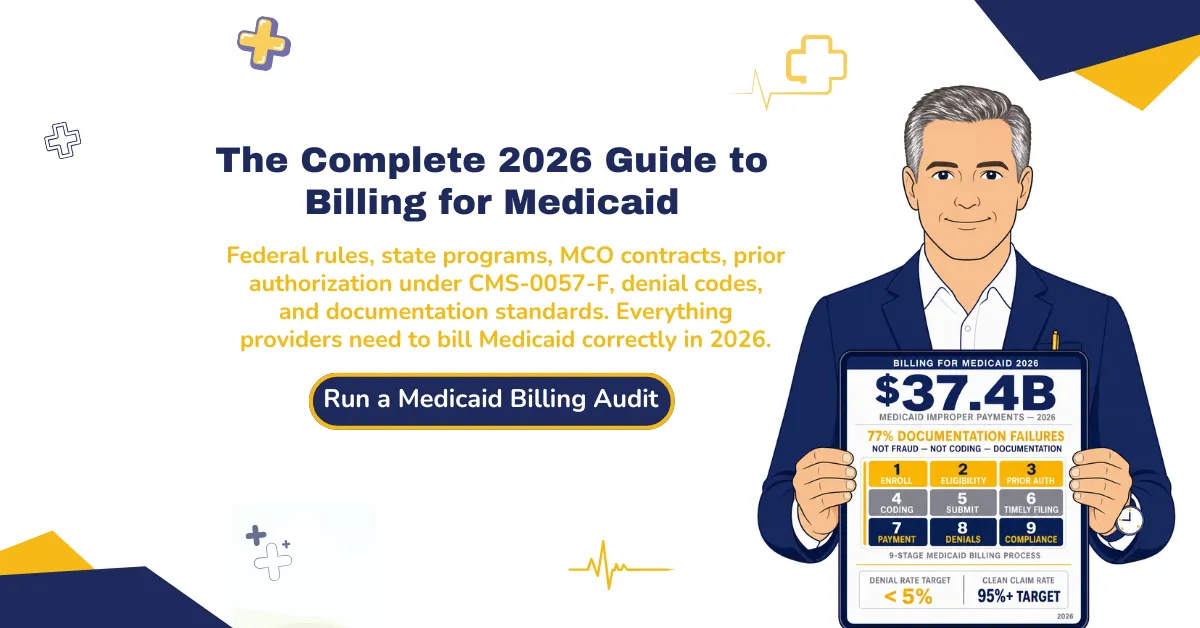
The CMS FY2025 PERM report just landed. The Medicaid improper payment rate jumped to 6.12%, representing $37.39 billion in improper payments. That’s up from $31.10 billion in 2024. Real money. Gone. And most of it wasn’t fraud.
Billing for Medicaid is the process by which healthcare providers submit claims to state Medicaid programs for reimbursement of covered services. Providers must enroll in their state’s Medicaid Management Information System (MMIS), submit claims electronically using the X12N 837P or 837I transaction standard (CMS-1500 or UB-04 paper forms when permitted), and include the patient’s Medicaid ID, billing NPI, ICD-10-CM diagnosis codes, and CPT or HCPCS procedure codes within state-mandated timely filing windows of 90 to 365 days.
CMS supplemental data shows 77.17% of Medicaid improper payments stem from insufficient documentation, not fraud. That single finding reframes the entire compliance conversation. Most billers assume Medicaid problems come from coding errors or eligibility gaps. The data says otherwise. Documentation excellence is the single biggest revenue protection any practice has in 2026.
Claimmax RCM has 15 years of RCM experience handling Medicaid claims across state FFS programs, Medicaid Managed Care Organizations, and specialty verticals. This guide is the comprehensive 2026 reference you need: all eight federal rules, six Tier 1 freshness wedges covering CMS-0057-F, CMS-0053-F, the CRUSH Initiative, two-track conversion factors, provider-level spending data, and the $37.4B improper payment crisis. Every figure comes from CMS, the Federal Register, OIG, AHIMA, AAPC, and HFMA as of May 2026.
What’s ahead: definition and FFS vs MCO distinction, 2026 critical updates, the eight federal rules, the nine-stage billing process, eligibility verification, prior authorization, medical coding, claim submission, timely filing, denial codes, common mistakes, specialty verticals, state programs, telehealth, documentation, KPIs, compliance, the outsourcing decision, and 12 FAQ entries. Every figure, regulation, and benchmark reflects the most current data available as of May 2026, with direct citations to primary regulatory sources.
What Is Medicaid Billing? FFS vs Managed Care Organization Billing
Medicaid billing is the financial process by which healthcare providers submit claims to state Medicaid programs and Medicaid Managed Care Organizations (MCOs) for services rendered to eligible beneficiaries. The process covers eligibility verification, prior authorization, coding, claim submission, payment posting, denial management, and appeals. Each state administers its own Medicaid program, which means billing rules, fee schedules, covered services, and timely filing windows vary significantly by state.
Most providers don’t realize Medicaid billing isn’t one payer. It’s two distinct delivery models. In Medicaid Fee-for-Service (FFS), providers bill the State Medicaid Agency directly through the state’s Medicaid Management Information System (MMIS). In Medicaid Managed Care, the state contracts with private health plans (MCOs, PIHPs, PAHPs), and providers bill those plans directly. More than 70% of Medicaid beneficiaries nationally are enrolled in managed care plans. That means most Medicaid claims don’t go to the state at all. They go to the MCO.
This distinction has real operational consequences. Being enrolled in your state’s FFS Medicaid program does not automatically enroll you with every MCO operating in that state. Each MCO requires separate credentialing, contracting, prior authorization rules, timely filing windows, claim submission portals, and appeal processes. A practice that bills correctly under FFS Medicaid rules can still see denials pile up because they’ve used FFS rules on MCO claims. Knowing which delivery model applies to each patient is the foundation of clean Medicaid billing.
Medicaid billing also differs from commercial insurance in three operational ways. First, Medicaid is the payer of last resort under federal law. If the patient has any other insurance, bill that first and Medicaid second. Second, Medicaid reimbursement rates are typically lower than Medicare or commercial insurance, and they vary state by state. Third, Medicaid timely filing windows are usually shorter and more strictly enforced. Missing the window makes the claim permanently uncollectible. There’s no commercial insurance equivalent that’s quite this unforgiving.
Medicaid and Medicare often get confused, but the billing rules differ significantly. Medicare is federal, with consistent rules nationwide for beneficiaries 65 and older or those with qualifying disabilities. Medicaid is state-administered with rules that vary across the 50 states, the District of Columbia, Puerto Rico, and the U.S. Virgin Islands. Patients enrolled in both programs are called dual eligibles. For dual eligibles, Medicare always bills first as primary payer, and Medicaid covers cost-sharing as secondary. We cover dual eligible billing in detail in Section 21.
For providers comparing Medicaid billing operations against full revenue cycle management scope, our companion guide on the difference between medical billing and full revenue cycle management walks through the broader RCM framework and how Medicaid fits within it. The next section covers the six 2026 regulatory updates every Medicaid biller must know.
2026 Critical Medicaid Billing Updates Every Provider Must Know
Six material 2026 updates affect billing for Medicaid right now. Most credentialing content online doesn’t reflect any of them. The PECOS migration just completed. NCQA’s 2025 standards govern credentialing surveys through June 30, 2026. Each update has direct operational consequences for your billing workflow.
Update 1: CMS-0057-F Prior Authorization Compliance (Reporting Due March 31, 2026)
CMS finalized the Interoperability and Prior Authorization Final Rule (CMS-0057-F), which took effect January 1, 2026. The rule applies to Medicare Advantage organizations, state Medicaid and CHIP fee-for-service programs, Medicaid managed care plans, CHIP managed care entities, and Qualified Health Plan issuers.
Affected payers must meet decision timeframes of 72 hours for expedited requests and 7 calendar days for standard requests. They must provide specific denial reasons and publicly report PA metrics. First metrics reporting was due March 31, 2026. Practices that build clean PA documentation packets see disproportionate downstream benefits from this transparency requirement.
Update 2: First-Ever HIPAA Claims Attachments Standard (Effective May 26, 2026)
CMS finalized the Administrative Simplification Claims Attachments Final Rule (CMS-0053-F). Effective May 26, 2026, with a 24-month compliance window extending to 2028. This is the first-ever HIPAA-adopted standard for electronic claims attachments.
The rule adopts HL7 Consolidated Clinical Document Architecture (C-CDA) IG Volume One, C-CDA IG Volume Two, and the HL7 Attachments IG. Projected industry savings reach $781 million annually by eliminating fax-based and mailed attachments. Providers must begin updating EHR and billing infrastructure now. The 2028 compliance deadline arrives faster than most operations expect.
Update 3: CMS Launches the CRUSH Initiative, Medicaid’s Most Aggressive Fraud Crackdown in Years
CMS launched the CRUSH Initiative (Comprehensive Regulations to Uncover Suspicious Healthcare) in 2026. The initiative initially targeted Minnesota, California, Maine, and New York, with the House Committee on Energy and Commerce sending RFIs to 11 states.
CRUSH covers modifications to program integrity requirements, enhanced identity proofing, ownership requirements, preclusion list expansion, and reduction of laboratory fraud including genetic and molecular diagnostic tests. The implication for Medicaid billers is direct. Documentation must be airtight. Outlier billing patterns will be flagged. Internal audits and compliance training are no longer optional.
Update 4: Medicaid Improper Payments Hit $37.4 Billion (CMS PERM 2026)
The CMS PERM 2026 report shows the Medicaid improper payment rate jumped to 6.12% ($37.39 billion), up from 5.09% ($31.10 billion) in 2024. The most important finding: 77.17% of these improper payments are due to insufficient documentation, not fraud.
This reframes the compliance conversation entirely. Most Medicaid revenue loss isn’t a coding problem or an eligibility problem. It’s a documentation problem. Providers who treat clinical documentation as the primary billing protection in 2026 win the audit defense game before it starts.
Update 5: CMS Released Provider-Level Medicaid Spending Data (February 14, 2026)
On February 14, 2026, CMS released a dataset with provider-level Medicaid spending data. Fields include the number of beneficiaries seen, counts of services, and total spending per procedure. Home care carries a major emphasis since long-term care is the second-largest source of Medicaid spending after hospitals.
The implication is significant. Outlier billing patterns are now publicly visible. Practices with unusually high volumes, atypical procedure mixes, or geographic anomalies will trigger audits. Run your own internal billing analytics before CMS does it for you. Pattern recognition is no longer a back-office task.
Update 6: New Two-Track Conversion Factors (Effective January 1, 2026)
Beginning January 1, 2026, the CY 2026 Physician Fee Schedule introduced two separate conversion factors per section 1848(d)(1)(A) of the Social Security Act. The qualifying APM conversion factor is $32.7365 (a 1.2% increase from $32.3465). The non-qualifying APM conversion factor is $32.5765 (a 0.7% increase from $32.3465).
Verify which conversion factor applies to each provider on your roster. Underpayment surprises traceable to incorrect conversion factor application are increasingly common in 2026. Accurate crossover claim calculations depend on getting this right.
The 8 Federal Rules Every Medicaid Biller Must Comply With
Medicaid is state-administered, but federally standardized. The state and MCO billing rules cover the operational “how.” The federal Code of Federal Regulations (CFR) covers the non-negotiable compliance “what.” Below are the eight federal rules every Medicaid biller must build into RCM controls. These rules apply across all 50 states. Violations create denial risk, recoupment exposure, and audit triggers.
| # | Rule | Federal Citation | What Providers Must Do |
|---|---|---|---|
| 1 | Payment in Full | 42 CFR Part 447 | Cannot balance bill Medicaid members for covered services |
| 2 | No Service Denial for Cost Sharing | 42 CFR §447.15 | Cannot deny services because patient can’t pay copay |
| 3 | Prompt Pay (FFS) | 42 CFR §447.45 | States must pay 90% of clean claims within 30 days; 99% within 90 days |
| 4 | Prompt Pay (MCO) | 42 CFR §438.214 | MCOs must meet prompt pay or contractual alternative |
| 5 | ORP Provider Enrollment | 42 CFR §455.410 | Ordering, referring, prescribing physicians must be enrolled |
| 6 | ORP NPI on Claims | 42 CFR §455.440 | Claim must include the ordering/referring provider’s NPI |
| 7 | Third-Party Liability (TPL) | 42 CFR §433.139 | Bill primary insurance first; Medicaid is payer of last resort |
| 8 | Reassignment and Factoring Limits | 42 CFR §447.10 | Restricts how RCM vendors structure billing payments |
Most billing teams know their state Medicaid manual cold. Far fewer know the federal CFR sections that override state policy. That gap creates audit risk. When auditors examine a Medicaid claim, they’re looking at federal CFR compliance, not just state policy compliance. A claim that passes state edits can still violate 42 CFR §433.139 (TPL) or 42 CFR §455.440 (ORP NPI). Both will trigger denials, recoupments, or worse.
Rule 1 (Payment in Full) requires Medicaid participation to be limited to providers who accept Medicaid payment as payment in full, plus any plan-allowed deductible, coinsurance, or copay. You can’t bill the patient the difference between Medicaid’s allowed amount and your normal fee. Rule 2 (Cost-Sharing) prohibits providers from denying services to a Medicaid beneficiary because they can’t pay the copay at point of service. The service has to be provided. The balance is a post-service matter.
Rules 3 and 4 (Prompt Pay) require state Medicaid agencies and MCOs to meet specific clean claim payment timelines. For FFS, states must pay 90% of clean claims within 30 days and 99% within 90 days. MCOs must meet the same prompt pay requirements unless the provider contract specifies an alternative schedule. When a payer chronically violates prompt pay, you have a federal regulatory complaint pathway. Most billers don’t know this. The right escalation language references 42 CFR §447.45 directly.
Rules 5 and 6 (ORP enrollment and NPI) require Medicaid claims to include the NPI of the ordering, referring, or prescribing professional, and that professional must be Medicaid-enrolled. Common denial driver: a non-enrolled physician orders a lab test, the lab submits the claim with the ordering physician’s NPI, and the claim denies because the ordering physician isn’t in the state’s Medicaid provider file. This looks like a coding problem. It’s actually a provider enrollment problem.
Rule 7 (TPL) establishes Medicaid as the payer of last resort under federal law. If the patient has any other coverage, you bill that first. Rule 8 (Reassignment limits) restricts how Medicaid payments can be reassigned to RCM vendors. A billing company can be paid for handling claims, but compensation must be cost-related, not percentage-based or contingent on collection. Factoring (selling claims to a third party) is prohibited entirely.
These eight federal rules form the compliance baseline for billing for Medicaid across all 50 states. Building the right controls into your RCM workflow takes systematic process design, not memorization. For practices that need a second set of eyes on federal compliance, our comprehensive revenue cycle management services include federal CFR audit preparation as part of standard service delivery. The next section walks through the step-by-step Medicaid billing process from end to end.
The Step-by-Step Medicaid Billing Process: 9 Stages Every Provider Must Master
Billing for Medicaid follows a sequential nine-stage process. Each stage has its own inputs, outputs, KPIs, and failure modes. A breakdown at any stage creates downstream problems that look like errors elsewhere. The table below summarizes all nine stages with the primary task, federal compliance requirement, and KPI benchmark every Medicaid biller should track.
| Stage | Primary Task | Federal Compliance | KPI Benchmark |
|---|---|---|---|
| 1. Provider Enrollment | Enroll in state MMIS and applicable MCOs | 42 CFR Part 455 | 100% active before billing |
| 2. Eligibility Verification | Confirm coverage on date of service via X12 270/271 | HIPAA Administrative Simplification | Verify before every encounter |
| 3. Prior Authorization | Submit PA when required via X12 278 | CMS-0057-F | 90%+ approval rate |
| 4. Medical Coding | Apply ICD-10-CM, CPT, HCPCS per state Medicaid NCCI | 2026 NCCI Policy Manual | 95%+ coder accuracy |
| 5. Claim Submission | Submit electronically via X12N 837P or 837I | HIPAA transaction standards | 95%+ clean claim rate |
| 6. Claim Adjudication | Track via X12 276/277 | State and MCO timelines | Within timely filing window |
| 7. Payment Posting | Post via X12 835 ERA | 42 CFR §447.45 prompt pay | 30-day posting window |
| 8. Denial Management | Work CARC/RARC denials within appeal window | State and MCO appeal rules | 70%+ recovery rate |
| 9. Documentation | Maintain audit-ready records | CMS PERM standards | Zero insufficient documentation findings |
Sections 6 through 11 walk through the front-end of this billing process: provider enrollment, eligibility verification, prior authorization, medical coding, claim submission, and timely filing. Sections 12 through 17 cover the back-end: denial codes, common mistakes, specialty verticals, state programs, telehealth Medicaid, and documentation. Each section builds on the previous one. The compliance details get more specific as we go deeper.
Stage 1: Provider Enrollment in the State Medicaid Program (and Every MCO)
Provider enrollment is Stage 1 of billing for Medicaid. Before submitting a single claim, the provider must be enrolled with the state Medicaid program through the state Medicaid Management Information System (MMIS). Providers must also be separately credentialed with each MCO operating in their state. Without active enrollment, every claim gets denied automatically, regardless of how clean the coding is.
Each state runs its own enrollment portal. Texas uses TMHP (Texas Medicaid and Healthcare Partnership). California uses PAVE (Provider Application and Validation for Enrollment). New York uses eMedNY. Florida and most states have direct MMIS portals. The enrollment application typically requires NPI (Type 1 individual and Type 2 organizational), Tax ID/EIN, active state medical license, DEA registration, malpractice insurance proof, business registration documents, W-9, and CAQH profile. Background checks and site visits are required for some provider types. Processing typically takes 30 to 90 days.
Some institutional providers must pay a CMS enrollment application fee. The CY 2026 fee is $750. This applies to DME suppliers, hospitals, and skilled nursing facilities as designated by CMS. Practitioners, including physicians, NPs, and PAs, generally don’t pay the fee. Verify your provider category before submitting the application. An incorrect fee status can delay approval by weeks.
This is where most providers get burned. Being enrolled in your state’s FFS Medicaid program does not automatically enroll you with the MCOs operating in that state. Each MCO requires its own credentialing application, contract negotiation, and enrollment process. A practice in Texas might be FFS-enrolled but not contracted with Molina, UnitedHealthcare Community Plan, Superior, Aetna Better Health, or Wellpoint. Patients enrolled in any of those MCOs would generate denied claims if their provider isn’t credentialed with that specific plan. Each MCO is effectively a separate payer.
Medicaid enrollment is not permanent. CMS requires providers to revalidate every 3 to 5 years, and your state may require updates any time license, address, or ownership information changes. Missing revalidation results in claim denials and enrollment deactivation. MCO contracts typically renew annually with new prior authorization rules, covered service lists, and timely filing windows. Staying current with all enrollment statuses is a continuous administrative function, not a one-time setup.
Federal rules under 42 CFR §455.410 require that any physician or non-physician practitioner who orders, refers, or prescribes services to a Medicaid beneficiary must also be enrolled in the state’s Medicaid program. The ordering provider’s NPI must appear on the claim per 42 CFR §455.440. Common denial driver: lab claims rejected because the ordering physician isn’t enrolled. The lab provider thinks it’s a coding problem. It’s actually an ORP enrollment problem.
Managing enrollment across the state Medicaid program, multiple MCOs, ORP requirements, and continuous revalidation drains billing teams. For practices launching new providers or expanding into additional states, our professional provider enrollment and credentialing services handle the full workflow from CAQH attestation through state and MCO contracting. The next section covers Stage 2: eligibility verification.
Stage 2: Medicaid Eligibility Verification (HIPAA X12 270/271)
Eligibility verification is Stage 2 in billing for Medicaid. Medicaid eligibility changes monthly. A patient who had active coverage last week may not have it today. Income changes, missed renewal paperwork, redetermination outcomes, and state eligibility reviews all affect coverage status. Skipping eligibility verification before each encounter is the single most preventable denial driver in Medicaid billing.
Eligibility verification runs on the HIPAA X12 270/271 transaction standard. The 270 transaction is the eligibility request submitted by the provider. The 271 transaction is the response from the state Medicaid agency or MCO. Operating rules for eligibility transactions have been required for HIPAA-covered entities since January 1, 2013. Modern Medicaid billing operations run automated 270/271 verification through clearinghouses or directly via state portals. Real-time eligibility checks now process in seconds, not days.
A complete Medicaid eligibility check confirms six things: active coverage on the exact date of service; plan type (FFS Medicaid, specific MCO, or PIHP/PAHP); covered benefit category; any copay obligations; primary or secondary insurance status (TPL data); and service-specific limitations or prior authorization requirements. Each of these data points feeds downstream billing decisions. Skipping any one creates predictable denial categories that emerge weeks later.
Eligibility verification is not a one-time process. Run checks at three points: at scheduling 24 to 48 hours before appointment, on the day of service before the encounter begins, and again before claim submission. For long-term care or recurring therapy patients, run monthly verification because Medicaid coverage can lapse mid-treatment without warning. The 2026 redetermination unwinding period has made coverage status more volatile than at any point in the program’s history.
Five methods exist for Medicaid eligibility verification: state Medicaid portal with real-time provider lookup; EHR system with integrated eligibility verification through payer connections; clearinghouse batch or real-time verification through Availity, Waystar, or Change Healthcare; automated voice response (AVR) phone system; and direct call to the state provider helpline. Portal and EHR-integrated methods are fastest. AVR and phone calls work as backup when systems are down. Always document the verification result in the patient record before the encounter.
Practices that automate Medicaid eligibility verification before every encounter cut denial rates significantly. The infrastructure to run real-time 270/271 checks at scale takes EHR integration, clearinghouse contracts, and trained staff who can read 271 responses correctly. For practices that lack this capacity internally, our specialized medical billing services cover eligibility verification as part of standard front-end workflow. The next stage is prior authorization, which has the most significant 2026 regulatory changes.
Stage 3: Prior Authorization (HIPAA X12 278 and CMS-0057-F Compliance)
Prior authorization is Stage 3 of billing for Medicaid and the most operationally complex front-end stage. State Medicaid agencies and MCOs require pre-approval for specific services before delivery. Without authorization for services that require it, the claim gets denied at adjudication regardless of medical appropriateness. Prior authorization denials rank among the top three Medicaid denial drivers across nearly all states.
The HIPAA-adopted standard for prior authorization is the X12N 278 transaction, classified by CMS as health care service review information. Modern practice management systems and EHRs integrate 278 transactions to submit electronic PA requests directly to state Medicaid agencies and MCOs. Manual fax-based prior authorization persists in many state programs but is being phased out. The 278 transaction reduces administrative burden when payers and providers use it consistently.
CMS-0057-F, the Interoperability and Prior Authorization Final Rule, took effect January 1, 2026 with first metrics reporting due March 31, 2026. The rule applies to state Medicaid and CHIP fee-for-service programs, Medicaid managed care plans, and CHIP managed care entities. Affected payers must meet decision timeframes of 72 hours for expedited requests and 7 calendar days for standard requests. Payers must provide specific denial reasons, not generic codes. They must publicly report PA metrics including request volume, approval and denial rates, and processing times. Providers can use this transparency to hold payers accountable for excessive denials and slow turnaround.
Prior authorization is required across most state Medicaid programs and MCOs for inpatient hospital admissions, specialty care referrals, home health services, durable medical equipment, high-cost prescription drugs and specialty pharmacy, behavioral health services beyond defined visit counts, and elective surgeries. Services rarely requiring PA include routine outpatient office visits, preventive care, and emergency services. Each state and each MCO maintains its own PA-required service list. There is no universal list.
PA-related denials cluster into predictable patterns: service delivered without authorization (CARC code CO-197); authorization received but expired before service date; authorization received for the wrong CPT code or quantity; authorization received for the wrong rendering provider when a covering provider sees the patient; and authorization received under the patient’s prior MCO but not the current one. Each of these errors creates appeal work that’s preventable through tighter front-end PA workflow.
Best practices for Medicaid PA workflow: build a PA-required service list specific to each MCO and the state FFS program. Submit authorization requests via X12 278 with complete clinical documentation supporting medical necessity. Track authorization status through the response cycle. Document authorization numbers in the patient record and on the claim before submission. Include the original authorization expiration date. Audit denial reasons monthly to identify recurring authorization gaps.
The combined burden of CMS-0057-F compliance, MCO-specific PA rules that change with each contract renewal, and constant prior authorization denials makes prior authorization one of the highest-leverage activities to outsource. At Claimmax RCM, our professional prior authorization services handle the entire authorization lifecycle: initial verification of PA requirements per state and MCO, electronic submission via X12 278 with complete clinical documentation, tracking through the response cycle, and dedicated denial appeal teams trained on Medicaid-specific authorization patterns. For practices losing money to authorization gaps, the specialized infrastructure required to manage this stage at scale is rarely worth building in-house.
Stage 4: Medical Coding for Medicaid (ICD-10-CM, CPT, HCPCS, and 2026 NCCI)
Medical coding is Stage 4 of billing for Medicaid. After eligibility is verified and authorization is secured, certified coders translate clinical documentation into standardized codes that state Medicaid agencies and MCOs use to adjudicate claims. ICD-10-CM codes describe diagnoses. CPT codes describe procedures and services. HCPCS Level II codes describe supplies, equipment, and services not covered by CPT. Together, these code systems form the language of Medicaid reimbursement.
Coding accuracy is non-negotiable. The ICD-10-CM Official Guidelines for Coding and Reporting FY2026 (updated April 1, 2026) govern the coding period from April 1, 2026 through September 30, 2026. CMS posted the 2026 NCCI Policy Manual for Medicaid Services on December 31, 2025, effective January 1, 2026. The manual contains updated edits, modifier rules, and bundling requirements specific to Medicaid claims. Practices coding against outdated NCCI edits create denial risk on every claim.
Medicaid coding has state-specific complications that don’t apply to commercial insurance. Some Medicaid programs use HCPCS Level II G-codes or T-codes that aren’t typical in commercial billing. EPSDT (Early and Periodic Screening, Diagnostic, and Treatment) services for pediatric Medicaid beneficiaries have their own code sets. State Medicaid programs publish their own modifier restrictions. CMS explicitly notes modifiers can only bypass NCCI edits if the Medicaid program allows it. Always verify the state Medicaid manual for code-level restrictions before submission.
This is where most coders get tripped up. The 2026 NCCI Policy Manual for Medicaid Services applies to Medicaid FFS claims reimbursed on HCPCS or CPT, including FFS claims processed in PCCM (Primary Care Case Management) managed care programs. CMS notes that applying NCCI to claims processed by full-risk MCOs is desirable but technically optional. Each MCO contract specifies whether NCCI edits apply to that plan. Practices billing for Medicaid across FFS and multiple MCOs need to track NCCI applicability per plan.
Common Medicaid coding errors that drive denials: diagnosis specificity insufficient to support medical necessity (CARC CO-50); diagnosis-procedure mismatch (CARC CO-11); modifier missing or incorrect (CARC CO-4); bundled services billed separately (CARC CO-97); unspecified codes used when more specific codes exist; and outdated codes from prior coding cycles. The foundation is always the same. Specific clinical documentation supports specific code selection. Without documentation specificity, coding accuracy is impossible.
Specialty coding adds another layer. Occupational therapy practices, for example, manage a complex code set across the 97000 series, 96000 series, and 98000 series, with state-specific modifier restrictions for time-based units. For a deeper walk-through of one specialty’s complete code set, our specialty-specific CPT code billing example covers occupational therapy CPT codes in 2026 detail.
Best practices for Medicaid coding: employ AAPC-certified or AHIMA-credentialed coders; provide continuous training on payer-specific coding rules and the FY2026 mid-year ICD-10-CM update; conduct monthly coding audits with statistically valid sample sizes; track coder accuracy at 95% or higher; and maintain payer-specific reference materials for state Medicaid programs and each MCO contract.
Stage 5: Medicaid Claim Submission (CMS-1500, UB-04, and X12N 837 Standards)
Claim submission is Stage 5 of billing for Medicaid. After coding is complete, the claim is generated and submitted to the state Medicaid agency or MCO through electronic transaction or paper form. The choice of form depends on provider type. The choice of submission method depends on what the payer accepts. Most modern Medicaid claims flow electronically. Paper claims still exist but represent a shrinking minority.
Two paper claim forms govern billing for Medicaid. The CMS-1500 form (electronic equivalent X12N 837P Professional) is used by physicians, nurse practitioners, physician assistants, therapists, and outpatient providers. The UB-04 form, also called CMS-1450 (electronic equivalent X12N 837I Institutional), is used by hospitals, skilled nursing facilities, home health agencies, hospice providers, and ambulatory surgery centers. Dental Medicaid claims use the ADA Dental Claim Form or X12N 837D Dental. Submitting on the wrong form results in automatic rejection.
The HIPAA-adopted electronic standard for Medicaid claims is the X12N 837 transaction set. The CMS Administrative Simplification page (last updated March 16, 2026) confirms 837P, 837I, and 837D as the official electronic claim formats. Most state Medicaid programs and MCOs require electronic submission. Electronic submission processes faster, with lower error rates and clearer rejection feedback through X12 277CA acknowledgment files.
Three channels exist for electronic Medicaid claim submission. Direct submission to the state MMIS portal works for FFS Medicaid claims and is preferred when the practice handles low volume. Clearinghouse submission through Availity, Waystar, or Change Healthcare provides batch processing, payer-specific error scrubbing, and acknowledgment tracking. EHR-integrated submission combines clinical documentation with claim generation in a single workflow. Most practices use a combination based on payer mix and claim volume.
Every Medicaid claim must include specific data elements: patient demographics with exact match to the Medicaid file (name, date of birth, Medicaid ID); rendering provider NPI matching state Medicaid enrollment; billing entity NPI and Tax ID; date of service; ICD-10-CM diagnosis codes linked to procedure codes; CPT or HCPCS procedure codes with appropriate modifiers; place of service code; prior authorization number when required; and ORP NPI when the claim involves ordered or referred services. Missing any element triggers rejection at the clearinghouse or payer edits.
Five errors cause most Medicaid claim rejections at the submission stage: wrong NPI on the claim; patient Medicaid ID typo or coverage mismatch; missing modifier required by state policy; date of service outside authorized period; and diagnosis code insufficiently specific to support the procedure. Practices using clearinghouse-only submission without internal pre-edit review run higher rejection rates.
For practices struggling with low clean claim rates or high pre-adjudication rejections, our expert medical billing services for clean claim submission cover end-to-end claim scrubbing, submission, and rejection management for both state Medicaid and MCO claims.
Stage 6: Medicaid Timely Filing Requirements by State (90 to 365 Days)
Timely filing is Stage 6 of billing for Medicaid. Federal regulation requires states to set claim submission deadlines, and states must require claims to be submitted within 12 months from the date of service per 42 CFR §447.45. In practice, most states set windows much shorter than 12 months. Some MCOs set windows as short as 90 days. Missing the window makes the claim permanently uncollectible. There is no appeal pathway for true timely filing failures.
The federal baseline under 42 CFR §447.45 establishes that state Medicaid agencies must require claim submission within 12 months from the date of service. This is the maximum window. States cannot extend beyond 12 months without a federal waiver. States routinely set windows shorter than 12 months. The actual window depends on whether the claim is FFS Medicaid or MCO Medicaid, and on the specific state and MCO contract. Always verify current windows before submission.
| State / Plan Type | FFS Window | Common MCO Window | Notes |
|---|---|---|---|
| California (Medi-Cal) | 12 months | 90 to 365 days, varies by MCO | DHCS sets FFS; plan-specific MCO windows |
| New York (eMedNY) | 90 days | 90 to 180 days | Among the shortest in the nation |
| Texas (TMHP) | 95 days | 95 days standard | TMHP and most MCOs aligned at 95 days |
| Florida | 12 months | 12 months | Among the more generous windows |
| Pennsylvania | 180 days | 90 to 180 days | Plan-specific MCO windows |
| Ohio | 12 months | 12 months | Generous statewide |
| Michigan | 12 months | Varies by MCO | MCO contracts vary |
| Illinois | 180 days | Varies by MCO | Plan-specific MCO windows |
| Virginia (Cardinal Care) | 12 months | Varies by MCO | DMAS sets FFS; MCO contracts vary |
| North Carolina | 365 days | 180 days standard | NCTracks for FFS |
Timely filing is the only Medicaid denial that has zero appeal pathway. Once the window closes, the claim is permanently uncollectible. Medicare claims denied for untimely filing are explicitly not initial determinations and not subject to appeal per CMS. Medicaid programs apply similar logic. Practices that don’t track timely filing aging by payer write off otherwise collectible claims for purely administrative reasons. A practice with 200 monthly Medicaid claims at an average value of $150 loses $5,000 to $10,000 per missed-window batch.
Best practices for timely filing management: maintain a payer-by-payer reference for current timely filing windows for state FFS Medicaid and every MCO contract; submit claims within 30 days of service whenever possible to leave appeal room if denials occur; build dashboards that flag claims aging beyond 60 days, then 90 days, then 120 days; and establish escalation triggers when claims approach the timely filing limit. Train AR teams to differentiate timely filing denials (uncollectible) from other denials (potentially appealable).
With Stage 6 covered, Part 1 has walked through the front-end and mid-cycle of billing for Medicaid: enrollment, eligibility, prior authorization, coding, submission, and timely filing. The next sections cover denial management, common mistakes, specialty verticals, state programs, telehealth Medicaid, documentation, KPIs, compliance, the outsourcing decision, and FAQs.
Top 15 Medicaid Claim Denial Codes (CARC and RARC) and How to Fix Them
Denial management is Stage 7 of billing for Medicaid, and it’s where most practices lose recoverable revenue. CMS reports the average claim denial rate across payers ranges from 5% to 15%. For Medicaid specifically, denial rates often run higher because of state-specific rules, MCO variability, and documentation requirements. The good news: most Medicaid denials are recoverable through proper appeal workflow. The bad news: 60% of denied claims are never reworked.
Two denial code systems govern Medicaid claim adjudication. Claim Adjustment Reason Codes (CARCs) explain why the claim was adjusted or denied at the line or claim level. Remittance Advice Remark Codes (RARCs) provide additional context or instruction. Both appear in the X12 835 Electronic Remittance Advice (ERA). Understanding both codes is required to work denials correctly. CARCs alone often don’t tell the full story. The RARC adds the specific operational fix needed for resubmission.
| Code | Reason | Common Cause | Fix |
|---|---|---|---|
| CO-4 | Modifier missing/invalid | Required modifier omitted | Add correct modifier per state policy; resubmit |
| CO-11 | Diagnosis-procedure mismatch | ICD-10 doesn’t support CPT | Verify documentation; correct linkage; appeal with notes |
| CO-15 | Authorization missing/invalid | PA not obtained or expired | Obtain retro auth if allowed; appeal with medical necessity |
| CO-16 | Claim missing information | Required field empty | Identify missing field via RARC; correct; resubmit |
| CO-18 | Duplicate claim | Same claim submitted twice | Verify original claim status before resubmitting |
| CO-22 | Coordination of benefits | Other coverage exists | Bill primary insurance first; resubmit Medicaid as secondary |
| CO-29 | Timely filing exceeded | Past state filing window | No appeal pathway; document for write-off |
| CO-50 | Not medically necessary | Documentation insufficient | Submit appeal with complete clinical notes |
| CO-97 | Service bundled | Procedure included in another | Verify NCCI edits; remove bundled line; resubmit |
| CO-109 | Wrong payer | Claim sent to wrong payer | Identify correct payer; resubmit |
| CO-119 | Benefit max exceeded | Annual or lifetime limit reached | Verify benefit; bill patient if no coverage |
| CO-167 | Diagnosis not covered | Diagnosis not payable for service | Use more specific diagnosis; appeal with documentation |
| CO-197 | Pre-cert/auth absent | Service required PA, none obtained | Submit retro auth request; appeal denial |
| PR-3 | Co-payment amount | Patient owes copay | Bill patient; not provider write-off |
| PR-204 | Service not covered | Non-covered Medicaid service | Verify coverage; bill patient if appropriate |
These 15 codes account for the majority of Medicaid claim denials across most state programs. Three categories drive the bulk of recoverable revenue: documentation-based denials (CO-50, CO-167, CO-11), authorization-based denials (CO-15, CO-197), and coordination-based denials (CO-22, CO-109). Practices that build automated denial categorization workflow into their RCM cycle recover significantly more than practices that work denials reactively.
Medicaid appeal workflow follows three levels in most states. Level 1: Provider reconsideration submitted to the state Medicaid agency or MCO with corrected claim or supporting documentation. Level 2: Formal administrative appeal with hearing if reconsideration is denied. Level 3: Judicial review through state administrative court. Each level has its own deadline, typically 30 to 90 days from the denial date, and documentation requirements. Most denials get resolved at Level 1 with proper documentation. Time is the enemy. Appeal deadlines run faster than most billing teams expect.
Successful Medicaid denial appeals require five documentation elements: the original claim with all line items; the EOB or ERA showing specific CARC/RARC denial codes; complete clinical documentation supporting medical necessity; provider attestation of services rendered; and the state-specific or MCO-specific appeal form completed with denial date, claim number, and basis for appeal. Submit with delivery confirmation. Document the submission date for the next-level deadline calculation.
Working through Medicaid denial codes systematically is exactly what specialized billing teams do every day. The infrastructure required to track CARC/RARC patterns by payer, automate denial categorization, file appeals within state-specific deadlines, and recover the maximum collectable percentage is rarely worth building in-house for most practices. At Claimmax RCM, our specialized denial management services work the same denial codes covered in this section across all 50 state Medicaid programs and major MCOs. Dedicated appeal teams trained on Medicaid-specific denial patterns. Root-cause analysis to prevent recurring denials at the source. We don’t write off claims that are recoverable.
Denial codes are the symptom. The underlying causes are operational mistakes that happen upstream. The next section walks through the most common Medicaid billing mistakes that produce these denials, with workflow fixes that prevent them at the source. Practices that fix root causes upstream see denial rates drop significantly within 90 days, often without changing anything else in their billing process.
Common Medicaid Billing Mistakes That Cost Practices Real Money
Most Medicaid denials trace back to upstream mistakes that practices make without realizing they’re losing money. The denial code is the symptom. The mistake is the root cause. Fixing root causes prevents the same denial from happening on the next 200 claims. Below are the seven most expensive Medicaid billing mistakes practices make in 2026, with the operational fix for each.
Mistake 1: Treating eligibility verification as optional or as a once-per-month check. Medicaid coverage changes monthly. The 2026 redetermination unwinding period has made coverage volatility worse than at any point in the program’s history. Practices that don’t verify eligibility on every encounter date generate predictable CO-22 (other coverage) and PR-204 (not covered) denials. Fix: automate real-time X12 270/271 verification at scheduling and again on the date of service.
Mistake 2: In billing for Medicaid, submitting claims with ordering or referring providers who aren’t enrolled in the state Medicaid program. Per 42 CFR §455.410 and 42 CFR §455.440, the ordering, referring, or prescribing provider’s NPI must appear on the claim and that provider must be Medicaid-enrolled. This is most common in lab, imaging, DME, and home health claims where the rendering provider is enrolled but the ordering provider isn’t. Fix: maintain ORP enrollment lists and verify before claim submission.
Mistake 3: Submitting on the wrong form. Hospitals and SNFs occasionally have outpatient claims that get submitted on the UB-04 when CMS-1500 is required. Therapy practices sometimes submit on CMS-1500 for institutional services that require UB-04. The wrong form generates immediate rejection at the clearinghouse or payer edits. Fix: build form selection logic into the practice management system based on service type and provider type, not provider preference.
Mistake 4: Coding against outdated NCCI edits. The 2026 NCCI Policy Manual for Medicaid Services updates quarterly. Practices using last year’s edits or generic Medicare NCCI for Medicaid claims generate CO-97 bundling denials. Fix: subscribe to CMS NCCI Medicaid updates, configure clearinghouse and PM system edits quarterly, and verify state-specific NCCI variations because some states modify edits beyond the federal baseline.
Mistake 5: Losing track of authorization expiration dates. PA approvals come with expiration dates that often don’t match the patient’s full treatment course. Authorization for 12 visits expires after 6 months even if only 8 visits were used. Fix: build authorization tracking into the EHR with automated alerts at 50%, 75%, and 90% of authorization usage or expiration. Renewal requests filed before expiration prevent lost claims.
Mistake 6: In billing for Medicaid, using documentation that supports the visit but not the specific code billed. CMS PERM 2026 data shows 77.17% of Medicaid improper payments come from insufficient documentation. The documentation has to support every element of the code. Time-based codes need start/stop times. E/M codes need documented MDM elements. Therapy codes need treatment minute documentation. Fix: implement code-specific documentation templates in the EHR with hard stops for required fields.
Mistake 7: Letting denied or unpaid claims age beyond the appeal window without active follow-up. Denials over 90 days have significantly lower recovery rates. Practices without dedicated AR follow-up workflow watch recoverable revenue convert to write-offs. Fix: build aging dashboards by payer with active follow-up cadence at 30, 60, and 90 days.
AR aging is where revenue gets quietly written off when nobody’s watching. Our dedicated AR follow-up team works claims aged beyond 30 days with structured payer-by-payer pursuit, denial appeal management, and root-cause documentation feeding back to upstream workflow corrections. The next section covers the specialty verticals where Medicaid billing gets even more complex.
Specialty Vertical Medicaid Billing: ABA, FQHC, Behavioral Health, Pediatric, Home Health, and CMHC
Billing for Medicaid varies significantly by specialty. Each vertical has its own code sets, credentialing requirements, documentation standards, and common denial drivers. The sections below cover the six highest-complexity Medicaid specialty verticals.
ABA Therapy Medicaid Billing (CPT 97151 through 97158)
Applied Behavior Analysis (ABA) therapy Medicaid billing uses Category I CPT codes 97151 through 97158 for assessment, protocol modification, treatment delivery, and family adaptive behavior treatment guidance. Most state Medicaid programs require BCBA (Board Certified Behavior Analyst) oversight, prior authorization for treatment hours, and detailed treatment plan documentation.
Common denial drivers include incorrect technician credentialing (RBT vs BCaBA vs BCBA), missing supervisor signatures, and treatment delivered by non-credentialed staff. Some states require unit-based billing in 15-minute increments; others use hourly billing. Verify state Medicaid specifications and individual MCO requirements before submission. EVV (Electronic Visit Verification) requirements apply to in-home ABA services in most states under the Cures Act mandate.
FQHC Medicaid Billing (Per-Visit PPS Rates)
Federally Qualified Health Center (FQHC) Medicaid billing operates under a Prospective Payment System (PPS) per-visit rate established by each state. The PPS rate is fixed regardless of services delivered during the visit, with limited exceptions for medical, dental, behavioral health, and certain procedural exclusions. FQHC billing requires the proper revenue codes (typically 0521 for clinic visit) and HCPCS T1015 (clinic visit/encounter) on the institutional claim.
Common denial drivers include billing CPT-only for visits that should bundle under T1015, missing revenue codes, and encounter dates that don’t match documentation. State-specific PPS rates are recalculated annually and require verification each January. Wraparound payments may apply when MCO payments fall short of the PPS rate.
Behavioral Health Medicaid Billing (CPT 90791, 90832, 90834, 90837)
Behavioral health Medicaid billing covers psychiatric evaluation (CPT 90791, 90792), individual psychotherapy (90832, 90834, 90837), family therapy (90846, 90847), group therapy (90853), and add-on codes for crisis services and complexity. The CMS Behavioral Health Strategy continues to expand Medicaid coverage of behavioral health services in 2026.
State Medicaid programs and MCOs frequently require initial PA after a defined number of visits, often 8 to 20. Documentation must show medical necessity for continued treatment. Common denial drivers include time-based code mismatches with session documentation, missing supervisor signatures for LCSW/LMHC trainees, and exceeding MCO visit limits without authorization renewal. Some states carve out behavioral health to specialty managed behavioral health organizations with separate enrollment requirements.
Pediatric Medicaid Billing and EPSDT Services
Pediatric Medicaid billing includes Early and Periodic Screening, Diagnostic, and Treatment (EPSDT) services for beneficiaries under 21. EPSDT requires comprehensive well-child exams at periodicity intervals defined by each state, with mandated screenings (vision, hearing, dental, developmental, lead screening) at specified ages.
Common pediatric Medicaid CPT codes include 99381 through 99385 (initial preventive medicine), 99391 through 99395 (periodic preventive medicine), and HCPCS T1018 for EPSDT screening services. Common denial drivers include missing required screenings, billing well-child visit and sick visit on the same day without modifier 25, and EPSDT codes used outside state-specified age ranges. Vaccines for Children (VFC) program billing has its own administration code requirements (90460, 90461) that vary by state.
Home Health Medicaid Billing (G-Codes and EVV Compliance)
Home health Medicaid billing uses HCPCS G-codes (G0151 physical therapy, G0152 occupational therapy, G0153 speech therapy, G0156 home health aide, G0299 RN, G0300 LPN) and revenue codes 0421 through 0469 on UB-04/X12N 837I. Federal EVV requirements under the 21st Century Cures Act mandate electronic verification for personal care services and home health services in all states.
EVV must capture six data points: type of service, individual receiving service, date of service, location of service, individual providing service, and time service begins and ends. Common denial drivers include missing EVV records, plan of care signature gaps, ordering physician not Medicaid-enrolled (the ORP requirement), and authorization unit overages. Each state implements EVV through a state-mandated vendor or open-vendor model.
Community Mental Health Center (CMHC) Medicaid Billing
Community Mental Health Center (CMHC) Medicaid billing uses HCPCS H-codes (H0001 alcohol/drug assessment, H0004 behavioral health counseling, H0031 mental health assessment, H2017 psychosocial rehab) and state-specific S-codes for partial hospitalization, intensive outpatient, and rehabilitation services. CMHC billing typically requires bundled per-diem rates for partial hospitalization rather than fee-for-service.
Common denial drivers include H-code unit calculations that don’t match documented service time, missing licensed clinician signatures on assessment forms, and partial hospitalization claims without required medical director attestation. Most states carve CMHC services into specialty behavioral health managed care organizations with separate provider enrollment, prior authorization, and billing requirements distinct from physical health Medicaid.
State-by-State Medicaid Programs: Quick Reference for Providers
Medicaid is administered by each state, which means billing rules, fee schedules, MCO contracts, and eligibility processes vary significantly. Below is a reference for the five largest state Medicaid programs by enrollment, with the state agency, primary portal, MCOs operating in the state, and notable billing nuances. Practices billing for Medicaid across multiple states should maintain payer-by-payer reference materials specific to each state’s rules.
California: Medi-Cal Billing
California’s Medicaid program operates as Medi-Cal, administered by the California Department of Health Care Services (DHCS). Provider enrollment runs through PAVE (Provider Application and Validation for Enrollment). Major Medi-Cal MCOs include Anthem Blue Cross, L.A. Care, Health Net, Molina, Kaiser Permanente, and Inland Empire Health Plan. FFS timely filing is 12 months. MCO timely filing varies by plan. Notable: California implemented CalAIM (California Advancing and Innovating Medi-Cal) reforms with expanded behavioral health, in-home support, and homelessness services billing categories.
Texas: Texas Medicaid and TMHP Billing
Texas Medicaid is administered by the Texas Health and Human Services Commission (HHSC) with claims processed through TMHP (Texas Medicaid and Healthcare Partnership). Major Texas STAR and STAR+PLUS MCOs include Aetna Better Health, Amerigroup/Wellpoint, Community Health Choice, Cook Children’s Health Plan, Driscoll Health Plan, Molina Healthcare, Parkland Community, Superior HealthPlan, Texas Children’s, and UnitedHealthcare Community Plan. Timely filing is 95 days for most claims. Notable: Texas operates a separate STAR Kids program for children with disabilities with distinct billing requirements.
New York: eMedNY Billing
New York Medicaid is administered by the Department of Health with claims processed through eMedNY. Major MCOs include Fidelis Care, Healthfirst, MetroPlus, EmblemHealth, MVP Health Care, and Affinity by Molina. FFS timely filing is 90 days, among the shortest in the nation. Notable: New York operates separate billing requirements for HARPs (Health and Recovery Plans) for adults with serious mental health and substance use needs, with carved-out behavioral health benefits and specialty network credentialing.
Florida: Florida Medicaid Billing
Florida Medicaid is administered by the Agency for Health Care Administration (AHCA). Florida’s Statewide Medicaid Managed Care (SMMC) program covers most beneficiaries through MCOs including Aetna Better Health, Centene/Sunshine Health, Humana, Molina, Simply Healthcare, and UnitedHealthcare. Florida operates Managed Medical Assistance (MMA) and Long-term Care (LTC) tracks separately. Timely filing is 12 months for FFS. MCO windows vary. Notable: Florida’s MMA program covers behavioral health within the same MCOs rather than carving it out.
Virginia: Cardinal Care Billing
Virginia Medicaid is administered by the Department of Medical Assistance Services (DMAS) under the unified Cardinal Care program, consolidating Medallion 4.0 and CCC Plus. Major Cardinal Care MCOs include Aetna Better Health, Anthem HealthKeepers Plus, Molina Complete Care, Sentara Community Plan, and UnitedHealthcare Community Plan. Timely filing is 12 months for FFS. Notable: Virginia DMAS publishes a public-facing Medicaid manual that’s frequently cited as a Google AIO source for state-specific Medicaid billing queries.
Telehealth Medicaid Billing in 2026: Place of Service, Modifiers, and Coverage Rules
Telehealth Medicaid billing changed significantly in 2026. State Medicaid programs and MCOs continue to expand telehealth coverage, but the modifier rules, place of service codes, and audio-only coverage policies vary across states. Practices billing for Medicaid via telehealth need to track each state’s current rules separately. The two-track conversion factors effective January 1, 2026 and the post-PHE permanent telehealth flexibilities also influence Medicaid telehealth crossover claims.
Place of service (POS) codes for telehealth Medicaid claims include POS 02 (Telehealth Provided Other than in Patient’s Home) and POS 10 (Telehealth Provided in Patient’s Home, effective January 1, 2022). The POS code selection affects payment because some Medicaid programs and MCOs pay differently based on patient location. Some states still allow POS 11 (office) with a telehealth modifier instead of POS 02 or 10. Verify current state Medicaid POS policy before submission.
Three telehealth modifiers govern Medicaid telehealth claims. Modifier 95 (Synchronous Telemedicine Service Rendered Via Real-Time Interactive Audio and Video) is most common. Modifier 93 (Synchronous Telemedicine Service Rendered Via Telephone or Other Real-Time Interactive Audio-Only Telecommunications System) applies for audio-only coverage. Modifier GT (formerly required, now mostly retired) still appears in some legacy state Medicaid systems. Each state Medicaid manual specifies which modifiers are required. Some states require multiple modifiers on the same claim line.
Audio-only telehealth coverage for Medicaid expanded permanently in many states post-COVID-19 PHE. Coverage typically requires the patient to have established care with the provider, the service to be appropriate for audio-only delivery, and documentation of why video wasn’t used. Behavioral health and primary care services see the most audio-only coverage. Specialty consultations typically require video. Modifier 93 distinguishes audio-only services from video telehealth on claims. Documentation of audio-only justification is required for audit defense.
Telehealth Medicaid denial drivers cluster around four issues: wrong POS code for the patient’s location (POS 02 vs POS 10); missing telehealth modifier or wrong modifier for the modality used; provider not credentialed to deliver telehealth in the patient’s state; and service not approved for telehealth delivery in the state Medicaid manual. Each issue has a specific operational fix at the front-end of the workflow, before claim submission.
The combined complexity of state-specific telehealth Medicaid coverage rules, modifier selection, POS code accuracy, audio-only documentation requirements, and cross-state licensure tracking makes telehealth one of the higher-leverage areas to specialize. Our specialized telehealth medical billing services handle telehealth Medicaid billing across all 50 states with current state-specific rule libraries, automated modifier and POS validation, audio-only documentation review, and dedicated denial appeals for telehealth-specific denial patterns. The next section covers documentation standards that protect every Medicaid claim from the documentation-driven denial wave.
Documentation Requirements: Your #1 Protection Against Medicaid Audits
Documentation is the number one protection every Medicaid biller has. CMS PERM 2026 data shows 77.17% of Medicaid improper payments are due to insufficient documentation, not fraud, not coding errors, not eligibility problems. That single data point reframes how practices should think about Medicaid billing risk. The audit defense isn’t built at the back-end of the cycle. It’s built at the encounter, where clinical documentation either supports the code billed or it doesn’t.
CMS considers documentation sufficient when the clinical record supports every element of the code billed. For E/M codes: documented chief complaint, history elements, examination findings, medical decision-making, and time when time-based. For procedure codes: documented procedure with start and stop times when time-based, indication for service, technique used, and outcome. For prescription drugs: documented diagnosis supporting medical necessity, dosage rationale, and refill history. Generic visit notes don’t satisfy code-specific documentation requirements.
Eight documentation gaps drive most insufficient documentation findings: missing or unsigned clinical notes; time-based codes without start/stop times; E/M codes without documented MDM elements; therapy services without treatment minute documentation; procedure codes without documented technique or outcome; refilled prescriptions without medical necessity rationale; behavioral health services without licensed clinician signature; and home health services without plan of care signed by ordering physician. Each gap is preventable through code-specific documentation templates with hard-stop fields.
Federal audit retention requirements vary by program. Medicaid records typically must be retained 5 to 10 years depending on state law and provider type. Audit response timelines are aggressive: 30 to 60 days from request is standard. Records must be complete, legible, signed, and reproducible electronically. Practices that scramble to produce records during audit response generate worse outcomes than practices with consistent, automated record retention workflows.
Clinical documentation training is a continuous function. Annual training isn’t enough. The 2026 NCCI updates, FY2026 ICD-10-CM mid-year update, CMS-0057-F PA documentation requirements, and state-specific documentation rules all change throughout the year. High-performing practices run quarterly documentation training with case examples drawn from their own denial patterns. Training that uses anonymized internal denial data drives faster behavioral change than generic CMS guidance because providers see how their own documentation gaps create downstream revenue loss.
Documentation excellence costs nothing to implement and prevents the largest single category of billing for Medicaid revenue loss. The practices that take the 77.17% statistic seriously and build documentation systems accordingly outperform their peers on every Medicaid KPI. Documentation isn’t a billing department problem. It’s a clinical workflow problem with billing department consequences. The next section walks through the KPI benchmarks that measure how well your documentation and billing operations are working.
Medicaid KPI Benchmarks Every Practice Should Track in 2026
Without measurement, billing for Medicaid performance is invisible. Practices that don’t track KPIs can’t tell when revenue is leaking, where the leak is happening, or whether interventions are working. Below are the seven KPIs every Medicaid biller should track weekly, with HFMA and MGMA benchmarks where available. These are the same metrics specialized RCM operations track on their client dashboards.
| KPI | Definition | Benchmark | Risk Threshold |
|---|---|---|---|
| Days in Accounts Receivable | Average days from claim submission to payment | Under 35 days | Over 50 days |
| Net Collection Rate | Collections as percentage of allowable charges | Above 95% | Below 90% |
| Clean Claim Rate | Percentage submitted without errors | Above 95% | Below 90% |
| First-Pass Resolution Rate | Percentage paid on first submission | Above 90% | Below 80% |
| Denial Rate | Percentage of claims denied | Below 5% | Above 10% |
| Cost-to-Collect Ratio | Operating cost as percentage of collections | Below 3% | Above 5% |
| AR Aging Over 90 Days | Percentage of AR aged beyond 90 days | Below 15% | Above 25% |
Days in AR is the single most-watched RCM metric. The HFMA benchmark for a healthy revenue cycle is under 35 days. Specialty practices may run higher. Mental health and FQHC practices often run lower because of the predictability of payer mix. For Medicaid-heavy practices, expect days in AR slightly higher than commercial insurance baselines because state Medicaid agencies and MCOs sometimes pay slower than commercial payers. Track Days in AR by payer separately to identify outliers.
Net collection rate measures actual collections against the allowable contracted rate after adjustments. Above 95% is healthy. Practices below 90% have collectible revenue leaking somewhere: write-offs, missed appeals, timely filing failures, or coding gaps. Calculate net collection rate by payer to identify which payers underperform. For Medicaid lines specifically, low net collection rate often points to authorization gaps, documentation deficiencies, or denial appeal workflow gaps rather than aggressive payer behavior.
Clean claim rate measures claims that pass payer edits on first submission without rejection. Above 95% is the standard benchmark. Below 90% is a red flag for upstream workflow problems: front-end demographic errors, eligibility verification gaps, coding mistakes, missing modifiers, or PA tracking failures. Clean claim rate is the leading indicator for many other metrics. Improvements in clean claim rate cascade into improved Days in AR, lower denial rate, and higher net collection rate.
Denial rate above 10% indicates systemic issues. The standard healthy denial rate is below 5%, with first-pass resolution rate above 90%. For Medicaid claims specifically, denial rate often runs 8% to 15% because of state-specific rules and MCO variability. Track denials by category (eligibility, authorization, documentation, coding, COB, timely filing) to identify root causes. Working denials by category lets practices fix upstream causes systematically rather than reactively.
Practices with mature Medicaid billing operations track all seven KPIs weekly with payer-by-payer breakdowns. Building this analytic infrastructure internally takes dashboards, automated data extraction from the practice management system, and ongoing analyst time. For practices that need this depth without the internal infrastructure investment, our comprehensive RCM solutions with KPI tracking include weekly KPI dashboards, payer-level performance analysis, and quarterly benchmarking against industry standards. The next section covers compliance and the 2026 CRUSH Initiative.
Medicaid Billing Compliance and the 2026 CRUSH Initiative
Medicaid billing compliance in 2026 sits in the most aggressive enforcement environment in the program’s history. The CRUSH Initiative (Comprehensive Regulations to Uncover Suspicious Healthcare), launched by CMS in 2026, represents the most significant Medicaid fraud crackdown in years. Combined with the public release of provider-level Medicaid spending data (February 14, 2026) and the $37.4B improper payments finding, every Medicaid biller in 2026 operates under elevated audit risk.
CRUSH initially targeted Minnesota, California, Maine, and New York, with the House Committee on Energy and Commerce sending RFIs to 11 states. The initiative covers six enforcement priorities: modifications to program integrity requirements; enhanced identity proofing for providers and beneficiaries; strengthened ownership disclosure requirements; expanded preclusion list for excluded providers; reduction of laboratory fraud including genetic and molecular diagnostic test misuse; and state-level coordination with HHS OIG investigations. Practices in CRUSH-targeted states should expect more frequent audits and stricter enforcement.
Federal anti-fraud enforcement against Medicaid billing operates through multiple agencies. HHS OIG handles investigations and exclusion list maintenance. DOJ prosecutes false claims violations. State Medicaid Fraud Control Units (MFCUs) operate in every state. CMS administers the Medicaid Integrity Program (MIP). Each agency has its own audit authority, settlement powers, and exclusion enforcement. Practices facing audit response from any of these agencies need legal counsel, not just billing expertise.
Five compliance controls protect practices from CRUSH-era audit exposure: quarterly internal coding audits with statistically valid sample sizes; documented training programs for all billing and clinical staff; written policies for medical necessity determination, modifier usage, and authorization tracking; annual OIG exclusion list checks for all employees and contractors; and documented response procedures for audit notifications. Each control creates audit-defensible evidence that the practice operates with reasonable diligence. Reasonable diligence is the legal standard for compliance defense.
Provider-level Medicaid spending data released February 14, 2026 changes the audit landscape. CMS, OIG, state MFCUs, and journalists can now identify outlier billing patterns publicly. Practices with unusually high volumes for specific procedures, atypical procedure mixes, geographic anomalies, or rapid spending increases trigger automated audit selection. Run internal billing analytics monthly to identify your own outliers before CMS does. Pattern recognition is no longer an investigative function. It’s a self-defense function.
Building comprehensive Medicaid billing compliance infrastructure takes coordinated investment across coding audits, documentation training, policy development, exclusion list monitoring, and analytics. For practices that want a partner who builds these protections into the standard service model, Claimmax RCM’s complete revenue cycle protection covers compliance, audit defense, and proactive billing protection across the full revenue cycle. The next section walks through the outsourcing decision in detail.
Should You Outsource Medicaid Billing? The In-House vs RCM Partner Decision
The outsourcing decision is one every Medicaid-participating practice eventually faces. The math is rarely as simple as “in-house is cheaper” or “outsourcing is cheaper.” The real comparison sits across six dimensions: total cost including hidden costs, capacity flexibility, expertise depth, compliance risk, technology infrastructure, and strategic focus. Below is the decision framework that helps practices make this call clearly rather than defensively.
Most practices underestimate the true cost of in-house Medicaid billing. The visible costs are billing staff salaries and billing software. The hidden costs include staff turnover and replacement, training and continuing education, missed deadlines from PTO and sick leave, denial losses from undertrained staff, AR aging from inconsistent follow-up, technology upgrades, and compliance staff time. When all costs are added, internal Medicaid billing typically costs 7% to 12% of collections, not the 3% to 5% practices estimate.
In-house billing for Medicaid works well when the practice has stable billing leadership with deep Medicaid expertise, billing volume large enough to justify dedicated specialists by payer type, technology infrastructure to support automated eligibility, PA, and clearinghouse workflows, compliance and audit defense capacity built in, and strategic capacity to keep up with regulatory updates. Most independent practices and small groups don’t meet all five criteria. Hospital systems and large multi-specialty groups often do.
Outsourcing Medicaid billing typically delivers stronger results when the practice has high payer mix complexity (multiple state Medicaid programs, multiple MCOs, dual eligibles), compliance risk concerns under CRUSH-era enforcement, billing leadership turnover or capacity gaps, scalability needs (practice growth, new providers, new specialties), or strategic preference to focus clinical and operational leadership on patient care rather than RCM management. The right RCM partner brings infrastructure that’s economically irrational to build internally for most practices.
Five questions guide the outsourcing decision: What’s our true total cost of in-house billing including hidden costs? What’s our denial rate and first-pass resolution rate compared to industry benchmarks? How well do we keep up with state-specific Medicaid rule changes? What happens to our billing operation if our key billing staff member leaves tomorrow? What strategic capacity could leadership reclaim if RCM weren’t internal? The answers usually point one direction or the other clearly.
Practices that have run the numbers and seen the gap between in-house Medicaid billing performance and what a specialized partner can deliver often find the financial case obvious once the hidden costs surface. For a deeper walk-through of the financial case, our companion guide on the ten proven benefits of outsourcing your revenue cycle management covers cost analysis, capacity comparison, and strategic implications in detail. The cumulative cost of internal Medicaid billing rarely shows up clearly in the P&L because much of it is buried in fully-loaded staff costs and opportunity cost.
With the outsourcing decision framework documented, the next section answers the most common Medicaid billing questions providers raise during this evaluation. The FAQ section addresses operational, regulatory, and strategic questions practices typically work through when evaluating Medicaid billing performance.
Frequently Asked Questions About Billing for Medicaid in 2026
The questions below cover what providers most commonly ask when evaluating their Medicaid billing operations. Each answer reflects current 2026 regulatory standards, with citations to primary sources where applicable.
How do I bill Medicaid as a provider in 2026?
To bill Medicaid as a provider, enroll in your state’s MMIS, get credentialed with each MCO operating in your state, verify patient eligibility via X12 270/271 before each encounter, obtain prior authorization when required (X12 278), code accurately using ICD-10-CM and CPT/HCPCS, submit claims via X12N 837P or 837I within state timely filing windows, and post payments via X12 835 ERA.
What is Medicaid billing?
Medicaid billing is the financial process by which healthcare providers submit claims to state Medicaid programs and Medicaid Managed Care Organizations for reimbursement of services delivered to eligible beneficiaries. The process covers eligibility verification, prior authorization, coding, claim submission, payment posting, denial management, and appeals across all 50 states with state-specific rule variations.
How hard is it to bill Medicaid?
Medicaid billing is operationally complex because each state administers its own program with unique rules, MCOs add additional payer-specific requirements, federal CFR rules apply across all states, prior authorization requirements vary by service and plan, timely filing windows can be as short as 90 days, and documentation standards are strict. Practices with mature workflow and dedicated specialists handle it smoothly.
What are the latest Medicaid billing rules in 2026?
Major 2026 Medicaid billing updates include CMS-0057-F Interoperability and Prior Authorization Final Rule (effective January 1, 2026), CMS-0053-F Claims Attachments Standard (effective May 26, 2026), the CRUSH Initiative for fraud enforcement, two-track conversion factors (effective January 1, 2026), provider-level spending data release (February 14, 2026), and the FY2026 ICD-10-CM mid-year update.
How long do I have to bill Medicaid?
Federal law under 42 CFR §447.45 sets the maximum at 12 months from date of service, but states routinely set shorter windows. Common state windows range from 90 days (New York) to 95 days (Texas TMHP) to 12 months (Florida, California, Ohio, Virginia). MCO timely filing varies by contract. Verify current windows for each payer.
What’s the difference between Medicaid FFS and Medicaid Managed Care?
Medicaid FFS bills the State Medicaid Agency directly through the MMIS portal. Medicaid Managed Care bills private MCOs that contract with the state. Today, more than 70% of Medicaid beneficiaries are enrolled in MCO plans. Each MCO requires separate credentialing, contracts, prior authorization rules, and timely filing windows distinct from FFS Medicaid.
What forms are used for Medicaid billing?
Two primary forms apply. CMS-1500 (electronic equivalent X12N 837P) is for professional services billed by physicians, NPs, PAs, therapists, and outpatient providers. UB-04/CMS-1450 (electronic equivalent X12N 837I) is for institutional services billed by hospitals, SNFs, home health agencies, hospice providers, and ambulatory surgery centers. Dental Medicaid uses the ADA Dental Claim Form or 837D.
How does prior authorization work for Medicaid?
Medicaid prior authorization requires pre-approval from the state Medicaid agency or MCO before specific services are delivered. Submit via X12 278 transaction with clinical documentation supporting medical necessity. Under CMS-0057-F (effective January 1, 2026), expedited PA decisions must occur within 72 hours and standard decisions within 7 calendar days for affected payers.
What is dual eligible billing?
Dual eligible patients have both Medicare and Medicaid coverage. Medicare always bills first as primary payer. Medicaid covers cost-sharing as secondary, including Medicare deductibles, coinsurance, and copays. The Medicare claim must be processed first. The Medicaid crossover claim is then submitted to the state Medicaid agency or applicable D-SNP MCO.
What are the most common Medicaid denial codes?
The most common Medicaid denial codes include CO-11 (diagnosis-procedure mismatch), CO-15 (authorization missing), CO-16 (claim missing information), CO-22 (coordination of benefits), CO-29 (timely filing exceeded), CO-50 (medical necessity), CO-97 (bundled service), CO-167 (diagnosis not covered), and CO-197 (pre-cert absent). Each has structured fixes through appeal workflow.
How do I appeal a Medicaid denial?
Submit Level 1 reconsideration with corrected claim or supporting documentation to the state Medicaid agency or MCO. If reconsideration is denied, escalate to Level 2 formal administrative appeal with hearing. Final escalation is Level 3 judicial review. Each level has 30 to 90 day deadlines from the denial date. Track deadlines carefully and document every submission.
What is EVV in Medicaid billing?
Electronic Visit Verification (EVV) is a federal requirement under the 21st Century Cures Act for Medicaid personal care services and home health services. EVV captures six data points electronically: type of service, individual receiving service, date of service, location, provider identity, and service start/stop times. Each state implements EVV through state-mandated or open-vendor systems.
For payment posting and ERA reconciliation specifically, our professional payment posting and ERA reconciliation services handle X12 835 processing, automated payment matching, denial categorization, and underpayment identification across state Medicaid and MCO claims. The final section closes the guide.
Building Medicaid Billing Excellence in 2026: The Path Forward
Billing for Medicaid in 2026 sits at the intersection of expanded enforcement (CRUSH Initiative, $37.4B improper payments, provider-level spending transparency), accelerated regulatory change (CMS-0057-F, CMS-0053-F, two-track conversion factors), and elevated documentation standards (77.17% of improper payments traced to insufficient documentation). Practices that build mature billing for Medicaid operations win. Practices that don’t watch revenue leak quietly across denial codes, timely filing failures, authorization gaps, and audit exposure.
Three priorities matter most heading into the rest of 2026. First, documentation excellence prevents the largest category of revenue loss and audit risk. Second, prior authorization workflow under CMS-0057-F creates new accountability mechanisms providers can leverage against MCOs that delay or deny improperly. Third, denial management and AR follow-up workflow deserve dedicated attention because 60% of denied claims are never reworked. Each priority has a concrete operational fix documented across the sections above.
Practices that haven’t reviewed their Medicaid billing operations against the federal rules, freshness wedges, and KPI benchmarks covered in this guide are operating on outdated assumptions. The 2026 regulatory environment is fundamentally different from 2024. Whether the path forward is internal capacity building or partnering with a specialized RCM team, the assessment has to happen.
At Claimmax RCM, we manage Medicaid revenue cycles for healthcare providers across primary care, behavioral health, FQHC, ABA, home health, occupational therapy, and specialty practices nationwide. Reach out to our team for a free Medicaid billing assessment that reviews your current operations against the federal rules, 2026 updates, KPI benchmarks, and denial patterns covered in this guide. The conversation is structured around your actual billing data, not a sales pitch. The cost is zero. The leakage in your current Medicaid cycle is what you’re paying to find out about.