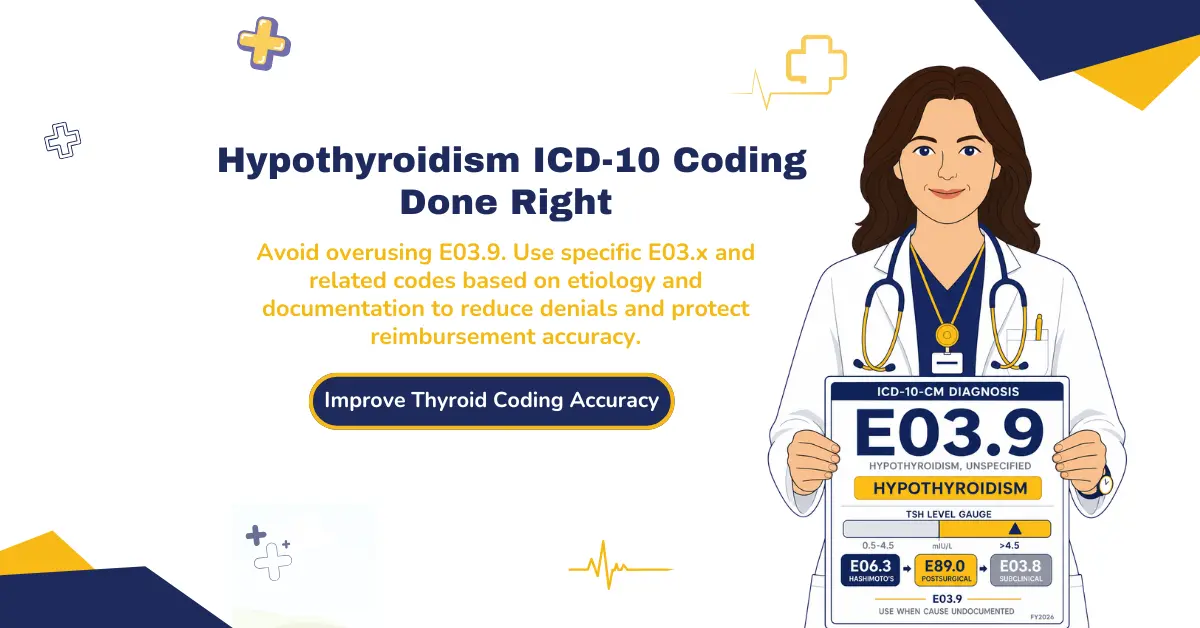
E03.9 is one of the most over-coded diagnoses in primary care and endocrinology billing. When a chart says “Hashimoto’s thyroiditis” but the claim shows E03.9, that’s a documentation-to-code mismatch. When the chart says “post-thyroidectomy hypothyroidism” and the claim shows E03.9, that’s a sequencing error. Estimates put preventable thyroid-related coding errors at 15 to 30 percent of thyroid claim denials across primary care practices, and E03.9 over-use is the root cause in most of them.
This guide reflects the ICD-10-CM Official Guidelines for Coding and Reporting FY2026, including the April 1, 2026 mid-year update that governs effective coding logic from October 1, 2025 through September 30, 2026. That update is the freshness benchmark zero current competitors reference. Everything here is current to that date.
E03.9 is the ICD-10-CM diagnosis code for hypothyroidism, unspecified. It is a billable code used for reimbursement when the cause or type of hypothyroidism is not documented. The code became effective October 1, 2025 and remains active through September 30, 2026 under the FY2026 ICD-10-CM code set, with the Official Guidelines updated April 1, 2026.
This guide covers the full E03.x code family plus related codes including E00 to E02 (iodine-deficiency), E06.3 (Hashimoto’s), E89.0 (postprocedural), and O99.28x (pregnancy). It also maps the CPT pairings, sequencing rules, Z-code applications, denial codes, and HCC documentation requirements that determine whether these hypothyroidism ICD 10 claims pay clean on the first submission.
Hypothyroidism ICD-10 Code Quick Reference (FY2026)
The table below reflects the FY2026 ICD-10-CM code set effective October 1, 2025 through September 30, 2026, with Official Guidelines updated April 1, 2026 per the CMS ICD-10 code files and CDC NCHS ICD-10-CM repository. Every code listed is verified billable for the current fiscal year unless noted as header or parent.
| ICD-10 Code | Description | Billable | Effective | Use When |
|---|---|---|---|---|
| E03.9 | Hypothyroidism, unspecified (Myxedema NOS) | Yes | 10/1/2025 | Cause not documented |
| E03.8 | Other specified hypothyroidism (incl. central, secondary, tertiary) | Yes | 10/1/2025 | Specified type, non-iodine, non-postprocedural |
| E03.5 | Myxedema coma | Yes | 10/1/2025 | Life-threatening severe hypothyroidism |
| E03.4 | Atrophy of thyroid (acquired) | Yes | 10/1/2025 | Acquired thyroid atrophy documented |
| E03.3 | Postinfectious hypothyroidism | Yes | 10/1/2025 | Hypothyroidism following thyroid infection |
| E03.2 | Hypothyroidism due to medicaments and other exogenous substances | Yes | 10/1/2025 | Drug-induced; requires T-code sequencing |
| E03.1 | Congenital hypothyroidism without goiter | Yes | 10/1/2025 | Congenital, no goiter present |
| E03.0 | Congenital hypothyroidism with diffuse goiter | Yes | 10/1/2025 | Congenital, diffuse goiter present |
| E02 | Subclinical iodine-deficiency hypothyroidism | Yes | 10/1/2025 | Subclinical, iodine-deficiency etiology |
| E01.8 | Other iodine-deficiency related thyroid disorders | Yes | 10/1/2025 | Iodine-deficiency related, other thyroid disorder |
| E00.0 to E00.9 | Congenital iodine-deficiency syndrome (multiple subtypes) | Yes | 10/1/2025 | Congenital iodine deficiency by type |
| E06.3 | Autoimmune thyroiditis (Hashimoto’s) | Yes | 10/1/2025 | Hashimoto’s documented; see sequencing in S8 |
| E89.0 | Postprocedural hypothyroidism (postsurgical, postirradiation) | Yes | 10/1/2025 | After thyroidectomy, RAI, radiation |
| O99.281 to O99.285 | Hypothyroidism complicating pregnancy (by trimester) | Yes | 10/1/2025 | Pregnancy; sequenced first per Section I.C.15 |
| O99.284 | Hypothyroidism complicating childbirth | Yes | 10/1/2025 | At delivery |
Before ICD-10 replaced ICD-9 in October 2015, hypothyroidism unspecified was coded to 244.9. The crosswalk from 244.9 to E03.9 is the standard reference when practices are migrating legacy data or comparing historical claim patterns against current submissions.
The sections below cover each code in depth, including the documentation requirements, Excludes1 rules, and sequencing patterns that determine when each code applies and when it doesn’t. Start with the hypothyroidism ICD 10 code most relevant to your patient panel, whether that is the E03.9 default or a specific hypothyroidism icd 10 subcode and use the table above as your daily reference.
What Hypothyroidism Means for Coders and Billers
Hypothyroidism is one of the most common chronic endocrine diagnoses in the United States, affecting an estimated 12% of the population at some point during their lifetime per the American Thyroid Association. That prevalence makes it one of the highest-volume chronic-disease code families in primary care and endocrinology billing, and one of the highest-risk categories for audit and denial when coding defaults become habits.
Clinically, the thyroid gland produces too little T4 (thyroxine) and T3 (triiodothyronine). Metabolism slows across every system. Common signs include fatigue, unexplained weight gain, cold intolerance, dry skin, constipation, bradycardia, and depression. The key lab pattern driving coding decisions is a high TSH (thyroid-stimulating hormone) combined with a low free T4. TSH rises because the pituitary is signaling the thyroid to produce more hormone. When the thyroid can’t respond, the free T4 stays low.
Each major cause maps to a distinct ICD-10 code. Hashimoto’s thyroiditis, the autoimmune destruction of thyroid tissue, codes to E06.3. Thyroidectomy and radioiodine ablation both code to E89.0. Drug-induced hypothyroidism routes to E03.2. Iodine deficiency routes to the E00 to E02 family. Congenital hypothyroidism routes to E03.0 or E03.1 depending on goiter status. When the cause is not documented or not yet identified, the default is E03.9.
Here’s the coder takeaway on every hypothyroidism ICD 10 encounter: the cause matters for coding because each etiology routes to a different code, and defaulting to E03.9 when documentation supports a specific code is a revenue and compliance problem. Documentation specificity isn’t just best practice here. It’s the difference between a clean claim and a denied or downcoded one.
Primary, Secondary, and Tertiary Hypothyroidism: Why Coding Differs
Three distinct anatomical failure points produce hypothyroidism, and each routes to a different ICD-10 code. Primary hypothyroidism means the thyroid gland itself is failing. Secondary hypothyroidism means the pituitary gland is failing to produce enough TSH to stimulate the thyroid. Tertiary hypothyroidism means the hypothalamus is failing to produce TRH, which in turn suppresses TSH, which then leaves the thyroid without stimulation. All three present clinically as hypothyroidism, but the underlying mechanism drives both the clinical management and the coding.
Primary hypothyroidism accounts for roughly 99% of all hypothyroidism cases, per AACE clinical guidelines. Coding routes to the E03.x family by etiology: E03.9 if the cause is unspecified, E03.4 if acquired thyroid atrophy is documented, E06.3 if Hashimoto’s is documented, and E89.0 if the cause is postprocedural. Hashimoto’s is the leading cause of primary hypothyroidism in iodine-sufficient regions including the United States.
Secondary and tertiary hypothyroidism are collectively called central hypothyroidism, and both code to E03.8 (other specified hypothyroidism). The FY2026 ICD-10-CM tabular inclusion list for E03.8 explicitly includes central hypothyroidism, secondary hypothyroidism, and tertiary hypothyroidism. The code choice isn’t ambiguous: when documentation names secondary, tertiary, or central hypothyroidism, E03.8 is the code.
Here’s the error to avoid. Some sources route secondary hypothyroidism to E23.0 (hypopituitarism). That’s incorrect. E23.0 codes the pituitary disorder itself, not the hypothyroidism that results from it. If a patient has hypopituitarism causing hypothyroidism, the correct coding is E23.0 for the pituitary condition plus E03.8 for the resulting hypothyroidism. Sequencing depends on encounter focus. Zero competitors in this cluster make that distinction clearly, and the E23.0 misrouting propagates because no one corrects it directly.
When documentation is ambiguous about the type, query the provider before defaulting. “Unspecified” should be a last resort, not a default behavior. If pituitary or hypothalamic involvement is documented but the specific type is unclear, a coder query is the right move.
Reference block:
- Primary hypothyroidism: E03.9 (unspecified) or specific E03.x or E06.3
- Secondary hypothyroidism: E03.8 (covers central, secondary, tertiary)
- Tertiary hypothyroidism: E03.8 (same code as secondary)
- Hypopituitarism causing hypothyroidism: E23.0 + E03.8
Per the ICD-10-CM Official Guidelines FY2026, sequencing between E23.0 and E03.8 follows encounter focus: the condition driving the visit is sequenced first.
E03.9: Hypothyroidism, Unspecified: When and How to Use the Default Code
E03.9 is a billable ICD-10-CM diagnosis code for hypothyroidism, unspecified, used when the type or cause of hypothyroidism is not documented in the medical record. The code is part of the FY2026 ICD-10-CM code set, effective October 1, 2025 through September 30, 2026 per the AAPC E03.9 reference and ICD-10 Data E03.9.
E03.9 carries Excludes1 instructional notes that coders must check before assigning the code. Per the official FY2026 tabular, E03.9 carries Excludes1 logic for E00 to E02 (iodine-deficiency related hypothyroidism) and E89.0 (postprocedural hypothyroidism). Excludes1 means these codes cannot be reported together on the same encounter. If iodine deficiency is the documented cause, E03.9 is the wrong code. If the postprocedural cause is documented, E03.9 is the wrong code.
E03.9 is billable, meaning it supports a clean claim submission on its own without further specificity. That’s why it’s the default choice across so many EHR systems and superbills. But “billable” doesn’t mean “best.” Specific codes drive better reimbursement under payer audit, lower denial rates, and stronger HCC capture for Medicare Advantage panels. Billable is the floor, not the ceiling.
The over-coding problem is real and measurable in hypothyroidism ICD 10 billing. E03.9 is the single most over-used hypothyroidism code in primary care. When provider documentation says “Hashimoto’s thyroiditis” but the coder routes to E03.9 instead of E06.3, that’s a documentation-to-code mismatch and an audit risk. When documentation says “post-thyroidectomy hypothyroidism” but the claim shows E03.9 instead of E89.0, that’s a sequencing error. When documentation says “subclinical hypothyroidism” but the claim shows E03.9 instead of E02 or E03.8, that’s a specificity error.
Some sources list “subclinical hypothyroidism” and “hypothyroidism in pregnancy” as synonyms for E03.9. Both are wrong. Subclinical hypothyroidism codes to E02 when iodine deficiency is the documented etiology, or E03.8 when the cause is non-iodine or other specified. Pregnancy-related hypothyroidism requires O99.28x sequenced first as the principal diagnosis, with the E-code sequenced second. Listing E03.9 as the synonym for either pattern propagates a coding error that costs revenue and creates audit exposure.
Three documentation patterns legitimately support E03.9. Provider notes hypothyroidism without specifying the type or cause. Lab results show high TSH and low free T4 but no etiology workup is complete. The patient is on long-term levothyroxine for previously diagnosed hypothyroidism with no type specified in the current chart. Outside those three scenarios, E03.9 is almost always a specificity gap, not a correct code choice.
Payers increasingly downcode or deny E03.9 claims when chart documentation reveals a specifiable type. Ongoing E03.9 use without documentation queries leads to revenue leakage that compounds month over month. Claims hitting denial codes like CO-50 (medical necessity) or N115 (LCD policy) often trace back to E03.9 over-use when documentation supports a more specific code. Claimmax RCM’s denial management services catch these gaps before submission, not after the denial.
E03.2: Drug-Induced Hypothyroidism and the “Code First” T-Code Rule
E03.2 codes hypothyroidism caused by medications or other exogenous substances. The most common offending drugs across specialties are amiodarone (cardiology), lithium (psychiatry), interferon-alpha (hepatology), and P-aminosalicylic acid (infectious disease). Increasingly, immune checkpoint inhibitors used in oncology including pembrolizumab and nivolumab are causing drug-induced hypothyroidism as a well-documented side effect.
The “Code First” rule for E03.2 is in the official FY2026 tabular instructional notes and missing from virtually every blog covering this code. Per the ICD-10-CM Official Guidelines FY2026, E03.2 requires this sequencing: Code First the poisoning code (T36 to T65 with fifth or sixth character 1 to 4 or 6) if the drug-induced hypothyroidism results from a poisoning, overdose, or wrong substance. Use an additional code (T36 to T50 with fifth or sixth character 5) for adverse effect to identify the specific drug if it was correctly prescribed and taken as directed but caused the hypothyroidism anyway.
The adverse effect versus poisoning distinction is the documentation pivot. Adverse effect means the drug was correctly prescribed, correctly taken, but caused hypothyroidism. Poisoning means overdose, wrong drug, intentional misuse, or a medication error. The fifth or sixth character of the T-code is the differentiator between these two scenarios. Coders can’t determine this from the lab result or the diagnosis alone. Provider documentation must specify the circumstance before the T-code character is assigned.
Four common drug-induced scenarios appear most often across specialty practices. Amiodarone-induced hypothyroidism in cardiology patients on antiarrhythmic therapy. Lithium-induced hypothyroidism in psychiatric patients on long-term mood stabilization. Interferon-induced hypothyroidism in hepatitis C treatment patients. Immunotherapy-induced hypothyroidism in oncology patients on checkpoint inhibitor regimens. Each requires E03.2 plus the appropriate T-code sequenced per the rules above.
Specialty practices managing these patients frequently miss the T-code sequencing on initial claims. The result is a CO-16 (missing or invalid information) or CO-11 (diagnosis inconsistent with procedure) denial. Specialty refills and long-term levothyroxine prior authorization renewals catch these documentation gaps at the worst possible moment. Claimmax RCM’s prior authorization services handle the documentation chain from initial drug-induced diagnosis through long-term levothyroxine maintenance.
Reference block: E03.2 sequencing pattern (per FY2026 ICD-10-CM tabular)
- Code first: T36 to T65 with 5th or 6th character 1 to 4 or 6 (poisoning, if applicable)
- E03.2 (drug-induced hypothyroidism)
- Use additional: T36 to T50 with 5th or 6th character 5 (adverse effect drug code, if applicable)
Subclinical Hypothyroidism: E02 vs E03.8 vs E03.9 Decision Logic
Subclinical hypothyroidism is defined by a TSH elevated above 4.5 mIU/L with free T4 still within the normal reference range. Patients may be asymptomatic or have mild non-specific symptoms that don’t clearly point to thyroid dysfunction. Per AACE hypothyroidism clinical guidelines, treatment thresholds vary significantly by TSH level, patient age, and pregnancy status. Coding depends on whether iodine deficiency is part of the documented clinical picture.
The E02 versus E03.8 decision is where the cluster-wide error lives. E02 (subclinical iodine-deficiency hypothyroidism) is the correct code when iodine deficiency is documented as the etiology. E03.8 (other specified hypothyroidism) covers subclinical hypothyroidism when the etiology is non-iodine or unspecified. Per the FY2026 ICD-10-CM tabular, E03.8’s inclusion list covers central hypothyroidism, hypothyroxinemia of prematurity, and subclinical hypothyroidism that is not iodine-deficiency related. E03.9 should not be used for subclinical hypothyroidism unless documentation is so vague that no specific subtype can be determined.
Why this matters for claims: payers running specificity audits flag E03.9 used for documented subclinical cases. Thyroid panel testing (CPT 84443 + 84439) supporting subclinical hypothyroidism management needs a specific subclinical code to demonstrate medical necessity under most payer LCDs. E03.9 doesn’t support that medical necessity argument for monitoring purposes.
Decision tree: Documentation says “subclinical hypothyroidism”
- Is iodine deficiency documented as the cause?
- Yes: code E02
- No: code E03.8 (other specified)
- Is the cause completely undocumented and the patient never worked up?
- Query the provider before defaulting to E03.9
The “subclinical” documentation trap catches coders regularly. Providers use “subclinical” loosely in clinical notes. Some mean lab-confirmed subclinical (high TSH, normal free T4). Others mean asymptomatic but actively treated. Those aren’t the same clinical scenario, and they don’t warrant the same coding approach. When documentation is ambiguous, query before assigning E03.9. CDI teams should flag any chart using “subclinical” without etiology documentation as a provider query trigger.
One related code that belongs on nearly every subclinical hypothyroidism encounter where the patient is on stable levothyroxine: Z79.899 (long-term current drug therapy). Z79.899 is added secondary to the main hypothyroidism code, never as the principal diagnosis. It strengthens the medical necessity documentation for ongoing monitoring labs and prescription refills.
Hashimoto’s Thyroiditis ICD-10: E06.3 Coding and Sequencing Logic
Hashimoto’s thyroiditis is the leading cause of hypothyroidism in iodine-sufficient regions including the United States, per the American Thyroid Association. It’s an autoimmune condition where anti-TPO and anti-thyroglobulin antibodies attack thyroid tissue, producing chronic inflammation and progressive loss of thyroid function. The ICD-10 code is E06.3 (autoimmune thyroiditis), which is the official tabular term covering Hashimoto’s disease, chronic lymphocytic thyroiditis, and autoimmune thyroiditis with hypothyroidism.
The sequencing debate in hypothyroidism ICD 10 coding has generated more confusion around Hashimoto’s in this cluster than almost any other topic. Sources disagree on whether to code E06.3 alone or E06.3 plus E03.9. The correct answer per ICD-10-CM coding conventions: code E06.3 alone when documentation confirms Hashimoto’s thyroiditis as the cause of the hypothyroidism. Adding E03.9 is redundant because E06.3 inherently implies hypothyroidism due to autoimmune thyroiditis. The single-code approach is the ICD-10-CM compliant default. Some payers and CDI programs prefer E06.3 plus E03.9 for chronic-condition tracking purposes, but that’s a policy-driven preference, not a rule-driven requirement.
When does the dual-code approach apply? If documentation explicitly states “Hashimoto’s thyroiditis with hypothyroidism” and the practice’s CDI policy or payer contract requires both codes for chronic-disease documentation, code E06.3 first followed by E03.9. The critical distinction: single-code (E06.3 alone) is the ICD-10-CM compliant path; dual-code (E06.3 + E03.9) is a policy path. Don’t mix the two rationales or present the dual approach as a rule requirement.
Lab pairings for Hashimoto’s encounters: anti-TPO antibodies (CPT 86376) and anti-thyroglobulin antibodies (CPT 86800) are the diagnostic markers confirming autoimmune etiology. TSH (CPT 84443) and free T4 (CPT 84439) confirm the hypothyroid state. The full Hashimoto’s diagnostic panel pairs E06.3 with these four CPT codes for medical-necessity support. Practices coding E06.3 should ensure lab orders document the antibody testing rationale clearly.
Documentation requirements for E06.3 are provider-driven, not lab-driven. Provider notes must explicitly say “Hashimoto’s thyroiditis,” “autoimmune thyroiditis,” or “chronic lymphocytic thyroiditis” to support E06.3. “Hypothyroidism” alone in the assessment defaults to E03.9 regardless of what the labs show. The shift from E03.9 to E06.3 happens when antibody testing confirms autoimmune etiology and the provider documents that specific diagnosis. CDI programs should query when high anti-TPO is visible in lab results but the working diagnosis in the assessment still reads generic hypothyroidism.
HCC mapping note: E03.9 and E06.3 don’t map to standalone HCC categories under CMS-HCC v28. But comprehensive chronic-condition capture and accurate comorbidity sequencing during hypothyroidism encounters affect overall RAF scores when diabetes, heart failure, or depression are also present. Section 15 covers the HCC and MEAT framework in full.
E89.0: Postprocedural Hypothyroidism After Thyroidectomy and Radiation
E89.0 (postprocedural hypothyroidism) applies when the thyroid fails due to a prior procedure rather than a primary thyroid disease process. The official FY2026 tabular inclusion list covers two specific postsurgical scenarios: postirradiation hypothyroidism and postsurgical hypothyroidism. The code applies after total or partial thyroidectomy, radioactive iodine ablation (RAI), or external beam radiation to the neck or head region causing thyroid damage.
Documentation patterns that route correctly to E89.0 include “post-thyroidectomy hypothyroidism,” “post-RAI hypothyroidism,” “iatrogenic hypothyroidism after thyroid surgery,” and “postsurgical hypothyroidism.” The Excludes1 note on the E03 category excludes postprocedural hypothyroidism specifically. That means E03.9 and E89.0 cannot be coded together for the same encounter. When the postprocedural cause is documented, E89.0 wins every time. Coding E03.9 when the chart documents a surgical or ablation history triggers Excludes1 conflicts that payers catch.
For ongoing levothyroxine management after thyroidectomy, the sequencing pattern is E89.0 as the primary hypothyroidism code plus Z79.899 (long-term current drug therapy) for the levothyroxine. The procedure history itself is captured by Z90.6 (acquired absence of other endocrine glands) when that structural history is relevant to the current encounter documentation.
The radioactive iodine pathway deserves specific attention. Patients treated with RAI for Graves’ disease or thyroid cancer commonly develop post-ablative hypothyroidism as an expected and often intended outcome of treatment. This routes to E89.0, not E03.9. For thyroid cancer survivors on long-term suppressive levothyroxine therapy, the complete code combination is E89.0 + Z85.850 (personal history of malignant neoplasm of thyroid) + Z79.899. This three-code combination tells the complete clinical story and supports the medical necessity for ongoing high-dose thyroid hormone suppression therapy.
Two common errors surface repeatedly on these claims. First, coders assign E03.9 instead of E89.0 for documented post-thyroidectomy patients, triggering the Excludes1 conflict. Second, coders assign E89.0 without supporting surgical or radiation history in current documentation, which triggers payer audits questioning the basis for the postprocedural code. Verify the procedural history is explicitly documented in the current encounter note or carries forward clearly in the problem list before applying E89.0.
Iodine-Deficiency Hypothyroidism: E00, E01, and E02 Code Family
Iodine deficiency remains the leading cause of hypothyroidism globally, though it’s relatively rare in the United States due to widespread iodized salt use. The ICD-10-CM separates iodine-deficiency hypothyroidism into its own code family (E00 to E02) because the etiology drives different clinical management protocols and different public health tracking requirements. It also carries an Excludes1 relationship with E03 that coders must respect.
The E00 family covers congenital iodine-deficiency syndrome. E00.0 is the neurological type, presenting with intellectual disability and motor deficits from severe prenatal iodine deficiency. E00.1 is the myxedematous type, presenting with growth failure and severe hypothyroidism. E00.2 is the mixed type combining features of both. E00.9 is unspecified congenital iodine-deficiency syndrome. These codes apply to infants and children with documented congenital iodine-deficiency syndrome often identified through newborn screening programs. They route differently from acquired congenital hypothyroidism, which is covered by E03.0 and E03.1 in Section 11.
E01 covers acquired iodine-deficiency related thyroid disorders. E01.0 is iodine-deficiency related diffuse goiter. E01.1 is iodine-deficiency related multinodular goiter. E01.2 is iodine-deficiency related goiter, unspecified. E01.8 is other iodine-deficiency related thyroid disorders and allied conditions. The E01 codes apply when iodine deficiency causes goiter or thyroid enlargement, with or without overt hypothyroidism.
E02 is subclinical iodine-deficiency hypothyroidism. As covered in Section 7, this code applies when documentation specifies both the subclinical hypothyroidism pattern (elevated TSH, normal free T4) and iodine deficiency as the documented etiology. E02 is the correct code for that combined documentation pattern, not E03.9.
The Excludes1 enforcement matters every time iodine deficiency is in the chart. E03 carries an Excludes1 note for the entire E00 to E02 family. Coders cannot report E03.9 with any E00 to E02 code on the same encounter. When iodine deficiency is the documented cause, the iodine-deficiency code family always wins over E03.9.
Congenital Hypothyroidism: E03.0 vs E03.1 and Newborn Screening Coding
Congenital hypothyroidism is hypothyroidism present at birth, typically detected through newborn screening programs that test heel-stick blood samples for TSH and T4 levels within the first 48 hours of life. Early detection and prompt treatment with levothyroxine prevent intellectual disability and developmental delays. The ICD-10-CM splits congenital hypothyroidism into two billable subcategories based on a single clinical differentiator: the presence or absence of goiter.
E03.0 is congenital hypothyroidism with diffuse goiter. The thyroid gland is present and enlarged at birth, typically from a hormone synthesis defect that causes compensatory hypertrophy. E03.1 is congenital hypothyroidism without goiter. The thyroid gland is hypoplastic, ectopically located, or absent entirely, covering thyroid agenesis (athyreosis), thyroid hemiagenesis, thyroid dysgenesis, and dyshormonogenesis without enlargement.
When to code which comes down to a single documentation check. Congenital hypothyroidism with palpable thyroid enlargement or imaging-confirmed diffuse goiter routes to E03.0. Congenital hypothyroidism without goiter, including thyroid dysgenesis, athyreosis, or enzyme defects that don’t produce gland enlargement, routes to E03.1. Newborn screening reports flagging elevated TSH should prompt provider documentation of the structural finding before the coder finalizes the code. The goiter presence or absence must be in the clinical documentation, not assumed from the screening result alone.
For newborn encounters, sequence the appropriate Z-code for the screening context when relevant (Z00.110 or Z00.111 for newborn health examination) alongside the congenital hypothyroidism code based on confirmed diagnosis. For ongoing pediatric management outside the newborn period, the congenital hypothyroidism code is the principal diagnosis driving the encounter.
Hypothyroidism in Pregnancy: O99.28x Sequencing Per Section I.C.15
Hypothyroidism complicating pregnancy carries serious clinical stakes. Untreated or undertreated maternal hypothyroidism is associated with miscarriage, preterm birth, preeclampsia, gestational hypertension, and impaired fetal neurodevelopment per ATA pregnancy guidelines. Coding accuracy matters for OB/GYN practices because thyroid testing and management claims require the right diagnosis sequencing to support medical necessity and avoid preventable denials.
The sequencing rule is definitive and it’s the rule most blog competitors get wrong. Per ICD-10-CM Official Guidelines Section I.C.15 (Chapter 15: Pregnancy, Childbirth, and the Puerperium), obstetric codes from Chapter 15 (categories O00 to O9A) take sequencing priority over codes from other chapters when the condition is pregnancy-related. For hypothyroidism complicating pregnancy, the O99.28x code is sequenced first as the principal diagnosis. The specific E-code identifying the hypothyroidism type is sequenced second. This is the opposite of how most blog resources describe it.
The O99.28x family by trimester:
- O99.281: Endocrine, nutritional and metabolic diseases complicating pregnancy, first trimester
- O99.282: Endocrine, nutritional and metabolic diseases complicating pregnancy, second trimester
- O99.283: Endocrine, nutritional and metabolic diseases complicating pregnancy, third trimester
- O99.284: Endocrine, nutritional and metabolic diseases complicating childbirth
- O99.285: Endocrine, nutritional and metabolic diseases complicating the puerperium
The trimester is determined by the documented gestational age at the current encounter, not the date the hypothyroidism was originally diagnosed.
Correct sequencing example: a patient presents at 22 weeks gestation with known hypothyroidism on levothyroxine, needing dose adjustment. Documentation: “Hypothyroidism complicating pregnancy, second trimester, on levothyroxine therapy.” Correct coding sequence is O99.282 (principal), E03.9 (secondary, or specific E-code if the type is known), Z79.899 (long-term levothyroxine therapy). The O99.282 wins principal because Section I.C.15 governs for pregnancy-related encounters. Coders who default to E03.9 alone on this claim trigger payer denial under obstetric medical-necessity rules and downcode the obstetric services.
Postpartum thyroiditis is a clinically distinct condition from pre-existing hypothyroidism that continues postpartum. Postpartum thyroiditis is transient autoimmune thyroid inflammation occurring within 12 months of delivery, potentially presenting as transient hyperthyroidism, transient hypothyroidism, or both in sequence. Coding routes to O90.5 (postpartum thyroiditis) for the postpartum-specific component. If hypothyroidism persists beyond 12 months and converts to chronic disease, E03.9 or E06.3 is added. Pre-existing hypothyroidism that continues postpartum is not postpartum thyroiditis and routes differently.
Lab pairings in pregnancy thyroid management: TSH (CPT 84443) and free T4 (CPT 84439) are routine monitoring throughout pregnancy. Anti-TPO testing (CPT 86376) supports E06.3 if Hashimoto’s is suspected as the underlying cause.
OB/GYN practices managing hypothyroidism ICD 10 encounters in pregnancy need coding teams that understand obstetric chapter sequencing rules. Errors in O99.28x sequencing trigger denials, downcoding, and audit findings that compound across a busy obstetric panel. Claimmax RCM’s medical billing services handle the obstetric-endocrine sequencing chain that drives clean hypothyroidism ICD 10 claim submission for pregnancy encounters.
Z-Codes for Hypothyroidism: Z79.899, Z83.49, Z86.39, and Z13.29
Z-codes capture status, history, and long-term care contexts that pair with active hypothyroidism diagnoses. They’re never coded alone for routine hypothyroidism management, but they provide essential context for risk adjustment accuracy, audit defense, and complete chronic-condition documentation.
Z79.899 is the long-term current drug therapy code most relevant to hypothyroidism billing. It’s added secondary when patients are on stable, ongoing levothyroxine as chronic management. Z79.899 is “other long-term (current) drug therapy” because levothyroxine doesn’t have a more specific Z79 subcategory of its own. Add Z79.899 to nearly every E03.9, E06.3, or E89.0 encounter where the patient is on stable thyroid hormone replacement therapy. This pairing strengthens medical necessity documentation for prescription refills and follow-up monitoring labs.
Z83.49 covers family history of other endocrine, nutritional, and metabolic diseases and is the correct code for family history of hypothyroidism, Hashimoto’s, or other endocrine conditions in the family history. Some sources incorrectly cite Z83.3 for this purpose. Z83.3 does not exist in the current ICD-10-CM. It is not a valid code. The correct family history code is Z83.49. Any practice using Z83.3 is submitting an invalid code that will trigger a rejection or a CO-16 denial.
Z86.39 covers personal history of other endocrine, nutritional, and metabolic diseases. Use Z86.39 when documentation includes a personal history of resolved or previously treated hypothyroidism, particularly for patients with prior thyroid cancer (paired with Z85.850), thyroidectomy patients on stable levothyroxine documented as historical, or patients whose hypothyroidism is referenced as background clinical history rather than active management.
Z13.29 is the screening code for other suspected endocrine disorder, covering thyroid screening encounters in asymptomatic patients. Use Z13.29 when the encounter is specifically a thyroid screening (TSH, free T4) without an existing hypothyroidism diagnosis on the problem list. If screening detects hypothyroidism, the clinical situation changes: the active diagnosis (E03.9 or specific E-code) becomes principal, and Z13.29 may be added for the screening context if payer policy supports it.
Reference block: Z-code summary for hypothyroidism
- Z79.899: Long-term current levothyroxine therapy
- Z83.49: Family history of endocrine disease (not Z83.3, which is an invalid code)
- Z86.39: Personal history of resolved or stable hypothyroidism
- Z13.29: Thyroid screening encounter (asymptomatic, no active diagnosis)
CPT Codes for Hypothyroidism Diagnosis and Monitoring: Medical Necessity Pairings
Medical necessity rules require diagnosis-procedure linkage on every claim. For hypothyroidism testing and monitoring, the CPT codes must pair with the right ICD-10 codes to demonstrate the clinical reason for the service. Mismatched pairings trigger CO-50 (medical necessity not met) denials and downcoding. The pairings below cover the standard hypothyroidism diagnostic and monitoring CPT code set.
CPT 84443 is the TSH test, the most-ordered thyroid lab in the United States. Pair CPT 84443 with the active hypothyroidism diagnosis: E03.9 for unspecified, E06.3 for Hashimoto’s, E89.0 for postsurgical, E03.2 for drug-induced, E02 or E03.8 for subclinical, or O99.28x for pregnancy encounters. For pure screening encounters in asymptomatic patients with no established diagnosis, pair with Z13.29. Some payers limit screening frequency under LCD policy, so verify before submission.
CPT 84439 is free T4 (the active, unbound hormone form) and is the more clinically useful T4 measurement in modern thyroid practice. CPT 84436 is total T4 (bound and unbound). Some published sources mislabel CPT 84436 as the TSH code. That is incorrect. CPT 84443 is TSH. CPT 84436 is total T4. Mixing these up at the billing level generates claim errors that billers often can’t trace back without a CPT reference check.
CPT 84480 is total T3 and CPT 84481 is free T3. T3 testing is less common in routine hypothyroidism management because hypothyroid patients have impaired T4-to-T3 conversion that free T4 levels already capture. T3 testing is indicated when central hypothyroidism is suspected, when T3 supplementation therapy is being considered, or for specific monitoring scenarios outside standard primary hypothyroidism management.
Antibody testing: CPT 86376 is microsomal antibodies (anti-TPO), the primary Hashimoto’s diagnostic marker. CPT 86800 is thyroglobulin antibodies. Both pair with E06.3 when documentation supports Hashimoto’s workup. For patients with established Hashimoto’s on chronic management, antibody testing is typically not repeated unless there’s documented clinical justification. Repeat antibody testing without that justification triggers payer scrutiny on medical necessity grounds.
Thyroid imaging: CPT 76536 is ultrasound of the thyroid, used to evaluate nodules, gland size, or structural abnormalities. Pair with E04.x codes for nontoxic goiter when relevant, or with E03.9 or E06.3 when imaging is part of a hypothyroidism workup with structural concerns. CPT 76536 paired with E03.9 alone for asymptomatic patients without documented structural findings often triggers CO-50 denial.
| CPT Code | Test | Best ICD-10 Pairings | Common Denial Trigger |
|---|---|---|---|
| 84443 | TSH | E03.9, E06.3, E89.0, E03.2, E02, E03.8, O99.28x, Z13.29 | Frequency limit per LCD |
| 84439 | Free T4 | Same as TSH | Frequency limit |
| 84436 | Total T4 | E03.9, E06.3, E03.8, central hypothyroidism workup | Use free T4 instead when possible |
| 84480 | Total T3 | E03.8, central hypothyroidism, T3 therapy monitoring | Routine hypothyroidism without T3 indication |
| 84481 | Free T3 | Same as total T3 | Routine hypothyroidism without T3 indication |
| 86376 | Anti-TPO | E06.3 (Hashimoto’s workup) | Repeat without documented justification |
| 86800 | Anti-thyroglobulin | E06.3, thyroid cancer surveillance | Repeat without documented justification |
| 84432 | Thyroglobulin | Thyroid cancer surveillance | Hypothyroidism alone without cancer context |
| 76536 | Thyroid ultrasound | E04.x (goiter), structural workup with E03.9 or E06.3 | Asymptomatic E03.9 alone without structural concern |
Verifying CPT-ICD pairings before submission is the single highest-leverage clean-claim activity for endocrinology and primary care thyroid panels. Practices submitting thyroid panels without verifying medical-necessity pairings see denial rates climb fast across a high-volume thyroid patient population. Claimmax RCM’s revenue cycle management services build pairing verification into every pre-submission scrub.
Hypothyroidism HCC Mapping and MEAT Documentation for Audit Defense
Hypothyroidism is one of the most common chronic conditions on Medicare Advantage panels, and hypothyroidism ICD 10 coding accuracy drives the risk-adjustment picture for these patients. Risk adjustment under the CMS-HCC v28 model, effective for payment year 2026, captures complete chronic-condition documentation annually for accurate RAF scoring. While E03.9 itself doesn’t map to an HCC under CMS-HCC v28, comprehensive chronic-condition coding and accurate sequencing affect overall risk scores meaningfully when comorbidities are involved.
The HCC reality: under CMS-HCC v28, hypothyroidism codes in the E03.x family, E06.3, and E89.0 don’t directly map to Hierarchical Condition Categories. That means standalone hypothyroidism doesn’t increase the RAF score. But comorbidities that commonly accompany hypothyroidism do carry HCC weight. Depression (F33.x maps to HCC 155 under v28), Type 2 diabetes (E11.x maps to HCCs 35 to 38), and heart failure (I50.x maps to HCC 226) are conditions coders must capture completely on every encounter where they’re documented. Accurate comorbidity coding during hypothyroidism encounters is where the risk-adjustment value lives.
MEAT criteria apply to every chronic condition on Medicare Advantage claims. RADV audits require chronic conditions to meet MEAT standards each calendar year: Monitor (lab results reviewed), Evaluate (clinical assessment performed), Assess (status documented as stable, worsening, or improving), and Treat (medication, dosing, and plan documented). For hypothyroidism, MEAT documentation typically appears as: TSH and free T4 reviewed (Monitor), clinical assessment of thyroid status performed (Evaluate), stability or adjustment status noted (Assess), levothyroxine dosing plan documented (Treat). A generic chart entry doesn’t survive audit.
Strong MEAT documentation for a stable hypothyroid patient reads like this: “Hypothyroidism, stable on levothyroxine 75 mcg daily. TSH 2.1 mIU/L (March 2026, within target range), free T4 1.2 ng/dL. Continue current dose. Recheck TSH in six months.” That note hits all four MEAT elements and supports E03.9 through a post-payment RADV audit. Weak documentation reads: “Hypothyroidism.” A single word in the assessment without monitoring data, clinical evaluation, or treatment plan fails MEAT entirely and creates recoupment exposure.
Hypothyroidism doesn’t have a dedicated HEDIS measure. But related measures including Comprehensive Diabetes Care, Statin Use in Adults with Diabetes, and Controlling High Blood Pressure frequently apply to hypothyroid patients with comorbid conditions. Comprehensive documentation at hypothyroidism encounters supports both HCC capture for those comorbidities and HEDIS measure performance on the related metrics.
CDI programs should query providers when chart documentation is generic without MEAT elements. Annual wellness visits, chronic care management visits (CCM), and specialty endocrinology follow-ups are the primary opportunities to capture audit-defensible MEAT documentation. Missed MEAT capture costs money on both the RAF scoring side and the audit-recovery side.
The Top 7 Hypothyroidism Coding Errors That Trigger Denials
Every coder makes mistakes. These seven errors are the most common hypothyroidism coding mistakes that show up in submitted claims, and each one creates measurable revenue leakage. Fixing these patterns is the fastest path to clean-claim rate improvement on thyroid panels.
Error 1: Defaulting to E03.9 when documentation supports a specific code. Provider notes say “Hashimoto’s thyroiditis” but the claim shows E03.9 instead of E06.3. Or notes say “post-thyroidectomy hypothyroidism” but the claim shows E03.9 instead of E89.0. This is the most common error in primary care hypothyroidism billing. Fix: documentation review before code assignment. CDI query when the provider specifies a type but the EHR routes to the unspecified default.
Error 2: Coding subclinical hypothyroidism as E03.9. Multiple online sources list “subclinical hypothyroidism” as an E03.9 synonym. That’s wrong. Subclinical hypothyroidism with documented iodine deficiency codes to E02. Subclinical hypothyroidism without iodine deficiency codes to E03.8. Fix: train coders to recognize the subclinical pattern (high TSH, normal free T4) and route to E02 or E03.8 based on iodine documentation, not to E03.9 by default.
Error 3: Treating pregnancy hypothyroidism as an E03.9 synonym. Hypothyroidism complicating pregnancy requires Section I.C.15 sequencing. O99.28x (by trimester) is sequenced first as principal. The E-code is sequenced second. Coding E03.9 alone on these encounters loses the obstetric context, triggers medical-necessity denials, and downcodes the obstetric services. Fix: build the O99.28x principal-sequencing rule into every OB/GYN coding workflow.
Error 4: Citing Z83.3 for family history of hypothyroidism. Z83.3 does not exist in the current ICD-10-CM. It is not a valid code. The correct family history code is Z83.49 (family history of other endocrine, nutritional, and metabolic diseases). Fix: use Z83.49 for family history of hypothyroidism or Hashimoto’s. Verify all Z-codes against the current tabular before assignment.
Error 5: Coding secondary hypothyroidism to E23.0. E23.0 codes hypopituitarism, the pituitary disorder itself, not the hypothyroidism that results from it. Secondary, central, and tertiary hypothyroidism all code to E03.8. If a patient has hypopituitarism causing hypothyroidism, code E23.0 plus E03.8. Sequencing follows encounter focus. Fix: separate the pituitary disorder code from the hypothyroidism code. They’re distinct conditions requiring distinct codes.
Error 6: Mislabeling CPT 84436 as the TSH code. CPT 84443 is TSH. CPT 84436 is total T4. This mislabeling appears in published RCM blog content and creates billing errors that trace back to CPT reference failures. Fix: standardize the CPT-ICD pairing reference using the table in Section 14. Verify CPT codes against the current AMA CPT manual before any claim submission.
Error 7: Skipping T-code sequencing for E03.2 drug-induced hypothyroidism. E03.2 requires Code First T-code sequencing for poisoning (T36 to T65) or Use Additional coding for adverse effect (T36 to T50). Skipping the T-code creates a CO-16 (missing or invalid information) denial. Fix: when E03.2 appears on any claim, verify the appropriate T-code is sequenced per the official tabular instructional notes. The adverse effect versus poisoning distinction must come from provider documentation, not coder assumption.
Each of these errors stems from documentation gaps, template lag, or default workflow behavior rather than advanced coding knowledge failures. All seven are fixable with workflow changes and targeted coder education.
Common Denial Codes for Hypothyroidism Claims and How to Prevent Them
Denials follow patterns on hypothyroidism ICD 10 claims. They hit a predictable set of denial codes when documentation, sequencing, or CPT-ICD pairings break down. The denial codes below map to the specific hypothyroidism scenarios that generate them most often, with prevention scripts that catch these patterns before the claim leaves the practice. Each denial costs between $25 and $118 in rework time, and many are never fully recovered. Prevention is always cheaper than recovery.
CO-50: Medical Necessity Not Met. Triggered when the diagnosis code doesn’t support the procedure under the payer’s LCD or medical-necessity criteria. Common hypothyroidism scenarios: thyroid panel testing (CPT 84443 + 84439) billed with E03.9 for asymptomatic patients who don’t meet diagnostic-monitoring criteria. Anti-TPO testing (CPT 86376) billed with E03.9 instead of E06.3. Thyroid ultrasound (CPT 76536) billed with E03.9 alone for patients without documented structural concerns. Fix: pre-submission scrub that verifies CPT-ICD pairings against payer LCD requirements before every claim release.
CO-11: Diagnosis Inconsistent with Procedure. Triggered when the diagnosis-procedure linkage fails the payer’s edit logic. Common hypothyroidism scenarios: T3 testing (CPT 84480, 84481) billed with E03.9 unspecified without documented T3-specific clinical indication. Repeat antibody testing (CPT 86376, 86800) without documented clinical justification for the repeat. Fix: build clinical-justification documentation prompts into EHR ordering templates for repeat tests and specialty thyroid panels.
CO-16: Claim Lacks Information. Triggered when required sequencing or supporting codes are missing. Common hypothyroidism scenarios: E03.2 billed without the T-code for adverse effect or poisoning as required by the tabular sequencing instruction. O99.28x billed without the secondary E-code identifying the specific hypothyroidism type. Fix: a sequencing checklist for drug-induced and pregnancy hypothyroidism scenarios run before claim submission every time.
N115: Local Coverage Determination Policy. Specific to LCD-driven coverage limits. Common hypothyroidism scenarios: TSH screening (CPT 84443) ordered more frequently than the payer’s LCD allows for asymptomatic patients. Anti-TPO testing on patients with established Hashimoto’s without new clinical justification for the repeat. Some LCDs limit thyroid screening to once every 12 or 24 months for asymptomatic adults. Fix: maintain a current LCD frequency reference for thyroid testing by payer and verify before every order.
CO-197: Precertification or Authorization Absent. Triggered when prior authorization is required but wasn’t obtained. Common hypothyroidism scenarios: brand-name levothyroxine prescriptions (Synthroid, Tirosint) requiring prior authorization when generic levothyroxine is the formulary standard. Specialty thyroid testing including reverse T3 or thyroid hormone resistance panels. Imaging beyond basic ultrasound. Fix: prior authorization workflow that flags brand-name thyroid hormone scripts and specialty testing at the point of order, before prescriptions are sent.
CO-45: Charge Exceeds Allowed Amount. Not hypothyroidism-specific but commonly triggered on complex chronic-disease management visits for hypothyroid patients with multiple comorbidities. Common scenario: complex hypothyroidism management with diabetes and heart failure billed at high E&M levels without documentation supporting that level of medical decision-making. Fix: E&M leveling review for hypothyroid patients where comorbidity-driven complexity is the basis for higher-level visit coding.
The cumulative cost of these denials adds up quickly. A primary care practice managing 200 hypothyroid patients can lose $15,000 to $30,000 annually to preventable denials when CPT-ICD pairings, sequencing rules, and LCD requirements aren’t built into the pre-submission workflow. Denials that do slip through need active recovery. The longer a denied hypothyroidism claim sits in AR, the lower the recovery rate.
Claimmax RCM’s denial management services catch these patterns before submission, while our AR follow-up team recovers the denials that slip through. Both work the same hypothyroidism code patterns covered in this guide.
Frequently Asked Questions: Hypothyroidism ICD-10 Coding
Short answers to the most common questions about hypothyroidism ICD 10 coding, written for working coders and billers.
What is the ICD-10 code for hypothyroidism?
The primary ICD-10-CM code for hypothyroidism is E03.9 (hypothyroidism, unspecified). It’s a billable code used when the type or cause isn’t documented. Specific subtypes have their own codes: E06.3 for Hashimoto’s, E89.0 for postsurgical, E03.2 for drug-induced, E02 for subclinical iodine-deficiency, E03.8 for other specified including central and secondary, and E03.0 or E03.1 for congenital with or without goiter.
What is the dx code for hypothyroidism?
The dx code for hypothyroidism is E03.9 when the type isn’t specified. “Dx code” and “ICD-10 code” mean the same thing in clinical billing. Use a more specific code (E06.3, E89.0, E03.2, E02, E03.8) when documentation supports the etiology. Specific codes drive better reimbursement and lower denial rates than the unspecified default.
What is the diagnosis code for E03.9?
E03.9 is the diagnosis code itself. It represents hypothyroidism, unspecified, in the ICD-10-CM code set. The corresponding ICD-9 code (used before October 2015) was 244.9. E03.9 is a billable code under FY2026 ICD-10-CM, effective October 1, 2025 through September 30, 2026, with the Official Guidelines updated April 1, 2026.
What is the difference between E03.9 and E06.3?
E03.9 is hypothyroidism, unspecified. E06.3 is autoimmune thyroiditis (Hashimoto’s). Use E06.3 when documentation confirms Hashimoto’s or autoimmune thyroiditis as the cause. Use E03.9 when the cause isn’t documented. Adding E03.9 alongside E06.3 is generally redundant because E06.3 inherently implies autoimmune hypothyroidism. Some payers and CDI policies prefer the dual-code approach for chronic-disease tracking, but ICD-10-CM coding rules don’t require it.
What is the ICD-10 code for subclinical hypothyroidism?
Subclinical hypothyroidism codes to E02 when iodine deficiency is the documented cause, or E03.8 (other specified hypothyroidism) when the cause is non-iodine or unspecified. E03.9 isn’t the correct code for documented subclinical hypothyroidism. The distinction matters for medical necessity and audit defense. Documentation should specify whether iodine deficiency is involved before code assignment.
What is the ICD-10 code for hypothyroidism in pregnancy?
Hypothyroidism complicating pregnancy sequences first under O99.28x by trimester: O99.281 (first trimester), O99.282 (second), O99.283 (third), O99.284 (childbirth), O99.285 (puerperium). The specific hypothyroidism E-code (E03.9, E06.3, E89.0) sequences second. Per ICD-10-CM Official Guidelines Section I.C.15, obstetric codes from Chapter 15 take sequencing priority for pregnancy-related conditions.
What is the ICD-10 code for postsurgical hypothyroidism?
Postsurgical hypothyroidism codes to E89.0 (postprocedural hypothyroidism). The same code applies to postirradiation hypothyroidism, including post-radioactive iodine ablation. E89.0 is the correct code for any hypothyroidism caused by thyroid surgery, RAI, or radiation therapy. The Excludes1 note on E03 prevents coding E03.9 alongside E89.0 on the same encounter.
What is the ICD-10 code for acquired hypothyroidism?
Acquired hypothyroidism with no specified cause routes to E03.9. When acquired thyroid atrophy is specifically documented, the correct code is E03.4 (atrophy of thyroid, acquired). Most adult-onset hypothyroidism is acquired by definition, distinguishing it from congenital hypothyroidism (E03.0 or E03.1). The “acquired” descriptor alone doesn’t change the unspecified default unless atrophy or a specific etiology is named.
Is E03.9 a billable code?
Yes. E03.9 is a billable, specific ICD-10-CM code that supports reimbursement on its own. It doesn’t require additional digits or further specificity to be claim-ready. Billable doesn’t mean optimal. Specific codes (E06.3, E89.0, E03.2) drive better reimbursement, lower denial rates, and stronger audit defense when documentation supports the specificity.
What is the ICD-10 code for Hashimoto’s thyroiditis?
The ICD-10 code for Hashimoto’s thyroiditis is E06.3 (autoimmune thyroiditis). E06.3 covers Hashimoto’s disease, chronic lymphocytic thyroiditis, and autoimmune thyroiditis with hypothyroidism. Use E06.3 alone when documentation confirms Hashimoto’s as the cause of the hypothyroidism. Per AHA/ACC clinical guidelines reference, anti-TPO antibody testing (CPT 86376) is the diagnostic marker most commonly paired with E06.3 to support medical necessity.
If your practice manages hypothyroidism patients across endocrinology, primary care, OB/GYN, or oncology service lines, the hypothyroidism ICD 10 coding patterns in this guide affect every claim. Getting them right means cleaner submissions, lower denial rates, and stronger audit defense. For practices that want a complete RCM audit of their hypothyroidism coding workflow, contact Claimmax RCM. Our team works the exact code patterns, sequencing rules, and denial codes covered in this guide.