POS 11: Quick Reference
| Field | Detail |
| Code | 11 |
| CMS Name | Office |
| Full Name | Place of Service 11 |
| Setting | Physician’s private practice, group practice, or standalone clinic |
| Type | Outpatient only (never inpatient) |
| Payment Rate | Non-facility (typically 10% to 40% higher than facility codes) |
| CMS-1500 Location | Box 24B |
| 2026 Conversion Factor | $33.40 (non-APM) / $33.57 (APM) |
| Common Services | Office visits, preventive care, minor procedures, in-office labs |
| Key Rule | Do NOT use for hospital-owned clinics (use POS 22 instead) |
| Telehealth | Use POS 02 or 10; POS 11 only with Modifier 95 for Medicare (through 2027) |
POS 11 in medical billing is the most commonly used place of service code on professional claims. It’s also one of the most frequently miscoded. That creates a real revenue problem most practices don’t even realize they have.
Here’s the thing about POS in medical billing: the place of service code you select directly controls your reimbursement rate. One POS error repeated across 20 claims per day can cost a practice over $150,000 per year. Not from complex coding. From the wrong two-digit code on the CMS-1500.
This guide covers what POS 11 actually means under the 2026 CMS rules, when to use it and when not to, how it directly affects your reimbursement under the Medicare Physician Fee Schedule, comparisons with POS codes like 22, 19, and 21, telehealth billing rules, denial codes, and compliance best practices.
At Claimmax RCM, we process thousands of claims monthly across 40+ specialties. POS coding accuracy is one of the first things we audit for every new practice we onboard, because it’s the single fastest way to recover lost revenue without seeing a single additional patient.
Whether you’re evaluating your current billing workflows or considering outsourcing to a medical billing partner, understanding POS 11 from the inside out helps you make better decisions for your practice’s revenue cycle.
What Is POS 11 in Medical Billing?
Most POS 11 errors in medical billing don’t come from carelessness. They come from not fully understanding what the code means, who it applies to, and where CMS draws the line.
Place of Service 11: The Official CMS Definition (2026)
POS 11 means “Office” in the Place of Service code set maintained by CMS. Here’s the official description of Place of Service 11:
“Location, other than a hospital, skilled nursing facility (SNF), military treatment facility, community health center, State or local public health clinic, or intermediate care facility (ICF), where the health professional routinely provides health examinations, diagnosis, and treatment of illness or injury on an ambulatory basis.”
Three words in that definition matter more than the rest.
“Other than a hospital.” POS 11 is invalid when a hospital owns or operates the clinic, even if it looks like a regular office. Same exam rooms, same staff, same address. Doesn’t matter. If the hospital signs the paychecks, it’s not POS 11.
“Routinely.” CMS expects an established, continuously operating practice. A pop-up clinic or one-time screening event likely won’t qualify under this standard.
“Ambulatory basis.” The patient walks in and walks out the same day. POS 11 is always outpatient. No exceptions.
The CMS Place of Service Code Set page was last updated February 17, 2026, confirming the POS 11 definition remains unchanged.
What Does POS Stand For in Medical Billing?
POS stands for Place of Service. These are two-digit codes assigned by CMS to identify where a healthcare service was physically provided. Think of them as location tags on every claim you submit.
POS codes are required on every professional claim, whether it’s filed on the CMS-1500 paper form or through the electronic 837P transaction under HIPAA. CMS currently maintains over 60 active codes, and each one represents a different care setting.
The physician’s office place of service code, POS 11, is the most commonly used non-facility code in outpatient medical billing. It also carries the highest non-facility reimbursement rates, which is exactly why getting it right matters so much.
Is POS 11 Inpatient or Outpatient?
POS 11 is strictly outpatient. It has no application in inpatient settings.
The code identifies care delivered in an office where the patient arrives, receives treatment, and leaves the same day. Once a patient gets admitted to a hospital for an overnight stay, the correct code changes to POS 21 (Inpatient Hospital).
Here’s where mistakes happen. The CMS Claims Processing Manual instructs: if the patient is a registered inpatient or outpatient of a hospital, providers must use the appropriate hospital POS codes (21, 19, or 22), even if the face-to-face encounter happened in a separate office suite.
Billers miss this constantly because the encounter looks and feels like a normal office visit. Same provider, same exam room, same documentation. But the patient’s status changed, and the POS code needs to change with it.
POS 11 vs Occurrence Code 11: A Critical Distinction
Despite sharing the number 11, these serve completely different purposes on completely different claim forms.
POS 11 tells the payer where care happened: the physician’s office. It goes in Box 24B on the CMS-1500 professional claim.
Occurrence Code 11 tells the payer when a condition started: the date of illness onset. It goes in Form Locators 31 to 34 on the UB-04 institutional claim.
Confusing the two leads to claim rejections or incorrect payer interpretation. This comes up most often in practices that bill both professional and institutional claims, or billing teams moving between inpatient and outpatient workflows.
If your team handles both claim types, this distinction is worth verifying. It’s one of the first things we check during a Claimmax RCM billing audit.
How POS 11 Affects Your Reimbursement in 2026
POS 11 in medical billing doesn’t just identify a location. It determines how much you get paid. Every claim your office submits with POS 11 triggers a completely different reimbursement calculation than the same service billed from a hospital setting. That difference hits your bottom line on every single visit.
Non-Facility vs Facility Rates: Why POS 11 Pays More
The Medicare Physician Fee Schedule uses a dual-rate structure. When you bill with POS 11, Medicare applies the non-facility rate. That rate compensates you for the full cost of delivering care: rent, clinical staff, equipment, supplies, and utilities.
Bill the same service under a facility code like POS 22, and Medicare applies the facility rate. It’s lower because the hospital bills separately for overhead. You only get paid for the professional service itself.
Here’s how the split works:
| Rate Type | Applies To | What It Covers |
| Non-Facility Rate | POS 11 (Office), POS 12, POS 49 | Professional service + all overhead (rent, staff, equipment, supplies) |
| Facility Rate | POS 21, 22, 23, 24 | Professional service only; facility bills separately for overhead |
How POS 11 Affects Your Reimbursement in 2026
POS 11 in medical billing doesn’t just identify a location. It determines how much you get paid. Every claim your office submits with POS 11 triggers a completely different reimbursement calculation than the same service billed from a hospital setting. That difference hits your bottom line on every single visit.
Non-Facility vs Facility Rates: Why POS 11 Pays More
The Medicare Physician Fee Schedule uses a dual-rate structure. When you bill with POS 11, Medicare applies the non-facility rate. That rate compensates you for the full cost of delivering care: rent, clinical staff, equipment, supplies, and utilities.
Bill the same service under a facility code like POS 22, and Medicare applies the facility rate. It’s lower because the hospital bills separately for overhead. You only get paid for the professional service itself.
Here’s how the split works:
| CPT Code | Service | POS 11 (Non-Facility) | POS 22 (Facility) | Difference Per Visit |
| 99213 | Established patient, Level 3 | ~$93 | ~$74 | $19 |
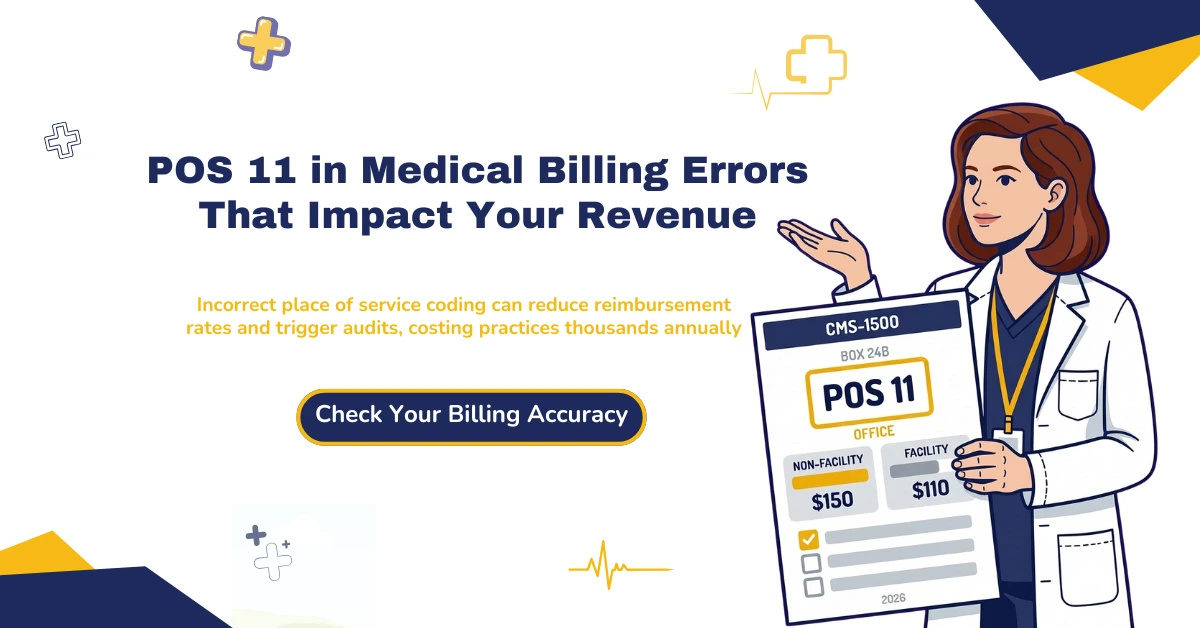
| 99214 | Established patient, Level 4 | ~$150 | ~$110 | $40 |
| 99215 | Established patient, Level 5 | ~$211 | ~$169 | $42 |
| 11102 | Tangential skin biopsy | ~$97 | ~$63 | $34 |
| 93000 | EKG with interpretation | ~$28 | ~$15 | $13 |
Based on the 2026 Medicare Physician Fee Schedule using the $33.40 conversion factor (non-APM). Rates vary by MAC jurisdiction and locality. Commercial payer rates differ but follow similar non-facility vs facility logic.
Look at CPT 99214. That’s a $40 difference on the most commonly billed E/M code in outpatient medicine. Multiply that across a full day of patients, and it adds up fast.
The $150,000 Revenue Impact: What Miscoding Actually Costs
Let’s walk through the math. Use CPT 99214 as your baseline, with an average POS 11 vs POS 22 difference of about $35 per visit.
A practice seeing 20 patients per day, five days a week, 50 weeks a year handles 5,000 office visits annually. If just 10% of those visits carry the wrong POS code, that’s 500 claims at $35 each: $17,500 lost. If every visit is miscoded, you’re looking at $175,000 in lost revenue.
According to the Medical Group Management Association (MGMA), practices with consistent POS coding errors see reimbursement reductions of 15% to 20%.
For a practice already operating on thin margins, recovering this money requires zero additional patients, zero extra hours, and zero new staff. Just accurate POS coding. This is exactly the kind of revenue recovery that Claimmax RCM identifies during our onboarding audit. At just 2.95% of collections, our billing services typically pay for themselves within the first 30 days through POS accuracy improvements alone.
2026 Update: G2211 Visit Complexity Add-On Boosts POS 11 Revenue
Here’s something most practices don’t know about yet. Since January 1, 2024, CMS has allowed providers to report add-on code G2211 with office/outpatient E/M codes 99202 to 99215. Starting January 1, 2026, CMS revised the descriptor and expanded coverage to include home visit codes 99341 to 99345 and 99347 to 99350.
G2211 adds approximately $16 per qualifying visit when paired with POS 11 E/M encounters.
Run the numbers: $16 per visit, 20 qualifying visits per day, 250 working days. That’s $80,000 per year in additional revenue, available only when POS 11 is billed correctly. An incorrect POS assignment can disqualify G2211 entirely.
This was finalized in the CY 2026 Medicare PFS Final Rule (CMS-1832-F). If your practice isn’t capturing G2211, you’re leaving real money on the table.
2026 PE RVU Changes Widen the Gap Further
The reimbursement gap between POS 11 and facility codes isn’t staying flat. It’s growing.
In the CY 2026 Final Rule, CMS finalized a policy reducing the facility Practice Expense (PE) RVU allocation to half the amount allocated to non-facility PE RVUs. What that means in practice: office-based payments under POS 11 are increasing while facility-based payments are decreasing.
The gap between POS 11 non-facility rates and POS 22 facility rates is wider in 2026 than in any previous year.
CMS also finalized dual conversion factors for 2026: $33.40 for non-APM clinicians and $33.57 for qualifying APM participants. On top of that, a 2.5% positive update was required under the One Big Beautiful Bill Act of 2025.
Bottom line: accurate POS 11 coding in pos 11 medical billing is worth more money right now than it’s ever been. If you haven’t audited your POS code 11 accuracy recently, 2026 is the year it costs you the most to wait.
When to Use POS 11: Rules and Qualifying Criteria
Knowing what POS 11 means is one thing. Knowing exactly when it applies to your claims is what actually keeps revenue flowing and auditors away. Here’s how to determine if POS 11 is the right code for a given encounter.
Key POS 11 Qualifying Criteria
Four criteria need to be true before you put POS 11 on a claim. If any one fails, a different place of service code applies.
- Provider Ownership: The practice is owned by a physician, physician group, or independent entity, not by a hospital or health system.
- Office-Based Care: Services are delivered on-site in a traditional office or clinic setting, not in a hospital department or wing.
- No Facility Fee: The provider bills one claim covering the professional fee only. No separate facility fee or split billing is involved.
- Overhead Responsibility: The provider bears all costs: rent, clinical staff, equipment, supplies, and utilities.
Meet all four? POS 11 is your code. Fail on ownership alone, and POS 22 probably applies instead. Claimmax RCM handles POS coding for over 40 specialties, and ownership verification is always the first thing we check.
Common Services Billed Under POS 11 by Specialty
The place of service code for a medical office covers a wide range of services. Here’s what POS 11 billing typically looks like across different specialties:
| Specialty | Common POS 11 Services | Typical CPT Codes |
| Family Medicine | Annual physicals, sick visits, chronic care management, vaccines | 99213 to 99215, 99392 to 99397, 90471 |
| Dermatology | Skin biopsies, mole removals, acne consultations | 11102, 17110, 99213 |
| Cardiology | Office visits, in-house EKGs, medication management | 99214, 93000, 93005 |
| Mental Health | Psychotherapy, psychiatric evaluations, medication management | 90834, 90837, 99214 |
| OB/GYN | Prenatal visits, Pap smears, well-woman exams | 99213, 99214, 99395 |
| Orthopedics | Joint injections, post-surgery follow-ups, fracture management | 20610, 99213, 99214 |
| Pediatrics | Well-child visits, immunizations, developmental screenings | 99392 to 99394, 90460 |
This table applies when services are rendered in a physician-owned office. If the practice is hospital-owned, use POS 22 regardless of specialty.
Can I Bill 36415 (Venipuncture) for POS 11?
Yes. CPT 36415 for routine venipuncture can be billed with POS 11 when the blood draw happens in the physician’s office. The patient doesn’t need to visit a separate lab.
One thing to watch: some commercial payers bundle 36415 into the office visit and won’t reimburse it separately. Medicare generally pays 36415 under POS 11 when it’s billed with the appropriate diagnosis code and the draw is medically necessary. Always check your payer’s specific rules before assuming separate reimbursement.
Can I Bill 99213 with POS 11?
Yes, and it’s one of the highest-volume claim combinations in all of Medicare. CPT 99213 (established patient, Level 3 office visit) paired with POS 11 is submitted millions of times every year.
For 2026, 99213 at POS 11 reimburses at approximately $93 under the non-facility rate ($33.40 conversion factor). The same code billed under POS 22 drops to about $74. That $19 difference per visit adds up across a full patient schedule.
Always document the encounter thoroughly to support the E/M level you’ve selected. Payers and auditors look at office visit pos claims closely, and underdocumented 99213s are a common audit trigger.
POS 11 for Mobile Clinics and Pop-Up Health Events
This is a gray area that catches a lot of practices off guard. Mobile clinics, health fairs, and community screening events may qualify for POS 11 if the care mirrors what you’d deliver in a traditional office and the provider maintains full operational control.
Here’s the issue: the CMS definition says “routinely provides.” One-time events may not meet that standard. If the mobile unit is registered as a provider location with CMS and payers, POS 11 is defensible. For a one-off event with no ongoing presence, POS 99 (Other Place of Service) is likely more appropriate.
Document everything. If you’re ever questioned, your records need to show why POS 11 was the right call.
When NOT to Use POS 11: Settings That Require Different Codes
Using the wrong POS code doesn’t just cause a denial. It can trigger an audit, a recoupment demand, or a compliance investigation. Knowing where POS 11 doesn’t belong is just as critical as knowing where it does.
Here are the settings where pos code 11 is the wrong choice.
Hospital-Owned Clinics: Use POS 22, Not POS 11
This is the number one POS 11 error in medical billing. A health system acquires a physician practice. The staff stays. The address stays. Exam rooms look identical. But the hospital now owns the clinic.
That single change flips the place of service from 11 to 22.
CMS is clear on this: if the patient is a registered outpatient of a hospital, use the hospital POS code, even if the face-to-face encounter happened in a separate office suite. The pos 11 vs pos 22 distinction comes down to one question.
Who owns the practice?
Here’s how to verify: check the Tax ID on the claims. If it matches the hospital system, that clinic isn’t POS 11. If the provider-based department status has been granted by CMS, POS 11 doesn’t apply either. Billing POS 11 in this scenario means you’ve been paid at non-facility rates for a facility service. That’s an overpayment, and payers will come back for it.
Hospital Inpatient Stays: POS 21
Once a patient is admitted to the hospital for an overnight stay, the correct code is POS 21 (Inpatient Hospital). POS 11 only covers ambulatory, same-day care. If the patient’s status changes to inpatient during an encounter that started in your office, the POS needs to reflect where the care ultimately occurred.
Emergency Rooms: POS 23
Emergency department services always use POS 23. Even if a provider who normally works in an office setting treats a patient in the ER, the place of service follows the location, not the provider. POS 11 doesn’t apply to any care delivered inside a hospital emergency department.
Ambulatory Surgical Centers: POS 24
Procedures performed in an ASC get POS 24, regardless of how minor they seem. A biller might think a quick procedure looks like an office visit, but if it happened at an ambulatory surgical center, the POS code is 24. The facility type determines the code, not the complexity of the service.
Skilled Nursing Facilities: POS 31
When a provider visits a patient in a skilled nursing facility, that’s POS 31. It doesn’t matter if the visit feels like a routine office encounter. The patient’s location dictates the code. POS 11 is reserved for your office, not theirs.
Telehealth Visits: POS 02 or POS 10
POS 11 is for in-person office visits. Telehealth requires different codes: POS 02 when the patient isn’t at home, POS 10 when they are.
Medicare does allow a limited exception. Providers physically located in their office during a video visit can bill POS 11 with Modifier 95. This exception is extended through 2027 under the Consolidated Appropriations Act, 2026. But most commercial payers require POS 02 exclusively, regardless of where the provider sits.
Full telehealth rules are covered in our dedicated section below.
Gray Areas: Hospital-Affiliated but Independently Operated
Not every situation is black and white. These gray zones come up constantly:
- A physician group rents space inside a hospital building but operates independently with its own Tax ID
- A practice was recently acquired by a hospital system but hasn’t transitioned its billing infrastructure yet
- A provider works part-time in both a private office and a hospital-affiliated clinic
Best practice: confirm legal ownership, payer contract terms, and provider-based department status before assigning POS 11 to any claim. When in doubt, verify with your compliance team, or have an experienced billing partner like Claimmax RCM review your location setup.
Our credentialing team processes payer enrollments at just $99 per insurance, the fastest and most affordable in the market, and we verify POS alignment with every enrollment.
POS 11 vs POS 22 vs POS 19 vs POS 21: Complete Comparison
On paper, POS 11, POS 22, POS 19, and POS 21 can all describe services delivered by the same provider to the same patient. But to payers and auditors, they represent fundamentally different billing scenarios with different reimbursement models, compliance expectations, and audit risk profiles.
Getting the place of service code 11 right means understanding exactly how it differs from every other code your practice might use.
Side-by-Side Comparison Table
This is the most important table in this guide. Bookmark it.
| Feature | POS 11 (Office) | POS 22 (On-Campus Outpatient Hospital) | POS 19 (Off-Campus Outpatient Hospital) | POS 21 (Inpatient Hospital) |
| CMS Name | Office | On Campus, Outpatient Hospital | Off Campus, Outpatient Hospital | Inpatient Hospital |
| Setting | Independent physician office | Hospital-owned, on campus | Hospital-owned, off campus | Hospital, admitted patient |
| Ownership | Physician / group practice | Hospital / health system | Hospital / health system | Hospital |
| sPatient Status | Outpatient | Outpatient | Outpatient | Inpatient (overnight stay) |
| Reimbursement Rate | Non-facility (HIGHER) | Facility (LOWER) | Facility (LOWER) | Inpatient payment rules |
| Billing Structure | 1 claim (professional only) | 2 claims (professional + facility) | 2 claims (professional + facility) | DRG-based or per-diem |
| Overhead Responsibility | Provider pays everything | Hospital covers overhead | Hospital covers overhead | Hospital covers everything |
| Patient Cost | Usually lower (no facility fee) | Higher (facility fee added) | Higher (facility fee added) | Insurance-dependent |
| Audit Risk if Misused | HIGH (overpayment exposure) | MEDIUM | MEDIUM | HIGH |
The California Medical Association captures the ownership distinction well: in an office (POS 11), the physician or group pays all overhead expenses, including rent, staff salaries, equipment, and supplies. In a hospital outpatient department (POS 22), the hospital covers those costs and bills a separate facility fee.
That’s the core difference. One claim vs two. Your overhead vs theirs.
POS 11 vs POS 49: Office vs Independent Clinic
Both POS 11 and POS 49 are non-facility codes. Both trigger the higher POS 11 non-facility reimbursement rate. The difference comes down to who owns the practice.
POS 11: Physician-owned or physician-group-owned office.
POS 49: Independent clinic not owned by physicians. Think community health centers or free-standing clinics operated by non-physician entities.
If a physician or physician group owns and operates the practice, use 11 place of service. If the clinic runs independently but isn’t physician-owned, POS 49 may be more appropriate. Your payer contracts should clarify which applies.
How to Determine Which POS Code Applies to Your Practice
Three steps. That’s all it takes to verify the right code.
- Check ownership. Who signs the paychecks? If it’s the hospital system, use POS 22 or 19. If it’s the physician or practice entity, POS 11 applies.
- Check the Tax ID. If the claim’s Tax ID matches a hospital system, that signals facility billing. Your POS should reflect it.
- Check provider-based status. CMS defines “provider-based” departments as extensions of a hospital, regardless of physical location. If CMS has granted provider-based status to your clinic, POS 11 isn’t appropriate.
When Claimmax RCM onboards a new practice, POS verification against ownership records and credentialing data is step one of our revenue cycle analysis.
POS 11 and Telehealth: 2026 Rules Every Provider Must Know
Telehealth billing and POS 11 in medical billing don’t mix the way most practices think they do. The rules changed after the public health emergency ended, and they keep shifting. What worked in 2023 won’t necessarily work now. Getting this wrong means denials, and in some cases, recoupment of payments you already received.
Here’s what you need to know for 2026.
Medicare Rules: POS 11 with Modifier 95 (Extended Through 2027)
Medicare still allows place of service 11 for telehealth services, but only under a specific condition: the billing provider must be physically located in their office during the video visit. When that’s the case, you bill POS 11 and append Modifier 95 to identify the service as synchronous telehealth.
Key updates for 2026:
- Telehealth flexibilities are extended through December 31, 2027 under the Consolidated Appropriations Act, 2026
- CMS removed frequency limitations for subsequent inpatient visits, nursing facility visits, and critical care consultations via telehealth
- Payment for modifier 95 and POS 11 claims is based on the non-facility rate, meaning providers receive the higher reimbursement
That last point matters. Billing POS 11 with Modifier 95 doesn’t just affect your claim routing; it directly increases what you get paid compared to POS 02.
One critical caveat: this is a Medicare-specific rule. Most commercial payers don’t follow this approach. Verify before you bill.
Commercial Payer Rules by Carrier
This is where telehealth POS coding gets complicated. Every payer has its own rules, and they don’t align with each other.
| Payer | Accepts POS 11 for Telehealth? | Required POS | Modifier Required | Notes |
| Medicare | Yes (provider in office) | POS 11 | 95 | Through Dec 2027 |
| Blue Cross Blue Shield | No (most states) | POS 02 | 95 or GT | Post-PHE rules |
| UnitedHealthcare | No | POS 02 | 95 | Standard policy |
| Aetna | Varies by plan | POS 02 (default) | Check plan | Plan-specific |
| Cigna | No | POS 02 | 95 | Post-PHE |
| State Medicaid | Varies by state | Check state rules | Varies | CA uses POS 02; TX varies |
What Medicare accepts is not what Blue Cross accepts is not what Medicaid accepts. Billing the same pos code 11 with Modifier 95 to every payer is a fast way to stack up denials from your commercial carriers.
At Claimmax RCM, we maintain a payer-specific telehealth billing matrix for every major carrier. Our telehealth billing services ensure your claims match current payer requirements. Starting at just 2.95% of collections, we handle the complexity so you don’t have to.
Audio-Only vs Video Visit POS Coding
Not all telehealth visits are the same, and POS coding reflects that.
Video visits (synchronous audio and video) use POS 02 for most payers, or POS 11 with Modifier 95 for Medicare when the provider is in the office.
Audio-only telephone visits follow different rules entirely. Medicare reimburses certain audio-only services but requires specific CPT codes (99441 to 99443). Most commercial payers don’t reimburse audio-only visits at the same rate as video. Some don’t cover them at all. POS codes for audio-only encounters are payer-dependent.
Here’s something that catches practices off guard: CMS has specified that virtual direct supervision requires real-time audiovisual communication. Audio only isn’t sufficient for supervision purposes. If your office relies on phone-based supervision for incident-to services, that arrangement doesn’t meet the 2026 standard.
2026 Update: Virtual Direct Supervision Made Permanent
This is a big one. In the CY 2026 Final Rule, CMS made permanent the allowance for virtual direct supervision in non-facility settings. What that means: supervision of incident-to services in an office setting (POS 11) can now be met through real-time audiovisual telecommunication equipment. The physician doesn’t need to be physically present in the building.
Before this change, the flexibility was temporary. Now it’s permanent policy.
Limitations still apply. Virtual direct supervision works only in POS 11 non-facility settings. It doesn’t cover services with 10-day or 90-day global periods. And again, audio-only doesn’t count.
For practices that rely on mid-level providers handling incident-to services, this change reinforces POS 11 as the primary setting for supervised outpatient care delivery. Your supervising physician can be offsite and still meet CMS requirements, as long as real-time video is available.
Decision Guide: Which POS Code for Your Telehealth Visit?
When you’re not sure which POS code to use for a virtual encounter, walk through this logic:
Is this an in-person visit? → Yes: use POS 11.
Is the patient at home? → Yes: use POS 10.
Is the patient somewhere other than home? → Yes: use POS 02.
Is the payer Medicare, and is the provider physically in the office? → Yes: you may use POS 11 with Modifier 95. Confirm current policy first.
Is the payer a commercial carrier? → Use POS 02 for most plans. Always verify payer-specific rules before billing.
When in doubt, POS 02 is the safest default for commercial payers. For Medicare, POS 11 with Modifier 95 gets you the higher POS 11 non-facility rate, but only if the provider is actually sitting in the office during the call.
Here are Sections 8 and 9, ready to paste.
Modifiers Commonly Used with POS 11
POS codes tell the payer where a service happened. Modifiers tell them how it happened. Both need to align correctly on the same claim line. A mismatched modifier and POS combination is one of the fastest ways to trigger a denial or a payer audit in pos 11 in medical billing.
Here are the modifiers your billing team needs to understand when working with POS 11.
Modifier 25: Separate E/M Service on Same Day as Procedure
Modifier 25 is the most frequently paired modifier with POS 11 office visit pos claims. It allows you to bill a significant, separately identifiable E/M service on the same date as a minor procedure.
Real example: a patient comes in for a scheduled mole removal (CPT 11102). During the same visit, the dermatologist spots a suspicious rash that needs its own evaluation. The mole removal gets billed as 11102 with POS 11. The rash evaluation gets billed as 99213 with POS 11 and Modifier 25.
Here’s the catch: your medical record has to clearly support two distinct clinical decisions. Payers are scrutinizing Modifier 25 claims more aggressively every year. If your notes don’t justify both services independently, expect a denial or a take-back.
Modifier 95: Synchronous Telehealth
Modifier 95 identifies a service delivered via real-time audio and video telehealth. As we covered in the telehealth section above, Medicare currently allows modifier 95 and POS 11 when the provider is physically present in the office during the video visit.
Key rule: Modifier 95 is for video visits only. Audio-only telephone encounters don’t qualify. And most commercial payers want POS 02 instead of POS 11, regardless of whether Modifier 95 is appended. Always check the payer’s current telehealth policy before submitting.
Modifier 26: Professional Component Only
Modifier 26 separates the professional interpretation from the technical component of a diagnostic service. In pos code 11 settings, this applies when the office performs a test like an EKG or X-ray but the interpretation is read by a different physician.
Watch out: some payers deny Modifier 26 for certain services billed with POS 11. Radiology reads, specifically CPT 70450 with Modifier 26, cause the most trouble. Verify payer policy before submitting these claims.
Modifier 59: Distinct Procedural Service
Modifier 59 tells the payer that two procedures performed during the same encounter are truly distinct and shouldn’t be bundled. In POS 11 settings, this comes up when multiple procedures target different anatomical sites or happen during separate patient encounters on the same day.
CMS encourages using the more specific NCCI-associated modifiers (XE, XS, XP, XU) when applicable before defaulting to Modifier 59. If one of the X modifiers fits, use it. Modifier 59 is the catch-all, not the first choice.
Modifiers You Should NEVER Pair with POS 11
Modifier 78: Don’t use this with POS 11. Modifier 78 is for unplanned returns to the operating room during a surgical global period. A physician’s office doesn’t have an operating room. This modifier belongs exclusively in facility settings like POS 21, 22, 23, or 24.
Modifier TC (Technical Component): Generally not used with pos 11 code when the rendering provider owns the equipment. TC is typically billed by the facility performing the technical portion in split billing arrangements, which don’t apply in independent POS 11 settings.
Knowing what NOT to bill is just as important as knowing what to bill. That kind of “negative knowledge” separates a competent billing team from an expert one, and it’s exactly what Claimmax RCM trains for during every practice onboarding.
POS 11 Denial Codes: CO-11, PI-11 & How to Appeal
When a claim containing POS 11 gets denied, the denial reason code tells you exactly what went wrong. Understanding the most common POS-related denial codes, and knowing how to appeal them, can recover thousands of dollars in lost revenue every month.
Here are the codes your billing team needs to recognize immediately.
What Is CO-11 Denial Code?
Claim Adjustment Reason Code (CARC) CO-11 means: “The diagnosis is inconsistent with the place of service.”
In a POS 11 context, this co 11 denial code fires when the diagnosis you submitted suggests a condition typically treated in a hospital or facility setting, but the claim shows place of service 11 (office). The payer’s clinical edits flag the diagnosis and POS combination as unlikely for an office encounter.
Common example: billing a complex trauma diagnosis with POS 11 when the payer expects POS 23 (Emergency Room) or POS 21 (Inpatient Hospital).
How to resolve it:
- Verify the diagnosis code accurately reflects the condition treated in the office
- If the diagnosis is accurate for office care, submit an appeal with clinical documentation supporting the office-based treatment
- Include chart notes showing the patient was seen, evaluated, and treated in the office setting
Don’t just resubmit. If the co11 denial code keeps recurring on similar claim types, the issue is systemic. Your diagnosis-to-POS edits need to be reviewed at the workflow level.
PI-11 and PI11 Denial Codes Explained
PI-11 carries the same meaning as CO-11: the diagnosis is inconsistent with the place of service code 11. The difference is where the financial responsibility lands. With PI-11, it shifts to the patient instead of the provider.
The pi 11 denial code typically shows up when a secondary payer processes the claim after the primary payer already adjusted it. The coordination of benefits sequence creates a patient liability assignment that cascades from the primary denial.
Here’s how to handle it: review the primary payer’s EOB (Explanation of Benefits) first. If the primary payer adjusted correctly, the pi11 denial code on the secondary claim is just following the chain. If the primary adjustment was wrong, appeal that denial first. The secondary claim will reprocess once the primary is corrected.
COB11 Denial Code
COB11 relates to Coordination of Benefits issues. The payer believes another insurance carrier is primary and should process the claim first.
While the cob11 denial isn’t exclusively a POS problem, it frequently shows up alongside POS-related denials when the patient has dual coverage and the place of service triggers different payer processing rules. Medicare as Secondary Payer (MSP) situations are a common trigger.
Resolution: verify the correct payer order, update the patient’s insurance records, and resubmit with accurate COB information. If coverage has changed, update eligibility records before resubmission.
Other POS-Related Denial Scenarios
Beyond the CO-11 family, POS errors trigger other denial patterns that cost practices real money:
| Denial Pattern | What Happens | Root Cause |
| Overpayment recoupment | Payer demands money back months after payment | POS 11 used instead of POS 22 → non-facility rate paid incorrectly |
| Claim rejection at clearinghouse | Claim never reaches the payer | POS field blank or invalid code entered |
| Audit flag / RAC review | Systematic review triggered | Pattern of POS 11 claims from hospital-owned locations |
| Global period denial | Post-op visit denied | POS mismatch between surgical claim and follow-up |
Here’s one that should get your attention: CMS has an approved RAC (Recovery Audit Contractor) issue, Topic 0108: Facility vs Non-Facility Reimbursement: Incorrect Coding, specifically focused on POS-driven payment differentials. POS miscoding is actively being audited under OIG audit priorities.
That means it’s not a matter of if auditors find POS errors. It’s when.
Step-by-Step Appeal Process for POS-Related Denials
When a POS 11 denial hits your aging report, follow this six-step framework:
- Review the denial reason code. Identify whether it’s CO-11, PI-11, COB11, or another POS-related issue. Each one requires a different response.
- Verify POS accuracy. Was POS 11 actually correct for this encounter? Check ownership, location, and patient status before you appeal a claim that was coded wrong in the first place.
- Gather supporting documentation. Pull clinical notes confirming office-based care, the appointment schedule, provider sign-in logs, and office address verification.
- Write the appeal letter. Reference the CMS POS definition, attach the supporting documentation, and explain why POS 11 is clinically and contractually appropriate for this encounter.
- Submit within the payer’s appeal deadline. Medicare allows 120 days for redetermination. Commercial payers typically give 60 to 90 days. Miss the window and the revenue is gone.
- Track the outcome. Log every appeal in your practice management system. Monitor resolution timelines and watch for patterns.
If your practice keeps seeing the same denial codes on repeat, the problem is systemic, not case-by-case. That’s when partnering with a denial management specialist makes the difference between chasing individual claims and fixing the root cause.
Claimmax RCM’s denial management services identify patterns, correct root causes, and recover denied revenue, with AR Follow-Up that tracks every dollar to resolution. All at 2.95% of collections with zero upfront fees.
Prevention Checklist: Stop POS 11 Denials Before They Happen
☐ Verify POS matches the actual service location before claim submission ☐ Confirm diagnosis codes align with office-based treatment expectations ☐ Check payer-specific POS requirements for the billed service ☐ Ensure provider NPI and Tax ID match the POS 11 location ☐ Run automated claim edits to catch POS-diagnosis mismatches ☐ Audit POS denial patterns monthly to identify systemic issues ☐ Update COB and eligibility records at every patient encounter
Catching these before the claim goes out is always cheaper than appealing after it comes back denied.
Where to Enter POS 11 on the CMS-1500 Form
Knowing the right POS code means nothing if it ends up in the wrong box. Here’s exactly where POS 11 goes on both paper and electronic claims, and why the address fields need to match.
Box 24B: Paper Claims
On the CMS-1500 form, POS 11 is entered in Box 24B, the Place of Service column within the service line section. Just enter “11.” Two digits. No zeros, no prefixes.
Each service line has its own Box 24B slot. If you’re billing multiple services from different locations on a single claim, like one office visit and one independent lab draw, each line item gets its own place of service code 11 or whichever POS applies to that specific service.
[IMAGE: Annotated CMS-1500 form with Box 24B highlighted. Arrow pointing to the POS column. Label: “Enter POS 11 here for office-based services.”]
Here’s what most billers overlook: Item 32 (Service Facility Location) needs to match. The address in Item 32 should correspond to the physical location where POS 11 services were rendered. CMS uses the Item 32 ZIP code for payment locality calculations under the MPFS. A mismatch between POS 11 and a hospital address in Item 32 is a red flag payers catch quickly.
Loop 2400 (SV105): Electronic 837P Claims
For electronic claims submitted via the 837P transaction format, which is the HIPAA standard for professional claim submission, the 11 place of service code is reported in Loop 2400, data element SV105.
Most practice management systems handle this mapping automatically. When you select the correct service location in your PMS, it populates SV105 with the corresponding POS code. But automatic doesn’t mean accurate. Verify that your PMS location profiles are configured correctly. Each physical site should have a fixed POS default that can’t be overridden without supervisor approval.
Item 32: Service Facility Location Alignment
CMS instructs that the service facility address, Item 32 on CMS-1500 or Loop 2310C on the 837P, must reflect where the service was actually performed. If POS 11 is reported but Item 32 shows a hospital address, payers will flag the mismatch.
Smart billing teams maintain a location registry where each physical site maps to its correct POS code, Tax ID, NPI, and address. That one document prevents silent mismatches that trigger post-payment audits. If your practice operates from multiple locations, this registry isn’t optional. It’s the foundation of clean claims.
7 Common POS 11 Billing Errors and How to Fix Each One
POS 11 errors are rarely complicated. They’re usually the result of bad defaults, missing training, or outdated workflows. Here are the seven mistakes we see most often in pos 11 in medical billing, along with exactly how to fix each one.
Error #1: Hospital-Owned Clinics Billed as POS 11
Health systems acquire physician practices constantly. The doctors stay. The staff stays. Even the address stays. But the hospital now owns the clinic, and that changes POS from 11 to 22. Billers miss it because nothing visible changed.
Fix: Check who signs the paychecks. If the hospital system owns the practice, use POS 22. Verify Tax IDs on claims match ownership records. Update your PMS location profiles immediately after any ownership change.
Error #2: Wrong Telehealth POS Code
Provider conducts a video visit from the office. Biller uses POS 11 because the provider is sitting in the office. Claim denies because the payer requires POS 02 for all telehealth encounters.
Fix: Know your payer rules. Most commercial payers require POS 02 post-PHE. Medicare still accepts POS 11 with Modifier 95 through 2027. Build separate encounter templates for in-person and virtual visits so the biller doesn’t have to guess.
Error #3: Inconsistent POS Across Multi-Site Practices
Dr. Smith works Mondays at her private office (POS 11) and Wednesdays at the hospital clinic (POS 22). Front desk uses POS 11 for everything because that’s the default in the system.
Fix: Set location-specific defaults in your PMS. Each site gets its own profile with the correct POS locked in. Require override justification for any manual POS changes. No exceptions.
Error #4: ASC Services Billed with POS 11
Provider performs a minor surgery at an ambulatory surgical center. Biller codes it as POS 11 because the procedure seemed simple enough for an office setting.
Fix: ASCs always use POS 24. If the procedure happens at an ambulatory surgical center, the code is 24, regardless of how minor the surgery appears. The facility type determines the code, not the complexity.
Error #5: Missing Location Documentation
Claim shows POS 11 but the medical record just says “patient seen and examined.” Where? An auditor can’t tell from that note.
Fix: Every encounter note template should include the service location. Document the physical office address or location name in the chart header or encounter details. Auditors compare documentation to POS codes. If they don’t match, you’ve got a problem.
Error #6: POS 11 as Default for All Encounters
New biller starts. Nobody trains them on POS codes. They use 11 for everything because somebody told them it’s the code for doctor visits.
Fix: Train every biller on POS codes during onboarding. Create a one-page POS code cheat sheet and post it at every workstation. Include POS verification as a line item in your new-hire training checklist. Five minutes of training prevents months of denials.
Error #7: Same POS Code Submitted to All Payers
Practice bills POS 11 identically to Medicare, Blue Cross, and Medicaid. Works for one. Denies from another. Different payers have different POS requirements for the same services.
Fix: Track payer-specific POS preferences in a matrix. What Medicare accepts is not what Blue Cross accepts is not what Medicaid accepts. Update the matrix quarterly and make sure your pos 11 medical billing workflows reflect the differences.
Best Practices for POS 11 Compliance in 2026
Getting POS 11 right isn’t a one-time fix. It’s an ongoing process that touches your EHR, your credentialing records, your payer contracts, and your staff training. Here’s how to build compliance into your daily workflows so errors stop happening at the source.
Configure Location Defaults in Your EHR and Practice Management System
The most effective way to prevent POS errors in medical billing place of service assignments is to eliminate manual POS selection entirely. Configure your EHR and PMS so each physical location automatically defaults to its correct code.
- Downtown private office → POS 11 (locked default)
- Hospital outpatient clinic → POS 22 (locked default)
- Off-campus hospital department → POS 19 (locked default)
Require supervisor-level approval for any manual POS override. This single configuration change prevents the majority of POS errors before claims ever reach the clearinghouse.
Create a Location Matrix for Multi-Site Practices
Build and maintain a master document that maps each physical site to its POS code, Tax ID, billing NPI, service address, ownership status, and payer-specific rules.
Update this matrix immediately when a practice is acquired by a hospital system, a new office location opens, a lease or ownership structure changes, or a payer updates their POS requirements.
This matrix becomes the single source of truth for your billing team. Without it, every claim submission involves guesswork.
Run Quarterly POS-Focused Audits
According to the Medical Group Management Association (MGMA), practices with consistent POS coding errors experience reimbursement reductions of 15% to 20%. Quarterly audits catch these errors before they compound into serious revenue loss.
Here’s a simple audit protocol:
- Pull 25 to 50 random claims billed with POS 11
- Verify each patient was actually seen at the office location
- Cross-reference the POS against ownership records and documentation
- Check telehealth encounters for POS compliance
- Review denial reports for POS-related patterns
If your practice lacks internal audit resources, Claimmax RCM includes POS auditing as a standard component of our medical billing services, starting at 2.95% of collections with no upfront fees.
Align Credentialing, Contracts, and POS Codes
POS coding accuracy depends on correct credentialing. Every payer contract, credentialing record, and NPI/Tax ID registration must reflect the actual practice locations and their corresponding pos code 11 assignments.
When a practice changes ownership, moves locations, or adds a new site, the credentialing records need to be updated with every payer. Skipping this step creates mismatches between your claims and payer records, triggering audit flags and payment delays.
Claimmax RCM processes payer enrollments at $99 per insurance, the fastest and most affordable credentialing in the market, and we verify POS alignment with every enrollment.
POS 11 on the Superbill
The superbill is the encounter form used to capture billable services before they reach your billing team. If your superbill includes a POS field, make sure it defaults to POS 11 for office locations.
Plenty of superbills skip the POS field entirely, relying on the billing system to assign it automatically. If your workflow doesn’t have a POS checkpoint on the superbill, add one. It’s a simple quality control step that catches errors at the point of care, before they turn into denied claims.
OIG and RAC Audit Readiness: What You Need to Know
Federal audit scrutiny on POS coding is intensifying in 2026. Here’s what’s on the radar:
RAC Topic 0108 specifically targets facility vs non-facility reimbursement errors. Recovery Audit Contractors are actively reviewing claims where professional fees were paid at non-facility rates but the service actually occurred in a facility setting.
The OIG Work Plan for 2025 to 2026 includes E/M coding accuracy, telehealth compliance enforcement, and incident-to billing. All three intersect directly with POS 11 usage and AAPC coding standards.
Predictive modeling has replaced random sampling for audit selection. CMS now uses algorithms that analyze billing patterns, POS code distributions, and payer data to flag high-risk providers for comprehensive review. If your POS 11 claim volume looks unusual for your practice type, the algorithm will notice.
Under the False Claims Act, knowingly submitting incorrect POS codes can result in civil monetary penalties exceeding $10,000 per claim. Even unintentional patterns of repeated errors may trigger scrutiny.
The best defense is a proactive one: regular audits, documented policies, trained staff, and accurate location records. Waiting for an auditor to find the problem is the most expensive way to learn your POS coding was wrong.
Complete Place of Service Code Reference Table [2026]
CMS maintains over 60 active pos codes used in medical billing. Below is a reference table covering the most commonly used place of service codes, organized by code number. This table reflects the CMS Place of Service Code Set as of February 17, 2026.
Bookmark this page. You’ll come back to it.
| POS Code | Name | Setting Type | Facility / Non-Facility | Common Services |
| 02 | Telehealth (Other Than Home) | Remote | Non-facility | Video visits; patient NOT at home |
| 03 | School | Non-facility | Non-facility | School-based health services |
| 04 | Homeless Shelter | Non-facility | Non-facility | Shelter-based care |
| 10 | Telehealth (Patient’s Home) | Remote | Non-facility | Video visits; patient at home |
| 11 | Office | Non-facility | Non-facility | Office visits, preventive care, minor procedures |
| 12 | Home | Non-facility | Non-facility | Home health visits |
| 13 | Assisted Living Facility | Non-facility | Non-facility | Residential assisted living care |
| 19 | Off-Campus Outpatient Hospital | Facility | Facility | Hospital-owned clinic, off campus |
| 20 | Urgent Care Facility | Non-facility | Non-facility | Walk-in urgent care visits |
| 21 | Inpatient Hospital | Facility | Facility | Admitted overnight; inpatient care |
| 22 | On-Campus Outpatient Hospital | Facility | Facility | Hospital outpatient department |
| 23 | Emergency Room, Hospital | Facility | Facility | Emergency department services |
| 24 | Ambulatory Surgical Center | Facility | Facility | Outpatient surgeries |
| 27 | Outreach Site/Street (NEW, Oct 2023) | Non-facility | Non-facility | Care for unsheltered homeless individuals |
| 31 | Skilled Nursing Facility | Facility | Facility | Skilled nursing care |
| 32 | Nursing Facility | Non-facility | Non-facility | Long-term nursing home care |
| 33 | Custodial Care Facility | Non-facility | Non-facility | Non-medical custodial care |
| 49 | Independent Clinic | Non-facility | Non-facility | Free-standing clinic |
| 50 | Federally Qualified Health Center | Non-facility | Non-facility | FQHC services |
| 53 | Community Mental Health Center | Non-facility | Non-facility | Outpatient mental health services |
| 55 | Residential Substance Abuse Treatment | Non-facility | Non-facility | Substance abuse programs |
| 61 | Comprehensive Inpatient Rehab | Facility | Facility | Inpatient rehabilitation |
| 65 | End-Stage Renal Disease Facility | Facility | Facility | Dialysis services |
| 72 | Rural Health Clinic | Non-facility | Non-facility | Rural health services |
| 81 | Independent Laboratory | Non-facility | Non-facility | Diagnostic lab services |
Place of service 11 (Office) is highlighted as the focus of this guide. Notice that POS 27 is the newest code in the set, added in October 2023 for outreach services to unsheltered individuals. CMS updates this code set periodically, so keep this reference handy.
For questions about how other 11 place of service code variations or any pos in medical billing affect your practice’s reimbursement, contact Claimmax RCM for a complimentary billing consultation.
POS 11 Validation Checklist: Before You Submit
Before submitting any claim with POS 11, run through this 10-point checklist. If you can’t confidently check every box, review the encounter details before the payer does it for you.
☐ The service was performed in a provider-owned or independently leased office
☐ The location is NOT owned or operated by a hospital or health system
☐ The practice is NOT classified as a provider-based department by CMS
☐ No separate facility fee applies; the provider bills one claim only
☐ All overhead costs (rent, staff, supplies, equipment) are borne by the provider
☐ Clinical documentation clearly identifies the office setting and physical location
☐ The EHR/PMS location profile is configured with place of service 11 as the correct default
☐ Credentialing records and NPI registration match the billing location
☐ Payer contract supports POS 11 for the specific service being billed
☐ Telehealth encounters are coded with POS 02 or POS 10 instead of POS 11 (unless Medicare + Modifier 95 applies)
This checklist is part of the standard claim review process at Claimmax RCM. If you’d like our team to audit your current POS coding for accuracy, request a free billing analysis.
Frequently Asked Questions: POS 11 in Medical Billing
Q1: What is POS 11 in medical billing?
POS 11 is the Place of Service code for “Office” used on professional medical claims. It indicates that a healthcare service was provided in a physician’s private practice, group practice, or standalone clinic, not in a hospital, facility, or telehealth setting. POS 11 triggers the higher non-facility reimbursement rate under the Medicare Physician Fee Schedule and most commercial payer contracts.
Q2: What does Place of Service 11 mean?
Place of service 11 means the service was delivered in an office setting where the provider operates independently and bears all overhead costs: rent, staff, equipment, and supplies. According to CMS, it applies to any location other than a hospital, SNF, or institutional facility where a health professional routinely provides ambulatory care.
Q3: Is POS 11 inpatient or outpatient?
POS 11 is strictly outpatient. It identifies office-based care where the patient arrives, receives treatment, and leaves the same day. Inpatient hospital services use POS 21. Using POS 11 for inpatient encounters will result in claim denials.
Q4: What is the place of service code for a physician’s office?
The physician’s office place of service code is POS 11 (Office). This 11 place of service code is entered in Box 24B of the CMS-1500 claim form for all office-based professional services.
Q5: What is the difference between POS 11 and POS 22?
POS 11 is for independently owned physician offices where the provider covers all overhead costs. POS 22 is for hospital-owned outpatient departments where the hospital handles overhead and bills a separate facility fee. POS 11 typically results in higher professional reimbursement because the provider absorbs full practice expenses. POS 22 results in lower professional fees because the hospital captures the facility component. Ownership determines which code applies.
Q6: Can I bill 36415 for POS 11?
Yes. CPT 36415 (routine venipuncture) can be billed with POS 11 when the blood draw is performed in the physician’s office. Check payer-specific rules, as some commercial plans bundle venipuncture into the office visit and may not reimburse it separately.
Q7: Can I bill 99213 with POS 11?
Yes. CPT 99213 (established patient, Level 3 office visit) is one of the most commonly billed codes with POS 11. In 2026, 99213 at POS 11 reimburses at approximately $93 under the Medicare non-facility rate ($33.40 conversion factor).
Q8: Can POS 11 be used for telehealth?
It depends on the payer. Medicare allows POS 11 with Modifier 95 for video visits when the provider is physically in the office. This exception extends through December 31, 2027. Most commercial payers require POS 02 (patient not at home) or POS 10 (patient at home) for telehealth. Always verify current payer-specific telehealth policies before billing.
Q9: What is CO-11 denial code?
CO-11 is a Claim Adjustment Reason Code meaning “the diagnosis is inconsistent with the place of service.” In a POS 11 context, this co 11 denial code fires when the diagnosis suggests a condition more typically treated in a hospital or facility setting. Resolution requires clinical documentation supporting office-based treatment and a formal appeal to the payer.
Q10: Is Occurrence Code 11 the same as POS 11?
No. They serve entirely different functions. POS 11 indicates where care occurred (physician’s office) and appears on CMS-1500 professional claims. Occurrence Code 11 indicates when a condition began (date of illness onset) and appears on UB-04 institutional claims. Confusing the two causes claim rejections.
Q11: Is POS 11 the same as PPO?
No. POS 11 is a Place of Service code indicating a physician’s office location. PPO (Preferred Provider Organization) is a type of health insurance plan. They’re unrelated concepts that share a similar abbreviation. POS in medical billing always refers to Place of Service, not Point of Service insurance plans.
Q12: Does POS 11 affect reimbursement rates?
Yes, significantly. POS 11 triggers non-facility reimbursement rates, which are typically 10% to 40% higher than facility rates. For example, CPT 99214 reimburses approximately $150 at POS 11 versus $110 at POS 22, a $40 difference per visit. For a busy practice, incorrect pos 11 in medical billing can cost over $150,000 annually in lost revenue.
How Claimmax RCM Ensures Accurate POS 11 Coding
What We Do for Every Practice We Onboard
At Claimmax RCM, POS accuracy isn’t a bonus feature. It’s a core part of how we run your revenue cycle from day one.
POS Audit: We review your existing claims for POS coding accuracy before submitting a single new claim. This catches revenue leaks from miscoded services, often recovering thousands of dollars in the first month alone.
Location Mapping: We build location-specific POS profiles in your billing system. Each practice site gets a locked default based on ownership verification, credentialing records, and payer contract terms. No guessing. No manual overrides without approval.
Claim Edits: Our billing platform runs automated POS validation against diagnosis codes, CPT codes, and payer rules before claims go out. If something doesn’t match, we flag and correct it before the payer ever sees the claim.
Denial Recovery: When POS-related denials do happen, our denial management team identifies the root cause, files appeals with supporting documentation, and tracks every dollar through to resolution.
Telehealth Compliance: We maintain a payer-specific telehealth POS matrix updated quarterly. Your virtual care claims match current requirements for Medicare, Blue Cross, United, Aetna, Cigna, and state Medicaid programs.
Why Practices Choose Claimmax RCM
| What You Get | Our Standard |
| Medical Billing | 2.95% of collections, no upfront fees, no monthly minimums |
| Credentialing | $99 per payer enrollment, fastest turnaround in the market |
| Denial Management | Included: root cause analysis + appeal filing + AR follow-up |
| Telehealth Billing | Included: payer-specific POS matrix maintained quarterly |
| POS Auditing | Included: quarterly reviews with actionable reports |
| Specialties Covered | 40+ specialties across the U.S. |
| Compliance Standards | HIPAA-compliant, CMS-aligned, OIG-ready |
| Onboarding | Free billing analysis, no obligation |
We don’t charge the highest price. We don’t charge the lowest. We charge 2.95% because that’s what it takes to deliver clean claims, fast reimbursement, and zero compliance surprises, at a rate that makes financial sense for practices of every size.
Our credentialing at $99 per insurance isn’t a promotional rate. It’s our standard. No competitor in the market matches this combination of speed, accuracy, and affordability for pos 11 medical billing and beyond.
Ready to Fix Your POS Coding and Recover Lost Revenue?
If your practice is losing revenue to POS coding errors, or if you’re not sure whether your medical billing place of service assignments are accurate, we’ll find out for you. Free.
Request a free billing analysis. Our team will review your claims, identify POS-related revenue leaks, and show you exactly how much you’re leaving on the table. No obligation. No sales pitch. Just data.
📋 Learn About Our Revenue Cycle Management
🔧 Explore Our Denial Management Services