


Subtotal $0.00

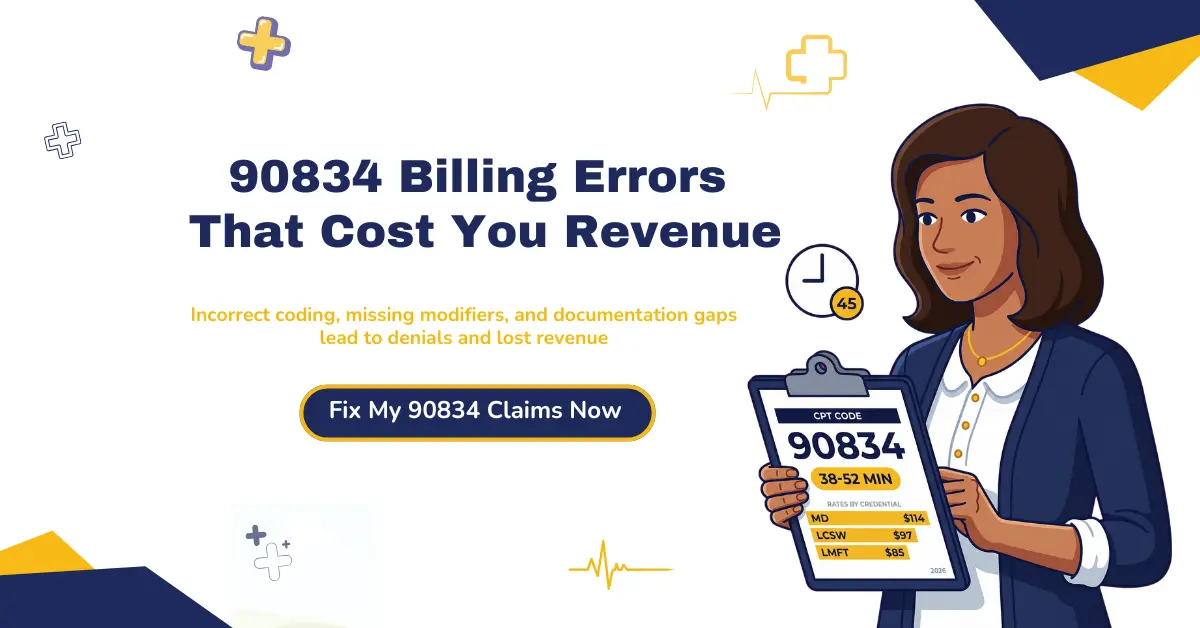
CPT Code: 90834
Description: Psychotherapy, 45 minutes with patient
Time Range: 38 to 52 minutes face-to-face
Setting: Outpatient (office, clinic, or telehealth)
Telehealth Modifier: 95 (synchronous audio-video)
2026 Medicare Rate (Non-Facility): ~$113.90 (national average)
Credential-Based Rate Range: MD/PhD ~$113 to $134 | LCSW/LPC ~$95 to $115 | LMFT/LMHC (Medicare) ~$85 (75% of psychologist rate)
Eligible Providers: MD/DO, PhD/PsyD, LCSW, LPC, LMFT, LMHC, PMHNP
Billable Units: 1 per day (standard; exceptions in PHP/IOP)
Prior Authorization: Not required by Medicare; varies by commercial payer (see payer matrix below)
Add-On Code for E/M: +90836 (not standalone 90834 with E/M on same day)
CPT code 90834 is the standard billing code for individual psychotherapy sessions lasting 38 to 52 minutes. It’s commonly called the 45-minute therapy session and is the most frequently billed procedure code in outpatient behavioral health.
Billing 90834 accurately is only half the equation. What most billing guides skip is that reimbursement for this code varies based on your credential type, your payer mix, your practice model, and your state. An LCSW billing 90834 in Texas receives a fundamentally different payment than a psychologist billing the same code in New York.
This guide covers the official 90834 CPT code description, the 38 to 52 minute time range, 2026 credential-specific reimbursement rates, payer adjudication rules, prior authorization thresholds, state Medicaid rate comparisons, practice-model billing considerations, the 90834 vs 90832 distinction most guides ignore, and documentation requirements mapped to audit triggers.
At ClaimMax RCM, behavioral health billing is our core specialization. This guide is built from real-world claim outcomes across thousands of therapy practices.
What Is CPT Code 90834?
Official AMA Code Descriptor
The American Medical Association CPT code set defines 90834 as:
“Psychotherapy, 45 minutes with patient and/or family member.”
The Centers for Medicare and Medicaid Services defines services under 90834 as insight oriented, behavior modifying, supportive, and/or interactive psychotherapy.
CPT codes are maintained by the AMA and serve as the HIPAA-mandated billing language across all payers. Code 90834 falls within the psychotherapy code family (90832 to 90838) and is a standalone psychotherapy code, meaning you report it without an evaluation and management service.
Here’s the key timeline shift. Since January 1, 2021, psychotherapy codes 90832, 90834, and 90837 are defined entirely by face-to-face time, not session complexity. Code selection comes down to one thing: how many minutes the clinician spends in direct therapeutic contact with the patient.
What 90834 Means for Your Practice
For most outpatient therapy practices, 90834 is the primary revenue-generating code. It represents roughly 60% to 75% of all psychotherapy claims submitted nationally. Understanding how this single code gets adjudicated, reimbursed, and audited across your specific payer mix and credential types is the highest-leverage billing optimization most practices can make.
The code covers one-on-one therapy sessions using any evidence-based approach: cognitive behavioral therapy, dialectical behavior therapy, EMDR, psychodynamic therapy, interpersonal therapy, or solution-focused interventions.
What it doesn’t cover: psychiatric diagnostic evaluations (90791/90792), group therapy (90853), family therapy (90846/90847), or crisis psychotherapy (90839/90840). Different codes exist for each of those services, and mixing them up creates denials.
90834 CPT Code Time Range: The 38 to 52 Minute Rule
Time Thresholds Across Psychotherapy Codes
Three CPT codes cover individual psychotherapy. The only difference between them is session duration.
| CPT Code | Session Label | Exact Time Range |
| 90832 | 30 minutes | 16 to 37 minutes |
| 90834 | 45 minutes | 38 to 52 minutes |
| 90837 | 60 minutes | 53+ minutes |
Sessions shorter than 16 minutes shouldn’t be reported under any psychotherapy code.
What Counts as Face-to-Face Time
Only time spent on direct therapeutic interaction counts toward the 38 to 52 minute 90834 time range. The following don’t count: scheduling appointments, collecting copays, writing progress notes after the session, reviewing intake paperwork, or any administrative task.
Per CMS guidelines, psychotherapy times are strictly for face-to-face services with the patient. Time spent on care coordination, treatment planning, or documentation outside the session isn’t billable under cpt code 90834.
The 37/38 Boundary: Why One Minute Changes Your Code
A session lasting 37 minutes must be billed as 90832. A session lasting 38 minutes qualifies for 90834. That one-minute difference changes your reimbursement from approximately $78 (the 90832 Medicare rate) to approximately $113.90 (the 90834 Medicare rate), a $35.90 per-session revenue difference.
Here’s where this gets real. For practices running 45-minute appointment slots, the 37/38 boundary matters when sessions end early. If a patient arrives late and effective therapy time is only 35 minutes, the correct code is 90832, not 90834. Documenting the actual face-to-face time honestly is both a compliance requirement and your best audit protection.
This boundary is the most common source of unintentional upcoding in therapy practices that schedule standard 45-minute slots but don’t track actual session duration. Your EHR should capture real start and stop times, not just the scheduled appointment window.
When to Use CPT Code 90834
Appropriate Use Criteria
Use cpt 90834 when you’re providing individual psychotherapy for 38 to 52 minutes in an outpatient setting. The session’s primary focus should be treating a diagnosed mental health condition using evidence-based therapeutic interventions. That’s the core rule, but here’s the full checklist:
- Session lasts 38 to 52 minutes of face-to-face therapeutic time
- Session is one-on-one (individual therapy)
- Primary purpose is treating a mental health, behavioral, or emotional condition
- Clinician uses evidence-based methods (CBT, DBT, IPT, psychodynamic, EMDR, or supportive psychotherapy)
- Session takes place in an outpatient setting: office, clinic, or telehealth
- No separate E/M service performed by the same clinician on the same date
If the clinician does perform an E/M service on the same day, don’t use standalone 90834. Bill the E/M code plus add-on +90836 instead. That’s the correct pairing, and getting it wrong triggers an automatic NCCI bundling edit denial.
When NOT to Use 90834
This is the CPT code for 45-minute psychotherapy, but it doesn’t cover every therapy scenario. Here’s what falls outside 90834:
- Sessions under 38 minutes (bill 90832)
- Sessions of 53 minutes or longer (bill 90837)
- Family therapy without the patient present (bill 90846) or with the patient present (bill 90847)
- Group psychotherapy (bill 90853)
- Psychiatric diagnostic evaluations (bill 90791 or 90792)
- Crisis psychotherapy (bill 90839/90840)
A few less obvious exclusions catch practices off guard:
- Teaching daily living skills, recreational therapy, or psychoeducation-only sessions
- Case management or care coordination without direct therapy
- Sessions conducted via asynchronous messaging, text, or email
- E/M provided by the same clinician on the same day (use E/M + add-on +90836)
Couples therapy is a common gray area. When both partners are present for the full session, most payers expect 90847, not 90834. Some payers will accept the 90834 CPT code if one partner is the identified patient and the session focuses on that individual’s treatment goals. Verify with each payer before billing. Getting this wrong creates a pattern of denials that’s hard to unwind.
Who Can Bill CPT Code 90834? Credential Types and Reimbursement Impact
Eligible Provider Types
CPT code 90834 can be billed by any licensed mental health professional authorized to provide and bill for individual psychotherapy:
- Psychiatrists (MD/DO)
- Psychologists (PhD/PsyD)
- Licensed Clinical Social Workers (LCSWs)
- Licensed Professional Counselors (LPCs)
- Licensed Marriage and Family Therapists (LMFTs)
- Licensed Mental Health Counselors (LMHCs)
- Psychiatric Mental Health Nurse Practitioners (PMHNPs)
- Physician Assistants (PAs) with appropriate supervision per state law
Scope of practice and billing eligibility vary by state. Always verify state-specific licensure requirements and payer credentialing status before submitting claims. A provider who’s licensed to practice therapy isn’t automatically credentialed to bill for it.
Credential-Based Reimbursement Table
Here’s what most billing guides don’t show you: your credential type directly determines your 90834 reimbursement. Two clinicians can provide the exact same 45-minute CBT session, and one gets paid $28 more simply because of the letters after their name.
| Provider Credential | Medicare Rate (2026 Non-Facility, National Avg.) | Typical Commercial Rate Range | Notes |
| Psychiatrist (MD/DO) | ~$113.90 (100% of PFS rate) | $130 to $175 | Highest rate tier; can also bill E/M + 90836 |
| Psychologist (PhD/PsyD) | ~$113.90 (100% of PFS rate) | $120 to $165 | Same Medicare rate as MD; some commercial payers pay slightly less |
| LCSW | ~$96.82 (85% of PFS rate) | $95 to $140 | Most common therapy provider; 85% rate in most states |
| LPC | ~$96.82 (85% of PFS rate) | $90 to $135 | Medicare enrollment varies by state; verify PECOS status |
| LMFT | ~$85.43 (75% of psychologist rate) | $85 to $130 | Medicare eligible since January 1, 2024; 75% rate per Consolidated Appropriations Act |
| LMHC | ~$85.43 (75% of psychologist rate) | $85 to $130 | Medicare eligible since January 1, 2024; 75% rate per Consolidated Appropriations Act |
| PMHNP | ~$96.82 (85% of PFS rate) | $100 to $150 | Can bill independently or incident-to; rate depends on billing arrangement |
The gap between the highest tier (MD at ~$113.90) and the lowest tier (LMFT/LMHC at ~$85.43) is $28.47 per session under Medicare. For a full-time therapist seeing 25 patients per week, that credential gap adds up to roughly $37,000 in annual revenue difference. You need to know where your providers fall in this structure to project revenue accurately.
LMFT and LMHC Medicare Eligibility (2024 to 2026 Update)
Starting January 1, 2024, LMFTs and LMHCs can independently enroll in and bill Medicare for psychotherapy services, including the 90834 CPT code. The Consolidated Appropriations Act, 2023 authorized this change after years of advocacy.
Here’s what you need to know about enrollment:
- LMFTs and LMHCs are reimbursed at 75% of the psychologist rate under Medicare, approximately $85.43 per 90834 session in 2026
- Enrollment requires the CMS-855I application or PECOS online enrollment
- Credentialing typically takes 60 to 120 days
- Providers must meet state licensure requirements and Medicare conditions of participation
If you have LMFTs or LMHCs on staff who aren’t enrolled yet, every Medicare patient they see is revenue you can’t collect. The enrollment process isn’t fast, so start it now if you haven’t already.
Supervised and Incident-To Billing
This is one of the most common questions we hear from group practices: can our pre-licensed therapists generate revenue?
The short answer is: it depends. Pre-licensed clinicians, including provisionally licensed therapists, interns, residents, and associates under supervision, can’t independently bill Medicare for cpt code 90834. But under certain conditions, their services can be billed under the supervising provider’s NPI using incident-to billing rules.
Incident-to billing requirements for 90834:
- The supervising provider has an established plan of care for the patient
- The supervising provider gives direct supervision (physically present in the office suite)
- The service is an integral part of the treatment plan the supervising provider initiated
- The claim goes out under the supervising provider’s NPI and credential level, receiving that provider’s rate
Not all payers accept incident-to billing for psychotherapy. Medicare has specific rules. Commercial payers vary widely. Check with each payer before you schedule Medicare patients with supervised clinicians and assume you’ll get paid.
Credential-based billing, Medicare enrollment timelines, and incident-to supervision rules add layers of complexity that most therapy practices aren’t staffed to manage internally. ClaimMax RCM’s behavioral health billing services and payer credentialing teams specialize in getting every eligible provider enrolled and billing at the correct rate for their credential level. If you’re not sure whether your roster is fully optimized, we can help you find out.
Documentation Requirements for CPT Code 90834
Required Documentation Elements
Every claim billed under CPT code 90834 needs clinical documentation that proves four things: session duration, therapeutic interventions, medical necessity, and patient progress. Miss any one of these, and you’re exposed in an audit.
Here are the seven elements every 90834 note must include:
- Session start and stop times. Exact times, not approximations. Write “Session began 2:05 PM, ended 2:50 PM,” not “45-minute session.” CMS requires documented start and stop times for all time-based psychotherapy codes. This is the single most cited audit deficiency in behavioral health.
- Patient diagnosis. Current, specific ICD-10-CM code supporting medical necessity, coded to the highest level of specificity. Using F32.9 when you have enough clinical information for F32.1 invites scrutiny.
- Clinical interventions used. Name the specific therapeutic modalities and techniques. Write “Applied cognitive restructuring to address catastrophic thinking patterns related to generalized anxiety,” not just “provided therapy.”
- Patient response. Document observable engagement, emotional responses, behavioral changes, or verbalized insights during the session.
- Risk assessment. Suicidal ideation, homicidal ideation, self-harm risk, or safety concerns. Document this even when negative. A note that says “No SI/HI reported, no safety concerns identified” takes five seconds and protects you in a chart review.
- Progress toward treatment goals. Show how this specific session advanced the objectives in the treatment plan. Vague statements like “patient is progressing” don’t count.
- Clinical plan forward. Next steps, homework assignments, changes to the therapeutic approach, and the plan for the next session.
Documentation by Practice Model
Generic documentation advice only goes so far. What actually works depends on how your practice operates.
Solo Private Practice
Solo practitioners carry 100% of the documentation burden. Build a consistent note template that auto-populates start and stop times from your scheduling system. Use a structured framework like SOAP or DAP that prompts each of the seven required elements. Complete notes within 24 hours. If you’re using an EHR, check that your template actually captures all seven elements listed above. Many default therapy templates omit risk assessment and treatment plan progress.
Group Practice
Group practices deal with documentation variability across multiple clinicians. Establish one standardized template that every provider uses, regardless of credential level. Run monthly random chart audits, pulling five to 10 notes per clinician to verify compliance. Pay close attention to supervised and pre-licensed clinicians; their notes need to reflect the supervising provider’s involvement when billing incident-to.
Telehealth-Only Practice
Telehealth notes require everything above, plus four additional elements: patient consent for telehealth (documented annually or per session depending on the payer), communication technology used (name the audio-video platform), patient location (state and setting, such as home or office), and provider location. Missing telehealth-specific documentation is the fastest-growing denial driver in behavioral health right now.
Community Mental Health Center (CMHC)
CMHCs billing 90834 under their facility NPI must ensure documentation identifies the specific rendering provider, their credential, the supervision arrangement if applicable, and facility-level compliance with state licensing requirements. CMHCs are subject to CMS Conditions of Participation that impose documentation standards beyond what private practices face.
90834 CPT Code Reimbursement Rates: Credential, Payer, and State Breakdown [2026]
What you actually collect for a 90834 session depends on three things: your credential, your payer, and your state. Let’s break down each one.
2026 Medicare Rates by Credential Type
The CMS Physician Fee Schedule sets the baseline. But not every provider gets the same baseline. Here’s the 2026 90834 CPT code reimbursement breakdown by credential, including facility versus non-facility rates:
| Credential | Non-Facility Rate | Facility Rate | Medicare Rate Basis |
| MD/DO, PhD/PsyD | ~$113.90 | ~$82 | 100% of PFS rate |
| LCSW, LPC, PMHNP, PA | ~$96.82 | ~$70 | 85% of PFS rate |
| LMFT, LMHC | ~$85.43 | ~$62 | 75% of psychologist rate |
Non-facility rates apply to office-based sessions and home-based telehealth billed with POS 10. Facility rates apply to hospital-based outpatient settings. Since January 1, 2024, CMS pays telehealth sessions using POS 10 at the non-facility rate, which is a meaningful distinction if your providers work across settings.
Commercial Insurance Rate Ranges
Commercial rates for cpt code 90834 are negotiable, and they vary by credential tier. Most practices don’t realize that commercial payers also pay differently based on provider type:
| Payer Category | Estimated 2026 Rate for 90834 |
| Commercial (average, all credentials) | $100 to $175 |
| Commercial (MD/PhD tier) | $130 to $175 |
| Commercial (LCSW/LPC tier) | $95 to $140 |
| Commercial (LMFT/LMHC tier) | $85 to $130 |
| EAP (Employee Assistance Programs) | $55 to $80 (typically lower, session-lim |
Here’s a quick benchmark: if your commercial 90834 reimbursement falls below 110% of the Medicare rate for your credential level, your payer contracts likely need renegotiation. You’re leaving money on the table that a contract review could recover.
EAP rates deserve special attention. At $55 to $80 per session, they’re often 40% to 50% below standard commercial rates. If EAP makes up a large portion of your payer mix, that’s dragging down your per-session average significantly.
Medicaid Rates by State
Medicaid reimbursement for cpt code 90834 medicare and commercial claims differ dramatically, but the biggest surprise for most practices is how much Medicaid rates vary from state to state:
| State | 90834 Medicaid Rate (Approx.) | % of Medicare | Notes |
| California | ~$80 | ~70% | Medi-Cal rates vary by managed care plan |
| Texas | ~$68 | ~60% | HHSC-administered; rates vary by MCO |
| Florida | ~$65 | ~57% | Medicaid managed care; verify with plan |
| New York | ~$88 | ~77% | OMH-licensed programs may receive higher rates |
| Pennsylvania | ~$72 | ~63% | Varies by HealthChoices MCO |
| Illinois | ~$66 | ~58% | Rates differ between Cook County and rest of state |
| Ohio | ~$64 | ~56% | Managed care plan-dependent |
| Georgia | ~$62 | ~54% | CMO-dependent |
| North Carolina | ~$70 | ~61% | Tailored Plan rates for BH may differ |
| Massachusetts | ~$82 | ~72% | MassHealth rates among the highest nationally |
The range here is striking. A therapist billing 90834 in Georgia collects roughly $62 from Medicaid, while the same session in New York pays ~$88. That’s a $26 per-session gap for the exact same service.
Practices with a high Medicaid payer mix need to watch these numbers carefully. Supplementing with commercial contracts isn’t optional; it’s what keeps the doors open.
Factors Affecting Your 90834 Payment
Beyond credential and payer type, several other factors shift what actually hits your bank account:
- GPCI (Geographic Practice Cost Index): CMS adjusts Medicare rates by locality, so a provider in Manhattan gets a different rate than one in rural Kansas
- Facility vs non-facility setting: non-facility pays higher in almost every scenario
- Provider credential level: covered in detail above
- Payer contract terms: commercial rates are negotiable; most practices never renegotiate
- Sequestration: Medicare payments are still subject to a 2% reduction
- 2026 conversion factor: approximately $33.40 to $33.57, up from $32.35 in 2025
If your 90834 reimbursement consistently falls below the benchmarks in these tables, the problem might be payer contract terms, incorrect credentialing, or claim submission errors. All of those are fixable. ClaimMax RCM’s behavioral health billing services team audits payer contracts, identifies underpayment patterns, and builds corrective billing protocols to close the gap. If the numbers don’t look right, let’s figure out why.
2026 CMS Updates That Affect 90834 Billing and Reimbursement
Four CMS policy changes in 2026 directly affect what you collect on cpt 90834 claims. Here’s what each one means in real dollars.
Conversion Factor Increase
The CY 2026 conversion factor increased to approximately $33.40 to $33.57, up from $32.35 in 2025. That’s a 3.26% to 3.77% bump. For a full-time therapist billing 90834 twenty-five times per week, this translates to roughly $1,500 to $2,000 in additional annual Medicare revenue per clinician. Not a windfall, but it adds up across a group practice with multiple providers.
Efficiency Adjustment Exemption
CMS finalized a 2.5% efficiency adjustment that reduces work RVUs for many procedure codes. Here’s the good news: time-based behavioral health services, including 90834, are explicitly exempt from this reduction. Surgical and procedural specialties absorb cuts. Psychotherapy billing is protected.
Facility vs Non-Facility Practice Expense Shift
CMS reduced indirect practice expense RVUs for facility-based services by 50%. If your providers bill 90834 from an office or via telehealth at non-facility rates, this policy works in your favor. Practices billing from hospital outpatient departments will see reduced reimbursement. It’s one more reason to pay attention to your place-of-service coding.
Psychotherapy Code Valuation Transition
CMS finalized increased valuation for timed behavioral health services over a four-year transition period running from CY 2024 through CY 2027. That means 90834 RVUs are being adjusted upward incrementally through 2027. A multi-year payment increase in Medicare is rare, and behavioral health is one of the few specialties benefiting from it.
Billing 90834 by Practice Model: Solo, Group, Telehealth-Only, and CMHC
How you bill the 90834 CPT code depends on how your practice is structured. The rules don’t change, but the risks and operational challenges look very different depending on your model.
Solo Private Practice
Solo practitioners face a streamlined but high-risk billing profile. You’re the clinician, the biller, and the compliance officer all at once.
Your credential level is your only rate tier. Make sure every payer contract reflects your highest eligible rate, because there’s no one else on the roster to offset a low-paying contract. No incident-to billing option exists in solo practice since there’s no supervising relationship.
Time documentation accuracy falls entirely on you. Set up auto-capture of session start and stop times in your EHR. A single denied billing code 90834 claim at the Medicare rate ($113.90) costs you the revenue plus the time to investigate, correct, and resubmit. When you’re also the one seeing patients, that follow-up time is hard to find.
Group Practice
Group practices with multiple credential levels create a tiered revenue structure for 90834. Managing that structure well is the difference between a profitable practice and one that’s leaving money scattered across its provider roster.
MD/PhD clinicians generate the highest per-session revenue. Schedule complex patients who require or benefit from the highest-credential provider. LCSW and LPC clinicians represent your largest provider pool; make sure every one of them is individually credentialed with all payers in your mix.
LMFTs and LMHCs who are newly Medicare-eligible should be enrolled now. Each un-enrolled LMFT or LMHC represents $85.43 per Medicare session left uncollected. Pre-licensed clinicians can only generate revenue through incident-to billing where the payer permits it. Verify those rules before scheduling Medicare patients with supervised providers.
One standardized documentation template across all credential levels reduces audit risk from note variability. Don’t let each clinician build their own format.
Telehealth-Only Practice
Practices operating exclusively via telehealth need to get three billing elements right every time:
- Modifier selection: Modifier 95 for audio-video sessions. Modifier 93 (or FQ for Medicare) for audio-only where permitted.
- Place of service: POS 10 when the patient is at home. POS 02 when the patient is at another location. Using POS 11 (office) for a telehealth session results in incorrect reimbursement calculation.
- Multi-state licensure: Telehealth practices serving patients across state lines must verify that the rendering provider is licensed in the patient’s state and credentialed with the patient’s payer in that state. Billing cpt code 90834 for a patient in a state where the provider isn’t licensed creates a compliance violation, not just a denial.
Community Mental Health Centers (CMHCs) and PHP/IOP
CMHCs operate under different billing rules than private practices. They bill under their facility NPI but must identify the rendering provider on every claim. CMS Conditions of Participation affect staffing ratios, supervision requirements, and documentation standards beyond what private practices face.
Partial Hospitalization Programs (PHP) and Intensive Outpatient Programs (IOP) may bill 90834 more than once per day per the 2026 NCCI Policy Manual. That reflects the structured treatment environment these programs operate in.
But there’s a catch. Each PHP/IOP 90834 claim needs documentation showing that the session addressed distinct therapeutic content. Two sessions on the same day covering the same treatment goals won’t survive a review.
Telehealth Billing for 90834: Modifiers, POS Codes, and Payer Rules
Telehealth billing for cpt code 90834 telehealth sessions looks straightforward until you realize every payer handles it differently. Here’s what you need to know, payer by payer.
Permanent Medicare Telehealth Flexibilities
Per the CMS Telehealth FAQ updated February 2026, behavioral health telehealth provisions for Medicare are permanent:
- Patients can receive behavioral health telehealth at home without geographic restrictions
- Audio-only behavioral health telehealth is permitted through December 31, 2027
- All additional Medicare telehealth flexibilities are extended through December 31, 2027
The home-based access piece is permanent and won’t expire. Audio-only has an end date, so keep that on your radar.
Place of Service Codes and Payment Impact
POS code selection directly affects your reimbursement. Getting this wrong is the most expensive single-field error in behavioral health billing.
| POS Code | Description | When to Use | Payment Impact |
| POS 02 | Telehealth, Other Than Home | Patient at clinic, community center, other non-home location | Facility rate (~$82 for 90834) |
| POS 10 | Telehealth, Patient Home | Patient receiving telehealth from home | Non-facility rate (~$113.90 for 90834) |
| POS 11 | Office | In-person sessions in provider office | Non-facility rate (~$113.90 for 90834) |
Using POS 02 instead of POS 10 for a home-based telehealth session costs you approximately $31.90 per claim ($113.90 minus $82). Across a therapist seeing 20 telehealth patients a week, that POS error adds up to over $33,000 in annual underpayment. One wrong digit in one field.
Payer-Specific Telehealth Rules for 90834
Here’s where it gets complicated. Each major payer handles 90834-95 telehealth claims differently:
| Payer | Audio-Video Accepted? | Audio-Only Accepted? | Modifier Required | Payment Parity? |
| Medicare | Yes (permanent for BH) | Yes (through 2027) | 95 (audio-video) or 93/FQ (audio-only) | Yes (POS 10 = non-facility) |
| UHC | Yes | BH only in most plans | 95 | Generally yes; verify plan |
| Aetna | Yes | Varies by state | 95 | Most plans: yes |
| Cigna | Yes | Limited acceptance | 95 | Varies; some pay reduced rate |
| BCBS | Yes (most states) | Varies by state plan | 95 (verify GT for legacy plans) | Varies; some have telehealth fee schedules |
| Medicaid | Varies by state | Varies by state | Varies (95, GT, or state-specific) | Rarely full parity; verify state policy |
Telehealth payment parity isn’t universal for 90834. Some commercial payers reimburse telehealth sessions at 80% to 90% of the in-person rate. Some Medicaid programs have separate telehealth fee schedules that pay even less than standard Medicaid office rates. Don’t assume in-person rates apply until you’ve verified with each payer.
In-Person Visit Requirements Starting 2028
CMS is adding an in-person requirement for home-based behavioral health telehealth starting January 1, 2028:
- An in-person visit within six months before the initial home-based telehealth session
- At least one in-person visit every 12 months after that
- Patients established before January 30, 2026 are only subject to the annual in-person requirement
- CMS allows limited exceptions for access barriers
Start planning for this now if your practice is telehealth-heavy. The 2028 deadline will arrive faster than you think, and building in-person capacity takes time.
Telehealth billing errors on 90834 claims, from wrong POS codes to missing modifiers to payer-specific rule violations, are the fastest-growing denial category in behavioral health. ClaimMax RCM’s dedicated therapy billing team builds payer-specific telehealth protocols into every claim your practice submits, catching errors before they reach the payer. If telehealth denials are piling up, we can help sort it out.
CPT Code 90834 vs 90837: Key Differences for Billing and Revenue
The primary difference between cpt code 90834 vs 90837 is session duration. 90834 covers psychotherapy sessions lasting 38 to 52 minutes, while 90837 covers sessions of 53 minutes or longer. But the differences that matter most to your practice go well beyond time.
Side-by-Side Comparison Table
| Feature | CPT 90834 | CPT 90837 |
| Session Duration | 38 to 52 minutes | 53+ minutes |
| Typical Session Label | 45-minute session | 60-minute session |
| 2026 Medicare Rate (National Avg., Non-Facility) | ~$113.90 | ~$154 to $160 |
| Revenue Difference per Session | Baseline | ~$40 to $46 more per session |
| Audit Risk | Standard | Higher; frequently scrutinized by payers |
| Prior Authorization | Rarely required | Often required by commercial payers after frequency threshold |
| Documentation Burden | Standard time documentation | Must justify clinical necessity for extended duration |
| Payer Acceptance | Broadly accepted | Some payers send warning letters to high-frequency 90837 billers |
| 90837-to-90834 Ratio Scrutiny | N/A | Payers flag providers whose 90837 volume exceeds 30% to 40% of total psychotherapy claims |
Revenue and Audit Risk Comparison
The 90837 premium over the 90834 CPT code is approximately $40 to $46 per session under Medicare. For a therapist scheduling eight 60-minute sessions per week, that adds up to roughly $16,640 to $19,136 in additional annual Medicare revenue compared to billing everything as 90834.
That revenue comes with strings attached. Payers including Highmark BCBS and Anthem have sent advisory letters to providers flagged as high-volume 90837 submitters, warning that claims may face additional review. The American Psychological Association Practice Organization has pushed back on behalf of providers, clarifying that legitimate 90837 billing shouldn’t be penalized.
Here’s the thing: the revenue-maximizing strategy isn’t upcoding 90834 sessions to 90837. It’s accurately documenting session time and billing the correct code every time. Practices that intermix cpt codes 90834 and 90837 based on actual session length show the kind of case-mix variation that protects against audit findings.
Payer Scrutiny Patterns for 90837
Select the code based on actual face-to-face psychotherapy time, not the scheduled appointment length. A traditional 50-minute therapy hour is cpt code 90834, not 90837. A 55-minute session is 90837.
If your session genuinely meets the 53-minute threshold and your documentation supports it, bill 90837. Don’t downcode to 90834 out of fear. Accurate coding is always the right approach, in both directions.
CPT Code 90834 vs 90832: When to Bill Each Code
Most billing guides compare 90834 with 90837. Almost none cover the 90832 vs 90834 distinction, even though it creates just as many billing problems in daily practice.
Side-by-Side Comparison
| Feature | CPT 90832 | CPT 90834 |
| Session Duration | 16 to 37 minutes | 38 to 52 minutes |
| Typical Session Label | 30-minute session | 45-minute session |
| 2026 Medicare Rate (Non-Facility) | ~$78 | ~$113.90 |
| Revenue Difference | Baseline | ~$35.90 more per session |
| Common Clinical Use | Brief therapy, medication follow-ups with psychotherapy, symptom monitoring | Standard ongoing psychotherapy, CBT/DBT/trauma processing |
| Prior Auth Risk | Low | Low |
| Documentation Threshold | Same 7 elements, lower time threshold | Standard |
The Revenue Cost of Misbilling at the 37/38 Boundary
Billing 90832 when a session genuinely lasted 38 or more minutes costs $35.90 per session under Medicare. A therapist who underbills five sessions per week at the 90832 rate, when actual time qualifies for the 90834 CPT code, loses approximately $9,334 per year.
This underbilling pattern is more common than upcoding. Practices that schedule 30-minute follow-up slots but routinely extend sessions to 38 or 42 minutes without updating the billing code 90834 are systematically leaving revenue on the table.
The fix is straightforward: document actual face-to-face time for every session. If a scheduled 30-minute appointment consistently runs 38 to 42 minutes, the correct code is cpt code 90834. Adjust your scheduling template or your clinical workflow, but always bill the code that matches documented time.
When 90832 Is Clinically Appropriate
90832 is the right code when the session genuinely runs 16 to 37 minutes. That includes:
- Brief supportive therapy for stable patients in a maintenance phase
- Follow-up sessions focused on symptom monitoring and medication adherence (when no E/M is performed)
- Sessions shortened by patient late arrival, early departure, or clinical judgment that the work is done before minute 38
- Crisis de-escalation follow-ups where extended therapy isn’t clinically indicated
- Sessions in integrated care or primary care behavioral health settings with shorter appointment windows
Don’t bill 90832 for a session that lasted 38 or more minutes just because the appointment was originally scheduled for 30. Code selection is based on actual time, not scheduled time. That distinction trips up more practices than you’d expect.
Same-Day Billing Rules for CPT Code 90834
90834 with E/M Codes on the Same Day
Per the 2026 NCCI Policy Manual, standalone psychotherapy code 90834 can’t be billed alongside evaluation and management codes (99201 to 99215) by the same provider on the same date of service. Here’s the correct approach:
| Scenario | Correct Coding |
| E/M + 45-minute psychotherapy (same clinician, same day) | E/M code (e.g., 99214) + add-on code +90836 |
| Psychotherapy only, no E/M (same day) | Standalone code 90834 |
Both services must be significant and separately identifiable. Time spent on the E/M component is excluded from the psychotherapy time calculation. Getting this wrong triggers an NCCI bundling edit that automatically denies the psychotherapy code.
90834 with Diagnostic Evaluation (90791/90792) on the Same Day
CPT codes 90791 and 90792 aren’t separately reportable with psychotherapy codes 90832 through 90838 on the same date by the same provider. Per the NCCI, psychotherapy inherently includes ongoing psychiatric evaluation. Billing both on the same day duplicates the evaluation component.
If it’s genuinely an intake day, bill the diagnostic evaluation code (90791 or 90792). Therapeutic work done during intake doesn’t support a separate billing code 90834 charge on the same date.
Billing Frequency Limits by Payer
Here’s the part most practices miss entirely. Beyond same-day rules, payers also impose weekly and annual frequency limits on the 90834 CPT code that vary dramatically:
| Payer | 90834 per Day | Weekly Limit | Annual Session Cap | Prior Auth Threshold |
| Medicare | 1 (exceptions in PHP/IOP) | None stated | None stated | Not required |
| UHC | 1 | 2 per week (standard plans) | Varies by plan (often 30 to 60 sessions) | After 20 to 30 sessions in most plans |
| Aetna | 1 | Not typically limited | Varies (some plans cap at 52/year) | After 20 to 26 sessions in many plans |
| Cigna | 1 | Not typically limited | Varies by plan | Review triggered at high frequency |
| BCBS | 1 | Varies by state plan | Varies by state plan | Varies (some state plans: after 12 to 20 sessions) |
| Medicaid | 1 (PHP/IOP exception) | Varies by state | Varies by state (some cap at 26 to 52/year) | Required in some states after initial sessions |
Exceeding payer frequency limits without prior authorization is one of the most common sources of retroactive claim denial in behavioral health. Here’s what makes it dangerous: the denials don’t surface at submission. They show up months later during post-payment audit, when the payer recoups payments for every session that exceeded the cap.
By the time you see the recoupment notice, you could be looking at thousands in clawbacks across multiple patients.
ICD-10 Diagnosis Codes Commonly Paired with CPT Code 90834
Every claim billed under cpt code 90834 must include a valid ICD-10-CM diagnosis code that establishes medical necessity for the psychotherapy session. The diagnosis code 90834 claims carry needs to be coded to the highest level of specificity your clinical documentation supports.
Here are the 90834 diagnosis code pairings we see most frequently:
| ICD-10 Code | Description | Common Context |
| F32.0 to F32.9 | Major Depressive Disorder, Single Episode | Mild to severe, with or without psychotic features |
| F33.0 to F33.9 | Major Depressive Disorder, Recurrent | Ongoing depressive episodes |
| F34.1 | Dysthymic Disorder (Persistent Depressive Disorder) | Chronic low-grade depression |
| F41.0 | Panic Disorder | Recurrent panic attacks |
| F41.1 | Generalized Anxiety Disorder | Excessive, persistent worry |
| F41.9 | Anxiety Disorder, Unspecified | When specific anxiety type isn’t yet determined |
| F43.10 | Post-Traumatic Stress Disorder (PTSD) | Trauma-related symptoms |
| F43.21 to F43.25 | Adjustment Disorders | With depressed mood, anxiety, mixed, etc. |
| F60.3 | Borderline Personality Disorder | Emotional instability, self-harm risk |
| F90.0 to F90.9 | ADHD | Attention-deficit presentations |
| F50.00 to F50.9 | Eating Disorders | Anorexia, bulimia, binge eating |
A few ICD-10 rules that trip practices up:
- Code to highest specificity. Using F32.9 (unspecified) when your clinical notes clearly document moderate severity (F32.1) can trigger a review or outright denial. Some payers auto-deny claims with unspecified behavioral health codes.
- Match the diagnosis to the service. The ICD-10 code must support medical necessity for psychotherapy at the frequency and duration you’re billing. A diagnosis of “tobacco use disorder” won’t justify weekly 90834 sessions without additional clinical rationale.
- Update as the clinical picture changes. If a patient initially presents with adjustment disorder (F43.21) but your assessment evolves to major depressive disorder (F32.1), update the diagnosis code. Carrying a stale diagnosis creates audit exposure.
- Verify payer-specific covered diagnosis lists. Some payers maintain lists of ICD-10 codes they’ll accept for 90834. A diagnosis that’s covered by Aetna might not be covered by a specific Medicaid MCO.
DSM-5 criteria should map precisely to the corresponding ICD-10-CM code. When there’s a mismatch between your clinical assessment and the billed diagnosis, that’s a red flag for any reviewer.
Common Billing Errors and Denial Reasons for CPT Code 90834
The most common reasons for 90834 CPT code claim denials come down to documentation gaps, coding mismatches, and payer-specific rule violations. Here are the 10 errors we see most often, ranked by how frequently they cause problems:
1. Incorrect Session Duration
Billing 90834 for sessions outside the 38 to 52 minute window. A 37-minute session requires 90832. A 53-minute session requires 90837. Sounds obvious, but when clinicians estimate time instead of documenting it, the wrong code goes out.
2. Missing Start and Stop Times
CMS requires documented start and stop times, not just a note that says “45-minute session.” When your EHR scheduling timestamps conflict with the times in your progress note, that’s an audit flag. Make sure both match.
3. Billing 90834 with E/M by the Same Provider
Using standalone cpt code 90834 instead of add-on +90836 when E/M is also provided. The NCCI bundling edit catches this and auto-denies the psychotherapy code.
4. Credential-Level Billing Errors
Billing under the wrong provider NPI, submitting claims for a pre-licensed therapist without proper incident-to setup, or billing at a credential level the provider isn’t enrolled for with the payer. LMFT and LMHC claims submitted to Medicare before the provider completes CMS-855I enrollment get denied without exception. No retroactive fix exists.
5. Payer Frequency Limit Violations
Exceeding session caps without prior authorization. These denials don’t show up at submission. They surface months later as retroactive recoupments. If your payer limits 90834 to 30 sessions per year and you billed session 31 without authorization, sessions 31 through 52 may all be recouped. That’s not one denial; it’s a cascade.
6. Telehealth Modifier and POS Errors
Failing to append Modifier 95 for telehealth, using POS 11 (office) instead of POS 10 (patient home) for home-based sessions, or submitting audio-only claims to payers that don’t accept Modifier 93 for 90834.
7. Insufficient Clinical Documentation
Notes lacking specific therapeutic interventions, patient response, risk assessment, or treatment plan progress. Generic notes or copy-forwarded notes from previous sessions are fraud indicators, not just documentation gaps.
8. Upcoding 90834 to 90837
Billing a 50 or 52 minute session as 90837. Payers monitor providers with high 90837-to-90834 ratios, and a pattern of consistently billing the higher code draws scrutiny.
9. Diagnosis Code Specificity Failures
Using unspecified ICD-10 codes (F32.9) when more specific codes are clinically documented (F32.1). Some payers auto-deny behavioral health claims with unspecified diagnoses.
10. Multi-State Telehealth Compliance Errors
Billing 90834 for a patient located in a state where the rendering provider isn’t licensed. This goes beyond a billing denial. It creates potential legal exposure for the practice and the individual clinician.
Most of these errors are preventable with the right billing infrastructure. ClaimMax RCM’s denial management team identifies error patterns across your claim data and implements corrective protocols before denials pile up. If you’re seeing the same denial reasons repeat, that’s a workflow problem we can fix.
How to Handle CPT Code 90834 Claim Denials
When a 90834 CPT code claim gets denied, the first step isn’t an appeal. It’s figuring out whether you need a corrected claim or a formal appeal. Those are two different processes, and using the wrong one wastes time.
Denial Reason Code Reference
Pull the CARC and RARC codes from your EOB or ERA. Here’s what the most common denial codes mean for cpt code 90834 claims and what to do about each one:
| Denial Category | Common CARC/RARC Codes | Action Required |
| Time documentation missing | CO-16, CO-4 | Add start/stop times, resubmit corrected claim |
| Authorization required or expired | CO-197, PI-15 | Obtain retroactive auth if available; appeal with clinical justification |
| Service not covered under plan | CO-96, CO-50 | Verify benefits, contact payer, or bill patient directly |
| Duplicate claim | CO-18 | Review claim history, verify date of service uniqueness |
| Incorrect modifier | CO-4, CO-252 | Correct modifier (add 95 for telehealth), resubmit |
| Provider not credentialed | CO-185 | Complete credentialing; resubmit after enrollment effective date |
| Bundling/NCCI edit | CO-97 | Review same-day billing; correct code combination |
| Frequency limit exceeded | CO-119, CO-197 | Submit appeal with clinical necessity documentation |
| Diagnosis doesn’t support service | CO-11 | Update ICD-10 to highest specificity; resubmit |
Step-by-Step Appeal Process
- Review the EOB/ERA. Identify the exact CARC and RARC codes. Don’t guess at the denial reason; the codes tell you exactly what the payer rejected and why.
- Determine if it’s correctable. Fixable errors like a wrong modifier or missing start/stop times need a corrected claim resubmission, not a formal appeal. Sending an appeal for a data entry error slows everything down.
- Gather supporting documentation. For medical necessity denials and frequency limit appeals, pull the treatment plan, relevant progress notes, and a written clinical rationale explaining why continued treatment at the billed frequency is warranted.
- Draft a written appeal. Include a cover letter citing the specific denial reason code, the corrective action taken or clinical justification provided, and all supporting documentation.
- Submit within the payer’s deadline. Medicare allows 120 days. Commercial payers typically allow 60 to 180 days, but it varies. Miss the deadline and you lose your appeal rights entirely.
- Track and escalate. Log every submission date. Follow up at 30 days for commercial payers, 60 days for Medicare. If the first-level appeal is denied, pursue a second-level appeal. Don’t let it sit.
Handling 90834 denials and appeals takes dedicated time and behavioral health payer expertise. ClaimMax RCM’s 90834 denial resolution specialists manage the entire process, from denial identification through resolution, including retroactive authorization requests and frequency limit appeals. As your mental health billing partner, we handle the appeals so your team can focus on patient care. If denials are stacking up, let’s talk.
Prior Authorization for 90834: Which Payers Require It and How to Manage It
Prior authorization for therapy is one of those billing tasks that doesn’t feel urgent until you’re staring at a retroactive recoupment notice. Medicare doesn’t require prior auth for cpt code 90834. But most commercial payers do once you hit a certain session count, and the thresholds vary wildly.
Payer-Specific Prior Auth Thresholds
| Payer | Auth Required? | Threshold | Auth Duration | Renewal Process |
| Medicare | No | N/A | N/A | N/A |
| UHC | Yes (most plans) | After 20 to 30 sessions | Typically 12 to 20 additional sessions | Submit treatment plan update + clinical justification |
| Aetna | Yes (many plans) | After 20 to 26 sessions | Typically 10 to 20 additional sessions | Submit updated treatment goals + progress documentation |
| Cigna | Varies by plan | Triggered at high frequency review | Varies | Clinical review request |
| BCBS | Varies by state | After 12 to 20 sessions (some state plans) | Varies by state plan | Submit to state-specific auth department |
| Medicaid | Varies |
The UHC and Aetna thresholds catch most practices off guard. You’re seeing a patient weekly, things are going well, and around session 25 the claims start bouncing. By then you’ve already billed five or six sessions without prior authorization in place.
Step-by-Step Prior Auth Process
Step 1: Identify the payer’s auth requirement. Before treatment begins, check whether the patient’s plan requires prior authorization for 90834 and at what session count it kicks in. Look it up on the payer’s provider portal or call the behavioral health authorization line.
Step 2: Submit initial authorization if required from session one. Some Medicaid plans require auth before the first session. Submit the request with patient demographics, ICD-10 diagnosis, proposed treatment frequency and duration, treatment goals, and clinical rationale supporting medical necessity for psychotherapy.
Step 3: Track session count against the auth limit. Keep a running count of 90834 sessions per patient against each payer’s threshold. Set alerts at five sessions before the limit so you can start the reauthorization process early. Don’t wait until you’ve hit the cap.
Step 4: Submit reauthorization before you reach the threshold. Include an updated treatment plan, progress toward initial goals, revised goals if needed, continued medical necessity justification, and the number of additional sessions you’re requesting.
Step 5: Document everything. Keep records of every prior authorization request, approval number, approved session count, and expiration date. Missing auth documentation is the number one cause of retroactive 90834 recoupment.
What to Do When Authorization Expires Mid-Treatment
If authorization expires and you keep treating the patient, claims for unauthorized sessions get denied retroactively. Here’s the part most clinicians miss: you can’t balance-bill the patient for services that required authorization you failed to obtain.
When a reauthorization request is pending and the patient needs continued care, document the clinical urgency and submit claims with the pending auth reference number. Some payers allow a grace period. Others don’t. Verify each payer’s policy on gap-period billing before you assume you’re covered.
One more scenario that trips practices up: patients transitioning from EAP to their insurance benefit. EAP typically covers three to eight sessions per issue. When those run out, a new prior authorization may be required under the patient’s insurance plan. Don’t assume EAP sessions count toward the insurance plan’s session threshold. They’re almost always tracked separately.
How to Bill CPT Code 90834: Step-by-Step Process
Here’s the complete billing workflow for the 90834 CPT code, from eligibility check through payment posting.
Step 1: Verify patient eligibility and benefits. Confirm the patient’s plan covers 90834. Check copay and coinsurance amounts, identify session frequency limits, and note any prior authorization requirements. Do this before the appointment, not after.
Step 2: Confirm provider credentialing status. Make sure the rendering provider is credentialed and enrolled with the patient’s payer. Check that the credential level matches the expected reimbursement tier. An uncredentialed provider means an unpayable claim.
Step 3: Conduct and document the session. Provide psychotherapy and document all seven required elements from the documentation section above: start/stop times, diagnosis, interventions, patient response, risk assessment, progress toward goals, and plan forward. Confirm session duration falls within 38 to 52 minutes.
Step 4: Select the correct code and modifiers. Use 90834 billing code if face-to-face time was 38 to 52 minutes. Append Modifier 95 for telehealth. If E/M was also performed, use the E/M code plus +90836 instead of standalone 90834. Select the correct POS code.
Step 5: Prepare the CMS-1500 claim form. Map your data to these CMS-1500 fields:
- Box 21: ICD-10 diagnosis code(s)
- Box 24A: Date of service
- Box 24B: POS code (11 for office, 02 or 10 for telehealth)
- Box 24D: CPT 90834 (with modifier if applicable)
- Box 24F: Charge amount per your fee schedule
- Box 24J: Rendering provider NPI
Step 6: Submit electronically. Send through your clearinghouse or EHR billing system. Electronic submission reduces data entry errors and speeds up processing compared to paper claims.
Step 7: Monitor and post payment. Track claim status in your practice management system. When the ERA comes back, run it through your payment posting workflow. Flag underpayments, partial denials, or full denials for immediate follow-up.
For practices managing high-volume 90834 submissions, a structured revenue cycle management workflow prevents the most common rejection and denial patterns from taking root.
Frequently Asked Questions About CPT Code 90834
Q1. What is CPT code 90834?
CPT code 90834 is the standard billing code for individual psychotherapy sessions lasting 38 to 52 minutes of face-to-face therapeutic time. It’s the most frequently billed procedure code in outpatient behavioral health, representing roughly 60% to 75% of all psychotherapy claims nationally. The code covers one-on-one therapy in office or telehealth settings.
Q2. What is the time range for CPT code 90834?
The 90834 time range is 38 to 52 minutes of face-to-face psychotherapy. Sessions of 37 minutes or fewer require 90832. Sessions of 53 minutes or more require 90837. Only direct therapeutic interaction counts toward the time threshold; administrative tasks like scheduling, note-writing, and copay collection are excluded.
Q3. What is the 90834 CPT code description?
Per the American Medical Association, the official 90834 CPT code description is “Psychotherapy, 45 minutes with patient and/or family member.” CMS defines services under this code as insight oriented, behavior modifying, supportive, and interactive psychotherapy delivered in an outpatient setting.
Q4. What is the difference between 90834 and 90837?
The 90834 vs 90837 difference comes down to time and reimbursement. CPT 90834 covers sessions lasting 38 to 52 minutes at approximately $113.90 (2026 Medicare). CPT 90837 covers sessions of 53 minutes or longer at approximately $154 to $160. However, 90837 carries higher audit risk and payer scrutiny than 90834, particularly for providers billing it at high volume.
Q5. How much does 90834 reimburse?
The 90834 CPT code reimbursement depends on credential type and payer. For 2026 Medicare, the national average is approximately $113.90 for MD/PhD providers, $96.82 for LCSW/LPC (85% rate), and $85.43 for LMFT/LMHC (75% rate). Commercial rates range from $85 to $175 depending on credential, payer contract, and geographic location.
Q6. Who can bill CPT code 90834?
Licensed mental health professionals can bill CPT code 90834, including psychiatrists, psychologists, LCSWs, LPCs, LMFTs, LMHCs, and PMHNPs. Since January 1, 2024, LMFTs and LMHCs can independently bill Medicare at 75% of the psychologist rate. Pre-licensed clinicians can’t bill independently but may bill under a supervisor through incident-to arrangements where payer policy allows.
Q7. Can CPT code 90834 be billed for telehealth?
Yes. Bill cpt code 90834 telehealth sessions with Modifier 95 for audio-video and the correct POS code: POS 10 for patient at home, POS 02 for other locations. Medicare permanently allows behavioral health telehealth in the patient’s home. Payment parity varies by commercial payer, so verify telehealth reimbursement terms before assuming in-person rates apply.
Q8. Can 99215 and 90834 be billed together on the same day?
No. Per the 2026 NCCI Policy Manual, standalone 90834 can’t be billed alongside E/M codes by the same provider on the same date. If both E/M and psychotherapy are provided on the same day, bill the E/M code plus add-on code +90836 instead of standalone 90834.
Q9. How much does an LCSW get reimbursed for 90834?
Under the 2026 Medicare fee schedule, LCSWs are reimbursed at 85% of the physician fee schedule rate for 90834: approximately $96.82 per session (non-facility, national average). Commercial insurance rates for LCSWs typically range from $95 to $140 per session depending on payer contract and geographic location.
Q10. What is the difference between 90832 and 90834?
CPT 90832 covers psychotherapy sessions lasting 16 to 37 minutes (90832 vs 90834). CPT 90834 covers sessions lasting 38 to 52 minutes. The 2026 Medicare rate for 90832 is approximately $78, compared to $113.90 for 90834, a difference of roughly $35.90 per session. Code selection must always be based on actual face-to-face time, not scheduled appointment length.
Q11. Which payers require prior authorization for 90834?
Medicare doesn’t require prior auth for 90834. UHC typically requires authorization after 20 to 30 sessions. Aetna often requires it after 20 to 26 sessions. BCBS varies by state plan, with some requiring auth after 12 to 20 sessions. Medicaid requirements vary by state. Always verify with the specific payer before you reach the threshold.
Q12. Can I bill 90834 for couples therapy?
Generally, no. When both partners are present for the full session, the appropriate code is typically 90847 (family psychotherapy with patient present) or 90846 (without patient present). If one partner is your identified patient and the session focuses on that individual’s treatment goals with incidental partner involvement, some payers may accept 90834 with supporting documentation. Verify with each payer before billing.
Q13. Can a pre-licensed therapist or intern bill 90834?
Pre-licensed clinicians can’t independently bill 90834 to Medicare or most commercial payers. Under incident-to billing rules, their services may be billed under the supervising provider’s NPI if the supervisor established the treatment plan, provides direct supervision (physically present in the office suite), and the payer accepts incident-to arrangements for psychotherapy services.
Q14. How many 90834 sessions per week does insurance cover?
Most commercial payers cover one 90834 CPT code session per day and one to two sessions per week for standard outpatient therapy. Some plans impose annual caps, typically 30 to 60 sessions. Partial hospitalization and intensive outpatient programs may bill multiple sessions per day. Verify frequency limits with each specific payer.
Q15. Does Medicaid cover 90834?
Yes. Medicaid covers 90834 in all states, though reimbursement rates and prior authorization requirements vary significantly. Rates typically range from $62 to $88 depending on the state. Some state programs require prior authorization from the first session, while others allow a set number of initial sessions before auth is needed.
Maximize Your 90834 Revenue with ClaimMax RCM
CPT code 90834 is the revenue backbone of outpatient behavioral health practices. Billing it correctly means more than knowing the 38 to 52 minute rule. It means understanding how your credential type determines your rate tier, how each payer adjudicates frequency limits and prior auth requirements, how your practice model affects documentation and compliance obligations, and how to prevent the denial patterns that silently erode your collections.
Here’s what matters most for cpt 90834 billing:
- Bill based on actual time, not scheduled time. Use 90834 when face-to-face psychotherapy is 38 to 52 minutes. One minute outside this range changes your code and your revenue.
- Know your credential-based rate. The gap between MD/PhD rates and LMFT/LMHC rates is approximately $28.47 per session under Medicare, compounding to roughly $37,000 annually per clinician.
- Track prior auth thresholds by payer. UHC, Aetna, and many BCBS plans require authorization after 20 to 30 sessions. Missing the threshold means retroactive recoupment.
- Document every session completely. Include exact start/stop times, specific interventions, and treatment plan progress. Documentation gaps are the number one audit trigger.
- Verify telehealth rules by payer. Payment parity, audio-only acceptance, and POS requirements all vary. Don’t assume your in-person rates apply to telehealth.
ClaimMax RCM: Behavioral Health Billing Built for Therapy Practices
ClaimMax RCM specializes exclusively in behavioral health billing. Our team understands the credential-based rate structures, payer-specific prior auth thresholds, and telehealth compliance requirements that make therapy billing different from every other specialty.
What we handle for therapy practices:
- Dedicated behavioral health billing team with certified coders specializing in psychotherapy codes
- Credential-level billing optimization so every provider bills at their correct rate tier
- Payer-specific prior authorization tracking and reauthorization management
- Telehealth billing protocols with payer-by-payer modifier and POS verification
- Full revenue cycle management from payer credentialing through payment posting
- Denial management with CARC-level analysis and appeal resolution
If preventable billing errors are costing you 90834 revenue, we can help you fix that. Reach out for a free behavioral health billing assessment.


