
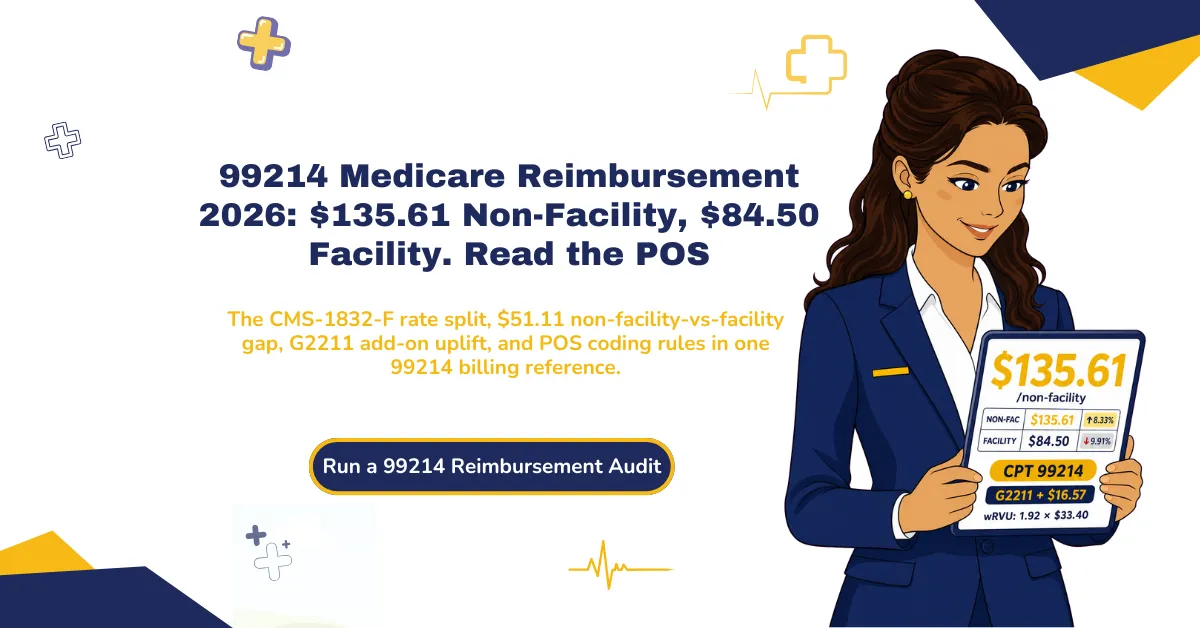
In 2026, the national average Medicare reimbursement for CPT code 99214 is $135.61 in a non-facility (private office) setting and $84.50 in a facility (hospital outpatient) setting. These rates are effective January 1, 2026, under the CMS-1832-F Physician Fee Schedule Final Rule.
For the medicare reimbursement for 99214, the non-facility rate is the number most outpatient practices need to benchmark against.
| Setting | 2025 Rate | 2026 Rate | Change |
|---|---|---|---|
| Non-Facility (Private Office, POS 11) | $125.18 | $135.61 | +$10.43 / +8.33% |
| Facility (Hospital Outpatient, POS 21/22) | $93.80 | $84.50 | -$9.30 / -9.91% |
Source: CMS Physician Fee Schedule, national average rates effective January 1, 2026. Rates vary by locality. Use the CMS Physician Fee Schedule Look-Up Tool to verify your specific rate.
The Work Relative Value Unit (wRVU) for CPT 99214 remains at 1.92 for 2026. This wRVU value is the physician work component that drives every reimbursement calculation and places 99214 at the moderate-complexity tier in the established patient E/M series.
The CY 2026 Medicare Physician Fee Schedule Final Rule (CMS-1832-F) finalized a positive conversion factor adjustment, increasing reimbursement for office-based providers by 3.26 to 3.77 percent while reducing the facility-based rate for codes like 99214. The two rates now move in opposite directions depending on where the service is billed.
Rates are subject to geographic adjustment using the Geographic Practice Cost Index (GPCI), and final payment amounts vary by Medicare Administrative Contractor (MAC) locality. Providers should check their local rate before using national averages for budget planning or payer contract benchmarking.
What Is the 2026 Medicare Reimbursement Rate for CPT 99214?
Medicare reimburses $135.61 for CPT 99214 in a non-facility (private office) setting and $84.50 in a facility setting as of 2026. These are national averages. Your actual medicare reimbursement for 99214 varies based on your geographic location and GPCI locality adjustment.
The 8.33 percent non-facility increase, from $125.18 in 2025 to $135.61 in 2026, is the largest single-year non-facility increase for 99214 in recent CMS history. The facility rate moved in the opposite direction, down 9.91 percent from $93.80.
Understanding which rate applies to your setting is the first step to accurate 99214 reimbursement benchmarking. The average reimbursement for 99214 across all settings and payers in 2026 is driven by the non-facility rate for most outpatient practices.
This data signals that medicare 99214 reimbursement 2026 is sharply diverging between office-based and hospital-based providers.
| Quarter | Non-Facility Rate | Facility Rate |
|---|---|---|
| Q1 2025 | $125.18 | $93.80 |
| Q2 2025 | $125.18 | $93.80 |
| Q3 2025 | $125.18 | $93.80 |
| Q4 2025 | $125.18 | $93.80 |
| Q1 2026 | $135.61 | $84.50 |
| Q2 2026 | $135.61 | $84.50 |
Source: CMS Physician Fee Schedule national payment amount files, PFREV26B (April 2026 release), effective January 1, 2026.
The 2026 rate difference between office and hospital billing comes entirely from the Practice Expense RVU component. The Work RVU of 1.92 is identical in both settings. It’s the overhead costs that drive the payment gap.
| Component | Non-Facility (Office) | Facility (Hospital) |
|---|---|---|
| Work RVU | 1.92 | 1.92 |
| Practice Expense RVU | 2.00 | 0.47 |
| Malpractice RVU | 0.14 | 0.14 |
| Total RVUs | 4.06 | 2.53 |
Source: CMS Physician Fee Schedule, Q2 2026 national average values.
The national average reimbursement for 99214 across all settings and payers in 2026 is driven by the non-facility rate for most outpatient practices. Commercial payers use the Medicare rate as a benchmark.
The 99214 cpt code reimbursement discussion later in this guide covers what BCBS, UHC, Aetna, and Cigna are actually paying against this Medicare baseline.
If your practice’s 99214 collections don’t align with these national benchmarks, it’s likely a billing workflow issue, not a payer problem. ClaimMax RCM’s medical billing service team identifies where the gap is and closes it.
Non-Facility vs. Facility Rate for 99214: Why the $51 Gap Exists and Who It Affects
The $51.11 difference between the 2026 non-facility rate ($135.61) and the facility rate ($84.50) for CPT 99214 isn’t arbitrary. It comes from Practice Expense (PE) RVUs, which are higher in office settings because the provider bears staff, supplies, and overhead costs directly.
CMS finalized a significant indirect PE methodology change in CY 2026 through CMS-1832-F. The rule recognizes that fewer physicians own their practices today, which means many practitioners billing from hospital-based clinics don’t actually bear the overhead costs the old PE formula assumed they did.
The result is a favorable PE RVU adjustment for office-based providers and a reduction for hospital-based clinic providers billing the same 99214 cpt code reimbursement. If your providers see patients in a hospital outpatient department and bill 99214, your 2026 reimbursement is down $9.30 from last year.
| Setting | POS Code | 2026 Medicare Rate | Rate Direction |
|---|---|---|---|
| Private Office | POS 11 | $135.61 | Up 8.33% from 2025 |
| Patient’s Home (Telehealth) | POS 10 | $135.61 | Non-facility rate applies |
| Hospital Outpatient | POS 22 | $84.50 | Down 9.91% from 2025 |
| Inpatient Hospital | POS 21 | $84.50 | Down 9.91% from 2025 |
| Telehealth (Other Location) | POS 02 | $135.61 | Non-facility rate applies |
Table note: POS 10 (patient’s home for telehealth) earns the non-facility rate, not the facility rate. This distinction costs practices thousands of dollars annually when coded incorrectly.
Billing 99214 telehealth claims with POS 02 instead of POS 10 when the patient is at home costs your practice $51.11 per claim. That’s the entire non facility vs facility 99214 gap applied to a single POS code error. On 20 telehealth visits per week, that’s over $53,000 in annual underpayment.
Practices billing 99214 from hospital-based outpatient clinics, employer-based clinics inside a hospital system, or mixed-setting groups need to audit their POS coding immediately. The 2026 indirect PE change isn’t temporary. It’s a permanent restructuring of how CMS values facility-based physician overhead. The 99214 reimbursement rate implications for facility-based providers carry into every future contract year.
For full regulatory detail, see the CY 2026 Physician Fee Schedule Final Rule (CMS-1832-F).
If your practice uses mixed settings and you’re unsure whether your POS codes are optimized for the 2026 PE methodology change, ClaimMax RCM’s payment posting service reconciles ERAs at the code level and flags every instance where the facility rate was applied when the non-facility rate should have been collected.
How CMS Calculates Your 99214 Medicare Reimbursement: The Complete Formula
Medicare calculates your 99214 medicare reimbursement using this formula:
(Work RVU x Work GPCI) + (PE RVU x PE GPCI) + (Malpractice RVU x MP GPCI) = Total Adjusted RVUs
Multiply Total Adjusted RVUs by the 2026 conversion factor to get your payment amount. This formula is what medicare 99214 reimbursement runs through for every single claim.
| Provider Category | 2026 Conversion Factor | vs. 2025 ($32.35) |
|---|---|---|
| Non-Qualifying APM Providers (Non-QP) | $33.40 | +3.26% |
| Qualifying APM Participants (QP) | $33.57 | +3.77% |
The QP and non-QP conversion factors are separate for the first time in Medicare history, effective January 1, 2026, under CMS-1832-F. If you’re unsure which applies to your practice, your MAC can confirm your APM participation status.
For a non-QP provider billing 99214 in a non-facility setting: 1.92 (wRVU) + 2.00 (PE RVU) + 0.14 (MP RVU) = 4.06 total RVUs. Multiplied by $33.40 (non-QP conversion factor): $135.61. That’s the national average. This is the exact 99214 reimbursement calculation behind every Medicare payment on this code.
The GPCI adjusts those RVU values based on regional cost differences. Regional variation is the biggest reason medicare reimbursement 99214 differs between providers billing the same code. A provider billing 99214 in New York City will receive a higher rate than a provider in rural Mississippi.
CMS data shows this geographic gap can exceed 27 percent in the non-facility rate between high-cost and low-cost localities. The geographic practice cost index is the variable your national average rate doesn’t reflect.
Example: A provider billing 99214 in Manhattan may collect over $160 in the non-facility setting after GPCI adjustment. A provider in rural Montana may collect closer to $118. Both use the same code, the same wRVU, and the same national conversion factor. The GPCI is the only variable. Providers in Texas can use the CMS PFS Look-Up Tool with their specific locality code to verify their exact adjusted reimbursement for 99214.
CMS finalized a negative efficiency adjustment of -2.5 percent in CY 2026 to account for productivity gains over time. CPT 99214 is explicitly exempt from this adjustment. E/M codes are carved out because they’re time-based services where efficiency gains don’t apply the same way as procedure codes.
This exemption protects the 99214 reimbursement rate from the efficiency haircut applied to many procedure codes.
The 2026 Conversion Factor Split: What QP and Non-QP Status Means for Your 99214 Revenue
For the first time in Medicare’s history, CMS established two separate conversion factors effective January 1, 2026. Whether your practice qualifies as a Qualifying APM Participant (QP) under an Advanced Alternative Payment Model determines which conversion factor calculates your medicare reimbursement 99214. This is a 2026-only structural change with permanent revenue implications.
The Split Explained: Non-QP Conversion Factor: $33.40 (3.26 percent increase from 2025). QP Conversion Factor: $33.57 (3.77 percent increase from 2025). The difference comes from three statutory updates: a 0.75 percent baseline increase for QPs, a 0.25 percent baseline for non-QPs, a 2.5 percent one-time increase from the One Big Beautiful Bill Act for both, and a 0.49 percent budget neutrality adjustment. The cpt code 99214 medicare reimbursement you actually collect depends entirely on which factor applies.
The $0.17 difference between the two 2026 conversion factors ($33.57 vs. $33.40) may look small. It isn’t. On a 99214 with 4.06 total RVUs in the non-facility setting, the QP rate produces $136.29 vs. the non-QP rate of $135.61.
Multiply that across a high-volume primary care practice seeing 25 patients daily with 40 percent billed at 99214, and the annual revenue difference from QP status exceeds $1,700. This is the 99214 reimbursement calculation that separates QP and non-QP practices at scale.
Your APM participation status determines which conversion factor applies. APM participation is determined by your QPP (Quality Payment Program) participation. If you’re in an Advanced APM through an ACO, bundled payment model, or similar program, you’re likely a QP.
If you’re not sure, check the QPP portal at qpp.cms.gov or contact your MAC for confirmation. The reimbursement for 99214 you’re collecting right now may reflect the wrong factor if your status hasn’t been verified against 2026 enrollment records.
Yes. Medicare reimbursement rates increased in 2026 for office-based providers. The non-facility rate for 99214 rose 8.33 percent, from $125.18 to $135.61. However, facility-based rates decreased 9.91 percent, from $93.80 to $84.50. The direction of the change depends entirely on your billing setting.
The medicare reimbursement for 99214 story in 2026 has two completely opposite headlines depending on where you practice.
For the AMA’s 2026 Physician Fee Schedule analysis covering the specific statutory components of the conversion factor increase for both QP and non-QP providers, the AMA’s documentation confirms the three-part statutory breakdown.
Not sure whether you’re billing at the QP or non-QP rate? ClaimMax RCM’s revenue cycle management services team verifies your QPP status and confirms the correct 2026 conversion factor is being applied to every 99214 claim before submission.
Commercial Payer Reimbursement for 99214: How BCBS, UHC, Aetna, and Cigna Compare to Medicare
Most commercial payers base their 99214 fee schedules on a percentage of the Medicare Physician Fee Schedule. The 2026 shift for commercial contracts is significant.
When Medicare rates increase, as they did by 8.33 percent for non-facility 99214 medicare reimbursement in 2026, commercial contracts benchmarked against prior-year Medicare schedules may now be paying below the new Medicare baseline.
The 99214 cpt code reimbursement your commercial contracts deliver is the number to watch this year.
| Payer | Office Rate | vs. Medicare | Telehealth Rate |
|---|---|---|---|
| BCBS (national avg.) | $130.37 | -3.9% | ~$124.85 |
| UnitedHealthcare | $124.63 | -8.1% | ~$119.42 |
| Aetna | $119.38 | -12.0% | ~$114.36 |
| Cigna | $121.11 | -10.7% | ~$115.10 |
| Medicare (benchmark) | $135.61 | Reference | $135.61 |
Commercial rates reflect national averages based on CMS Transparency in Coverage machine-readable files. Individual contracted rates vary by region, group size, and contract terms. Telehealth rates are estimated at approximately 95 percent of in-person rates for participating commercial plans. Verify your contract for exact terms.
If you’re contracted with any of these payers at rates tied to the 2025 Medicare schedule, you’re currently collecting below the 2026 Medicare baseline for every 99214 you bill. The Medicare baseline is your renegotiation anchor. That’s a contract renegotiation trigger.
The 8.33 percent non-facility rate increase is your data point for every payer conversation in 2026. The average reimbursement for 99214 benchmark you bring to those negotiations is $135.61, and every commercial rate below it is a documented gap.
Medicare Advantage plans don’t follow the Medicare Physician Fee Schedule directly. They negotiate rates independently with providers. Most Medicare Advantage plans pay 95 to 105 percent of traditional Medicare rates for E/M codes like 99214, but some high-deductible plans pay as low as 88 percent.
Verify your Medicare Advantage contracts separately from your traditional Medicare rate.
The gap between what BCBS pays ($130.37) and what Medicare pays ($135.61) for the same 99214 service is $5.24 per claim. On a practice billing 2,500 99214 claims annually to BCBS, that’s $13,100 in uncaptured reimbursement. That number is larger still for practices with high cpt 99214 medicare reimbursement volume through UHC or Aetna.
99213 vs. 99214 vs. 99215 Medicare Reimbursement: Side-by-Side Rate and Complexity Comparison
Choosing between 99213, 99214, and 99215 isn’t just a coding decision. It’s a revenue decision. The 2026 Medicare reimbursement difference between 99213 and 99214 in the non-facility setting is $45.52 per claim. The difference between 99214 and 99215 is $50.39. Every misassigned code has a dollar cost.
The medicare reimbursement 99213 vs 99214 question is worth $45.52 every single time you answer it wrong.
| Element | CPT 99213 | CPT 99214 | CPT 99215 |
|---|---|---|---|
| MDM Level | Low | Moderate | High |
| Time (2026) | 20-29 min | 30-39 min | 40-54 min |
| wRVU | 1.30 | 1.92 | 2.80 |
| Non-Facility Rate (2026) | ~$90.09 | $135.61 | ~$186.00 |
| Facility Rate (2026) | ~$64.27 | $84.50 | ~$120.15 |
| Annual Revenue Gap* | Reference | +$45.52/claim | +$95.91/claim |
Annual gap vs. 99213 billing 2,500 claims/year: 99214 generates $113,800 more; 99215 generates $239,775 more. For illustration purposes using national average non-facility rates.
2026 non-facility rates are national averages per the CMS Physician Fee Schedule. Facility rates sourced from hsccpa.com 2026 fee schedule analysis. Verify exact rates with the CMS PFS Look-Up Tool for your locality.
The most expensive coding error in the established patient E/M series isn’t upcoding. It’s undercoding. Practices that routinely assign 99213 to encounters that actually support the medicare reimbursement for 99214 lose $45.52 per claim. At 10 such encounters per week, that’s $23,670 in annual preventable revenue loss.
The medicare reimbursement 99213 vs 99214 gap is the single most common source of silent, preventable revenue loss in primary care billing.
When Does the Encounter Support 99214 Reimbursement vs. the Code Above or Below?
99214 reimbursement applies when the visit supports moderate medical decision-making or 30 to 39 total minutes. Two or more stable chronic conditions, one worsening chronic illness, or one undiagnosed new problem with uncertain prognosis each qualifies. The key threshold is moderate, not comprehensive.
When a visit actually supports 99215 but is coded as 99214 out of audit caution, the practice absorbs a $50.39 per-claim revenue penalty. Compliance-driven undercoding is not safer than accurate coding. It’s just quieter revenue loss. Accurate documentation is what protects both the 99214 reimbursement rate and audit defense simultaneously.
For the complete documentation and time-based coding framework for the code directly below 99214, ClaimMax RCM’s CPT 99213 billing guide covers the low-complexity MDM threshold and the 2026 reimbursement rate in detail.
G2211 Add-On Code: The Medicare Reimbursement Opportunity Hiding Inside Every 99214 Claim
G2211 is a Medicare-specific HCPCS add-on code that can be billed alongside CPT 99214 for established patients where the provider serves as the focal point for ongoing, complex care management. Most primary care practices that should be billing G2211 alongside 99214 aren’t.
That’s uncaptured revenue on every qualifying visit, invisible against the 99214 allowed amount because it never makes it onto the claim.
| Code | Description | 2026 Rate | Use With |
|---|---|---|---|
| G2211 | Complexity add-on for ongoing care management | ~$16.57 | 99211-99215, 99341-99350 |
| 99214 alone | Established patient, moderate complexity | $135.61 | Standalone |
| 99214 + G2211 | Combined reimbursement | ~$152.18 | When qualifying |
G2211 reimbursement rate is a 2026 national average estimate. Effective January 1, 2026, CMS expanded G2211 eligibility to include home and residence E/M codes (99341-99350) under CMS-1832-F. Confirm your MAC’s billing guidance before adding G2211 to 99214 submissions.
CMS expanded G2211 eligibility in 2026 to cover home and residence E/M codes. If your providers see 99214-level patients at home or in care facilities, G2211 is now billable in those settings too. That expansion wasn’t broadly communicated.
Practices missing it are leaving approximately $16.57 per qualifying visit uncollected. The cpt code 99214 medicare reimbursement story in 2026 includes G2211 for any practice serving complex primary care patients.
With G2211, the combined answer to how much does Medicare reimburse for 99214 in complex primary care settings rises to approximately $152.18.
To bill G2211 alongside 99214, document that this visit is part of ongoing care management for a single serious condition or a complex condition where you serve as the focal point for all needed services. That documentation language doesn’t need to be lengthy.
One clear sentence in the assessment satisfies the requirement. The MDM documentation that supports 99214 billing generally positions the encounter for G2211 eligibility as well.
One compliance rule governs G2211 and same-day procedures: Modifier 25 must be on the 99214 when a minor procedure is also billed. G2211 is separately reportable in that scenario, but Modifier 25 on the E/M code is not optional.
Missing it produces a denial that most billing teams incorrectly code as a documentation problem rather than a modifier error. The clean claim outcome depends on getting the modifier right before submission.
Why Your 99214 Gets Paid Less Than $135.61: The Six Reimbursement Gaps Billing Teams Miss
The 2026 national average Medicare payment is $135.61 for CPT 99214 in the non-facility setting. If your practice is collecting less than that on 99214 claims, the shortfall almost always comes from one of six specific billing workflow failures.
Each one has a dollar cost and a fix. These gaps are where it disappears.
Gap 1: Wrong Place of Service Code: The $51.11 Per-Claim Error
Using POS 02 instead of POS 10 when a Medicare patient receives telehealth 99214 at home applies the facility rate ($84.50) instead of the non-facility rate ($135.61). That’s a $51.11 reimbursement loss on every affected claim. POS code errors don’t generate denials. They generate silent underpayments.
The non facility vs facility 99214 distinction is entirely determined by how accurately your POS code reflects where the patient physically was during the visit.
Gap 2: Wrong GPCI Locality Applied by the Payer
CMS systems occasionally apply incorrect locality codes during claim adjudication, especially for multi-location practices. If your MAC applies a lower-cost locality to your claims, every 99214 payment is systematically short. Run a quarterly ERA review comparing expected geographic practice cost index-adjusted rates to actual payment amounts.
The difference is a recoverable underpayment. The non-facility rate you should be receiving is calculable and verifiable against CMS locality files.
Gap 3: QP vs. Non-QP Rate Mismatch
If CMS’s records show your practice as non-QP when you’re actually a Qualifying APM Participant, your 99214 claims process at $33.40 instead of $33.57. The $0.17 per-RVU gap is invisible on a single claim. Across 5,000 annual 99214 submissions at 4.06 RVUs each, that’s over $3,450 in annual shortfall.
Gap 4: Missing G2211 Add-On on Qualifying Visits
Practices that don’t bill G2211 alongside qualifying 99214 encounters miss $16.57 per claim. On 1,000 qualifying visits annually, that’s $16,570 in uncollected reimbursement for 99214-level complexity that Medicare is ready to pay.
Each ERA or EOB should be reconciled against the expected 99214 allowed amount at the claim level, not the batch level. The clean claim rate on G2211 submissions is high when the documentation supports it.
Gap 4 is less about denial risk and more about the non facility vs facility 99214 pattern being replicated with G2211 never showing up.
Gap 5: Prior Authorization Denials on 99214
Some commercial payers and Medicare Advantage plans require prior authorization for specific 99214 contexts, including certain specialist visits or high-frequency billing patterns. A missing authorization converts a $135.61 allowed claim to a $0 payment. Authorization failures are front-end failures, not billing failures, but billing teams absorb the revenue impact.
Gap 6: AR Aging Past the Appeal Window
Denied or underpaid 99214 claims that sit past 90 days in accounts receivable have significantly lower recovery rates. Most billing teams focus on denial rate, not denial resolution speed. Revenue from 99214 reimbursement shortfalls doesn’t recover itself. Claims past the filing limit become permanent write-offs.
All six of these reimbursement gaps are preventable with the right billing workflow. ClaimMax RCM’s denial management services team identifies root causes, corrects claim errors, and builds pre-submission checks that stop these failures before they become underpayments.
For practices where authorization-related 99214 denials are recurring, ClaimMax RCM’s prior authorization services team manages every payer authorization requirement before the claim goes out.
For denied or underpaid 99214 claims sitting in AR aging, ClaimMax RCM’s AR follow-up team contacts payers before claims age past the appeal window and works every recoverable shortfall systematically.
Documentation That Protects 99214 Medicare Reimbursement: The Two Pathways in 2026
The 2026 99214 medicare reimbursement is earned at the point of service and confirmed at the point of documentation. An encounter that clinically supports $135.61 but is documented at 99213 level pays $90.09. Documentation doesn’t create the payment.
It defends the payment you already earned by delivering the care. The MDM you perform is what determines the level. The documentation is what proves it.
| Pathway | 2026 Requirement | Documentation Anchor | What Protects Reimbursement |
|---|---|---|---|
| Medical Decision Making (MDM) | Moderate complexity, two of three MDM elements | Assessment and plan section | Specificity of MDM elements documented |
| Total Provider Time | 30-39 minutes on date of service | Start/stop time or total time statement | “Total time: [X] minutes” with activity list |
CMS MLN Evaluation and Management Services Guide (March 2026) confirms that history and examination no longer drive visit level selection. MDM or total time is the only determinant for 99214 level selection.
The 1.92 work relative value unit assigned to CPT 99214 reflects the physician effort assumed in a moderate complexity MDM visit or a 30-39 minute time-based visit. Documentation must support that effort level. The CMS MLN Evaluation and Management Services Guide updated in March 2026 is the primary source for these documentation standards.
The 2026 Split/Shared Visit Reimbursement Rule
CMS’s 2026 substantive portion definition for split/shared visits requires that more than half of the total visit time or a substantive part of the MDM was performed by the billing provider. The billing provider must sign and date the record.
Practices where physicians and NPPs share 99214-level encounters must document which provider did what, and the billing provider must be identified clearly. A documentation failure here doesn’t generate a denial. It generates a post-payment audit finding. The reimbursement risk is retroactive.
For incident-to billing, the supervising physician must be present in the office suite. A prior authorization issued for the physician doesn’t automatically extend to NPP-billed split/shared visits.
If your practice uses split/shared visit billing for 99214 encounters and you’re unsure whether your documentation meets the 2026 substantive portion standard, ClaimMax RCM’s telehealth medical billing services and medical billing team audits documentation patterns before they become audit findings.
How to Look Up Your Exact 2026 99214 Medicare Reimbursement Rate by Zip Code or State
The CMS Physician Fee Schedule Look-Up Tool at cms.gov gives you the exact 2026 99214 medicare reimbursement rate for your specific locality. Select 2026 as the year, enter code 99214, select your MAC locality, and choose non-facility or facility. The result is your actual allowed amount, not the national average.
| State/Region | GPCI Direction | Approx. Non-Facility Rate Range |
|---|---|---|
| New York (Manhattan) | High adjustment | $155 to $165 |
| California (LA/SF) | High adjustment | $148 to $158 |
| Texas (Dallas/Houston) | Moderate adjustment | $128 to $136 |
| Texas (rural) | Low adjustment | $118 to $126 |
| Mississippi/rural states | Low adjustment | $115 to $122 |
These are illustrative GPCI-adjusted ranges based on 2026 CMS locality data. Use the CMS PFS Look-Up Tool for your specific locality code. Texas providers should select the correct locality (Dallas vs. Rest of Texas vs. Houston) for accurate results.
99214 Revenue Modeling: What Accurate Medicare Reimbursement Adds to Your Practice’s Bottom Line
The revenue formula for 99214 in 2026 is: total RVUs (4.06 in non-facility) multiplied by the conversion factor ($33.40 for non-QP, $33.57 for QP) equals $135.61. Multiply that by your annual 99214 volume and you have your maximum collectable 99214 Medicare reimbursement before GPCI adjustment.
This is the ceiling the Medicare system is willing to pay for 99214.
| Practice Scenario | Daily 99214 Volume | Annual Medicare Revenue | G2211 Uplift (20% qualifying) |
|---|---|---|---|
| Solo primary care | 10 claims | $338,025 | +$41,425 |
| 3-provider group | 30 claims | $1,014,075 | +$124,275 |
| 10-provider group | 100 claims | $3,380,250 | +$414,250 |
Assumptions: 250 working days, 100% Medicare payer mix for modeling purposes, national average non-facility rate $135.61, G2211 at $16.57 applied to 20% of encounters meeting complexity threshold.
The gap between maximum collectable reimbursement for 99214 and actual collected revenue is what your RCM infrastructure determines. POS errors, GPCI mismatches, QP status failures, missing G2211, and AR aging together can reduce actual collections by 8 to 15 percent below the allowed amount.
That’s $27,042 to $50,704 annually on a solo practice model. These figures are based on the 2026 Physician Fee Schedule (PFS) national average rate, effective January 1, 2026.
If your practice’s actual 99214 collections are more than 5 percent below these benchmarks, the shortfall is recoverable. ClaimMax RCM offers a no-obligation billing audit that identifies exactly where the gap is and what it costs your practice annually.
Frequently Asked Questions About 99214 Medicare Reimbursement
How much does Medicare reimburse for CPT 99214 in 2026?
Medicare reimburses $135.61 for CPT 99214 in a non-facility (private office) setting in 2026. The facility rate (hospital outpatient) is $84.50. Both are national averages effective January 1, 2026. Your exact rate depends on your GPCI locality adjustment and whether you’re a Qualifying APM Participant.
Did Medicare reimbursement rates for 99214 increase in 2026?
Yes, for non-facility settings. The 2026 non-facility rate for 99214 increased from $125.18 to $135.61, an 8.33 percent increase. The facility rate decreased from $93.80 to $84.50, a 9.91 percent reduction. The direction depends entirely on your billing setting.
What was the Medicare reimbursement rate for 99214 in 2025?
The 2025 Medicare non-facility rate for CPT 99214 was $125.18. The facility rate was $93.80. Both figures applied from January 1, 2025 through December 31, 2025. The 2026 rates replaced these effective January 1, 2026, under the CMS-1832-F Final Rule.
What is the Medicare fee schedule rate for 99214 and how is it calculated?
The Medicare fee schedule rate for 99214 is calculated by multiplying the code’s total RVUs (4.06 in non-facility settings) by the annual conversion factor ($33.40 for non-QP providers in 2026) and applying GPCI geographic adjustments. The result is the Medicare allowed amount for that provider’s locality.
Does Medicare cover CPT code 99214?
Yes. Medicare covers CPT 99214 when billed by an enrolled provider for an established patient visit that meets medical necessity requirements. The visit must be documented at the moderate complexity MDM level or 30 to 39 total provider minutes. Coverage applies to both traditional Medicare Part B and most Medicare Advantage plans.
What is the typical reimbursement for CPT 99214 across payers?
The typical reimbursement for 99214 varies by payer. Medicare pays $135.61 non-facility in 2026. BCBS averages $130.37. UnitedHealthcare averages $124.63. Aetna averages $119.38. Medicare Advantage plans typically pay 95 to 105 percent of traditional Medicare rates. Commercial contracts benchmarked to prior-year Medicare schedules may now be below the 2026 Medicare baseline.
What modifiers affect 99214 Medicare reimbursement?
Modifier 25 must be appended to 99214 when a same-day minor procedure is also billed. Modifier 95 is required for telehealth 99214 claims via synchronous audio-video. POS 10 (patient at home) earns the non-facility rate. POS 02 (other telehealth location) also earns the non-facility rate. No modifier is needed for standard in-office 99214 claims.
How does Medicaid reimbursement for 99214 compare to Medicare?
Medicaid reimbursement for 99214 varies significantly by state and is set by each state’s Medicaid program, not CMS. Most state Medicaid programs pay 60 to 85 percent of the Medicare allowed amount for 99214. Some states like California and New York have higher Medicaid rates for primary care E/M codes under enhanced payment programs.
Start Recovering Every Dollar Your 99214 Claims Have Earned
You’ve seen the 2026 rates. You’ve seen what the six reimbursement gaps cost. You’ve seen what G2211 adds and what POS errors take away. The question isn’t whether your practice is leaving Medicare revenue on the table. It’s how much, and how long it’s been happening.
ClaimMax RCM audits your 99214 billing patterns against the 2026 CMS benchmarks, identifies every gap, and fixes the workflow that’s creating it. We review POS codes, locality adjustments, G2211 eligibility, modifier compliance, and AR aging on 99214 claims. Most practices find recoverable medicare reimbursement 99214 shortfalls in the first 30 days.
Get Your Free 99214 Billing Audit at updated.claimmaxrcm.com/contact/
Also see how ClaimMax RCM’s medical billing service works for practices with high 99214 volume.
All rate data in this article is sourced from the CMS Physician Fee Schedule national payment amount files (PFREV26B, April 2026 release), the CY 2026 Medicare Physician Fee Schedule Final Rule (CMS-1832-F), the CMS MLN Evaluation and Management Services Guide (March 2026), and the AMA 2026 Physician Fee Schedule analysis. Rates reflect national averages effective January 1, 2026, and vary by locality. Verify your exact rate using the CMS PFS Look-Up Tool before contract negotiations or fee schedule benchmarking.