
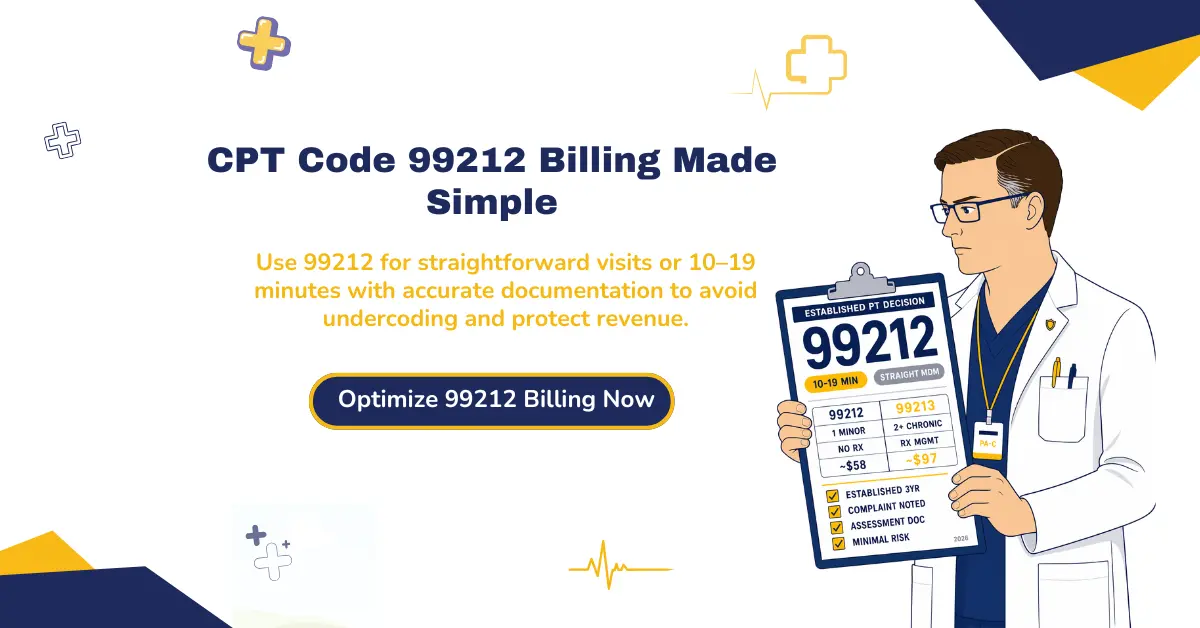
The 99212 cpt code is the most frequently undercoded E/M code in the established patient series. Billing teams default to it when a higher code fits, and they default away from it when it fits perfectly. Both errors cost real revenue. Neither one generates a denial flag. They just quietly reduce collections on every visit where they happen.
This isn’t a general overview of what 99212 is. This is the decision guide: how to choose correctly between 99202 and 99212, how to apply the 99212 vs 99213 rule that most billing teams still get wrong, what the 2026 fee schedule actually pays by payer, and what a complete documentation checklist requires before submission.
ClaimMax RCM works with billing teams across every specialty on exactly these coding decisions. If 99212 is generating denials or revenue leakage from undercoding, our medical billing service team handles both.
What Is 99212 CPT Code?
Per the American Medical Association’s CPT guidelines, the 99212 cpt code covers an office or other outpatient visit for the evaluation and management of an established patient requiring straightforward medical decision making or 10 to 19 minutes of total time on the date of the encounter. It sits at the second level in the established patient E/M series (99211 to 99215) and is the workhorse code for routine follow-up visits across virtually every outpatient specialty.
| Element | Detail |
|---|---|
| Code | 99212 |
| Patient Type | Established (seen within past 3 years) |
| MDM Level | Straightforward |
| Time Range | 10 to 19 minutes total time |
| Setting | Office or other outpatient |
| Code Selection | Use EITHER total time OR MDM. Not both. |
What makes 99212 billing complicated isn’t the definition. It’s the decision: when does this encounter cross into 99213 territory, when was the patient actually new and should have been billed 99202, and when does the encounter only support 99211 instead? That decision framework is what the rest of this guide covers.
Who Is an Established Patient for 99212 CPT Code?
An established patient is one who has received professional services from the same physician, or another physician of the exact same specialty and subspecialty within the same group practice, within the past three years. That three-year clock matters. Once it closes, the patient resets to new patient status. The wrong code at that point isn’t just a billing error. It’s an automatic denial.
The practical check before coding any visit: when was the patient last seen by any provider in this group with the same specialty? If that date was more than three years ago, the correct code is in the 99202 to 99205 range, not the 99212 to 99215 range. Getting this wrong produces a CO-16 denial on the first pass.
Per the CMS MLN Evaluation and Management Booklet, the established patient determination is based on professional services, not administrative visits or nurse-only encounters. Section 5 covers the full comparison between 99202 and 99212 in a side-by-side decision table.
CPT 99212 Time and MDM: Choosing Your Billing Method
CPT 99212 requires 10 to 19 minutes of total time when time is used for code selection. There is no minimum time requirement when MDM drives the code. Those two sentences represent the single most important practical fact about 99212 billing.
Time-Based vs MDM-Based Code Selection
Providers can choose either path for any given encounter. They don’t have to use both. If the MDM is clearly straightforward, document the MDM and don’t bother tracking time. If total time is documented and falls in the 10 to 19 minute range, that alone supports the code. Pick one method and document it completely.
Here’s a change that still catches people off guard. Before 2021, 99212 carried a 10-minute typical time. That concept doesn’t exist anymore. Time ranges replaced typical times, and total time, not just face-to-face time, now drives the code level. That’s the current E/M framework.
What Counts Toward Total Time
Total time includes every qualifying activity the billing provider performs on the date of the encounter: chart review, the examination, counseling, ordering, documenting, coordinating care, and interpreting results when not separately reported. Only the billing provider’s time counts. Clinical staff minutes don’t go on that clock regardless of how much time they spend.
For 99212, straightforward MDM means one self-limited or minor problem, minimal or no data reviewed, and minimal risk from the treatment decision. The AAFP’s published clinical examples are a useful reference for understanding which encounters land at straightforward versus the next level up.
| Code | Time Range | MDM Level |
|---|---|---|
| 99211 | May not require provider | May not require physician |
| 99212 | 10 to 19 minutes | Straightforward |
| 99213 | 20 to 29 minutes | Low |
| 99214 | 30 to 39 minutes | Moderate |
| 99215 | 40 to 54 minutes | High |
99202 vs 99212: New Patient vs Established Patient Decision Guide
The difference between 99202 and 99212 is the patient relationship. 99202 is for new patients being seen for the first time or not seen in the past three years. 99212 is for established patients seen within that window. Both codes require straightforward MDM and 10 to 19 minutes of total time. Their clinical requirements are identical.
The reimbursement differs because 99202 carries a higher rate to compensate for the additional work of establishing a new care relationship from scratch. The provider is building the clinical picture for the first time, which takes more cognitive effort even when the problem is simple.
| Feature | CPT 99202 | CPT 99212 |
|---|---|---|
| Patient type | New (first visit or not seen in 3+ years) | Established (seen within past 3 years) |
| MDM required | Straightforward | Straightforward |
| Time range | 10 to 19 minutes | 10 to 19 minutes |
| Setting | Office or other outpatient | Office or other outpatient |
| 2026 Medicare rate (non-facility) | ~$81 to $84 | ~$56 to $59 |
| Code selection basis | Either MDM or total time | Either MDM or total time |
| Primary difference | First encounter; new clinical relationship | Follow-up; established care relationship |
The Coding Error That Costs Revenue
The most common error at this code boundary: a provider sees a patient who hasn’t been to the practice in over three years, assumes they’re established because they’re in the EHR system, and bills 99212 instead of 99202. The claim gets paid. The practice collects $56 instead of $81. That gap compounds across every patient who has aged out of the three-year window without anyone checking.
Before coding any visit, confirm the last date of professional service in the same specialty group. If it’s within three years, 99212 is correct. If it isn’t, start at 99202.
ClaimMax RCM has published separate billing guides for CPT 99202, CPT 99203, CPT 99204, and CPT 99205. The full new patient E/M series is covered in our existing guides.
99212 vs 99213: The Decision That Affects Your Revenue Most
The single most frequent coding error in the established patient E/M range is undercoding 99213 visits as 99212. It doesn’t trigger a denial. It doesn’t generate an audit flag. It just quietly removes $35 to $45 from every visit where it happens.
The deciding factor: if the visit involves any prescription drug management, any ordering or reviewing of diagnostic tests, or addressing two or more stable chronic conditions, the encounter supports 99213, not 99212. That one sentence covers the vast majority of code boundary decisions between these two levels.
| Factor | CPT 99212 | CPT 99213 |
|---|---|---|
| MDM Level | Straightforward | Low complexity |
| Time Range | 10 to 19 minutes | 20 to 29 minutes |
| Problems Addressed | 1 self-limited or minor problem | 2+ stable chronic conditions or 1 acute uncomplicated illness |
| Data Review | Minimal or none | Limited (review or order tests, review external records) |
| Risk | Minimal (OTC recommendation, no Rx changes) | Low (prescription drug management) |
| 2026 Medicare Rate (non-facility) | ~$56 to $59 | ~$95 to $100 |
| Revenue Differential Per Visit | Baseline | ~$35 to $45 higher |
The Prescription Management Rule
Prescription drug management consistently pushes encounters from 99212 to 99213. Writing a new prescription, adjusting a dosage, refilling an existing medication with documented evaluation of the patient’s current response, and counseling on medication side effects all qualify as prescription management. If any of that happened, the visit is 99213.
The Revenue Impact at Scale
A practice that sees 20 established patients per day and consistently undercodes five of those visits at 99212 when 99213 applies is leaving $175 to $225 of daily revenue on the table. Over 50 weeks, that’s over $40,000 annually from one coding habit.
If undercoding in the 99212 to 99213 range is a pattern in your practice, our denial management services team identifies these gaps as part of a billing review.
99212 vs 99214: Recognizing When Visit Complexity Escalates
Confusing 99212 with 99214 is rare because the complexity gap is significant. But understanding where 99212 fits in the full E/M range helps billing teams recognize when an encounter has genuinely moved into higher-complexity territory.
| Factor | CPT 99212 | CPT 99214 |
|---|---|---|
| MDM Level | Straightforward | Moderate |
| Time Range | 10 to 19 minutes | 30 to 39 minutes |
| Problems Addressed | 1 self-limited or minor problem | Chronic illness with exacerbation, or new problem requiring workup |
| Data Review | Minimal | Moderate (ordering/reviewing tests, independent interpretation) |
| Risk | Minimal (OTC, no Rx changes) | Moderate (prescription drug management with significant risk, minor surgery) |
| 2026 Medicare Rate (non-facility) | ~$56 to $59 | ~$136 to $140 |
| Revenue Differential Per Visit | Baseline | ~$80 higher |
Use 99214 when a chronic illness is worsening, a new problem needs additional workup before a treatment decision, or the management plan involves prescription drugs that carry significant risk. Any acute exacerbation of a chronic condition, any specialist referral for a new problem, and any prescription with meaningful side effect risk puts the encounter into 99214 territory. That’s a fundamentally different clinical picture from the 99212 scenario.
For higher-level E/M coding support, our revenue cycle management team can review your practice’s current E/M distribution and identify where coding accuracy is affecting collections.
CPT 99212 Modifier 25 and NCCI Bundling: When and How They Apply
CPT 99212 does not inherently require a modifier. Modifier 25 must be appended when billing 99212 on the same day as a separately reportable procedure and the E/M service is significant and separately identifiable from the procedure.
When Modifier 25 Applies
The documentation has to carry the weight here. The E/M note must clearly show that a distinct clinical evaluation occurred beyond the usual pre- and post-procedure work. If the note blends the evaluation into the procedure documentation without separating them, expect either a denial or a bundling edit that removes the 99212 reimbursement entirely.
Here’s a common legitimate scenario. A provider evaluates a patient’s sinus congestion and also administers a flu vaccination during the same visit. That’s a valid 99212-25 combination if the evaluation of the sinus congestion is clearly documented as a separate clinical assessment from the vaccine administration. Two distinct purposes. Two distinct sections in the note.
NCCI Bundling Rules
The CMS NCCI Policy Manual identifies specific procedure codes that bundle 99212 when submitted on the same date without appropriate modifiers. Before any same-day claim with both an E/M code and a procedure code goes out the door, verify the NCCI edit for that code pair. Automatic denials from NCCI bundling violations are entirely preventable with pre-submission checking.
Modifier errors and NCCI bundling violations are among the most common causes of preventable E/M claim denials. Our denial management services team verifies modifier usage and NCCI compliance on every claim before submission.
CPT 99212 Fee Schedule 2026: Medicare Rates, RVUs, and Commercial Payer Data
The 2026 99212 cpt code fee schedule data reflects CMS national average rates. These numbers vary by geographic location, so what your practice actually collects depends on your locality modifier. Use the CMS Physician Fee Schedule Look-Up Tool to verify your specific rate before using these figures for contract negotiations or fee schedule benchmarking.
| Payer Type | 2026 CPT 99212 Rate | Notes |
|---|---|---|
| Medicare (non-facility, POS 11) | ~$56 to $59 | National average. Locality adjustments apply. |
| Medicare (facility, hospital outpatient) | ~$33 | Lower than non-facility rate. |
| Medicare (telehealth, POS 10) | Non-facility rate | POS 10 earns the higher non-facility rate. |
| Medicaid | $31 to $60 | Varies significantly by state. |
| Commercial insurance (average) | $50 to $100 | Contract-specific. Verify with your payer. |
Table source: 2026 national averages per the CMS Physician Fee Schedule. Verify your exact rate with the CMS PFS Look-Up Tool at cms.gov.
RVU Breakdown for Contract Negotiations
For practices negotiating payer contracts or evaluating fee schedule performance, the RVU composition matters. CPT 99212 carries approximately 0.70 work RVUs, 0.80 practice expense RVUs (non-facility), and 0.04 malpractice RVUs, totaling approximately 1.54 RVUs. The 2026 non-QP conversion factor is $33.40, putting the base rate at approximately $51 to $52 before geographic adjustment. Full details are in the CMS CY 2026 PFS Final Rule.
E/M Exemption Note
E/M codes including 99212 are exempt from the 2026 efficiency adjustment that CMS applied to procedural codes. No rate cut applies here. Payment posting on 99212 claims should not reflect any efficiency adjustment reduction.
Systematic payment posting service review catches underpayment errors before they accumulate. When payer systems apply incorrect locality adjustments or process a claim at the facility rate instead of the non-facility rate, the difference per claim is small but compounds significantly across high-volume E/M billing.
CPT 99212 Documentation Checklist: What Every Note Needs Before Submission
Before any 99212 claim leaves the practice, every answer on this checklist should be yes. If any answer is no, the note has a problem that needs to be addressed before the claim goes out.
MDM-Based Documentation Checklist
- Is the patient established: seen by a provider in this group with the same specialty within the past three years?
- Is the chief complaint or reason for the visit clearly stated in the note?
- Is one self-limited or minor problem identified and documented as the presenting issue?
- Does the note include a clinical assessment: what the provider found and what it means clinically?
- Is the management plan documented: continuation of treatment, OTC recommendation, reassurance, or follow-up instruction?
- Is data review minimal or none: no outside records interpreted, no lab review, no imaging ordered?
- Does the treatment plan reflect minimal risk: no new prescriptions, no diagnostic tests ordered, no significant procedure?
- Is the rendering provider’s name and credential visible in the note?
Additional Checks When Billing by Time
If billing 99212 by time rather than MDM, two more checks apply: is total time documented as 10 to 19 minutes, and does the note describe the specific activities that consumed that time beyond just the face-to-face encounter?
Creating EHR smart text or dot phrases that include these eight elements keeps documentation consistent across providers and visit types. Consistent documentation is what survives payer audits. Template-generated notes that carry forward previous visit details without modification create audit liability, not protection.
Attribution: Checklist developed in alignment with CMS Claims Processing Manual guidance and AMA CPT 2026 guidelines.
CPT 99212 Billing Examples Across Clinical Specialties
The 99212 cpt code billing requirements are identical across every specialty. What varies is the clinical context. Here are three specialty-specific examples billing teams can use as reference when reviewing documentation for compliance.
Cardiology: Stable Angina Follow-Up
Date of Service: 2026
Patient: M. Rodriguez, 62-year-old established patient
Chief Complaint: Follow-up for stable angina
History: Patient reports no change in symptom frequency. Nitroglycerin not used since last visit. Denies shortness of breath at rest.
Examination: Blood pressure 128/74. Resting heart rate 68. No murmurs.
Assessment: Stable coronary artery disease, symptom-controlled on current regimen.
Plan: Continue current antianginal regimen. No medication changes. Return in three months.
Total Time: 13 minutes
CPT Code Selected: 99212
Rationale: One stable problem. No medication changes. No data review. Minimal risk.
Pediatrics: Established Child Patient, Simple Acute Illness
Date of Service: 2026
Patient: T. Kim, 7-year-old established patient
Chief Complaint: Follow-up for resolved ear infection
History: Parent reports no ear pain since completing antibiotic course. Child eating and sleeping normally.
Examination: Tympanic membranes clear bilaterally. No erythema.
Assessment: Resolved acute otitis media.
Plan: No further treatment needed. Return if symptoms recur.
Total Time: 10 minutes
CPT Code Selected: 99212
Rationale: One self-limited problem, resolved. No new treatment decisions. Minimal risk.
Urgent Care: Stable Acute Complaint Re-Evaluation
Date of Service: 2026
Patient: D. Patel, 28-year-old established patient
Chief Complaint: Follow-up for resolved ankle sprain
History: Pain resolved. Full weight-bearing without difficulty. Returned to normal activity.
Examination: No swelling, full range of motion, no tenderness on palpation.
Assessment: Resolved lateral ankle sprain.
Plan: Activity as tolerated. No further follow-up needed unless symptoms return.
Total Time: 11 minutes
CPT Code Selected: 99212
Rationale: One resolved self-limited problem. No diagnostic review. Minimal risk.
Can CPT 99212 Be Billed via Telehealth?
Yes. CPT 99212 is eligible for telehealth billing when the encounter is conducted via synchronous audio-video technology and meets the same straightforward MDM or 10 to 19 minute requirements as an in-person visit.
CMS moved CPT 99212 to the permanent Medicare Telehealth Services List effective 2026. This isn’t a temporary pandemic-era allowance anymore. Telehealth eligibility for this code is not expiring. The clinical bar is identical to an in-person encounter: straightforward MDM or 10 to 19 minutes. Audio-only visits typically don’t qualify. Those encounters get reported under telephone service codes instead.
Modifier and POS Requirements
Append Modifier 95 to indicate synchronous telehealth. For the Place of Service code: use POS 10 when the patient is at home, POS 02 when the patient is at another location. POS 10 earns the non-facility rate, which is higher than the facility rate. Getting that POS code wrong costs the practice money on every telehealth 99212 claim it affects.
Commercial payers have independently developed telehealth coverage policies for 99212. Not all follow CMS. Verify each payer’s current telehealth coverage list before submitting telehealth claims. Policies update annually and coverage that existed last year may have changed under the current plan year.
ClaimMax’s telehealth medical billing services team manages 99212 telehealth claims across all payers. We track payer policy changes so claims submit with the correct modifiers and meet current coverage criteria.
Prior Authorization, Denial Prevention, and Payment Posting for CPT 99212
Prior Authorization for CPT 99212
Most payers don’t require prior authorization for 99212 as a standard E/M code. But some commercial managed care plans and Medicaid managed care organizations require prior authorization for E/M visits in specific clinical circumstances, particular patient populations, or when the patient’s plan has behavioral carve-outs. If your practice is generating CO-15 (lack of prior authorization) denials on 99212 claims, the root cause is payer-specific, not a coding error. Our prior authorization team tracks payer-level prior auth requirements so your team doesn’t get surprised by them.
Denial Prevention for 99212
The most common denial codes on 99212 claims are CO-50 (non-covered service or medical necessity, which fires when the ICD-10 diagnosis code doesn’t support the visit), CO-16 (missing or invalid information, which fires when patient demographics or provider NPI are incorrect), and CO-97 (bundled service, which fires when NCCI edits apply without the correct modifier). All three are preventable with pre-submission review. Our AR follow-up team works denied 99212 claims through every correction and resubmission stage.
Payment Posting Accuracy for 99212
Once a 99212 claim pays, accurate payment posting service review confirms the practice received the correct amount per its fee schedule. Underpayment on E/M codes is common when payer systems apply incorrect locality adjustments or process the claim at the facility rate instead of the non-facility rate. Systematic payment posting review catches these errors before they accumulate into uncollected revenue.
Frequently Asked Questions About 99212 CPT Code
What is the difference between 99202 and 99212?
The difference is the patient relationship. 99202 is for new patients being seen for the first time or not seen within the past three years. 99212 is for established patients seen within that window. Both require straightforward MDM and 10 to 19 minutes. But 99202 reimburses approximately $25 higher because of the additional work involved in establishing a new care relationship from scratch.
What is the 99212 cpt code time requirement in 2026?
CPT 99212 requires 10 to 19 minutes of total time when time drives code selection. There is no minimum time requirement when straightforward medical decision making is used instead. You select one method per encounter, not both. Documenting both when one is sufficient adds unnecessary documentation burden without changing the billing outcome.
When should 99212 be used instead of 99213?
Use 99212 when the encounter involves one self-limited or minor problem with minimal data review and no prescription management. Use 99213 when the encounter involves prescription drug management, ordering or reviewing diagnostic tests, or addressing two or more stable chronic conditions. That prescription management trigger is the most common boundary between these two codes.
Does cpt 99212 require Modifier 25?
CPT 99212 does not inherently require any modifier. Modifier 25 is required only when billing 99212 on the same day as a separately reportable procedure. Without Modifier 25 in that scenario, the payer will either deny the 99212 claim or bundle it into the procedure payment. The E/M note must clearly document a separately identifiable service to support the modifier.
Can cpt 99212 be billed via telehealth in 2026?
Yes. CPT 99212 is on the permanent Medicare Telehealth Services List as of 2026. The encounter must use synchronous audio-video technology and meet the same MDM or time requirements as an in-person visit. Append Modifier 95 and use POS 10 when the patient is at home to ensure the claim processes at the correct non-facility rate.
What is the 2026 Medicare reimbursement for cpt 99212?
The 2026 Medicare national average for CPT 99212 is approximately $56 to $59 in the non-facility office setting and approximately $33 in the facility setting. Exact rates vary by geographic locality. Verify your specific rate using the CMS Physician Fee Schedule Look-Up Tool at cms.gov.
What is the RVU for 99212 in 2026?
CPT 99212 carries approximately 0.70 work RVUs, 0.80 practice expense RVUs in the non-facility setting, and 0.04 malpractice RVUs, totaling approximately 1.54 RVUs. Using the 2026 non-QP conversion factor of $33.40, the base rate before geographic adjustment is approximately $51 to $52. Full details are available in the CMS CY 2026 PFS Final Rule.
What is the difference between 99212 and 99214?
99212 requires straightforward MDM (one self-limited problem, minimal data, minimal risk) covering 10 to 19 minutes. 99214 requires moderate MDM (chronic illness with exacerbation, new problem needing workup) covering 30 to 39 minutes. The 2026 Medicare rate difference is approximately $80 per encounter. Correct selection at this boundary has meaningful revenue impact at scale.
Can 99212 be billed with a procedure code on the same date?
Yes, when a separately identifiable E/M service occurred and is clearly documented beyond the usual procedure work. Modifier 25 is required on the 99212 to signal the separately identifiable service. Without documentation showing the E/M was distinct from the procedure, the claim will generate a CO-97 bundling denial.
What prior authorization requirements apply to 99212?
Most payers don’t require prior authorization for standard 99212 E/M visits. However, some commercial managed care plans and Medicaid managed care organizations require prior authorization for E/M visits in specific clinical circumstances or for certain patient populations. CO-15 denials on 99212 claims signal a prior authorization gap, not a coding error.
Getting 99212 right is a consistency problem, not a knowledge problem. Billing teams know the code. What breaks down is the decision at every encounter: choosing correctly between 99202 and 99212, recognizing when the encounter has crossed into 99213 territory, verifying the documentation before submission, and catching underpayments when claims post incorrectly.
Slipped 99212 charges and undercoded 99213 visits rarely surface in AR follow-up because they were never identified as a problem in the first place. And the ones that do get billed incorrectly cycle through denial management queues that consume staff time and delay revenue.
ClaimMax RCM handles medical billing, denial management, AR follow-up, credentialing services, telehealth billing, prior authorization, and payment posting for practices across all specialties. If 99212 coding decisions, undercoding patterns, or E/M documentation gaps are affecting your revenue, our team handles all of it.
Contact our team to schedule a billing review for your practice.